Part 1 — The Night My Son Became a Stranger
The first time my son struck me, I told myself he had lost control.
The tenth time, I stopped trying to explain his behavior.
By the thirtieth, I finally understood something no mother should ever have to learn: the child you spend your entire life protecting can grow into the person you need protection from.
My name is Eleanor Hayes. I was sixty-nine years old, a widow, and the owner of a successful construction company I had built from nothing after my husband died.
For forty years, I had worked through financial crises, dishonest contractors, sleepless nights, and the kind of setbacks that could destroy a business overnight. I had survived all of them.
Yet nothing had prepared me for what happened at my son’s birthday dinner.
His name was Daniel.
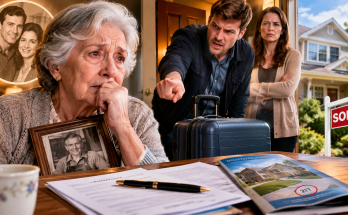
He was thirty-seven years old, married to a woman named Vanessa, and living in a beautiful mansion I had purchased for him and his family several years earlier.
I had paid for his education, helped him start his business, covered his debts when his investments failed, and repeatedly rescued him from problems he had created himself.
I never thought of those things as sacrifices.
I was his mother.
I believed that helping him was simply what mothers did.
That belief began to crumble on a Friday evening in October.
I arrived at Daniel’s house carrying a birthday cake I had baked myself. Although he had a professional chef and a housekeeper, I remembered how much he had loved the chocolate cakes I made when he was a little boy.
I thought the gesture might make him smile.
Instead, Vanessa opened the door and looked at the cake as though I had brought something embarrassing into her home.
“Daniel is in the dining room,” she said. “You should go straight there.”
There was no greeting. No hug. Not even a polite question about my drive.
I swallowed my disappointment and walked inside.
The dining room was decorated with expensive flowers, crystal glasses, and candles. Daniel sat at the head of the table wearing a dark suit. His friends had already arrived, and several bottles of wine stood open beside the plates.
When he saw me, he barely lifted his eyes.
“You’re late.”
I checked my watch.
I was seven minutes early.
“I’m sorry, sweetheart. I stopped to pick up your cake.”
He glanced at the box.
“We ordered dessert.”
A few people laughed awkwardly.
I placed the cake on a side table and sat down.
For the first half hour, I tried to enjoy the evening. I asked about Daniel’s business, complimented the food, and listened while his friends discussed their recent vacations.
Then Daniel raised his glass.
“Since everyone is here, I have an announcement.”
Vanessa smiled.
I assumed they were expecting a baby or planning a trip.
Instead, Daniel looked directly at me.
“Vanessa and I have decided that it’s time for you to stop interfering in our lives.”
The table fell silent.
I put down my fork.
“Interfering? Daniel, what are you talking about?”
He leaned back in his chair.
“You call too often. You ask too many questions. You keep acting as though we’re children who need your permission to do everything.”
“I call because I care about you.”
“Exactly. You always have an excuse.”
Vanessa reached for her glass, hiding what looked like a satisfied smile.
I felt heat rise in my cheeks.
“Daniel, if I’ve done something to upset you, we can talk about it privately.”
“No. I’m tired of pretending everything is fine.”
He stood abruptly, knocking his chair backward.
“You think because you paid for this house, you own us. You think your money gives you the right to control everybody.”
I stared at him.
“I have never asked you to live your life according to my wishes.”
“Then sign the property documents.”
I blinked.
“What documents?”
He pulled a folder from beneath the table and threw it in front of me.
“I’ve told you about this before. The house needs to be transferred into my name. Vanessa and I want financial independence, and we can’t have you holding everything over our heads.”
I opened the folder.
The documents would transfer the property to Daniel and Vanessa. The house was worth several million dollars, and the paperwork appeared to have been prepared by a lawyer.
But there was a problem.
I had never agreed to give them ownership.
“I need my attorney to review these,” I said.
Daniel’s face hardened.
“Of course you do. You can’t let me make one decision without bringing your lawyer into it.”
“I’m not refusing. I’m asking for time to understand what I’m signing.”
He snatched the folder from my hands.
“You’re impossible!”
His voice echoed through the dining room.
I stood, hoping that would end the argument.
“Daniel, please. Not tonight.”
Then he struck me.
The sound was so unexpected that nobody moved.
I pressed a hand against my cheek.
For one terrible second, I looked at my son and saw the little boy who used to run into my arms whenever he fell.
I waited for him to realize what he had done.
I waited for an apology.
Instead, he hit me again.
And again.
I tried to step away, but he followed me. Vanessa remained seated, watching with an expression I will never forget.
I lost count of the blows as my mind struggled to understand what was happening.
When the room finally went quiet, I was trembling and struggling to remain standing.
Daniel pointed toward the door.
“Get out of my house.”
I looked around the table.
His friends stared at their plates. Vanessa slowly folded her napkin.
Not one person came to help me.
I picked up my handbag.
Then I looked at Daniel.
“You have made a terrible mistake.”
He laughed.
“Is that supposed to frighten me?”
“No,” I whispered. “It’s supposed to warn you.”
I walked out without another word.
The night air was cold against my face. I sat in my car for several minutes, gripping the steering wheel while tears blurred the windshield.
I could have called the police immediately.
I could have driven to the hospital.
Instead, I drove to the one person who had stood beside me through every difficult chapter of my life.
My attorney, Robert Miller.
At eleven forty-five that night, I called his private number.
“Robert,” I said, trying to steady my voice. “I need your help.”
He heard something in my voice and immediately asked where I was.
When I told him what had happened, he said only three words.
“Don’t go back.”
Then he arranged for me to receive medical attention and contacted the appropriate authorities.
At two in the morning, I sat in a quiet room with an ice pack against my cheek.
Robert placed a glass of water beside me.
“What do you want to do about the house?”
For years, I had believed that leaving Daniel the property was a way of securing his future.
Now I understood that I had confused providing for him with allowing him to take whatever he wanted.
“Find out exactly what rights I have,” I said. “And make sure every document is handled properly.”
Robert nodded.
“Anything else?”
I looked at the photograph of my late husband on my phone.
“Yes. I want to stop protecting Daniel from the consequences of his decisions.”
I didn’t sleep that night.
By sunrise, I had made the first difficult decision of my life as a mother.
I would no longer finance my son’s entitlement.
But I had no idea that the property documents he had placed in front of me were hiding a much darker secret.
Part 2 — The House Was Never His
At eight the next morning, I arrived at Robert’s office.
My face was swollen. My ribs hurt whenever I moved, and I had barely slept. Yet my mind felt clearer than it had in years.
Robert had already reviewed the property records.
“The house is owned by your holding company,” he explained. “Daniel and Vanessa have permission to live there, but they have never legally owned it.”
“I know.”
“That distinction matters. We need to review the occupancy agreement and the applicable notice requirements before taking any action.”
I nodded.
I wanted no revenge that depended on lies, shortcuts, or illegal threats. I wanted the truth documented and my rights protected.
Robert opened another folder.
“There’s something else.”
He showed me a series of financial inquiries connected to the property. Someone had been exploring ways to use its value to secure a substantial loan.
My stomach tightened.
“Did I authorize this?”
“Not according to the records we’ve reviewed so far. We’re investigating who submitted the inquiries and what representations were made.”
I thought about Daniel’s folder from the night before.
The pressure to sign.
The anger when I refused.
Suddenly, his behavior seemed less like a spontaneous outburst and more like the desperate reaction of someone whose plans were falling apart.
“Could he have been trying to borrow money against the house?” I asked.
“It’s possible, but we shouldn’t jump to conclusions. We need evidence.”
Robert explained the next steps. We would preserve the documents, notify the relevant parties where appropriate, and make sure no one could act on my behalf without proper authorization.
Then he asked whether I wanted to continue allowing Daniel to live in the property.
I looked out the window.
For years, I had imagined that house as Daniel’s permanent home. I had chosen every detail carefully, from the garden where he could raise children to the large kitchen where his family could gather.
But a house was not a home simply because a mother had paid for it.
A home required respect.
And I could no longer pretend that respect existed between us.
“I want the property sold,” I said. “If the legal and contractual requirements can be satisfied, I want to proceed.”
Robert didn’t celebrate the decision.
He simply nodded and began explaining the process.
The sale would have to be completed properly, with the necessary reviews and formalities. Daniel and Vanessa would receive whatever notice the law and their agreement required.
I understood that.
I wasn’t trying to make them homeless overnight.
I was ending an arrangement that had become harmful and financially dangerous.
By late morning, the first calls began.
Daniel called seventeen times.
I didn’t answer.
Then Vanessa sent a message.
Eleanor, please call me. Daniel is upset, and this has gone too far.
I stared at the screen.
The previous evening, she had watched her husband hit me repeatedly.
Now she was worried about how upset he felt.
I replied with one sentence.
I am safe, and all further communication about the property should go through my attorney.
She called immediately.
I declined the call.
An hour later, Daniel finally left a voicemail.
His voice was furious.
“You can’t do this to me. That house is my future. If you sell it, I’ll make sure everyone knows what kind of mother you really are.”
I listened to the message twice.
Then I forwarded it to Robert.
I felt no satisfaction.
Only exhaustion.
That afternoon, I visited my doctor for a full examination and followed her recommendations. I also provided the authorities with an account of the assault.
It was one of the hardest things I had ever done.
But I was beginning to understand that silence would not protect me. It would only make it easier for Daniel to believe he could do it again.
Three days later, Robert called.
“We’ve received additional information about the financial inquiries.”
I sat down.
“What information?”
“Someone appears to have represented that you were prepared to cooperate with a financing arrangement. We haven’t established the full circumstances yet, but the documents warrant a closer investigation.”
I closed my eyes.
Daniel had not merely demanded a house.
He might have been trying to turn my property into a financial resource without my consent.
“Keep investigating,” I said.
“And Eleanor?”
“Yes?”
“Don’t meet with Daniel alone.”
I promised I wouldn’t.
That evening, I returned to my own home, the smaller house where my husband and I had lived before my business became successful.
I had kept it for sentimental reasons.
For the first time in years, I was grateful I had never given it away.
I made tea, sat beside the window, and watched the rain begin to fall.
Then my phone rang.
It was Daniel.
This time, I answered.
“Mom,” he said, his voice suddenly gentle. “We need to talk.”
“What do you want to talk about?”
“The house. The documents. Everything.”
“Speak to Robert.”
“He’s your lawyer. He’s not family.”
I closed my eyes.
“Neither is the way you treated me at your birthday dinner.”
Silence.
Then Daniel said something that chilled me.
“You don’t know the whole story.”
“What does that mean?”
He lowered his voice.
“Ask Vanessa what happened in September.”
Before I could respond, he ended the call.
I sat perfectly still.
September.
That was when Vanessa had begun asking unusual questions about my company, my will, and my financial arrangements.
That was also when Daniel had started insisting that I transfer the house.
I called Robert again.
“We need to find out what happened in September,” I told him.
Because suddenly, I wasn’t just trying to recover from what my son had done to me.
I was trying to discover what he had been planning before that terrible night.
Part 3 — The Secret Vanessa Couldn’t Hide
The answer arrived two days later in the form of an unexpected visitor.
I was sitting in my living room when the doorbell rang.
A woman in her early thirties stood on the porch. She introduced herself as Olivia Grant, an accountant who had worked with Daniel’s company.
She looked frightened.
“I know I shouldn’t be here,” she said, “but I think you deserve to know what happened.”
I invited her inside, then called Robert and asked him to join us by telephone.
Olivia placed a thick envelope on the coffee table.
“Daniel’s business has been struggling for more than a year,” she explained. “He told people he was expanding, but several major contracts fell through. He borrowed money to maintain the appearance that everything was fine.”
I listened without interrupting.
“At first, the loans were manageable. Then he began missing payments. He became desperate to find additional financing.”
“And the house?”
“Your son believed the property could solve everything.”
Olivia explained that she had questioned the proposed financing arrangement after discovering inconsistencies in the information being circulated. She had refused to approve records she could not verify.
She wasn’t claiming to know every detail of what Daniel had done. She had brought the records she possessed and was willing to cooperate with a proper investigation.
I was grateful for her caution.
“Did he forge my signature?” I asked.
“I can’t tell you that. I can only show you the documents I saw and explain what concerned me.”
Robert instructed Olivia to preserve the originals and provide them through the appropriate channels.
After she left, I sat quietly for a long time.
Daniel had always been ambitious.
When he was younger, I admired that quality. I thought he would build something meaningful, something he could be proud of.
I had never imagined that he might risk everything simply to preserve an expensive lifestyle.
But the financial records were only part of the story.
The next morning, Vanessa called me.
“I heard Olivia visited you.”
I didn’t ask how she knew.
“What do you want, Vanessa?”
“Please don’t let Daniel destroy himself.”
I almost laughed.
“He is responsible for his own decisions.”
“You don’t understand how much pressure he’s under.”
“I understand that he hit me thirty times in front of you.”
She fell silent.
For several seconds, I heard only her breathing.
Finally, she whispered, “I was afraid of him.”
The words surprised me.
“Afraid of Daniel?”
“Not just that night. For months, he’s been angry, unpredictable. He blames everyone when something goes wrong. I kept telling myself that if I supported him, things would improve.”
“Why didn’t you stop him?”
“I should have.”
Her voice broke.
“I should have called for help. I should have done something.”
I felt two conflicting emotions. I was angry with her, and I believed her fear might be genuine.
Both could be true.
“Are you safe now?” I asked.
“I’m staying with my sister.”
I told her to seek appropriate support and contact the authorities if she felt threatened.
Then I asked about September.
She hesitated.
“Daniel told me he had spoken to you about transferring the house. He said you had agreed, and the only thing left was paperwork.”
“That was a lie.”
“I know that now.”
“Why did you believe him?”
“Because I wanted to believe that everything would be all right.”
Her admission was painful, but it revealed something important. Daniel had not merely been hiding his financial difficulties. He had been telling different people different stories, hoping nobody would compare them.
Vanessa agreed to provide Robert with the information she had.
That afternoon, Robert received another set of records.
Among them was a draft proposal suggesting that the property could be used to support a loan. It was not proof that a loan had been completed or that Daniel had committed a specific offense, but it raised serious questions about whether he had accurately represented my intentions.
Robert arranged for the records to be examined.
Meanwhile, the sale of the property proceeded through the proper legal process.
Daniel learned that the transaction was moving forward and became increasingly desperate.
He sent apologies, threats, and long messages about everything he believed I had done wrong as a mother.
One message said he had spent his entire life feeling overshadowed by my success.
Another accused me of humiliating him by refusing to give him the house.
Then came a message that made me put my phone down.
If you had trusted me, none of this would have happened.
I read it several times.
He had struck me.
He had demanded property that did not belong to him.
He had pressured me to sign documents.
Yet somehow, in his mind, I was responsible for his choices.
I finally understood why nothing I had done for him had ever been enough.
I had spent years trying to solve his problems, believing that each rescue would teach him gratitude.
Instead, each rescue had taught him that someone else would pay the price.
That night, I wrote Daniel a letter.
I didn’t send it immediately.
I wanted every word to be true.
My dear son,
I love you. That has never changed.
But love cannot mean allowing you to hurt me. It cannot mean giving you everything you demand because I am afraid of losing you.
I will not lie for you, pay debts you have concealed from me, or sign documents I do not understand.
You are responsible for the man you have become. You are also responsible for the man you choose to become next.
I hope you choose wisely.
Mom.
I placed the letter in an envelope.
Then I turned off the light.
For the first time in years, I did not lie awake wondering how I could make Daniel happy.
I wondered whether he would ever learn to take responsibility for himself.
Part 4 — The Morning Everything Changed
The sale was completed several weeks later.
The buyer had conducted the necessary reviews, the legal documents had been finalized, and the arrangements for possession were handled according to the applicable requirements.
I did not celebrate.
I felt relief, but it was mixed with grief.
I had once imagined grandchildren playing in that garden. I had pictured holiday dinners around the enormous dining table and family photographs on the staircase.
Those dreams had belonged to a different version of my family.
Now I had to let them go.
The morning the sale became final, Daniel arrived at Robert’s office without an appointment.
Robert called me before allowing any meeting to take place.
“He’s demanding to see you.”
“Is he alone?”
“Yes, but I recommend that you don’t meet without safeguards.”
I considered refusing.
Then I realized that I had spent weeks allowing fear to determine which conversations I could have.
I agreed to a brief meeting, with Robert present.
Daniel entered looking exhausted. His expensive clothes were wrinkled, and the confidence he usually wore like armor had disappeared.
He stared at me.
“You really sold it.”
“Yes.”
“After everything I’ve done to you?”
I was startled by the question.
“After everything you’ve done to me?”
He looked away.
For a moment, I saw the possibility of remorse.
Then he shook his head.
“You’ve ruined my life.”
“No, Daniel. Your financial decisions are yours. Your behavior toward me is yours. Selling a property I legally own doesn’t change that.”
He clenched his jaw.
“Where am I supposed to go?”
“You have options. You can find somewhere appropriate to live, make arrangements for your finances, and speak to your attorney about any issues you believe need to be addressed.”
“You’d let your own son struggle?”
“I will not let my own son abuse me and expect me to reward him for it.”
He stared at me as though he had never heard those words before.
Perhaps he hadn’t.
I had always softened the truth to spare his feelings.
I had always given him another chance before he had taken responsibility for the last one.
This time, I remained silent.
Finally, he asked, “Are you going to press charges?”
I looked at Robert before answering.
“The assault has been reported. I will cooperate truthfully with the authorities.”
His face changed.
“Mom, please.”
I felt my heart ache.
There was a time when those words would have made me abandon every boundary I had established.
But an apology was not a substitute for accountability.
“You need to understand something,” I told him. “I didn’t create this situation. I am no longer going to pretend that I did.”
He lowered his head.
For several minutes, neither of us spoke.
Then he stood.
“I hope you’re happy.”
“I’m not happy, Daniel.”
My voice trembled.
“I’m heartbroken. But I am no longer willing to sacrifice my safety to protect you from the truth.”
He left without saying goodbye.
I sat in Robert’s office until my hands stopped shaking.
That afternoon, I received a call from the investigator handling the financial concerns. The review was continuing, and I was asked to provide additional records. I agreed.
I didn’t know what the final findings would be.
I didn’t need to.
I knew that I had done the right thing by refusing to sign documents I did not understand and by allowing the evidence to be examined.
The following months were difficult.
Daniel and Vanessa began living separately. His business faced financial and legal scrutiny, and he had to confront the consequences of decisions he had spent years avoiding.
I heard from him occasionally.
Sometimes he sounded angry.
Sometimes he sounded frightened.
Once, he sent a message saying he missed the way things used to be.
I wanted to believe that meant he was changing.
But missing the benefits of a relationship is not the same as understanding the harm one has caused.
I did not send money.
I did not purchase another house for him.
I did not tell him that everything would be forgiven if he simply came home.
Instead, I continued with my own life.
I returned to the office several days a week. I spent time with old friends, visited my husband’s grave, and began volunteering with a local organization that helped older adults facing financial exploitation or abuse.
I learned that many people remained silent about mistreatment by family members because they were ashamed.
I understood that shame.
I had spent weeks wondering what other people would think if they learned my son had hit me.
Would they blame me for raising him?
Would they say I had spoiled him?
Would they ask what I had done to provoke him?
Eventually, I stopped asking myself those questions.
A person can make mistakes as a parent without becoming responsible for another adult’s violence.
I could regret the times I had rescued Daniel too quickly without accepting blame for his decision to hurt me.
That distinction changed my life.
Part 5 — The Apology I Never Expected
Almost a year after the birthday dinner, a letter arrived at my home.
The handwriting was Daniel’s.
I recognized it immediately.
For several minutes, I left the envelope on the kitchen table.
Then I opened it.
Mom,
I have started seeing a counselor. At first, I went because I thought it might help me convince you to trust me again. But the more I talked, the more I realized that I had been blaming you for problems I created myself.
I told myself you were controlling because you wouldn’t give me everything I wanted. I told myself you were trying to humiliate me when you asked questions about my finances.
I convinced myself that my anger was your fault.
None of that made what I did acceptable.
I hit you. I frightened you. I used your love as an excuse to believe you would never hold me accountable.
I am sorry.
I don’t expect you to forgive me because I finally understand what I did. I know that understanding doesn’t erase the damage.
I just wanted you to know that I am trying to change.
Daniel.
I read the letter twice.
Then I sat at the kitchen table and cried.
Not because the past had been repaired.
It hadn’t.
I cried because I had missed my son, and because a small part of me had hoped he might someday recognize the difference between love and entitlement.
I did not answer immediately.
Weeks passed before I agreed to meet him for lunch at a public restaurant.
He arrived early and stood when I entered.
For a moment, he looked as though he wanted to hug me. Then he stopped himself.
“Hello, Mom.”
“Hello, Daniel.”
We sat across from each other.
He looked older. Not because of gray hair or the lines around his eyes, but because he seemed to understand, perhaps for the first time, that the world did not owe him an easy life.
He told me about counseling, the mistakes he had made in his business, and the difficult work of rebuilding his finances.
I listened.
He did not ask me to pay his debts.
He did not demand another chance.
Finally, he looked at me.
“I don’t expect you to forget what happened.”
“Good,” I said gently. “Because I can’t.”
He nodded.
“I understand.”
“And Daniel, I need you to understand something else. Forgiveness is not the same as giving you back the life you had before. If we rebuild our relationship, it will have to be different.”
“I know.”
“That means no threats. No demands. No pretending that my money belongs to you. And if you ever become violent again, I will protect myself.”
His eyes filled with tears.
“I understand, Mom.”
I wanted to believe him.
But I had learned that trust is not restored by a single conversation.
It is restored through consistent actions over time.
So we began slowly.
A lunch every few weeks.
Short conversations.
Honest answers.
No financial rescues.
No promises that could not be kept.
Sometimes our meetings were uncomfortable. Sometimes Daniel became defensive when we discussed the past. When that happened, I ended the conversation rather than returning to the old pattern of comforting him until he felt better.
It was difficult.
But slowly, I began to see a difference.
He learned to accept the word no without treating it as an insult.
He began paying his own expenses and seeking professional advice instead of expecting me to solve every crisis.
He stopped demanding that I prove my love through money.
Those changes did not erase what had happened.
They simply gave us a chance to build something more honest.
Part 6 — What I Learned About Being a Mother
Two years after that terrible night, I moved into a smaller home near a park.
I sold the remaining property I no longer needed and reorganized my business so that it would not consume every hour of my life.
I spent more time with friends.
I took a trip I had postponed for decades.
I planted roses in my garden because my husband had always loved them.
And I learned to enjoy quiet mornings without feeling guilty for not doing something for somebody else.
Daniel and I still had a relationship, but it was no longer built on the assumption that I would always rescue him.
He had to earn my trust.
I had to stop confusing his disappointment with my failure.
One Sunday afternoon, he visited me and helped repair a loose gate in the garden.
When we finished, we sat on the porch with cups of coffee.
He looked at the roses.
“Do you ever wish you had done things differently with me?”
I thought carefully before answering.
“Of course. Every parent has regrets.”
He lowered his eyes.
“But I also wish I had understood earlier that helping you through a difficult moment wasn’t the same as removing every consequence from your life.”
He nodded slowly.
“I think I needed to learn that.”
“Maybe. But I wish you had learned it without hurting anyone.”
He looked at me then.
“I’m sorry, Mom.”
This time, I believed he meant it.
I reached across the table and touched his hand.
“I love you, Daniel.”
He squeezed my fingers.
“I love you too.”
We sat quietly for a while.
I did not know what the future would bring. I couldn’t promise that we would never struggle again, and I would never pretend that the past had disappeared.
But I knew I had finally stopped living in fear of disappointing my own child.
That was a freedom I had never expected to find.
Sometimes people ask me whether selling the house was revenge.
It wasn’t.
Revenge would have meant trying to hurt Daniel because he had hurt me.
What I did was reclaim the right to make decisions about my own property, my finances, and my safety.
I stopped allowing guilt to dictate my choices.
I stopped protecting an adult from the consequences of his own behavior.
And I stopped believing that being a good mother required me to endure everything in silence.
The thirty blows my son delivered that night left injuries that healed slowly.
But the greatest wound was not the bruising on my face.
It was the realization that I had spent years believing love meant never saying no.
I know better now.
Love can be generous without being limitless.
Forgiveness can be possible without pretending the harm never happened.
And a parent can love a child deeply while refusing to let that child destroy her life.
I am sixty-nine years old.
I have built a business, survived the loss of my husband, and endured a betrayal I once thought would break me.
I still love my son.
But I no longer measure that love by how much I am willing to lose.
The house is gone.
The money I once spent trying to protect Daniel is gone.
The family I imagined having may never exist in the way I dreamed.
Yet I have something I had almost forgotten was mine.
My peace.
And if I could speak to the woman I was before that birthday dinner, I would tell her this:
You are allowed to love your children without surrendering yourself.
You are allowed to say no.
You are allowed to ask for help.
And no matter how old you are, or how much you have sacrificed, you never have to accept abuse simply because the person hurting you shares your blood.
Sometimes the bravest thing a mother can do is stop rescuing her child.
Sometimes the most loving thing she can do is finally protect herself.
And sometimes, the life you begin after the worst betrayal is the first life you have truly lived for yourself.
THE END