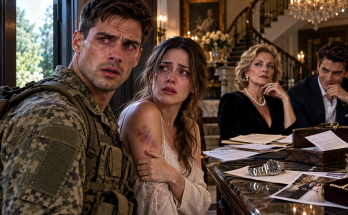
Priya spread the proposed custody agreement across my kitchen table on a cold November morning. Outside, the garden had surrendered most of its leaves, and the air smelled faintly of rain. Owen was at school. The house was quiet except for the cat shifting on the sofa. I had imagined this moment throughout the custody battle, but now that the documents were in front of me, I felt no urge to celebrate. The agreement represented a necessary correction to decisions that should never have been made. It could protect Owen’s daily life, but it could not restore the weeks he spent afraid or the trust damaged between father and son.
The proposal recognized that Owen’s primary residence would remain with me. Grant would not seek immediate reinstatement of the expanded custody or international travel arrangements. Any contact would follow a structured plan based on the child’s welfare, professional guidance, and court approval. There were provisions requiring transparency about travel, communication, and changes in circumstances. The agreement also acknowledged that the financial interests surrounding Walter’s trust created a conflict that needed to remain separate from parenting decisions. Priya explained each clause slowly, making sure I understood both its protections and its limits.
I asked whether signing would prevent Grant from seeking changes in the future. Priya said family court orders could be revisited when circumstances justified it, particularly as children grew and their needs changed. No agreement could guarantee that every future dispute would disappear. What mattered was establishing clear, enforceable arrangements based on the current evidence and Owen’s welfare. I appreciated her refusal to promise certainty. I had spent too many years listening to Grant describe uncertain outcomes as inevitable because he wanted them to be true.
The agreement also required Grant to participate in appropriate parenting education and therapeutic work before any expansion of contact could be considered. Supervised visits would continue initially, with professional assessments informing future decisions. Owen would not be required to discuss financial matters, provide information about the trust, or act as a messenger between adults. Priya had insisted on those provisions. I was grateful. For months, my son had been treated as a route toward information and assets. I wanted the legal documents to make clear that his role was simply to be a child.
I asked whether Grant had agreed voluntarily. Priya said his attorneys had indicated he was prepared to accept the essential terms, though final approval would depend on the court. His financial and criminal legal problems likely influenced the decision, but his motives did not alter the practical protections the agreement could provide. He had acknowledged that his conduct damaged Owen’s trust and that forcing another prolonged custody battle might cause further harm. I did not know whether that recognition came from remorse, legal advice, or both. I decided I did not need to settle the question before acting in Owen’s interests.
We reviewed the documents for nearly two hours. Priya highlighted several points requiring clarification, including procedures for emergency communication and the relationship between court-ordered contact and recommendations from Owen’s therapist. She wanted no ambiguity that could later be used to pressure the child or bypass supervision. I listened carefully and asked questions. Months earlier, I had been intimidated by legal language and worried that Grant’s wealth made every argument unequal. Now I understood that precision was a form of protection. A sentence written clearly today could prevent a painful dispute later.
When we finished, Priya gathered the papers and told me she would negotiate the remaining details. She asked how Owen was doing. I described the science fair, his growing enthusiasm for the lighthouse project, and the nightmares that still interrupted some nights. I also told her about the supervised visit with Grant. Owen had been emotional afterward but seemed relieved that his father listened without demanding forgiveness. Priya said those observations would help inform future arrangements. She reminded me that progress might be uneven. I agreed. Some mornings Owen raced downstairs eager for school; on others, he needed reassurance that I would still be home when he returned.
That afternoon, I picked Owen up from school and took him to the library. He wanted a book about astronomy and another about building simple machines. We wandered through the children’s section while rain tapped against the windows. He found a large illustrated book about telescopes and carried it to a reading table. I sat beside him, watching his finger move along the diagrams. He asked whether we could build a telescope next. I laughed and told him we might need to finish the lighthouse before starting another project. He said the lighthouse was finished, so we were free to begin. I could not argue with his logic.
On the drive home, he asked whether the judge had made a final decision. I told him the adults were working on an agreement that would keep him living with me and establish safe arrangements for seeing his father. He seemed relieved. Then he asked whether he would have to speak in court again. I said there was no plan for him to repeat the experience of the first hearing, and that the professionals involved were working to protect him from unnecessary pressure. He looked out the window for a long moment. Then he said he wished the judge had asked whether he wanted to be responsible for deciding. The comment pierced me.
I told him he should never have been placed in that position. He had been allowed to express his feelings, but adults were responsible for interpreting them and making decisions about his welfare. He nodded. Then he asked whether the judge had believed he really wanted to leave me. I said the court had considered his words alongside many other factors, and that the adults involved had not understood everything happening around him. Owen seemed to think about that. He finally said he hoped the judge knew he loved me. I told him I believed she did, and that I certainly knew it now.
We returned home and made dinner together. Owen peeled carrots with exaggerated caution while I prepared chicken and rice. He asked whether the trust money meant we could buy a bigger house. I told him the fund had specific rules and was intended for his long-term needs. We would learn how it could be used appropriately, but we did not need to change our lives simply because money existed. He looked around the kitchen and said he liked our house. He wanted a telescope, perhaps a better bicycle someday, but he did not want different stairs or a different bedroom. I smiled and said we could discuss bicycles when he outgrew the one he had.
After dinner, Priya called with an update from the financial case. Martin Vale had entered a formal plea agreement resolving some allegations concerning false documents and financial misconduct. The agreement required him to provide truthful information and cooperate with efforts to recover records and identify improper transactions. The court would determine the appropriate consequences according to the law. Priya emphasized that not every related issue had been resolved, but Vale’s admissions were significant. They supported the conclusion that Walter’s approval had been falsely represented in trust-related paperwork.
I felt a quiet satisfaction, though not happiness. Vale had used his professional authority to manipulate documents that affected a child’s future. He had tried to pressure me privately with a questionable amendment while I was frightened for Owen. Knowing he had begun accepting responsibility mattered. But the harm extended beyond the legal violations. His conduct had contributed to Walter’s distrust, Grant’s desperation, and the chain of events that brought Owen to Middleburg. No sentence or agreement could make those consequences disappear.
Priya said Lang’s case continued through the courts. Prosecutors had assembled substantial evidence from the separate ledger, bank records, communications, and witness testimony. Lang disputed important allegations, and the judicial process would determine his responsibility. Grant’s position remained under review because he had participated in transactions and attempted to influence trust administration while also providing information that helped investigators. His cooperation did not guarantee immunity. I understood that the final outcome might take time. For once, I did not feel compelled to know every detail immediately. Owen’s safety no longer depended on my ability to follow each development.
Several days later, Beck asked to meet with me one more time about Walter’s files. I arranged the appointment through Priya. He explained that investigators had recovered a final set of documents from Vale’s records. Among them was a copy of correspondence Walter had prepared for an independent trustee shortly before his hospitalization. The letter confirmed that he rejected any arrangement allowing his personal assets to be redirected toward the Whitaker businesses or obligations connected to Lang. It also instructed the trustee to preserve Owen’s interests regardless of changes in parental custody or residence. The language was explicit enough to resolve lingering questions about Walter’s intent.
I asked whether the letter had ever been delivered. Beck said the available evidence suggested it had reached the trustee through a secure channel before Walter became seriously ill. That explained why the trust’s protections held despite repeated attempts to alter them. Walter had not relied solely on the lighthouse or the documents left for Owen. He had established independent legal safeguards that continued functioning after his death. The hidden materials served a different purpose: preserving evidence of the financial scheme and exposing attempts to interfere with those safeguards.
The distinction eased a burden I had carried for weeks. Walter had not expected an eight-year-old to control millions of dollars through a mysterious card. The trust existed independently, administered by professionals with legal obligations. Owen’s discovery of the video had activated the evidence trail in a way Walter never intended for a child so young. The black card was a verification tool, not a key that could empty an account. The lighthouse contained records meant for responsible adults. Much of the danger arose because Grant and Lang believed Owen possessed information they needed, not because the child actually controlled the fund.
Beck also explained the final mystery surrounding the duplicate lighthouse. Walter had commissioned two nearly identical ornaments because he feared someone might search his study after discovering he was collecting records. The visible copy remained on the desk. The original, containing the letter and storage device, was moved to a secure location accessible through instructions preserved on Owen’s tablet. Walter apparently expected the information to be retrieved later by an adult he trusted. Owen found it earlier than anyone anticipated. That timing created the crisis. The duplicate misled Grant long enough for Owen to carry the original out of the estate.
I asked whether Walter had left any explanation for why he chose me. Beck referred to the letter we found inside the lighthouse. Walter had observed my care for Owen and believed I would prioritize his welfare over the Whitaker family’s reputation. He had also expressed regret for treating me as an outsider. Beck said the records contained no indication that Walter intended to make me wealthy or give me control of the family businesses. His purpose was narrower and more personal: he wanted his grandson protected from financial obligations and family pressure.
I thought of Walter standing in our old dining room, watching me comfort Owen after a fall. He had rarely offered praise, but perhaps he had noticed more than I understood. The thought did not erase his mistakes. He had delayed difficult conversations and left dangerous evidence in a form that eventually burdened a child. Still, his independent safeguards had prevented the trust from being diverted. His final letters had given investigators a path toward the truth. He had been flawed, but he had tried to draw a line that others would not cross.
Before the meeting ended, Beck told me investigators no longer needed Owen to help interpret the recovered records. They had authenticated the relevant materials through independent sources. His notebook and video recollections had helped locate evidence, but the case could now proceed without further relying on his memory. I felt a profound relief. Owen had spent months believing he was responsible for keeping his grandfather’s promise. Now the adults had enough information to carry the work themselves.
I thanked Beck for treating Owen carefully. He said the child had been brave, but he hoped we would not allow bravery to become another expectation placed on him. Children should not have to prove their courage through dangerous circumstances. I agreed. I wanted Owen to remember the science fair, the garden, and the telescope he hoped to build, not the frightening responsibility of protecting hidden documents.
The custody agreement was finalized in court the following week. The judge reviewed the terms, asked questions about Owen’s welfare, and approved arrangements that kept his primary home with me while establishing controlled, professionally guided contact with Grant. The order recognized the serious concerns arising from the recent events and the importance of preventing financial matters from influencing parenting decisions. It also provided a framework for future review based on Owen’s needs rather than either parent’s wealth.
I sat beside Priya as the judge completed the proceeding. This time, Owen was not required to choose between us. He was at school, working on a project about the phases of the moon. The contrast mattered. The first hearing had placed him in a room where adult expectations shaped his words. The final proceeding restored responsibility to the adults who should have carried it all along.
Afterward, Priya and I stood outside the courthouse beneath a gray sky. She asked whether I felt relieved. I considered the question. The custody battle was settled for now. The trust remained protected. The investigation had exposed substantial wrongdoing. Grant had acknowledged important parts of his conduct. Yet our family would never return to the simple arrangement that existed before the first petition arrived. Owen would need time to rebuild trust, and I would need time to stop expecting every unfamiliar telephone call to bring another emergency.
“I think I feel tired,” I said.
Priya smiled gently. “That makes sense.”
We walked toward the parking garage. I thanked her for helping me protect Owen without turning him into a weapon against his father. She said that had always been the goal. Then she handed me a copy of the signed order. It was thinner than the folders I carried during the first hearing, but it represented something more important than victory. It gave our son a stable place to grow while the adults accepted the consequences of their choices.
That evening, Owen asked whether we could celebrate. I told him we could choose something special for dinner. He selected homemade pizza and chocolate ice cream. We spread flour across the kitchen counter, rolled the dough unevenly, and argued cheerfully about how much cheese belonged on each half. The cat watched from a chair, hoping someone would drop a piece of chicken. When the pizza emerged from the oven, one edge was slightly burned. Owen declared it perfect.
After dinner, he helped me hang his science-fair certificate beside the height marks near the kitchen door. He measured himself and discovered he had grown almost half an inch since the last mark. He insisted that I write the date carefully. I did, then stepped back while he examined the new line. The marks recorded years of ordinary growth, untouched by court orders, bank accounts, or business arrangements. They were evidence of something simple and enduring: he had been here, loved and cared for, through every season.
Before bed, Owen asked whether he would ever have to protect Grandpa’s money again. I told him no. The trust was being managed by responsible adults under clear rules. His job was to learn, play, make mistakes, and discover what kind of person he wanted to become. He looked relieved. Then he asked whether he could still keep the green dinosaur. I laughed and said of course. It belonged to him long before the mystery began.
When he fell asleep, I remained beside him for several minutes. The hallway light glowed through the open door. I could hear the faint hum of the house settling into night. For the first time in months, I did not feel compelled to check my phone. The legal and financial proceedings would continue, but Owen’s immediate future was no longer balanced on a hidden document or a courtroom statement.
I went downstairs and placed the signed custody order in a drawer beside his school records. Then I looked at the cardboard lighthouse on the mantel. Its little red stripes shone beneath the lamp. Walter’s brass ornament remained with investigators, but Owen’s model was here, built from ordinary materials and powered by a small battery. It held no secrets.
I turned on the light and watched it sweep across the room.
The story had begun with my son choosing his father in court and leaving me convinced that love had lost to wealth. Now I understood that the real contest had never been between our townhouse and the Whitaker estate. It had been between adults who treated a child’s future as something to control and the responsibility to let him grow without carrying their burdens.
The final legal consequences were still ahead, but one essential question had already been answered.
Owen had never stopped wanting to come home.