The first time someone tried to kill me, I thought it was an accident.
The second time, my younger sister was laughing.
And the third time, I finally understood why my parents had been counting the days until my thirty-fifth birthday.
But I’m getting ahead of myself.
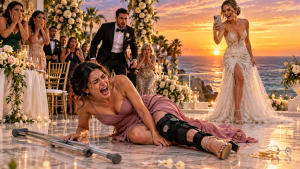
The moment that destroyed my family happened on a beautiful California evening, with the Pacific Ocean glittering beyond an expensive wedding terrace and champagne glasses catching the last golden light of sunset.
I was lying on the marble floor, screaming.
My right leg was twisted beneath me.
My black orthopedic brace had shifted, and a pain unlike anything I’d ever experienced was tearing through my knee.
Eight weeks earlier, I’d survived a devastating workplace accident.
Now, I had just heard the same sickening sound again.
**CRACK.**
A bone breaking.
My sister Sutton stood several feet away, holding her phone.
She was laughing so hard she could barely speak.
“Oh my God, Fallon!
Your FACE!”
Someone shouted for help.
A woman dropped her champagne flute.
My mother, Althea, pushed through the gathering crowd with a horrified expression.
But Sutton simply raised her phone higher.
**”RELAX!
IT WAS FOR CONTENT!”**
I remember staring at her, struggling to understand how someone could find another person’s agony entertaining.
“Sutton,” I whispered.
“You broke my leg.”
She rolled her eyes.
“God, you’re so dramatic.”
Then her maid of honor said something that changed everything.
“Sutton, you told me she knew about the prank.”
My sister’s smile faltered.
And standing directly behind them was her fiancé, Alden Pierce.
He had heard every word.
What happened afterward would expose a $180,000 lie, a dangerous corporate conspiracy, and a secret my parents had hidden from me for almost fifteen years.
But the most terrifying revelation was still waiting.
**The fall wasn’t supposed to leave me alive.**
***
My name is Fallon Mercer.
At thirty-four, I had built a life that looked ordinary from the outside but represented years of fighting for every inch of independence.
I owned a modest but beautiful house outside Dayton, Ohio.
I drove a paid-off SUV, maintained a healthy savings account, and worked as a commercial aviation risk assessor.
People often asked what that meant.
Usually, I told them I inspected airplanes.
The truth was more complicated.
My job involved identifying the tiny mechanical failures, overlooked safety procedures, and hidden maintenance defects that could turn an ordinary workday into a catastrophe.
I’d spent years climbing through aircraft hangars, examining cargo systems, reviewing maintenance records, and confronting executives who hated hearing that their expensive equipment needed to be grounded.
I was good at finding things people didn’t want discovered.
Unfortunately, that skill had made me extremely unpopular in my own family.
My mother liked telling relatives that I “looked at dirty airplanes.”
My father, Clayton Mercer, frequently joked that I’d never learned how to be feminine because I spent too much time around machinery.
And Sutton?
Sutton treated my career as proof that I was fundamentally defective.
“Some women just aren’t meant to have glamorous lives,” she’d once announced during Thanksgiving dinner.
Everyone laughed.
I hadn’t.
Not because I was offended by the comment itself.
Because I’d paid for that Thanksgiving dinner.
And the electricity.
And half the groceries in my parents’ house.
I’d stopped doing those things three years earlier, after finally understanding that no amount of financial assistance would make my family respect me.
Sutton was thirty-one, beautiful, charming, and remarkably skilled at convincing people she was more successful than she actually was.
Her social media accounts suggested she lived in a world of private events, designer clothing, luxury resorts, and celebrity clients.
In reality, she worked occasional freelance assignments as an event stylist and relied on our parents to cover everything else.
When she couldn’t make rent, Mom helped.
When her credit cards reached their limits, Dad intervened.
When she wanted a vacation, someone always found the money.
I was expected to admire her ambition.
**She was the daughter who deserved everything.
I was the daughter who was expected to provide it.**
The pattern had started long before adulthood.
When I was eighteen, I worked double shifts at a diner to save money for my first car.
After three years, I’d accumulated $4,000.
It wasn’t much by some standards, but to me, it represented freedom.
Then Sutton, fifteen at the time, failed to make her high school’s cheerleading squad.
She cried.
She refused dinner.
She announced that her life was ruined.
My father responded by withdrawing every dollar from my savings account.
He bought her designer handbags and paid for a luxury spa weekend.
When I discovered the missing money, I confronted him.
“That was mine.”
Dad shrugged.
“Sutton needed cheering up.”
“I worked three years for that money.”
“And you’ll work another three.
You’re good at that.”
I started crying.
That’s when Mom appeared.
“Fallon, stop making your sister feel guilty.”
Sutton watched from the staircase, holding one of her new handbags.
She was smiling.
Later that evening, Dad made me apologize to her for ruining what he called her recovery weekend.
I remember hiding in the bathroom afterward, pressing my forehead against the cold mirror.
That night, my grandmother Rose called.
She had heard what happened from my aunt June.
When I told her everything, she became unusually quiet.
Then she said something I would remember for the rest of my life.
**”Sweetheart, there’s a difference between an accident and a pattern.
Never let someone call a pattern an accident just because the truth makes them uncomfortable.”**
At eighteen, I thought she was talking about money.
At thirty-four, I would discover she had been warning me about something much bigger.
***
Eight weeks before Sutton’s wedding, temporary maintenance scaffolding collapsed beneath me during an inspection at an aircraft maintenance facility.
I fell nearly twelve feet.
The accident fractured my right tibia and destroyed my ACL.
The surgeons repaired the fracture with metal pins and reconstructed the damaged ligament.
When I woke up, my leg was wrapped in thick bandages, and an orthopedic specialist explained that my recovery would take months.
He was particularly concerned about the stability of my knee.
“One hard twist,” he warned, “could undo everything.”
I followed every instruction.
I attended physical therapy.
I wore the rigid black brace.
I used crutches even when I hated them.
And when Sutton’s wedding approached, I considered staying home.
The ceremony was scheduled at Cliffside Resort, an extravagant oceanfront property in California.
The resort featured white stone balconies, enormous glass windows, dramatic staircases, and terraces suspended above the Pacific.
It was breathtaking.
It was also the worst possible place for someone recovering from major knee surgery.
When I told Mom I might not be able to attend, she went silent.
Then she asked, “Do you have any idea how strange the family photographs will look with one bridesmaid missing?”
That was all.
No concern about my recovery.
No questions about my pain.
Just photographs.
I should have refused.
Instead, I bought an airline ticket.
Part of me still wanted to believe that if I showed up when my family needed me, maybe someday they would show up when I needed them.
I arrived forty-eight hours before the ceremony.
By the time I reached the bridal suite, my leg was throbbing.
I carefully lowered myself into a velvet chair and propped my injured leg on an ottoman.
The room smelled of expensive perfume, fresh flowers, and champagne.
Sutton walked in wearing a white silk robe.
Her eyes immediately dropped to my brace.
“You’re not seriously wearing that tomorrow.”
I stared at her.
“Sutton, I have metal pins in my leg.”
She sighed dramatically.
“It looks industrial, Fallon.”
“It’s medical equipment.”
“I spent eighteen months planning this wedding, and you’re going to ruin every photograph looking like you escaped a construction accident.”
Her maid of honor laughed.
I tightened my hands around the chair.
“The dress is long.
Most people won’t even see it.”
Before Sutton could answer, Alden entered carrying iced coffees.
He handed one to me.
“How’s the knee holding up?”
“Better when I’m sitting.”
He nodded.
“I already asked the photographer to keep a stool nearby during portraits.
You’re not standing for forty-five minutes just because somebody wants perfect pictures.”
I was genuinely touched.
“Thank you.”
He smiled.
“If anyone has a problem with the stool, they can Photoshop it out.”
I laughed.
Then I noticed Sutton watching us.
Her champagne flute was clenched so tightly that her knuckles had turned white.
When Alden looked toward her, she immediately smiled.
But I recognized the expression she’d been wearing.
Jealousy.
Cold, familiar jealousy.
Later that afternoon, she cornered me outside my hotel room.
“Alden thinks you’re some heroic wounded soldier now.”
I sighed.
“Nobody thinks that.”
“Just don’t milk it tomorrow.”
“I’m not trying to get attention.”
She tilted her head.
Then she smiled.
**”Don’t worry.
I’ve already thought of something that’ll make everyone laugh about that ridiculous brace.”**
I asked what she meant.
She walked away.
I assumed she was planning some embarrassing joke.
I had no idea she was planning to knock me off my crutches.
***
The following evening, the welcome reception began on the resort’s oceanfront terrace.
Soft music drifted between white floral arrangements.
Waiters circulated with champagne.
The sun was sinking toward the horizon, turning the water copper and gold.
I stood near the railing, keeping most of my weight on my uninjured leg.
Sutton approached with her phone.
“Fallon!
Come here!
We need a cute sister moment!”
I hesitated.
“Can we do it sitting down?”
“Oh, for God’s sake.
It’s literally ten seconds.”
She waved toward the videographer, a young man named Leo.
“Get ready.
This is going to be hilarious.”
I adjusted my crutches.
“Sutton, please don’t make me move too fast.”
She leaned close.
“Trust me.”
Then she stepped behind me.
Something struck my right crutch.
The rubber tip slid sideways across the polished stone.
My upper body twisted.
Instinctively, I tried to catch myself.
On my injured leg.
The pain hit before I reached the floor.
**CRACK.**
I screamed.
One crutch flew beneath a table.
The other clattered across the terrace.
My knee folded beneath me at an impossible angle.
For several terrible seconds, I couldn’t breathe.
People rushed toward me.
Someone called for an ambulance.
Sutton laughed.
“It was for content!”
Then her maid of honor asked why she hadn’t warned me.
And Sutton made the mistake that would eventually destroy her.
She answered honestly.
“I told you she’d fall if I knocked that crutch.
With her bad knee, she couldn’t possibly catch herself.”
Her maid of honor went pale.
“Sutton, you said she knew.”
“Obviously I couldn’t tell her.
She would’ve ruined the reaction.”
Alden heard everything.
His expression changed slowly.
First disbelief.
Then horror.
Then something colder.
“Sutton.”
She turned.
“What, babe?”
He pointed toward me.
“Did you deliberately knock her crutch?”
Sutton laughed nervously.
“It was a prank.”
“Answer the question.”
“You’re making this into something it’s not.”
Alden looked toward Leo.
“Did your camera record what she just said?”
Leo swallowed.
“Yes, sir.”
Sutton’s face changed.
“Delete it.”
“Don’t,” Alden ordered.
My mother stepped forward.
“Alden, sweetheart, let’s not destroy the wedding over a misunderstanding.”
He turned toward her.
“A misunderstanding?
Your daughter deliberately injured someone recovering from surgery.”
Mom pressed her lips together.
“Fallon has always been sensitive.”
For the first time in my life, someone looked directly at my mother and refused to accept that explanation.
“No,” Alden said.
“She has a broken leg.”
The paramedics arrived minutes later.
They carefully stabilized my knee and prepared to carry me toward the elevator.
As they moved the stretcher, Sutton grabbed Alden’s arm.
“You’re seriously leaving our wedding weekend because of HER?”
He removed her hand.
Then he said something that made the entire situation even stranger.
**”Sutton, there’s something you should know.
I spoke to your father yesterday about the wedding expenses.”**
She froze.
“What does that have to do with anything?”
“Everything.
Especially the $180,000 you told me Fallon borrowed from your family.”
I turned my head.
“What?”
Alden looked at me.
“Fallon, did you borrow money from your parents to pay for your surgery?”
I stared at him.
“No.”
“Not even part of it?”
“No.
My insurance covered most of the medical expenses.
I’ve paid the remaining bills myself.”
His face drained of color.
“Then why did Sutton tell me your parents had emptied their retirement accounts to save your house?”
Before I could answer, Sutton screamed.
**”DON’T LISTEN TO HER!”**
I remember the sudden silence.
Even the music seemed to fade.
Alden looked at his fiancée.
Then at me.
And quietly asked, “Where did my money go?”
***
I spent the next several hours in a hospital emergency department.
The new scans were devastating.
My tibia had fractured near the previous surgical repair.
Two fixation points had shifted.
The reconstructed ACL had ruptured.
There was also damage around the joint that would require another operation.
The orthopedic surgeon didn’t sugarcoat it.
“You’re facing a significantly more difficult recovery now.”
“Will I walk normally again?”
He hesitated.
“We’ll do everything possible.”
That hesitation frightened me more than his words.
I had spent my adult life moving through hangars, climbing inspection ladders, and standing beneath aircraft engines.
My legs weren’t just part of my independence.
They were part of my career.
Now I was staring at a future that might look completely different.
Once the medication began working, I finally started crying.
Not the dramatic kind.
The quiet, exhausted kind that comes when your body has run out of ways to hold everything together.
Alden sat in a chair near the window.
He had followed the ambulance to the hospital.
He hadn’t touched his phone for almost an hour.
When he noticed my tears, he didn’t tell me to be strong.
He simply handed me tissues.
“I’m sorry,” he said.
I shook my head.
“You didn’t do this.”
“No.
But I should’ve recognized what was happening.”
I looked at him.
“What exactly did Sutton tell you?”
He rubbed his face.
“About three weeks ago, she said your accident had left you in serious financial trouble.”
I stared at him.
“Why would she say that?”
“She told me your medical insurance refused to cover the reconstruction.
She said you were behind on your mortgage and your parents had loaned you $180,000.”
“That’s insane.”
He nodded.
“She said your parents couldn’t afford the wedding deposits because they’d used their retirement savings to help you.”
I felt sick.
“So you gave them the money?”
“I loaned your father $180,000.
He signed a repayment agreement.”
“Why?”
“Because Sutton said the wedding would have to be canceled unless her parents recovered what they’d loaned you.”
I closed my eyes.
Even lying in a hospital bed, I could practically hear my sister’s voice.
Fallon ruined everything.
Fallon is selfish.
Fallon always makes things difficult.
“She showed me paperwork,” Alden continued.
“There was a promissory note with your signature.”
I opened my eyes.
“My signature?”
He nodded.
“And a statement saying you’d accepted financial assistance from something called the Mercer Family Recovery Fund.”
I’d never heard of it.
Alden studied my face.
“Fallon, I need you to understand something.
I didn’t know any of this was fake.”
I believed him.
His reaction on the terrace had been too immediate, too genuine.
“Can you show me those documents?”
“Yes.”
He paused.
“There’s something else.”
My stomach tightened.
“What?”
“Your father used shares in his family’s holding company as collateral for the loan.”
I frowned.
“My father doesn’t have a holding company.”
Alden looked confused.
“He does.
Or at least, he says he does.”
“My father’s industrial supply business closed years ago.”
Alden slowly leaned back.
“Fallon, the company on those documents is currently operating.”
I stared at him.
He reached for his phone.
The screen displayed a scanned agreement.
At the top was a company name.
**MERCER PRECISION HOLDINGS, LLC.**
Beneath it was my father’s signature.
And on the attached financial disclosure was another name.
Mine.
**FALLON R.
MERCER — BENEFICIAL INTEREST HOLDER.**
I felt the room tilt.
“What does that mean?”
Alden looked at the document, then back at me.
“I was hoping you could tell me.”
***
The next morning, I called an attorney.
Her name was Mara Chen.
A former insurance defense lawyer turned civil litigator, Mara had a reputation for handling complicated corporate fraud cases.
She arrived at the hospital wearing a navy pantsuit, carrying a leather briefcase and the expression of someone who disliked surprises.
After listening to the entire story, she asked one question.
“Do you have copies of everything?”
Alden had already collected the loan documents.
Leo, the videographer, had preserved the original recordings from the reception.
The resort had also saved its security footage.
Mara studied the paperwork.
Then she looked at me.
“Do you recognize this signature?”
It was my name, written in an exaggerated version of my handwriting.
“No.”
“Have you ever borrowed $180,000 from your parents?”
“No.”
“Have you ever signed documents related to Mercer Precision Holdings?”
“Never.”
She placed the paperwork on the table.
“Then we’re dealing with more than an assault.”
She explained that the documents appeared to contain forged signatures and potentially fraudulent representations involving corporate assets.
The financial statement was particularly strange.
It listed me as a beneficiary of a family trust.
I told Mara I’d never received money from a trust.
She asked about my grandparents.
My paternal grandmother, Rose Mercer, had died when I was twenty.
Grandpa had passed away years earlier.
Grandma Rose had been an accountant who helped my father establish his first industrial supply business.
I remembered her spending long evenings at the dining room table, reviewing invoices with reading glasses balanced on her nose.
She was the only person in our family who consistently treated my ambitions as something worth celebrating.
When I graduated from high school, she’d given me a silver compass necklace.
“Because you know where you’re going,” she’d said.
After her death, Dad told me she’d left everything to him.
I hadn’t questioned it.
Mara wrote something in her notebook.
“What was your relationship with your grandmother?”
“Close.”
“Did she ever mention leaving you anything?”
I thought about it.
There had been a conversation during my sophomore year of college.
Grandma was sitting on her back porch, drinking iced tea.
She’d asked whether I still planned to work in aviation.
When I said yes, she’d smiled.
“Good.
I hope you’ll always have the freedom to choose your own future.”
Then she’d said something odd.
“Some gifts aren’t meant to make life easier immediately.
They’re meant to make sure no one can ever take your choices away.”
I’d assumed she meant education.
Now I wasn’t so sure.
I told Mara.
She became very still.
“Fallon, I want permission to obtain the probate and trust records from your grandmother’s estate.”
“Why?”
“Because if your name appears on a financial disclosure as a beneficial interest holder, there’s a reason.”
She hesitated.
“And I don’t think your family wants you to know what that reason is.”
***
While I recovered from surgery, Sutton launched a public relations campaign.
It started with a social media post.
She described the incident as “a harmless bridal party joke that was tragically misunderstood.”
She claimed I’d been upset about the attention surrounding her wedding.
She claimed I’d exaggerated my injuries.
Then she posted a heavily edited video.
It showed her standing beside me.
It showed me falling.
It did not show her striking my crutch.
And it ended before anyone heard her admission.
The caption read:
“Sometimes family members can’t stand seeing you happy.”
Within hours, thousands of strangers were calling me dramatic.
Some accused me of trying to sabotage my sister’s wedding.
Others suggested I was pretending to be injured for money.
I watched the comments from my hospital bed, feeling increasingly numb.
Then Mom called.
I almost ignored it.
But I wanted to hear what she had to say.
“Fallon,” she began, “you need to stop this nonsense.”
I stared at the ceiling.
“What nonsense?”
“Your sister is devastated.”
“I had surgery this morning.”
“That’s unfortunate, but Sutton’s entire wedding is falling apart.”
“She knocked my crutch out from under me.”
“She was joking.”
“She knew I was injured.”
Mom sighed.
“You’ve always struggled with forgiveness.”
I closed my eyes.
“Mom, I could have lost the ability to walk.”
“And Sutton could lose her fiancé.”
Something inside me finally went quiet.
Not broken.
Not numb.
Finished.
“Those aren’t equivalent things.”
“You don’t understand how much money we’ve invested in this wedding.”
“Apparently, Alden invested $180,000.”
Silence.
Then Mom’s voice changed.
“Who told you that?”
“Alden.”
“Fallon, you need to stay out of financial matters you don’t understand.”
I almost laughed.
“Apparently, I’m named in the financial documents.”
Another silence.
Longer this time.
Then Mom said, very softly, **”You need to be careful about what you start digging into.”**
I sat upright.
“Is that a threat?”
“No, sweetheart.”
Her voice became sickeningly gentle.
“It’s a warning.
Some things are better left alone.”
She hung up.
For several seconds, I stared at my phone.
Then I called Mara.
When she answered, I repeated the conversation word for word.
She listened without interrupting.
Finally, she said, “Fallon, don’t speak to your parents alone again.”
“Why?”
“Because I think this situation is much more serious than a family dispute.”
***
Three days later, Alden came to my hospital room.
He looked exhausted.
His engagement ring was gone.
Actually, he’d never worn one, but the watch Sutton had given him for their engagement was missing from his wrist.
I noticed because Sutton had made an enormous production out of buying it.
“How are you feeling?” he asked.
“Like somebody rebuilt my leg with a hammer.”
He gave a tired smile.
Then he sat down.
“I canceled the wedding.”
I looked at him.
“I’m sorry.”
“Don’t be.”
“Still, I know this wasn’t how you imagined things going.”
He stared at his hands.
“Fallon, Sutton told me a lot of things about you.”
I waited.
“She said you resented her because she was getting married.
She said you were successful professionally but lonely and bitter.”
I looked toward the window.
“Of course she did.”
“She also said you borrowed money constantly and refused to repay anyone.”
I laughed once.
It hurt.
“I’ve spent my entire adult life making sure I never have to borrow from them.”
He nodded.
“I believe you now.”
He reached into his jacket and produced a small envelope.
Inside was a printed photograph.
It showed me standing beside a cargo aircraft at an aviation safety conference four years earlier.
I recognized it immediately.
It had appeared in an industry newsletter after I received an award.
“Where did you get this?”
“Sutton showed it to me when we first started dating.”
I frowned.
“Why?”
“She said it was a photo of the sister she was always trying to protect.”
I stared at him.
He continued.
“She told me your professional success came at the expense of your emotional stability.
She said your parents had spent years covering for you.”
I felt something cold settle in my chest.
Sutton hadn’t merely complained about me.
She’d built an entire fictional version of my life.
Alden leaned forward.
“There’s another reason I came.”
He showed me an email.
It was from my father.
The subject line read:
URGENT FAMILY FINANCIAL MATTER.
Inside, Dad insisted Alden honor his loan agreement despite the canceled wedding.
He threatened legal action.
He also warned that if Alden continued supporting me, the family would reveal “sensitive information about Fallon’s professional conduct.”
My stomach tightened.
“What professional conduct?”
Alden studied me.
“I was hoping you knew.”
I didn’t.
But I remembered something from the accident investigation eight weeks earlier.
Something that had bothered me from the beginning.
The scaffold that collapsed beneath me had supposedly passed a safety inspection only two hours before I climbed it.
Yet when I examined the accident photographs afterward, I noticed something strange.
One of the locking collars appeared to be missing its retention pin.
I’d raised concerns with the maintenance contractor.
They told me the photograph was misleading.
Then my employer’s risk department advised me to focus on recovery.
At the time, I’d been too medicated and exhausted to fight.
Now, looking at Dad’s email, I felt the first real spark of suspicion.
**Why would my father threaten to expose professional misconduct when he supposedly knew nothing about my accident?**
***
Mara’s investigator was a retired police detective named Daniel Reeves.
He was in his early sixties, broad-shouldered, and spoke so calmly that even terrible information sounded manageable.
He visited me at home a week after my discharge.
I’d returned to Ohio with help from a colleague, Naomi Brooks, who had been my closest friend since graduate school.
Naomi had temporarily moved into my guest room.
She drove me to appointments, made sure I ate real food, and threatened to confiscate my laptop whenever I tried to work for too long.
When Daniel arrived, she was making coffee.
He placed a folder on my kitchen table.
“I’ve looked into Mercer Precision Holdings.”
I leaned forward.
“What did you find?”
“It’s active.
Very active.”
He opened the folder.
There were corporate records, property filings, and photographs of industrial facilities.
Mercer Precision Holdings controlled several companies.
One distributed specialized industrial components.
Another provided equipment leasing and logistics services.
A third owned commercial real estate.
Their combined operations were substantially larger than the struggling family business I’d known growing up.
“Your father’s company never closed,” Daniel said.
I stared at him.
“He told me it went bankrupt.”
“One of the original entities was dissolved, but the business continued under different names.”
“Why hide that from me?”
He slid another document forward.
“That’s what we’re trying to determine.”
It was a corporate ownership chart.
Several subsidiaries led to a parent holding company.
And above that company was a trust.
**THE ROSE MERCER FAMILY LEGACY TRUST.**
My grandmother’s name.
Daniel tapped the page.
“You’re listed as the primary beneficiary.”
For several seconds, I couldn’t speak.
Then I asked the obvious question.
“How much is it worth?”
He hesitated.
“We don’t have complete financial records yet.
But based on available filings and asset valuations, the trust’s interest may be worth several million dollars.”
Several million.
I stared at the chart.
My mind flashed back to every cheap apartment I’d rented during college.
Every double shift.
Every student loan payment.
Every birthday when my parents told me they couldn’t afford a gift because Sutton needed something.
But the money wasn’t what hurt.
It was the secrecy.
“Grandma never told me.”
Daniel nodded.
“That doesn’t necessarily mean she didn’t intend for you to know.”
I looked at him.
“What does that mean?”
“We haven’t obtained the full trust agreement.”
He turned another page.
“And there’s something else.”
The equipment leasing subsidiary was called Western Span Industrial Services.
I recognized the name immediately.
It was the company responsible for the temporary scaffolding at the aircraft facility where I’d been injured.
My breath stopped.
Daniel watched my face.
“Fallon?”
I pointed at the paper.
“That company supplied the scaffold.”
He nodded slowly.
“We thought that might be significant.”
I looked at the ownership chart again.
My father’s business.
My grandmother’s trust.
The equipment that nearly killed me.
For the first time, the separate pieces of my life began fitting together in a way that terrified me.
***
I called Mara immediately.
She listened as I explained the connection.
Then she asked me to repeat one detail.
“You’re certain Western Span supplied the scaffold?”
“Absolutely.
Their logo was on the equipment inspection form.”
“Do you have a copy?”
“Yes.”
I had kept my original accident documentation in a folder on my laptop.
Old habits.
Aviation risk assessors learn to save everything.
I opened the file and emailed it to her.
Then I began reviewing the photographs myself.
The images showed the collapsed platform, twisted support rails, and broken locking assembly.
I enlarged one photograph.
There, partially hidden beneath the platform, was a metal collar with a distinctive crescent-shaped manufacturing mark.
I recognized it.
Three days before the accident, I’d written a preliminary report about unusual wear patterns on several replacement locking assemblies.
The supplier had claimed the components met industry standards.
I’d requested additional certification.
The report had never received a response.
Instead, the next thing I remembered was falling.
I searched my archived emails.
The original inspection request was there.
So was a notification that someone had marked the issue resolved.
The clearance document contained my electronic signature.
I stared at the screen.
**I HAD NEVER APPROVED THAT EQUIPMENT.**
I opened the metadata.
The clearance had been issued at 11:43 p.m.
On the night of my accident.
At that exact time, I had been in surgery.
My hands began shaking.
“Naomi!”
She rushed into the room.
“What happened?”
I pointed at the screen.
“Someone signed a safety clearance using my credentials while I was unconscious.”
She read the document.
Her expression changed.
“Fallon, that’s impossible.”
“No,” I whispered.
“That’s fraud.”
I called Mara again.
This time, she answered immediately.
When I explained what I’d found, she became completely silent.
Then she said, “Do not alter those files.”
“I haven’t.”
“Don’t forward them to anyone else except through the secure channel I’ll send you.”
“Okay.”
“And Fallon?”
“Yes?”
“I’m going to contact your employer’s legal department and the appropriate investigators.”
My stomach tightened.
“Do you think someone caused the collapse deliberately?”
She paused.
“I don’t know yet.”
Then she added something I would hear in my nightmares.
**”But someone certainly worked very hard to make it look as though you approved the equipment that failed.”**
***
A week later, my father appeared at my front door.
I was sitting on the couch with my injured leg elevated when the doorbell rang.
Naomi checked the security camera.
“It’s your dad.”
I felt my shoulders tighten.
“Don’t let him in.”
But before she could speak through the door, he called out.
“Fallon, I know you’re home.”
I asked Naomi to record the conversation.
Then I opened the door with the security chain engaged.
Dad stood on the porch wearing a charcoal suit.
He looked older than I remembered.
Not frail.
Just tired.
“Sweetheart,” he said warmly.
I hadn’t heard him use that word in years.
“What do you want?”
He glanced at the chain.
“Can we talk like adults?”
“We are.”
He sighed.
“Your mother is worried sick.”
“About my leg?”
“About what you’re doing to this family.”
I almost laughed.
“I didn’t knock myself off my crutches.”
His jaw tightened.
“Sutton made a mistake.”
“She committed an assault.”
“Don’t use legal language with me.”
“Then don’t show up at my house demanding I ignore what happened.”
He stared at me.
Then his expression softened.
“Fallon, I know you’ve always felt overlooked.”
I went very still.
He continued.
“We haven’t been perfect parents.”
That was the closest thing to an admission I’d ever heard.
For one foolish second, hope moved through me.
Then he said, “But what you’re doing now could destroy everything we’ve worked for.”
There it was.
Not an apology.
A negotiation.
“What exactly have you worked for, Dad?”
He studied me.
“Your attorney has been asking questions.”
“She’s doing her job.”
“About matters that don’t concern you.”
I felt my pulse quicken.
“Does Mercer Precision Holdings concern me?”
His expression went blank.
Only for a second.
But I saw it.
“Where did you hear that name?”
“Is Western Span one of your companies?”
He looked past me into the house.
“Fallon, open the door.”
“No.”
“You’re making this more complicated than necessary.”
“Did your company supply the scaffold that collapsed beneath me?”
He didn’t answer.
I repeated the question.
This time, he said, “Industrial equipment failures happen every day.”
I gripped the doorframe.
“That isn’t what I asked.”
His face hardened.
“Listen to me very carefully.
You have no idea what you’re interfering with.”
I felt something cold move down my spine.
“Then explain it.”
He leaned closer.
**”You have a good life, Fallon.
A nice house.
A career.
You survived your accident.
Be grateful for that.”**
I stared at him.
“Are you threatening me?”
He exhaled.
“I’m trying to keep you safe.”
“From whom?”
His eyes shifted toward my security camera.
Then he stepped back.
“Tell your lawyer to stop.”
He walked away without another word.
Naomi appeared beside me.
Her face was white.
“Please tell me we recorded that.”
I looked at the small camera above the door.
“We did.”
***
Three days later, Mara received a call from my aunt June.
June was my father’s younger sister.
She lived in Oregon and had barely spoken to our family in more than a decade.
When I was a teenager, she had been the only adult besides Grandma Rose who occasionally challenged my parents.
Then she’d abruptly stopped visiting.
Mom said she’d become bitter.
Dad said she was jealous.
I’d always assumed the estrangement was about money.
I was right.
But not in the way I expected.
June asked to speak to me privately.
We arranged a video call.
The moment her face appeared on my screen, she began crying.
“Oh, Fallon.”
I hadn’t seen her in nearly twelve years.
Her hair had turned silver around the temples, but her eyes were exactly as I remembered.
“Hi, Aunt June.”
She pressed a tissue against her face.
“I’m so sorry.”
“Why?”
“Because I should have found you years ago.”
I didn’t know what to say.
She lifted a thick envelope.
“Your grandmother gave me this shortly before she died.”
I leaned closer.
“What’s in it?”
“A copy of the original trust agreement.”
My heart began pounding.
June explained that Grandma Rose had built Mercer Industrial Supply with my grandfather.
After he died, she’d retained significant ownership in the business while allowing my father to manage daily operations.
She was proud of the company.
But she had become increasingly worried about Clayton’s spending and willingness to bend rules.
When she discovered he’d taken my college savings, she confronted him.
He dismissed her concerns.
Then she learned he’d used company money to cover Sutton’s credit card bills.
That was when she contacted an estate attorney.
She created a trust.
Its primary purpose was to protect the majority ownership interest she intended to leave me.
I stared at the screen.
“Why me?”
June smiled sadly.
“Because your grandmother believed you were the only person in the family who couldn’t be bought.”
My throat tightened.
“Why didn’t anyone tell me?”
June looked down.
“The trust was structured to protect the assets until you reached a specified age.
Your grandmother didn’t want you becoming a target while you were young.”
“What age?”
June hesitated.
“I don’t remember the exact provision.
It’s in the complete document.”
“Where is it?”
“Your mother retained the original after the successor trustee died.”
I frowned.
“Mom?”
June nodded.
“She became the acting trustee.”
The words landed heavily.
My mother.
The woman who had watched Sutton laugh while I lay screaming on a marble floor.
“June, why didn’t you contact me sooner?”
Her eyes filled again.
“I tried.”
She held up several envelopes.
Letters.
All addressed to me.
All returned.
The forwarding address on them was an apartment I’d lived in during college.
But I’d updated my mailing address with the post office years before.
“I called your parents,” June continued.
“Your mother said you’d made it clear you wanted nothing to do with me.”
My stomach twisted.
“She never told me.”
June nodded.
“I finally believed her.
I’m ashamed of that.”
I looked at the stack of letters.
For years, I’d thought June had abandoned me.
She’d thought I’d rejected her.
Mom had kept us apart.
Then June said something that changed my understanding of my childhood.
“Fallon, your grandmother never stopped trying to protect you.”
She lifted one final envelope.
Across the front, in Grandma Rose’s elegant handwriting, were five words.
**FOR FALLON, WHEN SHE’S READY.**
***
The letter arrived two days later.
I waited until Naomi had gone to the grocery store before opening it.
Inside were four handwritten pages.
The paper smelled faintly of cedar, like Grandma’s old linen closet.
I recognized her handwriting immediately.
My hands shook as I began reading.
“My darling Fallon,
If you’re reading this, then either I have finally convinced your father to do the right thing, or someone has failed to keep the promises they made me.
I hope it is the first.
But I have learned that hope is not a substitute for preparation.”
Tears blurred the page.
Grandma wrote about the day Dad took my car money.
She described how helpless she’d felt watching him punish my independence while rewarding Sutton’s demands.
Then she wrote something that made me stop breathing.
“I confronted Clayton about the money because I feared it was not an isolated incident.
I discovered other irregularities in the family business, including transactions that had no legitimate purpose.
I have made arrangements to protect the portion of the company that belongs to me.
One day, that protection will belong to you.”
I wiped my cheeks.
The letter continued.
“You have always been the child who notices things other people hope will remain hidden.
That gift will sometimes make your life lonely.
People who depend on deception rarely love the person who asks for receipts.
Do not become smaller to make them comfortable.”
I pressed the paper against my chest.
For years, I’d wondered whether Grandma truly understood how my parents treated me.
Now I knew.
She had seen everything.
The final paragraph was the most important.
“There is a condition in the trust that I hope you will never need to think about.
It exists because I believe a person should be mature enough to understand the responsibilities that come with wealth.
But if anyone ever uses your future as a reason to make you afraid, remember this:
The truth is usually found in the document someone refuses to show you.
And if your father ever tells you an accident was unavoidable, ask who benefited from it.”
I read that last sentence again.
Then again.
**ASK WHO BENEFITED FROM IT.**
I looked at the photograph of Grandma on my bookshelf.
She was laughing at some forgotten family picnic, sunlight caught in her silver hair.
“Grandma,” I whispered, “what did you know?”
I didn’t expect an answer.
But the next morning, one arrived.
***
Mara called shortly after eight.
She sounded more serious than I’d ever heard her.
“We’ve received a preliminary forensic report on the scaffolding failure.”
I sat upright.
“What did they find?”
“The locking assembly wasn’t merely defective.”
My heart began pounding.
“What do you mean?”
“The retention mechanism appears to have been deliberately altered.”
I gripped the phone.
“Altered how?”
“Someone replaced the original locking pin with an improperly fitted substitute that couldn’t withstand the expected load.”
I felt nauseated.
The scaffold hadn’t simply failed.
Someone had made it unsafe.
Mara continued.
“The maintenance records also show an unauthorized inspection clearance issued under your credentials after you were already hospitalized.”
“I know.”
“Yes.
But we now have evidence connecting that clearance to an account used by Western Span’s regional operations office.”
I stared at the wall.
“Western Span belongs to my father’s holding company.”
“That’s correct.”
“Do you think Dad did it?”
“We don’t know who personally altered the equipment.
But investigators are now treating the circumstances as potentially criminal.”
The room seemed to shrink around me.
I remembered the day of the original accident.
The cold metallic smell inside the aircraft hangar.
The hum of ventilation fans.
The scaffolding platform beneath my boots.
I’d been examining a cargo-door actuator when I felt the first movement.
A tiny shift.
Almost nothing.
Then the platform dropped.
I remembered screaming.
I remembered seeing the concrete rushing toward me.
And I remembered thinking, just before impact, that the equipment shouldn’t have failed.
Because I’d inspected it.
Because I’d flagged the suspicious hardware.
Because I knew the load limits.
Now the memories returned with brutal clarity.
There had been a maintenance technician near the platform that morning.
A man wearing a Western Span badge.
He’d been unusually eager to get me onto the upper section.
“Better view from up there,” he’d said.
I’d barely noticed him.
Now I could see his face.
His orange safety vest.
The tattoo on his left wrist.
I described him to Mara.
She listened carefully.
Then she said, “That may be very important.”
“Why?”
“Because the company initially told investigators no Western Span personnel were present at the time of your fall.”
I closed my eyes.
Someone had lied.
Again.
And suddenly my father’s visit made sense.
He hadn’t come to apologize.
He’d come to warn me.
***
Sutton’s reaction to the investigation was spectacular.
She called me seventeen times in one afternoon.
I ignored every call.
Then she sent messages.
“YOU’RE RUINING MY LIFE.”
“ALDEN WON’T ANSWER ME.”
“YOU’RE MAKING MOM SICK.”
“YOU ALWAYS HAVE TO BE THE VICTIM.”
Finally, she sent a voice message.
I almost deleted it.
Instead, I listened.
Her voice was breathless and angry.
“Fallon, I know you think you’re winning, but you have no idea what you’re doing.
Dad says you’re about to destroy things that don’t belong to you.
You need to stop asking about Grandma’s money.”
I replayed the last sentence.
Then I sent the message to Mara.
Ten minutes later, she called.
“Don’t respond.”
“I wasn’t planning to.”
“Good.”
She paused.
“How does Sutton know you’re investigating the trust?”
“I don’t know.”
“Then we need to assume your parents have told her.”
The thought bothered me.
Sutton had always been financially dependent on Mom and Dad.
What if she knew more than she’d admitted?
What if the wedding wasn’t merely an expensive celebration?
What if the timing mattered?
I looked at my calendar.
The welcome reception had taken place nineteen days before my thirty-fifth birthday.
That seemed ordinary enough.
Until I remembered Grandma’s letter.
A person should be mature enough to understand the responsibilities that come with wealth.
I opened the photocopied trust summary June had sent.
Most of the document consisted of technical legal language.
Then I found a sentence.
“Distribution of principal shall occur upon satisfaction of the beneficiary’s age-related vesting requirement.”
The exact age was listed in a separate schedule.
A schedule we still didn’t have.
My stomach tightened.
I called Mara.
“I think my birthday matters.”
She paused.
“Why?”
I explained.
She went quiet.
Then she said, “Fallon, I’m going to request emergency preservation of the trust records.”
“What are you thinking?”
“I’m thinking we need to find out exactly when your parents lose control.”
***
Alden visited me again the following week.
This time, he brought a cardboard box.
It contained everything Sutton had left at his apartment.
Designer sunglasses.
Expensive cosmetics.
A pair of shoes that probably cost more than my first car.
And a stack of documents.
“I didn’t want to go through her things,” he explained.
“But my attorney said anything related to the financial transactions might be important.”
I understood.
He placed a folder on the table.
“These were in her desk.”
Inside were printed emails between Sutton, my mother, and an event planning company.
Most concerned flowers, catering, and photography.
But one thread caught my attention.
It discussed the date of the wedding.
The resort had originally offered Sutton several available weekends.
She’d rejected two of them.
Then Mom sent an email.
“September 18 is absolutely essential.
There can be no delay beyond that weekend.”
I frowned.
“Why was that date essential?”
Alden shook his head.
“I don’t know.”
He showed me another email.
Mom had written:
“Fallon must be present for all scheduled family activities.
Please ensure there are no accommodations that would allow her to remain in her room during the welcome reception.”
My stomach dropped.
I’d told Mom about my injury weeks before the wedding.
Why would she specifically demand my presence at the reception?
I kept reading.
A later message from Sutton said:
“Don’t worry.
I’ll make sure she comes outside.
She won’t want to look difficult in front of everyone.”
I felt cold.
Alden watched me.
“Fallon?”
I held up the page.
“They planned to make sure I was there.”
He studied the email.
His jaw tightened.
“That doesn’t prove they planned to hurt you.”
“I know.”
But it proved they were thinking about me long before the supposed spontaneous prank.
I opened another message.
Mom had sent it three days before the wedding.
“Make sure the camera gets the terrace and the railing.
We need everything to look natural.”
I stared at the words.
My hands began trembling.
Alden leaned closer.
“What is it?”
I looked at him.
“Why would my mother care where the camera was positioned?”
He didn’t answer.
Neither of us wanted to say what we were thinking.
***
Two days later, investigators found the Western Span technician.
His name was Travis Bell.
He was forty-two, lived outside Columbus, and had worked in industrial equipment maintenance for almost two decades.
Initially, he denied being at the aircraft facility.
Then investigators showed him security footage from the hangar entrance.
His face was clearly visible.
So was the tattoo on his left wrist.
Travis changed his story.
He admitted he’d been assigned to replace several locking assemblies.
He claimed the equipment was already damaged when he arrived.
But when investigators confronted him with the altered components and falsified inspection records, he requested an attorney.
The following week, he began cooperating.
Mara called me after learning investigators had obtained relevant documents.
“We have a significant development.”
I was sitting in physical therapy, waiting for my appointment.
“What happened?”
“Travis admitted he was paid to change the locking hardware on the scaffold.”
I felt my chest tighten.
“By whom?”
“According to his statement, the instructions came through a regional manager.”
“Who?”
“Someone named Brent Hollis.”
I recognized the name.
Brent had worked for my father’s company when I was a teenager.
He used to come to our house for barbecues.
Dad called him his most reliable employee.
“Is Brent still working for Dad?”
“Yes.”
My hands started shaking.
Mara continued.
“Investigators have recovered messages discussing the timing of your inspection.”
I swallowed.
“Did they know I would be on that platform?”
“They appear to have known when and where you’d be working.”
The physical therapist called my name.
I couldn’t move.
“Mara,” I whispered, “why would they want me hurt?”
She didn’t answer immediately.
Then she said, “We still need to understand the motive.”
After the call, I sat in my wheelchair and stared at the gray hospital floor.
I’d spent eight weeks believing I’d survived a terrible accident.
Now I knew someone had arranged for the scaffold to fail while I was standing on it.
And my father was connected to the company responsible.
That evening, I opened Grandma’s letter again.
**ASK WHO BENEFITED FROM IT.**
For the first time, I wondered whether the answer was my own family.
***
The trust records arrived eleven days after the wedding.
Mara called me to her office.
Naomi drove.
Alden was already there when we arrived.
Daniel sat beside Mara, surrounded by folders.
The atmosphere was so serious that I immediately knew something was wrong.
Mara gestured toward the chair.
“Fallon, sit down.”
I lowered myself carefully.
My brace creaked.
“Just tell me.”
She opened a document.
“We obtained the complete trust agreement through the original estate attorney’s archived records.”
I held my breath.
“The Rose Mercer Family Legacy Trust was established to hold sixty-one percent of Mercer Precision Holdings and its related assets.”
I stared at her.
“Sixty-one percent?”
“Yes.
A controlling interest.”
My grandmother had left me control of the company.
Not a small inheritance.
Not a savings account.
A business empire my father had spent years claiming no longer existed.
Mara continued.
“The trust was designed to distribute ownership outright to you upon your thirty-fifth birthday.”
The words hit like a physical blow.
“My birthday.”
She nodded.
I looked at my calendar.
Eight days remained.
Mara slid the document toward me.
“Your mother has been serving as acting trustee.
Once you turn thirty-five, her discretionary control ends.”
I stared at the pages.
“So that’s why they were hiding it.”
“Partly.”
I looked up.
“What do you mean?”
Mara’s expression was grim.
“There’s another provision.”
She turned the page.
“Section fourteen.
Contingent distribution.”
My eyes followed her finger.
The language was complicated.
But one phrase stood out.
“If the primary beneficiary fails to survive until the vesting date…”
My breathing changed.
Mara finished the sentence.
“…the trust’s assets shall pass to the designated contingent beneficiary.”
I looked at her.
“Who?”
She hesitated.
Then she said one word.
**”Sutton.”**
The room went silent.
I stared at the document.
My grandmother had named Sutton as the alternate beneficiary if I died before turning thirty-five.
It made sense in a terrible, ordinary way.
Grandma had wanted the family assets to remain within the next generation if something happened to me.
She had probably never imagined anyone would treat that contingency as an opportunity.
Mara placed another sheet beside the trust agreement.
It was a financial valuation.
The trust’s underlying assets were worth considerably more than the preliminary estimate.
Real estate.
Industrial contracts.
Manufacturing facilities.
Equipment.
Investment accounts.
After liabilities and adjustments, the trust’s controlling interest was estimated at approximately **$28.6 million.**
I couldn’t speak.
Alden stared at the number.
Naomi covered her mouth.
But I barely noticed.
Because I wasn’t thinking about the money.
I was thinking about the scaffold.
The deliberately altered locking pin.
My father’s warnings.
My mother’s insistence that I attend the wedding.
Sutton striking my crutch near the terrace railing.
And the fact that both incidents had occurred shortly before my birthday.
I looked at Mara.
My voice sounded strange.
“If I died before turning thirty-five, Sutton would inherit everything?”
Mara nodded.
“Under the terms of the original trust, yes.”
“And Mom would continue controlling the assets while Sutton was under the relevant distribution age?”
“She could potentially retain trustee authority over the successor share, subject to the trust terms and court supervision.”
My hands went numb.
I whispered the question nobody wanted to hear.
**”Are you telling me my family has been trying to kill me before my birthday?”**
***
Nobody answered immediately.
Mara was the first to speak.
“We have evidence of deliberate interference with your workplace equipment.
We have evidence Sutton intentionally caused your second fall.
And we now have a possible financial motive.”
I looked at the valuation.
Twenty-eight million dollars.
I thought of the $4,000 Dad stole when I was eighteen.
That had been enough to teach me where I stood.
Apparently, twenty-eight million was enough to make me disposable.
I began shaking.
Naomi moved beside my chair.
“Fallon.”
I barely heard her.
My mind was racing backward through the previous two months.
Mom insisting I attend the wedding.
Dad asking whether my brace was removable.
Sutton repeatedly complaining that I couldn’t walk normally.
The technician encouraging me onto the scaffold.
The unsigned report.
The forged clearance.
Every detail suddenly looked different.
Then another memory surfaced.
Three weeks before the wedding, Mom had called to ask whether I’d updated my emergency contacts.
I’d told her Naomi was listed as my primary contact.
Mom had sounded offended.
“Why wouldn’t you list your family?”
I’d shrugged it off.
Now I wondered why she cared.
I looked at Mara.
“What happens if I die now?”
Mara answered carefully.
“Because you haven’t yet reached the vesting date, the contingent beneficiary provision could still become relevant.
However, given the evidence of misconduct, courts would examine any attempt to benefit from wrongdoing very closely.”
The implication was horrifying.
My parents had only a few days left.
I looked at Alden.
His face was pale.
“I brought you into this,” he whispered.
I shook my head.
“No.
Sutton did.”
He stared at the documents.
“I was going to marry her.”
I reached across the table.
“You didn’t know.”
He looked at me.
“But I almost gave them exactly what they wanted.”
I understood.
His $180,000 loan had helped finance a wedding designed to bring me to California.
A wedding scheduled shortly before the day my parents would lose control of the trust.
A wedding where Sutton had deliberately knocked me off my crutches.
I turned toward Mara.
“What do we do?”
Her expression hardened.
“We protect you.”
She had already contacted investigators and requested emergency court intervention to preserve the trust assets.
Now she was arranging additional security.
She also advised me not to return home until the immediate threat could be assessed.
I stared at her.
“You’re saying I need to hide from my parents?”
“I’m saying we have enough information to take their threats seriously.”
For the first time in my life, I was afraid to be alone.
Not because of strangers.
Because of the two people who had raised me.
***
That night, I stayed at an accessible hotel with Naomi.
Daniel arranged discreet security.
My phone remained on the bedside table.
Every time it vibrated, my stomach tightened.
At 9:14 p.m., Mom sent a message.
“Sweetheart, I heard you’re very upset.
Please call me.”
At 9:31, Dad wrote:
“We need to resolve this before your birthday.”
I stared at those words.
Before your birthday.
He hadn’t even tried to hide it.
At 10:07, Sutton sent a photograph.
It was from the wedding rehearsal.
She stood beside me, smiling.
I was wearing my black brace.
Underneath, she wrote:
“Remember when we were still sisters?”
Something about the message made me unexpectedly sad.
Because I did remember.
I remembered teaching her to ride a bicycle.
I remembered helping her with algebra homework.
I remembered staying awake with her during thunderstorms because she was afraid of lightning.
I remembered defending her when other girls made fun of her braces.
For years, I’d loved her without keeping score.
I’d assumed that somewhere underneath the selfishness and cruelty, she loved me too.
Now I didn’t know whether she had ever seen me as anything more than an obstacle.
I turned off my phone.
Naomi sat beside me.
“You don’t have to answer any of them.”
I nodded.
Then I asked, “Do you think Sutton knew?”
Naomi hesitated.
“Knew what?”
“That I could die.”
She looked at me.
“I don’t know.”
That was the question I couldn’t stop asking.
Had Sutton intended to humiliate me?
Or had she intended something far worse?
The difference mattered.
Not because either choice excused her.
But because I needed to know whether my sister had looked at me on that terrace and decided my life was worth less than her inheritance.
***
The answer came from Leo.
The wedding videographer had been quietly cooperating with investigators.
He had preserved the original camera footage, backup audio, and a wireless microphone feed used for the evening’s speeches.
Most of the footage showed ordinary wedding preparations.
Flowers being arranged.
Guests arriving.
Sutton laughing with her bridesmaids.
But one recording was different.
Leo had placed a wireless microphone on my mother so she could deliver a welcome speech.
Afterward, she apparently forgot to turn it off.
The audio continued recording while she walked through the reception.
For nearly twenty minutes, there was nothing unusual.
Background conversations.
Clinking glasses.
Music.
Then Mom approached Sutton near a side corridor.
The recording captured their voices.
Mom said, “Is she outside yet?”
Sutton replied, “Yes, but she’s standing by the tables.”
“Get her closer to the railing.”
My blood turned cold.
Sutton laughed.
“Mom, why does it matter?”
“Because the ocean needs to be in the shot.”
“You’re being obsessive.”
“Just do what we discussed.”
There was a pause.
Then Sutton said, “I still think she’ll be furious.”
Mom answered, “Fallon is always furious.
That doesn’t mean anything.”
Another pause.
Then the sentence that changed everything.
**”You only have one chance before the twenty-seventh.
Don’t waste it.”**
My birthday was September 27.
Sutton sounded confused.
“Why do you keep saying that?”
Mom didn’t answer directly.
Instead, she said, “Just make sure she loses her balance near the steps.”
Leo’s recording continued.
A few seconds later, Sutton laughed.
“Fine.
But if she starts screaming, I’m blaming the prank.”
Mom replied quietly.
**”That’s exactly what you’re supposed to do.”**
I stopped breathing.
Mara paused the audio.
Nobody spoke.
The room felt impossibly cold.
I stared at the screen.
My mother had known.
She had told Sutton where to position me.
She had specifically mentioned the steps.
And she’d referred to my birthday.
I looked at Mara.
“She wanted me to fall down the stairs.”
Mara nodded slowly.
“That’s one possible interpretation, and investigators will examine it.”
I shook my head.
“No.
Listen to her voice.”
I had spent thirty-four years learning every shade of my mother’s tone.
Her disappointment.
Her manipulation.
Her false concern.
Her icy satisfaction.
This was something different.
This was instruction.
Calm.
Precise.
Calculated.
I looked at the paused recording.
There was my mother, elegant in a champagne-colored dress.
Smiling at guests.
Greeting relatives.
Planning what could have been my death.
***
Investigators moved quickly after receiving the recordings.
Search warrants were executed at several business offices and residences.
Financial records were preserved.
The accounts associated with the trust were placed under emergency court supervision.
My parents’ attorneys immediately called the allegations outrageous.
They claimed the recording was being taken out of context.
They claimed Sutton had planned a harmless social media prank.
They claimed the original scaffolding collapse was an unrelated industrial accident.
Then the financial evidence began arriving.
The $180,000 Alden had transferred to my father had moved through an account called the Mercer Family Recovery Fund.
No such charitable or medical recovery organization existed.
The name was merely a label attached to an account controlled by my mother.
Investigators traced much of the money to wedding expenses and personal debts.
But one payment stood out.
**$35,000 to a consulting company controlled by Brent Hollis.**
Brent was the Western Span manager who’d instructed Travis Bell to alter the scaffold.
The transfer occurred shortly before my original accident.
The timing was impossible to ignore.
Then came another discovery.
My father had used forged trust documents to obtain financing for several business transactions.
He’d falsely represented that I had approved distributions.
He’d created documents suggesting I received financial assistance from the trust.
And he’d repeatedly used my signature without permission.
The $180,000 medical loan lie served more than one purpose.
It explained why my parents supposedly needed money.
It helped persuade Alden to finance the wedding.
And it supported a false narrative that I had accepted substantial financial benefits through arrangements controlled by my parents.
Mara explained that the fraud had developed over years.
My father had used the trust’s ownership interest to support business ventures while diverting funds for personal expenses.
Some investments were legitimate.
Others weren’t.
There were missing distributions.
Unexplained transfers.
Improper loans.
False certifications.
The deeper investigators looked, the worse things became.
Then they found the email that finally connected my father to the original scaffolding sabotage.
It was sent from a private account investigators linked to him.
The recipient was Brent Hollis.
The subject line contained only two words.
“Inspection issue.”
The message read:
“She’ll be at the hangar Thursday morning.
We cannot let her finish the review.
Handle the platform problem before she gets to the upper access point.”
Brent replied:
“Understood.
No paper trail.”
My father responded:
**”Make sure it looks like equipment failure.”**
I read the message in Mara’s office.
Then I read it again.
My father had known where I would be.
He’d known I was investigating the equipment.
He’d given instructions to stop me.
And he’d wanted the consequences to look accidental.
The man who taught me to ride a bicycle had arranged for the platform beneath my feet to fail.
I stared at the email until the words blurred.
Then I asked Mara a question.
“Why didn’t he just tell me about the trust?”
She looked at me sadly.
“Because the truth would have ended his control.”
***
My parents were arrested within days of the final search warrants.
The charges and investigations involved financial fraud, conspiracy, falsification of records, and the suspected deliberate endangerment that caused my workplace injuries.
Additional allegations related to the wedding incident remained under review.
Sutton was arrested separately in connection with the assault.
The local news covered the story extensively.
At first, the headlines focused on the glamorous wedding scandal.
A bride accused of deliberately injuring her sister for social media.
Then reporters discovered the family trust.
The industrial equipment company.
The forged financial documents.
The suspicious workplace accident.
Suddenly, the story wasn’t about a wedding anymore.
It was about an alleged conspiracy involving millions of dollars and two separate incidents that had nearly killed the same woman.
My phone filled with messages from people who hadn’t spoken to me in years.
Cousins apologized.
Former family friends expressed shock.
People who had watched my mother humiliate me at dinners suddenly claimed they’d always known something was wrong.
I didn’t answer most of them.
I was too exhausted.
Too angry.
Too busy learning how to walk again.
The first time I stood without putting weight on the injured leg, I cried.
The first time I managed ten careful steps with my physical therapist beside me, I cried again.
Not because the pain was unbearable.
Because I was still alive to feel it.
Recovery became its own kind of rebellion.
Every difficult movement reminded me that my family had failed to erase me.
And every small improvement felt like taking something back.
***
Sutton contacted me through her attorney.
She wanted to speak.
Mara initially advised against it.
But several weeks later, after investigators had secured the evidence they needed, arrangements were made for a supervised conversation.
I agreed for one reason.
I wanted to ask her a question.
We met in a neutral conference room.
Sutton looked nothing like the woman from her wedding photographs.
Her hair was pulled into a messy ponytail.
She wore an ordinary gray sweater.
There were dark circles beneath her eyes.
For the first time in my life, she looked small.
When I entered using a walker, she began crying.
“Fallon.”
I sat down.
“Don’t.”
She pressed a tissue to her mouth.
“I’m sorry.”
I waited.
“I never meant for you to get hurt that badly.”
I looked at her.
“You knocked my crutch away.”
“I thought you’d fall onto the terrace.”
“With a broken leg.”
She stared at the table.
“I wasn’t thinking.”
“That’s not true.”
Her eyes lifted.
“You thought about it enough to tell your bridesmaid.”
She began crying harder.
“I know.”
“You thought about it enough to position the camera.”
“Fallon, please.”
“You thought about it enough to make sure I couldn’t catch myself.”
She covered her face.
I waited.
Then I asked the question.
**”Did you know Mom wanted me dead?”**
Sutton stopped crying.
For several seconds, she didn’t move.
Then she slowly lowered her hands.
“What?”
I studied her face.
“The trust.
My birthday.
The steps.”
Her expression changed.
Not into surprise.
Into recognition.
And that was worse.
“Sutton.”
She shook her head.
“No.”
“Tell me.”
Her voice became very small.
“Mom said if something happened to you before your birthday, everything would come to me.”
I felt the room tilt.
“Did you believe her?”
Sutton stared at the floor.
“Yes.”
“Did you know about the scaffold?”
“No.”
I didn’t know whether that was true.
She continued.
“Mom said the company was falling apart.
Dad had borrowed money.
She said you were going to take everything and leave us with nothing.”
I stared at her.
“Everything belonged to the trust.”
“I didn’t know that.”
“You knew enough to want me out of the way.”
Sutton began trembling.
“Mom told me nobody would get seriously hurt.”
I looked at her.
“She told you to knock a crutch away from someone recovering from reconstructive surgery.”
Sutton said nothing.
I leaned forward.
“Answer me.”
She whispered, “She said it would be funny.”
“And you believed her?”
Sutton’s eyes filled.
“I wanted Alden to stop looking at you like you were better than me.”
There it was.
The petty jealousy beneath the enormous cruelty.
I sat back.
For years, I’d imagined Sutton might someday grow up.
Might apologize.
Might recognize what our parents had done to both of us.
But sitting across from her, I understood something painful.
She had been spoiled.
She had been manipulated.
She had been taught that love meant winning.
But she had also made choices.
Terrible choices.
Her voice broke.
“Do you hate me?”
I considered the question.
Then I answered honestly.
**”I don’t know what I feel about you anymore.
But I know I’ll never trust you again.”**
She began sobbing.
I stood carefully.
As I reached the door, she whispered, “Fallon, please don’t leave me.”
I stopped.
Those words brought back a hundred memories.
Sutton crying over cheerleading.
Sutton demanding money.
Sutton threatening to cut me off unless I helped her.
Every time, I’d stayed.
Every time, I’d sacrificed something to keep her comfortable.
Not anymore.
I looked back.
“You were willing to watch me fall, Sutton.”
Then I opened the door.
**”Now you have to learn how to stand on your own.”**
***
My thirty-fifth birthday arrived on a rainy Sunday.
I woke at six in the morning.
For a few moments, I simply lay in bed listening to the rain tap against the windows.
Then I reached for my phone.
There were messages from Naomi, my colleagues, Aunt June, and several friends.
No message from my parents.
No message from Sutton.
For the first time in my life, their silence didn’t hurt.
It felt peaceful.
At nine, Naomi arrived carrying pancakes and a small cake decorated with thirty-five blue candles.
Aunt June had flown in from Oregon.
Alden came later with flowers and a ridiculous oversized birthday card.
He’d written:
“To the woman who survived the world’s worst wedding.”
I laughed so hard my knee hurt.
We spent the morning eating breakfast, telling stories, and pretending the previous two months had been ordinary.
Then Mara called.
The court-appointed fiduciary had confirmed the trust’s vesting date.
As of that morning, I had satisfied the age requirement.
My beneficial rights were no longer contingent on surviving to some future birthday.
The court was still sorting through the complicated financial misconduct and protecting the business assets.
There would be audits.
Hearings.
Civil proceedings.
Possibly years of litigation.
But one fact had changed permanently.
**My mother could no longer use my approaching thirty-fifth birthday as leverage over my future.**
I was alive.
I had reached the date.
And the inheritance my grandmother had intended for me could no longer pass to Sutton merely because I failed to survive until thirty-five.
I sat quietly after the call.
Aunt June noticed.
“What is it?”
I looked at her.
“Grandma really did this.”
June smiled.
“She loved you.”
My throat tightened.
“I wish she were here.”
June took my hand.
“She knew exactly what kind of woman you would become.”
I looked toward the window.
Rain streaked the glass.
For years, I’d believed Grandma’s greatest gift was making me feel loved.
Now I understood she’d tried to give me something else.
Protection.
A future no one else could control.
And, perhaps without realizing how necessary it would become, the chance to survive my own family.
***
The criminal cases took more than a year to resolve.
The process was slower and less dramatic than television.
There were hearings.
Motions.
Expert reports.
Financial examinations.
Witness interviews.
Some days felt like progress.
Others felt like standing still.
Eventually, the evidence against my father became overwhelming.
The altered scaffold components.
The forged inspection clearance.
The payments to Brent Hollis.
The messages discussing my scheduled inspection.
His role in the financial misconduct.
The investigators also established that my father had known about the upcoming trust distribution for years.
He’d been under increasing financial pressure as the vesting date approached.
Once control transferred to me, he would no longer be able to authorize trust-related transactions without proper legal authority.
And if I examined the records, I would discover the misuse of funds.
The motive was as simple as it was monstrous.
He couldn’t afford for me to survive long enough to ask questions.
My mother faced her own evidence.
The wedding audio.
The planning emails.
Her role in manipulating trust records.
Her instructions concerning the terrace.
Her insistence that Sutton position me near the steps.
There were things prosecutors could prove beyond a reasonable doubt.
Other things remained contested.
But the broader picture was unmistakable.
**My family had spent years treating my existence as an inconvenience, and when my independence threatened their control, that inconvenience became a target.**
Sutton eventually entered a plea concerning her role in the wedding assault and cooperated in the broader investigation.
She admitted deliberately knocking my crutch away.
She also acknowledged that she’d known about the trust’s contingent inheritance provision.
She claimed she’d never intended to kill me.
I don’t know whether I’ll ever believe her.
Maybe she thought I would merely fall.
Maybe she imagined a broken leg would keep me quiet.
Maybe she was too consumed by jealousy to understand the danger.
I stopped trying to solve that question.
It belonged to her conscience.
Not mine.
Alden recovered much of his $180,000 through the legal process, although not without significant expense and frustration.
He also ended his relationship with Sutton permanently.
We remained friends.
Some people assumed we would become romantically involved.
We didn’t.
Alden was a good man who had been deceived.
I was a woman rebuilding her life.
Neither of us needed to turn our shared trauma into a love story.
Sometimes the most meaningful relationship is simply one in which someone tells the truth and stays decent when doing so becomes difficult.
***
My recovery continued.
I eventually returned to professional work, although my responsibilities changed.
I spent less time climbing scaffolding and more time reviewing inspection systems, training engineers, and helping companies recognize patterns of preventable failure.
At first, I hated the limitations.
There were mornings when my knee ached so badly I wanted to throw my brace across the room.
There were days when I mourned the effortless movement I’d once taken for granted.
But slowly, I learned to build a different life.
Not smaller.
Different.
I also made a decision about Mercer Precision Holdings.
I wasn’t interested in running a company that had been used to hurt people.
I hired independent professionals to conduct a full safety and financial review.
Unsafe equipment was withdrawn.
Employees who had raised concerns were invited to submit them through protected channels.
We separated legitimate operations from the misconduct that had infected the business.
And I established a workplace safety initiative dedicated to preventing accidents caused by falsified inspections and defective equipment.
I named it the Rose Mercer Safety Foundation.
The first grants went to training programs for industrial workers and safety inspectors.
It felt like the right way to honor Grandma.
She’d spent her life reviewing numbers and looking for irregularities.
I’d spent mine examining machines and looking for defects.
Different careers.
The same principle.
**Never ignore the warning sign simply because acknowledging it would be inconvenient.**
For the first time, the family business was being used to protect people instead of deceive them.
I thought that was where the story would end.
I was wrong.
Because fourteen months after Sutton’s wedding, Mara called me with one final discovery.
And it changed everything I thought I knew about my grandmother.
***
It began with an old storage unit.
During the financial investigation, the court-appointed fiduciary found payments to a storage facility in Cincinnati.
The account had been maintained in my grandmother’s name.
My father had continued paying the monthly fees after her death.
Nobody knew what was inside.
Mara arranged for the unit to be opened as part of the estate review.
I expected old furniture.
Business records.
Maybe photographs.
Instead, investigators found twenty-seven carefully labeled boxes.
Most contained ordinary accounting documents.
But one box was marked:
“ROSE MERCER — PERSONAL.”
Inside were letters, photographs, and several video recordings transferred onto DVDs years earlier.
There was also a sealed envelope bearing my name.
Mara offered to have everything delivered.
I asked to collect it myself.
I wanted to see what Grandma had left behind.
The envelope contained a short handwritten letter.
“My darling Fallon,
If these records ever reach you, I hope they answer the question I never knew how to explain.
Why did I choose you?
Why did I create protections that must have seemed unnecessary?
Why did I distrust the people who should have loved you most?
The answer begins before you were born.”
My hands went cold.
I continued reading.
Grandma explained that when my father was young, he’d nearly destroyed the family business through reckless borrowing.
My grandfather had saved it.
Then, years later, Dad repeated the behavior.
Grandma covered the losses once.
Then twice.
Finally, she stopped.
But there was something else.
Something I’d never known.
When I was four years old, my father had falsified company records to conceal a dangerous equipment failure.
The defect caused an accident at an industrial site.
A maintenance worker was seriously injured.
Grandma discovered the altered reports.
She forced my father to correct the records and compensate the injured worker through the appropriate legal process.
But he never forgave her.
He accused her of choosing a stranger over her own son.
According to her letter, he told her:
“One day, you’ll regret teaching people they can take everything from me.”
Grandma wrote that she’d never forgotten those words.
When she saw me growing into a young woman fascinated by engineering, safety, and accountability, she began worrying about what would happen if I ever discovered my father’s dishonesty.
And when he stole my college car money to indulge Sutton, she understood that he was already willing to sacrifice me for convenience.
So she made arrangements.
Not because I was special.
Not because I was her favorite.
But because she’d watched my father repeat the same pattern for decades.
He lied.
He concealed.
He blamed someone else.
And when the truth threatened him, he became dangerous.
Grandma had tried to protect me with legal documents.
But there was one thing she hadn’t anticipated.
**That my father would eventually see those protections as a reason to eliminate me.**
I sat for a long time with the letter in my lap.
Then I noticed the final sentence.
“Before you judge the past, watch the recording labeled 1996.”
I looked inside the box.
There it was.
A small DVD case.
1996.
I was four years old.
I had no idea what it contained.
***
That evening, Naomi helped me connect an old DVD player to my television.
The recording began with shaky home-video footage.
A sunny backyard.
Children laughing.
My grandmother’s voice behind the camera.
Then a little girl appeared.
Me.
I was wearing denim overalls and holding a plastic toy airplane.
I smiled directly into the camera.
“Grandma!
Watch!”
I lifted the airplane above my head and ran across the grass.
Then the camera moved.
My father was standing beside a picnic table, speaking with another man.
Grandma called his name.
“Clayton, come say hello.”
He turned.
His expression was irritated.
The footage continued.
He walked toward me.
I ran to him, holding out the toy airplane.
“Daddy, look!”
He barely glanced at it.
“Not now, Fallon.”
I stopped.
My tiny face crumpled.
Then Grandma moved closer.
“Clayton, she’s just excited.”
He sighed.
“Rose, she’s always underfoot.”
The camera shifted.
Grandma’s voice became firm.
“She’s your daughter.”
Dad laughed bitterly.
“Then maybe she should learn not to make everything harder.”
I watched my four-year-old self lower the toy airplane.
Something inside me broke.
Because even then, I’d been trying to earn his attention.
Even then, he’d treated me as a problem.
But the recording wasn’t finished.
Grandma set the camera on the picnic table.
The angle tilted slightly toward the garden.
Dad remained in view.
He thought nobody was paying attention.
Then Mom approached.
She was holding baby Sutton.
Dad looked at the baby and smiled.
His entire expression changed.
“There she is,” he said warmly.
Mom handed Sutton to him.
He lifted her into his arms and kissed her forehead.
“Our little princess.”
I appeared at the edge of the frame.
Still holding my airplane.
I watched him laugh with Sutton.
Then I quietly walked away.
Grandma’s voice came from behind the camera.
“Clayton, you have two daughters.”
He shrugged.
“Sutton needs me.”
Grandma answered softly.
**”So does Fallon.”**
Dad looked toward the little girl disappearing through the garden gate.
Then he said something that made my blood turn to ice.
“Fallon will be fine.
She always lands on her feet.”
The room went silent.
Naomi reached for my hand.
I stared at the screen.
My father had spent thirty years telling himself I didn’t need anything.
No protection.
No kindness.
No fairness.
No love.
Because I was strong.
Because I could handle it.
Because I always landed on my feet.
Even when he deliberately arranged for the ground beneath me to disappear.
I thought that was the devastating final truth.
Then Grandma’s recording continued.
And I heard her say something that changed the meaning of everything.
She moved behind the camera.
Her voice was quiet, but unmistakable.
**”No, Clayton.
One day, you’re going to find out what happens when the child you keep pushing down finally stands up without you.”**
The image shook as she picked up the camera.
Then the screen went black.
***
I cried that night.
Not for the money.
Not for the years of deception.
Not even for the family I’d lost.
I cried for the little girl in denim overalls who had stood in her own backyard holding a toy airplane, wondering why her father smiled at her sister but never at her.
For the teenager who worked three years to buy a car.
For the college student who paid her own tuition while her parents financed Sutton’s luxuries.
For the thirty-four-year-old woman who climbed onto a scaffold believing that the world was dangerous but her family was merely disappointing.
And for the woman who lay on a wedding terrace, screaming in pain while her sister laughed.
I cried for every version of myself that had mistaken endurance for love.
Then I put Grandma’s letter inside a frame.
Not the pages about money.
Not the trust agreement.
Just one sentence.
**”You do not have to become smaller to make dishonest people comfortable.”**
I placed it beside my front door.
Where I would see it every morning.
***
Two years after the wedding, I returned to California.
Not for revenge.
Not for a confrontation.
And certainly not for another wedding.
I was attending a conference on industrial safety and corporate accountability.
The organizers had asked me to speak about the human consequences of falsified inspections.
I almost refused.
Then I remembered Grandma.
I accepted.
The conference was held at a hotel not far from Cliffside Resort.
On the final afternoon, I rented a car and drove along the coast.
I stopped at a public overlook where I could see the ocean stretching toward the horizon.
The wind smelled of salt.
The sunlight glittered on the water.
I stood beside the railing, using a cane.
My knee would probably never feel completely normal again.
There were days when it ached.
Days when stairs remained difficult.
Days when I missed the body I’d had before the accidents.
But I was standing.
I was alive.
And for once, nobody was telling me how my survival might ruin their photographs.
My phone vibrated.
It was a message from Mara.
The final financial recovery proceedings involving the family trust had concluded.
The court-appointed administrators had completed the major asset reconciliation.
After restitution, legal expenses, and restructuring costs, the trust retained substantial value.
I now held the controlling interest Grandma had intended me to receive.
The business was stable.
Its safety reforms were continuing.
And the foundation we’d created had just approved a new scholarship program for young women entering aviation engineering.
I looked at the message and smiled.
Then another notification appeared.
An email from a lawyer representing Sutton.
She wanted permission to send me a letter.
I looked at the screen for a long moment.
Then I replied:
“Not at this time.”
I wasn’t angry.
I wasn’t afraid.
I simply wasn’t ready.
Forgiveness, I’d learned, was not an obligation.
And reconciliation was not a prize someone earned by finally admitting what they’d done.
I put the phone away.
The wind moved through my hair.
Behind me, cars passed along the coastal highway.
Far below, waves struck the rocks.
For a moment, I thought about everything my family had tried to take from me.
My money.
My health.
My confidence.
My career.
My future.
Even my life.
Then I thought about the thing they had never managed to steal.
My ability to recognize the truth.
And I smiled.
Because there was one final irony my parents would never fully understand.
They had spent years treating me like I was worth nothing.
They’d hidden my inheritance.
They’d built lies around my name.
They’d manipulated an entire wedding to keep me from reaching my thirty-fifth birthday.
They’d tried to turn my own profession against me.
And in the end, the very skills they’d mocked were what exposed them.
The daughter who supposedly just “looked at dirty airplanes” had followed the evidence.
She’d recognized the forged inspection.
She’d questioned the defective equipment.
She’d saved the photographs.
She’d demanded the records.
She’d found the missing pieces.
And she’d survived long enough to watch their empire of lies collapse.
I took one careful step away from the railing.
Then another.
I didn’t need to prove that I was stronger than Sutton.
I didn’t need my parents to admit they were wrong.
I didn’t need anyone to tell me I deserved to exist.
**I had finally learned that being loved by the wrong people was never worth losing myself.**
As I walked toward my car, I touched the silver compass necklace resting against my collarbone.
Grandma had given it to me when I graduated from high school.
For years, I thought it was simply a beautiful keepsake.
Now, I understood why she’d chosen it.
A compass doesn’t tell you where other people want you to go.
It tells you which direction is true.
And for the first time in my life, I was following mine.
But there was one last surprise waiting for me.
When I reached the car, my phone rang again.
The caller was Aunt June.
I answered.
“Hey, June.”
“Fallon, are you sitting down?”
I laughed.
“After everything we’ve been through, that’s a dangerous opening.”
She didn’t laugh.
“Sweetheart, I found something else among your grandmother’s documents.”
I felt my smile fade.
“What?”
“A sealed corporate agreement.
It wasn’t part of the original trust records because it was filed under your grandfather’s private partnership.”
I leaned against the car.
“Okay.”
June took a breath.
“Your grandmother didn’t just leave you control of Mercer Precision Holdings.”
I stared toward the ocean.
“What are you saying?”
“Years ago, your grandparents helped finance the development of several commercial properties.
One investment remained inside a separate partnership.
Your father apparently never realized the final ownership transfer had been completed.”
My heart began pounding.
“What property?”
June paused.
Then she said the name.
**”Cliffside Resort.”**
I stopped breathing.
The place where my sister had tried to humiliate me.
The place where I’d heard my reconstructed knee break.
The place where my mother had positioned me near the stairs.
The place where my family had celebrated while I was being taken away in an ambulance.
June continued.
“Your grandmother’s partnership retained a forty-percent ownership interest in the resort’s underlying property.
The documents designate you as the successor owner of that partnership interest.”
I stared at the distant coastline.
The resort stood beyond the curve of the cliffs.
White stone.
Glass balconies.
Terraces overlooking the Pacific.
I had spent two years believing the greatest victory was surviving what happened there.
Now I learned that a substantial interest in the very property where my family had tried to erase me had been quietly waiting for me all along.
I began laughing.
Not the hysterical laughter of someone losing control.
The astonished laughter of someone discovering that life had saved one final, impossible irony.
June sounded concerned.
“Fallon?”
“I’m here.”
“Are you okay?”
I looked at the ocean.
Then I remembered Sutton standing above me with her phone.
“It was for content!”
I remembered Mom worrying about ruined photographs.
Dad worrying about his money.
Alden staring at the camera.
The ambulance.
The hospital.
The unbearable pain.
And Grandma’s voice, reaching across decades.
“One day, you’re going to find out what happens when the child you keep pushing down finally stands up without you.”
I wiped tears from my cheeks.
“I’m more than okay, June.”
I looked toward Cliffside Resort one last time.
Then I said something I never imagined I’d say.
**”My family tried to destroy me at a resort they thought belonged to someone else.
And now I own a significant piece of the ground they were standing on.”**
June laughed softly.
And I realized something.
The most satisfying revenge wasn’t watching Sutton lose her wedding.
It wasn’t watching my parents face the consequences of their crimes.
It wasn’t recovering the stolen money.
It wasn’t even discovering what Grandma had left me.
**The greatest victory was that my family had done everything they could to make sure I never reached my future.**
**And I reached it anyway.**
I started the engine.
The road ahead curved along the coast, bright beneath the afternoon sun.
For thirty-five years, my family had written the story they wanted me to believe.
The unwanted daughter.
The difficult sister.
The woman who made everything harder.
But that story was finished.
And this time, nobody else would decide how mine ended.
**THE END.**