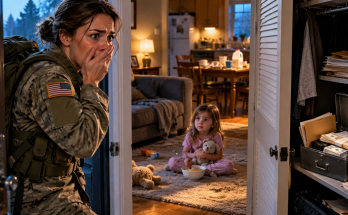
I saw Lily again on a Saturday afternoon in late June. The meeting took place at a quiet family center recommended by a professional who had been helping Jonathan arrange appropriate contact. Daniel and Vanessa agreed to the visit after several discussions about how to keep Lily away from the financial dispute. I arrived early, carrying a small bag of books and a photograph of Arthur that I hoped she might want. My hands were unsteady as I arranged the items on the table. I had imagined our reunion many times, but I did not know whether Lily would run toward me, remain shy, or ask why I had disappeared from her life.
She entered holding Daniel's hand. For a moment, she stood in the doorway, studying me with the serious expression she often wore when trying to understand something difficult. Then she released his hand and crossed the room quickly. I bent down as she reached me, and she threw her arms around my neck. I held her carefully, feeling the warmth of her cheek against mine. She smelled of soap and the faint sweetness of the strawberry shampoo Vanessa used for her hair. The familiar scent brought tears to my eyes. Lily pulled back and examined my face. "Grandma, where did you go?" she asked.
I told her I had been living in another home while the adults worked through some problems. She frowned. "Mommy said you wanted to leave." I took a breath. I did not want to accuse her parents in front of her, but I would not confirm something untrue. I said that I had not wanted to be away from her and that the reasons were complicated. What mattered was that I loved her and had been thinking about her every day. Lily considered this, then asked whether Grandpa would have been angry about the arguments. The question hurt more than I expected. I told her Arthur would have wanted everyone to treat one another with honesty and kindness, even when they disagreed.
Daniel remained near the doorway while a family-center staff member helped settle the visit. He looked uncomfortable, as though unsure whether to approach. I nodded to him but kept my attention on Lily. She opened the bag and discovered a book about mechanical clocks. Arthur had owned an older edition, and I found a similar one because I remembered how much she enjoyed his explanations. She turned the pages slowly, pointing to drawings of gears and springs. Then she looked up and said Grandpa had promised to show her how to repair a watch when she was older. I told her I remembered. My throat tightened, but I managed to smile.
We spent the next hour talking about school, her friends, and the small garden project her class had started. Lily showed me a drawing of a flower with a bright yellow center. She said it reminded her of the roses at Maple Avenue, though she knew roses did not usually have yellow centers. I told her drawings did not have to obey every rule of gardening. She laughed, and for a few minutes the room felt almost normal. I could hear Arthur's voice in my memory, gently teasing her about the way she insisted on knowing exactly how things worked. The grief remained, but Lily's presence gave it a softer shape.
Near the end of the visit, Lily asked whether the family would have to move. Daniel's shoulders tightened. I looked toward the staff member, who gently suggested that the adults could address housing questions separately. Lily persisted. She said people had been coming to the house and that her parents argued about money. I told her adults sometimes faced problems that made them worried, but those problems were not caused by children. I assured her that several people were working to make sure she was safe and cared for. I did not promise that everything would remain the same. I had learned how damaging false reassurance could be.
When the visit ended, Lily hugged me again and asked whether we could meet soon. I said I hoped so and would do everything appropriate to make that possible. Daniel waited until she was occupied with the staff member before approaching. He thanked me for coming. His voice was quiet. I told him Lily deserved regular contact with people who loved her, provided it could be arranged without conflict. He nodded. For a moment, we stood together in the awkward silence of people who had once known how to speak freely. Then he said he was continuing to cooperate with the investigation. I told him I was glad he was taking responsibility. I did not offer comfort beyond that.
On the drive home, I thought about Lily's questions. She was old enough to recognize fear and dishonesty but too young to understand the financial transactions that had changed her family. I worried that she might blame herself or imagine that speaking about the arguments would hurt her parents. Children often tried to protect adults in ways that adults failed to notice. I resolved to keep our conversations centered on her life rather than the dispute. She needed places where she could be a child, not another witness to the conflict.
Jonathan called the following Monday with news about the financial investigation. Rebecca Shaw had identified additional transfers suggesting that Graham's companies had used new financing to meet older obligations while continuing to present the redevelopment project as profitable. The findings were preliminary and required further analysis, but the pattern raised serious concerns. Some transactions lacked clear supporting documentation. Others involved related companies that appeared to receive substantial payments without providing corresponding services. I asked whether the money could be recovered. Jonathan said that depended on the legal status of the transactions, the location of assets, and the rights of creditors.
Daniel had supplied communications in which Graham repeatedly assured him that funds were available and that investors would soon be repaid. Some messages contradicted the accounting records. Jonathan said the evidence might support Daniel's claim that Graham misled him about the project's condition. At the same time, Daniel had knowingly made false representations about family assets and authorized questionable documents. The investigation would have to separate those issues. I found the distinction important. I did not want my son's genuine victimization, if established, to become an excuse for the harm he caused. Nor did I want his wrongdoing to prevent investigators from recognizing misconduct by Graham.
Rebecca later met with me to explain the broader financial picture in language I could understand. She drew a simple diagram showing Northline, Meridian, and several related companies. Money entered through loans and investor contributions. Some supported actual project expenses. Other amounts moved into affiliated entities, where their ultimate use was less clear. The structure made it difficult for outsiders to determine whether the redevelopment project possessed the resources Graham claimed. Rebecca emphasized that complex corporate arrangements were not inherently improper, but transparency and accurate reporting were essential. The problem arose when transactions were misrepresented or concealed.
I asked whether Arthur would have recognized the danger earlier than Daniel. Rebecca said his insistence on independent review was exactly what a cautious investor should have done. Arthur had asked for verified financial statements, ownership records, and clear documentation of liabilities. Those requests were ordinary safeguards, not evidence of distrust for its own sake. Hearing that confirmed something I already believed, but it also deepened my regret. I had urged Arthur to be more accommodating because I feared hurting Daniel's feelings. My husband had been protecting us from a risk he understood more clearly than I did.
That evening, I found an old photograph of Arthur standing in the garage beside an early prototype of the medication-safety device. The workbench was crowded with components, and he wore the same faded sweater he used for years. I remembered the frustration of those early experiments. Parts failed, designs needed revision, and months passed without certainty that the invention would work. Arthur never hid problems from himself. If a mechanism failed, he examined why and changed it. Daniel had grown up watching that process, yet he had learned a different lesson from his own business troubles. Instead of studying failure, he tried to borrow enough time to avoid admitting it.
My work on the assistance program continued. With guidance from experienced advisers, I began developing a plan for a small fund to support older adults facing financial exploitation or forced displacement. We discussed eligibility, safeguarding procedures, partnerships with legal-aid organizations, and the importance of independent oversight. I insisted that the program should not be named after me. If anything, I wanted it to honor Arthur's contribution to patient safety and his belief that practical problems deserved practical solutions. The advisers suggested establishing the structure carefully before announcing it publicly. I agreed. I had seen enough grand promises unsupported by sound administration.
The first possible partnership involved a nonprofit that already provided housing assistance to older residents. Its director, a woman named Elena Morales, met me for coffee and described the challenges her team faced. Many clients were not entirely without income. They had pensions, savings, or property interests, but relatives controlled access to those resources. Some were pressured to sign documents they did not understand. Others were threatened with abandonment if they refused to surrender money. I recognized my own experience in several examples, though I understood that each case was different. Elena said the most valuable assistance often began with restoring someone's ability to make independent choices.
I told her about my nursing career and my interest in combining temporary accommodation with reliable legal referrals. She asked thoughtful questions about governance and long-term funding. I appreciated that she did not flatter me because I had money. She wanted to know whether the program could function responsibly after the initial excitement passed. I thought of Arthur and smiled. He would have liked her. By the end of the meeting, we agreed to explore a limited partnership that could be evaluated before expanding. It was the first concrete step toward building something useful from resources I had never expected to possess.
Meanwhile, the dispute over Maple Avenue continued through the appropriate legal process. The bank had strengthened its position concerning title and unauthorized encumbrances, but questions remained about possession and certain personal property removed from the house. Jonathan said inventories and records were helping identify what belonged to the trust and what belonged to Daniel or Vanessa. He warned that recovery of some items might be difficult if they had already been sold or transferred. I told him the tools mattered to me more for sentimental reasons than financial value. Arthur's workbench had been part of our marriage. I wanted it preserved if possible.
Several missing items were located at a storage facility rented through a company connected to Northline. They included equipment from Arthur's garage, boxes of books, and several pieces of furniture. The bank arranged for the items to be secured while ownership was reviewed. I was relieved that they had not been destroyed. One box contained a set of small mechanical watches Arthur had been repairing. Jonathan sent me photographs. I recognized a silver pocket watch that belonged to Arthur's father. Its case was scratched, and the second hand had never worked properly. Arthur had intended to repair it for Lily when she was older.
I asked whether the watch could eventually be given to her. Jonathan said the ownership and estate arrangements would need to be respected, but he saw no reason we could not explore an appropriate gift once the property questions were resolved. I imagined Lily holding it and asking how the mechanism worked. Perhaps I could find someone who would teach her what Arthur had planned to teach. The thought brought a small measure of comfort. Not every connection to the past had to be preserved exactly as it was. Some could continue through new relationships and acts of care.
The investigation into Patricia Sloan also progressed. Jonathan said the notary's revised account was being evaluated alongside documents and communications from Graham's office. Her admission that I had not appeared personally was important, but questions remained about her knowledge and the extent of her participation. Richard Bell's records supported parts of her explanation while contradicting others. Investigators were examining whether the false authorization formed part of a broader pattern of defective paperwork. I asked whether other people might have been harmed by similar practices. Jonathan said that possibility was being considered, though he would not speculate without evidence.
I found the uncertainty unsettling. Until Arthur's death, I had imagined our family dispute as something contained within the walls of Maple Avenue. Now it involved lenders, investors, document preparers, and people whose savings or businesses might be affected. Graham's network seemed to reach farther than Daniel understood. I wondered how many others had trusted his confident promises. I also wondered whether some had recognized warning signs and ignored them because admitting the truth would be costly. The pattern was painfully familiar. Daniel had done the same. So, in smaller ways, had I.
One afternoon, I received a letter from Vanessa. It arrived through Jonathan rather than directly. Her handwriting was neat and controlled. She acknowledged that the situation had become serious and said she regretted the distress caused by my departure from Maple Avenue. She described herself as frightened by the possible collapse of the family business and claimed Graham had assured them the paperwork was proper. She did not explicitly acknowledge her role in pressuring me to sign the transfer. Instead, she wrote that emotions had been high after Arthur's death and that misunderstandings occurred. I felt anger rise as I read the word misunderstandings.
There had been no misunderstanding about the suitcase or the demand that I leave. Vanessa had labeled furniture, prepared documents, and told me she would not take responsibility for my life. She had known I was exhausted. She had coordinated with Daniel and Graham before the funeral. I did not need her to use dramatic language or condemn herself. I needed her to describe what she actually did. I told Jonathan I would not respond to a letter that minimized the facts. If Vanessa wished to correct her account, she could do so through appropriate channels and with specific acknowledgment of her actions.
A few days later, Lily sent me a drawing. It showed a house with red roses beneath the windows and three figures standing in the garden. One was labeled Grandma, another Lily, and the third Grandpa. Arthur's figure had a small yellow circle above his head. On the back, she wrote that she remembered him whenever she saw a clock. I sat at the kitchen table holding the paper until my eyes blurred. I did not know how to explain the strange mixture of happiness and sorrow that came from being remembered so tenderly. I placed the drawing beside Arthur's photograph in the bedroom.
The next meeting with Lily was easier. She arrived carrying a small notebook and asked whether I could tell her more about Grandpa's inventions. We spent an hour drawing gears and discussing how a safety mechanism could prevent mistakes. I avoided technical details beyond her understanding, but she listened carefully. She said she might want to become an engineer or a nurse. I told her she had plenty of time to decide and that curiosity would serve her well wherever she went. Daniel watched from a distance, and for a moment I saw regret cross his face as Lily laughed. I hoped he understood what he had nearly destroyed.
After the visit, Daniel approached me briefly. He said he had given investigators additional records concerning Graham's transfers and that Caroline believed the information might help clarify his own responsibility. He looked frightened, and I did not pretend otherwise. I told him that cooperating truthfully was the right thing to do regardless of the outcome. He asked whether I thought Arthur would ever have forgiven him. I took time before answering. I said Arthur loved him deeply, but love did not mean he would have ignored what happened. Forgiveness was not something Daniel could demand from a person who was no longer alive.
Daniel nodded and looked away. I wanted to place my hand on his shoulder as I had when he was young. I did not. The distance between us was painful but necessary. If I comforted him too quickly, he might hear it as reassurance that the consequences would disappear. I wanted him to understand that I remained his mother without becoming his shield. He thanked me for allowing the visit with Lily and left. I watched him walk toward the exit, shoulders hunched. He looked like a man finally feeling the weight of decisions he had avoided for years.
Later that week, Rebecca called Jonathan with an important development. Investigators had identified records suggesting that Graham moved money into an account controlled by an entity associated with a close relative shortly before the disputed transfer attempt involving my authorization. The timing and documentation raised questions about whether he was attempting to keep assets beyond the reach of creditors. The inquiry was continuing, and no final conclusion had been reached. Jonathan told me that Daniel's cooperation helped locate some of the records. I asked whether the money could be frozen or recovered. He said appropriate legal remedies were being evaluated.
The news intensified pressure on Graham's businesses. Rebecca explained that lenders were demanding accurate accounts and that some financial partners no longer accepted the projections previously supplied. Northline's ability to obtain new financing had become severely limited. Daniel and Vanessa faced the possibility of losing assets pledged under their personal guarantees. I worried about Lily, but Jonathan reminded me that we were exploring ways to support her welfare independently. I could help ensure a child had stability without paying debts incurred through misleading transactions. The boundary felt less cruel now that I understood why it mattered.
That night, I sat in the library and reviewed the plans for the assistance program. Elena Morales had sent preliminary recommendations about staffing and safeguarding. I made notes in the margins, thinking about how many people might need help recognizing coercion before signing documents. Education could be as important as emergency shelter. I wanted older adults to know they could ask questions, seek independent advice, and refuse pressure from relatives without surrendering their dignity. I thought of the night I signed the transfer papers and wished someone had been standing beside me, calmly explaining that I did not need to decide while exhausted and grieving.
Before bed, I received a message from Jonathan. He said the investigation had uncovered an additional document prepared shortly after Arthur's death. It appeared to be a draft agreement concerning my relocation and future financial management. Unlike the papers I had signed, this draft contained provisions that would have placed broad restrictions on my access to certain information and required Daniel's involvement in major decisions. Jonathan believed the document might reveal the longer-term plan behind my eviction. He wanted to review it with me the next morning.
I set down the telephone and looked toward the photograph of Arthur. For weeks, I had believed the goal was simply to obtain the house and secure a loan. Now it appeared that someone had considered extending control over my finances and decisions well beyond the immediate crisis. I wondered whether Daniel understood the full implications of the arrangement or whether he had been willing to sign whatever Graham placed before him. The question frightened me because it suggested the scheme was not merely an attempt to borrow against property. It might have been an attempt to make my independence temporary, conditional, and subject to my son's permission.