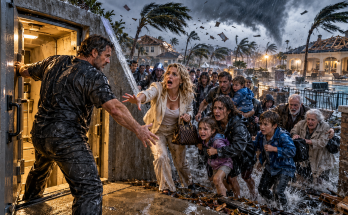
Denise Caldwell stood motionless when I told her she could enter. Rain ran from her hair down the collar of her ruined blouse, and one of her expensive shoes had disappeared somewhere along the flooded driveway. She seemed to expect another condition or accusation. I gave her neither. Instead, I pointed toward the entrance and told her to help the people behind her move quickly. Children needed to go first, followed by anyone elderly, injured, pregnant, or unable to descend the stairs without assistance. Richard Bell repeated the instructions to the crowd, his voice strained by the wind. Behind us, a pine tree bent so far that I could see its pale roots lifting slightly from the soaked ground.
The first families hurried through the gate with their heads lowered. A mother carried a toddler wrapped in a wet blanket, while her husband guided their older child by the shoulder. Two men helped an elderly resident move carefully down the protected stairs. A woman with an injured ankle leaned against Cynthia Lane, who had finally abandoned her architectural committee composure and was concentrating on keeping people upright. I watched each person pass through the entrance while Jason and another volunteer managed the interior count. The storm battered the workshop overhead. Rainwater streamed past the drainage channel, but the reinforced access structure remained stable.
Denise lingered near the gate until several families had gone ahead. She kept looking toward the driveway, apparently searching for residents who might still be approaching. I told her to continue downstairs and let the volunteers guide the remaining arrivals. She hesitated, then asked whether there was truly enough room. I answered that the shelter was certified for 132 occupants and that we were recording every entry. Her gaze shifted toward the stainless-steel ventilation tower behind the workshop. For an instant, she seemed to recognize it as something other than an architectural nuisance. Then another violent gust struck the trees, and I urged her inside.
Richard remained with me near the entrance while the final groups arrived. He looked exhausted, his face streaked with rain and grit. I asked how the crowd had gathered so quickly. He explained that families had first assembled at the clubhouse after realizing they could no longer evacuate safely. As conditions worsened, people had begun discussing whether the building could withstand the storm. Some had remembered my shelter, but Denise initially insisted the association had not approved its use. When part of her own house became unsafe and the clubhouse began showing signs of damage, the argument had ended. People had demanded a safe place to go.
I asked whether anyone had been left behind. Richard said he believed the remaining residents had either evacuated earlier, found secure shelter elsewhere, or already reached my property. He could not guarantee that nobody was still outside, and the uncertainty troubled us both. I told him we would keep the entrance available only while it was safe to do so. Once the wind reached the point where opening the doors endangered everyone inside, we would have to secure them. He nodded without arguing. The authority he had displayed at board meetings had been replaced by an awareness of circumstances neither of us could control.
For the next twenty minutes, we moved people through the entrance in an orderly but exhausting stream. Wet shoes squeaked against the concrete stairs. Children clung to parents, and adults struggled with bags that suddenly seemed far too heavy. Several residents carried emergency medication in plastic containers. A man brought a portable oxygen device, and we found him a suitable position away from crowded passageways. The two dogs already inside began barking when unfamiliar people entered, but their owner quickly settled them. The air smelled of damp fabric, sweat, and the metallic tang of the storm that had followed everyone underground.
Jason stood near the central hall with the clipboard, writing names as quickly as people could provide them. Megan helped younger children settle on the benches while carefully limiting her own movement. Nancy Palmer and another older resident distributed dry towels from a supply cabinet. The crowd's noise filled the rooms, echoing from the concrete walls. Every few seconds, someone asked a question about the weather or tried to reach a relative by telephone. I reminded people to keep the corridors open and directed anyone with urgent medical needs toward the area we had designated for assistance.
By the time the last group had entered, the final count stood at 120 neighbors, plus me. One hundred twenty-one people were now gathered inside Frank Holloway's underground shelter, leaving eleven places beneath the certified emergency occupancy limit. I checked Jason's figures twice because the margin was smaller than I would have preferred. The count included everyone who had entered, from infants to elderly residents. Space was tight, and some would need to sit shoulder to shoulder or rest on carefully arranged bedding. Nevertheless, the air system was functioning, the emergency routes remained unobstructed, and the essential supplies were accessible.
I looked at my watch. It was 4:14 p.m. The wind outside had become a continuous roar interrupted by sharp cracking sounds from the trees. I instructed the entrance volunteers to step back while I completed the final safety check. Through the security camera, I could see branches moving across the driveway like loose objects caught in a river. Nobody remained visible near the gate. I called into the main hall to confirm the count one last time, then closed the primary reinforced steel door and engaged its locking mechanism. The heavy seal settled into place with a dull mechanical sound.
For several moments, the shelter seemed almost quiet. The ventilation system maintained its steady hum, and the generator continued operating beneath the floor's faint vibration. People shifted into more comfortable positions, removing wet jackets and helping children settle. A few adults began speaking softly, their voices carrying through the hall. I checked the structural instruments and confirmed that everything remained within the expected range. Then I went to the radio station and adjusted the receiver to an emergency broadcast frequency. We needed reliable information about Simon's movement, especially now that our phones were becoming less useful.
Eight minutes after the main door closed, something enormous struck the ground above us. The sound was unlike ordinary thunder. It began with a violent crack, followed by a deep impact that traveled through the walls and floor. The entire shelter shuddered. Several people screamed, and a few children began crying immediately. A metal cup fell from a bench and rolled across the concrete. I steadied myself against the radio cabinet and looked toward the structural monitor. The readings fluctuated briefly before returning to normal. No critical alarm appeared.
Jason hurried over and asked what had happened. I told him a tree or another large object had probably fallen nearby, though I could not verify the source. He looked toward the ceiling as if the concrete might reveal what was happening above it. I reminded him that the structure had been engineered for precisely this kind of emergency. His expression eased slightly, but his hands remained clenched around the clipboard. I checked the camera feeds and found that one exterior view had gone dark. Another showed only a blurred patch of rain and moving debris. Whatever had fallen had either damaged equipment or blocked part of our view.
The noise unsettled everyone. A small boy asked whether the roof had broken, and his father struggled to answer. I crouched beside them and explained that the shelter walls and ceiling were made from reinforced concrete designed to resist severe forces. I did not promise that nothing else would happen. Instead, I told him we were monitoring the building and that the equipment showed no sign of structural failure. He listened with intense concentration before returning to his father's side. His father thanked me quietly, then looked away, blinking hard.
The emergency radio delivered the first reliable report of Simon's landfall. Powerful winds were striking the coastline, and flooding had begun affecting communities closer to the Atlantic. Officials warned of additional dangers within the hurricane's rainbands, including possible tornadoes. The announcer's voice remained measured, but the information was grave. I listened for updates affecting Wilmington and the surrounding inland region. The broader storm was still moving, and our exposure would continue for hours. The shelter had survived its first serious impact, but the most dangerous period was not necessarily behind us.
I explained the latest information to Jason and asked him to help communicate it calmly to the others. We agreed that frequent, factual updates would be better than allowing rumors to circulate through the crowded rooms. People needed to know what we knew, but they also needed to understand what remained uncertain. I told the residents that the shelter was operating normally and that we would remain inside until conditions improved enough for a safe assessment. Nobody objected. The sound above us was persuasive enough without additional warnings.
Denise sat near the entrance on a folding chair, her hands resting motionless in her lap. Someone had given her a dry towel, but she had not used it. Her eyes followed me as I passed, and for a moment I thought she might try to speak. Instead, she lowered her gaze toward the floor. Richard sat several feet away, helping an older resident arrange a blanket beneath his knees. Cynthia was near the children's area, distributing bottled water. None of them mentioned association rules, fines, or property standards. Their silence was striking after weeks of relentless correspondence.
The shelter's temperature began rising gradually as more than a hundred bodies generated heat in the confined space. I checked the ventilation settings and made a small adjustment within the system's rated operating range. Fresh air continued moving through the ducts. The carbon dioxide reading remained acceptable, though higher than it had been with fifty-eight occupants. I asked people not to block the vents with bags or bedding. Several residents moved their belongings immediately. Frank's meticulous labels, posted near the controls and equipment access points, made the procedures easier to follow under pressure.
As evening approached, Jason helped organize the first distribution of food and water. We could not treat the shelter as though every occupant had unlimited supplies, so portions needed to be sensible and waste kept low. Families with infants or special medical needs received attention first. The food itself was ordinary emergency fare, but people accepted it without complaint. A little girl offered part of her snack to another child who had dropped his. Nearby, Harold Palmer insisted he did not need a chair until Nancy told him, with the firmness of someone who had spent decades managing his stubbornness, that he was sitting down.
I moved through the central hall again and saw Megan sitting upright with her children beside her. She looked tired but alert. I asked whether she was comfortable and whether the baby was moving normally. She assured me that she was all right, though she admitted the constant noise had made her nervous. Jason returned with a bottle of water, and she took it from him with a small smile. Their daughter had begun drawing on the back of an old inventory sheet, using a pencil someone found in a supply drawer. Their son watched the page with complete seriousness, occasionally suggesting what she should add.
For the first time since the neighbors arrived, I allowed myself to sit. My legs ached from climbing stairs and carrying supplies. My shoulders were damp, and I realized I had not eaten since breakfast. I opened a packet of crackers and listened to the sounds around me. A hundred different lives had been compressed into the rooms Frank had built. Some residents knew one another well. Others had exchanged little more than greetings before that afternoon. They had different jobs, incomes, opinions, and histories with the association. Yet none of those distinctions had mattered when they crossed the shelter threshold.
I thought about the morning's confrontation. At 8:15, Denise had stood on my porch with a lawyer and contractor, insisting that the ventilation equipment be disconnected. She had spoken as though protecting Harbor Pines required removing anything that reminded residents of danger. By late afternoon, she had led frightened neighbors to the very facility she wanted disabled. The reversal would have been almost unbelievable if I had not witnessed every stage of it. Yet I felt little satisfaction. The situation had progressed too far for anyone to consider it a victory over a troublesome board president.
One of the older residents approached and thanked me for opening the shelter. He said his family had been unable to leave because traffic had stopped and the road behind them was flooding. He did not know what would have happened if the gate had remained locked. I told him I was relieved they had reached us safely. As he returned to his family, I noticed Denise watching from her chair. Her face had changed since the morning. She looked older, though perhaps it was only exhaustion and the absence of the polished confidence she usually wore so carefully.
A fresh burst of noise traveled through the concrete from somewhere overhead. This time it was a prolonged scraping sound followed by several smaller impacts. Conversations stopped. I checked the instruments again and confirmed that the structural readings remained stable. Jason came toward me, and I showed him the display. He nodded, but neither of us spoke until the sound faded. Outside, Simon continued tearing through Harbor Pines, and we had no way to see the full extent of the damage. Every unexplained noise reminded me that the surface world was changing while we sat protected beneath it.
A few residents began drifting into uneasy sleep. Others remained awake, listening to the radio or holding quiet conversations. I made another round of the rooms, checking that water supplies were secure and that nobody had accidentally blocked an exit. A nurse named Rebecca Hill identified herself and offered to help monitor residents with medical needs. I thanked her and showed her the first-aid supplies, emergency contact information, and available space where someone could lie down if necessary. Having a trained medical professional among us brought considerable reassurance, particularly because Megan was so close to the end of her pregnancy.
Rebecca spoke with the diabetic resident about his medication and checked on several elderly people who had arrived exhausted. She then visited Megan, asking routine questions and making sure she had a comfortable place to rest. Megan insisted she felt fine, but Rebecca advised her to report any pain, dizziness, bleeding, or unusual symptoms immediately. Jason remained close, his concern evident in the way he repeatedly checked whether Megan needed anything. I watched them for a moment and felt grateful that we had someone capable of recognizing medical problems before they became emergencies.
I returned to the equipment panel and checked the generator's operating history. The engine had run steadily since the neighborhood power failure, and the fuel level remained satisfactory. Battery backup was available if the generator stopped, but it would not sustain every system indefinitely. The ventilation equipment, lighting, communications, and essential monitoring instruments depended on careful management of our power supply. I inspected the panel for warning indicators and listened to the engine through the reinforced maintenance access. Its familiar rhythm was reassuring. I had heard it hundreds of times during routine tests, but never with so many lives depending on its continued operation.
Denise approached while I was recording the readings. She stopped a few feet away, holding the towel someone had given her. For once, she seemed uncertain how to begin a conversation. She asked whether the shelter was holding up. I told her the structure was sound and the systems were performing normally. Her gaze shifted toward the generator controls. She asked whether the machinery she had wanted disconnected was supplying the air everyone was breathing. I confirmed that it was. She stared at the panel for several seconds, then said she had not realized how completely the different systems depended on one another.
I could have explained that the engineering documents had made those relationships clear months earlier. Instead, I told her the ventilation system was an essential part of the shelter's operation, not an optional exterior improvement. She nodded slowly. There was no argument in her expression, only an uncomfortable recognition of something she could no longer dismiss. Before she could say more, Rebecca called from the central hall. Megan had begun experiencing abdominal pain, and Jason wanted assistance. I left Denise standing beside the equipment cabinet and hurried toward the medical area.
Megan was sitting forward on her cot, one hand pressed against her stomach. Her face had lost some color. Rebecca knelt beside her, asking when the pain had started and whether it came and went. Jason stood close enough to touch her shoulder, his eyes fixed on Rebecca's face. Megan was trying to remain calm, but the discomfort was clearly frightening her. At eight months pregnant, trapped underground during a major hurricane with no reliable way to reach a hospital, even a minor symptom carried consequences. Rebecca asked everyone nearby to give her room.
I checked the radio, hoping the county emergency frequency remained available, then returned to the group. Rebecca was assessing Megan carefully, trying to determine whether the contractions were caused by stress or represented the beginning of labor. Jason asked whether we could call an ambulance if necessary. I told him that we would try to contact emergency services, but I could not promise a vehicle could reach Harbor Pines in those conditions. He looked toward the sealed entrance, and I saw the possibility settle into his expression. Above us, the wind continued roaring.
Megan gripped Jason's hand as another wave of discomfort passed. Rebecca remained beside her, calm and attentive, but she did not offer reassurance before she had enough information. I brought additional blankets and ensured that the medical area had adequate light. Several residents nearby became quiet, aware that something serious might be developing. Denise stood at the edge of the hall, watching with her towel clutched against her chest. The storm had already forced her to confront the consequences of her decisions. Now the possibility of a medical emergency threatened to make those consequences painfully immediate.
For the next twenty minutes, we monitored Megan while Rebecca evaluated her symptoms. The discomfort eventually began to ease, and there were no signs that labor had begun. Rebecca explained that stress could produce contractions that did not lead to delivery, but she would continue watching Megan closely. Jason sat down beside his wife, exhausted by the fear he had been holding inside. Megan leaned against him and closed her eyes. Their daughter moved closer without speaking and placed her small hand over her mother's. I stepped away, relieved that we had escaped one emergency without creating another.
I had barely returned to the control area when a sharp alarm sounded from the generator panel. The warning cut through the shelter's ordinary noise, drawing every nearby face toward the mechanical corridor. A red indicator flashed beside the fuel-pressure gauge. I leaned closer, checked the reading, and felt my relief vanish. The pressure was falling, and the engine's rhythm had begun to change. Beyond the control room, 120 neighbors sat beneath the earth relying on the electricity, ventilation, and lighting that the generator helped sustain. I called Jason over and opened Frank's maintenance instructions. We had a limited battery reserve, a powerful hurricane overhead, and a fuel system that was beginning to fail. I took the spare filter from the emergency kit and told Jason we were going into the reinforced service chamber.