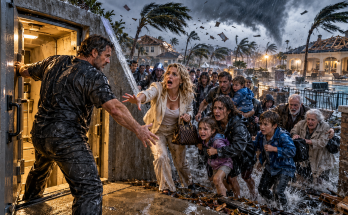
The final engineering report arrived eleven days after Hurricane Simon struck Harbor Pines. I was standing in the damaged workshop when Rachel Foster called to tell me the investigators had completed their examination of the generator's fuel system. Workers were replacing sections of the roof above me, and the sound of hammering made it difficult to hear her. I stepped outside, away from the debris, and asked her to repeat the finding. She said the contaminated fuel had not resulted from ordinary filter deterioration. Investigators had identified evidence of improper interference with the protected service equipment during the contractor's unauthorized visit.
I leaned against the surviving brick wall and looked toward the underground entrance. For nearly two weeks, I had been careful not to accuse anyone without proof. I had replayed the security footage, examined the damaged seal, and wondered whether my own maintenance had somehow overlooked a problem. Now the report established that someone had disturbed the fuel system after my last documented inspection. The exact sequence had been reconstructed through the physical evidence, contractor records, and statements obtained during the inquiry. Rachel told me the findings would have consequences, but she cautioned that the legal process was still developing.
Martin Kessler had admitted entering the protected service enclosure on the Thursday before the hurricane. He had been instructed to assess how the shelter could be made inoperable under the association's proposed enforcement plan. According to the investigation, he had interfered with the fuel-system inspection fitting during that unauthorized assessment and failed to restore the protective seal properly. The disturbed fitting allowed contamination to enter the fuel circuit. Investigators concluded that his actions were responsible for the abnormal material found in the filter I had removed during the storm.
The report did not establish that Denise had specifically instructed Kessler to contaminate the generator. She had authorized the visit and approved an enforcement objective that sought to disable the shelter, but the evidence distinguished those decisions from the contractor's direct interference with mechanical equipment. Kessler acknowledged that he had not been qualified to service the generator's fuel system and had not understood the full implications of disturbing the protected fitting. He described his actions as careless rather than malicious. The investigators documented that explanation without treating it as a justification.
I asked Rachel whether Kessler understood how close the generator had come to failing. She said he had been informed. The specialist's report explained that the contamination had restricted fuel flow under sustained emergency load, producing the pressure fluctuations Jason and I had observed. Had we not replaced the filter and restored stable fuel delivery, the engine might have stopped during the hurricane. The batteries could have maintained essential systems temporarily, but the shelter's long-term safety margin would have been severely reduced. With 121 people inside and both exits obstructed, that failure could have become life-threatening.
I stood beside the workshop for several minutes after the call. The repair crew continued working overhead, unaware of the conversation. I could smell fresh-cut timber and damp earth. Beyond the driveway, the fallen pine had been removed, leaving a broad scar in the ground where its roots had torn free. The scene reminded me of the night we entered the service chamber, when the generator's rhythm changed and Jason held the flashlight while I followed Frank's instructions. The danger had been real. It had also been avoidable.
Rachel explained that the findings would be referred to the appropriate authorities for consideration of any legal or regulatory action. The civil claims involving unauthorized entry, equipment damage, and association enforcement would proceed separately. She would not predict criminal charges or penalties before officials completed their work. I appreciated her restraint. I had no desire to turn the experience into a collection of dramatic accusations. I wanted an accurate account of what had happened, compensation for documented damage, and safeguards preventing a similar incident.
The association's position had weakened substantially by then. Denise had resigned as president, and Cynthia had stepped aside from the architectural committee. Richard remained temporarily involved in disaster recovery while an independent review of the board's actions was arranged. Homeowners demanded access to the records concerning the clubhouse, drainage vulnerabilities, contractor instructions, and enforcement campaign. The association's management company began compiling the documents under legal supervision. For the first time since the dispute began, I was not the one repeatedly asking officials to examine paperwork they preferred to ignore.
A week later, Rachel and I attended a formal meeting with representatives of the association's insurer and legal counsel. The discussion was practical rather than dramatic. We reviewed the unauthorized contractor visit, the disputed fines, and the proposed work that would have disabled the shelter. Rachel presented the original county certification, inspection history, and correspondence showing that I had repeatedly informed the board of the facility's legal and technical status. The association's representatives asked questions about the ventilation tower, generator, and emergency exits. This time, nobody suggested that the shelter's appearance mattered more than its function.
Negotiations continued through several sessions. Eventually, the association agreed to withdraw the penalties and release any related enforcement claims against my property. The accumulated fines, which had exceeded twenty-three thousand dollars before the storm, were canceled. The association also agreed to reimburse certain legal expenses and address documented losses arising from the unauthorized equipment interference, subject to the settlement terms and insurance arrangements. Separate storm damage remained an insurance matter. The settlement did not restore my workshop or repair the neighborhood, but it ended the attempt to force the shelter out of operation.
I insisted on one additional provision: the association would acknowledge the shelter's existing certification and could not attempt another deactivation through informal architectural enforcement. Any legitimate future safety concern would have to be reviewed through appropriate engineering and regulatory procedures. Rachel incorporated that requirement into the agreement. The association's counsel accepted it after several revisions. When I signed the final documents, I felt more exhausted than triumphant. The dispute had consumed months of my life, and the hurricane had given those months a significance I never wanted them to have.
The engineering investigation also led to a change in how contractors were authorized to work around emergency equipment. Harbor Pines adopted procedures requiring documented permission, qualified personnel, and appropriate regulatory review before anyone could inspect or alter protected mechanical systems on private property. That policy should never have required a disaster to inspire it. Nevertheless, I was relieved to see the requirement written clearly, without the vague language Denise had used to justify intrusion. A rule intended to protect safety was finally being developed with safety as its actual purpose.
Denise requested a private meeting several weeks after the settlement. Rachel advised me that I was under no obligation to accept, but I decided I wanted to hear what she had to say. We met at a small café outside Harbor Pines, where repairs and road closures still made travel inconvenient. Denise arrived without her usual polished appearance. Her hair was simply arranged, and she wore a plain cardigan over a blue blouse. She looked tired, though less frightened than she had inside the shelter. When she sat down, she placed both hands around her coffee cup.
She began by saying she had spent years confusing authority with responsibility. At first, I thought she was repeating the apology she had offered during the emergency. Then she explained that she had genuinely believed strict rules and careful presentation would protect the neighborhood's value. Every visible reminder of danger had seemed like a threat to the community she was supposed to represent. My shelter, with its steel ventilation tower and reinforced entrances, contradicted the image she wanted prospective buyers to see. Instead of examining why it existed, she had tried to make it disappear.
I asked whether she understood that the issue had never been property values alone. She nodded. She said the concealed drainage report and misleading clubhouse communications were the decisions she regretted most. Residents had relied on information that should have been clearer, and the storm had revealed the consequences. She admitted she had pressured Richard and Cynthia to support her enforcement strategy. She also acknowledged authorizing Kessler's preliminary access assessment without ensuring he possessed the qualifications or permission required to work near protected equipment.
When I asked about the fuel contamination, Denise looked down at her cup. She said she had not ordered Kessler to interfere with the generator, but she accepted responsibility for placing him in a position where he should never have been. She had treated the facility as an obstacle to be removed and assumed someone else would handle the technical consequences. Her words were not a complete answer to everything that had happened, but they matched the documented evidence. I told her that accountability meant more than acknowledging a mistake once the outcome became embarrassing.
She said she understood. She had resigned from the board, cooperated with investigators, and agreed to provide records that might expose her own failures. She did not ask me to withdraw any claims or conceal the findings. Then she looked up and said something I had not expected. She told me that when the storm destroyed part of her house, she had been certain she was going to die. The people around her were crying, and the clubhouse no longer felt safe. In that moment, she had remembered the shelter she had spent weeks trying to shut down.
Denise paused before continuing. She said she had feared I would refuse to open the gate when she arrived. She knew I had every reason to be angry, and she had imagined standing outside with frightened neighbors while I reminded her of everything she had done. Instead, I had told her to help the children and elderly residents enter first. She said she had thought about that moment every day since the hurricane. I listened without interrupting. The memory was still vivid to me: the wind bending the pines, rain striking the entrance, and a crowd of people waiting for protection.
I told her I had not opened the shelter because she deserved forgiveness. I opened it because the people outside needed help and because the structure had been built for that purpose. Her conduct had not changed the danger they faced. Refusing entry would have punished children, elderly residents, and families who had no responsibility for the board's decisions. Denise nodded slowly. She said that distinction was precisely what she had failed to understand. She had treated community membership as a matter of rules and compliance rather than mutual obligation.
I did not tell her everything was forgiven. Some of the harm was too serious to resolve over coffee. Residents had lost homes, faced dangerous evacuation conditions, and spent a terrifying night underground. The shelter's generator had nearly failed because an unauthorized contractor interfered with equipment he did not understand. Denise's decisions had contributed to those circumstances, even if she had not intended the final result. I told her that trust would have to be rebuilt through consistent behavior, not a single apology. She accepted that without argument.
When we left the café, Denise thanked me once more for saving her life. I told her the shelter had protected all of us and that many people had contributed to keeping it safe. She gave a small, tired smile. We parted without another promise. I did not know whether we would ever become friends, and I did not particularly need that outcome. What mattered was that she had stopped trying to justify the indefensible. For the first time, our disagreement had reached something resembling an honest conclusion.
Harbor Pines changed substantially during the months after Simon. Repairs continued through autumn, and some families remained displaced while insurance claims and construction work progressed. The association commissioned independent reviews of its drainage systems, evacuation routes, and emergency communications. The eastern culvert was redesigned and upgraded as part of a broader infrastructure project. Residents received clearer guidance about which buildings were suitable for sheltering and which were not. The clubhouse was repaired for its ordinary community functions, without being represented as a hardened hurricane refuge.
A new HOA board was elected after the independent review. Several members had been among the people sheltered underground during Simon. Their first priorities were practical: transparent records, infrastructure maintenance, emergency planning, and a fair process for resolving property disputes. The meetings were not always pleasant, and disagreements did not disappear. But homeowners were given access to engineering reports and meaningful opportunities to ask questions. I attended the early sessions, occasionally offering information about the shelter's maintenance and emergency systems. Nobody suggested that the ventilation tower should be hidden because it might concern potential buyers.
The county also approached me about establishing a formal cooperative arrangement for emergency use of the shelter. I agreed to explore the proposal, provided the building remained privately owned and managed according to its engineering limitations. Officials conducted another inspection, reviewed its maximum emergency occupancy, and helped develop a plan that distinguished emergency refuge capacity from long-term supply requirements. We established procedures for communication, registration, medical triage, and coordination with evacuation authorities. The goal was not to encourage people to remain in danger when safe evacuation was possible. It was to provide a reliable option when conditions made other routes unavailable.
I expanded the emergency supplies and improved the equipment redundancy with professional guidance. The damaged fuel-system components were replaced, and the generator received a comprehensive inspection. Additional protective measures were installed around the exhaust housing, although no engineer could guarantee that falling trees would never create another obstruction. We reviewed the secondary exit design and improved access for debris removal after severe weather. The ventilation tower remained in its original location behind the workshop, standing as a functional piece of equipment rather than a symbol of conflict.
The workshop took longer to restore. Much of the roof had to be replaced, and water had damaged tools and materials that Frank had left behind. During the repairs, I found an old wooden box containing spare labels, handwritten equipment notes, and a photograph of the shelter under construction. Frank stood beside a concrete form with two workers, his sleeves rolled above his elbows. The image showed the structure before the surrounding homes existed, when the property was mostly open land and trees. I placed the photograph beside the one I had saved from my office.
I wished Frank could have seen what happened during Simon. He had designed the shelter after experiencing the consequences of a hurricane through his family's losses. He knew that emergency structures were rarely appreciated until the moment they were needed. I imagined him inspecting the generator logs, questioning the damaged seal, and asking whether I had followed the maintenance procedure correctly. He would have cared more about the engineering lessons than about the newspaper attention. That thought made me smile for the first time while sorting through his old records.
Jason and Megan eventually returned to a repaired home. Their baby was born several weeks after the hurricane, healthy and strong. They named her Grace. Jason called me from the hospital, his voice shaking with joy, and asked whether I wanted to visit. When I arrived, Megan was sitting upright with the baby in her arms. Their older children stood beside the bed, eager to show me their new sister. Megan laughed when she remembered the night Rebecca had monitored her contractions underground. She said Grace had apparently decided that surviving a hurricane was enough excitement before making her entrance into the world.
I held the baby for a few minutes, careful to support her head. She was impossibly small, with dark hair and a serious expression that reminded me of Jason. Looking at her, I thought about how close the family had come to being stranded on a flooded road. I remembered Megan resting on the shelter cot while her children huddled beside her, and Jason struggling to conceal his fear. Now the room was bright with afternoon sunlight, and the danger felt distant enough for them to laugh about parts of it. The distance was a gift none of us took lightly.
Rebecca continued volunteering with community emergency preparedness programs. Her calm work inside the shelter had impressed county responders, and she helped develop training sessions for residents interested in basic first aid and emergency communication. Harold and Nancy Palmer became enthusiastic participants in neighborhood safety discussions. Nancy occasionally stopped by with food during the workshop repairs, insisting that I needed someone to make sure I ate properly. Harold helped organize a group of homeowners who checked on elderly residents before severe weather. Their efforts were modest, but they addressed needs that formal documents alone could not meet.
Richard Bell eventually resigned from the board after helping transfer records to the new leadership. He told me he regretted remaining silent when Denise dismissed the drainage assessment and the engineering certification. He had allowed his discomfort with confrontation to become an excuse for inaction. I respected that he acknowledged the failure rather than blaming Denise for everything. Cynthia also left her committee position and supported the new requirement for qualified review of safety-related structures. Their decisions could not undo the past, but they suggested that some lessons had been learned.
The investigation into Kessler's actions proceeded through the appropriate legal and regulatory channels. The findings established unauthorized interference with the fuel-system fitting and documented his failure to follow proper procedures. The resulting claims were addressed through the applicable processes, including compensation for verified equipment damage. I did not follow every hearing or administrative exchange. Rachel handled the legal details, and I focused on restoring the shelter. What mattered to me was that the record no longer treated the contamination as an unexplained mechanical accident.
The most important change, however, was less visible than a new culvert or revised HOA rule. Residents began speaking more openly about risk. They asked where they would go during evacuation orders, how to receive reliable emergency alerts, and what supplies their households should maintain. People who had once assumed modern houses and attractive landscaping guaranteed safety started making plans grounded in actual conditions. The neighborhood did not become fearful or obsessed with disaster. It became more realistic about the place where we lived.
Several months after the hurricane, the community held a gathering to thank the emergency responders, volunteers, and residents who had helped during the storm. The repaired clubhouse was not yet fully open, so the event took place outdoors on a clear afternoon. Families brought food, children ran across the grass, and neighbors who had barely known one another before Simon sat together sharing stories. Captain Hale attended, as did Laura Bennett and several members of the rescue team. Rebecca received particular recognition for her work with the medical needs inside the shelter.
I had hoped to remain near the back, but Jason persuaded me to stand with the volunteers. He gave a short speech about the night we spent underground, describing the fear, crowded rooms, and relief of hearing responders knock against the secondary hatch. He thanked the people who had helped his family and the families around them. Then he looked toward me and said the shelter existed because Frank Holloway had built it and because I had refused to let it fall into disrepair or be disabled. The audience applauded. I felt awkward standing there, but I understood what Jason wanted to acknowledge.
When it was my turn to speak, I did not prepare anything elaborate. I thanked the responders and the residents who had helped keep the shelter organized. I spoke about Frank and his belief that preparedness was an obligation to the future, not a prediction of disaster. I told the crowd that the structure had saved us because it was maintained, because its systems had backups, and because people followed procedures even when frightened. I also reminded them that the safest decision during a hurricane was not always to gather in one underground room. Early evacuation, reliable information, and proper planning remained essential.
I ended by saying that community standards should never become more important than community safety. No one needed a beautiful neighborhood badly enough to ignore flood risks, conceal engineering reports, or threaten a working emergency refuge. The lesson was not that every homeowner should build a shelter like Frank's. It was that people responsible for others had to respect evidence, admit uncertainty, and make decisions according to real dangers rather than appearances. When I finished, I stepped away from the microphone, relieved to return to the crowd.
Denise attended the gathering but did not seek attention. I saw her standing near the edge of the lawn, speaking with an elderly resident whose home had been badly damaged. She was no longer association president, and some neighbors remained angry with her. Others were willing to acknowledge that she had accepted responsibility and helped during recovery. I did not interfere with those judgments. People were entitled to decide for themselves what forgiveness meant. When Denise noticed me across the lawn, she gave a small nod. I returned it, and we continued with our separate conversations.
That evening, after the gathering ended, I drove home along streets that were beginning to look familiar again. New roofing shone above repaired houses, and young trees had been planted where enormous pines once stood. Some yards still bore scars from heavy equipment and floodwater. The neighborhood was recovering, but it would never be exactly as it had been before Simon. Neither would the people living there. We had seen how quickly ordinary confidence could collapse and how much responsibility depended on choices made long before a warning sounded.
I parked beside the restored workshop and walked toward the shelter entrance. The new protective housing reflected the last light of the evening. I unlocked the outer door and descended the concrete stairs, listening to the ventilation system begin its familiar quiet cycle. The central hall was empty. The benches had been cleaned, the supplies replenished, and the bedding returned to sealed storage. Nothing remained of the frightened crowd except the memory of their voices and a framed copy of the occupancy record hanging near the control room.
I stopped beside that record. One hundred twenty neighbors had entered during the hurricane. Every one of them had emerged alive. The number did not capture the fear, exhaustion, or hours spent listening to trees crash above us, but it represented something no engineering diagram could fully express. Behind every name was a household, a history, and a future that continued because a safe place had been available when other choices disappeared.
I completed my routine inspection before leaving. The generator started smoothly. Fuel pressure remained steady. Ventilation readings were normal, emergency batteries were fully charged, and both exits operated correctly. I recorded the date in Frank's maintenance log and closed the binder. For years, I had performed those tasks because they were sensible precautions. After Simon, each reading carried a more personal meaning. I knew exactly what could happen if a seal failed, an exhaust outlet became blocked, or someone treated the equipment as an inconvenience.
At the top of the stairs, I paused and looked back into the illuminated corridor. I remembered Denise standing outside in the storm, drenched and frightened, with dozens of neighbors waiting behind her. I remembered the moment I opened the gate and told everyone to come inside. That choice had not erased our conflict, and it had not made the aftermath easy. But it had ensured that the dispute would be settled by living people rather than by families mourning those left outside.
I closed the reinforced door and stepped into the evening air. Harbor Pines was quiet. Somewhere beyond the trees, children were laughing in a neighboring yard, and a car moved slowly along the repaired road. The storm shelter stood behind my workshop, plain and practical, exactly where Frank had intended it to remain. I no longer thought of it as merely the reason I had purchased the property. It was a promise that had been tested under terrible circumstances and kept.
And when I looked at the houses beyond my fence, I understood that the strongest thing we had preserved was not concrete, steel, or machinery. It was the willingness to protect one another even when pride, anger, and fear gave us reasons to turn away.
The End
Read more original stories on Feel Every Story.