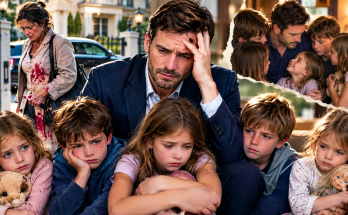
The morning Theo and his family were expected to arrive, I woke earlier than usual. I could hear rain touching the roof of the guesthouse, gentle at first and then stronger as the wind moved across the marshes. For several minutes, I remained in bed listening. I had imagined this visit so many times that the reality felt strangely uncertain. Hugo and Cheyenne were coming to Newport, and I would see them in person for the first time since the night Theo ordered me out of his home. I was excited, but I could not entirely silence the fear that our new understanding would vanish once the familiar demands of family life resumed.
I had prepared carefully without allowing myself to become exhausted. The guesthouse was tidy, and I had placed fresh flowers on the table. Nora helped me choose a few simple things the children might enjoy, including a small collection of local postcards and a book about birds found along the Oregon coast. I resisted the urge to prepare an elaborate meal. Theo and Khloe had arranged accommodation nearby and agreed to manage the children's meals and activities. We would spend time together, but I would not serve as a substitute parent throughout the visit. Repeating that distinction in my mind felt almost unnecessary until I remembered how easily I had once abandoned my plans whenever someone needed something.
Theo called shortly before noon to say they were approaching Newport. He sounded cheerful but slightly nervous. I told him Nora would meet them at the entrance and guide them toward the guesthouse. When the car finally appeared, I was standing beneath the small porch roof with my cardigan pulled close against the damp air. Hugo climbed out first. He looked taller than I remembered, and his hair had grown longer. For an instant, he stared at me as though checking that I was truly there. Then he ran forward. I bent carefully and held him close, feeling the familiar warmth of his arms around me.
Cheyenne followed almost immediately, carrying a small backpack decorated with bright patches. She threw her arms around my waist and began talking before I had finished greeting Hugo. She wanted to show me a drawing, tell me about her dance class, and ask whether the marshes really had birds with long legs. I laughed, overwhelmed by the sound of her voice. Theo approached more slowly. He hugged me gently, careful of my back, and I felt the tension in his shoulders. When he stepped away, his eyes were wet. Khloe stood beside the car, holding a bag and watching us. I went to greet her as well. We embraced briefly, awkwardly but sincerely.
Nora welcomed everyone with her usual warmth and helped them understand the layout of the property. Theo and Khloe had booked a nearby place to stay, so the luggage remained mostly in their car. We settled in the guesthouse for tea and snacks while the children explored the room. Hugo noticed Sebastian's photograph and asked whether Grandpa would have liked the marshes. The question caught me unprepared. I looked at the picture, remembering my husband's love of quiet places and gardening. I told Hugo that Sebastian would probably have spent hours watching the birds and trying to identify every plant. Hugo smiled and said he wanted to do that too.
The first afternoon passed gently. The rain stopped, and we walked a short distance along the path near Nora's property. I moved slowly, and the children adjusted their pace without complaint. Cheyenne kept pointing out things she wanted me to see: a cluster of flowers, a bird standing motionless in shallow water, and a small wooden bridge crossing a narrow channel. Hugo carried a notebook and tried to sketch what he saw. Theo walked beside me for part of the way, asking about my medical progress. I told him I was improving gradually but still needed to be cautious. He did not suggest walking farther. Instead, he asked whether I wanted to return to the guesthouse.
That question pleased me. In the past, I would have continued an activity rather than disappoint the children. Now I said I was ready to rest. Hugo protested briefly because he wanted to explore another section of the path. Theo explained that Grandma needed to stop and that they could return another day. He said it without irritation or embarrassment. Hugo accepted the decision after a moment. We walked back together, and I felt a quiet sense of relief. Perhaps the conversations we had shared over the previous months were beginning to appear in ordinary behavior.
That evening, Theo and Khloe took the children to dinner and invited Nora and me to join them. I accepted because I felt well enough and wanted the pleasure of sitting around a table without being responsible for preparing the food. We chose a casual restaurant near the waterfront. Hugo described everything he had seen that afternoon, while Cheyenne insisted that the birds had been watching us as carefully as we watched them. Theo laughed, and Khloe reminded her to eat before her food grew cold. The conversation was ordinary, occasionally chaotic, and deeply comforting. I had missed that kind of family noise more than I realized.
There were awkward moments. When the waiter brought the bill, I reached automatically toward my handbag. Theo noticed and gently touched my wrist. He said he and Khloe had invited us and would pay. I hesitated, embarrassed by how strong the habit had become. For years, I had often paid before anyone could object, partly because I wanted to help and partly because generosity made me feel secure in my place. This time, I allowed my son to handle the bill. It was a small reversal, but it carried meaning. Theo did not make a performance of paying. He simply treated the expense as his responsibility.
The next morning, we visited a small local exhibition. Cheyenne was fascinated by paintings of the coast, while Hugo wanted to know how the artists made water look transparent. I enjoyed answering questions when I could and admitting when I did not know. Khloe stayed near the children, helping them read the descriptions and keeping track of their belongings. I noticed how naturally she handled tasks I had once taken over without being asked. When Cheyenne became restless, Khloe suggested a break. She did not look toward me for approval or assistance. I felt unexpectedly grateful. The children were enjoying the visit, and I could participate without managing every detail.
After the exhibition, we returned to Nora's property for lunch. Theo and Khloe had picked up food on the way, and we ate together at the table overlooking the marshes. Hugo wanted to play a game afterward, and Cheyenne asked whether I could show her my watercolor supplies. I agreed to a short painting session, explaining that I would need to rest later. We spread paper across the table and painted the view through the window. Cheyenne worked quickly, covering the page with bright colors. Hugo concentrated on making the birds recognizable. I painted slowly, enjoying the quiet movements of their hands and the occasional arguments about which shade of blue was correct.
When the children finished, Theo offered to clear the table. I began gathering brushes out of habit, but he asked me to sit down. “You've already done enough,” he said. The words made me smile. He carried the supplies to the sink and helped the children put everything away. Khloe wiped the table and collected the scraps of paper. I watched them work together and realized how unfamiliar it felt to remain seated while others handled the cleanup. I had spent so many years anticipating what needed doing that I barely knew how to let a task remain someone else's. It took deliberate effort not to rise and help.
The first real difficulty came later that afternoon. Theo received a work-related call that required his attention. Khloe had arranged to speak with someone about an activity for the children and needed to step outside for a few minutes. Hugo and Cheyenne were still in the guesthouse, looking through the postcards Nora had given them. Without thinking, Khloe turned toward me and said she would only be a little while. The sentence was harmless on its surface, but I recognized the familiar assumption beneath it. The children were with me, so I would naturally supervise them while the adults attended to other matters.
I could have said nothing. The children were calm, and I was not physically uncomfortable. But the point of our new arrangement was not whether I could manage ten minutes on a particular afternoon. It was whether my willingness to spend time with the children would be treated as automatic responsibility. I looked at Khloe and asked how long she expected to be away. She said perhaps half an hour. I told her I had planned to rest shortly and would prefer that one parent remain available. My voice was polite, but I felt my heart begin to race. Even after months of practice, saying no directly to Khloe required effort.
Her expression changed. For an instant, I saw the irritation I remembered from Maple Oak. She glanced toward Theo, who was still speaking on the telephone, and then back at me. I could almost hear the argument beginning before either of us spoke: it was only half an hour, I was already sitting with the children, and surely a grandmother could manage such a small request. But Khloe stopped herself. She looked toward Hugo and Cheyenne, then asked whether I needed to lie down immediately. I told her I was tired and wanted to rest soon, but more importantly, we had agreed that the visit would not become an opportunity to leave childcare arrangements to me without discussion.
Khloe stood quietly for a moment. Then she nodded. She said she could postpone her conversation until Theo finished his call. I thanked her. The exchange lasted less than two minutes, yet afterward my hands felt unsteady. I had expected resistance and prepared myself to defend a boundary that should not require elaborate explanation. Instead, Khloe had accepted it. The children continued looking through postcards, unaware of the significance of the moment. I was glad. They deserved a visit free from another confrontation between adults.
When Theo finished his call, Khloe spoke with him quietly. I could not hear every word, and I made no attempt to listen. He came into the room a few minutes later and asked whether I wanted to rest. I said I did. He told the children Grandma needed some quiet time and suggested they explore a nearby shop with him and Khloe. Hugo asked whether I would join them later. I said perhaps, depending on how I felt. He accepted the uncertainty. They gathered their belongings, said goodbye, and left the guesthouse. I watched through the window as Theo helped Cheyenne into the car. The quiet that followed was not lonely. It was peaceful.
Nora found me sitting with my feet raised, a book open on my lap. She asked whether everything was all right. I described the conversation with Khloe. Nora listened, then said I had handled it calmly. I told her I had felt terrified, which made us both laugh. She reminded me that habits formed over years rarely disappear without occasional discomfort. I agreed. What mattered was not that nobody ever made an assumption again. What mattered was whether we could recognize it, correct it, and continue without turning every boundary into a personal rejection.
The family returned in the early evening with a small bag of pastries. Khloe came into the guesthouse carrying the bag and asked whether I had rested well. I told her I had. She hesitated, then said she wanted to apologize for assuming I would watch the children while she handled her own plans. She had not intended to pressure me, but she recognized that the request had touched the very issue we were trying to change. I thanked her. I did not need her to be perfect. I needed her to notice the pattern and respond differently. She seemed relieved when I said so.
Over dinner, the children told us about the shop they had visited and the postcards they had chosen. Hugo had picked one showing a lighthouse. Cheyenne had selected a painting of flowers near the sea. They wanted to send the postcards to friends when they returned home. I helped them write short messages, but when Cheyenne asked whether I could address every envelope, Khloe gently suggested that she do some of the work herself. I smiled. It was another small moment of responsibility finding its proper place. The evening passed without tension, and I went to bed tired in a pleasant way rather than exhausted.
On the third day, we spent time near the waterfront. I sat on a bench while the children explored a safe area with their parents. The air was cool, and the distant sound of water moving against the shore reminded me of the first evening Nora and I had eaten shrimp in Newport. I thought about how much had changed since then. When I arrived, I was grieving the loss of my relationship with Theo and uncertain whether I would ever see the grandchildren again. Now they were nearby, laughing with their parents, and I was able to enjoy their happiness without being responsible for producing it.
Theo sat beside me while Khloe took the children to look at a small display. He asked whether the visit was going well from my perspective. I appreciated that he wanted an honest answer. I told him it had been wonderful to see the children and that I was grateful he and Khloe were respecting my limits. Then I mentioned the brief difficulty the previous afternoon. Theo said Khloe had already told him about it. He acknowledged that they were still learning. “We got so used to thinking you'd be available,” he said, “that sometimes the old assumption appears before we notice.” I agreed. I was learning too. Sometimes I still wanted to volunteer for tasks that would leave me in pain.
He asked whether I could imagine visiting Maple Oak someday. I considered the question. The town held memories, friends, and places I still cared about. But returning to Theo's house would also bring back the scene at the dining table and years of routine responsibilities. I told him I might be willing eventually, but not until I felt confident that a visit would remain a visit. Theo said he understood and would not pressure me. Then he asked whether I missed the house Sebastian and I had owned. I said I missed it sometimes, but I had begun to appreciate living somewhere smaller. He looked toward the water and admitted he was still adjusting to the idea that the house belonged to another family.
We spoke about Daniel and Emily, the young couple who had purchased Maple Oak. Theo said he had felt embarrassed after going to the property and discovering strangers living there. He had expected to find me and had instead been forced to confront how much had changed. I told him the sale had been carefully considered and that I hoped the new owners would enjoy the house as Sebastian and I had. Theo nodded. Then he said he had begun to understand that loving a place did not give him the right to decide what should happen to it. I was glad he could say that without resentment. It suggested that his apology was becoming part of a broader change in how he understood my independence.
On the final evening of the visit, we gathered at Nora's house for a simple meal. The children were tired from their activities, and the adults were relaxed enough to talk about ordinary things. Nora told a story about a disastrous cake she had attempted years earlier. Theo remembered the incident and laughed until he had to wipe his eyes. I watched him with affection. For much of his life, my son had been funny, hardworking, and generous in ways that the conflict had temporarily obscured. I did not want to reduce him to his worst evening. But neither did I want to pretend that evening had never happened. Reconciliation required holding both truths together.
After dinner, Cheyenne asked whether she could speak with me alone for a moment. We sat near the window while the others cleared the table. She looked down at her hands and asked whether I had forgiven Daddy and Mommy. I was startled by the seriousness of her question. I told her that adults sometimes need time to repair relationships and that we were working toward being close again. She asked whether that meant everyone would stop arguing. I wished I could promise her that. Instead, I explained that disagreements happen in families, but people can learn to handle them with respect. I told her none of the arguments had been her responsibility.
Cheyenne leaned against me, and we sat quietly for a while. Then she said she liked Newport because I seemed happy there. The observation moved me deeply. I had worried that the children would see my move as abandonment. Yet Cheyenne had noticed something I was still learning to recognize in myself. I had become happier. Not because I loved my family less, but because my days now included rest, treatment, friendship, and interests of my own. I kissed the top of her head and told her I was glad she liked the place. She asked whether she could visit again. I said I hoped so, provided we made plans that worked for everyone.
The following morning, the family prepared to leave. Hugo carefully packed his postcards and notebook. Cheyenne insisted on carrying the painting she had made in the guesthouse. Theo checked the car, while Khloe made sure nothing had been left behind. I stood on the porch with Nora, watching them organize themselves. There was no expectation that I would finish packing or search for missing belongings. When everything was ready, the children hugged me tightly. Hugo said he wanted to send more letters. Cheyenne promised to paint another picture of the marshes when she got home.
Theo embraced me last. He thanked me for welcoming them and said he hoped the visit had not been too tiring. I told him it had been a pleasure because we had shared the responsibilities. Khloe hugged me as well and thanked me for giving everyone a chance to begin again. I told her I appreciated the effort she had made. There was still awkwardness between us, but it no longer felt impossible to imagine a respectful relationship. As the car pulled away, Hugo and Cheyenne waved through the rear window until the road curved out of sight. I remained on the porch for a long moment, feeling both the ache of goodbye and the comfort of knowing the visit had been real.
Later that afternoon, I received a message from Theo. He said the children were already discussing another trip and that he and Khloe had enjoyed seeing me. Then he added something unexpected. He asked whether, when I felt ready, we could talk about a more permanent arrangement for family visits—one that would allow the children to remain close to me without returning to the old expectations. I read the message carefully. The request was reasonable, but it would require us to consider difficult practical questions about distance, health, expenses, and time. I did not want to rush into promises. I wrote back that I would be willing to discuss it after we had all rested from the journey.
That evening, I sat beside the guesthouse window with Cheyenne's painting propped against a book. The colors were bright, the marsh grass uneven, and the birds wonderfully oversized. I smiled at the picture. The visit had not solved everything, but it had shown that change was possible when each person accepted responsibility for their own behavior. I had said no without losing the children. Khloe had corrected an assumption without turning it into an argument. Theo had helped manage the family instead of looking to me for every solution. Those were modest achievements, yet they mattered more than any dramatic declaration of forgiveness.
I went to bed feeling tired but peaceful. Before turning out the light, I checked my calendar. My medical appointments remained in place, and my watercolor class was scheduled for the following week. There was no need to move anything because the children had visited. My life had accommodated my family without disappearing beneath their needs. As I closed the calendar, I realized that the next challenge would be preserving that balance over years rather than days. A successful visit was encouraging. A lasting relationship would depend on what we chose to do when the excitement faded and ordinary responsibilities returned.