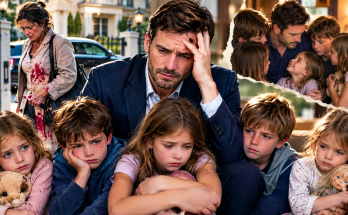
Part 1: The Boy in the Back Seat
At 4:37 on Sunday morning, I watched my nine-year-old son walk into our kitchen carrying two filthy sleeping bags and an orange parking warning from Walmart.
His name was Finn.
He was supposed to have spent the weekend at his best friend Owen’s house, just as he had nearly every Friday for the past two months.
Instead, he stood in front of me with dirt on his knees, red eyes, trembling hands, and a plastic grocery bag tied around one of his shoes.
“Mom, please don’t be mad.”
Those were his first words.
Not I’m tired.
Not I had a bad dream.
Not even Can I have breakfast?
He was afraid of me being angry.
I dropped the mug I was holding onto the counter.
“Finn, sweetheart, what happened?”
He glanced at the sleeping bags.
One was his navy-blue camping bag. The other was red, with the name OWEN written across the bottom in black marker.
“Where’s Owen?”
Finn lowered his head.
“He’s still there.”
“Where?”
“In the car.”
I stared at him, waiting for him to explain that this was some strange game the boys had invented.
But he didn’t smile.
He didn’t laugh.
He simply stood there, exhausted and terrified.
“Which car, Finn?”
“Wade’s old Buick. Behind Walmart.”
Wade Parker was Owen’s stepfather. He had married Owen’s mother, Beth, six months earlier. I had met him at their wedding and remembered him as a polite man who spoke confidently about family values.
Every Friday, I dropped Finn at their house.
Every Sunday, I collected him.
Sometimes Finn seemed unusually quiet. Sometimes he fell asleep before dinner. I had assumed the boys stayed up playing video games or watching movies beneath blankets.
I had never imagined that my son was hiding something from me.
“Finn, why were you sleeping in a car?”
His chin began to tremble.
“Because Owen isn’t allowed to sleep inside when his mom works nights.”
For several seconds, I couldn’t speak.
Beth was a nurse who frequently worked overnight shifts on Fridays and Saturdays.
“How long has this been happening?”
Finn rubbed his eyes.
“I don’t know. Eight weekends, maybe.”
Eight weekends.
For nearly two months, my child had been spending his nights in a parked car with another little boy.
I reached for the orange paper.
It was a warning that the vehicle could not remain in Walmart’s parking lot overnight and might be towed if it wasn’t moved.
“Why was Wade’s car at Walmart?”
“He brought us there last night. He said he had things to do.”
“And he left you?”
Finn nodded.
“Did he tell you when he’d come back?”
“He said we should stay quiet and not make trouble.”
I felt something cold spread through my chest.
“Where is Owen right now?”
“In the back seat.”
“Why didn’t he come home with you?”
Finn began crying.
“He said you might call the police. He thinks Wade will hurt him if he gets in trouble.”
I knelt and pulled my son into my arms.
“Finn, listen to me. You did nothing wrong.”
“But Owen said I should go home.”
“Why didn’t you?”
“Because he was scared.”
His little shoulders shook against mine.
“He told me the first time that he was fine. But he wasn’t fine, Mom. He was crying, and he didn’t want me to see. I couldn’t leave him.”
I closed my eyes.
My son had been trying to protect his best friend while believing that he might be punished for doing so.
I kissed his forehead, grabbed my keys, and told him to put on his coat.
“We’re going to get Owen.”
Before leaving, I called Beth.
She answered on the third attempt, sounding confused by the hour.
“April? Is everything okay?”
“No. Finn just came home. He says Owen has been sleeping in Wade’s car on the weekends.”
The silence on the other end was immediate.
“What?”
“I’m driving to Walmart. Finn says Wade left both boys there last night.”
“That’s impossible.”
“I wish it were.”
Then Beth said something that made my hands tighten around the steering wheel.
“April, Wade told me the boys were staying with you.”
I nearly missed the turn.
“What do you mean?”
“He said Owen was spending the weekend at your house. He told me Finn was going to his grandparents’ place, so the arrangements made sense.”
“Beth, I’ve been dropping Finn at your house every Friday.”
Neither of us spoke.
Then Beth whispered, “My God.”
When we pulled into Walmart’s nearly empty parking lot, I saw an old silver Buick parked near the far edge.
A small face watched us through the rear window.
Owen.
He was still there.
Part 2: What I Found in the Buick
I parked beside the Buick and stepped out.
The morning air was cold enough to make my breath visible. The parking lot lights flickered overhead, illuminating the sleeping bags scattered across the back seat.
Owen saw Finn and immediately sat up.
For one brief second, relief crossed his face.
Then fear replaced it.
He looked toward the store entrance, as if Wade might emerge at any moment.
I approached slowly and tapped on the window.
“Owen, sweetheart, it’s April. Can you unlock the door?”
He hesitated.
Finn ran forward.
“It’s okay! My mom knows!”
Owen’s eyes filled with tears.
“Did you tell her everything?”
Finn nodded.
Owen began shaking his head.
“No, no, no. You weren’t supposed to.”
I crouched beside the door so I wouldn’t tower over him.
“Owen, listen to me. Nobody is going to punish you for telling the truth.”
He stared at me through the glass.
“That’s what Wade says before he gets mad.”
Those words hurt more than anything else he could have said.
I kept my voice gentle.
“I’m not Wade. And you’re not in trouble.”
After a few seconds, the lock clicked.
I opened the door.
The smell inside was stale and unpleasant. There were empty water bottles on the floor, crushed snack wrappers beneath the seats, and a thin blanket covering the back bench.
Owen wore a sweatshirt far too light for the weather. His hair was tangled, and his eyes were swollen from crying.
I reached out my hand.
“Come with us, sweetheart.”
He looked at Finn.
“Can I?”
“Of course you can,” I answered.
He climbed out and immediately clung to Finn.
I wrapped my coat around both boys and called Beth.
“I’m with him. We’re taking him somewhere safe. Where are you?”
“I’m leaving the hospital now,” she said, crying so hard that her words broke apart. “April, please don’t let him out of your sight.”
“I won’t.”
I looked at Owen.
“Has Wade hurt you?”
The little boy went completely still.
Finn grabbed his hand.
“You can tell her,” he whispered.
Owen stared at the pavement.
“Sometimes he grabs my arm. Sometimes he locks the back door so I can’t come inside. He says I’m old enough to learn how to be tough.”
My stomach twisted.
“How often does that happen?”
“Whenever Mom works.”
“Does your mom know?”
He shook his head.
“He tells her I’m sleeping at Finn’s house. He says she worries too much, so I shouldn’t tell her things that will upset her.”
That explained the exhaustion, the fear, and the strange excuses Finn had made over the previous weeks.
But there was something else.
I noticed Owen was clutching a small, folded piece of paper.
“What do you have there?”
He immediately tried to hide it.
“It’s nothing.”
I didn’t reach for it.
“Okay. You don’t have to show me.”
He looked surprised.
Then, slowly, he unfolded it himself.
It was a list of dates written in a child’s handwriting.
Next to each date were short notes.
Friday. Cold.
Saturday. Mom working.
Friday. Wade angry.
Saturday. Don’t wake him.
At the bottom, Owen had written one sentence.
If Mom asks, I was sleeping at Finn’s house.
I turned away for a moment because I couldn’t bear for either boy to see my face.
Nine years old.
He had been keeping records of the nights he was forced to sleep outside because he was afraid nobody would believe him.
I photographed the note and the parking warning, then contacted the authorities. I explained that two children had been left overnight in a vehicle and that one child had described being denied safe shelter.
The dispatcher instructed me to stay with them until help arrived.
I didn’t hesitate.
We waited in my car with the heater running. Finn gave Owen his spare sweatshirt, and I found crackers and juice in the glove compartment.
Owen ate slowly, watching the road between every bite.
When the first patrol car arrived, he nearly dropped his drink.
I held his hand.
“You’re safe right now.”
He looked at me with an expression I would never forget.
“How long does safe last?”
I had no easy answer.
So I told him the truth.
“We’re going to work very hard to make sure it lasts.”
Part 3: The Mother Who Didn’t Know
Beth arrived twenty minutes later.
She ran across the parking lot before her car had fully settled into its parking space.
“Owen!”
He stood beside me, frozen.
Beth dropped to her knees and opened her arms.
For a moment, he didn’t move.
Then he ran to her.
She wrapped herself around him, crying into his hair.
“I’m sorry. I’m so sorry, baby.”
Owen clung to her coat.
“I didn’t want you to lose your job.”
Beth pulled back, confused.
“What?”
“Wade said if I told you, you’d have to quit nursing because you’d have to watch me all the time. He said you’d be angry that I made things difficult.”
Beth’s face crumpled.
“Oh, sweetheart. No.”
She held his cheeks between her hands.
“Nothing you could ever tell me would make me stop loving you. Nothing.”
The officers spoke with Beth and the boys separately, carefully documenting what each child remembered.
Beth told us that Wade had been controlling their household finances and had recently begun insisting that she leave all family arrangements to him.
Whenever she questioned him, he accused her of being overprotective.
He had convinced her that Owen was adjusting poorly to their marriage and that he needed firmer discipline.
But Beth had never agreed to make her son sleep outdoors.
She had never known about the Buick.
She had never given permission for either boy to be left alone in a parking lot.
“I trusted him,” she said quietly while Owen sat beside Finn in my car. “I thought he was helping me raise my son.”
“Trusting someone doesn’t make you responsible for their lies,” I told her. “What matters now is what you do with the truth.”
Beth wiped her face.
“I’m taking Owen home with me.”
One of the officers explained that the immediate priority was ensuring the children had a safe place to stay while the allegations were investigated. Beth cooperated fully and arranged for Owen to remain with her at a trusted relative’s home.
Wade, meanwhile, could not be reached.
He had apparently left the area after dropping the boys at Walmart.
Before leaving, Beth looked at me.
“Why didn’t Finn tell you?”
I glanced toward my son.
“He was afraid Owen would suffer if he did.”
Beth covered her mouth.
Two little boys had been carrying an adult’s secret because they believed protecting the adults was their responsibility.
That morning, I decided neither of them would have to do that again.
Part 4: The Phone Call at Noon
At noon, Wade finally called Beth.
She put the phone on speaker with an officer present.
His voice sounded irritated.
“Where are you? I’ve been trying to reach you.”
Beth stared at the phone.
“Where is my son supposed to have been sleeping last night?”
There was a pause.
“What are you talking about?”
“Don’t lie to me, Wade.”
He sighed theatrically.
“Beth, you’re exhausted. You’re not thinking clearly.”
“My nine-year-old son spent the night in your car in a Walmart parking lot.”
Another pause.
Then Wade laughed.
It was a short, dismissive sound.
“He told you that?”
Beth closed her eyes.
“Yes.”
“He was being difficult. I needed to teach him some responsibility.”
“You left him outside.”
“He had blankets. He was fine.”
“He was terrified!”
“You’re making this into something it isn’t. Boys need discipline.”
Beth’s voice became steady.
“No. Boys need parents who keep them safe.”
Wade began raising his voice.
“You’re going to destroy this marriage over a misunderstanding?”
She looked at Owen, who was sitting beside Finn at the kitchen table of her sister’s house. He had been given a warm meal and clean clothes, but he still startled whenever a car door slammed outside.
“This isn’t a misunderstanding,” she said. “You lied to me. You lied about where my son was sleeping. You used another child to keep your secret.”
Wade’s tone changed.
“Listen carefully. If you tell the police lies about me, you’ll regret it.”
The officer ended the call and documented the threat.
Beth sat very still.
For six months, Wade had told her that he was the only person who could hold their family together.
Now she understood what he meant.
He wanted to control the information, the decisions, and even the story her son was allowed to tell.
That afternoon, Beth contacted a lawyer and began the process of separating from Wade. She also cooperated with the authorities as they investigated the children’s accounts and the evidence collected from the car.
There would be interviews, reports, and difficult conversations ahead.
But Wade’s version of events would no longer be the only version anyone heard.
Part 5: The Secret Finn Had Been Carrying
That evening, after Owen had gone to bed in a proper room at his aunt’s house, Finn sat beside me on our sofa.
He had barely spoken since breakfast.
I wrapped a blanket around him.
“Can I ask you something?”
He nodded.
“Why didn’t you tell me the first weekend?”
He stared at his fingers.
“Owen said his mom was already sad because Wade got angry a lot. He said if she found out, she’d cry.”
“And the second weekend?”
“He said Wade would tell everyone I was lying.”
I swallowed.
“And the third?”
Finn’s eyes filled.
“By then, Mom, I had already lied to you. I told you we played games all night.”
He looked at me as though he expected me to be furious.
“I thought you’d stop letting me see him. Then he’d be alone.”
I pulled him close.
“Finn, I need you to understand something. You were trying to help your friend. But this was too big for you to handle by yourself.”
“I’m sorry.”
“You don’t need to apologize for being scared.”
“But I lied.”
I took a breath.
“Yes, you did. And we will talk about honesty. But I also know why you were afraid. When someone makes a child believe that telling the truth will hurt the people he loves, that is a heavy burden.”
He began crying.
“I didn’t know what else to do.”
I held him until his breathing slowed.
Then I said something I wished every child could hear.
“You can always tell me when something feels wrong. Even if you’ve made a mistake. Even if someone tells you not to. Even if you’re worried I’ll be angry. My job is to help you, not make you carry everything alone.”
Finn rested his head against my shoulder.
“Can Owen come over next weekend?”
I smiled through my tears.
“If his mom says it’s okay and the arrangements are safe, absolutely.”
He was quiet for a moment.
“Can we sleep inside?”
I kissed his hair.
“Every single night.”
Part 6: What the Investigation Revealed
The weeks that followed were difficult.
Owen received support from professionals trained to speak with children who had experienced frightening situations. Beth attended appointments with him and made sure he understood that he had done nothing wrong.
The authorities continued investigating the allegations against Wade.
The parking warning, the children’s accounts, the dates Owen had recorded, and other information helped investigators establish a clearer timeline. Beth also provided messages in which Wade had falsely described the boys’ weekend arrangements.
Some of those messages contradicted his explanation that the children had been staying at my house.
Other evidence raised questions about how often he had left the boys unsupervised and whether he had deliberately concealed their whereabouts.
I did not try to conduct my own investigation. I answered questions honestly, preserved the information I had, and let the appropriate professionals handle the case.
Beth moved out of the home she had shared with Wade and stayed with her sister while she worked through the legal and practical arrangements.
She also began to understand how gradually the deception had developed.
At first, Wade had simply offered to handle things.
He took over school pickups, household bills, and weekend schedules. He told Beth she was too tired from nursing to worry about small details.
When she asked questions, he accused her of not trusting him.
When Owen became quiet, Wade said the boy was being manipulative.
When Beth noticed that her son seemed exhausted on Sunday mornings, Wade blamed video games.
Every explanation had sounded plausible in isolation.
Together, they formed a pattern that Beth could no longer ignore.
One evening, she called me.
“I keep thinking about how many chances I had to notice,” she said.
“You were given a story that was designed to keep you from asking questions.”
“But I’m his mother.”
“And you’re taking steps to protect him now.”
She was silent.
Then she whispered, “I don’t know how to make him feel safe again.”
“You don’t have to repair everything in one day,” I said. “Just keep showing him that your words match your actions.”
That became her focus.
She kept promises, answered Owen’s questions honestly, and allowed him to talk about what had happened without pressuring him to forgive anyone.
She never told him to be brave for her.
She told him he was allowed to be a child.
Part 7: The First Friday Without Fear
Three weeks after that terrible Sunday morning, Owen came to our house for dinner.
Beth brought him herself.
He stood on the front step with a small backpack and glanced toward the driveway.
“No Buick,” he said quietly.
“No Buick,” I agreed.
Finn opened the door before either of us could knock.
“Owen! Come on! I saved you the good controller!”
For the first time since I had met him, Owen laughed without immediately looking over his shoulder.
They played video games until dinner, argued about whose turn it was to choose the game, and complained when I told them to wash their hands.
Ordinary things.
Beautiful things.
At bedtime, I found them sitting on the floor beside the sofa, talking in whispers.
“What are you two doing?” I asked.
Finn held up two sleeping bags.
His blue one.
Owen’s red one.
“We were just looking at them.”
I sat beside them.
Owen ran his fingers over the writing on his bag.
“Can I get a new one?”
“Of course,” I said.
He hesitated.
“Can we throw these away?”
Finn looked at him.
“But they helped us stay together.”
Owen thought about that.
“They also remind me of the car.”
I understood.
We didn’t have to decide immediately. We could keep the bags, replace them, or donate them. The choice was theirs to make when they were ready.
That night, we stored them in the garage while the boys chose new blankets for their next camping adventure.
There would be no secret trips to a parking lot.
No pretending a car was a bedroom.
No nine-year-old trying to decide whether his friend mattered more than his own safety.
Just two boys learning that friendship did not require them to face danger alone.
Part 8: The Letter
Several months later, Beth told me that Owen had written a letter for Finn.
He wanted to give it to him privately.
They sat together at our kitchen table on a quiet Saturday afternoon while I made hot chocolate.
Owen unfolded a sheet of paper.
“Dear Finn,” he began.
“Thank you for not leaving me alone when I was scared. I know you wanted to tell your mom, and I know I asked you not to. I’m sorry I made you feel like you had to keep a secret.”
He paused, struggling with the next sentence.
Finn waited patiently.
Owen continued.
“I thought if anyone knew what was happening, everything would get worse. I thought my mom might stop loving me if I caused problems. But she told me that I wasn’t the problem.”
His voice became quieter.
“You helped me understand that I can tell the truth even when I’m afraid. You were my best friend when I needed one the most.”
He folded the letter.
Finn’s eyes were wet.
“You’re still my best friend.”
Owen smiled.
“I know.”
Finn hugged him.
I turned away, pretending to check the oven because I didn’t want to embarrass them with my tears.
They were only nine years old.
They should have been writing stories about superheroes, building cardboard forts, and arguing over which ice cream flavor was best.
Instead, they had learned lessons about fear and responsibility that no child should have to learn so young.
But they had also learned something else.
They had learned that adults could listen.
That telling the truth could lead to protection rather than punishment.
And that asking for help did not mean betraying someone you loved.
Part 9: The Sunday Morning That Changed Everything
A year later, I woke early on a Sunday and found Finn sitting at the kitchen table.
He was drawing a picture.
“What are you making?” I asked.
He turned the paper toward me.
It showed two children standing beside a small house. A yellow sun filled the sky, and a dog was running across the yard.
Above the house, he had written:
A SAFE PLACE IS WHERE YOU CAN TELL THE TRUTH.
I sat beside him.
“That’s a wonderful picture.”
He smiled.
“Owen helped me think of the words.”
I looked at the drawing for a long time.
I still remembered 4:37 that morning. I remembered the dirty sleeping bags, the orange warning notice, and my son’s terrified voice asking me not to be angry.
For months, I had replayed those first moments, wondering how I had missed the signs.
But I had finally learned that the most important moment wasn’t when the boys had been left in the car.
It wasn’t when Owen had written his list of dates.
It wasn’t even when Beth discovered that her husband had lied to her.
It was the moment Finn walked through our kitchen door and decided that, despite his fear, he would tell me what had happened.
He had trusted me enough to bring the truth home.
And my responsibility was to make sure that trust was never wasted.
I hung his picture on the refrigerator.
Then I made pancakes.
Owen arrived a little later with Beth, carrying a board game and a bag of apples. The boys argued about the rules before the first pancake had finished cooking.
Beth laughed.
I laughed.
For a moment, our kitchen sounded exactly as a kitchen with children should sound: noisy, imperfect, and full of life.
The sleeping bags were gone.
The Buick was gone from their lives.
The secret had lost its power.
There were still hard days ahead. Healing did not erase what had happened, and none of us pretended that everything could be fixed by a happy ending.
But Owen could sleep through the night again.
Beth could work without wondering whether the person she trusted was telling her the truth.
Finn could be a nine-year-old boy instead of a little guardian carrying another child’s fear.
And every Sunday morning, when I heard small feet running down the hallway, I felt grateful for the ordinary sound.
Because I knew what it meant.
The children were home.
They were safe.
And they no longer had to be brave alone.
THE END