PART 1 — THE NIGHT MY FAMILY TURNED AGAINST ME
My name is Rachel Doyle. I was thirty-two years old when my parents decided that I no longer deserved a place in their home.
It happened on Christmas Eve.
The temperature outside had fallen to twenty-two degrees Fahrenheit, and snow was beginning to collect along the edges of the driveway. Inside the house where I had grown up, the Christmas tree glowed in the living room, presents sat beneath its branches, and the smell of cinnamon drifted from the kitchen.
Everything looked warm and welcoming.
Everything except the faces of my family.
For seven months, I had been living with my parents after a relationship I believed would last forever ended in a painful breakup. I had lost the apartment I shared with my former partner, drained much of my savings covering the expenses of our separation, and found myself starting over at an age when I thought I would already have my life figured out.
Moving back home had been humiliating enough.
I promised myself it would be temporary.
I found two part-time jobs, paid for my own groceries, washed my own clothes, and contributed whenever I could. I repaired a leaking pipe beneath the kitchen sink, repainted the backyard fence, and drove my mother to medical appointments when she couldn’t use her car.
I never asked my parents for spending money.
I never demanded special treatment.
Most importantly, I never complained when my father made comments about how people my age should already own their homes.
I told myself that he was simply worried about me.
That Christmas Eve, I was folding laundry in my bedroom when my mother called from downstairs.
“Rachel, come to the kitchen. Your father wants to speak with you.”
Something in her voice made my stomach tighten.
When I entered the kitchen, my father sat at the table with his arms crossed. My mother stood beside the counter, staring at a cup of tea. My younger sister, Vanessa, leaned against the refrigerator, scrolling through her phone.
A sheet of paper lay in front of my father’s chair.
“Sit down,” he said.
I pulled out a chair.
“What’s wrong?”
He pushed the paper toward me.
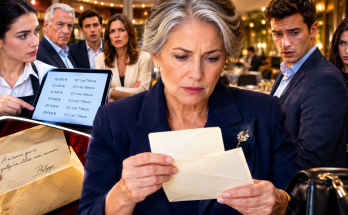
It contained a list of expenses: electricity, water, heating, internet, groceries, and various household costs. Beside each category was an amount. At the bottom, someone had written a total exceeding four thousand dollars.
I stared at it.
“What is this?”
“A calculation,” my father replied. “We’ve been discussing how much it costs to have you living here.”
“I buy my own groceries.”
“You’re still using the kitchen.”
“I pay for my phone. I do my own laundry. I even paid for the parts to repair the sink.”
He waved his hand dismissively.
“That’s not the point.”
“Then what is the point?”
His expression hardened.
“The point is that you’re thirty-two years old, Rachel. You’re not a child. We shouldn’t have to support you.”
My face grew hot.
“I never asked you to support me forever. I told you I needed a few months to get back on my feet.”
“Seven months,” Vanessa interjected without looking up. “That’s a long time.”
I turned toward her.
“You told me I could stay until I found a place.”
“Things change,” she replied with a shrug.
I looked at my mother, waiting for her to remind them that I had been doing everything I could.
She remained silent.
My father stood.
“We’re done enabling you.”
I didn’t understand what he meant until he walked to the hall closet and returned carrying a small travel bag.
The zipper was closed.
The bag was already packed.
He placed it on the table.
I looked inside. There were three shirts, two pairs of trousers, a sweater, my toothbrush, and my phone charger.
My hands began to tremble.
“You packed my things?”
“You can collect the rest later.”
“When?”
“After Christmas. We’ll arrange something.”
I stood up.
“I’m going upstairs. I need my medication, my laptop, my winter coat, and the rest of my clothes.”
My father stepped in front of me.
“No.”
I thought I had misunderstood.
“What do you mean, no?”
“You heard me. You’re leaving tonight.”
“Dad, it’s freezing outside.”
“Then you should have thought about your situation before it came to this.”
I looked at my mother.
“Please. Tell him this is ridiculous.”
She finally raised her eyes.
For one brief second, I thought she might help me.
Instead, she said, “Rachel, you need to learn that the world doesn’t owe you anything.”
“I know that. I’m working two jobs. I’m trying to save money. What else do you want from me?”
“You always have an excuse,” she answered.
Vanessa slipped her phone into her pocket.
“Honestly, Rachel, you make everything so dramatic.”
I looked at my sister, then at my father, then at the woman who had given birth to me.
I suddenly understood that this conversation had never been about four thousand dollars.
They had already made their decision.
My father held out the bag.
“Take it and go.”
I wanted to scream. I wanted to remind them of every time I had helped them, every time I had swallowed an insult, and every time I had told myself that family would never deliberately hurt me.
Instead, I took the bag.
I walked toward the front door, hoping someone would stop me.
Nobody did.
When I stepped outside, the cold struck my face so sharply that my eyes watered. I hurried to my car, threw the bag onto the passenger seat, and turned the heater to its highest setting.
Behind me, the front door closed.
Then I heard the lock turn.
I sat motionless in the driveway.
The house where I had celebrated birthdays, opened Christmas presents, and learned to ride a bicycle had become a place where I was no longer welcome.
My phone showed twenty-two dollars in my checking account.
My next paycheck was several days away.
I had no apartment, nowhere to sleep, and only the clothes in the bag beside me.
I opened my contacts and scrolled to my friend Simone’s number.
She had invited me to spend Christmas Eve with her family, but I had declined because I didn’t want to make my difficult circumstances the center of someone else’s holiday.
I could call her now.
I could explain everything.
But shame held my fingers still.
I imagined telling her that my parents had thrown me out. I imagined the pity in her voice, the questions I couldn’t answer, and the embarrassment of arriving at her door with a single bag.
So I put the phone down.
For almost an hour, I sat in the driveway, unable to make myself leave.
Then I remembered something.
My grandfather’s bank card.
Three years earlier, shortly before he died, Grandpa Owen had called me into his study. He was a quiet man who rarely discussed money, but that afternoon he seemed unusually serious.
He placed a bank card in my hand.
“Keep this somewhere safe, Rachel.”
“What is it?”
“Something I want you to have.”
“How much money is on it?”
He smiled faintly.
“That isn’t the important question.”
I turned the card over.
“When should I use it?”
“When you genuinely need it. Not when you want something expensive. Not when you’re trying to impress somebody. When you find yourself in a situation you cannot manage alone.”
He had written a few words on a small envelope.
For the day you really need it.
I had never used the card.
I kept it behind my driver’s license, believing it might be connected to a modest emergency fund. I had never asked my parents about it because Grandpa had specifically told me to keep it private until I needed it.
Now, sitting in the freezing driveway, I realized I had reached that day.
The bank was closed for Christmas Eve.
I started my car and drove to a diner that stayed open all night.
I ordered the cheapest coffee on the menu and sat beside a window, watching snow gather on the pavement. Every time the door opened, cold air swept across the floor.
Families passed outside carrying wrapped presents. Couples laughed beneath streetlights. Somewhere, children were opening gifts.
I was thirty-two years old, and I was spending Christmas Eve trying to keep warm in a diner because my own parents had decided I was a burden.
I didn’t cry until nearly midnight.
Then I took Grandpa’s card from my wallet and held it between my fingers.
“I hope you knew what you were doing,” I whispered.
For the first time that night, I felt that I wasn’t entirely alone.
PART 2 — THE ACCOUNT MY GRANDFATHER HID FROM EVERYONE
At nine the next morning, I walked into the bank.
I hadn’t slept. My eyes were swollen, my hair was tangled, and the clothes I’d worn the previous evening were creased from hours in a diner booth.
A bank manager named Arthur approached me.
“Good morning. How can I help you?”
I handed him the card.
“My grandfather gave me this before he died. I was told to keep it until I really needed it. I’ve never used it, and I don’t know what account it’s connected to.”
Arthur examined the card and asked for identification.
He typed information into his computer.
At first, his expression was ordinary. Then he stopped typing.
He checked something else.
Then he asked me to confirm my date of birth.
“Is there a problem?” I asked.
“Not necessarily. I just need to verify a few details.”
He disappeared into an office and returned several minutes later.
“Ms. Doyle, would you mind sitting down?”
My stomach tightened.
“Is the account closed?”
“No.”
“Is there a debt attached to it?”
“No. Quite the opposite.”
He turned his monitor toward me.
The number on the screen made no sense.
$473,000.
I stared at it.
Then I counted the digits.
“That’s not possible.”
Arthur checked the account again.
“It is correct.”
I shook my head.
“My grandfather wasn’t wealthy. He owned a small house and worked as a mechanic for most of his life.”
Arthur explained that the account had been established in my name when I was fifteen. My grandfather had made regular deposits over the years, and the funds had accumulated interest. His final contribution had been made approximately six weeks before his death.
I covered my mouth.
All those years, I had imagined the card might contain a few hundred dollars.
Instead, my grandfather had quietly built a financial foundation that could change my life.
“Am I really allowed to use it?” I asked.
“The account records identify you as the sole owner. We’ll verify the documentation and make sure everything is in order before you make any transfers.”
I felt tears gathering in my eyes.
Grandpa had known that life could become difficult. He had prepared for a future he would never live to see.
But Arthur wasn’t finished.
“There is another matter in the account records that you should know about.”
He explained that, approximately two years after my grandfather’s death, someone had visited the bank asking questions about the account.
The visitor had not been authorized to access it, so the bank had refused to provide confidential information.
“Who was it?”
Arthur consulted the record.
“Your father, Mr. Doyle.”
The room seemed to grow smaller.
“My father came here?”
“According to the record, yes. He asked about an account associated with your grandfather’s estate. Our staff did not disclose the balance or provide access.”
I couldn’t speak.
My father had known there was something Grandpa had left behind.
He had tried to find out what it was.
And he had never told me.
Suddenly, the events of the previous evening began connecting in my mind.
The expense list.
The accusations about my dependence.
The bag packed before I had even been called downstairs.
The way my father had blocked the staircase.
Had he thrown me out because he believed I had access to money and wanted to force me into a desperate situation?
Had he hoped that I would eventually tell him about the card?
Or had the inquiry been unrelated to what happened on Christmas Eve?
I couldn’t know.
I refused to turn suspicion into certainty without evidence.
But one fact was clear: my father had investigated an account connected to my grandfather, and he had never mentioned it.
Arthur advised me to take my time before making any major financial decisions.
I reviewed the account documents, verified my identity, and arranged for secure access to the funds. I also confirmed that nobody else was authorized to withdraw money.
I didn’t purchase a luxury car.
I didn’t call my parents to announce that I was suddenly wealthy.
I didn’t even leave the bank feeling triumphant.
I felt grief.
My grandfather had given me something precious, and the first time I truly needed help, the discovery arrived after my own family had abandoned me.
I walked outside and called Simone.
She answered immediately.
“Rachel? Where have you been? I’ve been calling you since last night!”
I tried to explain what had happened.
I made it through the first few sentences before my voice broke.
Simone was silent for a moment.
Then she said, “Where are you right now?”
“Outside the bank.”
“Stay there. I’m coming.”
“You don’t have to—”
“Rachel, I’m coming.”
Forty minutes later, she pulled into the parking lot and rushed toward me. She wrapped her arms around me before I could say another word.
I began crying against her shoulder.
“I’m sorry,” I whispered. “I didn’t want to ruin your Christmas.”
She pulled back and looked at me.
“You spent the night in a diner because you were afraid to ask me for help?”
I lowered my eyes.
“Rachel, you are not an inconvenience.”
Those five words hurt more than I expected.
Because I had spent seven months trying to prove to my parents that I wasn’t a burden.
And my friend had offered me more kindness in a single sentence than they had shown me in months.
That afternoon, Simone took me to her home. Her family made room for me at the dinner table, and nobody asked me to justify my existence.
For the first time in a long while, I could eat without feeling that every bite was being counted against me.
I didn’t tell them about the $473,000.
The money was mine, and I wanted time to understand what it meant.
That night, as I lay in the guest room, I thought about Grandpa Owen.
I remembered his hands, rough from decades of work. I remembered how he always listened before giving advice. I remembered the way he used to slip me a little money for books and insist that I never tell my father because he wanted it to remain my gift.
He had understood something about our family that I had been unwilling to see.
Love could be generous.
But generosity could also become a weapon when it came with humiliation, control, or expectations.
Grandpa had given me security without asking me to surrender my independence.
My parents had offered me shelter and made me feel that I owed them my dignity in exchange.
I finally understood the difference.
PART 3 — THE HOUSE I BUILT FOR MYSELF
During the following week, I began rebuilding my life.
I contacted a landlord and found a small apartment on the other side of town. It had one bedroom, a narrow kitchen, and windows that looked toward a row of old maple trees.
The carpets were worn.
The bathroom needed new fixtures.
The kitchen cabinets were painted an unpleasant shade of yellow.
I loved it immediately.
Nobody else had a key.
Nobody could walk into my room and tell me that I was wasting space.
Nobody could decide that I had become too expensive to keep around.
I signed the lease and used a portion of my savings to furnish the place. I purchased a mattress, a table, a secondhand sofa, and a few basic kitchen supplies.
I kept working both jobs.
I met with a financial adviser and developed a plan to protect my inheritance. I paid off the small debts that had accumulated during my breakup, established an emergency fund, and set aside money for future housing and retirement.
The adviser warned me against making decisions simply because I was hurt or frightened.
That advice proved valuable.
I could have bought an expensive house immediately. I could have quit both jobs and spent months trying to decide what to do with my life.
Instead, I chose stability.
I wanted to know that whatever happened next, I would never again remain in a harmful situation simply because I had nowhere else to go.
My parents did not call during the first few days.
Neither did Vanessa.
I wondered whether they were relieved that I was gone.
Perhaps the house was quieter without me. Perhaps they believed they had finally forced me to grow up.
I stopped trying to guess.
A week after Christmas, I received a message from my mother.
Your father says you have somewhere to stay. We need to discuss when you will collect your things.
I replied that I would arrange a time and asked them to place my belongings in boxes.
Her response arrived almost immediately.
You don’t need to behave like a stranger. We are still your family.
I read the message several times.
Then I typed a reply.
Family doesn’t have to agree about everything. But family shouldn’t make someone stand outside in freezing weather with nowhere to sleep.
She didn’t respond.
Two days later, my father called.
“Your mother says you’re upset.”
“Of course I’m upset.”
“We all said things we didn’t mean.”
I closed my eyes.
“Did you mean to throw me out?”
He sighed impatiently.
“Rachel, this is exactly what I’m talking about. You take everything personally.”
“You packed a bag before you called me downstairs.”
“We were trying to make a point.”
“What point?”
“That you can’t rely on us forever.”
I looked around my apartment.
There were still boxes beside the sofa, and I hadn’t yet hung the curtains. A small lamp cast a circle of light across the kitchen counter.
“I don’t rely on you anymore,” I said.
He went quiet.
Then he asked a question I hadn’t expected.
“Have you contacted anyone about Grandpa’s estate?”
My heart began beating faster.
“What do you mean?”
“Your grandfather left certain arrangements. We need to make sure everything has been handled properly.”
I remembered Arthur’s words.
My father had visited the bank years earlier.
Now, barely a week after throwing me out, he wanted to discuss Grandpa’s arrangements.
“Why are you asking me?”
“Because I’m your father.”
That answer no longer meant what it once had.
I told him that any financial matters concerning me would be handled privately and through the appropriate professionals.
He sounded offended.
“You think we’re trying to take something from you?”
“I didn’t say that.”
“You’re treating us like criminals.”
“No. I’m asking for privacy.”
He ended the call.
I sat on the sofa for a long time afterward.
I didn’t know whether my father wanted money, information, or simply control over a situation he couldn’t understand.
But I finally accepted that I didn’t need to discover his every hidden motive before I could protect myself.
I could set boundaries based on what had actually happened.
That was enough.
PART 4 — THE QUESTIONS MY FATHER COULDN’T ANSWER
In February, my parents invited me to dinner.
The message came from my mother, who said she wanted us to “put the past behind us.”
I almost declined.
Then I decided I wanted to speak to them once, face-to-face, without the confusion and shock that had surrounded Christmas Eve.
I arrived at their house shortly before seven.
The Christmas decorations were gone. The living room looked exactly as it had when I left, except for the empty space where the tree had stood.
My mother hugged me briefly.
My father nodded toward the dining room.
Vanessa was already seated.
Dinner was polite at first. We discussed work, the weather, and a cousin who had recently moved to another state.
Nobody mentioned Christmas Eve.
Finally, my father put down his fork.
“Your mother and I think it’s time we clear the air.”
I waited.
“We were worried about you,” he continued. “You had no stable relationship, no permanent home, and no real plan. We thought you needed a wake-up call.”
“You could have told me you wanted me to move out.”
“We did tell you.”
“No. You gave me a bag and put me outside at night.”
He frowned.
“You were being dramatic.”
I looked at him steadily.
“I had twenty-two dollars in my account. I had nowhere to sleep. You knew it was freezing.”
My mother lowered her head.
Vanessa shifted in her chair.
My father crossed his arms.
“You’re thirty-two. You should have been able to handle it.”
“I did handle it.”
“Then what’s the problem?”
“The problem is that you deliberately made a difficult situation more dangerous because you wanted to teach me a lesson.”
Nobody spoke.
Then I asked him about the bank.
I told him what Arthur had explained, including the date of the inquiry.
My father’s face changed.
Only for a moment, but I saw it.
“That was years ago,” he said.
“Why did you go?”
“I wanted to know whether your grandfather had left anything that required our attention.”
“Did the bank tell you anything?”
“No.”
“Did you ever tell me you had visited?”
He shook his head.
“Because there was nothing to tell.”
I took a slow breath.
“Then why are you so interested in Grandpa’s arrangements now?”
My father looked toward my mother.
She appeared genuinely confused.
“Rachel, what are you talking about?” she asked.
I explained what I had learned.
My mother turned toward my father.
“You went to the bank?”
“It was a long time ago.”
“Why didn’t you tell me?”
He ignored her question.
Instead, he looked at me.
“How much did he leave you?”
There it was.
Not a question about whether I was safe.
Not an apology for what happened.
Not even a question about how I had survived that night.
The first thing he wanted to know was the amount.
I could have told him.
I could have watched his expression change as he learned the number.
But I didn’t owe him that information.
“My finances are private,” I said.
He pushed his chair back.
“After everything we’ve done for you, you think you can sit here and keep secrets from your own family?”
I stared at him.
“After everything you’ve done for me?”
“Your mother and I gave you a roof over your head.”
“And I contributed to the household. I worked. I bought my own food. I helped with repairs. I never asked you to fund my life.”
“We gave you a place to stay when you had nowhere else to go.”
“Yes,” I replied. “And I’m grateful that I had a roof for those seven months. But gratitude doesn’t mean I have to accept being humiliated.”
My mother began crying.
In the past, her tears would have made me abandon my argument and comfort her.
This time, I stayed where I was.
I could feel compassion for her without pretending that nothing had happened.
My father pointed toward the door.
“If you’re going to accuse us of terrible things, perhaps you shouldn’t come here.”
I stood.
“That’s fine.”
He seemed surprised.
I continued, “I didn’t come here to punish you. I came because I wanted to know whether you understood what you did.”
He said nothing.
“I don’t need you to give me money. I don’t need you to pay my rent. I don’t even need you to agree with every decision I make.”
I looked at my mother.
“But I needed my parents to treat me like a human being when I was struggling.”
My voice shook, but I kept speaking.
“You told me I couldn’t take care of myself. You made sure I had nowhere to go. And when I finally found a way forward, you became interested in what Grandpa had left me.”
I paused.
“That is why I can’t pretend everything is normal.”
My father looked away.
My mother wiped her eyes.
Vanessa stared at the table.
Nobody offered an explanation that changed what had happened.
So I collected my coat and left.
This time, I walked to my car without hoping someone would stop me.
PART 5 — THE LETTER GRANDPA LEFT BEHIND
Three months later, I received a letter from an attorney who had handled some of my grandfather’s affairs.
The envelope was ordinary, and the contents were brief.
The attorney explained that an old file had recently been reviewed during a routine records check. Among the documents was a letter Grandpa Owen had asked him to retain for me.
The letter had been written shortly before Grandpa’s death.
I read it alone in my apartment.
My dear Rachel,
If you are reading this, I am probably no longer around to answer your questions. I wish I could have stayed longer, but life rarely gives us the time we think we have.
You have always been more capable than you believe. I have watched you work hard to make people happy, even when they do not make the same effort for you.
I want you to understand something important. Helping someone is not the same as controlling them. Giving someone a place to stay is not permission to humiliate them. And loving someone does not mean they must surrender their choices.
The money I saved for you is meant to give you options. It is not a prize, and it is not a debt. You do not owe me repayment. You do not owe anyone an explanation for using it wisely.
If life becomes difficult, do not mistake the person who makes you feel small for the person who can make you strong.
You already possess that strength.
Build a life in which kindness is welcomed, but cruelty is not required as the price of belonging.
With all my love,
Grandpa Owen.
I read the letter three times.
Then I folded it carefully and placed it in the drawer beside my bed.
For years, I had believed that being a good daughter meant enduring whatever my parents said because they were my parents.
I had mistaken silence for maturity.
I had mistaken constant forgiveness for love.
I had mistaken the fear of losing my family for proof that I needed them more than they needed me.
Grandpa’s letter didn’t make me hate my parents.
It made me understand that I could love them and still choose distance.
It also made me realize that the money wasn’t the greatest gift he had left me.
The greatest gift was the freedom to decide what kind of life I wanted.
I continued working, but I eventually reduced my hours at the second job. I enrolled in a professional course I had postponed for years and began applying for better positions.
I volunteered twice a month at a community organization that helped people facing housing insecurity.
The first time I met a woman who had been forced to leave her family home, she sat across from me with her hands folded tightly in her lap.
“I’m embarrassed,” she whispered. “I’m forty years old. I should have figured things out by now.”
I recognized the expression on her face.
I recognized the belief that needing help meant she had failed.
I leaned forward.
“You’re allowed to need help. That doesn’t make you a failure.”
She looked at me, and her shoulders slowly relaxed.
In that moment, I understood why Grandpa had wanted me to have choices.
Security wasn’t simply about avoiding hardship.
It was about being able to face hardship without believing you deserved to suffer.
PART 6 — WHEN THEY FINALLY NEEDED ME
By the following autumn, my life had changed in ways I couldn’t have imagined the previous Christmas.
I had a better job, a growing savings account, and a comfortable routine. I moved into a slightly larger apartment and adopted a rescue cat named Oliver.
I still missed my grandfather.
I still felt sadness when I remembered the Christmas Eve that had changed my relationship with my family.
But I no longer woke up wondering whether my parents thought I was a disappointment.
I was building a life I could respect.
Then, one rainy Thursday afternoon, my mother called.
I almost let it go to voicemail.
Something in her voice made me answer.
“Rachel?”
“Hi, Mom.”
She sounded tired.
“Your father has been having some financial difficulties.”
I sat down.
“What kind of difficulties?”
She explained that several expenses had accumulated after an unexpected home repair and a change in my father’s work situation. They were struggling to cover everything at once.
“We were hoping you might be able to help us temporarily,” she said.
I closed my eyes.
The irony was painful.
The same parents who had accused me of being a financial drain were now asking for assistance.
For a moment, I felt the old reflex return.
I could solve this. I had enough money to help. I could transfer the amount they needed and avoid another argument.
But I remembered Grandpa’s letter.
Helping someone was not the same as surrendering your boundaries.
“What are you asking me to do?” I said.
My mother hesitated.
“We need help with some bills.”
“How much?”
She told me the amount.
It was affordable.
I could have paid it without threatening my own security.
But I had learned that the important question wasn’t simply whether I could afford to help.
It was whether helping would place me back inside the same pattern of guilt, control, and resentment.
“Mom, I need to be clear about something.”
She fell silent.
“I can consider helping with a specific emergency. But I won’t become responsible for your household finances, and I won’t accept being insulted if I say no to something.”
Her voice grew defensive.
“Rachel, we’re your parents.”
“I know.”
“After everything we’ve done for you—”
I felt a familiar ache, but I didn’t retreat.
“Mom, I remember everything you’ve done for me. I also remember Christmas Eve.”
She began to cry.
I waited until she could speak again.
“I’m not saying I will never help you,” I continued. “I’m saying we have to be honest about what happened. I can’t pretend you didn’t throw me out when I was struggling.”
“We were wrong,” she whispered.
The words were so unexpected that I didn’t immediately respond.
“What?”
“We were wrong to send you away like that.”
I held the phone more tightly.
“Does Dad agree?”
She hesitated.
“He hasn’t said it in those words.”
I felt disappointment, but not surprise.
“Then I think we still have more to discuss.”
I told her I would review the specific bills and decide what I could reasonably contribute, without making any promises beyond that.
When the call ended, I sat quietly for several minutes.
I had imagined this moment many times.
Sometimes I imagined refusing them everything. Sometimes I imagined helping them immediately and proving that I was a better person than they had been.
Neither fantasy had prepared me for the real thing.
The real thing was more complicated.
I didn’t want revenge.
I wanted a relationship that could exist without fear.
If my parents were genuinely prepared to acknowledge the harm they had caused, perhaps something could be rebuilt.
But I would not purchase their affection with my inheritance.
After reviewing the situation, I decided to help with one essential repair, paying the contractor directly rather than transferring money without any clear arrangement.
It was a choice I made freely.
It wasn’t a payment for forgiveness.
It wasn’t permission to return to the old relationship.
And it wasn’t a promise that I would always rescue them.
When my father later called to thank me, his voice sounded uncomfortable.
“I appreciate what you did,” he said.
“You’re welcome.”
There was a pause.
Then he added, “Your grandfather would have wanted you to help family.”
I looked toward the drawer where I kept Grandpa’s letter.
“Grandpa wanted me to be kind,” I replied. “He also wanted me to stand on my own feet.”
My father didn’t answer.
For once, I didn’t try to fill the silence.
PART 7 — THE CHRISTMAS I FINALLY UNDERSTOOD
The following Christmas Eve, I decorated my apartment with a small tree and strings of warm white lights.
Oliver slept beneath the coffee table while snow drifted past the windows.
Simone arrived carrying a dish of roasted vegetables, followed by two friends who had nowhere else they wanted to be that evening.
We cooked together, exchanged inexpensive gifts, and laughed over a disastrous attempt at making gingerbread cookies.
Nobody kept a list of what everyone had contributed.
Nobody suggested that a person who needed help was a burden.
At eight o’clock, my phone buzzed.
It was a message from my mother.
We hope you have a peaceful Christmas, Rachel. Your father and I are thinking of you.
I read it, then put the phone down.
I didn’t know what the future of our relationship would be.
My mother had acknowledged some of the damage, but rebuilding trust would require more than a single apology. My father still struggled to admit that his actions had hurt me. Vanessa and I had barely spoken.
I no longer needed to force a resolution simply because the calendar said it was Christmas.
I could leave the door open to reconciliation without walking back into a situation that had hurt me.
Later that evening, after my friends had gone home, I sat beside the tree and opened Grandpa’s letter again.
I thought about the frightened woman who had sat in a diner booth the previous year, convinced that asking for help would make her pathetic.
I wished I could reach back through time and tell her something.
I would tell her that being abandoned doesn’t mean you are unworthy of love.
I would tell her that the people who reject you do not get to define your future.
I would tell her that independence is not about never needing another person. It’s about being able to choose relationships in which help and kindness flow both ways.
Most of all, I would tell her that she didn’t have to earn the right to be treated with dignity.
I had spent years trying to convince my parents that I was capable.
I had worked harder, apologized faster, and swallowed more hurt than I should have.
But the lesson I learned on that freezing Christmas Eve wasn’t that I needed to become more impressive.
It was that I needed to stop allowing other people to determine my worth.
The money my grandfather left me gave me practical freedom.
His letter gave me something deeper.
Permission to build a life without begging anyone to approve of it.
I folded the letter and returned it to the drawer.
Then I turned off the living room lights, leaving only the Christmas tree glowing in the darkness.
Outside, the temperature was falling.
Inside, I was warm.
My home was quiet, peaceful, and entirely mine.
And for the first time in my life, I understood that family wasn’t simply the place where you began.
It was also the people who made room for you when life became difficult.
Sometimes those people were relatives.
Sometimes they were friends.
And sometimes, after years of waiting for someone else to protect you, you finally learned how to protect yourself.
THE END.