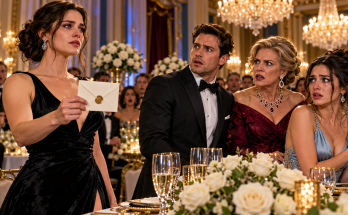
The ballroom fell silent with surprising speed. A few guests continued speaking near the windows, unaware that the music had stopped, but even those conversations faded when Cassidy introduced herself. She stood beneath the chandeliers in her pale blue gown, one hand resting against the microphone stand. From the doorway, I could see the front tables clearly. Helen Carlisle sat with her fingers folded around a champagne flute. Two of Grant's colleagues leaned toward each other, confused. Patricia stood near the stage steps, her expression so rigid that she scarcely appeared to breathe. Cassidy looked across the room and began again, more slowly.
“My name is Cassidy Monroe,” she said. “Many of you were invited here to meet someone named Vanessa. I need to explain that Vanessa is not a real person.” A murmur moved through the tables. Cassidy waited for it to subside. “I'm an actress. I agreed to portray a wealthy woman as part of a private arrangement intended to examine someone's behavior. I understand that my involvement was deceptive, and I'm not asking anyone to excuse it. But I cannot allow this evening to continue while people are being told that I possess a family fortune, a powerful investor father, or a pregnancy that does not exist.”
For a moment, no one seemed to know how to react. Then several guests began speaking at once. A woman near the stage asked whether Cassidy was joking. Someone at the back laughed uncertainly, waiting for an explanation that would turn the announcement into entertainment. Cassidy shook her head. “This isn't a performance. My actual name is Cassidy Monroe. I don't come from the family you've been told about, and I'm not carrying Grant Whitmore's child.” Her voice remained steady, though I could see her knuckles whiten around the microphone.
Patricia rushed toward the stage. “That's enough,” she said loudly. Her voice carried through the speakers because Cassidy had not moved away from the microphone. Several guests turned toward her. Patricia climbed the short steps, reached for the stand, and demanded that Cassidy stop speaking. Cassidy stepped aside, allowing her to approach without resistance. “Ladies and gentlemen,” Patricia began, forcing a smile, “we've encountered an unfortunate personal misunderstanding. There's no need for anyone to become concerned. Please continue enjoying the evening.” The words sounded absurd against Cassidy's confession.
A man seated near the front raised his hand. I recognized him as Martin Keller, a senior executive from Grant's company. He stood without waiting to be acknowledged. “Patricia, are you saying Vanessa isn't the person we've been introduced to?” Patricia hesitated. “Her circumstances are more complicated than we understood.” Martin looked toward Cassidy. “Does she have any connection to the investment group Grant mentioned?” Cassidy answered before Patricia could speak. “No. I have no authority to represent any investment company, and I never provided verified credentials for such a role.” Martin's expression hardened.
Grant appeared beside me at the ballroom entrance. He stopped when he heard Martin's question. For several weeks, he had been talking about Vanessa's connections as though they guaranteed a promotion. Now one of the men whose approval he valued most was discovering the truth. I watched Grant's shoulders tighten. He looked toward the stage, then toward the tables occupied by colleagues and clients. The confidence he had displayed earlier was gone. He seemed suddenly uncertain where to stand.
Cassidy continued. “I understand some guests may have been told that my father could arrange business opportunities. Those claims are false. No such investor is involved. I have never promised anyone a job, financing, or a business introduction.” Martin remained standing. “Grant told me he'd been speaking with Vanessa's family about a major real-estate partnership.” Cassidy shook her head. “I don't know what Grant told you. I can only say that no such partnership existed through me.” Martin sat down slowly, his face expressionless.
Patricia attempted to regain control. “Grant was exploring possibilities,” she said. “Nothing formal had been arranged.” A guest near the aisle responded that the invitation had mentioned significant professional developments. Another asked whether the banquet was connected to an investment announcement. Questions began spreading across the room. Patricia turned toward Grant with a look of desperation, but he remained by the entrance. He was not prepared to defend the story he had helped create. Instead, he looked toward me, as though my presence were the most offensive part of the evening.
I felt the attention of nearby guests shift in my direction. Helen Carlisle rose from her seat and approached. “Savannah,” she whispered, “is this true?” I nodded. Her expression was troubled. “Did you know about it?” I glanced toward Tessa, who stood a step behind me. “I knew Cassidy's real identity. I arranged the introduction.” Helen's eyes widened. “Why?” The question was reasonable, and I did not attempt to make my answer more flattering than the truth. “I suspected Grant was pursuing another woman because he believed she was wealthy. I wanted to know whether that was what mattered to him.” Helen stared at me for a long moment.
“That sounds terribly risky,” she said. “It was.” I looked toward the stage. “And it went further than I intended.” Helen seemed surprised by my admission. Perhaps she expected me to defend every part of the plan now that it had produced such public consequences. But I had never believed that arranging a deception was an admirable way to solve marital problems. I had done it because I was frightened, exhausted, and desperate for certainty. The distinction did not excuse my choices. It merely explained them.
Cassidy stepped away from the microphone and allowed the event coordinator to speak. The coordinator announced that dinner service would continue while the hosts addressed private matters. The request did little to quiet the room. Guests were already exchanging questions, opening phones, and reconsidering conversations they had held with Grant and Patricia. Several appeared embarrassed to have praised Vanessa's supposed wealth so enthusiastically. Others seemed angry at having been invited under misleading circumstances. I watched a woman who had complimented Cassidy's jewelry earlier quietly remove an envelope from her handbag and return it to her purse. I wondered whether she had intended to offer a business proposal.
Grant finally moved toward the stage. He walked quickly, his face flushed. “Cassidy,” he said as he reached her, “you had no right to do this.” The microphone was no longer in her hand, but his voice carried. She looked at him with visible fatigue. “You wanted me to stand beside you while people congratulated us on a pregnancy that doesn't exist.” “We could have handled it privately.” “You had opportunities to handle it privately. You chose to keep celebrating.” Grant lowered his voice, but his anger remained obvious. “You and Savannah planned to humiliate me.” Cassidy did not argue that the arrangement had been harmless. “We planned to learn whether your interest was genuine. What happened afterward was not controlled by us.”
Patricia joined them, her eyes bright with anger. “I want every document you've signed,” she demanded. “Every message, every photograph, everything.” Cassidy shook her head. “I'll provide information through the appropriate channels. I'm not handing over my records in a ballroom.” Patricia turned toward Tessa, who had approached with me. “You'll hear from our lawyers.” Tessa nodded. “You're entitled to seek legal advice. We recommend it.” Patricia seemed infuriated by the absence of resistance.
A photographer, uncertain whether he should continue working, stood near the head table with his camera lowered. Several servers were carrying plates into the room, carefully avoiding the gathering near the stage. The smell of roasted meat and buttered vegetables drifted through the air. The ordinary mechanics of an expensive banquet continued despite the collapse of its purpose. I found the contrast unsettling. Patricia had spent tens of thousands of dollars to create an evening of admiration, and now the same staff she had hired were trying to prevent dinner from becoming another problem.
Grant approached me near the side of the stage. “Are you satisfied?” he asked. His face was pale beneath the warm lights. I shook my head. “No.” He gave a bitter laugh. “You've ruined everything.” I looked at him. “You told Cassidy our marriage was over before you filed for divorce. You told her I couldn't have children. You told your mother she was expecting your son, knowing you'd never been intimate with her.” He flinched at the final statement. “You don't understand what was happening.” “Then explain it.”
He opened his mouth, then stopped. For several seconds, he seemed to search for an answer that would preserve both his dignity and his version of events. Finally, he said, “I thought she might be pregnant from something that happened before we met.” I stared at him. “And you were prepared to claim the child as yours?” He looked away. “I wanted a family.” The answer struck me more deeply than I expected. He had not said he wanted a child he could love. He had said he wanted a family, as though the appearance of one mattered more than its reality.
Patricia approached before I could respond. “You manipulated my son,” she said. Her voice was shaking. “You knew he was vulnerable.” I looked at her carefully. “Vulnerable to what?” She gestured toward the ballroom. “Promises about success. About finally having the life he deserves.” “And what did you believe I deserved?” The question stopped her. I continued quietly. “You watched me try for years to make this marriage work. You knew how much your comments hurt me. You still used my supposed infertility to make another woman seem superior.” Patricia looked toward Grant, seeking support. He said nothing.
For the first time, Helen Carlisle stepped into the conversation. “Patricia,” she said, “perhaps we should all speak more carefully.” Patricia turned sharply. “Helen, this is a family matter.” Helen's expression changed. “You invited us here to celebrate it publicly. You spoke about Savannah at dinner parties. You made her private life part of our conversations.” Patricia stared at her. Helen continued, more gently, “You can't insist it's private only now that the story has become uncomfortable.” I felt a strange mixture of gratitude and sadness. Helen had been present for many of those earlier remarks. She was correct now, but I wondered why it had taken so long for anyone to say so.
Martin Keller approached Grant. His voice was controlled, but his expression was severe. “We need to speak tomorrow,” he said. Grant stiffened. “Martin, this has nothing to do with work.” “You've been telling colleagues that an investor connection was imminent. Some of us were led to believe there might be legitimate business opportunities.” Grant began explaining that he had been misled. Martin held up a hand. “Then you should have verified the information before presenting it as fact.” He glanced toward Cassidy. “And you should not have allowed personal claims to become part of professional discussions.” Grant looked as though the floor had shifted beneath him.
Patricia attempted to intervene, telling Martin that Grant was a talented employee who had been deceived by a sophisticated performance. Martin listened politely but did not soften. “Whatever happened personally, Grant still has responsibilities at work,” he said. “We'll review the situation through the appropriate process.” He excused himself and returned to his table. Grant watched him go. I knew how much he valued Martin's opinion. For years, he had described him as someone whose approval could determine his future. Now Martin had walked away without offering reassurance.
Tessa touched my elbow. “We should finish what we came to do,” she said quietly. I nodded. The envelope remained unopened beneath my arm. It contained the material we had prepared to clarify Cassidy's role and preserve an accurate record of what had happened. It also contained information Grant and Patricia had not yet examined, including correspondence relevant to the promises they believed had been made. Tessa had advised against displaying everything before the guests. The purpose was not to turn private records into entertainment. It was to ensure that the relevant people understood the facts and could no longer claim ignorance.
We moved to a small sitting area beside the ballroom, away from the microphones and curious guests. Grant followed reluctantly. Patricia came as well, still insisting that the evening could somehow be rescued. Cassidy joined us after speaking briefly with the event coordinator. Her expression was tired, and she had removed the borrowed earrings. Without them, she looked younger and less distant from the woman I first met in the café. The contrast made Patricia visibly uncomfortable. She had admired Cassidy when she believed the jewelry signified wealth. Now she seemed offended by the same woman's ordinary appearance.
Tessa placed the envelope on a low table and opened it. Inside were copies of the written arrangement establishing Cassidy's limited role, records of relevant communications, and a chronology of the decisions that followed her introduction to Grant. Tessa explained the contents carefully, distinguishing documented facts from interpretations. Cassidy confirmed the dates of her meetings and the statements she had made. Grant stared at the papers without touching them. Patricia examined the first page, then pushed it away. “This proves you planned to deceive us,” she said. Tessa nodded. “It documents Cassidy's role and Savannah's involvement. It also documents statements and decisions made afterward.”
Grant picked up a copy of the chronology. His eyes moved down the page. I watched him reach the entry concerning the supposed pregnancy. He stopped reading. “You wrote all this down?” he asked Cassidy. “Yes.” “Why?” “Because Savannah wanted accurate information, and because I didn't want anyone later claiming I had promised things I hadn't.” He looked toward me. “You were building a case against me.” I shook my head. “I was trying to understand whether you were telling me the truth.” His expression hardened. “You could have asked.” The answer was so familiar that I almost laughed. “I did ask. You told me I was insecure.”
Patricia reached for another sheet, then paused when she saw a reference to the banquet financing. She looked toward Tessa. “Why is that included?” Tessa explained that Cassidy had retained messages in which Patricia described the celebration as an investment in future financial connections. Patricia's face darkened. “Those were private conversations.” “They are relevant to the reason the event was organized,” Tessa replied. “And they may matter if financial claims are made later.” Patricia looked suddenly uneasy. I remembered the lake house, the loans, and her confidence that Vanessa's supposed father would make the expense insignificant.
Grant set down the papers. “What do you expect us to do now?” he asked. I considered the question. I had spent months imagining this moment, expecting some form of acknowledgment. Now that it had arrived, I understood how little control I had over what Grant chose to learn. “Tell the truth,” I said. “Stop claiming Cassidy is someone she isn't. Stop using me as the explanation for decisions you made yourself. And speak to professionals about the financial obligations you've created.” Patricia scoffed. “You sound very pleased with yourself.” I looked at her. “I'm not pleased. I'm exhausted.”
For the first time that evening, Cassidy spoke directly to Patricia without the polished manners of Vanessa. “Mrs. Whitmore, I should never have allowed the pregnancy story to continue. I'm sorry for my part in that.” Patricia stared at her. Cassidy continued, “But you must understand that I never asked you to mortgage your house. I never requested this banquet. I never promised you money.” Patricia's expression shifted between anger and disbelief. “You let me believe I was welcoming my grandson.” Cassidy lowered her eyes. “Yes. I should have stopped that sooner.” The admission was quiet and sincere. Patricia seemed unable to accept it because doing so would require acknowledging that her own decisions had contributed to the disaster.
From the ballroom came the sound of chairs moving. Guests were beginning to leave. The evening had not ended formally, but its purpose was gone. Through the open doors, I saw the enormous cake still standing untouched beneath its lights. The flowers remained beautiful. The quartet had resumed playing softly, perhaps because the musicians had been contracted for a fixed period. I thought about the absurdity of spending so much money to create an image that could be dismantled by a few honest sentences.
Grant looked at me with an expression I could not immediately read. “You said Evelyn left you money,” he began. “How much?” Tessa closed the folder before I answered. I felt a familiar disappointment settle over me. Even here, after everything, he returned to the question of wealth. “Enough to make my own choices,” I said. Grant leaned forward. “Savannah, this could change things.” I shook my head. “It changes my circumstances. It doesn't change what happened.” He stared at me, then glanced toward the documents. His face tightened as though he were finally beginning to understand that the possibilities he had imagined were no longer available to him.
Patricia stood abruptly. “I need to speak to the hotel manager,” she said. “There must be some way to reduce the charges.” Tessa advised her to review the contracts and seek legal guidance before making assumptions. Patricia ignored the suggestion and hurried toward the ballroom. Grant remained seated. I could see that he wanted to follow her, but he also wanted to continue questioning me about the inheritance. For the first time, neither option promised the outcome he desired.
I rose and collected my handbag. Cassidy stood beside me. Tessa returned the documents to her portfolio. Grant looked up. “Savannah,” he said, “don't leave yet.” I paused. He swallowed. “I think I finally understand how badly I handled everything.” I waited. His voice became quieter. “But I need you to understand that I didn't know who Vanessa really was.” I looked at him for a long moment. “You knew who I was,” I replied. “That should have mattered more.” Then I turned toward the exit, leaving him with the documents and the silence he had spent years expecting me to fill.