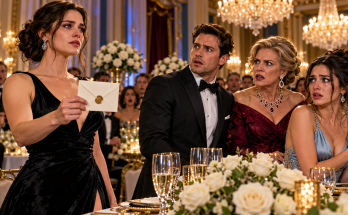
The hotel lobby smelled of fresh lilies and polished wood. A pianist played near the windows, his music floating above the low conversation of guests arriving for private events. I stepped out of the revolving door and paused long enough to steady the envelope beneath my arm. Across the marble floor, a large arrangement of white roses stood beside a gold-framed sign welcoming guests to the Whitmore family celebration. My name appeared nowhere on it, which was hardly surprising. Earlier that morning, I had been legally removed from the family. By evening, Patricia had arranged flowers, music, and a five-course dinner to commemorate my replacement.
Tessa Morales waited near the concierge desk, dressed in a charcoal evening suit with a slim leather portfolio in her hand. She had arrived twenty minutes earlier to review the final arrangements with the hotel's event coordinator. Her expression was composed, but she studied my face before speaking. “You can still choose not to enter,” she said. I glanced toward the ballroom corridor, where guests were following signs decorated with silver ribbons. “I know.” She nodded. “Then we follow the plan. No accusations we cannot support, no unnecessary arguments, and no handling of documents by anyone who isn't entitled to them.” Her careful tone reminded me why I had trusted her with Evelyn's estate. Tessa did not mistake an emotionally satisfying confrontation for a sound decision.
I told her I wanted Cassidy to decide for herself how much of her own involvement she would disclose. Tessa confirmed that they had spoken earlier. Cassidy understood the arrangement was ending that evening and had agreed to identify herself truthfully. She had also insisted upon retaining copies of the agreements that established what she had been hired to do and the boundaries she had observed. I appreciated her caution. What had begun as an attempt to answer questions about my marriage had become a public deception larger than either of us had anticipated. I was responsible for my part in creating it. Grant and Patricia were responsible for the decisions they made while believing it.
The ballroom doors stood open at the end of a carpeted hallway. From a distance, I could hear a string quartet playing a familiar classical piece. Laughter rose above the music, followed by the ringing of glasses. Two attendants stood beside a table displaying escort cards arranged alphabetically. A young woman in a black dress approached with a professional smile and asked for my name. I gave it. Her eyes moved across the guest list, then returned to me with a slight frown. “I'm sorry, Ms. Brooks. I don't seem to have a place assigned to you.” I told her I understood and asked whether the event coordinator was available. Before she could answer, a voice behind me spoke my former married name.
“Savannah Whitmore?”
I turned and found Helen Carlisle standing several feet away. Helen had been one of Patricia's closest friends for more than twenty years. She was a tall woman in her late sixties, with carefully arranged blond hair and a reputation for remembering every detail of other people's lives. She had attended my wedding, admired the flowers, and told me I looked beautiful. Since then, our conversations had rarely extended beyond polite greetings at family gatherings. Now she stared at me as though I had appeared in the wrong place at the wrong time. “What are you doing here?” she asked. Her eyes dropped to my black gown and the envelope beneath my arm.
“Good evening, Helen,” I said. “The divorce is final. It's Brooks again.” She glanced toward the ballroom and lowered her voice. “Does Patricia know you're coming?” I answered that she would shortly. Helen's expression changed from surprise to alarm. “This is supposed to be a happy evening.” I almost smiled at the phrase. Happiness had apparently become something the Whitmores could protect only by ensuring I remained absent. “I don't intend to disturb the guests unnecessarily,” I said. “But there are some facts the hosts need to understand.” Helen's attention settled on Tessa, who introduced herself as my attorney. That was enough to make her stop asking questions.
We entered together. The ballroom was larger than I expected, with high ceilings, crystal chandeliers, and tall windows overlooking the illuminated streets. White roses stood in silver vessels at the center of every table. The linens were ivory, the place settings edged in gold, and delicate candles reflected in the polished silverware. Near the stage, a seven-tier cake stood beneath its own arrangement of lights. Patricia had spared no expense. I remembered her pride in arranging loans against the Wisconsin property and wondered whether she had considered how quickly those obligations would remain after the flowers wilted and the guests went home.
A photographer moved among the tables, encouraging guests to gather in small groups. Uniformed servers carried trays of sparkling wine and appetizers. I recognized relatives, former colleagues of Grant's, and several people who had visited our condominium over the years. Some smiled automatically when they saw me, then remembered the occasion and looked away. Others appeared embarrassed. One of Grant's cousins started toward me, hesitated, and returned to his conversation. Their discomfort hurt more than I wanted to admit. Many of these people had known me for years. Now they were uncertain whether acknowledging my existence might offend the people paying for dinner.
At the far end of the ballroom stood Grant, wearing a dark tuxedo. Cassidy was beside him in a pale blue gown that caught the light whenever she moved. Her hair had been arranged in an elegant low twist, and borrowed diamond earrings glittered beneath the chandeliers. She looked exactly like the sophisticated heiress Patricia believed she had welcomed into the family. Grant rested one hand lightly against her back as he spoke to an older man I recognized from a previous business function. His expression was open and animated. I had not seen him look so confident in months.
For a moment, the sight brought an unexpected rush of grief. Grant had once looked at me with that same attention. On our wedding day, he had taken my hand as though he could scarcely believe his good fortune. Now he stood beside another woman in a room decorated to celebrate the life he imagined he was about to receive. I knew Cassidy's role. I knew the apparent wealth surrounding her was fiction. Still, the expression on Grant's face was real. His excitement was not rehearsed. He believed he was standing at the beginning of something extraordinary, and the contrast between that belief and what I knew made the scene almost unbearable.
Cassidy noticed me first. Her eyes moved briefly toward the entrance, and her smile faltered for less than a second. Then she returned her attention to the conversation. We had agreed not to acknowledge each other until the proper moment. She maintained her posture, accepted a glass of mineral water from a server, and continued listening. I recognized the discipline required. Cassidy had told me she could convincingly perform confidence, wealth, or indifference, but she could not make herself comfortable with the cruelty she had witnessed. That distinction was one of the reasons I had come to respect her.
Patricia stood near the head table, receiving compliments from guests. She wore a deep burgundy gown and a diamond necklace I had seen only twice before. Her hair had been professionally styled, and she moved through the room with the satisfaction of someone presiding over a social victory. Several people praised the flowers. Others mentioned how fortunate Grant was to have found happiness again. Patricia accepted each compliment as though she had personally arranged the circumstances that made his happiness possible. I watched her touch one guest's arm and gesture proudly toward Cassidy. Her smile widened until she saw me.
The change was immediate. Patricia's hand stopped in midair. She stared across the ballroom, and the warmth disappeared from her expression. For several seconds she seemed unable to believe what she was seeing. Then she excused herself from the conversation and crossed the room with a speed that made her necklace sway against her chest. I remained beside Tessa near the entrance to the seating area. Patricia stopped close enough that I could smell her expensive perfume. “What are you doing here?” she demanded. Her voice was low but sharp. “I told you this event had nothing to do with you.”
“I know what you told me,” I replied. “I came because there's something important you need to understand.” She glanced at the envelope. “If this is about money, speak to Grant another day.” Tessa introduced herself before I could answer. Patricia turned toward her with visible irritation. “I don't need another attorney. The divorce was finalized this morning.” Tessa agreed. “We're not here to reopen the divorce proceedings.” Patricia's eyes narrowed. “Then leave. You're embarrassing yourselves.” I looked past her at the people beginning to notice our conversation. “Patricia, I would prefer to handle this without a scene.” She gave a short, incredulous laugh. “You arrive uninvited at my banquet, and you're worried about making a scene?”
Her voice had risen enough to attract attention. A server slowed beside us, then continued walking. Helen Carlisle appeared near a table and watched with an expression of anxious curiosity. Patricia followed my glance and seemed to realize how visible our disagreement had become. She seized my elbow and attempted to guide me toward the hallway. I stepped away before she could move me. “Please don't touch me,” I said. She looked stunned, as though I had violated a rule more important than the one she was breaking. “You don't dictate conditions in my family,” she whispered.
“I'm not in your family anymore. You made that clear this morning.” The words came out quietly. Patricia's face tightened. For a moment, I saw anger without the polished social manners that usually concealed it. “And you should be grateful Grant was generous enough to let you leave without a fight.” I looked at her carefully. “He offered me money because he wanted a clean ending. I declined.” She lifted her chin. “Then why are you here?” I glanced toward Cassidy. “Because the future you've spent so much celebrating isn't what you think it is.”
Patricia followed my gaze. Her expression changed from anger to disdain. “You cannot bear seeing him with a woman who's accomplished more than you.” I had expected that response. “This isn't about competition.” “Of course it is. Vanessa comes from a world you could never enter. Her father owns properties across the country. She understands business, social obligations, and what a successful marriage requires.” Patricia spoke louder with every sentence, apparently forgetting her earlier desire to avoid attention. “And unlike you, she's giving my son a child.”
Several guests turned toward us. I felt their attention settle on my face. The humiliation was familiar, but something about its repetition exhausted me. For years, I had accepted accusations about fertility because Grant had begged me to protect his medical privacy. I had never agreed to make those accusations permanent public truth. Tessa shifted slightly beside me, a quiet reminder of our boundaries. I did not mention the medical report. Instead, I asked Patricia whether she had ever met Vanessa's father. Her mouth tightened. “I've already explained that he values privacy.” “Has Grant met him?” “He will.” “Have either of you confirmed the family investments she's described?”
Patricia stared at me. I could see that the questions irritated her more than any insult would have. She had built the evening around certainty, and I was asking her to justify it. “I don't need your approval,” she said. I shook my head. “I'm not offering or withholding approval.” “Then stop interrogating me.” She turned toward a hotel employee who had approached after noticing the dispute. “This woman isn't invited,” Patricia said. “Please have security escort her out.” The employee looked at me, then at Tessa. His discomfort was evident. He asked whether we would mind stepping into the corridor while the matter was clarified.
I agreed. I had no intention of creating difficulties for hotel staff. Patricia, however, seemed to interpret my cooperation as victory. She followed us toward the ballroom doors, continuing to explain that the celebration was private and that her former daughter-in-law had no right to interfere. I let her speak until we reached the corridor. Then Tessa asked to contact the event coordinator. Patricia objected, but the employee had already sent a message. Within moments, a woman in a dark tailored suit arrived and introduced herself as the manager overseeing the banquet.
Tessa explained that we wished to communicate with two individuals attending the event and that she was prepared to discuss the matter privately. The manager listened, then clarified that Patricia controlled the guest list and that uninvited visitors could not remain in the ballroom against the host's wishes. Tessa acknowledged the policy. I understood that we might need to deliver the information another way. Then, before anyone could continue, Grant appeared at the ballroom entrance. He had evidently noticed his mother was missing.
His expression changed when he saw me. “Savannah?” He looked from my face to the envelope, then toward the event manager. “What's going on?” Patricia answered immediately. “Your ex-wife is trying to disrupt the celebration.” Grant frowned. “Why would you come here?” I was struck by the fact that he sounded more perplexed than angry. He genuinely had not anticipated that I might appear. In his mind, the divorce had placed me outside the boundary of his life. He had expected me to remain there quietly while he enjoyed the rewards of leaving.
“I need to speak with you and Cassidy,” I said. The name slipped out deliberately. Grant looked confused. “Who?” “The woman you know as Vanessa.” His posture stiffened. Patricia stared at me. “What kind of nonsense is this?” Tessa opened her portfolio and removed a sealed packet. “Mr. Whitmore,” she said, “we believe there are material facts about tonight's circumstances that you should examine before making further commitments.” Grant looked at the packet but did not take it. “Are you threatening me?” “No,” Tessa replied. “We're offering information.”
He laughed nervously. “This is unbelievable. We finalize the divorce this morning, and now you show up with a lawyer because you can't handle me moving on.” The words carried into the hallway. I felt an old impulse to defend myself, to explain everything quickly enough that he would understand. I resisted it. “I didn't come because you moved on,” I said. “I came because you never checked where you were going.” Patricia made an impatient sound, but Grant's attention remained on me. He appeared irritated by the calmness of my answer.
Then Cassidy appeared behind him. She had left the ballroom without her glass and was walking toward us with deliberate steps. Grant turned and reached for her hand. “Vanessa, go back inside,” he said. “I'll handle this.” Cassidy looked at me, then at Tessa. Her face was pale beneath the carefully applied makeup. “No, Grant,” she said. “I need to be here.” He seemed surprised by her tone. “You don't need to deal with my ex-wife.” Cassidy did not move. “That's part of the problem,” she answered. “You keep assuming you know what other people need.”
Patricia forced a smile. “Darling, don't let Savannah upset you. She's having difficulty accepting the divorce.” Cassidy turned toward her. “Mrs. Whitmore, Savannah isn't the person you should be angry with.” Patricia's smile faltered. Grant released Cassidy's hand. “What does that mean?” She looked at him for several seconds before answering. “It means my name isn't Vanessa.”
The corridor seemed suddenly quieter. Behind us, music continued inside the ballroom, and guests could be heard laughing near the entrance. Grant stared at Cassidy as though she had spoken in another language. “What?” he asked. She drew a breath. “My name is Cassidy Monroe. I'm an actress. I don't have a wealthy father who can arrange your promotion. I don't own properties in Aspen or Palm Beach. The car you've seen me driving is rented, and the jewelry I'm wearing tonight is borrowed.” Patricia's mouth opened, but no sound came out.
Grant shook his head. “This is some kind of joke.” Cassidy's expression remained steady. “No.” “Vanessa, stop.” She flinched slightly at the false name. “Grant, please listen. There is no investment fortune waiting for you. There never was.” He looked toward me with sudden fury. “What did you do?” I met his eyes. “I arranged for you to meet someone who appeared to have everything you said you wanted. What you did afterward was your decision.” He took a step toward me, but Tessa moved slightly between us without touching him.
Cassidy continued before he could speak. “You told me your marriage was already over when it wasn't. You told me Savannah was responsible for your inability to have children. You talked about marrying me because of my father's supposed connections.” Grant's face had gone red. “You were recording our conversations?” “I kept dated notes,” she answered. “I also retained the messages you sent me. You were never forced to say any of those things.” Patricia began shaking her head. “This is fraud. You've deceived us. You've made fools of us.” Cassidy looked at her sadly. “I did present a false identity. I'm prepared to accept responsibility for that. But no one required you to borrow money or arrange this banquet.”
At the word money, Patricia seemed to recover her voice. “You don't understand what I've invested,” she said. Her eyes moved rapidly between Cassidy and me. “The flowers, the musicians, the hotel, the loans…” She stopped. The realization had begun to reach her, though she was resisting it. Grant turned toward Cassidy. “The pregnancy,” he said. “Tell me the pregnancy is real.” Cassidy lowered her eyes briefly. “It isn't.” Patricia made a small sound, almost like someone losing her breath.
Grant's expression shifted from anger to alarm. “But you showed us the ultrasound.” Cassidy nodded. “It was a theatrical prop. I never claimed to a doctor that it was authentic.” Grant stared at her. “You told my mother you were expecting.” “I suggested I might be pregnant, and you accepted it. You never asked how a child could be yours when we had never been intimate.” His face seemed to lose its color. For the first time that evening, he had no immediate argument.
Patricia gripped the back of a nearby chair. “You have destroyed my family,” she whispered. I looked at the woman who had supervised packing my belongings before sunrise, who had praised my replacement in front of relatives, who had risked her property to celebrate imagined wealth. I felt no satisfaction in seeing her shaken. “Patricia,” I said, “you decided what kind of person I was before you knew me. You decided what Vanessa was worth before you knew her. And you treated both judgments as facts.” Her eyes filled with tears of anger. “You did this deliberately.”
“Yes,” I answered. “I arranged the introduction. I wanted to know what Grant would choose. I won't pretend that was a simple or admirable decision.” I glanced at my former husband. “But I didn't choose for him.” Grant looked as though he wanted to deny every word, yet Cassidy stood beside him, holding the evidence of conversations he remembered having. For a moment he seemed smaller than the confident man who had greeted guests beneath the chandeliers.
From the ballroom entrance came the sound of applause. Someone had announced that the hosts were needed for a toast. Patricia turned toward the open doors, where the celebration continued without any awareness of what had happened in the corridor. One hundred and seventeen guests were waiting to congratulate a couple whose future had just dissolved. Grant looked at the doorway, then at Cassidy, then at me. “Nobody can know about this,” he said. His voice was barely audible. I studied his face and realized that even now, confronted with the truth, his first concern was not the damage he had caused. It was whether anyone would see it.