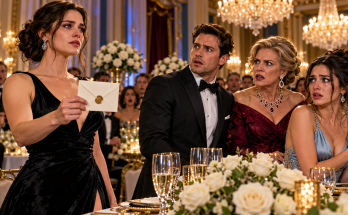
The photograph stayed on my phone long after the screen began to dim. Nolan sat at the far side of a polished dining table, his dark jacket folded over the back of his chair. Diane occupied the seat nearest him, her expression intent as she examined a document. Paige leaned toward Owen Pierce, pointing at something outside the camera's view. Between them lay a pale blue folder bearing the name of my inspection business. I recognized the handwritten label because I had made it myself, years before meeting Nolan. The upper-right corner had a small triangular tear from the day I caught it beneath a filing cabinet drawer. There was no reasonable explanation for that folder being on the table without my knowledge.
I enlarged the photograph carefully, resisting the impulse to search for a dramatic revelation in every shadow. The image showed more than the four people. A water glass stood beside Nolan's elbow, and a folded menu rested beneath Diane's handbag. Through the window behind them, I could see part of a brick wall and a narrow strip of ornamental lighting. A reflection in the glass suggested the photographer had been standing near the entrance rather than sitting at the table. Whoever sent the picture had either taken it personally or obtained it from someone who had been present. I checked the message again. There was no introduction, no request for money, and no explanation of how the sender had acquired the photograph. Only the accusation that Nolan knew whose name they were using.
Avery made a soft sound in my arms, drawing me away from the screen. I settled into the rocking chair and watched her small mouth move against the edge of her blanket. She was not yet two weeks old, and I could measure nearly every day of her life against something I had discovered about her father. I hated that association. I wanted to remember her first bath, the warmth of her fingers, the way Mom smiled whenever Avery opened her eyes. Instead, the days were filling with legal documents, disputed signatures, and the uneasy anticipation of another message. I placed the phone facedown on the table until she finished feeding. Whatever the photograph meant, it would still exist when I picked it up again.
When Dad came upstairs, I showed him the message without offering my interpretation. He examined the photograph, then asked whether I had retained the original message. I told him I had. Caroline had already advised me not to forward potentially important evidence through unnecessary channels or alter the original file. Dad nodded and studied the image again. "That looks like the private dining room at Bellamy's," he said. I knew the restaurant. Nolan had taken me there for our second anniversary, and Diane favored it for celebrations intended to impress acquaintances. Dad pointed to the narrow band of brass trim beside the window. He had attended a company dinner there several years earlier and remembered the room's distinctive fixtures.
I asked whether we should contact the restaurant. Dad said the investigators could determine whether records or security footage were available through the proper process. He wasn't prepared to approach employees informally or risk confusing the evidence. Instead, he asked me to describe exactly when I had last seen the folder. I remembered reorganizing my office during the seventh month of pregnancy. Nolan had offered to help, and I had allowed him to handle old reports and registration documents while I rested. The blue folder had been in the lower drawer of the filing cabinet. He had held it briefly, asked whether I still needed the original certificates, and returned it. At least, I had watched him move toward the cabinet with it. I hadn't actually seen him place it inside.
That distinction bothered me. I had assumed he returned the folder because there was no reason for him to do anything else. The photograph showed that, at some later point, it had left my office. I went through the memory again, searching for a moment when Nolan might have taken it. He occasionally carried work bags between the condominium and the dealership. He sometimes collected papers from my desk when he offered to tidy the room. Any of those opportunities would have been sufficient. But I couldn't say when the folder disappeared. The uncertainty was frustrating precisely because I had spent my career teaching others not to fill gaps in a timeline with assumptions.
Dad contacted Martin and Rebecca while I sent the original message to Caroline through the secure method she'd established. Within an hour, Rebecca called to ask about the folder's contents. I explained that it had held professional registration copies, older inspection templates, continuing-education records, and correspondence relating to my certification. Some documents included examples of my signature. The originals were supposed to remain in my office, though I had not checked the drawer since going into labor. Rebecca said the photograph could help establish access and opportunity, but it would need authentication. She also reminded me that possessing copies of professional documents did not, by itself, prove who had created the false reports.
The next day, Caroline arranged for an independent digital-forensics specialist to preserve the message and examine the file information available from my phone. His name was Daniel Cho, and he spoke with the cautious precision of someone accustomed to explaining why electronic evidence was less straightforward than people imagined. The image had been stripped of most original camera metadata before reaching me. Its dimensions suggested it might have been copied or exported through another service. The sender's number was associated with a prepaid account, but that fact alone couldn't identify the person using it. Daniel documented the message, its timestamp, and the available technical details. He cautioned against replying with accusations or clicking any additional links the sender might provide.
I had already typed a response asking who the person was. I deleted it before sending. Instead, under Caroline's guidance, I sent one brief message stating that I had received the photograph and was willing to pass relevant information to the appropriate investigators. I did not promise confidentiality or suggest that I could protect the sender from consequences. The message remained unanswered throughout the morning. By afternoon, I began wondering whether whoever contacted me had changed their mind. Then another message appeared. It contained no photograph this time, only a sentence asking whether I remembered the woman who served us at Bellamy's on our anniversary.
I remembered her immediately, though I couldn't recall her name. She had been an older woman with silver-framed glasses and a dry sense of humor. Nolan had ordered an expensive bottle of wine and tried to impress her by describing a promotion he expected to receive. She had smiled politely, then asked whether he wanted the bottle opened before or after dinner. When he left the table to answer a call, she'd noticed that I was pregnant and brought me sparkling water with lemon without being asked. I remembered telling Nolan afterward that she was unusually attentive. He'd barely listened. The message brought back a detail I hadn't thought about in months: the server had recognized Diane from previous visits and greeted her by name when she stopped at our table that evening.
I showed the message to Caroline. She advised me not to speculate about the sender's identity until we had more information. Rebecca's team could contact the restaurant through formal channels and determine whether a former employee had relevant observations. I agreed, though the delay was difficult. The sender seemed to know enough about my life to identify our anniversary dinner. That suggested either direct personal knowledge or access to someone who had worked at the restaurant. I wondered whether a server had overheard the family meeting and later recognized the significance of the documents. If so, why contact me anonymously rather than speak directly to investigators?
On Wednesday afternoon, Martin called with a preliminary update. Bellamy's management had confirmed that the private dining room could be reserved for business meetings. Records showed a reservation under Diane's name during the period suggested by the photograph. The restaurant could not immediately confirm who attended, but payment records and staffing schedules were being preserved. Martin said a former employee might have information and that the company was arranging an interview. He would not give me a name until the person's willingness to participate was established. I respected that decision, though it meant carrying another uncertainty through the evening.
Nolan continued requesting contact with Avery. Caroline had begun working toward a temporary arrangement that accounted for my recovery, Avery's feeding schedule, and the need to avoid confrontations. Nolan's messages alternated between affectionate concern and resentment. In one, he said he hoped I would not allow my father's company to destroy the relationship between him and his daughter. In another, he wrote that Owen Pierce had manipulated the dealership's vendor process long before Nolan understood what was happening. I preserved both without responding directly. His willingness to blame Owen might contain truth, but it did not explain why my personal folder appeared at a private meeting attended by his mother and sister.
That evening, I received a call from Lily. She sounded quieter than usual. Diane had asked her whether she'd spoken to me, and Lily had admitted only that she was concerned about Avery. Her mother accused her of disloyalty and warned that people who helped outsiders investigate family business should not expect to be welcomed afterward. Lily told me she had left the apartment rather than argue. She was staying with a friend for a few nights. I could hear how painful the decision had been. Despite Diane's controlling behavior, Lily had spent her entire life trying to win her approval. Now she was beginning to understand that her mother's affection came with conditions.
I asked whether she recognized the dining room in the photograph. She said she did. Diane had reserved it for a family celebration months earlier, though Lily had not attended the particular meeting shown. She recognized Owen's dark blue folder from the conversation she'd overheard at her mother's apartment. When I described the photograph's composition, Lily became thoughtful. She remembered that Diane often requested the same private server at Bellamy's because the woman was discreet and didn't interrupt conversations. Lily couldn't remember the server's surname, but she thought her first name was Teresa. I passed the information to Martin, carefully distinguishing Lily's recollection from confirmed facts.
The following morning, Dad drove into Columbus for a meeting with company counsel. Before leaving, he came into the kitchen where I was eating toast beside Avery's bassinet. He asked whether I had checked my professional office inventory. I told him I hadn't returned to the condominium and didn't intend to do so without appropriate arrangements. He agreed. Caroline had advised that anything potentially relevant should be documented carefully, particularly if there was a possibility of disputed access. Dad said the company had located additional copies of inspection templates in its records, some with formatting identical to my older reports. The files were being analyzed to determine whether they originated from my documents or a common commercial template.
I asked whether the investigation had found the original blue folder. Dad shook his head. The photograph established that it had been at Bellamy's, but no one had yet located it. "If Nolan took it," I said, "he may have destroyed it." Dad didn't dismiss the possibility. He simply replied that electronic records and other copies might still establish what happened. I watched him leave through the back door, his shoulders slightly bent beneath the old work jacket. When I was younger, he had seemed capable of solving almost any practical problem. Now I understood that some damage couldn't be repaired with tools, money, or experience. Even he couldn't undo what my husband had chosen to do.
At lunchtime, Rebecca called from headquarters. The former employee had agreed to speak with investigators. Her name was Teresa Valdez, and she had worked at Bellamy's for nearly nineteen years before retiring earlier that summer. Teresa remembered Diane's reservation because the group had occupied the private room for several hours, remaining after the scheduled meal service had ended. She recalled the discussion becoming tense when one of the women challenged the amount of money being requested. The employee couldn't reliably identify every document on the table, but she remembered seeing a folder with a professional name on it. She also recalled that Nolan had stepped into the hallway twice to make calls.
I asked whether Teresa had taken the photograph. Rebecca said the investigators were still establishing its origin and whether the image had been shared with anyone else. Teresa had not yet consented to all details of her interview being disclosed. I felt a flicker of frustration, followed by shame. The woman had come forward voluntarily. She didn't owe me immediate access to everything she remembered. I thanked Rebecca and asked her to pass along my appreciation. It mattered that someone outside Nolan's family had chosen to tell the truth rather than avoid involvement.
By late afternoon, Daniel had identified something else about the original message. Although its camera metadata was missing, the photograph included a small reflection near the window that could help determine the photographer's position. More importantly, the image appeared to have been captured from a higher angle than a seated customer would normally have. It was consistent with someone standing near a service station or doorway. That supported the possibility of a staff member taking it, though it did not establish who. Daniel cautioned me not to attach too much significance to an image's geometry without the original device or corroborating evidence.
While I reviewed his report, I noticed a detail I'd overlooked. Nolan's hand rested on the blue folder, but his index finger pointed toward Diane. He appeared to be speaking, and Diane was staring at a page held by Paige. Owen had turned away from the documents, looking toward the doorway with an expression of irritation. I wondered whether the photograph had captured an argument. Teresa's recollection of disagreement over money made that possibility plausible. Yet I couldn't know what anyone was saying. The image was a fragment of time, not a transcript.
That night, an unfamiliar number called. I almost ignored it. Caroline had warned me about direct contact from unknown parties, but I answered after seeing that the number matched the one used to send the photograph. A woman's voice spoke quietly. She sounded older, with a trace of the accent I'd noticed in the server at Bellamy's. "Mrs. Mercer?" she asked. Hearing Nolan's surname made me tense. "This is Claire." There was a pause. "My name is Teresa. I believe you've seen something I sent." I sat down on the edge of the bed, careful not to wake Avery. Teresa explained that she had heard the company was investigating unusual dealership transactions. She had retained the photograph because the meeting had disturbed her, but she had been afraid to become involved while still employed.
I asked why she had sent it to me instead of contacting the company. Teresa hesitated. She said she had recognized my name from the folder and later learned that I was Nolan's wife. When she saw a social media post celebrating Avery's birth, followed by rumors about Nolan's employment, she worried that I might be unaware of what had happened. A younger relative had helped her contact me without revealing her personal number. She apologized for the anonymous message. I told her I understood why she'd been cautious, then asked whether she would continue speaking with Rebecca. She said she intended to cooperate fully.
Before ending the call, Teresa volunteered one detail she had not yet explained clearly. She remembered Nolan telling the group that I would never agree if I knew exactly what the paperwork meant. Diane had answered that husbands and wives shared responsibilities and that obtaining a signature afterward would resolve the matter. Teresa couldn't recall the surrounding conversation, and she admitted that she had been moving dishes while they spoke. But the exchange had unsettled her enough that she remembered it months later. I felt the room grow cold around me. Those words resembled the logic Nolan had used when he brought the authorization form to the hospital.
I asked Teresa whether she remembered what happened to the blue folder. She said Nolan placed it inside a leather portfolio before leaving. Diane had insisted that nothing be left on the table. Owen departed first, visibly irritated. Paige followed him into the hallway, while Nolan remained behind speaking privately with his mother. Teresa had not overheard that final conversation. I thanked her and ended the call after confirming that she would share the information with investigators. Then I documented the conversation while the details remained clear, including Teresa's uncertainties and the fact that she had not heard everything.
I sat for a long time with the phone in my lap. The evidence was becoming more substantial, but it was also forcing me to surrender explanations I'd clung to for months. Nolan hadn't merely stumbled into a vendor arrangement that happened to involve my professional identity. According to Teresa's account, he had discussed whether I would agree to the paperwork and had taken possession of my folder afterward. I couldn't establish every detail of his intentions, but the pattern was increasingly difficult to dismiss.
Avery woke and began to cry. I lifted her carefully, feeling her small body settle against mine. My hands moved automatically through the familiar routine of checking her diaper, adjusting her blanket, and preparing to feed her. I remembered Nolan standing beside the hospital bed, telling me she was perfect. I had believed him. Perhaps he'd meant it. But loving a child in a moment of wonder was not the same as accepting the responsibilities that followed. His choices had exposed both of us to uncertainty and harm.
Near midnight, Caroline called with another update. Rebecca's team had identified a digital copy of the blue folder's contents among files associated with Mercer Family Fleet Services. Some documents had been scanned together into a single archive. The file-creation dates fell shortly after the meeting at Bellamy's. The archive included my registration certificate, older inspection templates, and several examples of my signature. It also contained a draft authorization form bearing a typed version of my name.
Then Caroline told me something that made me sit perfectly still.
One page in the archive contained an image of my signature placed beneath the authorization language. The investigators had not established whether it was a completed document or a digitally assembled draft. The signature appeared visually similar to one used on a legitimate report I had prepared years earlier. Caroline said the original files and audit records would be examined before anyone determined how the image had been inserted.
I looked toward Avery's bassinet. The farmhouse was quiet, and Mom had left a small lamp burning in the hallway. For the first time, I understood why Diane kept insisting I had signed more documents than I remembered. Someone had created a version of the authorization that appeared to bear my approval. Whether it had ever been used as a final record remained unknown. But my husband had tried to obtain a real signature from me after our daughter was born, and an earlier digital version now existed in his family's business files.
The question was no longer simply who had stolen my credentials.
It was whether Nolan had planned to make me responsible for the fraudulent work if the scheme ever came to light.