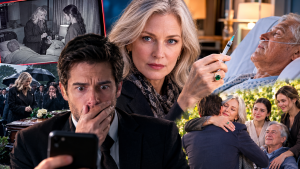
PART 1 — THE WOMAN WHO WAS SUPPOSED TO BE DEAD
The woman standing beside my father’s bed had been dead for three years.
I knew that because I had watched them lower her coffin into the ground. I had stood beneath a black umbrella while rain soaked through my suit, listening to my younger sister, Vanessa, sob uncontrollably beside me.
I had even placed a white rose on the coffin before the cemetery workers covered it with dirt.
Yet at 11:47 on a Monday morning, I was staring at my phone, watching a security camera recording that made absolutely no sense.
There she was.
My mother.
Her blonde hair had turned silver, and her face looked older than I remembered. But I recognized the small scar beneath her chin, the emerald ring on her right hand, and the way she tilted her head whenever she concentrated.
She was alive.
And she was holding a syringe above my paralyzed father’s arm.
My younger sister stood beside her, watching the bedroom door.
I couldn’t breathe.
Then my wife screamed from upstairs.
“Ethan! Get up here! Something is happening to your father!”
I dropped my coffee and ran.
My name is Ethan Wren. I was thirty-nine years old, the owner of a successful construction company in Ohio, and until that morning, I believed my life was difficult but understandable.
My father, Arthur, had suffered a devastating stroke two years earlier. He could barely move his right arm, couldn’t walk without assistance, and had lost most of his ability to speak.
Before the stroke, he had been the strongest man I knew.
He had built our family hardware business from a tiny rented storefront into a respected local company. He could repair almost anything, and he taught me that a person’s character was measured by what they did when nobody was watching.
My mother, Eleanor, had been the heart of our home.
She loved old jazz records, gardenias, and Sunday breakfasts that lasted until noon. When she died suddenly three years ago, our family seemed to lose its foundation.
Vanessa took her death especially hard.
She was thirty-five, intelligent, ambitious, and fiercely protective of everything our parents had built. She insisted on handling the funeral arrangements, organizing the paperwork, and settling the estate.
I was too devastated to question her.
Then my father suffered his stroke.
Since then, my wife, Claire, had devoted herself to caring for him.
Claire was thirty-two and had worked as a registered nurse before we married. She could have continued her career, but when Dad returned home from rehabilitation, she volunteered to oversee his daily care.
I hired professional caregivers, arranged physical therapy, and converted a downstairs bedroom into a private medical suite. Claire coordinated everything.
For two years, she fed Dad, monitored his medications, helped him bathe, and read aloud to him every evening.
I believed she was the kindest person I had ever known.
Until Vanessa arrived at my office nine days before I saw my supposedly dead mother.
She carried a thick folder and placed it on my desk.
“Your wife is stealing from Dad,” she announced.
Inside were bank statements showing hundreds of dollars in withdrawals from an account reserved for his medical expenses.
There were also photographs of bruises on his arms.
“Claire is abusing him,” Vanessa said. “And she’s using his money to help her mother.”
I felt sick.
“Have you spoken to her?”
“Of course not. She would deny everything.”
Vanessa told me she had discovered suspicious transactions near the neighborhood where Claire’s mother lived. She suggested Claire was taking money from our father to support her struggling family.
I wanted to believe there was an explanation.
But the photographs disturbed me.
That night, I confronted Claire about the bruises.
She looked at me in surprise before lowering her eyes.
“He caught his arm against the wheelchair again,” she said quietly.
“Again?”
“Ethan, he’s fragile. His skin bruises easily.”
“Why didn’t you tell me?”
“I didn’t think it was serious.”
Her answer seemed reasonable, but Vanessa’s accusations had already planted a seed of doubt.
The following morning, I arranged for a security company to install cameras in the common areas of our house and my father’s bedroom, following the applicable privacy requirements.
I told myself I only needed to establish the truth.
Instead, I began watching my wife as if she were a stranger.
For two nights, the recordings showed nothing suspicious.
Claire helped Dad eat breakfast. She read him the newspaper. She encouraged him to squeeze a rubber therapy ball.
Then, at 2:16 a.m. on the third night, she entered his bedroom, opened the medication cabinet, and removed a small bottle.
She counted several tablets into her hand.
Then she slipped them into her pocket.
Before leaving, she leaned toward Dad and whispered something I could barely hear.
“Just a little longer, Arthur. Please don’t give up.”
My father opened his eyes.
Claire took his hand.
“Nobody can know until we have proof.”
I replayed the recording until dawn.
What proof?
What was she hiding?
And why was she secretly removing medication from my father’s room?
I had no idea that my questions would lead me to a woman I had buried three years earlier.
Or that the woman I trusted most was about to reveal the darkest secret my family had ever kept.
PART 2 — THE SECRET INSIDE MY FATHER’S MEDICINE CABINET
The next morning, I pretended nothing had happened.
Claire prepared breakfast while I sat across from her at the kitchen island.
“How did Dad sleep?” I asked.
“Better than yesterday.”
“Did he take his medication?”
She paused for half a second.
“Yes.”
I studied her face.
“All of it?”
Claire put down the coffee pot.
“Ethan, what’s wrong?”
“Nothing.”
She stared at me for a moment, then looked away.
I hated myself for lying to her, but I couldn’t ignore what I had seen.
That afternoon, I called Dr. Samuel Mercer, my father’s neurologist.
I asked about the medication prescribed after Dad’s stroke.
Dr. Mercer confirmed that my father was receiving several medications to manage his blood pressure, prevent complications, and address other conditions.
When I mentioned the bottle Claire had taken, his response surprised me.
“What color was the label?”
“White, I think.”
“And did you see the name?”
“No.”
There was a long silence.
“Mr. Wren,” he finally said, “I would prefer to discuss your father’s treatment in person. Bring the medication list to my office.”
His voice sounded strained.
I made an appointment for the following afternoon.
But before I could go, Vanessa called.
“I need you to come home immediately,” she said. “Claire has locked herself in Dad’s room.”
When I arrived, I found Vanessa standing in the hallway with her arms folded.
Claire was inside with my father.
“What happened?” I asked.
“She won’t let me check his medication,” Vanessa replied. “She says only she can handle it.”
I opened the bedroom door.
Claire was kneeling beside Dad’s bed, holding his hand.
She stood as soon as she saw me.
“Your sister has been asking me to give him something that isn’t on his prescription list,” she said.
Vanessa laughed sharply.
“That’s ridiculous.”
Claire reached into her pocket and removed a folded piece of paper.
“I found this in the medication cabinet.”
It was a handwritten instruction to increase one of Dad’s sedating medications.
The signature at the bottom appeared to belong to Dr. Mercer.
But Claire had already contacted the doctor’s office and learned that no such instruction had been issued.
“Someone put it there,” she said.
Vanessa’s face changed.
Only for an instant.
But I saw it.
“You’re accusing me now?” Vanessa demanded.
“I’m saying someone wants your father to remain heavily sedated.”
“He’s paralyzed! He needs medication!”
“He needs the correct medication.”
I stepped between them.
“Enough. We’re taking Dad to an independent specialist.”
Vanessa stared at me.
“You’re going to let your wife manipulate you into destroying this family?”
“No,” I replied. “I’m going to find out what’s happening.”
That night, I reviewed every recording again.
At 10:43 p.m., Vanessa entered the house using her own key.
She went directly to my father’s room.
She remained inside for six minutes.
When she emerged, she carried a small object in her hand.
I zoomed in.
It looked like a key.
She went downstairs, opened the locked cabinet where we kept Dad’s older medical records, and removed a thick envelope.
Then she looked directly at the hallway camera.
She smiled.
It wasn’t a nervous smile.
It was the smile of someone who knew exactly where the cameras were.
My stomach tightened.
The next morning, I asked Vanessa why she had visited the house the previous night.
“To check on Dad,” she replied.
“Why did you open the medical records cabinet?”
“I needed his insurance paperwork.”
“Why didn’t you ask me?”
She looked offended.
“Because I didn’t realize I needed permission to visit my own father.”
I had no answer.
But I knew she was lying.
Later that afternoon, Claire showed me something that changed everything.
A photograph.
It had been taken two weeks earlier by a private caregiver who had briefly worked at our house.
The image showed an older woman standing outside my father’s bedroom window.
She wore a gray coat and a dark scarf.
Her face was partially turned away from the camera.
But on her right hand was an emerald ring.
My mother’s ring.
Claire looked at me.
“I think someone has been visiting your father at night.”
I stared at the photograph.
“Who is she?”
Claire swallowed.
“I don’t know.”
Then she added something that made my blood run cold.
“But your father recognizes her.”
PART 3 — THE RECORDING THAT CHANGED EVERYTHING
Two days later, I returned home early from a business meeting.
The house was quiet.
I found Claire sitting beside my father’s bed with an old record playing softly in the background.
It was one of my mother’s favorite jazz songs.
For a moment, I couldn’t move.
Claire was holding Dad’s left hand and gently encouraging him to lift his fingers.
“Come on, Arthur,” she whispered. “You can do this.”
My father struggled.
His fingers trembled.
Then, slowly, he raised his index finger.
Claire gasped.
“That’s it!”
He raised it again.
I stepped into the room.
Dad turned toward me.
His eyes were clearer than I had seen them in months.
“Can you hear me?” I asked.
He blinked once.
Claire explained that she had been working with an independent rehabilitation specialist who believed Dad might have retained more awareness and motor function than his previous evaluations suggested.
His communication was still severely limited, but he had begun responding to simple questions through eye movements and deliberate finger gestures.
“Why didn’t you tell me?” I asked.
“Because the progress is inconsistent. And because I needed to know why his condition seemed to worsen after certain medication changes.”
She showed me a notebook containing dates, medication times, blood pressure readings, and observations about Dad’s responsiveness.
The pattern was disturbing.
On several days when he received medication from the disputed bottle, he became unusually difficult to awaken.
On days when the medication was withheld under professional medical guidance, he appeared more alert.
Claire had documented everything.
“You could have told me,” I said.
“I tried.”
Her voice broke.
“Every time I asked you to look more closely, Vanessa told you I was stealing. Every time I questioned the medication, someone changed the subject. And every time your father tried to communicate, he became too tired to continue.”
I looked at the notebook.
The evidence was organized, careful, and frightening.
Then Dad squeezed Claire’s hand three times.
She leaned toward him.
“Do you want to tell Ethan something?”
He blinked twice.
Claire had taught him a simple communication system: one blink for yes, two for no, and repeated finger movements to request that she continue asking questions.
“Is someone hurting you?” she asked.
Dad closed his eyes.
Then he opened them and blinked once.
My knees weakened.
“Who?” I whispered.
Claire began naming people.
“Vanessa?”
Two blinks.
“Dr. Mercer?”
Dad hesitated.
Then one blink.
My entire body went cold.
The doctor who had treated my father for two years might be involved in whatever was happening.
Claire reached for her phone.
“We need to contact the independent neurologist immediately.”
But before she could make the call, the bedroom door opened.
Vanessa stood there.
She looked at our father, then at Claire’s notebook.
For the first time since I had known her, my sister appeared genuinely afraid.
“What have you done?” she whispered.
I stepped toward her.
“What have you been doing?”
She looked at me.
Then she began to cry.
“You don’t understand.”
“Then explain it.”
She shook her head.
“I can’t.”
“Why not?”
Her eyes moved toward the window.
For a moment, I thought she was going to tell us everything.
Instead, she whispered four words.
“She’s coming back tonight.”
“Who?”
Vanessa covered her mouth.
I grabbed her arm.
“Who is coming back?”
She pulled away.
“Our mother.”
I stared at her.
“Mom is dead.”
Vanessa’s face crumpled.
“No, Ethan. She isn’t.”
The room seemed to tilt around me.
“You’re lying.”
“I wish I were.”
She looked toward Dad’s bed.
“She never died. We buried an empty coffin.”
Before I could speak, headlights swept across the bedroom wall.
A car had stopped outside the house.
Vanessa backed away from the door.
“Please,” she whispered. “Whatever you do, don’t let her see that you know.”
Then the doorbell rang.
PART 4 — THE MOTHER WHO NEVER DIED
I opened the front door.
An older woman stood on the porch.
She wore a dark coat and carried a small leather bag.
Her hair was silver now, but her blue eyes were unmistakable.
For three years, I had dreamed of seeing those eyes again.
Now that the moment had arrived, I could barely stand.
“Hello, Ethan,” she said.
My mother.
I stepped backward.
She entered the house slowly, studying my face with a mixture of sorrow and exhaustion.
“I know you have questions.”
“Questions?” I shouted. “I buried you!”
Tears filled her eyes.
“I know.”
“I watched your funeral!”
“I know, sweetheart.”
“Don’t call me that!”
She flinched.
For several seconds, neither of us spoke.
Then I demanded to know what had happened.
My mother sat down at the kitchen table.
Three years earlier, she explained, she had discovered that someone was moving money from my father’s business accounts into a series of shell companies.
She had initially suspected a dishonest accountant.
But when she followed the transactions, she discovered that the money was connected to a redevelopment deal my father had been negotiating before his health began to decline.
The deal involved several valuable properties, including a parcel of land near the river that had belonged to our family for decades.
The property was worth millions.
Someone wanted control of it.
My mother began collecting documents.
Then, one night, her car went off the road during a storm.
The authorities identified her from personal belongings recovered at the scene and dental records.
The vehicle was badly damaged, and the body recovered from the accident was identified as hers.
But my mother insisted she had never been in that car.
She had been taken to a private medical facility after being attacked outside her home.
A woman with a similar build and appearance had died in the crash.
Someone had used the confusion to make my mother legally appear dead.
“Who did this?” I asked.
She looked toward the stairs.
“I thought I knew. But I was wrong.”
She had spent three years moving between temporary locations, trying to gather enough evidence to expose the people responsible.
She had avoided contacting us because she believed our communications were being monitored.
When my father suffered his stroke, she tried to reach him.
But Vanessa had intercepted her messages.
Eventually, my mother discovered that Dad’s medication might be connected to the same financial conspiracy.
She returned because she feared he would die before she could prove what had happened.
“And Vanessa?” I asked. “How long has she known?”
My mother closed her eyes.
“Almost two years.”
The revelation hurt more than I expected.
Vanessa had watched me grieve.
She had stood beside me at the funeral.
She had comforted me when I thought I had lost the last parent I could still turn to.
And all that time, she knew our mother was alive.
“Why?” I demanded.
My mother looked down at her hands.
“Because Vanessa was threatened.”
“By whom?”
She hesitated.
“Your father’s business partner, Richard Hale.”
Richard had been my father’s closest friend for more than twenty years. He had helped finance the original hardware store and later became a minority partner in several property investments.
After Dad’s stroke, Richard had become increasingly involved in managing the family’s assets.
He was also the person who had recommended Dr. Mercer.
My mother said Richard had discovered that Dad’s old property documents gave him far less control than he had claimed.
If Dad recovered enough to speak clearly and review the documents, Richard’s financial arrangements could be exposed.
“So he wanted Dad incapacitated,” I said.
My mother nodded.
“He needed him alive, but unable to challenge anything.”
The room fell silent.
Then I remembered the syringe.
“Why were you holding a syringe in Dad’s room?”
My mother looked at me with exhausted eyes.
“It contained a medication prescribed by an independent physician. Your father was having a serious episode, and I was helping Claire follow the emergency instructions.”
She reached into her bag and produced a sealed medical kit and a doctor’s written instructions.
“Your wife has been protecting him.”
I felt ashamed.
I had secretly watched Claire, suspected her of abuse, and questioned her loyalty.
Meanwhile, the real danger had been standing inside our family for years.
But one question remained.
“Why didn’t you tell the police?”
My mother gave a bitter laugh.
“Because the first detective I spoke to told Richard everything I had said.”
She looked directly at me.
“And because I have evidence that could destroy more than one powerful person.”
She opened her leather bag.
Inside were photographs, bank statements, copies of property deeds, and a small digital recorder.
Then she placed one final document on the table.
It was a letter signed by my father six months before his stroke.
The letter named the person he believed was stealing from the family.
The signature was unmistakable.
And the name at the bottom was not Richard Hale.
It was Vanessa Wren.
PART 5 — MY SISTER’S CONFESSION
I read the letter three times.
My sister had been accused of stealing from our father before his stroke.
The document claimed that several payments had been authorized under her credentials, and that she had attempted to transfer ownership of the riverfront property to a company she controlled.
I looked at my mother.
“Is this real?”
She nodded.
“But it isn’t the whole story.”
When Vanessa entered the kitchen, she saw the letter in my hand.
Her face went white.
For a long moment, she stood without speaking.
Then she pulled out a chair and sat down.
“I did sign those documents,” she admitted.
I stared at her.
“You stole from Dad?”
“No.”
“Your signature is right here!”
“I signed them because Richard told me they were temporary management documents. He said Dad wanted me to help protect the company.”
“And you believed him?”
“I was twenty-nine, Ethan. Dad was already having health problems, and Richard had been handling the business for years.”
She wiped her eyes.
“He showed me financial reports. He told me the company was in danger. He said if I didn’t help, hundreds of employees would lose their jobs.”
“That doesn’t explain why you hid Mom’s survival.”
Vanessa’s shoulders shook.
“Richard found out I had helped her investigate him. He showed me photographs of you leaving work. He knew where you lived. He said if I contacted you or the police, you would be next.”
I wanted to hate her.
Part of me did.
But I could see the fear in her face.
“Then why accuse Claire?”
Vanessa looked at my wife.
“Because Richard told me Claire had discovered the medication changes. He said she was stealing from Dad and preparing to expose everyone. He told me if I made Ethan distrust her, we could get her out of the house before she interfered.”
Claire’s expression hardened.
“You tried to destroy my marriage.”
Vanessa lowered her head.
“I know.”
“You could have come to me.”
“I didn’t know who to trust.”
Claire’s voice trembled.
“You could have trusted the person who was keeping your father alive.”
Vanessa began sobbing.
Then she told us about the night she had helped arrange our mother’s funeral.
Richard had introduced her to a funeral director who claimed the body had been identified conclusively. Vanessa had not seen the face clearly.
She had been told that our mother had died in a private accident, and that the authorities were handling the case.
Only weeks later, she received a message from our mother.
At first, Vanessa thought it was a cruel joke.
Then her mother called her from an unfamiliar number and described a childhood memory that nobody else knew.
Vanessa realized the truth.
She met our mother secretly.
And from that moment forward, Richard controlled her through threats and fear.
“Why didn’t you tell me?” I asked.
Vanessa looked at me through her tears.
“Because you were the only person in this family who still believed everyone could be good.”
I turned away.
I had spent years thinking my sister was arrogant and controlling. I had assumed her obsession with money and reputation came from vanity.
I had never imagined that fear had been driving her decisions.
But understanding her actions did not erase their consequences.
“You accused my wife of abusing Dad,” I said. “You tried to make me turn against her.”
“I know.”
“You watched me grieve for Mom.”
“I know.”
“You let me believe our family was broken beyond repair.”
Vanessa covered her face.
“I’m sorry.”
I couldn’t forgive her then.
Not completely.
But I could see that she had finally stopped lying.
My mother placed the digital recorder on the table.
“This is what matters now.”
She explained that the recorder contained a conversation between Richard and Dr. Mercer.
They discussed changing Dad’s medication, keeping his neurological assessments limited, and obtaining signatures on documents before he could communicate reliably.
The conversation didn’t establish every detail of the conspiracy, but it gave us a direction for investigators to pursue.
My mother had recorded it during a meeting she attended while pretending to cooperate with Richard.
She had not yet handed it to the authorities because she needed corroborating evidence.
Now we had the medical records, the disputed medication instructions, the financial documents, and my security footage.
For the first time, we had a chance to expose the truth.
Then my phone rang.
It was Richard.
“Hello, Ethan,” he said pleasantly. “I understand there has been some confusion at your house.”
I looked at my mother.
She silently motioned for me to put the call on speaker.
Richard continued.
“I think we should meet. There are some documents your father needs to sign, and I would hate for a family misunderstanding to interfere with his care.”
“What documents?”
“Routine business matters.”
“Send them to my attorney.”
There was a pause.
Then his voice changed.
“Be careful, Ethan. Your father is a sick man. Your mother is dead. Your wife has been behaving suspiciously, and your sister is under considerable stress.”
He knew.
He knew we had discovered something.
“If you make the wrong decision,” he added, “you could lose everything your father worked for.”
I looked at the documents on the table.
“No,” I said quietly. “I think you might.”
I ended the call.
My mother gathered the evidence.
Claire contacted the independent neurologist and arranged for an urgent medical evaluation.
I called my attorney and requested that every financial transaction involving my father’s property be reviewed.
For the first time in years, our family was working together.
But Richard wasn’t going to surrender quietly.
That evening, someone broke into our house.
PART 6 — THE NIGHT THE TRUTH CAME OUT
At 1:12 a.m., the security alarm sounded.
I woke to Claire shaking my shoulder.
“Ethan, somebody’s downstairs.”
I grabbed my phone and checked the cameras.
A figure in dark clothing was moving through the study.
The intruder went directly to my desk and opened the drawers.
He wasn’t looking for money.
He was looking for something specific.
The digital recorder.
Fortunately, my mother had taken it with her when she left earlier that evening.
I called the police.
Then I heard a crash downstairs.
The intruder had found the locked cabinet containing my father’s original property records.
He removed several folders and began photographing their contents.
I stayed upstairs with Claire while officers approached the house.
When the intruder heard the sirens, he ran through the back door.
Two officers caught him near the driveway.
He was carrying a flash drive containing copies of confidential financial documents.
During questioning, he initially claimed he had been hired to retrieve stolen business files.
But after investigators examined his phone, they discovered messages from an account linked to Richard Hale’s office.
That discovery changed the investigation.
The following morning, police interviewed Vanessa, my mother, Claire, and me separately.
We handed over the documents and recordings.
My father’s independent neurologist also provided a report describing the unexplained medication changes and the need for further investigation.
The doctor made it clear that Dad’s medical treatment had to be evaluated by qualified professionals. No one was permitted to alter his prescriptions without proper medical authorization.
Within days, investigators obtained warrants to examine Richard’s business records and Dr. Mercer’s prescribing history.
They discovered that several payments had been made to companies associated with Richard shortly after my father’s stroke.
They also found emails discussing the riverfront property and the possibility that Dad might recover enough to challenge the proposed transfer.
But the most important evidence came from my father himself.
Over the following weeks, his rehabilitation team helped him communicate more reliably.
His speech remained limited, but he could answer questions using a combination of eye movements, gestures, and a communication board.
One afternoon, an investigator asked whether Richard had visited him shortly before the stroke.
Dad selected YES.
The investigator asked whether they had argued.
Again, YES.
Then the investigator asked whether Richard had given him anything to drink.
Dad hesitated.
His hand began to tremble.
Claire leaned forward, speaking gently.
“You don’t have to answer anything you’re not ready to answer, Arthur.”
Dad looked at her.
Then he slowly selected YES.
The investigator did not draw conclusions from that answer alone. Instead, the information was added to the case and compared with medical records, witness statements, and other evidence.
A toxicology specialist reviewed the available samples and historical records where possible, although the passage of time limited what could be established.
The investigation continued for months.
Richard denied everything.
He claimed the documents had been misunderstood and that the payments were legitimate consulting fees.
Dr. Mercer initially insisted he had acted in my father’s best interests.
But the digital recording, financial records, medication discrepancies, and communications between the men told a different story.
Then Vanessa agreed to testify.
She provided investigators with the messages Richard had sent her, along with the documents she had signed under his direction.
Her cooperation helped establish the timeline.
Eventually, Richard was arrested on charges connected to financial fraud, attempted unlawful property transfers, and the conspiracy uncovered by investigators. Dr. Mercer also faced criminal and professional proceedings related to the evidence.
The legal process took time, and not every allegation could be proven immediately.
But the truth was finally being examined in a court of law instead of hidden behind our family’s reputation.
For the first time since Dad’s stroke, I felt that the future belonged to us again.
Then my mother asked to speak with me alone.
She sat in the garden beneath the old maple tree where she used to read on summer afternoons.
“I owe you an explanation,” she said.
“You’ve already explained a lot.”
“Not everything.”
She looked toward the house.
“When I disappeared, I believed staying away was the only way to protect you. I thought I could solve the problem and return before any of you were hurt.”
She took my hand.
“But I made a terrible mistake. I let fear convince me that silence was safer than honesty.”
I sat beside her.
“I don’t know how to think about the last three years.”
“Neither do I.”
“You were alive, and I was mourning you.”
Her eyes filled with tears.
“I know.”
“I needed you.”
She bowed her head.
“I know, sweetheart.”
This time, I didn’t tell her not to call me that.
I leaned forward and held her.
For the first time since the day of her funeral, I cried in my mother’s arms.
Not because I had lost her.
But because I had found her and realized how much time we could never recover.
PART 7 — THE FATHER WHO FOUGHT HIS WAY BACK
Six months later, my father’s bedroom looked completely different.
The medical equipment was still there, but the room no longer felt like a place where life had stopped.
Morning sunlight fell across the curtains. A vase of fresh gardenias stood beside the window, and Dad’s old jazz records played softly in the afternoons.
His recovery was slow.
Some days, he could move his fingers and communicate clearly.
Other days, exhaustion made even a simple response difficult.
But he was improving under the supervision of his rehabilitation team.
Claire returned to nursing part-time, while a professional care team helped manage Dad’s daily needs.
She no longer carried the entire responsibility alone.
I had spent months apologizing to her.
At first, she accepted my apologies quietly.
Eventually, she told me something I would never forget.
“I didn’t need you to believe I was perfect, Ethan. I needed you to believe I deserved to be heard.”
She was right.
I had allowed suspicion to replace conversation. I had watched recordings instead of asking questions. I had treated the person caring for my father as a potential criminal while accepting accusations from someone who had repeatedly lied to me.
Trust, I learned, was not the absence of questions.
It was the willingness to seek answers fairly.
Vanessa also began rebuilding her life.
She resigned from her position at the family company and cooperated fully with investigators. She faced difficult questions about the documents she had signed, and she accepted that her actions had consequences even though she had also been threatened.
Our relationship remained strained.
We spoke, but not every conversation ended with forgiveness.
Some wounds required more than an apology.
Still, when she visited Dad, she sat beside his bed and read to him from the same mystery novels our mother used to love.
One afternoon, Dad reached for her hand.
Vanessa froze.
“Dad?”
He squeezed her fingers.
Then he slowly raised his other hand and touched her cheek.
She broke down crying.
“I’m sorry,” she whispered. “I’m so sorry.”
Dad couldn’t speak the words she wanted to hear.
But he didn’t pull away.
Sometimes, that was enough to begin again.
My mother moved into a small guesthouse on our property while the legal issues surrounding her identity and disappearance were resolved.
She worked with investigators to establish what had happened and to correct the official records.
Her return was not simple.
The world had recorded her as dead, and proving otherwise required extensive documentation and legal proceedings.
But she was alive.
That was what mattered most.
One Sunday morning, I found her sitting beside Dad’s bed, holding his hand while the two of them listened to jazz.
I stood in the doorway.
For a moment, I remembered the security recording that had started everything.
The syringe.
The silver hair.
The emerald ring.
The woman I had believed was a ghost.
My mother looked up.
“Come in, Ethan.”
I sat beside her.
Dad turned his head toward me.
Then, with great effort, he moved his lips.
It took several attempts before I understood what he was saying.
“Family.”
One word.
A lifetime of meaning.
I took his hand.
“Yes, Dad,” I whispered. “Family.”
He closed his eyes, exhausted but peaceful.
For the first time in years, I believed him.
PART 8 — THE LETTER MY MOTHER LEFT BEHIND
A year after my mother’s return, we gathered in the garden for a small family dinner.
There were no reporters, no lawyers, and no investigators.
Just the people who had survived the truth.
Dad sat in his wheelchair beneath the maple tree. Claire sat beside him, helping him manage his meal. Vanessa brought dessert, and my mother insisted on preparing the coffee herself.
It was an ordinary evening.
That was what made it extraordinary.
After dinner, my mother asked me to walk with her.
She handed me a sealed envelope.
“I wrote this three years ago,” she said. “I intended to send it to you if I ever believed it was safe.”
Inside was a letter written in her familiar handwriting.
I opened it.
My dearest Ethan,
If you are reading this, it means I have either found my way home or finally lost the chance to do so.
I want you to understand something before you judge the decisions I made.
I was afraid.
I was afraid of the people who wanted your father’s property. I was afraid of what they might do to you and Vanessa. And I was afraid that if I told you the truth, you would try to protect me and place yourself in danger.
So I chose silence.
I told myself that a mother should be willing to sacrifice anything for her children.
But I have learned that sacrifice without honesty can become another kind of wound.
While I was hiding, I imagined the day I would return. I imagined sitting at your table, hearing your father laugh, and watching you argue with your sister about something unimportant.
I thought I could simply step back into the life I had left.
I was wrong.
Time does not wait for the truth to catch up.
There are birthdays I cannot recover, conversations I cannot repeat, and moments when you needed your mother and I was not there.
I cannot ask you to pretend those years never happened.
I can only ask you to let me spend the years that remain proving that love is more than a feeling.
It is showing up.
It is telling the truth, even when the truth is frightening.
And it is having the courage to trust the people who have earned your trust.
I love you, Ethan. I loved you when I left, I loved you when I watched from a distance, and I love you now.
Whatever happens next, please remember that the worst thing that happened to our family was not that a person we trusted betrayed us.
It was that fear almost convinced us to stop trusting one another.
Love,
Mom.
I folded the letter carefully.
For a long time, I couldn’t speak.
Then I looked at her.
“I don’t know if I can ever get those three years back.”
She nodded.
“I know.”
“But I don’t want to spend the next three years punishing you for them.”
Her eyes filled with tears.
I hugged her.
We stood beneath the maple tree while the evening breeze moved through its branches.
From the garden, I could hear Claire laughing at something Vanessa had said.
My father watched us through the open window.
And for the first time in a very long time, the house felt like a home.
I had begun this journey believing I needed to discover which member of my family was hurting my father.
I had thought the cameras would reveal a criminal, that the evidence would provide a simple answer, and that the truth would immediately repair everything.
Instead, the truth revealed a complicated story of fear, greed, manipulation, and terrible choices.
My mother had disappeared to protect us, but her silence had hurt us.
My sister had been threatened, but she had also harmed the people she loved.
My wife had been falsely accused, yet she had continued caring for my father when everyone doubted her.
And my father, trapped inside a body that could no longer obey him, had fought patiently to make himself heard.
I couldn’t change the past.
I couldn’t erase the funeral, the accusations, the lies, or the years we had lost.
But I could choose what happened next.
That night, I placed my mother’s letter inside a drawer beside the old family photographs.
Then I turned off the lights and walked upstairs.
For the first time in three years, I no longer feared that the next morning would bring another terrible discovery.
My mother was alive.
My father was recovering.
My wife was safe.
And my sister was finally telling the truth.
The woman I had buried had returned to us, but she had not returned to the life we once knew.
She had returned to a family that had been broken by secrets and was learning, one difficult day at a time, how to become a family again.
And that was our real ending.
Not revenge.
Not money.
Not even justice, although justice mattered.
It was the quiet miracle of having another chance to sit together at the same table.
Because sometimes the greatest mystery is not how someone disappeared.
It is whether the people left behind can learn to love one another after the truth finally comes home.
THE END