The courthouse was quiet when I arrived. A few reporters waited near the entrance, their cameras protected against a cold morning rain. Rebecca met me beneath the stone awning and walked beside me through security. She carried a thin folder containing the final version of my statement and the financial information relevant to Hartwell's losses. I wore a navy suit and the simple pearl bracelet that had belonged to my mother. It was the same bracelet I had been fastening in the bridal suite when Ethan entered carrying the agreement I refused to sign. I had considered leaving it at home, but it reminded me of my family rather than the violence of that morning.
Ethan was already seated when we entered the courtroom. He wore a dark suit, his hair neatly arranged, his hands resting on the table before him. I recognized the posture he used during difficult business meetings, an outward display of composure that once persuaded me he could handle any problem. Today he seemed diminished by the setting. His lawyers arranged documents beside him, and he listened without turning toward me. There were no groomsmen laughing nearby, no mother whispering instructions, and no congregation prepared to accept his confidence as proof of authority.
The court addressed the negotiated resolution of specified financial offenses connected to the fraudulent transactions involving Hartwell Medical Systems. Ethan acknowledged responsibility for his role in authorizing and concealing improper payments and participating in the financial scheme that had diverted corporate funds. The court reviewed the factual basis, the terms of the agreement, and the consequences attached to it. I listened carefully, aware that the resolution concerned defined conduct rather than every accusation raised during the investigation. Nevertheless, hearing him formally accept responsibility for financial wrongdoing marked a profound change from the denials he had issued after the wedding.
The final disposition included a substantial custodial sentence, financial penalties, and restitution obligations intended to compensate Hartwell for proven losses. The precise recovery would depend on available assets and continuing enforcement proceedings, but the court made clear that the financial harm was serious. Several associates faced separate outcomes based on their individual conduct. The process had identified wrongdoing at different levels of Mercer Capital, including decisions that allowed fraudulent transactions to continue. Ethan's efforts to present himself as an innocent businessman betrayed by an unstable fiancée had not survived examination of the records.
When I was invited to speak, Rebecca gave me a small nod. I stood and unfolded my prepared statement. My hands were steady enough to hold the pages, although I could feel my heartbeat in my throat. I described Hartwell as a company my father had built through decades of work and careful relationships with employees, hospitals, and suppliers. I explained that the diverted money represented more than a number in an accounting report. It had forced us to redirect resources toward investigations, legal proceedings, and stronger controls at a time when those resources should have supported legitimate operations.
I then spoke about trust. Ethan had entered my life while I was grieving and had presented himself as someone who would help preserve my father's work. Instead, he used that access to pursue control over assets that did not belong to him. The financial scheme depended partly on his belief that personal influence could substitute for proper authority. I told the court that the harm extended beyond money because it had undermined confidence among people who relied on Hartwell's decisions. Restoring that confidence would take longer than any single hearing.
I did not describe every detail of the wedding. Those matters had been addressed through the separate assault proceedings, where Ethan's responsibility for injuring me had also been established and appropriate legal consequences imposed. The record included the medical evidence and testimony concerning what happened in the bridal suite. I had not been required to accept the description of the injury as a mutual misunderstanding. That mattered to me more than any public apology he might have offered. The facts had been examined without allowing his influence to decide whose account counted.
When I finished speaking, I folded the pages and returned to my seat. Ethan did not look at me. I did not need him to. The judge's decision rested on evidence gathered by people whose work had taken months, and the outcome belonged to a legal process larger than either of us. I felt no desire to approach him afterward or ask why he had done what he did. I had spent too long believing that an explanation from Ethan might somehow repair the damage. His choices were now documented. Understanding every private motive was no longer necessary for me to move forward.
Outside the courthouse, Rebecca issued a brief statement concerning Hartwell's recovery efforts and continuing commitment to sound governance. We did not take questions about my private life. The reporters followed us for several steps, then turned toward the attorneys emerging from the building. I reached the car and sat quietly while Rebecca settled beside me. Rain streaked the windows. After several minutes, she asked whether I wanted to return to the office. I told her I needed some time before going back.
The broader investigation had also produced consequences for Vivian, Charles, Gregory, and Thomas. Their situations were not identical. The evidence distinguished those who directed transactions, those who assisted in concealing them, and those who later cooperated with investigators. Vivian faced substantial legal and financial consequences for her participation in the arrangements connected to Mercer Capital. Charles's admissions and cooperation were considered alongside evidence of his own failures and decisions. Gregory and Thomas were held accountable for their involvement while their assistance helped establish the larger pattern. None of them could simply return to the positions of unquestioned authority they once enjoyed.
Mercer Capital's reputation had collapsed under the weight of the investigation. Its business relationships were reviewed, assets were sold or placed under restrictions, and many employees faced uncertainty through no fault of their own. I did not celebrate their difficulties. The people who processed payments, maintained offices, and supported families through ordinary jobs were not necessarily responsible for the decisions made by senior executives. Hartwell's recovery team cooperated with lawful efforts to identify assets while avoiding unnecessary harm to uninvolved employees whenever possible. I had learned how easily powerful people's misconduct could spread consequences far beyond the people who benefited from it.
Over time, Hartwell recovered a significant portion of the diverted funds through restricted accounts, asset proceedings, and restitution arrangements. Not every dollar returned immediately, and some losses remained subject to continuing collection efforts. The company nevertheless regained financial stability without abandoning its obligations to employees and hospital customers. Independent auditors confirmed improvements in internal controls. The board established clearer procedures for granting third-party access and reviewing unusually structured transactions. I supported those reforms because I knew that good intentions could not replace reliable systems.
My own role at Hartwell changed as the company recovered. I remained actively involved in governance and strategic decisions, but I relied on experienced executives to manage daily operations. I attended meetings prepared, asked questions when I did not understand technical matters, and refused the old assumption that leadership required pretending to know everything. I had once feared admitting uncertainty because Ethan used it against me. Now I considered the ability to ask for independent advice one of the most important responsibilities I possessed.
Project Second Chance continued its careful development. Under Adrian Foster's technical leadership and Dr. Miriam Hayes's clinical guidance, the team reconstructed the recovered software, revised several mechanical components, and conducted controlled laboratory assessments. Progress was uneven. A sensor problem delayed one series of tests. A redesigned support system required additional durability work. The engineers rejected an early configuration because it did not meet their safety criteria. Those setbacks were frustrating, but they were recorded rather than concealed.
Daniel Price remained an important adviser. He questioned the usefulness of features that looked impressive during demonstrations but offered little practical benefit. He argued for simpler controls, more comfortable supports, and equipment that could be adjusted without requiring a large technical team every time. His contributions influenced several design decisions. The research group also invited other people with relevant lived experience to participate in the advisory process. Their feedback challenged assumptions the engineers had not realized they were making. Slowly, the project became less a continuation of one man's private experiment and more a collaborative effort.
The first successful laboratory demonstration of the revised system came many months after the court proceedings. It involved a controlled mechanical test arrangement rather than a patient. The frame executed a limited sequence of assisted movements while the monitoring system recorded forces, timing, and sensor responses. The emergency-stop mechanism functioned as designed during the test, although further validation remained necessary. When the engineers reviewed the results, there was no shouting or dramatic announcement. Adrian simply smiled and said they had established one more piece of evidence that the design could be developed responsibly.
I watched the test from behind a safety barrier. The machinery moved slowly, with the quiet mechanical sounds I remembered from my father's workshop. Samuel stood beside me, his hands resting on the rail. When the sequence ended, he took off his glasses and cleaned them with the same handkerchief he had used the day we first examined Arthur's notebooks. I asked whether he thought my father would be pleased. Samuel considered the question. Then he said Arthur would probably want to see the error logs before offering an opinion. We both laughed.
The team did not announce that the device could restore mobility or replace established rehabilitation treatments. There was still a long path toward any potential clinical application. Further safety testing, regulatory review, and carefully designed studies would be necessary. The program's value depended on discovering what the technology could actually accomplish, including its limitations. I found that honesty more meaningful than the extravagant claims investors sometimes urged us to make. If Project Second Chance ultimately failed, it would still have to fail for sound scientific reasons rather than because we had neglected the work or surrendered it to people interested only in ownership.
The old workshop in Virginia became an archive and occasional meeting place for the research team. We preserved Arthur's original tools, notebooks, and early prototypes while moving active development into appropriate laboratory facilities. Samuel helped catalog the historical materials. Eleanor reviewed correspondence and photographs to ensure that the account of the project's origins remained accurate. I wanted future researchers to understand the work Arthur had done, including the mistakes and unresolved questions. His legacy did not require us to pretend he had completed something he had only begun.
I spent more time at the old house after the legal proceedings ended. At first, I had returned because of the research. Gradually, I began visiting without needing a professional reason. I repaired the porch steps, sorted books, and planted herbs near the kitchen window. Some evenings, I cooked a meal and ate at the table where Arthur once explained engineering problems using salt shakers and folded napkins. The house no longer felt like a museum of everything I had lost. It became a place where I could remember ordinary conversations without immediately reliving his final days.
The fear left by Ethan's violence diminished more slowly. I continued receiving professional support and learned to recognize situations that brought back the helplessness of the bridal suite. There were nights when a sudden noise woke me or an unexpected hand on my shoulder made me tense. I stopped treating those reactions as failures. I could acknowledge them and still continue building a life that did not revolve around the person who caused them. I made decisions about my relationships carefully, allowing trust to develop through consistent behavior rather than promises.
I also learned to maintain boundaries with people who believed my family's wealth entitled them to influence me. Some acquaintances treated the wedding scandal as entertainment and wanted details they had no right to demand. Others offered business opportunities disguised as personal concern. I became more willing to say no without providing elaborate explanations. Rebecca teased me once that I had finally learned a skill Arthur spent years trying to teach the company's executives. I told her I wished he had been available to see the result. She answered that he had left me enough examples to work from.
Eleanor remained part of my life. We met for lunch regularly, sometimes discussing Hartwell and sometimes talking about books, gardening, or her grandchildren. One afternoon, I thanked her again for speaking at the chapel. She waved away the praise and said she had simply said what any decent person should have said. I disagreed. Many people had seen my injuries and remained silent. Her willingness to challenge Vivian in front of powerful guests had helped me understand that respect did not always come from the people with the most impressive titles.
Samuel continued visiting the research team until his health made frequent travel inconvenient. He remained cheerful about the arrangement, insisting that younger engineers should be allowed to make mistakes without an old man standing over their shoulders. When he did attend meetings, he asked questions that revealed how thoroughly he understood the project's history. He had worked beside Arthur through successes and failures, and he never allowed the team to forget that an elegant design could still be impractical. His presence connected the new research program to the patience and humility with which it began.
A year after the courthouse proceedings, Hartwell held a small gathering to recognize the people who had preserved the company and helped establish Project Second Chance. There were no extravagant decorations or elaborate speeches. We met in a conference hall near the research laboratories, where engineers, employees, advisers, and members of the board could speak informally. Daniel attended with several representatives from the advisory group. Dr. Hayes presented a cautious report on the research program's progress. Adrian explained the remaining technical problems and the next stages of testing.
When it was my turn to speak, I brought my father's first notebook to the lectern. I did not open it to display some miraculous prediction. I simply explained that Arthur had begun the project because he believed engineering should respond to real human needs. I thanked the people who had protected his work when others attempted to turn it into a financial asset detached from its purpose. I also thanked the employees who had preserved evidence, asked difficult questions, and helped Hartwell rebuild its systems after the fraud.
I did not mention Ethan by name. Everyone knew why the company had endured such a difficult period. Repeating his name would not make the work more meaningful. Instead, I described the importance of accountability, independent review, and the freedom to raise concerns without fear of punishment. Those principles had helped expose the financial misconduct and were equally important to the research. A medical device could not be developed responsibly in an environment where people were afraid to report failures. The lesson belonged to more than my personal experience.
After the gathering, Daniel came to speak with me. He said he appreciated that the team had not presented the prototype as a completed solution. He knew people living with severe injuries who had spent years listening to promises that proved impossible to keep. He wanted this project to be different, whether it eventually produced a useful device or helped researchers understand why certain approaches failed. I told him I agreed. His willingness to challenge our assumptions had already made the work stronger.
That evening, I drove to St. Matthew's Chapel. I had not planned the visit far in advance. The anniversary of the wedding was approaching, and I had been thinking about the place where my life appeared to collapse before hundreds of witnesses. I contacted Pastor Reeves earlier in the week and asked whether I could spend a few minutes inside. He agreed and met me at the side entrance shortly before sunset. The chapel was empty except for a caretaker arranging hymnals near the front pews.
Pastor Reeves looked older than I remembered. He greeted me gently and asked whether I wanted company. I told him I would prefer to sit alone for a while. He nodded and withdrew to his office. I walked down the central aisle without flowers, cameras, or music. The polished floor reflected the last light coming through the stained-glass windows. I recognized the place where Ethan had stood with his groomsmen and the wooden altar where I left my engagement ring. Nothing in the room had changed dramatically, yet it no longer seemed to hold the same power over me.
I sat in the front pew. For several minutes, I listened to the quiet sounds of the building settling around me. I remembered entering with a split lip and a torn veil, hearing people laugh as Ethan humiliated me. I remembered Vivian's expression and the pressure of Ethan's fingers against my bruised wrist. The memories still hurt. I did not pretend otherwise. But they were no longer the only things I associated with that morning.
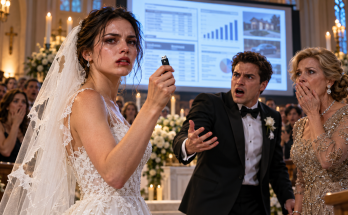
I also remembered Rebecca entering with Thomas, Eleanor standing to challenge Vivian, and the screen revealing documents Ethan believed he had concealed. I remembered placing the ring on the altar and walking toward the doors. Most of all, I remembered the moment outside when Samuel handed me the wooden box containing Arthur's key. At the time, I did not understand how important that gift would become. I thought it represented one more responsibility my father had left behind. Now I knew it had opened a path toward work that gave my life a purpose beyond the struggle with Ethan.
Pastor Reeves eventually returned and sat several feet away. He apologized for failing to intervene when Ethan made his humiliating remark at the altar. He said he had been uncertain how to respond and had allowed the ceremony to proceed despite recognizing that something was wrong. I appreciated his willingness to acknowledge that failure without offering excuses. I told him the responsibility for hurting me belonged to Ethan, but that people who witnessed cruelty could make a difference by refusing to treat it as ordinary. He nodded and said he had thought about that morning often.
Before leaving, I walked to the front of the chapel and stood beside the altar. I placed my hand on the smooth wood, remembering the cold weight of the flash drive hidden beneath my bouquet. The device had contained evidence carefully assembled over months, but its importance was not simply that it embarrassed Ethan. It allowed the people gathered there to see facts he had tried to conceal. I had been afraid that speaking would destroy my future. In reality, remaining silent would have allowed him to control it.
When I stepped outside, the sky had turned pale gold. A breeze moved through the trees, and the chapel bells began ringing for the evening service. I stood on the steps without hurrying toward my car. The last time I had left that building, I wore a damaged wedding dress and wondered whether I would ever feel safe again. Now I was still learning, still recovering, and still uncertain about parts of my future. But those uncertainties belonged to me. They were not imposed by someone demanding my obedience.
I drove to Virginia the following morning. At the old house, I opened the workshop door and found Samuel reviewing drawings with two young engineers. They greeted me, then returned to a discussion about the prototype's sensor system. I hung my coat beside the entrance and joined them. The work was ordinary and difficult. There were questions to answer, measurements to repeat, and costs to examine. Nobody expected miracles. Nobody needed me to surrender my judgment to prove that I trusted them.
Later, when the others went to lunch, I opened Arthur's notebook to the page where he first described Project Second Chance. Beneath the calculations, he had written a brief reminder to himself: the purpose of the machine was to assist the person using it, not to make that person dependent on the machine. I traced the line with my eyes. It expressed something larger than engineering. Genuine help increased another person's ability to choose. Ethan had called his control protection, but he had sought the opposite.
I closed the notebook and looked around the workshop. My father was gone, and no achievement could change that. The money Hartwell recovered could not restore the trust Ethan had destroyed. Legal consequences could establish responsibility, but they could not erase every injury. Project Second Chance might one day help patients, or it might teach its researchers valuable lessons without becoming a finished product. I accepted those uncertainties because the work was honest.
Outside, sunlight reached across the gravel toward the old house. I could hear Samuel laughing at something one of the engineers had said. I picked up my notes and went to join them.
A year earlier, I had walked toward an altar believing I needed to prove that I could stand against the man who intended to control my life. I no longer needed to prove it. I had protected my father's company, helped expose the fraud, refused a marriage built on coercion, and chosen to continue work that might benefit people I had never met.
The future was not the life I once imagined. It was mine to build, one careful decision at a time.
The End
Read more original stories on Feel Every Story.