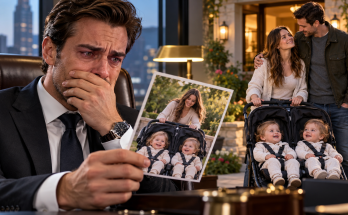
The first thing I noticed the following morning was that the photograph of Elena had been moved. I had left it beside Renata's drawing on my study desk, angled toward the window. Now it faced the wall. Nothing else appeared disturbed. The documents remained inside their locked case, the drawers were closed, and the windows were secured. Yet that small change told me someone had entered the room while I slept. I stood in the doorway, looking at the back of the frame, and felt the old familiar pressure of being watched inside my own home.
I called Teresa before touching anything. She arrived carrying a basket of freshly folded laundry, her expression changing when she saw me standing beside the desk. I asked whether she had entered the study during the night. She shook her head. “I finished downstairs before ten, Mr. Mauricio. After that, I stayed in my quarters.” I asked about my parents. Teresa hesitated. “Your father was awake late. I heard him speaking in the library.” When I asked whether anyone else had been in the house, she mentioned hearing the front entrance open shortly after midnight. She had assumed Vittorio was seeing off a visitor.
I turned the photograph around. Elena's face looked back at me, tired and determined, her arms wrapped protectively around the infant. Whoever had moved the frame might have done so for an innocent reason. My mother sometimes rearranged objects without thinking. My father had never respected a closed door. But after the threatening message, I could not dismiss the possibility that someone wanted me to know my privacy was an illusion. I photographed the desk, checked the security system, and discovered that the study corridor camera had stopped recording at 11:47 the previous night.
The interruption lasted nineteen minutes. The system reported a maintenance command entered through an administrator account. I had not authorized maintenance, and there was no scheduled service. I copied the log to a secure device and called Samuel. He advised me to preserve the original records and report the suspicious access rather than attempting to identify the visitor myself. I followed his advice. Then I contacted the security company and requested an independent review of the administrator accounts. For years, my father had controlled the estate's arrangements. I had never considered that dependence dangerous until now.
Renata appeared in the doorway wearing her yellow pajamas and carrying her stuffed rabbit by one ear. “Daddy, you look worried again.” I crouched beside her. “I'm thinking about something important.” She studied the photograph. “Did the lady make you sad?” I looked at Elena's face. “Sometimes remembering someone makes you sad because you miss them.” Renata considered this with the seriousness she brought to questions about the world. “But you can be happy you remember them too.” I drew her into my arms. “Yes, sweetheart. You can.”
We ate breakfast together in the kitchen. I asked Teresa to remain with Renata while I attended another meeting with Samuel. She agreed, but before I left, she touched my sleeve. “There is something I should tell you about Mr. Keller,” she said quietly. “When Miss Elena came to the back entrance, he wasn't alone. There was a woman waiting in his car. I never saw her face clearly, but I remember a red scarf tied around her hair.” I asked why she had not mentioned the woman earlier. Teresa looked ashamed. “I thought she was only a passenger. Now I don't know what matters.”
I told her that small details sometimes mattered more than anyone realized. Then I wrote down her description and asked her to tell Samuel directly when he took her formal statement. As I drove away, I kept imagining Elena standing in the rain while Keller waited beside his car. I had pictured that scene repeatedly since Teresa described it, but now a second figure occupied the shadows. Had the woman in the car been there to help Elena, to supervise her, or simply to witness what happened? I did not know. I was learning how dangerous it could be to fill gaps in evidence with whatever story seemed most satisfying.
Samuel was waiting when I reached his office. Beside him sat a woman in her late forties, wearing a gray jacket and holding a leather handbag across her knees. Her brown hair was cut just below her chin, and she appeared uncomfortable beneath the bright conference-room lights. Samuel introduced her as Claire Donovan. I recognized her immediately, although the years had altered her face. She had worked at Martin Keller's firm during the period surrounding Renata's adoption. She rose when I entered, but she did not offer her hand.
“I've wanted to speak with you for a long time,” she said. Her voice was soft and precise. I sat opposite her, conscious of the effort it seemed to cost her simply to remain in the room. Samuel explained that Claire had agreed to provide information voluntarily, subject to legal protections and review of any confidentiality obligations. She had already identified several documents she believed were connected to Renata's case. He cautioned both of us to keep the conversation factual. Claire nodded. I opened my notebook and asked her to begin wherever she felt the history first became important.
She told me that Keller's office had handled confidential matters for my father long before Elena disappeared. Some concerned legitimate business transactions. Others involved personal arrangements that Claire had been instructed not to discuss. She had been a junior records administrator, responsible for organizing files, preparing correspondence, and maintaining restricted archives. Keller was meticulous about separating ordinary client records from material he considered unusually sensitive. Those restricted records were kept in a locked cabinet, accessible only to a few employees. Claire had sometimes been asked to catalogue them.
“Did you see Elena's name?” I asked. Claire lowered her eyes. “Yes. Before I understood who she was.” She explained that a file bearing Elena's name had appeared in the restricted archive shortly after my father arranged for me to travel on business. At first, it contained correspondence about a personal dispute and several notes regarding future communications. Later, it expanded to include medical information, financial arrangements, and documents concerning a child. Claire had been told that the matter involved a vulnerable woman receiving assistance from a wealthy family. She had believed that explanation until inconsistencies began appearing.
She described two sets of records. One was prepared for formal proceedings and contained the information needed to support Renata's adoption. The other held background documents that explained how certain decisions had been made. The second file was not an ordinary duplicate. It included correspondence omitted from the first, records showing that Elena had attempted to contact me, and instructions about how information should be presented to various parties. Claire said she never saw a complete copy, but she had handled enough pages to recognize the difference.
I asked whether my father had authorized the separation. Claire hesitated. “His name appeared on some correspondence, but I can't tell you that he knew every detail.” She glanced at Samuel before continuing. “Martin Keller directed the office staff. Adrian Vale sometimes delivered instructions through Keller. We were told to treat those instructions as urgent.” I remembered my father's admission that Vale had promised to manage Elena's situation. The words sounded different now. Management had apparently meant deciding what each person could know, then storing the contradictions in a separate place.
“Why did you leave the firm?” I asked. Claire pressed her palms together. “Because I found a letter that should have been delivered to you.” She explained that Elena had written several messages during the period when she was being kept away from me. One had arrived through a medical intermediary and was addressed unmistakably to Mauricio DeLuca. It contained information about Renata's birth and asked that I be permitted to see the child. Claire had prepared it for dispatch according to the office's usual procedures. Keller later returned it with instructions to place it in the restricted file.
She had questioned the decision. Keller told her that direct contact would expose Elena and her daughter to danger. When Claire asked what danger, he said the situation was more complicated than she understood. She accepted that answer for a while. Then she discovered that correspondence supposedly sent to Elena had also been retained. Some letters from my family were missing from the outward dispatch records, while others had been rewritten before delivery. Claire began to suspect that both Elena and I were receiving carefully controlled versions of the truth.
The room felt suddenly airless. I remembered the short note that supposedly ended my relationship with Elena. I remembered writing letters afterward, leaving messages, and asking my parents whether anyone had heard from her. I had assumed silence meant refusal. Claire watched me struggling to absorb what she had said. “I don't know where all your letters went,” she said. “I never handled every piece of correspondence. But I saw enough to understand that the communication was not honest.” Her restraint made her testimony more convincing than a dramatic accusation would have been.
Samuel asked Claire about the second adoption file. She explained that Daniel Mercer, the records custodian, had been instructed to transfer restricted materials into long-term storage when Keller's firm reorganized. Mercer had maintained a coded inventory. Claire believed one box concerned Elena and Renata, although she could not remember its final location. Before leaving the firm, she copied several inventory references and dates. She had kept them for years, uncertain whether exposing the information would help the people involved or place them at greater risk.
“Why come forward now?” I asked. Claire looked toward the window. “Because someone contacted me six weeks ago and asked whether I still had the inventory references.” I felt my attention sharpen. She said the caller claimed to represent Elena Rossi. The person knew details of the restricted archive that had never been publicly disclosed. Claire refused to share the references without verifying the caller's identity. Several days later, she received a second call warning her not to speak to me or Samuel Price.
I showed her the threatening message from my telephone. Claire read it carefully, then shook her head. “I can't identify the sender. But the language reminds me of the warnings we received when Vale was involved.” She explained that Vale rarely issued direct threats. Instead, he framed obedience as the only sensible way to protect someone vulnerable. He made disobedience sound irresponsible. I thought of my father's repeated insistence that every deception had been necessary for someone's safety. Perhaps he had learned that language from the man he employed.
Claire opened her handbag and removed a small envelope. Inside were copies of inventory pages, a handwritten list of dates, and a photograph of a storage label. Samuel examined the documents before passing them to me. The label bore a reference number, a date, and the letters E.R. Beneath them was a second identifier that Claire said had been added after Renata's adoption was finalized. It appeared that someone had continued accessing the restricted material long after Elena supposedly died.
I looked at the final recorded access date. It was less than a year old. The realization unsettled me more than the older evidence. The deception had not simply been committed years ago and abandoned. Someone had maintained an interest in the file while Renata was growing up in my care. I imagined her first day at preschool, her birthday parties, the evenings when she fell asleep against my shoulder. Somewhere during those ordinary moments, a stranger had been checking records that could alter her life.
Samuel asked Claire whether she had any reason to believe Elena was alive. She shook her head slowly. “I never saw a death certificate. I heard Keller say she had been transferred to another facility. Later, people in the office were told she had died. But nobody showed us documentation.” She paused. “There was a nurse involved. Her name was Margaret Ellis. She handled some of the communications from the medical facility.” I wrote the name down. Claire watched my pen move. “I don't know whether she is still alive. But she knew more about Elena's condition than anyone in Keller's office.”
The mention of a nurse gave the medical photograph new significance. I asked Claire whether Margaret Ellis might have been the woman Teresa saw in Keller's car. Claire said Margaret sometimes wore a red scarf, although she could not be certain the two women were the same. My mind raced toward the possibility, but Samuel intervened gently. “We should treat that as a lead, not an identification.” I nodded. The discipline was becoming familiar, even when it frustrated me. Every false certainty risked sending us away from the truth.
After Claire left, Samuel and I reviewed the documents. The inventory references appeared genuine, but retrieving the underlying records would require cooperation from Mercer or formal legal procedures. Samuel had already contacted Mercer through counsel. He hoped to arrange a meeting soon. We also discussed the threats. I had reported the suspicious message and the security-system interruption, and Samuel recommended that I remain alert without making assumptions about who was responsible. He advised me not to discuss the investigation with anyone beyond those who needed to know.
I drove home in the late afternoon, carrying copies of Claire's records in a locked case. The estate appeared peaceful beneath a pale sky. Gardeners worked near the fountain, and Renata's bicycle stood beside the front steps. I found her in the kitchen helping Teresa arrange strawberries on a plate. She greeted me with sticky fingers and a detailed account of how she had learned to cut soft fruit using a child-safe knife. I listened, washed her hands with her, and sat down while she offered me the largest strawberry.
My father entered while we were eating. He looked tired, but his voice was carefully casual. “Mauricio, I heard you met someone from Keller's old office.” I stared at him. I had told no one at the estate. Teresa looked down at the counter. Renata continued eating, unaware of the tension. I asked my father where he had heard that. He said an acquaintance had mentioned seeing me downtown. The explanation was possible, but it did not satisfy me. Samuel's meeting had been private. I wondered whether Claire had been watched.
I asked Teresa to take Renata into the garden. Once they were gone, I turned to my father. “Who is still reporting to you about this investigation?” Vittorio's face hardened. “I have spent my life maintaining relationships. People tell me things.” I placed the strawberry plate on the table. “Then tell your relationships to stay away from my daughter.” His anger flared. “Everything I did was meant to protect this family.” I looked at him steadily. “You keep saying that. But every new fact shows how much harm your protection caused.”
He gripped the back of a chair. “There are details you don't understand.” I told him about the second file, the intercepted letters, and the evidence that someone had accessed the records recently. His expression changed when I mentioned the last point. He asked for the date. I gave it. He lowered himself into the chair, staring at the floor. “That was after Keller became ill,” he said quietly. I had not known Keller was sick. My father explained that the attorney had suffered a serious stroke and withdrawn from active work. His firm had been reorganized soon afterward.
“Who controlled the files after that?” I asked. Vittorio rubbed his forehead. “I don't know.” I did not believe that he knew nothing, but his alarm seemed genuine. He looked toward the garden where Renata was playing. “If someone accessed those records after Keller was gone, then Vale may not be acting alone.” I asked whether Vale had contacted him recently. My father hesitated, then admitted receiving several calls. He claimed he had refused to discuss Elena. I asked why he had not told me. “Because I thought ignoring him would make it stop.”
I stood without answering. My father reached toward me, then withdrew his hand. “Mauricio, I know I've failed you.” The words were quieter than anything he had said before. I looked at the man who had once seemed incapable of doubt. “You didn't simply fail to tell me something,” I said. “You made decisions about my life and Elena's life without our consent. And you allowed Renata to grow up inside a lie.” He lowered his head. For once, he did not argue.
That evening, after Renata had gone to bed, Samuel called again. Daniel Mercer had agreed to speak, but only under controlled conditions. He was frightened, Samuel said, and insisted that the records could place him in danger if handled carelessly. He claimed he had preserved a sealed package because he believed the instructions for destroying it were improper. The package was connected to the restricted archive, and Mercer wanted legal assurance before releasing it.
Samuel's voice became more serious. “Mauricio, Mercer says the package includes a statement from Elena herself. He claims it was recorded after the date your parents say she died.” I stood beside the study window, looking into the dark garden. The glass reflected my face, drawn and pale. For seven years I had mourned a woman whose death had never been proved. Now a witness claimed to possess her words from a time when I believed she was already gone.
I asked whether Mercer had heard the recording. Samuel said he had not, but the custodian knew its label and the circumstances in which it was stored. A meeting had been arranged for the next day. Before ending the call, Samuel warned me not to tell my parents about the recording until its authenticity could be examined. I agreed. Then I placed the telephone on the desk and looked at Elena's photograph.
The questions that had tormented me were changing. I no longer asked only why she had disappeared or why my parents lied. I wanted to know what Elena had said when she was finally able to speak for herself, and who had decided that I should never hear it. I took Renata's drawing from beside the photograph and placed it inside the locked case with the documents. The following day, I would listen to whatever remained of Elena's voice. I knew that once I heard it, I could never return to the life I had believed was mine.