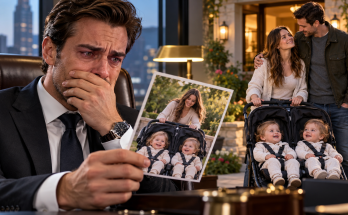
The message arrived shortly after midnight, when the house had finally become quiet. I was sitting at the study desk, comparing photographs of Elena with the documents Samuel had given me. Renata had fallen asleep upstairs after insisting I read her favorite story twice. I had promised to check on her before going to bed, but the hours kept slipping past as I searched for dates and connections. Then my telephone lit up with a message from an unknown number. It contained only a sentence: Stop looking for Elena if you want the child to remain safe.
I read it three times. The wording was deliberate. It did not threaten me directly, and it did not identify Renata by name. Yet it made clear that whoever sent it knew about my search and understood precisely where I was most vulnerable. I took a screenshot and forwarded it to Samuel, then saved the message without replying. My first instinct was to race upstairs and check Renata's room. I forced myself to walk rather than run. She was sleeping on her side, one hand tucked beneath her cheek, her stuffed rabbit pressed against her chest.
I stood in the doorway until my breathing settled. The message had turned my private investigation into something more urgent. I did not know whether it was a serious threat, a crude attempt at intimidation, or an effort to prevent me from discovering something that would embarrass powerful people. I knew only that I could not ignore it. I checked the locks on the windows and doors, then arranged for the security system to alert me directly if anyone entered the property during the night. I also decided that Renata would not be left alone with anyone outside the small circle of people I trusted.
In the morning, Samuel called before breakfast. He had received the message and advised me to document it for the authorities. He also wanted to move our next meeting forward. I told him about the note hidden in the blanket and the possibility of a second adoption file. He said he had been pursuing that possibility through a separate channel. “There's something you need to see,” he added. His voice was unusually serious. I asked whether it concerned Elena. “Yes,” he said. “And I believe it may explain why someone is trying to frighten you away.”
I left Renata with Teresa and drove to Samuel's office. The morning traffic moved slowly through streets washed clean by overnight rain. At a red light, I caught my reflection in the rearview mirror. I looked exhausted, with dark circles beneath my eyes and a day's stubble along my jaw. Seven years earlier, I had searched for Elena with the same sleepless determination. Back then, I had eventually accepted my parents' explanation because every path seemed to end in silence. This time I had Renata to protect, and silence was no longer an acceptable answer.
Samuel greeted me without ceremony. On the conference table lay several documents, including a copy of the note from the blanket. He had arranged for an experienced document examiner to assess its physical characteristics, but the work was not yet complete. More importantly, he had located references to a second file in correspondence involving Martin Keller. The records suggested that certain materials concerning Renata's biological family had been kept separately from the documents used to finalize the adoption. Samuel emphasized that he still needed the originals before he could determine exactly why.
“Who has the second file?” I asked. Samuel placed a sheet of paper before me. It listed the name of a private records custodian who had handled archival materials for Keller's firm. The custodian had since retired, but Samuel had obtained contact information through professional channels. The man's name was Daniel Mercer. I had never heard of him. Samuel explained that Mercer might possess records, or at least remember what had happened to them. We agreed that Samuel would make the first approach, supported by an appropriate legal request, rather than risk alerting anyone who might interfere.
Then Samuel showed me another document. It was not an official record but a copy of correspondence dated several years after Elena's disappearance. The letter had been sent to a person whose name was partially obscured. It referred to an individual using Elena Rossi's name and questioned whether previous information about her death was accurate. I leaned forward, searching the page for context. The language was cautious, almost clinical. It did not prove Elena was alive, but it demonstrated that someone had been asking the same question long before I received the envelope.
“Why wasn't this brought to me?” I asked. Samuel shook his head. “I don't know who received the original or what action they took. The surviving copy was found among unrelated materials.” I studied the date. By then Renata had already been living with me. I remembered taking her to a park that summer, watching her wobble across the grass on uncertain legs. Somewhere, at the same time, a letter had existed questioning the death of her biological mother. I wondered how many opportunities to discover the truth had passed unnoticed.
Samuel asked me to describe my last conversation with Elena before her disappearance. I closed my eyes briefly, trying to separate memory from everything I had learned since. We had argued about where we would live after the wedding. My parents wanted us on the estate, but Elena preferred a modest apartment closer to her school. She worried that moving into my family's home would allow my parents to influence every decision we made. I had insisted they meant well. She had looked at me for a long moment and asked whether I would recognize control if it came disguised as concern.
I had been offended. Instead of listening, I had accused her of judging my family unfairly. We ended the evening without resolving the argument. The next morning, my father sent me away on business. By the time I returned, Elena was gone. I told Samuel everything, including how stubbornly I had defended my parents. He listened without offering sympathy that would have felt undeserved. When I finished, he said, “You made mistakes in that relationship. That does not justify anyone deliberately preventing you from knowing about your child.”
His words stayed with me as we reviewed the remaining documents. I had spent years regretting my final conversation with Elena, imagining that my impatience had driven her away. Now the evidence suggested something more complicated. She may have been isolated from me at the very moment she needed support. The possibility did not erase my mistakes, but it challenged the story I had told myself about her departure. I began to understand that guilt, like grief, could become a convenient explanation when the truth was kept out of reach.
Near noon, Samuel received a call from his assistant. He listened for a moment, then asked that the information be sent securely. After ending the call, he told me that an investigator had located a possible connection between Daniel Mercer and a former employee of Keller's firm. The employee had left unexpectedly around the time Renata's adoption was finalized. Her name was Claire Donovan. Samuel could not yet say whether she had handled the records, but a surviving contact list placed her in the department responsible for sensitive client files.
The name stirred a faint memory. I had attended several meetings at Keller's office years earlier, and a woman named Claire had sometimes brought documents into the conference room. She was quiet, efficient, and seemed uncomfortable whenever Keller raised his voice. I remembered one occasion when she entered the room to ask him about a signature. He dismissed her sharply, and she left without looking at anyone. At the time, I thought nothing of it. Now I wondered whether she had known more than she was permitted to say.
Samuel explained that Claire might be able to clarify how the records were prepared and whether anyone had ordered them altered. However, locating her could take time, and there was no guarantee she would cooperate. I told him to proceed lawfully and keep me informed of any material developments. He nodded, then placed a printed copy of the threatening message beside the correspondence. “We should consider whether the timing is connected,” he said. “Someone may know that records are being examined. But we cannot assume the sender is the same person behind the petition.”
I left the office with copies of the new material and a clearer sense of how little I still knew. The name Elena Rossi appeared in too many conflicting accounts. My parents insisted she had died. Samuel could not verify her death. Someone had filed a petition using her identity. An old letter questioned the original account, and a hidden note pointed toward records concealed from me. Each clue seemed to open another door, but none yet revealed who stood on the other side.
When I reached the estate, I found my father waiting in the library. He had removed his jacket and rolled up his sleeves, a sign that he expected a difficult conversation. He asked me to sit. I remained standing. “I know you've been meeting with Price,” he said. I asked how he knew. “People talk.” I thought of the threatening message and felt my anger sharpen. “Did someone tell you to frighten me into stopping?” Vittorio looked genuinely startled. “What are you talking about?” I showed him the message on my telephone.
He read it twice. The color drained from his face. “Who sent this?” he asked. “That's what I intend to find out.” My father handed back the telephone. For once, he did not attempt to dismiss my concern. Instead, he moved to the fireplace and stared at the cold ashes. “Mauricio, there were people involved in Elena's situation who were not part of our family. I thought I could manage them.” I waited. He rubbed a hand across his forehead. “I was wrong.”
I asked him to name those people. He mentioned Keller, then stopped. I pressed him. Finally he admitted that Keller had introduced him to a man who claimed he could resolve the difficulties surrounding Elena and the baby without public scandal. My father described the man as an intermediary who specialized in sensitive family matters. I asked for his name. Vittorio hesitated so long that I thought he would refuse. Then he said, “Adrian Vale.” The name meant nothing to me, but the way my father spoke it made clear that it carried weight.
“What did Vale do?” I asked. Vittorio lowered himself into a chair. “He arranged meetings, handled communications, and said he could keep everyone protected.” I looked at him in disbelief. “Protected from whom?” My father stared at his hands. “That is what I should have asked.” I could hear the fear beneath his anger now. He had made an agreement with someone whose methods he did not fully understand. Worse, he had allowed that agreement to affect Elena and Renata. I asked whether Vale had been the man who took Elena from the estate.
Vittorio shook his head. “Keller went to meet her that evening. Vale handled what followed.” I asked what that meant. My father said he had been assured Elena would receive assistance and remain safely away from the family until matters were settled. He claimed he had not known she would be unreachable afterward. I wanted to believe him, but his earlier lies made every explanation difficult to accept. “Did you ever try to find her?” I asked. His silence was answer enough.
My mother entered before I could continue. She had apparently been listening outside the library. Her face was pale, and she held an old photograph in her trembling hands. “Vittorio, tell him about the hospital,” she said. My father looked at her with sudden alarm. “Carmen, not now.” She crossed the room and placed the photograph on the table. It showed Elena seated beside a window, holding a baby. The room behind her was unmistakably medical, with a hospital bed and equipment partially visible.
I picked up the photograph. Elena looked exhausted but alive, and the baby in her arms was wrapped in the same pink blanket I had found in the storage room. On the back, someone had written a date and a location. I recognized the city, but not the facility. Carmen explained that the picture had been sent to them after Elena's supposed disappearance. “We were told she was recovering,” she said. “Then later they told us there had been complications.” My father lowered his head.
“Who told you?” I asked. Carmen looked at Vittorio. He did not answer. “Adrian Vale?” I pressed. She nodded. I placed the photograph beside my telephone and copied the details on the back. The date did not fit neatly with the version of Elena's death I had been told. I wanted to confront my parents with every contradiction, but I knew that shouting would not create missing records. I asked whether they possessed any letters, medical documents, or communications from that period. Carmen said she had kept a box.
She led me upstairs to a narrow room beside her bedroom. Inside a locked cabinet, she removed a wooden box containing old correspondence. Several envelopes bore no return addresses. Others displayed Keller's firm's name. There were receipts, notes, and a few photographs. I carried the box to a table and began arranging the contents by date. My mother watched silently. When I found a document referring to the transfer of personal belongings from the medical facility, she covered her mouth with one hand.
Among the papers was a letter from Adrian Vale. It referred to the need for continued discretion and warned against contacting Elena directly. The language was careful, avoiding explicit threats while making the consequences of interference sound severe. I photographed the page and placed it with the other evidence. Then I found a small card bearing a telephone number and the initials C.D. I looked at my mother. She said she did not remember it. Her uncertainty might have been genuine. I no longer trusted my ability to tell.
I called Samuel from the hallway and described what we had discovered. He advised me to secure the box and avoid altering the documents. When I mentioned Adrian Vale, his voice changed. He asked me to repeat the name. I did. There was a pause long enough for me to hear the faint rustling of papers at his end. “Mauricio,” he said, “that name has appeared in another part of the investigation. I wasn't certain it referred to the same person.”
I asked where. Samuel explained that someone connected to the petition had listed a former representative named Adrian Vale in older correspondence. The connection did not establish that Vale had filed the petition, but it suggested his involvement might have continued beyond the original adoption. I looked back toward the room where my mother stood beside the open box. The people who had controlled Elena's communications years earlier might still be influencing what happened to Renata. The thought made me feel as though the walls of the estate had grown closer.
After ending the call, I returned to Renata. She was sitting on the floor with Teresa, building a tower from wooden blocks. She looked up and smiled. For a few minutes, I helped her arrange the pieces, balancing the smallest blocks on top. When the tower fell, she laughed and immediately began again. Her ease was a relief. She did not know how much of her past was being reconstructed in another room. I intended to keep it that way until I had reliable answers.
That evening, I took Renata for a short walk in the garden. The air smelled of damp earth and roses. She held my hand and told me that when she grew older, she wanted to be an artist and paint animals that did not exist. I asked what kind. She described a bird with four wings and a rabbit with a lion's tail. I listened, smiling despite the weight in my chest. The garden had been a place where my parents exercised quiet authority over every detail. Walking there with Renata, I began to imagine a life beyond the estate, one where she would not have to measure her words against someone else's expectations.
When we returned, Teresa told me that Samuel had called. He had received a response from a contact regarding the medical facility shown in the photograph. I settled Renata with her supper, then returned the call. Samuel said the facility had changed ownership years earlier, but some historical records might still exist. He had also received information suggesting that the location had been used by private clients seeking confidentiality. He was careful not to promise that Elena's records would be found. Still, for the first time, we had a specific place to investigate rather than a chain of family recollections.
Then Samuel told me something that changed my plans. An attorney representing the petitioner had agreed to communicate through formal channels. The petitioner was still identified as Elena Rossi, but verification remained pending. Samuel had requested a confidential meeting under conditions designed to protect all parties. No date had been confirmed. I asked whether he believed the petitioner was truly Elena. “I believe we are closer to answering that question,” he said. “But I won't give you certainty before the evidence supports it.”
I stood beside the study window after the call, watching the lights come on along the driveway. Somewhere beyond the estate, someone was using Elena's name to challenge Renata's adoption. My parents had concealed her existence from me, a lawyer had helped manage her disappearance, and an intermediary whose name I had never heard had apparently remained connected to events for years. I had begun this investigation expecting to discover why my family lied. Now I needed to know whether the woman I loved had survived those lies.
I gathered the documents into a secure case and wrote down every name that had emerged: Carmen DeLuca, Vittorio DeLuca, Martin Keller, Daniel Mercer, Claire Donovan, Adrian Vale, and Samuel Price. Beside Elena's name, I left an empty space. I did not know whether she was alive, where she might be, or whether the petition represented her wishes. Yet I knew that my search could no longer be confined to my family's version of the past.
Before bed, Renata asked whether I would be home the next morning. I told her I would be there when she woke, though I might have to leave afterward for an appointment. She nodded, satisfied by the answer, and pulled her blanket beneath her chin. I kissed her forehead and turned out the lamp. In the hallway, I stopped beside the closed door and listened to the quiet of the house.
I had spent seven years accepting a death that no one could prove, and four years raising a child whose history had been deliberately obscured. The next decisions could affect every person involved, most of all Renata. I could not rush toward an unverified claim merely because I wanted Elena to be alive. Nor could I retreat into the comfort of the life my parents had arranged. I called Samuel once more and confirmed that I would cooperate fully with the investigation, preserve the evidence, and seek independent verification of every important claim.
When I finally returned to the study, the photograph of Elena stood beside Renata's drawing. One showed a frightened young mother holding a newborn. The other showed a child imagining a family in which everyone could stand together beneath the same sun. I looked at them both and understood the choice before me. I would follow the evidence, however painful it became, and protect the daughter who depended on me while I did it. For the first time since Elena disappeared, I was prepared to hear an answer that might change my entire life.