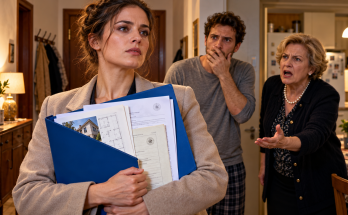
Fourteen days after the funeral, my father appeared at my front door wearing an expensive black coat and carrying no flowers. My mother stood beside him with her handbag clasped in both hands. Vanessa was already checking her reflection in the glass panel beside the door, smoothing her hair as though she had arrived for lunch. I watched them through the hallway window for several seconds before opening it. None had called to ask whether I wanted visitors. Mother had simply sent a message that morning saying the family needed to discuss something important.
The house had become a place of small, almost unbearable sounds. The refrigerator clicked on and off. Rainwater dripped from the gutters. Occasionally the swing outside tapped against the oak tree, and I would turn toward the noise before remembering that Rose was not playing in the yard. I had slept badly and eaten very little. I wore Daniel's gray cardigan over a plain dress because it still smelled faintly of him. When I opened the door, my mother examined me from head to toe.
“Oh, Claire.” She reached forward and gave me a stiff embrace. “You look exhausted. Have you been taking care of yourself at all?”
Before I could answer, Vanessa stepped around us. “It's freezing in here,” she complained, heading toward the kitchen. “You should turn the heat up. Honestly, this place feels abandoned.”
My father entered last. He had founded Holloway Development when I was young and built it into a successful contracting business through a combination of ambition, charm, and an extraordinary ability to make other people feel indebted to him. He had always treated a room as something to assess before beginning a conversation. Now his eyes moved across the living room, past the windows overlooking the lake, toward the staircase and the renovated kitchen beyond it.
“You've kept everything exactly the same,” he observed.
“It's been two weeks.”
“Yes, well.” He removed his coat and folded it over his arm. “At some point, you'll need to start making practical decisions.”
I waited for him to ask about Daniel. He did not. Mother wandered toward the mantel, where a photograph showed Daniel standing on a beach with Eli on his shoulders and Rose clinging to his leg. The picture had been taken during our last summer vacation. Rose was laughing so hard that her eyes were closed. Mother glanced at it, then began straightening the decorative candles beside the frame.
Vanessa returned from the kitchen carrying a bottled drink from my refrigerator. She had not asked before opening it. “You can't possibly want to stay in this enormous house by yourself,” she said. “There are four bedrooms upstairs, that whole guest suite, and the lakefront property to maintain. It's too much responsibility.”
“I haven't decided anything about the house,” I replied.
Dad seated himself in Daniel's favorite chair. Seeing him there made my stomach tighten. Daniel used to sit in that chair on Sunday mornings while Eli read beside him and Rose built towers out of wooden blocks on the carpet. My father leaned back, crossing one ankle over his knee, and folded his hands as though he were beginning a business meeting. “That's precisely what we've come to discuss.”
He began by explaining the cost of maintaining a lake house. Property taxes, insurance, repairs, and unexpected expenses could become a burden, he said, particularly for someone who had suffered a significant emotional loss. His tone was measured and authoritative. He spoke about my grief as if it were a financial condition that had to be managed rather than the result of losing my entire immediate family.
“I have insurance,” I told him. “Daniel and I planned for emergencies.”
“Money isn't the only issue. You might not be thinking clearly right now. That's perfectly understandable.” He glanced toward Mother, who nodded at once. “A responsible family steps in when someone isn't in a position to handle complicated decisions.”
I looked from one face to another. “What decision have you already made?”
Vanessa settled on the sofa, pulling a cushion into her lap. “Dad thinks the house could be put to much better use. You know that my husband and I have been discussing a change. We've outgrown our apartment, and we'd love somewhere peaceful where we could make a fresh start.”
I had heard enough about Vanessa's apartment to know it was larger than the first house Daniel and I had rented. She and her husband spent money rapidly and complained about financial pressure just as often. Their expenses included weekend trips, carefully staged parties, designer clothes, and a steady stream of purchases for Vanessa's event and lifestyle business. She called it building her brand. Daniel once quietly observed that a profitable company and an expensive hobby were not necessarily the same thing.
“You want to buy my house?” I asked.
Vanessa exchanged a look with Dad. “Not necessarily buy it in the traditional sense. There are smarter ways to arrange things within a family.”
My father took over. He explained that transferring the property to someone better positioned to maintain it could prevent future difficulties. Vanessa and her husband could live there, take responsibility for the grounds, and keep the house connected to the family. He made it sound like a favor. The more he spoke, the clearer it became that he expected me to surrender ownership or control without receiving anything close to the property's value.
“You're talking about giving Vanessa my home,” I said.
“Don't use words that make everything sound ugly,” Mother replied. “Your sister isn't a stranger. Besides, this house must be filled with painful reminders. A clean break might help you heal.”
I studied her face. She seemed entirely convinced that she was offering sensible advice. “The reminders are the reason I want to stay here.”
Mother pressed her lips together. “Your children would never have wanted you to spend the rest of your life trapped in sadness. And they certainly wouldn't want their aunt struggling when there's a perfectly good house sitting mostly empty.”
For a moment, I could only stare. My children's wishes had become something my mother felt entitled to interpret. Eli, who had carefully saved his allowance to buy Rose a birthday present, and Rose, who used to insist that every family member receive an equal portion of dessert, were being used as arguments in favor of handing over the place where they had lived.
“Please don't tell me what my children would want,” I said.
Vanessa gave a small, impatient laugh. “Nobody's attacking you, Claire. We're trying to solve a problem. You're acting as if we came here to steal something.”
“You came here to ask for my house.”
“We came because you clearly can't manage things properly.” Her gaze moved toward the children's toys near the fireplace. “Look around. You haven't even started clearing any of this away.”
The room went quiet. I followed her gaze to Rose's wooden puzzle, still spread across the rug. Eli's school photograph stood on the nearby bookshelf. I had not moved those things because every time I tried, I felt as though I were helping the world erase them.
My father unfolded himself from Daniel's chair. “That's enough. Claire, nobody expects you to decide today. But refusing to discuss a reasonable arrangement is only going to make things harder. You know I understand property matters. Vanessa needs stability, and you need to be relieved of an unnecessary burden. There is an obvious solution.”
He approached the mantel and looked briefly at the beach photograph. I wondered whether he remembered that Eli had once asked him to attend a school project exhibition, or that Rose had made him a birthday card covered in blue fingerprints. He showed no sign of remembering either child. His attention returned to the house.
I had grown up hearing that Vanessa needed more support because she was emotional, ambitious, sensitive, or misunderstood. When she failed an examination, the family blamed her teachers. When she lost a job, someone had treated her unfairly. When she wanted something expensive, my parents found a reason it was an investment. I had become the daughter who handled difficulties quietly, paid her own bills, and rarely complained. Daniel had never approved of the arrangement, but he had respected my right to make my own decisions about my family.
There was a photograph on the mantel that captured a summer afternoon when Daniel and the children had been building a sandcastle. Eli was giving instructions, Rose was trying to pour water into the moat, and Daniel was laughing because the whole structure was collapsing. I looked at it while my family waited for me to answer. For the first time, I understood that nothing I surrendered would satisfy them. If I gave Vanessa the house, they would praise me for being generous, then expect me to find somewhere else to disappear.
“You've made your position clear,” I said.
Dad nodded, apparently satisfied. “Good. I knew you'd be reasonable once you understood what was at stake.”
I turned toward him. “I do understand. More than I did when you arrived.”
Vanessa's expression softened into a smile she used whenever she believed she was about to receive something valuable. “See? We really can work together. Once you've had time to settle, we can discuss the paperwork.”
I did not correct her. I was too tired to spend another hour explaining why the answer was no. Instead, I opened the front door and told them I needed to rest. Mother objected that they had only just arrived, but my father guided her toward the porch, reminding her that I was emotionally fragile. Vanessa stopped at the doorway and asked whether she could come back the following week to measure some rooms. I told her not to make plans involving my property.
After they left, I walked slowly through the living room. The air still carried Vanessa's perfume, a sweet scent that clashed with Daniel's cardigan. I opened two windows despite the cold. Then I sat on the carpet beside Rose's unfinished puzzle and picked up a piece shaped like a duck. It was astonishing how much more carefully I could hold a child's toy than I had been able to hold a telephone at the cemetery.
That evening, Michael called to ask whether I had eaten. I told him about the visit. He listened without interrupting, then asked a question that caught me off guard. “Claire, do they know what Daniel left you?”
“Daniel's estate? I don't think so. Why?”
“Because the way you're describing this sounds less like concern and more like people checking what they can get their hands on.”
I glanced toward the staircase. Daniel had kept most of our financial affairs organized, though we had always discussed major decisions together. He had named me executor of his estate, and our wills were stored with other important documents. Michael knew Daniel's professional habits. He also knew that my husband had recently been involved in a difficult investigation, although he could not tell me much about it.
“Was Daniel worried about something before the accident?” I asked.
Michael hesitated. “He had a complicated assignment. Some of the findings were bothering him. He told me he was working through the details before deciding what to do.”
“Did it involve my father?”
The silence lasted long enough to make me sit straighter. Michael eventually said, “I don't know the full story, Claire. Daniel kept client matters confidential. But if you're going through his papers, don't throw anything away. And if you find something unusual, take it to someone you trust.”
After the call, I stood outside Daniel's study. For two weeks, I had avoided opening the door because everything inside belonged so completely to him. His desk chair, the books, the pencils sharpened to different lengths, the jacket he kept hanging behind the door. Entering felt like crossing into a room where he might still be working, ready to turn and ask whether I wanted a cup of coffee.
But Michael's hesitation remained with me. So did my father's peculiar interest in the property, and the way Mother had watched the study door when she walked through the hallway. I remembered an evening shortly before the accident when Daniel had ended a phone call abruptly after hearing my footsteps. He had not appeared guilty, exactly. He had looked troubled. When I asked what was wrong, he told me he was trying to verify a few things and would explain once he had the facts.
I did not open the study that night. Instead, I took out the estate documents Daniel and I had signed together, confirmed the arrangements we had made, and placed the folder beside my bed. He had trusted me to handle what remained of our lives. I wanted to understand the responsibilities he had left me before anyone else tried to claim them.
The following morning, Vanessa sent several messages. She mentioned a real estate agent who could provide a valuation and said Dad had some ideas for simplifying the transfer. Her final message suggested that grief might prevent me from recognizing a good opportunity. I did not respond. I saved the messages in a separate folder and turned off notifications.
Then I went upstairs, carried Daniel's spare keys into the study, and sat behind his desk. The wood was marked by a pale coffee ring near the edge, exactly where he always rested his mug. I ran my thumb across the mark, remembering how often I had teased him about damaging the finish. The bottom drawer was locked. Daniel rarely locked anything in our home, and the small brass key on his ring was one I had never needed to use.
When I found the right key, the drawer opened with a reluctant scrape. Inside lay ordinary stationery, several envelopes, and a thick folder bearing a short message in Daniel's handwriting. The message made my breath catch before I had even lifted the cover. It was a set of instructions for what should happen if he was no longer there to explain his work.
I placed the folder on the desk. I knew my husband well enough to understand that he would not have written something so serious without a reason. Then I opened it, and the first page showed the name of my father's company.