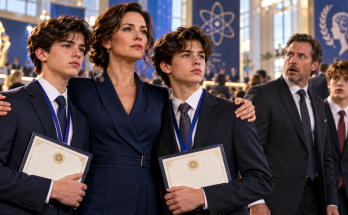
The funeral director was waiting beside the cemetery gates when my father finally answered his phone. I had called him eleven times that morning, and each unanswered ring had left me a little less capable of standing upright. Rain soaked through the shoulders of my black dress. Beyond the windshield, three polished coffins waited beneath a green canopy, surrounded by white flowers and folding chairs. I had arranged everything myself because the people I loved most were inside those coffins. My husband, Daniel. Our son, Eli. Our daughter, Rose. Now the director was asking whether we should begin, and I was still trying to persuade my parents to come.
“Claire?” My father's voice sounded irritated rather than concerned. “What is it now?” Behind him, I heard music, several people talking over one another, and the sharp clatter of dishes. Someone laughed close to the phone. For a moment, I was so confused by those ordinary sounds that I forgot why I had called. The world at the other end of the line was carrying on as though nothing had happened. In mine, three people had died, and I had spent the previous week signing documents that no wife or mother should ever have to touch.
“Dad, they're going to start soon.” I pressed my free hand against the steering wheel to steady myself. “Please tell me you're coming. I can ask them to wait another twenty minutes.”
There was a pause, followed by a muffled exchange with someone beside him. Then he returned, speaking with the patient firmness he used whenever he believed I was being unreasonable. “Claire, we've already explained the situation. Your sister has guests here. The caterers arrived late, and your mother is dealing with everything. This is Vanessa's birthday celebration. We can't simply walk away.”
I watched a cemetery employee straighten the flowers beside Rose's coffin. Someone had placed a little white ribbon among the roses. I had chosen those flowers because my daughter used to collect petals from our garden and arrange them in crooked circles on the kitchen floor. She was six years old. Eli was nine. Neither of them would ever have another birthday. Yet my father was explaining that Vanessa turning twenty-nine required both of my parents to remain at her party.
“Daniel is being buried today,” I told him. My voice barely carried through the phone. “So are your grandchildren. I need you here.”
“I understand you're upset.” He lowered his voice. “But Vanessa only has one twenty-ninth birthday. We arranged this months ago. You know how sensitive she gets when people disappoint her.”
It was a strange moment to remember that my son had once cried for an hour because he believed he had disappointed his grandfather by losing a baseball game. Daniel had knelt beside him afterward, showing him the grass stains on his own trousers and explaining that losing a game was not the same as failing someone. Daniel had been better at those conversations than I was. He knew when to make a joke and when to let silence do the work.
“Please,” I said again. “I don't want to stand there without my family.”
My father exhaled sharply. “You have other people there, don't you? Daniel had colleagues. Friends. There's no reason to make everyone feel guilty because circumstances aren't convenient.”
Then my mother took the phone. I recognized the rustle of her bracelets before she spoke. “Claire, sweetheart, your father isn't trying to upset you. But you cannot turn this into some terrible test of loyalty. There are two daughters in this family.”
I closed my eyes. I could see Vanessa's birthday table without being there: the gold decorations, the expensive cake, my mother adjusting napkins until every corner matched. For weeks, she had been discussing the party's flowers as if they were a diplomatic matter. When Daniel and the children died, I assumed those arrangements would become irrelevant. Instead, the party had remained exactly where it was on the calendar, while three funerals somehow became an inconvenience.
“I'm not asking you to choose between daughters,” I said. “I'm asking you to bury your grandchildren.”
Mother's voice hardened. “That's a cruel way to put it. We'll visit their graves another day. You need to understand that grief doesn't mean everybody else stops living.”
I could not answer. The funeral director was approaching my car with his umbrella tilted against the wind. He stopped a respectful distance away when he noticed the phone against my ear. My father said something in the background, and Mother replied that she would be finished in a moment. Then she told me to take care of myself, and the call ended.
For several seconds, I remained motionless. Water tracked down the windshield, blurring the people gathering beneath the cemetery canopy. I had spent most of my life believing that if something truly terrible happened, my parents would come. They had missed school concerts, graduations, and important dinners, always because Vanessa needed something more urgently. But I had never imagined they could look at the day their grandchildren were being buried and decide that balloons and champagne deserved their attention instead.
The director opened my door and held the umbrella above me. His name was Mr. Harris, and he had developed the careful manner of a man who understood that grief could make the simplest question unbearable. “Mrs. Claire, we can give you a little more time if there's someone you're expecting.”
I looked toward the three coffins. Daniel's was dark walnut, chosen because he had always loved the warmth of natural wood. Eli's and Rose's were smaller and pale. I had hated myself while selecting them, as though the act of choosing meant I had accepted that they belonged inside. “No,” I told Mr. Harris. “Everyone who's coming is here.”
Daniel's former colleagues stood near the front, their coats darkened by rain. His closest friend, Michael, held a folded umbrella and looked as if he had not slept. Our neighbor, Mrs. Bennett, had brought a thermos of tea she kept trying to give me. A few parents from the children's school waited quietly together. People who owed us nothing had rearranged their lives to stand in that cemetery. The three people who had known me since childhood were celebrating with champagne forty minutes away.
The service passed in fragments. I remember the scrape of shoes against wet gravel and the small movement of a minister turning a page. I remember Michael speaking about Daniel's dry humor, his habit of working late when he believed a client was being cheated, and the way he could turn an ordinary Sunday afternoon into an adventure for our children. Michael stopped twice before he finished. I wanted to thank him, but my throat closed whenever I tried.
Someone spoke about Eli, who had been fascinated by bridges and could explain the difference between suspension cables and support beams with the seriousness of a much older child. Someone else remembered Rose bringing injured insects home in tissue boxes because she believed every living thing deserved a chance to recover. I stood with my hands locked together and listened to strangers describe pieces of the life that had once filled my kitchen.
The accident itself had happened so suddenly that my mind still refused to hold it in one complete memory. Daniel had taken the children into town while I stayed home to finish some paperwork. Eli needed supplies for a school project, and Rose had insisted on accompanying them because Daniel had promised hot chocolate afterward. A truck struck their vehicle at an intersection. By the time the hospital contacted me, nothing remained for the doctors to do. For days, I kept remembering Daniel searching for his keys by the front door, Eli calling that he was ready, and Rose running back to kiss my cheek. I had told them to be careful. Daniel had smiled and promised they would be.
When the first coffin was lowered, my knees weakened. Michael stepped closer, but I managed to remain standing. I wanted to reach into the grave and pull Daniel back. I wanted to tell the workers that there had been a mistake, that my children were frightened and would need their blankets. None of those wishes had anywhere to go. The ceremony continued with the indifferent precision of necessary things.
Afterward, people approached me with warm hands and exhausted faces. Some offered meals. Others offered rides, help with paperwork, or simply company. Mrs. Bennett told me she would leave supper on the porch and not knock. Michael said he would come by whenever I needed him. I thanked each person because manners were still available to me when feeling was not.
I returned to our lake house after dark. The building stood among pines, its wide windows facing water that had turned almost black beneath the storm clouds. Daniel and I had bought it years earlier, before Eli was born, when we were earning enough to stop renting but still frightened of taking on a mortgage. The wooden floors creaked near the stairs. A swing hung from the oak tree beside the backyard. Rose had recently tied a blue ribbon around one of its ropes. I saw it moving in the wind as I parked.
Inside, the ordinary evidence of family life was more painful than the funeral had been. Eli's unfinished bridge model covered one end of the dining table. Rose's yellow sweater lay over a kitchen chair. Daniel's reading glasses rested beside a half-finished crossword puzzle. His cedar-scented soap remained near the bathroom sink. Every object suggested that someone had stepped away temporarily and would soon return to collect it.
On the kitchen counter, beside the flowers Mrs. Bennett had delivered, lay a sympathy card from my parents. It was still in its inexpensive envelope, which Mother had apparently dropped off without coming inside. I opened it carefully. A printed message expressed sorrow and offered comfort during difficult times. Neither of my parents had written a word beneath it. Their signatures were absent too. Perhaps they had been too busy getting ready for the party.
I sat at the table and stared at the blank space beneath the printed sentiment. Daniel would have known what to say about it. He had always been able to identify the precise absurdity in my family's behavior without making me feel foolish for loving them. Sometimes he would ask why I kept volunteering to be disappointed. I usually defended my parents, explaining that they were imperfect rather than cruel. Now there was no one beside me to challenge that explanation.
My phone lit up shortly after nine. Vanessa had posted a collection of photographs from her birthday celebration. I opened them almost without thinking. There she was beneath an arch of gold balloons, laughing as my father lifted a champagne glass. Mother stood beside the cake, smiling with the pleased exhaustion of someone whose carefully arranged event had succeeded. Vanessa's husband appeared in several pictures. There were flowers, decorated tables, and a room crowded with guests.
Beneath the photographs, Vanessa had written that the people who truly valued you were the ones who made the effort to be present. I read the sentence twice. The photographs had been taken while Daniel, Eli, and Rose were being lowered into the ground. My father's jacket was the same navy one he wore to business celebrations. Mother had chosen pearl earrings. They looked happy, relaxed, and entirely untouched by what had happened to my family.
I put the phone facedown. I could have called Vanessa and demanded an explanation. I could have written a message describing the coffins, the wet grass, or the silence that had followed me into the house. But an explanation would not change the empty chairs at the cemetery. They had understood what the day meant. They had simply decided to spend it elsewhere.
Near midnight, I went upstairs and opened the door to Daniel's study. His desk faced the lake, and the shelves were crowded with technical manuals, old photographs, and files from his accounting work. He was a forensic accountant, the kind companies and attorneys hired when financial records failed to tell a believable story. He could examine a maze of invoices and discover a missing payment that nobody else had noticed. He used to joke that numbers were far less inventive than people who tried to manipulate them.
I entered only far enough to switch off a desk lamp that had been burning since the day of the accident. On the desk lay a notebook, a pen, and a sealed folder among his work papers. I did not touch anything. Daniel had been unusually distracted during the last week of his life, taking calls behind closed doors and asking questions about my father's development company that I had dismissed as professional curiosity. I remembered him telling me that there were things he needed to verify before discussing them with me.
I closed the study door and returned to the hallway. At that moment, I had no reason to suspect that Daniel's unfinished work would become important to anyone beyond his clients. I believed the worst had already happened, and that the only task remaining was to survive it.
Then, shortly after midnight, my mother sent a message asking me not to hold the birthday celebration against Vanessa. She added that my sister had worked hard to make the occasion special and deserved a little happiness. There was no question about how the funeral had gone, whether I had eaten, or whether I needed someone to stay with me.
I read the message without replying. For the first time in my life, I did not feel an obligation to make my mother comfortable with what she had done. I placed the phone inside a kitchen drawer, turned off the light, and walked upstairs past the two bedrooms that would never again fill with children's voices.
That night, I made one decision that did not require anyone's permission. I would stop asking my parents to behave like people who loved me. I had no idea how far that decision would carry me, or how much they would eventually demand when they discovered I was no longer willing to give them everything they wanted.