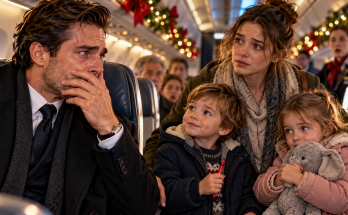
I looked at Luke first because he was closest to me. He had pressed so hard on his red crayon that a corner of the paper tore beneath it. He examined the damage with a frown, then carefully turned the page over and began again. Violet sat with her elephant resting on her knees, watching her mother for signs of trouble. Neither child understood the words Cassandra had just spoken. I did, though understanding was not the same as believing. My son and daughter were sitting within reach, nearly three years old, and until a few minutes earlier I had not known they existed.
I had imagined becoming a father once. Cassandra and I had discussed children during our first year together, long before our relationship became a casualty of my expanding company. She wanted a noisy home where music played in the kitchen and children could leave their shoes by the door without anyone becoming irritated. I used to joke that I would teach them to build machines before they learned to ride bicycles. We disagreed about ordinary things, such as whether children should own pets or how much television was acceptable. Those conversations had felt safely distant. Now I was looking at two real children whose lives had continued without me.
“How long have you known?” I asked. Cassandra's expression changed immediately. It was a small movement, barely more than a tightening around her mouth, but I recognized it as hurt. She told me that she discovered the pregnancy about two weeks after leaving our apartment. The information should not have surprised me, given the dates, but it did. I was struck by the image of her standing alone with a pregnancy test while I was probably preparing for another acquisition meeting. She had always called me first when something important happened, whether the news was wonderful or frightening. This time, apparently, that instinct had led nowhere.
She explained that she initially wanted to tell me in person. She called the number she had used throughout our relationship, only to discover it was no longer active. She contacted my office, leaving her name and requesting a private conversation. An assistant promised to pass along the message. When no reply came, she called again. Another assistant informed her that I was overseas. She sent emails to the business address I had previously used, then tried reaching me through the company's administrative staff. Each attempt ended with the same vague assurance that someone would notify me when my schedule permitted it.
I listened without interrupting. It would have been easy to claim that none of those messages had reached me, but doing so would have avoided the more important question. Why had I created a life in which an ordinary person could not speak to me without passing through several layers of permission? Cassandra described visiting my new apartment after receiving no response. Security refused to allow her upstairs. She offered to wait in the lobby, but the guard told her that unauthorized visitors could not remain on the property. Someone suggested that she contact the company's legal department if her business involved a financial claim.
She looked away while recalling that last remark. I felt heat rise beneath my collar. “They thought I wanted money,” she said. “They didn't ask why I was there. They saw a woman trying to reach a wealthy man and decided they already understood the situation.” I began to apologize, but she raised her hand. She didn't need another polished apology, she told me. She had spent enough time listening to explanations about procedures, schedules, and the demands of my position. What she wanted now was for me to understand what those procedures had cost her. I nodded and let her continue.
During the first months, she still believed I would eventually learn the truth and contact her. She saved copies of the emails and wrote a letter containing the pregnancy dates and her doctor's information. When she learned she was expecting twins, she sent another message because the news seemed too important to leave unspoken. Her pregnancy became increasingly exhausting, and she reduced her teaching hours when she could no longer stand comfortably through long lessons. A friend helped her find additional administrative work she could complete from home. She paid bills carefully and worried about how she would manage when the babies arrived.
“You could have contacted my lawyers,” I said before thinking. Cassandra turned toward me with an expression that made me regret the words immediately. She reminded me that she had been twenty-six years old, frightened, and pregnant. She wasn't filing a lawsuit or negotiating a commercial transaction. She was trying to tell someone she once loved that they were going to have children together. The fact that I regarded attorneys as the natural solution showed how far apart our lives had become. I lowered my eyes. She was right, and no professional explanation could make my response less inadequate.
I asked whether she had ever considered pursuing formal support. She said she had, particularly during the difficult months after the twins' birth. Friends encouraged her to establish paternity and insist that I contribute financially. But Cassandra had been exhausted, overwhelmed, and determined to protect the babies from becoming instruments in a public dispute. She was also painfully aware that I had resources she could not match. She feared a legal battle would consume the time and energy she needed to raise them. Eventually, she decided to build a stable life without expecting anything from me.
Her mother helped during the first weeks after the birth, while her sister took turns staying overnight when possible. Luke arrived shortly before Violet, and both required careful monitoring at first because they were smaller than expected. When Cassandra mentioned the hospital equipment and the anxiety of watching two newborns, I felt the familiar ache associated with Clara. I had spent my professional life trying to prevent families from enduring those experiences, yet I hadn't been present when my own children needed the same care. The contradiction was almost more than I could endure.
She described the months that followed with a restraint that made her account more difficult to hear. There were nights when both babies cried, days when she couldn't remember whether she had eaten, and mornings when she returned to teaching after hardly sleeping. Luke learned to smile before Violet, though Violet began recognizing familiar melodies earlier. Their first steps came several weeks apart. Luke was adventurous and frequently attempted to climb furniture. Violet preferred observing carefully before trying anything unfamiliar. Cassandra spoke about them with unmistakable affection, but I could hear the fatigue beneath her words.
I asked whether they knew anything about their father. Cassandra looked toward the children, who were now sharing the crayon despite Luke's reluctance. She had never told them that their father was dead or that he deliberately abandoned them. She simply explained that their family looked different from some other families and that their mother loved them very much. As they grew older, she knew they would ask more questions. She had no convincing answer prepared for those questions, because she never knew whether I had received her messages or chosen not to respond. Living with that uncertainty had been its own form of punishment.
Luke interrupted us by holding up his drawing. It depicted a large green dinosaur beside a smaller red one, both standing beneath a crooked yellow sun. He explained that the larger dinosaur was guarding the smaller one because a storm was approaching. I studied the picture with a seriousness I normally reserved for engineering plans. When I told him I liked the way he had drawn the dinosaur's legs, he smiled and showed me the crayon that had brought us together. I wondered whether he would remember this conversation when he was older, or whether I was merely another passenger who had admired his artwork.
Violet's elephant slipped from her lap and landed near my shoes. I picked it up carefully, brushing a piece of lint from its worn ear. She accepted it without speaking, but her eyes remained fixed on mine. After a moment, she pointed toward my face and observed that my eyes looked like hers. Luke immediately insisted that his eyes were the same color too. I smiled because the children expected agreement, but the observation struck me with unexpected force. Their resemblance to me was no longer a frightening theory. It was part of the ordinary way they understood themselves, something they had carried since birth without knowing its significance.
Cassandra watched this exchange with an expression I couldn't interpret. I suspected she had spent years noticing those similarities, perhaps with resentment or sadness. Every time Luke smiled, she might have remembered the man who never answered her calls. Every time Violet looked up at her, she might have been reminded of someone she once trusted with her future. I wanted to ask whether she had ever hated me, but the question felt selfish. Her feelings deserved more respect than being reduced to a verdict intended to ease my guilt. Instead, I asked what the children enjoyed doing and listened while she answered.
Luke loved dinosaurs, toy vehicles, and any opportunity to run through puddles. He disliked mushrooms and frequently insisted that socks were unnecessary. Violet preferred picture books, strawberries, and music. She carried Ellie, the gray elephant, almost everywhere, especially when she felt uncertain. Both children enjoyed bedtime stories, although they often requested different endings from the ones their mother read. Cassandra spoke with more ease as she described them. I found myself asking dozens of small questions, each answer revealing another piece of a world that had existed just outside my awareness for nearly three years.
When Cassandra mentioned that Violet had recently been frightened by a thunderstorm, I remembered the turbulence earlier in the flight. I asked how she comforted them when they became upset. She explained that reassurance worked better than pretending there was nothing to fear. She told them what was happening in language they could understand and stayed close until they felt secure. The simplicity of her approach embarrassed me. At work, I had developed an instinct to conceal uncertainty, even when employees would have benefited from honest explanations. Cassandra, with two toddlers and far fewer resources, had learned a form of leadership I had never mastered.
I wanted to make an immediate offer of financial support. The words rose almost automatically, accompanied by calculations of accounts, trusts, and educational investments. But I stopped before speaking. Cassandra had already warned me that money could not repair the years of absence. It could provide security, which mattered, but it could not make Luke remember a father at his second birthday or give Violet someone to hold her during an earlier illness. I realized I was searching for a solution that would allow me to feel effective without enduring the slower work of building relationships.
“Tell me what you need,” I said at last. Cassandra examined me carefully. She had heard that question from me before, usually when I was preparing to purchase something expensive after missing an important occasion. This time, I kept my hands still and waited for an answer rather than offering suggestions. She said she needed stability for the children. Their lives could not be reorganized around my sudden discovery, however sincere my reaction might be. I would have to learn their routines, respect their fears, and accept that she remained the parent they trusted most.
She also needed time to decide how much of our past she could set aside. I told her I understood, though in truth I was only beginning to grasp the difficulty. I had entered her life again without warning, carrying the influence and wealth of a man accustomed to immediate decisions. She had spent years constructing a world in which she could depend on herself. My arrival threatened that hard-won independence even if my intentions were good. She would need to see whether I could be useful without taking control, present without demanding gratitude, and patient when the children did not respond as I hoped.
I asked whether we should explain who I was before the plane landed. Cassandra considered the question. Luke was still drawing, while Violet had fallen asleep against her mother's shoulder. She thought it would be better to introduce the idea gradually, in a familiar environment, when the children weren't tired. I agreed. It was difficult to accept that such an important truth required ordinary patience, but Cassandra understood their needs better than I did. I had already missed the beginning of their lives. I would not damage their present because I wanted the comfort of being recognized immediately.
For the first time since joining Prescott Technologies, I stopped thinking of my schedule as something other people had to accommodate. Cassandra and the children were traveling to Denver to spend Christmas with her sister. They had packed gifts, winter clothing, and enough toys to survive the trip. I asked whether they had somewhere comfortable to stay, and Cassandra assured me they did. Her sister had prepared a room for the twins and was looking forward to seeing them. I felt the quiet humiliation of realizing that another family had built traditions with my children while I spent Christmas holidays reviewing contracts.
As the flight continued, Luke grew sleepy and leaned against Cassandra's arm. Violet stirred, then settled again with Ellie beneath her chin. I looked at their small faces and tried to imagine telling my mother about them. My parents had grown older in the years since Clara's death. They knew almost nothing about my private life because I rarely allowed them to ask. My mother still called every Christmas to remind me that I was welcome at their table, whether I arrived with gifts or not. I often promised to visit after the holidays. Somehow, another year would pass before I managed it.
Cassandra asked what I was thinking. I told her about Clara and the reason I had started the company. She remembered the story, of course. She had been one of the few people who understood how deeply my sister's death had shaped me. She listened while I admitted that I had begun confusing professional achievement with personal safety. Every successful deal gave me a temporary sense of control, followed by another fear that something might be lost. I had tried to construct a life in which nothing unpredictable could hurt me. Instead, I had excluded nearly everything that gave life meaning.
She didn't rush to comfort me. That restraint was familiar and, strangely, reassuring. Cassandra had always been willing to listen without pretending that an explanation erased the consequences of a choice. She said my history helped her understand why I behaved as I did, but it didn't change what she and the children had endured. I accepted the distinction. For once, I didn't attempt to defend myself with the importance of my work. I simply acknowledged that I had hurt her and that I couldn't recover the years we had lost.
When the pilot announced that we would begin descending toward Denver, I felt an immediate surge of anxiety. The flight had created a temporary space where Cassandra and I could speak without anyone demanding my attention. Once we landed, my phone would reconnect, and the waiting acquisition would return with all its urgency. Merritt's executives would be expecting me. Marcus would call. Lawyers would insist that every minute mattered. I glanced at Luke sleeping against his mother's side and realized that the familiar demands of my life were about to collide with something I had never planned for.
I leaned toward Cassandra and asked one final question before the cabin lights brightened. “What would you like me to do when we arrive?” She looked at the children and then back at me. Her answer was simple enough that I knew I would remember it for the rest of my life. She did not ask for a mansion, a settlement, or an announcement. She asked me not to make promises tonight that I would forget by tomorrow. I nodded, feeling the weight of every promise I had broken before.
I took my phone from my pocket and turned off the notifications. Then I looked at the woman I had once expected to marry and the two children I was only beginning to know. “I can't repair what happened,” I said. “But I want the opportunity to become someone they can depend on.” Cassandra's face remained guarded, although her eyes softened slightly. She told me that dependability could only be demonstrated over time. I accepted that. The landing gear lowered with a dull mechanical vibration, and I understood that when the aircraft touched the runway, I would have to decide whether the man who had made those promises was capable of keeping them.