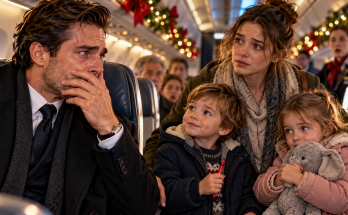
The red crayon rolled beneath my shoe just as the flight attendant asked everyone to buckle their seat belts. I was standing beside my first-class seat, trying to resolve a problem with a seven-hundred-and-eighty-million-dollar acquisition, when something tugged at the hem of my trousers. A little boy with sandy curls was looking up at me. His small hand was extended, and his expression carried the solemn urgency of someone who had misplaced a valuable possession. “Excuse me,” he said. “My red one went under you.”
I crouched and retrieved the crayon from beneath the seat. It had a flattened tip, and its paper wrapping was torn near the middle. When I handed it over, the boy smiled, revealing a tiny indentation in his left cheek. My hand stopped halfway back to my side. I had seen that dimple in thousands of photographs of myself, but never on another person so young. Then he lifted his eyes, and an unsettling recognition passed through me. They were green, with a faint ring of gray surrounding each pupil. My eyes. Even the way his eyebrows drew together while he examined the damaged crayon seemed familiar.
“Thank you, mister,” he said. “It escaped when I was drawing a dinosaur.” I managed to ask his name. “Luke,” he replied, pleased that I had shown an interest. Before I could say anything else, a woman's voice reached us from several rows behind. She was calling him gently but firmly, reminding him that the airplane would soon begin moving. The sound passed through me with the force of something physical. I had spent almost three years trying not to remember that voice. I knew its impatience when someone tracked mud across a clean floor, its tenderness when speaking to frightened animals, and the little hesitation before it said something painful.
I turned toward economy class and saw Cassandra Hayes standing beside a row of seats, one arm supporting a little girl and the other reaching for Luke. Her brown hair was gathered carelessly at the back of her head. She wore a dark sweater beneath a winter coat, and exhaustion showed around her eyes. None of those details prevented me from recognizing her immediately. She looked at me, and the color left her face. The little girl against her shoulder shifted, revealing sandy hair and a pair of unmistakably green eyes. Cassandra tightened her arm around the child. “Damon,” she said quietly. I had heard executives pronounce my name with respect, anger, and fear. Nothing had ever made it sound quite like that.
For a moment, I was unable to speak. Cassandra had been the woman I intended to marry before I persuaded myself that success required the sacrifice of everything that interfered with it. We had lived together for four years. She had known me before magazine covers, private aircraft, and the people whose entire working lives depended on anticipating my wishes. I knew how she liked her coffee and how she hummed while cooking. I also knew the expression she wore when she had finally reached the end of her patience. It was the expression on her face now, mixed with something I couldn't immediately identify. Fear, perhaps. Or the exhaustion of facing a conversation she had never expected to have.
The flight attendant stepped closer, reminding me that departure was imminent. I barely acknowledged her. Luke had moved back toward Cassandra and was watching us with open curiosity. The girl pressed her face against her mother's neck. I looked between them, making calculations that seemed absurd even as my mind insisted on completing them. Cassandra and I had separated three Decembers earlier. The children appeared to be somewhere between two and three years old. Their coloring was mine, their expressions unnervingly familiar, and the boy even possessed the small dimple my mother used to tease me about. I could feel my heartbeat against my collar. “Cassandra,” I said, lowering my voice, “how old are they?”
“Damon, this isn't the place.” Her answer was immediate, almost rehearsed. I glanced toward Luke, who was trying to tuck the crayon into the pocket of his jacket. The little girl had begun rubbing her eyes. They were real children, tired and restless and concerned with things far removed from my sudden terror. “Are they mine?” I asked. Cassandra closed her eyes briefly. When she opened them, there were tears along the lower lashes. She asked me not to discuss it in front of them. I wanted to insist, to demand an answer before another second passed, but the little boy looked at his mother and asked why I seemed upset. Cassandra stroked his hair. “We knew each other before you were born,” she told him.
I had built Prescott Technologies by learning when to push and when to withdraw. At forty, I could negotiate under pressure without betraying a single thought. Yet it took everything I possessed to return to first class without another question. I sat down, fastened my seat belt, and stared at the seat in front of me. The leather smelled faintly of cleaning solution. Someone across the aisle complained about a missing coat. Outside, ground vehicles moved under the airport's blue-white lights. The ordinary world continued with insulting indifference. Twenty rows behind me sat the woman I had loved and two children who might belong to me.
My phone vibrated against the armrest. Marcus Bell, my chief financial officer, had forwarded the final authorization documents for the Merritt Systems acquisition. The message was marked urgent, followed by another warning that Calder Enterprises was preparing a competing offer. Everything depended on my signature before midnight. We had spent nine months negotiating the purchase, evaluating patents, resolving financing arrangements, and convincing nervous investors that Merritt's neonatal monitoring systems would transform our medical technology division. I had been traveling to Denver to complete the transaction personally. Until a few minutes earlier, I regarded it as the most important night of my professional life.
I opened the document but couldn't read beyond the first paragraph. A memory kept interrupting me: Cassandra standing barefoot in the kitchen of our old apartment, holding two mismatched mugs and asking whether I would be home before dinner. At the time, I had been studying a spreadsheet and barely raised my head. She had waited, allowing me the opportunity to correct myself. I told her not to organize her evenings around a man running a growing company. I could still remember how slowly she set the second mug on the counter. There had been no argument that night. Somehow, the silence had been worse.
When Cassandra and I first met, my company occupied two cramped floors in a converted warehouse. She taught music and had an astonishing ability to make difficult things feel manageable. When the heating failed during our first winter together, she brought every blanket into the living room and turned the evening into an improvised camping trip. We ate canned soup by candlelight and laughed when the power returned before we had finished. She wasn't impressed by money, which initially made me determined to earn more of it. I imagined giving her a beautiful home, vacations wherever she wanted, and security she would never have to question. I failed to notice when those gifts became substitutes for my presence.
My obsession had begun years before Cassandra entered my life. When I was seventeen, my baby sister Clara developed serious complications shortly after her birth. I remembered hospital corridors smelling of disinfectant and coffee, my mother's trembling hands, and the physician explaining that certain monitoring equipment wasn't available when it was most urgently needed. Clara died before my parents could bring her home. Whether better equipment would have saved her was a question no one could answer with certainty. I grew into adulthood determined to make sure fewer families faced that helplessness. Prescott Technologies began as a small engineering project and eventually became a medical technology company worth billions. Somewhere along the way, I stopped recognizing the difference between protecting patients and winning.
The company expanded faster than anyone expected. There were factories to acquire, investors to reassure, and competitors determined to outrun us. I learned to sleep on planes, eat at my desk, and treat relationships as obligations to be scheduled. At first, Cassandra admired my determination. She understood why the work mattered. But as the years passed, every postponed dinner became another disappointment, every anniversary another apology, and every vacation an inconvenience that I promised to compensate for later. I told myself she didn't understand the responsibilities I carried. In reality, she understood them well enough to see what they were costing me.
Our last argument had taken place in December, almost three years earlier. Snow was falling outside our apartment, and Cassandra had prepared dinner before I informed her that I needed to return to the office. She stood near the doorway with her arms folded, not angry in the familiar way but painfully calm. She wanted to know when the promises would become real. I told her that things would improve after the merger. She reminded me that I had offered the same answer after the previous acquisition. When I raised my voice and spoke about everyone depending on me, she looked directly into my eyes and asked whether I understood that she depended on me too.
A week later, she moved out. I returned home to find her books gone from the living room and the small ceramic bowl where she kept her keys missing from the hallway table. She had left a note explaining that she loved me but could no longer build a life around my occasional availability. I read it twice, then placed it in a drawer beneath several unfinished contracts. I told myself she had made a choice. I never seriously considered that I might have made it for her. Instead, I buried the pain under another round of negotiations and eventually stopped mentioning her name.
A security incident at the company prompted changes to my phone number and residential arrangements shortly afterward. My new apartment had controlled access, and my assistants screened correspondence. I justified the precautions because the business had become a target for aggressive competitors, opportunists, and occasionally threatening strangers. I assumed that anything genuinely urgent would reach me. The arrangement created extraordinary convenience. I could pass entire days without an unwelcome conversation. I now wondered how many conversations I had avoided without knowing what they contained.
The aircraft began moving away from the gate. I looked through the window at the rain-darkened runway, trying to assemble a version of events that did not involve two children growing up without my knowledge. Perhaps they were Cassandra's nieces or nephews. Perhaps the resemblance was coincidence. Perhaps she had married someone else and the children merely favored her family. Each explanation collapsed beneath the expression she had worn when I asked whether they were mine. She had not denied it. She had asked for privacy. I knew Cassandra well enough to understand that distinction.
My phone vibrated once more. Marcus wanted confirmation that I would be ready to authorize the final agreement immediately after landing. He reminded me that Merritt's executives had already gathered at the Denver office and that outside counsel was prepared to complete the closing. I typed a brief acknowledgment, then erased it. The words looked obscene against the memory of Luke's small hand reaching toward mine. I had always believed serious decisions required complete information. Yet I was being asked to choose between a transaction I understood in exhaustive detail and a possibility I could barely comprehend.
At cruising altitude, the cabin lights dimmed. Flight attendants moved through the aisle with trays of drinks, and the low conversation of passengers blended into the steady noise of the engines. I tried to concentrate on the Merritt valuation, but a child's laugh carried faintly from the rear cabin. I couldn't tell whether it belonged to Luke. That uncertainty disturbed me more than it should have. I suddenly wanted to know which foods made him laugh, whether he liked dogs, and who tucked him into bed. I wondered whether his sister was frightened of the dark and whether Cassandra still sang the same lullaby she used to hum when she couldn't sleep.
The thought of Cassandra raising two children alone was nearly impossible to bear. I knew how much work her teaching required and how carefully she had once managed money. She was practical, resourceful, and stubborn about accepting assistance. But twins meant twice the sleepless nights, twice the laundry, and twice the worry when someone developed a fever. I imagined her carrying two infants through a grocery store while I attended another luxury conference, congratulating myself on my discipline. My stomach tightened. Even if the children weren't mine, she deserved more concern than I had shown when she left.
I began reviewing old memories with an attention I had never given them before. Had Cassandra tried to reach me after our separation? I remembered a receptionist mentioning that an acquaintance had called several times. I couldn't recall the name because I had interrupted her to ask about a board meeting. There had also been a handwritten envelope forwarded to my previous residence, though I couldn't remember what became of it. I felt suddenly ashamed of how little I knew about my own life beyond the office. Entire years had passed in which my calendar documented every professional meeting while leaving almost no record of the people I had loved.
The seat belt sign illuminated again as the plane encountered rough air. A few passengers gasped when the aircraft dipped. I gripped the armrest and heard a frightened child crying somewhere behind me. A woman's voice answered, soft and steady, saying that the clouds were simply moving around the airplane. Cassandra. She had always found language that made frightening experiences less threatening. I remembered her explaining thunder that way during a storm when our apartment windows rattled. The knowledge that she might be using the same words to comfort my daughter brought an unexpected sting to my eyes.
I pressed the call button and asked the attendant whether I could move to the rear cabin when the turbulence ended. She examined my expression, then explained that everyone needed to remain seated until the captain switched off the sign. I accepted the answer, although waiting felt unbearable. For years, I had been accustomed to solving problems by giving instructions. Now the most important questions of my life had to wait for a light above the aisle to go dark. I sat with my hands folded and watched it, unable to think about anything else.
When the sign finally disappeared, I stood before the attendant had completed her announcement. I walked past passengers sleeping with their heads against the windows and families preparing snacks for restless children. Each row seemed to take an unreasonable amount of time to pass. Then I saw Cassandra beside the window in row twenty-eight. Luke was drawing on a folded sheet of paper. The little girl held a gray stuffed elephant with one ear bent backward. Cassandra raised her eyes as I approached. She wasn't surprised. She looked like someone who had been preparing herself for this moment since the aircraft left the ground.
I stopped beside the empty seat next to her. My voice sounded unfamiliar when I asked permission to sit. Cassandra considered me for several seconds, then shifted the children's belongings aside. Luke watched with lively interest, while his sister hid the elephant beneath her chin. I lowered myself into the seat and waited until Cassandra looked at me again. “I need the truth,” I said quietly. “But I don't want to frighten them.” Her fingers tightened around the armrest. She studied my face as though searching for the man she once knew beneath the one I had become.
Finally, Cassandra leaned closer. The children were occupied with their drawing and stuffed animal, unaware that the shape of their lives was about to change. She took a breath, and for an instant I saw the same young woman who had stood in our apartment doorway three years earlier, asking me to understand what mattered. This time, there was no laptop between us and no meeting waiting to interrupt. “Damon,” she whispered, “Luke and Violet are your children.” The engines continued their steady roar, but everything else seemed to fall silent.