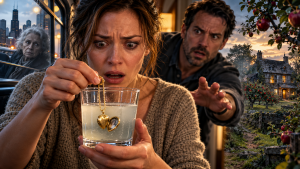
PART 1 TITLE: A Stranger on My Evening Bus Knew About a Gift My Husband Had Not Yet Given Me and Feared What It Would Do
The first time I saw my husband afraid of me, I was standing in our kitchen with a drinking glass in my hand. Inside it lay the gold necklace he had given me the night before. The water was cloudy, the small heart-shaped pendant had opened along an almost invisible seam, and something dark was escaping from a metal chamber concealed inside it. Julian stopped in the doorway before I could say a word. He stared at the glass, then at me. His face emptied of color. “Where did you find that?” he asked. It was a strange question. He had placed the necklace in my hands himself, kissed my forehead, and called it a gift worthy of our marriage. Now he looked as though I had uncovered something he had buried.
I tightened my grip on the glass. “You gave it to me, Julian. Remember?” He didn’t smile. His eyes moved toward the hallway, then the window overlooking the neighboring apartment building. “Put it down,” he said. “Carefully.” I asked him what was inside the pendant. Instead of answering, he took a step toward me. For five years I had known the rhythm of his movements, the little pause before a joke, the way he tilted his head when he wanted forgiveness. None of those familiar gestures appeared now. He was assessing the distance between us. The realization made me retreat until my hip struck the counter.
His phone vibrated beside the coffee machine. A message appeared beneath the name Daniel Reeves, a real estate agent Julian had occasionally mentioned. I saw a reference to a buyer waiting to transfer $450,000 once the paperwork on a cottage was completed. My grandmother’s cottage. Before I could ask how Daniel knew about it, another message illuminated the screen. This one demanded confirmation that I had not discovered the pendant’s contents. Julian snatched up the phone, too late to hide what I had read. “This isn’t what you think,” he said. I had never heard such desperation from him. Then three knocks sounded from our front door, and a woman’s voice called through the wood, warning me not to surrender the glass.
I knew that voice. Seven days earlier, I had heard it over the rattling engine of a crowded Chicago bus. Until that evening, I had believed my life was merely difficult rather than dangerous. My name is Morgan Bennett, I was thirty-six years old, and I worked as an assistant accountant for Kessler & Rowe, a modest construction company in Chicago. Julian Archer, my husband, was thirty-eight. We rented an apartment near Oak Park, where the radiators clanked in winter and sunlight reached the living room for perhaps two hours on a clear afternoon. We weren’t wealthy, but our difficulties had always seemed temporary. At least, that was what Julian promised.
I carried the reliable paycheck in our household. Julian carried ideas. For several years he had been preparing to succeed at one venture or another, usually with spectacular confidence and very little evidence. His online automobile-parts business collapsed after disagreements with suppliers. A trading account disappeared beneath a series of poorly explained losses. An import scheme lasted three months, while a logistics partnership ended before I ever met the alleged partner. I paid the rent, electricity, groceries, insurance, and payments on the car Julian insisted he needed for meetings. I also covered his credit-card bills. Every few months he produced a new spreadsheet showing how close we were to financial freedom. The figures changed; the conclusion never did. We only needed to support his efforts a little longer.
When I questioned the arrangement, Julian became wounded rather than angry. He would sit beside me, take both my hands, and remind me that successful marriages required faith. “I thought you wanted us to build something together,” he said once, after I asked why he had purchased expensive equipment for another project. I tried to explain that I wanted stability, not a fortune, but he made that sound like a failure of imagination. Eventually I learned to examine the household accounts after he went to bed. The habit embarrassed me. I had begun hiding ordinary arithmetic from the man I married.
There was one asset Julian could not touch. My grandmother Clara had left me a cottage on eleven acres in Door County, Wisconsin. It stood beyond an aging orchard, with weathered white siding, green shutters, and a screened porch where rain sounded like handfuls of dry beans thrown across a roof. A footpath led through the trees to a narrow creek. My parents had died in a house fire when I was six, and Clara, my father’s mother, raised me there. She taught me to bake pies without wasting the bruised apples, to save seeds for the next planting season, and to recognize when someone was offering affection with an expectation attached. When she died seven years earlier, she left the land to me without conditions.
Julian never understood my attachment. To him, the cottage represented money sitting uselessly in Wisconsin. He regularly mentioned a figure of $450,000, sometimes quoting imaginary buyers, sometimes calculating what we could do with the proceeds. We could pay our debts, move into a better apartment, or finance the business that would finally succeed. He insisted the house was deteriorating and that sentimentality would cost us dearly. I told him I would repair it when I could, but I would not sell. During our first arguments he laughed at my stubbornness. Lately he had stopped laughing. He simply waited, as if convinced that enough pressure would eventually turn my refusal into surrender.
The Tuesday I met the stranger had already been a discouraging day. A supplier invoice had been entered twice at work, and I spent most of the afternoon reconciling payment records while my supervisor watched the clock. The sky was dark by the time I left. Rain pushed across the sidewalks in thin gusts, making the traffic lights shimmer against the wet pavement. I boarded my usual CTA bus with a damp canvas tote pressed against my hip. Inside were a container from lunch, a half-read paperback, and several receipts I had promised to organize at home. I remember being tired enough to consider taking a taxi despite knowing I couldn’t justify the fare.
The bus was almost full. I found a seat near the middle, beneath a window streaked with water. Two teenagers shared earbuds behind me. A man in a construction jacket slept with his chin against his chest. At the next stop, an elderly woman boarded slowly, holding the rail with one hand and a worn brown handbag with the other. Her gray trench coat looked carefully maintained, though the cuffs had begun to fray. A dark green beret covered her silver hair. She waited while several passengers looked past her. I stood before the driver had finished closing the doors. “You can sit here,” I told her. She studied my face for a moment, longer than politeness required, then accepted.
She smelled faintly of lavender soap, a scent that brought my grandmother’s linen cupboard sharply to mind. I held the overhead rail while the bus lurched forward. After several stops, the woman touched the sleeve of my coat. “I need you to listen carefully,” she said. Her voice was soft but not uncertain. I leaned closer, expecting a request for directions. Instead she spoke about my husband. She told me that when he presented me with a necklace, I must not put it around my neck. I should place the entire piece of jewelry in water and leave it there until morning.
At first I assumed she had confused me with someone else. I said as much, attempting a reassuring smile. She didn’t return it. “I’m speaking to the right woman, Morgan.” My fingers tightened around the metal rail. Nobody on the bus had addressed me by name. I hadn’t introduced myself. Before I could recover, she added that Julian must not know about our conversation. Hearing his name frightened me more than the warning itself. A stranger knowing where I worked might have been explained by coincidence. Knowing both my name and my husband’s, along with a gift I had never discussed, required a different explanation.
I asked who she was. Her gaze shifted toward the front of the bus, where passengers crowded around the exit. For the first time, she appeared uncertain. “Someone who should have spoken sooner,” she answered. I asked whether Julian had hired her, whether this was some kind of practical joke, or whether she knew my family. She shook her head at the first two questions and hesitated at the third. The automated announcement sounded for my stop. I wanted to remain and demand an explanation, but the aisle was crowded, and the doors were already opening. She released my sleeve. “Remember the water,” she said. “Whatever he tells you, don’t put it on.”
I stepped down onto the wet pavement and immediately turned around. Through the smeared window I could still see her. She was sitting with both hands folded over her handbag, watching me with an expression I could not interpret. It wasn’t satisfaction. She looked deeply unhappy. As the bus pulled away, I considered photographing its route number or following it to the next stop. Instead I went home, telling myself that an elderly woman had recognized me from somewhere and invented a peculiar warning. People behaved strangely on public transportation. I had lived in Chicago long enough to know that. Yet I found myself checking behind me twice on the walk to our building.
Julian was at the dining table when I arrived, moving numbers around on his laptop. He looked up, greeted me affectionately, and asked whether I had remembered to buy coffee. I hadn’t. He sighed, then said it didn’t matter. An hour later he complained about how much I had spent on groceries. The familiar exchange should have made the bus conversation feel ridiculous. Instead I watched him closely. When he asked why I seemed distracted, I said work had been stressful. He pressed no further, although he reminded me that we needed to discuss the cottage before the month ended. I asked why the deadline mattered. He gave me a vague answer about changing market conditions and returned to his computer.
During the following days I nearly told him about the stranger several times. A part of me wanted to hear him laugh and offer a harmless explanation. Perhaps she had worked with him, perhaps he had ordered jewelry and mentioned me to someone. But every time I considered bringing it up, I remembered how firmly she had warned me to keep the encounter secret. That frightened me because it required admitting the possibility that I needed protection from Julian. I could accept that my husband was irresponsible with money. I could even admit he had become manipulative about the cottage. I could not yet reconcile those failings with the idea that he might deliberately hurt me.
The week passed under an uncomfortable calm. Julian became unusually attentive. He washed the dinner dishes without being asked, offered to drive me to work, and suggested that we take a weekend trip once his next business arrangement was completed. I wanted to enjoy it. For years I had wished he would notice how exhausted I was, and now he seemed determined to be considerate. But his attention carried an awkward quality, as though he were following instructions. He repeatedly asked whether I felt well. At breakfast he watched me finish my coffee before touching his own. Once, when I mentioned that I had a headache, he reacted so sharply that I stared at him.
On the following Monday evening, exactly a week after the bus encounter, Julian arrived home wearing a new pale-blue shirt and the cologne I had bought him the previous Christmas. He carried a small shopping bag from a jewelry store. My first reaction was irritation. Our checking account had barely enough money to cover the next utility payment. Then he smiled, looking almost like the man who had proposed to me, and my irritation softened. He said he had been thinking about how much I had sacrificed for us and wanted to show his appreciation. From the bag he took a navy velvet box.
Inside lay a slender gold chain with a tiny heart suspended from it. The pendant looked carefully polished, with an almost invisible line dividing its sides. Julian told me it was especially made for me. I touched the metal with one finger and felt the room narrow around the box. The bus woman’s words returned with perfect clarity. I had not mentioned the conversation to anyone. I had never requested jewelry. Yet here was the precise gift she had described. “Do you like it?” Julian asked. His smile held, but I noticed his right thumb rubbing repeatedly against the edge of the box.
I told him it was lovely. He lifted the chain and moved behind me, intending to fasten it around my neck. I stepped aside and said I wanted to save it for the following day because I was tired and still needed a shower. He paused with the clasp between his fingers. For an instant his expression hardened. Then he gave a short laugh and suggested that I wear it to bed, just this once. I refused gently. His jaw moved as if he were grinding his teeth. At last he placed the necklace back in its box, kissed me, and said he hoped I understood how much trouble he had taken to obtain it.
That night he worked in our spare room long after I had gone to bed. I lay listening to the click of his keyboard and the occasional scrape of his chair. Around midnight I got up, retrieved the velvet box, and carried it into the kitchen. I filled a drinking glass with cold water. The chain sank immediately. The heart pendant turned once as it descended, catching the under-cabinet light, then settled at the bottom. I watched it for several minutes. Nothing happened. Feeling foolish, I slid the glass behind a Dutch oven inside a cupboard where Julian rarely looked. I returned to bed without sleeping much.
At six the next morning I entered the kitchen while Julian was still showering. I opened the cupboard and found the water had taken on a dull gray color. Small black flecks floated around the chain. The pendant had separated enough to reveal a miniature chamber containing a dark substance. I didn’t touch it. I carried the glass into the light, trying to understand whether the metal had corroded or whether the necklace had been deliberately constructed to release something. Then Julian appeared behind me, still fastening his shirt. His reaction was immediate, unmistakable, and nothing like the surprise of a man whose expensive gift had been damaged.
He demanded the glass. I refused and asked what the pendant contained. His tone shifted between pleading and accusation. He said I was ruining a special moment, that I didn’t understand what I was doing, that I should trust him after everything we had endured together. When I mentioned the gray residue, he stopped speaking. His phone vibrated, and the messages from Daniel Reeves appeared. I read them before Julian could hide the screen. Daniel wanted confirmation that the cottage transaction could proceed. More disturbing still, he expected me to remain ignorant of what had been concealed in the necklace. I felt the blood drain from my hands.
Julian reached for the glass. I moved away and demanded to know why a real estate agent was discussing my property without my permission. He struck the counter with his fist. The sound made me jump, spilling a little gray water onto the laminate. He stared at the spill as if it were an emergency. “Don’t let that touch you,” he snapped. Then he seemed to realize what he had said. For several seconds we stood facing one another, with the smell of burnt toast rising from the toaster and the glass trembling between my fingers. My husband had just warned me away from the contents of his anniversary gift.
Three firm knocks interrupted us. Julian turned toward the hallway, and I heard the same woman from the bus asking me not to hand over the evidence. He ordered me to remain where I was. Through the door she addressed him by name. His expression changed, not into surprise but recognition. I had the terrible feeling that he knew exactly who was waiting outside. When I asked, he called her a confused stranger. Yet his hand was shaking. I looked from him to the glass, then toward the apartment entrance. The woman spoke again, telling me there was something about Julian I deserved to know. I understood then that whatever lay inside the pendant was only part of the danger.
END PART 1
PART 2 TITLE: The Woman Outside Our Apartment Door Had a Face From My Husband’s Past and Evidence of Another Life He Had Destroyed
“Don’t open it.” Julian spoke so quietly that I might have mistaken his words for concern if I hadn’t seen his face. He stood between me and the hallway, his shoulders rigid, his eyes moving between the front door and the glass in my hand. The woman knocked again, and I heard her tell him she knew he was inside. He closed his eyes briefly. It was such an unusual gesture that I felt another cold wave of realization. My husband had lied about knowing her. Now the lie was unraveling in front of us, and he had no prepared explanation.
I asked him to move. He said the woman was interfering in matters that belonged between a husband and wife. I reminded him that she had warned me about the necklace before he had given it to me. That stopped him. His gaze sharpened. “What did she say to you?” he asked. I didn’t answer. He tried a different approach, softening his voice and using the affectionate nickname he usually saved for moments when he needed something. He said the residue in the glass could be harmless manufacturing material and that we ought to have a jeweler examine it together. The proposal might have sounded reasonable if he had not been reaching for the glass as he spoke.
I stepped around the kitchen island. Julian followed. He told me I was making a terrible mistake, that I was trusting someone who wanted to destroy our marriage. I asked whether he could explain Daniel Reeves’s messages. His expression tightened at the name. He claimed there was an ordinary business transaction underway and that he had intended to surprise me with an offer on the cottage. I reminded him that I had never authorized an offer. He accused me of turning a generous opportunity into a personal attack. He sounded almost relieved to return to an argument he understood. For a moment we were back in the familiar pattern of defending ourselves over money.
Then the woman called his name again. She told him she would not leave. Julian’s composure fractured. He moved suddenly, caught my wrist, and tried to wrench the glass away. Pain shot toward my elbow. I shouted at him to release me. He tightened his grip and demanded that I stop behaving irrationally. The glass struck the countertop, sloshing water over my fingers. I jerked backward. The kitchen seemed impossibly small. I could smell Julian’s cologne and feel the sharp edge of the cabinet handle digging into my side. I had never been physically afraid of him before, and the shock of recognizing that fear left me almost speechless.
The apartment door opened. An elderly woman in a gray coat stood at the entrance, her green beret slightly crooked from the wind. Behind her was a tall man wearing a brown jacket. He held a telephone upright, its camera directed toward Julian. The woman ordered my husband to let go of me. Her voice was calm, but it carried through the room with enough authority that Julian released my wrist at once. The man announced that he was recording and that police had been called. Julian demanded to know how they had entered the building. The woman explained that our downstairs neighbor had heard the shouting and helped them reach our apartment.
My husband attempted to laugh. He said strangers had forced their way into his home and were harassing his wife. The man with the phone did not lower it. The elderly woman approached us carefully, looking first at my wrist, then at the glass. She asked whether I had worn the necklace. I shook my head. Her shoulders relaxed just enough for me to notice. “Keep it away from your skin,” she said. Julian made an impatient noise, but he remained beside the refrigerator, no longer trying to take the glass. The balance of power in the room had changed with the arrival of witnesses.
When the woman finally looked directly at him, Julian whispered a single word of recognition. She answered with an expression of exhausted sadness. He said he had believed she was gone. She asked whether he had told me she was dead. The question struck me so abruptly that I almost missed its meaning. I looked at Julian, waiting for him to object. He avoided my eyes. The woman turned toward me and introduced herself as Ruth Ellison. Then she explained that she was Julian’s mother. I stared at her while the refrigerator motor hummed behind us. Of all the possibilities I had imagined during the previous week, this was not one.
Julian had told me his mother died when he was twenty-four. The subject was painful, he said, and he rarely discussed his childhood. Once he had shown me a photograph of a dark-haired woman beside a decorated Christmas tree. I remembered thinking she had his eyes. Ruth was older now, her features more delicate, but as I examined her face I recognized the shape of her cheekbones and the slight downward turn at the corners of her mouth. I asked Julian to tell me it was a misunderstanding. He said nothing. Ruth explained that her son had been allowing people to believe she was dead for twelve years.
The discovery rearranged memories I had never questioned. During our wedding preparations, I had suggested placing a photograph of his mother beside my grandmother’s picture. Julian refused, saying it would be too upsetting. He had no relatives at the ceremony beyond a distant cousin who left before dinner. He never wanted to visit his hometown, and he dismissed questions about his family as unnecessary reminders of grief. I had interpreted those boundaries as signs of a man protecting himself from sorrow. Now I understood that some of them had served a different purpose. He had erased a living person from his life and persuaded me to accept the absence as tragedy.
I asked Ruth why her son would do such a thing. She looked toward him, and he warned her not to answer. She continued anyway. Years earlier, she said, Julian had been involved with a woman named Leah Parker. Leah had nearly died after becoming ill under circumstances Ruth had never accepted as innocent. Julian interrupted, accusing his mother of inventing stories and exaggerating old disagreements. She reached inside her handbag and withdrew a faded photograph. In it, a younger Julian stood beside a dark-haired woman outside a lakeside house. Both appeared happy. Around the woman’s neck hung a fine chain with a small heart-shaped pendant.
I leaned closer to the photograph. I could not tell whether the jewelry was identical in every detail, but the design was unmistakably similar. Ruth identified the woman as Leah, Julian’s former fiancée. Nine years earlier, Leah had inherited a waterfront property near Milwaukee after her father’s death. Julian had proposed after they had been together only a short time. He encouraged her to sell the house and use the proceeds for his business plans. When she refused, their relationship deteriorated. Ruth described arguments about loyalty, gratitude, and sacrifice. Listening, I heard the vocabulary of my own marriage, spoken years before I had met him.
According to Ruth, Julian had eventually given Leah a necklace as an anniversary present. Soon afterward, Leah’s health began to deteriorate. She complained of exhaustion, then confusion. She misplaced ordinary objects and struggled to remember conversations. There were days when she could no longer trust her sense of direction. Her loved ones initially suspected stress or an undiagnosed illness. Leah was frightened by the changes, and Julian reportedly offered explanations that made her doubt her own judgment. Eventually she collapsed and needed extensive medical care. Her recovery included four months in rehabilitation, with some difficulties lasting much longer.
Investigators later found evidence that Leah had been exposed to a hazardous substance. They had not been able to prove conclusively how it reached her or who was responsible. By the time attention turned toward the necklace, Julian had withdrawn from the relationship. Ruth believed the gift had been involved, but belief was not the same as proof. She told me this distinction herself, even though her anger toward Julian was obvious. I appreciated the precision. The woman standing before me was not claiming to know more than she did. She was describing what had happened, what had been found, and what she feared had happened again.
Julian rejected the account. He said Leah had been unstable and that his mother had always been determined to blame him for her problems. Ruth asked why he had purchased another necklace with such a similar pendant. Instead of answering, he shouted at her. The sudden volume startled me more than the words. Until that morning, Julian had rarely raised his voice in front of other people. He preferred sarcasm, disappointment, or long silences. Seeing him lose control before witnesses made me wonder how much effort he had spent maintaining the image I knew.
Police arrived while Ruth was still holding the photograph. Two officers entered the apartment and separated us to ask questions. The tall man identified himself as Thomas Vale, a retired police investigator Ruth had hired to examine her concerns. He explained how he had contacted the downstairs neighbor after hearing the disturbance and had documented the confrontation on his phone. I described the bus warning, Julian’s gift, the overnight discovery, and the messages from Daniel Reeves. One officer photographed my wrist, where red marks remained from Julian’s grip. Another carefully secured the glass and necklace as possible evidence, taking precautions to avoid contact with the contents.
I watched the necklace disappear into an evidence container. Less than twelve hours earlier, I had been deciding whether to wear it to work. Now uniformed officers were discussing laboratory testing and the possibility of deliberate tampering. The speed of the change made everything feel unreal. When an officer asked whether I believed the pendant contained poison, I said I didn’t know. I could only describe what I had seen. Julian had warned me not to touch the liquid, but he offered no satisfactory explanation of what it contained. His silence seemed more meaningful than any accusation I could have made.
Julian tried to speak to me while the officers completed their questions. He said our private problems were being exploited by his mother and that the situation would look ridiculous once the necklace was tested. He reminded me of our wedding, our plans, and the difficult years we had supported each other. He also mentioned the mortgage payments we hoped to afford someday. I was struck by how smoothly he combined sentiment with money, as though both belonged in the same argument. I had loved him through failed ventures, embarrassing debts, and countless broken promises. He appeared to believe those years entitled him to my cooperation now.
One of the officers asked whether I felt safe remaining in the apartment. Julian answered before I could, insisting that everything was fine. The officer repeated the question to me. I looked at the man beside the refrigerator. He had returned to his usual posture, arms folded, eyebrows slightly raised, looking wounded by the suggestion that he could threaten anyone. I knew that expression. It had persuaded me to apologize after arguments I had not started. For the first time I saw it from a distance, detached from the love I had used to explain it away. I told the officer I did not feel safe.
Julian stared at me. He said I was exaggerating an unfortunate misunderstanding. I held up my wrist. The marks were already beginning to darken. “You did this because I wouldn’t give you a glass,” I said. His mouth opened, then closed. There was nothing he could offer that would make the pain imaginary. I asked whether I could gather my belongings while the officers remained. They agreed. Ruth offered to wait near the door, and Thomas said he could arrange transportation. I went into the bedroom, shut the door halfway, and found myself standing motionless before the wardrobe I had shared with Julian for five years.
Packing seemed oddly difficult. I knew what to take if we went away for a weekend, but not what a woman needed when she no longer trusted her husband. I chose identification, bank cards, medication, my laptop, a few changes of clothes, and the folder containing our marriage certificate. I found a photograph from our wedding in the top drawer. Julian had one arm around my waist, and I was laughing at something outside the frame. I studied it for a moment before placing it facedown. The person in the picture looked familiar, but the happiness on her face seemed to belong to another time.
Ruth joined me at the bedroom doorway. She did not touch anything without asking. I questioned her about why she had remained silent for so long, why she had not warned me before the wedding. She said she understood my anger and expected no immediate trust. Julian had cut off contact years before, changing addresses and telephone numbers. She had learned about our marriage only three years earlier. Efforts to locate or approach me had been complicated by Julian’s control over the information she could obtain. She had reported suspicions to authorities, but there was little new evidence. Until recently, she feared a direct accusation might drive me further into his confidence.
Her explanation did not erase the years I had spent with him, and I told her so. Ruth accepted that. She looked tired, not defensive. “I should have done more,” she said. I believed she meant it. I also understood that I had no way to evaluate everything she told me that morning. The photograph, the necklace, and Julian’s reaction supported her account, but I was not prepared to grant complete faith to another stranger merely because my husband had betrayed mine. I thanked her for helping me and said I needed independent answers. She nodded, as though that was precisely what she had hoped I would say.
I wheeled my suitcase into the hallway while the officers finished speaking with Julian. He watched without approaching. His expression had become carefully neutral, the way it looked when he lost an argument in public and planned to revisit it later. At the elevator, he called after me. I turned, expecting a plea or an apology. Instead he asked whether I truly believed I could leave with everything that mattered. I said I was taking only what belonged to me. His mouth curved into a small, unsettling smile. Then he mentioned my grandmother and suggested I had no idea what she had left behind.
The elevator doors began to close. I asked him what he meant, but he did not answer. He remained in the hallway, watching the gap narrow. When the doors finally shut, I leaned against the cool metal wall and tried to steady my breathing. Ruth stood beside me without speaking. I had escaped the immediate danger, but Julian’s final words followed me down through the building. He knew something about Clara’s property that I did not. Whatever arrangement connected him to Daniel Reeves had already moved beyond persuasion. I realized I needed to find out what had been done in my name before there was nothing left to protect.
END PART 2
PART 3 TITLE: The Woman My Husband Tried to Erase Revealed His Earlier Victim and Led Me Toward Payments I Was Never Meant to Find
Ruth took me to a diner several miles from our apartment, where the seats were covered in cracked red vinyl and an elderly waitress carried coffee between tables without writing down orders. Thomas chose a booth near the entrance, keeping his telephone beside a folder he had brought from his car. I sat across from Ruth, staring at steam rising from a mug of tea. My wrist ached whenever I moved it. In the space of a morning I had learned that my husband had a living mother, a former fiancée who had nearly died, and a financial arrangement involving my inheritance. Yet the ordinary sounds around us continued: silverware striking plates, a radio playing beneath the counter, someone arguing pleasantly about how to cook eggs.
Ruth asked whether I wanted something to eat. I said no. She waited a little longer before apologizing for not warning me sooner. The apology irritated me more than I expected. I asked why she had allowed me to spend five years married to a man she believed capable of harming women. I knew how unfair the question sounded even as I spoke. She had not arranged my marriage or concealed the necklace herself. But I needed somewhere to place the fury that had been gathering since the kitchen. Ruth listened without interrupting. When I finished, she said she had been searching for a safe way to reach me and would explain whatever I wanted to know.
I began with Julian’s childhood. She described a curious, affectionate boy who dismantled broken radios and sometimes managed to repair them. He collected baseball cards, argued passionately about the Cubs, and spent summer afternoons building structures from discarded lumber. His father died when Julian was sixteen. Ruth did not claim that this loss explained everything afterward, but she believed it marked a change. Her son began hiding small things from her: money borrowed from friends, unpaid bills, explanations that shifted whenever she questioned them. By his early twenties the dishonesty had become more serious. He took money from her savings without permission, then promised to replace it.
A few years later, Julian used her signature on a loan application she had never seen. Ruth discovered the debt only when letters began arriving. She confronted him, and he apologized with apparent sincerity. He spoke of pressure, embarrassment, and desperate efforts to build a future. She helped him resolve the immediate crisis. Looking back, she said she had mistaken his remorse for a commitment to change. I recognized that pattern. Whenever Julian’s business ventures failed, he became intensely affectionate for several days. He would cook dinner or bring home flowers, then ask me to believe in him one more time. I had interpreted those gestures as evidence that the man I loved remained beneath the disappointment.
Ruth reached across the table and showed me a second photograph of Leah Parker. It had been taken outside a waterfront house near Milwaukee, where Leah lived after inheriting the property from her father. Leah looked confident, one hand resting against the porch railing, her hair loose in the wind. Ruth explained that Julian had proposed within six months of their meeting. He was charming, attentive, and eager to learn everything about Leah’s life. The trouble began when he insisted the inherited house should finance his next venture. Leah refused. He became resentful, then increasingly controlling. He criticized her friendships and portrayed her attachment to the property as evidence that she did not prioritize their relationship.
The resemblance to my own marriage was difficult to bear. Julian had never demanded that I sell the cottage outright during our first year together. He had started by asking questions about maintenance costs and property taxes. Later he made suggestions about how we might use the proceeds. Only after his business failures accumulated did he begin describing my refusal as selfish. When I mentioned this progression, Ruth nodded slowly. Leah had described something similar. At first, he asked her to consider a possibility. Later, he behaved as though she had broken a promise by refusing. The original request disappeared beneath an argument about whether she loved him enough.
Then Ruth described the illness. She was careful to distinguish what Leah had reported from what doctors and investigators had confirmed. Leah had experienced fatigue, confusion, and troubling lapses in memory after receiving a necklace from Julian. The symptoms worsened over time until she collapsed and required hospitalization. Medical testing eventually raised serious concerns about exposure to a harmful substance. Rehabilitation lasted several months. Ruth had seen Leah afterward and remembered how frightened she was by ordinary uncertainties, such as forgetting where she had left her keys. The knowledge that her own mind had become unreliable was particularly devastating. Julian, meanwhile, had disappeared from her life.
I asked whether the police had believed Leah. Ruth said investigators questioned Julian and examined what evidence remained, but they could not establish the chain of events beyond reasonable dispute. The necklace had not been preserved properly from the beginning, and key questions about the exposure remained unanswered. Leah was afraid of further contact and wanted to rebuild her life away from him. No prosecution followed. Ruth’s voice tightened as she explained how easily that uncertainty had allowed Julian to dismiss the entire episode. He called Leah unstable. He accused his mother of choosing a stranger over her own son. Eventually he severed contact, and Ruth became another woman whose account he wanted discredited.
I asked where Leah lived now. Ruth said she was safe but would not disclose her location without permission. That answer impressed me more than a dramatic declaration would have. Even after everything she believed Julian had done, Ruth respected Leah’s right to control her own story. I had spent years with someone who treated my decisions as obstacles. Watching his mother decline to share a survivor’s address reminded me that concern could exist without possession. I told her I hoped Leah was well. Ruth said recovery had taken time, but Leah had gradually built a life that belonged to her again.
The question that troubled me most remained unanswered. How had Ruth known that Julian would give me a necklace on that particular week? I looked directly at her and asked whether she had been following me. She did not deny it. Instead she opened her handbag and removed a folded printout. It showed a fine gold chain with a heart pendant almost identical to the one the police had taken. Beneath the image someone had written a brief note about an expected delivery date. Ruth explained that she and Thomas had been investigating business connections between Julian and a real estate operation associated with Daniel Reeves. An order for jewelry resembling Leah’s necklace had become a warning they could not ignore.
Six weeks earlier, Julian had unexpectedly visited Ruth. He wanted her signature on documents affecting a small parcel of land she still owned. The request had been disguised as a routine property matter. Ruth refused to sign without reviewing the papers. Julian became irritated but stayed long enough to make a telephone call. Ruth overheard part of a conversation involving Daniel Reeves, who was connected to Julian’s business arrangements. They discussed the timing of a necklace delivery and a pending Wisconsin transaction. Ruth initially thought she might have misunderstood. Then Thomas helped her examine publicly available property and corporate records, and the same names repeatedly appeared.
They had learned my approximate commuting schedule and arranged for Ruth to approach me on the bus. She had chosen a public place because she feared a confrontation near our home would alert Julian. I thought about the elderly woman boarding through the rain, looking around the crowded bus before I offered my seat. What I had mistaken for coincidence had been a deliberate effort to reach me. I asked why she had not simply explained who she was. Ruth paused before replying. If a stranger had announced that she was my husband’s supposedly dead mother and warned that he might poison me, what would I have done? I wanted to say I would have listened. Instead I remembered how often I defended Julian to my friends.
I probably would have telephoned him before I reached home. That admission hurt. Ruth said she had hoped a specific instruction would remain in my mind long enough to be tested when the gift appeared. She did not know precisely what the pendant contained. She knew only that a similar necklace had been associated with Leah’s illness and that Julian seemed determined to conceal something. She had chosen the water test because she hoped it might reveal tampering without my wearing the jewelry. I asked what would have happened if the water had remained clear. She shook her head. She could not promise that the test would have detected every danger. She had acted with incomplete information because the alternative was remaining silent.
I looked down at my hands. In the kitchen, I had been inches from putting the necklace around my neck. Julian had urged me to wear it immediately, then suggested keeping it on overnight. The memory made me nauseated. I thought about all the times I had interpreted his persistence as romantic enthusiasm. I also thought about Clara, whose lessons about caution I had dismissed as the habits of an older woman who had experienced too much loss. For years I had wanted to prove I was capable of trusting people. Somewhere along the way, I had confused trust with refusing to notice what was happening around me.
My tears came without warning. They embarrassed me, partly because I was sitting in a public diner and partly because I still felt a ridiculous obligation to defend Julian. I remembered the mornings he had made me laugh, the vacations we had saved for, the way he held my hand at my grandmother’s funeral. Those memories did not disappear merely because I knew something terrible about him. I could recall genuine tenderness and still recognize deliberate cruelty. The contradiction hurt more than I expected. Ruth moved beside me and placed an arm around my shoulders. I cried against the coat of the woman my husband had claimed was dead.
After several minutes I washed my face in the diner restroom and returned to the table. Thomas had finished his telephone call and was speaking quietly to Ruth. He asked whether I felt able to look at some documents. I told him I would rather know the truth than spend another night imagining it. He did not rush to present a theory. First he asked what Julian had told me about his finances, then whether I had ever seen formal records of his businesses. I explained that my husband showed me projections but rarely original statements. He considered his accounts private, although I paid most of our shared expenses.
Thomas asked whether Julian had ever mentioned a consulting firm. I remembered a name he had used briefly on a business card: JMA Consulting. The initials stood for Julian Michael Archer. I had assumed it was another venture that failed before obtaining customers. Thomas made a note. He asked about my employer, Kessler & Rowe, and whether I had any role in approving outside consultants. I explained that I reconciled invoices and payment records, but larger engagements were handled above my level. Sometimes I saw vendor names without knowing what services they supplied. The subject felt strangely familiar, more comfortable than questions about the necklace. Numbers were something I could examine without guessing what they meant.
My phone began ringing. Julian’s photograph filled the screen. I let the call end. He immediately tried again. Then a series of messages arrived, beginning with requests that I return home so we could discuss everything privately. Soon the tone changed. He accused Ruth of manipulating me, said the police had misunderstood a harmless incident, and warned that leaving him could cost me the cottage. I read the last message twice. Julian had finally connected my safety and my inheritance in an explicit threat. He no longer pretended they were separate matters. I showed the phone to Thomas, who advised me to preserve the messages and avoid responding until I had spoken with an attorney.
Ruth looked at the screen and then at the folder beside Thomas. They exchanged a glance I did not understand. Thomas asked whether I had heard of Lakepoint Access Holdings LLC. I said I had not. He opened the folder and showed me a collection of public corporate filings, real estate records, and financial information he had gathered during his investigation. Some documents were incomplete, and he emphasized that their meaning still needed verification. Even so, the pattern was concerning. Lakepoint had connections to Daniel Reeves, the agent whose messages appeared on Julian’s phone. Other records suggested financial activity involving a consulting business associated with my husband.
Thomas placed a transaction summary in front of me. Across eighteen months, payments to JMA Consulting totaled almost $270,000. I counted the figures twice. My first reaction was to assume there had been a mistake. Julian had repeatedly told me he earned almost nothing during that period. I had covered his expenses while he complained about unpaid invoices, reluctant investors, and debts that threatened our future. I remembered canceling a dental appointment because we needed to make his car payment. I remembered choosing between replacing my winter boots and paying for one of his business licenses. Now I was looking at evidence that a company bearing his initials had received substantial payments.
I told Thomas the numbers could not be right. He asked why. I explained how much Julian had depended on my salary. Ruth sat very still as I spoke. Thomas suggested several possibilities, none of them reassuring. The company could have been receiving funds that Julian had hidden from me. Payments might have been routed through an entity I did not know existed. Some transactions could have been structured for purposes other than ordinary consulting work. He said records would need to be authenticated before anyone could draw definitive conclusions. But he also made clear that I should not assume Julian had been telling the truth about his income.
The thought changed the meaning of our financial arguments. I had believed Julian’s dependence was the consequence of repeated failure, something embarrassing but not malicious. If he had been receiving substantial payments, then our household’s chronic shortages might not have been accidental. They may have helped keep me frightened enough about money to consider selling the cottage. I could not yet prove the motive, but I could no longer ignore the possibility. I asked Thomas whether the payments were connected to Daniel’s proposed property transaction. He turned to another page, saying that the source of the money was the part he most wanted me to examine.
At the top of the page stood the name of the company that had issued the payments. I recognized it instantly. Kessler & Rowe Construction. My employer. The firm where I had spent nearly six years reconciling invoices, handling paperwork, and trying to prove myself dependable. I felt a strange rush of heat behind my eyes. Evelyn Kessler, my boss, had hired me when I was struggling and treated me with a warmth I had never entirely expected from an employer. Yet the records suggested that her company had been sending large amounts of money to Julian’s consulting business while I struggled to support him. I looked at Thomas and asked what Evelyn had to do with my marriage.
He said he did not know the full answer yet. I stared at the company name, remembering the Christmas party where I had first met Julian. Evelyn had been standing beside the decorated tree when she called me over and introduced us. My husband had not wandered into my life by chance. The woman who gave me my job had placed us in front of each other. I looked at Ruth, then back at the documents. For the first time I considered that the relationship I had spent five years trying to save might have begun as someone else’s arrangement.
END PART 3
PART 4 TITLE: A Familiar Name in the Payment Records Forced Me to Question My Marriage and Uncovered a Warning My Grandmother Left Behind
The first person I thought of when I saw the payments to Julian was Evelyn Kessler. Not because I suspected her of wrongdoing, but because she had always seemed to be on my side. Seven years earlier, I was twenty-nine and struggling after losing a bookkeeping position. Clara’s death had left me with grief, outstanding medical expenses, and a property I could not bear to sell. Evelyn offered me a position at Kessler & Rowe for more money than I had requested. She listened when I explained my circumstances, sent flowers when I was ill, and remembered my birthday when even some relatives forgot it. I considered her generosity one of the fortunate events that allowed me to begin again.
Now I sat in a diner with a transaction summary before me, unable to reconcile the woman I knew with the company name printed at the top. I asked Thomas whether there could be another business with the same name. He showed me identifying information from the records and said the connection appeared genuine, although the services invoiced still required investigation. I examined the payment dates. Several coincided with periods when Julian told me we were nearly out of money. One fell in a month when I had borrowed from my small emergency fund to keep us current on rent. I remembered Julian’s gratitude at the time. He had held me close and promised I would never regret believing in him.
Ruth noticed that I had stopped speaking. She asked what I was remembering. I told her about the company’s annual Christmas celebration, the night Evelyn introduced me to Julian. I could still picture the conference room decorated with inexpensive silver garlands and a tall artificial tree. Julian had arrived in a charcoal suit that fit him perfectly. He was confident without seeming arrogant, funny without dominating every conversation. Evelyn called me over and said there was someone she particularly wanted me to meet. Julian knew where I worked, complimented my accounting skills, and asked whether I enjoyed living in Chicago. I had been flattered that someone so self-assured seemed genuinely interested in my ordinary life.
Within a few weeks he began calling regularly. On our first dates, he remembered small details about my work and asked thoughtful questions about my family. When I mentioned the cottage in Door County, he seemed fascinated by my grandmother’s orchard. I described the creek, the porch, and the way Clara insisted that every apple had a use, even the damaged ones. Julian listened attentively. It felt unusual to meet someone who cared about the places that shaped me. Looking back, I realized he had also asked whether I owned the property outright and whether anyone else had a claim on it. I had laughed at the questions and assumed he was simply curious.
I told Thomas about the conversation. He asked whether Evelyn knew I had inherited the cottage before she introduced us. Of course she did. I had discussed the property during my hiring process because I occasionally needed time away to handle repairs and estate matters. Evelyn had expressed sympathy for my loss and asked about the acreage. At the time, there was nothing suspicious about the question. Employers sometimes took an interest in the lives of their employees. But when I placed her questions beside Julian’s and considered the payments between their businesses, coincidence no longer seemed a complete explanation. Thomas wrote down the details without commenting on what they might mean.
He opened another folder containing corporate information connected to Lakepoint Access Holdings. The structure was complicated. One ownership interest was held through an entity controlled by Evelyn’s brother. Another was managed by Daniel Reeves. The connections were sufficient to raise concerns, although Thomas said the precise relationships and any misconduct still needed to be established. I listened while he explained the difference between ownership, management, and the companies that appeared on payment records. As an accountant, I understood the mechanics. What I struggled with was the human possibility behind them: people I trusted might have been cooperating in secret around something that belonged to me.
Thomas laid out a map of Door County. My grandmother’s property was bordered in red, its eleven acres forming an irregular shape around the old orchard. Beside it stretched a larger area marked as a proposed Lakepoint development corridor. The map included prospective access routes for a commercial and waterfront project. A narrow passage along the eastern boundary of Clara’s land appeared to connect proposed sections of the development. I leaned over the table, recognizing the creek and a curve in the old county road. I had walked that boundary with Clara many times. She called the eastern edge the quiet part of the orchard because the trees protected it from traffic and neighboring farms.
According to Thomas, investors had spent considerable time acquiring land for the project. Securing access across the eastern section of my property could help them avoid expensive redesigns or approval problems. He did not claim to know exactly what the project was worth, but its financial scale was far greater than the amount Julian had mentioned as a possible sale price. I studied the red boundary. For years my husband had spoken as though the cottage were a burden that could be converted into enough cash to rescue our marriage. I had never considered that someone else might regard the property as a missing piece in a much larger development.
“Why wouldn’t they just make me an offer?” I asked. Thomas said that was an important question. Perhaps someone had considered a direct purchase too costly. Perhaps the investors expected me to refuse. Perhaps they wanted control of the land without paying a price that reflected its strategic value. None of these possibilities, he emphasized, established that the payments to Julian were improper. But together with his pressure to sell and the suspicious messages, they justified further scrutiny. I appreciated his restraint. I needed facts I could defend, not another confident person telling me what to believe.
I thought about Julian’s failed ventures. The elaborate presentations, the missing partners, the business expenses that always appeared just before household bills came due. Had he been genuinely attempting to build successful companies, or had at least some of those activities served to keep us in financial distress? The idea made me feel foolish, then angry, then exhausted. I had worked late hours to preserve a marriage that might have benefited someone else precisely because I was struggling. When I said this aloud, Ruth reached for my hand. I withdrew it gently. I needed room to think, and she respected that without taking offense.
The necklace remained the most frightening part of the pattern. I asked what would have happened if I had continued refusing to sell. Thomas looked at the photograph of Leah, which was still lying beside his folder. He did not speculate about an exact outcome. The necklace had to be tested, and investigators would need to determine who altered it and why. Yet there was enough reason for me to remain away from Julian and avoid direct contact. Ruth said that if she had learned nothing else from Leah’s experience, she had learned how dangerous it could be to dismiss unexplained illness when another person controlled the circumstances around it.
I wanted to know whether Evelyn had any knowledge of the necklace. Thomas said he had no evidence of that. His investigation had uncovered financial and property connections, not a proven conspiracy to injure me. I understood the distinction, but it did little to ease my fear. Julian might have acted independently, or someone might have encouraged him. The question had to be answered by evidence. I looked again at the map and realized that if I panicked and confronted Evelyn before protecting the cottage, I might alert people who still had access to records I knew nothing about. For once, I decided not to speak immediately.
That afternoon I telephoned Maya Collins, the attorney who had handled some of Clara’s estate matters after her death. Maya was in her early fifties, practical, direct, and unlike Julian, entirely unimpressed by confident speeches. She remembered me as soon as I introduced myself and asked about the cottage. Hearing someone speak of it without mentioning its sale value nearly undid me. I explained the encounter on the bus, the necklace, Ruth’s identity, the police investigation, Daniel Reeves’s messages, and the payments connected to my employer. Maya allowed me to speak without interruption. Then she began asking questions, each more precise than the last.
Her immediate concern was whether I had recently signed any documents that Julian had given me. I said I had not signed anything related to the cottage. Maya asked whether he had brought home papers described as insurance forms, banking documents, or routine renewals. I hesitated. Three weeks earlier, Julian had asked me to sign paperwork for refinancing our car. He said lower monthly payments would relieve pressure on our budget. I remembered signing two pages while he stood beside the dining table, reminding me that he needed to submit the application before the office closed. I had not read every page. I had trusted his explanation.
Maya asked whether I had copies. I said no. She wanted to know whether the documents had been notarized, whether anyone witnessed the signatures, and whether I could remember the headings. I struggled to answer. Julian had folded the papers to show me where to sign. I could recall the placement of a signature line and a small box for the date, but not much else. As I spoke, my embarrassment returned. I worked with financial documents every day. I knew how easily signatures could be misused. Yet I had made exceptions at home because I believed caution between spouses suggested a lack of trust.
Maya interrupted when I began blaming myself. She told me that what mattered now was preserving records and determining whether anyone had used my identity without authorization. She recommended immediate steps to protect the property, including reviewing county filings and notifying appropriate parties if suspicious activity appeared. She also warned me not to contact anyone connected with the proposed transaction until we understood the documents. I agreed. Thomas offered to provide the corporate materials for her review, and I gave Maya permission to speak with him about the records he had collected. The practical work was a relief. It gave me something to do besides replay Julian’s face in the kitchen.
Ruth offered me her guest room for the night. I hesitated because she was still a near stranger, even if she had proved to be Julian’s mother. Thomas assured me that the address was not one he believed Julian was currently using, and Ruth said I was welcome to arrange another place if I preferred. I decided to stay temporarily while Maya examined the property records. Ruth’s house was small and tidy, with shelves of old novels, potted herbs on the kitchen windowsill, and framed family photographs. I noticed there were no recent pictures of Julian on display. In the guest room, a quilt lay folded at the foot of the bed, and clean towels waited beside a glass of water.
I placed my suitcase on the floor and sat on the mattress without unpacking. The silence was unfamiliar. At home, Julian usually occupied the evening with telephone calls, music, or plans he wanted me to discuss. Here I could hear only a clock in the hallway and an occasional passing car. I looked at my wrist. The red marks had darkened to a bruised purple. I photographed them, following the officer’s suggestion, then saved the images with the day’s date. It was a small act, but it felt important. I was no longer relying on memory or accepting another person’s version of what had happened.
Around five, Maya called with preliminary information. Someone had requested records concerning Clara’s property using documents that appeared to bear my authorization. She had not yet obtained every supporting page, and she was careful not to describe the request as a completed transfer. But the signatures she had seen raised concerns. She asked me to confirm whether I had applied for anything involving the cottage. I said I had not. Maya explained that a fraudulent authorization could cause serious problems even if it did not lawfully transfer ownership. She intended to notify the county recorder and relevant title companies while examining the underlying paperwork.
I asked whether the cottage could be sold without my knowledge. Maya said an unauthorized sale would not be lawful, but forged documents could still create a complicated dispute. She wanted me to understand the difference between my rights and the practical damage a determined fraudster might cause. We discussed safeguarding identity documents, preserving communications, and preparing a formal challenge to anything filed without consent. I listened closely, writing notes on the back of an envelope. When I finished, my hand was shaking. The woman who had stood in the kitchen holding a poisoned-looking necklace had now become someone trying to defend her grandmother’s home from paperwork she had never seen.
After the call, I wandered into Ruth’s kitchen. She was peeling potatoes at the counter, dropping the skins into a small bowl instead of the trash. Clara had done the same thing for her compost pile. The resemblance stirred a painful tenderness. Ruth asked whether I wanted to help prepare dinner. I took a knife and began chopping carrots. For a while we worked without discussing Julian. She told me where the cutting boards were kept and complained about the price of vegetables. I was grateful for the ordinary conversation. It allowed me to exist for a few minutes without being a witness, a frightened wife, or the owner of property someone wanted to take.
During dinner Ruth asked whether I had visited the cottage recently. I admitted it had been almost eight months. Julian always had reasons we should postpone the journey. Fuel was expensive, the roof needed inspection, and our weekends were too full. I had accepted those explanations because our household finances were strained. Now I wondered whether keeping me away from the property had served his plans. Ruth told me that Clara had been deeply attached to the orchard. I stopped eating. I had not told her much about my grandmother. When I asked how she knew, Ruth looked momentarily uncomfortable and said she had learned a little about Clara over the years. Before I could question her further, my phone rang again.
This time it was Maya. Her voice was different, more measured, as though she had considered carefully how to begin. She said she had discovered something among the instructions Clara left with her before her death. I sat down at Ruth’s kitchen table. Maya explained that my grandmother had deposited a sealed envelope to be given to me under a specific circumstance: if anyone attempted to pressure or force me into surrendering the cottage. I asked why she had not mentioned it during the estate settlement. Maya said Clara had been explicit. The envelope was to remain unopened until the condition occurred. Until that day, Maya had treated it as an unusual but binding personal instruction from an elderly client.
I asked what was inside. Maya said she did not know because Clara had expressly forbidden her to open it. She had preserved the envelope with the estate records and had checked that it remained intact. I could collect it at her office the following morning. My throat tightened when I imagined Clara preparing something for a future she feared but could not prevent. She had never explained such concerns to me while she was alive. She had encouraged me to travel, build a career, and meet people without carrying her worries. I had assumed the property was simply a place she loved. Now I was beginning to suspect that her determination to preserve it was connected to matters she had deliberately kept from me.
Maya said there was one additional detail. Clara had written a short instruction on the outside of the envelope, beneath my name. It was intended for the moment I learned who was attempting to acquire the orchard. I asked her to read it. As she spoke, I looked through Ruth’s kitchen window at the small garden darkening beneath the evening sky. Clara’s message warned that when I finally understood who wanted the land, I must remember that the cottage itself was not the true object of their interest. I repeated the words silently, trying to imagine what else the property could contain or control. Beyond Ruth’s house, a train sounded in the distance. My grandmother had anticipated a struggle that was only now becoming visible, and somewhere in her sealed envelope lay the explanation I had spent my entire marriage failing to recognize.
END PART 4
PART 5 TITLE: My Grandmother’s Sealed Letter Revealed Why Powerful Strangers Wanted Our Orchard and Why She Had Never Trusted Their Promises
I woke before dawn with my grandmother’s warning turning through my mind. The cottage itself was not the true object of their interest. I had repeated those words so often during the night that they had begun to lose their meaning. From the guest room window, I watched the first gray light gather over Ruth’s garden. Somewhere beyond the quiet street, Julian was still free to make telephone calls, contact lawyers, and interfere with property he had no right to touch. My husband had spent years teaching me to doubt my judgment whenever it conflicted with his wishes. That morning, for the first time, I was determined to trust the questions he had taught me not to ask.
I found Ruth in the kitchen at six-thirty, standing beside a kettle with her gray hair loosely gathered behind her head. She looked older without the green beret, and more tired. She asked whether I had slept. I told her I had managed a few hours. Neither of us pretended that was enough. While she prepared tea, I called Maya Collins to confirm that the envelope was still available and that she had arranged to inspect any recent filings against the Wisconsin property. Maya told me to come directly to her office rather than to my apartment or workplace. She had already requested certified copies of the documents associated with the suspicious authorization. Until she understood precisely what had been submitted, she wanted me to sign nothing and speak to no one involved in the proposed sale.
Thomas arrived shortly after eight. He had exchanged his brown jacket for a navy coat and carried a slim leather folder. He offered to drive me to Maya’s office, explaining that he wanted to compare the letter’s contents with the property records he had collected. I agreed on the condition that the decision about what to disclose remained mine. He accepted without hesitation. I was beginning to appreciate how little he resembled Julian in ordinary conversation. Thomas did not regard every question as a challenge to his authority. He answered what he knew, admitted what he didn’t, and allowed silence to remain silence. That should not have felt remarkable, but after five years of marriage it did.
Maya’s office occupied the second floor of a brick building above a pharmacy. I had visited it several times after Clara’s death, always carrying documents that seemed to reduce a person’s life to property descriptions and financial obligations. The receptionist recognized me and quietly directed us to a conference room. Maya entered with a cardboard archival folder and a sealed cream-colored envelope. My name appeared across the front in Clara’s unmistakable handwriting. She had always pressed too hard with her pen, leaving slight grooves beneath the letters. Seeing those marks unsettled me more than I expected. For seven years I had kept her recipes and postcards, but I had not encountered anything she had written specifically for a moment I had yet to live.
Maya placed the envelope on the table without pushing it toward me. She explained that Clara had delivered it personally during a consultation concerning the property. At the time, my grandmother had discussed possible development pressure around the orchard and asked that the letter remain private unless someone attempted to obtain the land through intimidation, deception, or coercion. Maya had advised her to record any concrete threats, but Clara insisted that certain details needed to remain with her until she was ready to disclose them. She died before returning to the subject. Maya had respected the written instructions, although she now regretted not asking more questions about what Clara feared.
My fingers trembled as I broke the seal. Inside were four handwritten pages, a folded copy of a survey, and a small photograph. The picture showed Clara standing beside a younger man near the creek on the eastern boundary of the property. He wore work boots and held a surveying instrument. On the back she had written a name: Arthur Whitcomb, 1998. I didn’t recognize him. The first page of the letter began with my childhood nickname, the one Clara used when she wanted my full attention. I swallowed hard and continued reading.
She wrote that the orchard was more than the house and the trees I remembered. Long before I inherited it, an easement dispute had arisen between her family and neighboring landowners. A development company wanted permanent access through the eastern boundary because the neighboring terrain made alternative routes expensive. Clara refused an unrestricted agreement. Years later, a representative returned with new proposals and increasingly elaborate arguments about economic benefits. He claimed the area would eventually become too valuable for a single family to preserve. Clara distrusted the pressure but recognized that someone else might someday attempt the same arrangement with me.
The second page contained a detail that made me lean forward. Beneath a strip of low ground beside the creek ran a privately installed drainage and utility corridor created decades earlier to serve agricultural operations. The corridor connected several adjoining parcels, and its legal status was unusually complicated. Ownership of Clara’s land did not automatically give outsiders the right to build upon or permanently occupy it. A recorded easement and later modifications restricted certain uses. Any developer hoping to construct the proposed access route would need either my informed consent or a successful legal challenge. Clara had preserved documents that could establish those restrictions, but she feared that copies held by other parties might be incomplete or misleading.
Thomas asked permission to examine the survey. I gave it to him while continuing through the letter. Clara described a metal document box concealed beneath a removable floorboard in the cottage’s upstairs storage room. It contained original agreements, correspondence, and records relating to the boundary. She had kept duplicates with an attorney who later retired, but she was uncertain whether his office had transferred every file. The box also held an account of meetings with people who had offered money, threatened legal action, and attempted to persuade her that she was standing in the way of progress. I remembered the storage room: a narrow space beneath the roof, smelling of cedar and old insulation. I had searched it for Christmas decorations, never for legal documents.
On the third page Clara wrote about my parents. I stopped reading. Their deaths had shaped everything in my childhood, yet Clara rarely discussed the fire in detail. She said it had occurred quickly, that the investigators had found no evidence of deliberate harm, and that grief sometimes left more questions than anyone could answer. In the letter she explained that my father, her son Daniel Bennett, had been helping her review the property records shortly before his death. He had discovered inconsistencies in a proposal submitted by one of the companies seeking access. Clara did not claim that the fire was connected to his work. She explicitly warned against confusing suspicion with proof. But she wanted me to understand why she had never accepted assurances from people whose financial interests depended on controlling the eastern boundary.
I lowered the pages. Maya watched me carefully. “Did you know about any of this?” I asked. She said Clara had discussed old easements and development proposals during estate planning, but had not shared the family history contained in the letter. Thomas examined the survey with a concentration that suggested he had recognized something important. When I asked, he pointed to a narrow shaded strip running beside the creek. The proposed Lakepoint development corridor crossed that same section on the map he had shown me at the diner. The alignment was too close to dismiss. Whoever designed the development understood the strategic importance of my land.
The final page contained the sentence Maya had read aloud the previous evening. Clara warned that anyone attempting to obtain the cottage might be seeking access rights worth far more than the building itself. She urged me to have every document reviewed independently and to remember that a person who genuinely respected me would accept my refusal without trying to make me feel guilty. I read that line several times. It described something she had taught me throughout childhood, but I had failed to recognize its relevance when Julian began pressuring me. Beneath her signature she added one more instruction: before speaking to any developer, find Arthur Whitcomb if he was still alive. He had witnessed the original survey and understood why certain boundaries mattered.
Thomas said he could help locate Arthur through professional records. Maya agreed that the original survey and agreements needed independent review by a Wisconsin property attorney familiar with easements and title disputes. She cautioned that the letter alone did not establish the present legal position. Clara’s memories might be accurate, but the controlling rights would depend on recorded documents, subsequent agreements, and applicable law. I appreciated the clarity. The letter gave us a direction, not a guarantee. Still, for the first time since Julian handed me the necklace, I had evidence of something that existed before our marriage and might explain why strangers were so determined to influence my decisions.
I asked Maya about the suspicious authorization. She opened another folder and showed me a photocopy of a document bearing my name. It purported to grant limited authority to Julian Archer to discuss and execute certain preliminary arrangements concerning the cottage. The wording was dense and broader than anything connected to a car loan. My signature appeared near the bottom. I recognized the shape of the first letter and the way I usually crossed the second one, but I could not remember signing this page. Maya pointed out irregularities in the document’s preparation. She would not call it a forgery until we examined the original, the notarial records, and the circumstances under which it had been created.
My stomach tightened as I remembered the papers Julian presented at our dining table three weeks earlier. He had folded the pages so that only the signature lines were visible. I had asked whether everything concerned the car refinancing, and he had assured me it did. If this authorization had been among them, then he had obtained my signature through deception. If the signature had been copied or fabricated, the misconduct was even more direct. Either possibility was devastating. I had spent years thinking my husband needed my financial support. Now I was facing the possibility that he had been using my trust to create legal control over the one asset I refused to surrender.
Maya explained that she would immediately notify the appropriate recording office and relevant title parties of the dispute. She also wanted to preserve evidence from Julian’s messages and any copies of documents I had signed at home. I gave her the date of the supposed refinancing and described how the papers had been arranged. Thomas offered to help organize a timeline. I agreed, then asked whether we should contact Evelyn Kessler. Maya said not yet. The connections between Evelyn, the consulting payments, and the development company warranted careful investigation, but an accusation made without sufficient evidence could complicate our efforts to preserve records. She recommended that I maintain a written account of everything I remembered and avoid informal conversations about the matter.
By early afternoon, Thomas had identified a possible address for Arthur Whitcomb in northern Wisconsin. He was eighty-one and appeared to be living in a retirement community outside Sturgeon Bay. Thomas suggested calling before making the trip, but I wanted to see the cottage as soon as possible. Maya advised against going alone. There was no proof that anyone had entered the property, yet the attempted authorization and Julian’s recent behavior made caution sensible. We agreed that Thomas would accompany me the following morning after arranging a visit with Arthur. Ruth offered to come too, but I asked her to remain in Chicago. If Julian tried to contact her, I wanted someone able to document it without placing us all in the same location.
Before leaving Maya’s office, I asked whether Clara had paid her to preserve the envelope all those years. She smiled faintly and said my grandmother had been meticulous about settling her accounts. Then she mentioned something I had forgotten: Clara had insisted that I remain the sole decision-maker concerning the property even if I married. She had specifically asked Maya to explain the importance of maintaining separate ownership and independent legal advice. I remembered the conversation, though at the time it had seemed like routine estate guidance. Clara had anticipated the possibility that love and financial pressure might someday become entangled. She could not protect me from every choice, but she had tried to leave me the means to protect myself.
We returned to Ruth’s house before sunset. I spent two hours organizing photographs of the documents, the messages from Julian, and the records Thomas had collected. The work steadied me. Each item belonged in a sequence. The necklace had been ordered before the attempted property transaction. Julian had received messages about the cottage while insisting that his businesses produced no income. Evelyn’s company had made payments to an entity associated with him. None of those facts alone explained everything, but together they formed a pattern I could no longer dismiss as coincidence.
At seven, my phone displayed a call from Evelyn. I watched it ring until voicemail answered. Her message was warm and concerned. She said she had heard I was experiencing marital difficulties and wanted to make sure I was all right. She also mentioned that several accounting files needed my attention and hoped I would return to work soon. I listened twice. The words were ordinary, but the timing troubled me. I had not informed the office about the necklace or the police investigation. Someone had told her enough to describe the situation as marital difficulties. I wondered whether Julian had already spoken with her, or whether she had learned from another source.
I forwarded the message to Maya and did not respond. A second voicemail arrived twenty minutes later, this time from Julian. He sounded calmer than he had in the apartment. He said he wanted to make things right and that there had been misunderstandings about the property documents. Then his voice hardened. He warned that going to Wisconsin would accomplish nothing because the valuable records were already beyond my reach. I felt a chill move across my shoulders. I had told no one connected to him that I intended to visit the cottage. Either he was guessing, someone was watching my movements, or he knew more about Clara’s hidden documents than I had imagined.
Thomas listened to the recording. He did not dismiss the possibility that Julian was attempting to frighten me without possessing any real information. Still, he suggested changing our departure time and notifying local authorities before entering the property. I agreed. We would leave before dawn, reach Door County while businesses were open, and visit Arthur before proceeding to the cottage. I packed Clara’s letter, photographs of the survey, and the copy of the disputed authorization. Ruth stood in the doorway while I closed my bag. She told me that her son had always been good at discovering what people valued most. I looked at the documents in my hands and realized that Julian had mistaken my grandmother’s property for a bargaining chip. For me, it had become the place where his story might finally break apart.
END PART 5
PART 6 TITLE: At the Abandoned Cottage, a Broken Lock and an Old Surveyor’s Memory Exposed the First Evidence of a Carefully Planned Betrayal
The road into Door County was bordered by bare fields and stands of trees turning gold at their edges. Thomas drove while I studied the folded survey on my lap. We had left Chicago before sunrise, stopping only for coffee and fuel. Every familiar landmark made my chest tighten. I remembered traveling this route with Clara when I was small, counting barns and pretending that the next bend would reveal the cottage. Now the landscape seemed both intimate and unfamiliar. I was returning to a place I loved because someone might have entered it without permission, searched for documents, and attempted to use them against me.
Arthur Whitcomb lived in a modest retirement community outside Sturgeon Bay. His apartment overlooked a courtyard planted with ornamental grasses and late-season flowers. When he opened the door, I recognized him immediately from Clara’s photograph, although age had altered his posture and thinned his hair. He wore a checked shirt tucked into dark trousers and held a walking cane with a polished wooden handle. I introduced myself as Daniel Bennett’s daughter. His expression changed. He looked at me for several seconds before stepping aside. “You have your father’s eyes,” he said. The words struck with unexpected force. I had heard them from Clara, but not from anyone who had known my father as an adult.
Arthur invited us into a living room crowded with books, maps, and framed photographs of Wisconsin landscapes. He remembered Clara vividly. He described her as a woman who could distinguish every apple variety in her orchard by the shape of its leaves and who refused to accept a boundary measurement without seeing the field notes. He laughed when he told me how she had challenged him during their first survey. Then his expression grew serious. He asked whether someone was trying to purchase the land. When I said yes, he leaned back in his chair and looked toward the window. “I wondered when they would come back,” he said.
I showed him the old survey. Arthur adjusted his glasses and traced the eastern boundary with a finger. He explained that the low ground beside the creek had been used for drainage and utility access long before modern development proposals. Some neighboring owners held limited rights for maintenance, but those rights did not authorize a commercial road or unrestricted expansion. A developer had attempted to combine old agreements into a broader interpretation that Clara challenged. Arthur had prepared a survey to establish the physical location of the corridor. He remembered disputes over measurements, access points, and the placement of markers. The disagreements had lasted for years because the strip of land was far more important to the proposed development than its modest appearance suggested.
Thomas asked whether Arthur knew the present Lakepoint investors. Arthur shook his head. Companies had changed names, owners had retired, and property interests had been transferred. He cautioned that he could not identify the current rights without examining the complete chain of title. But he recognized the general route on the modern development map. It crossed the same sensitive boundary Clara had defended. He said an unrestricted agreement could increase the feasibility of the project enormously. I thought of the $450,000 figure Julian repeated as though it were a generous offer. If access through my land solved a major development problem, the true economic value of my consent might be much higher.
Arthur grew quiet when I asked about my father. He remembered Daniel as a careful man who liked to understand the reasons behind legal language. Shortly before the fire, Daniel had reviewed a set of proposed easement revisions and questioned a clause that appeared to grant more extensive rights than the parties had discussed. Arthur said Daniel intended to obtain independent advice. He had also begun comparing signatures and dates across older documents. The work frustrated the developer’s representatives, who wanted an agreement completed quickly. Arthur could not say whether any of those disagreements were connected to the fire. He emphasized that investigators had not established deliberate wrongdoing. I was relieved by his caution, even as I felt the old uncertainty reopen.
He asked whether Clara had preserved the original correspondence. I told him about the metal box beneath the upstairs floorboard. Arthur nodded. He remembered helping her organize several documents after the dispute became contentious. Some were written agreements; others were letters recording what representatives had promised during negotiations. One file contained field measurements and photographs that could resolve disagreement over the corridor’s location. Arthur said those materials might be valuable if someone now claimed broader rights than were actually granted. I asked whether he could accompany us to the property. He declined because of his mobility, but he offered to review any copies we found and directed us to a retired survey technician who might help confirm the boundary markers.
Before we left, Arthur placed a hand over mine. He told me that Clara had never wanted the orchard preserved merely because she disliked change. She believed landowners should be allowed to make informed decisions without being deceived about what they possessed. If an honest developer offered fair terms, she would have considered them. What she refused was an agreement that concealed its true consequences. I looked at the old man across from me and understood something I had missed while growing up. Clara’s stubbornness had not been resistance for its own sake. It was a demand that people tell the truth before asking her to surrender something important.
We reached the cottage shortly after noon. The gravel lane was overgrown along its edges, and fallen leaves had gathered beneath the porch steps. The house stood where it always had, white siding weathered to gray, green shutters fading in the sunlight. For a moment I forgot Julian, the necklace, and the transaction records. I saw Clara standing at the kitchen window, wiping her hands on a dish towel as she watched our car approach. The image vanished when Thomas slowed beside the front porch. The chain on the outer gate had been cut. Its broken ends hung from the post.
Thomas stopped the car. We examined the gate without touching the damaged metal. I knew the chain had been intact during my previous visit because I had fastened it myself. The lock was gone. We called the local sheriff’s office and reported a possible unauthorized entry. A deputy said he would meet us at the property. While we waited, I walked only as far as the front steps. The porch boards creaked beneath my shoes. One of the window screens had been bent outward. Near the foundation, fresh impressions in the soft ground suggested a vehicle had turned around recently. I felt anger rising beneath my fear. Someone had treated Clara’s home as an obstacle to be searched rather than a place where people had lived.
The deputy arrived in a marked vehicle and examined the gate, doors, and windows. With his assistance, we entered the cottage. The front room smelled of dust, cold wood, and the faint sweetness of dried apples that always seemed to linger in the house. Several drawers stood open. Papers had been removed from a cabinet and left in untidy piles. The kitchen cupboard where Clara kept her handwritten recipe books had been searched. Upstairs, the storage room door was ajar. I knew immediately that someone had been there. The small brass latch had been bent backward, and the narrow strip of carpet inside lay folded against the wall.
The floorboard Clara described was loose. I knelt beside it while the deputy photographed the room. Beneath the board was a shallow cavity. Its edges were marked with fresh scratches, and the dust had been disturbed. The metal box was gone. I sat back on my heels, unable to speak. I had spent the journey imagining what Clara had preserved, how her records might explain the development pressure and protect the cottage. Now the hiding place was empty. Julian’s message echoed in my mind: the valuable records were already beyond my reach. I had hoped he was bluffing. The exposed cavity suggested otherwise.
Thomas asked the deputy to document the condition of the hiding place and the surrounding room. He also photographed a small piece of blue packing tape caught beneath a nail. The deputy collected it according to procedure, making no promises about its significance. I walked downstairs and stood beside the kitchen sink. The view through the window was unchanged. The orchard sloped gently toward the creek, its trees scattered across grass turning brown beneath the season’s first cold nights. Clara had washed dishes at this sink while telling me stories about my father. I wondered what she would have said if she knew strangers had searched her home for the papers she left to protect me.
While the deputy completed his report, Thomas examined the downstairs cabinet. He found several old folders, but none contained the original agreements Arthur described. One drawer held utility bills from years before, along with receipts for roof repairs and a faded calendar. I began sorting them because I needed something useful to do. At the bottom of the drawer was a narrow envelope addressed to Clara. Its sender was a law office in Green Bay that had closed more than a decade earlier. Inside was a carbon copy of a letter confirming that certain boundary documents had been deposited with the firm’s archives. A reference number appeared near the top. I felt a sudden lift of hope.
Thomas examined the letter and agreed it might lead to surviving copies. We photographed it and placed it in a protective sleeve. Then I noticed a handwritten note on the reverse side, in Clara’s firm script. It read, “Second set with Margaret. Ask about the blue ledger.” I knew several women named Margaret from Clara’s social circle, but none immediately seemed connected to the property dispute. Thomas asked whether Clara had employed a bookkeeper. I remembered Margaret Hale, a retired school secretary who helped her organize receipts and occasionally stayed at the cottage. Margaret died several years before Clara, or so I believed. I could not remember whether she had children.
I checked my phone for old contacts. There was an entry for Margaret Hale with a Wisconsin number that might no longer work. I called it anyway. A recorded message said the line had been disconnected. Thomas suggested that Maya might be able to locate surviving records from the defunct law office and any estate documents relating to Margaret. The search had not ended with the stolen metal box. Clara had anticipated the possibility that originals might disappear and apparently created additional safeguards. Her caution, once a source of affectionate teasing among relatives, now felt like a gift.
We went outside before the deputy left. He provided information about the report and advised us to secure the property. I asked whether the break-in could be connected to the disputed authorization. He said investigators would need evidence before drawing conclusions, but he would include the circumstances in his report. Thomas arranged for a local locksmith to repair the gate and replace damaged locks. I called Maya and described what we had found. She instructed me to preserve photographs, receipts, and communications and said she would request records associated with the old law office. She also wanted copies of the deputy’s report for the property dispute.
After the calls, I walked toward the orchard. Thomas remained close enough to see me without intruding. The trees had grown wild during my absence. Branches crossed the footpath, and fallen apples softened beneath the grass. I found the old wooden bench Clara had built with my father. One leg had sunk into the soil, leaving the seat tilted. I sat anyway. For years Julian had described the property as a financial burden. Standing there, I finally understood why I had resisted selling it even when our finances were desperate. The land held memories, but it also represented a promise. Clara had given me something that belonged to me without requiring me to earn it through obedience.
My phone rang while I sat beneath the trees. The number was unfamiliar. I answered cautiously. A man introduced himself as Daniel Reeves. His voice was polished and friendly. He said he represented interested purchasers and understood I had questions about a proposed transaction. I asked how he obtained my private number. He avoided the question and explained that delays could create unnecessary complications. The buyer, he said, remained willing to proceed at $450,000 if I cooperated promptly. I asked whether he had visited the property. He laughed lightly and said he had reviewed public information. I mentioned the broken gate. His silence lasted just long enough for me to notice.
Daniel recovered quickly. He said unauthorized entry would be regrettable and that he knew nothing about it. Then he added that some investors became impatient when opportunities were threatened. I asked whether he was warning me. He denied it, speaking in the smooth language of someone accustomed to leaving himself room to retreat. I told him future communication must go through Maya. His tone cooled. He suggested I was making a mistake by involving lawyers and hinted that my husband’s cooperation had already settled several important matters. I asked which matters. He refused to answer directly.
Before ending the call, Daniel said something that made me stand. He claimed the development company possessed documentation establishing access rights across the eastern boundary. I replied that my grandmother had disputed those rights and that I intended to examine the complete record. He said the old papers were unlikely to help me. Then, with deliberate emphasis, he mentioned that my father had once involved himself in the same dispute and gained nothing from it. The words were carefully chosen. He did not explicitly threaten me, but he invoked a dead man whose history he had no personal reason to discuss. I ended the call and immediately wrote down everything I remembered.
Thomas listened to my account without interruption. He said the reference to my father was disturbing and should be preserved along with the rest of the timeline. We did not know what Daniel meant or whether he had any genuine information about the fire. I refused to build conclusions from a deliberately suggestive remark. Still, the call confirmed that Daniel knew far more about the property’s history than an ordinary buyer would need to know. He also appeared comfortable using that knowledge to unsettle me.
We returned to the cottage and finished securing the windows. As the afternoon light began to fade, I found myself studying the old cabinet again. Clara had hidden the metal box beneath a floorboard, but she had also left a clue in an ordinary drawer. I wondered whether the person who searched the house had overlooked the envelope because it looked unimportant. That possibility gave me a small, stubborn satisfaction. Whoever had entered expected to find a single collection of documents. Clara had been careful enough to create more than one trail.
On the drive back toward Sturgeon Bay, Maya called with news from the recording office. The disputed authorization was not the only document submitted in connection with the cottage. A preliminary agreement had been prepared in anticipation of transferring certain property interests to an entity associated with Lakepoint Access Holdings. The agreement bore a signature purporting to be mine. Maya had compared it with several authentic examples and believed there were significant discrepancies. She still needed certified originals and expert examination before reaching a formal conclusion. But she was sufficiently concerned to prepare an immediate challenge.
I asked whether the proposed transaction had been completed. Maya said no final transfer had been confirmed, and she was taking steps to prevent reliance on the questionable documents. Relief passed through me so suddenly that I had to close my eyes. Then she told me the date on the preliminary agreement. It had been prepared before Julian presented the supposed car-refinancing papers. Someone had been arranging the transaction while I still believed we were discussing ordinary household expenses. I looked out at the darkening fields and understood that the attempted betrayal had not begun with the necklace. It had been underway for months.
END PART 6
PART 7 TITLE: A Second Set of Documents Led Me to a Hidden Payment Agreement and a Woman Who Knew What My Husband Had Promised
Maya called again before we reached the highway. She had found an old reference to Margaret Hale in Clara’s estate records and believed Margaret’s daughter, Ellen, might still live near Green Bay. The information was incomplete, but it gave us a direction. Thomas suggested staying overnight in Door County rather than driving back to Chicago immediately. I agreed. We checked into a small motel on the edge of Sturgeon Bay, where the hallway smelled of laundry detergent and the rooms overlooked a parking lot. I placed Clara’s letter beside my bed and read it once more. Every sentence seemed more deliberate now that I had seen the disturbed hiding place.
I called Ruth to let her know we were safe. She listened while I described Arthur’s recollections, the broken gate, and the missing metal box. When I mentioned the possible second set of documents, she asked whether Clara had written a name. I told her about Margaret Hale. Ruth paused, then said she had heard that name before. I sat upright. She explained that, during one of Julian’s visits years earlier, he had mentioned a woman connected to a Wisconsin property dispute. She could not remember the full conversation, but she recalled him complaining about an elderly person who kept records nobody else knew existed. At the time she had assumed it was another exaggerated business grievance.
I asked when the conversation occurred. Ruth said it was before Julian met me, perhaps six or seven years earlier. The timing unsettled me. If he had been discussing records associated with Clara’s property before our introduction, the relationship between us might have been connected to the development dispute from the beginning. Ruth cautioned that she could not be certain the conversation concerned the same Margaret. I understood, but the possibility was strong enough that I added it to the timeline. When we finished speaking, I stared at my phone for a long time. The woman who had introduced me to Julian was Evelyn. The man who had married me had apparently known something about my inheritance before he learned my favorite book.
The following morning, Thomas drove us to the address Maya had found. Ellen Hale lived in a modest house outside Green Bay, surrounded by maple trees and a garden already cleared for winter. She was in her late fifties, with short brown hair and an alert expression. When I introduced myself as Clara Bennett’s granddaughter, her face softened. She remembered visiting the orchard with her mother and eating warm apple cake at Clara’s kitchen table. She invited us inside immediately. The familiarity of her memories was comforting, but I had learned enough to approach even kindness carefully. I explained why we had come before accepting anything from her.
Ellen listened while I described the break-in and the missing documents. She became visibly upset. Her mother had helped Clara organize property records for years, she said, partly because the volume of correspondence had become difficult to manage. Margaret was meticulous and rarely discarded anything important. When Clara became worried that certain originals might disappear, Margaret agreed to preserve duplicates. Ellen remembered seeing blue binders and a thick ledger in her mother’s study. After Margaret died, the materials had been packed with her personal papers. Ellen believed some boxes remained in the basement. She offered to look with us.
The basement smelled of cardboard and old wood. Shelves lined one wall, holding labeled containers from several decades of family life. Ellen moved carefully among them, reading labels aloud. We found school records, tax returns, holiday photographs, and letters from relatives. At last she pulled down a large plastic storage box marked “M. Hale—Legal and Property.” Inside were several blue binders and a clothbound ledger. The sight made my throat tighten. Clara’s handwriting appeared on a tab near the front of one binder. Ellen placed the box on a worktable and stepped back, giving me room to examine it.
I opened the first binder. It contained copies of correspondence between Clara and representatives of a development company that had changed names more than once. Some letters were courteous proposals. Others warned of costly legal consequences if she refused cooperation. A few included marked-up maps with proposed access routes. Thomas photographed the covers and identifying details before we disturbed the order. The second binder held surveys, notes from meetings, and correspondence with attorneys. The documents appeared to support Arthur’s account of the disputed easement. They also included a written objection from my father, Daniel Bennett, questioning whether a proposed agreement had accurately represented the rights being granted.
I held my father’s letter in both hands. He had signed it in dark blue ink, his handwriting more angular than Clara’s. I had almost no adult memories of him, only fragments from childhood: his voice singing badly in the car, the rough fabric of his work jacket, the way he lifted me onto his shoulders to reach apples. Here was something different. He had written carefully, citing specific clauses and requesting independent review. He was not merely a figure in family photographs. He had been a man willing to challenge powerful interests when he believed the terms were misleading. I read his final paragraph twice before asking Thomas to help me preserve a copy.
Ellen brought the clothbound ledger upstairs so we could examine it in better light. Its pages contained dates, meeting notes, names, and references to payments or proposed compensation. Margaret had cross-referenced correspondence with numbered documents. She also recorded visits by company representatives and the promises they made. Some entries concerned routine matters, such as survey appointments. Others described pressure on Clara to sign documents before consulting counsel. One page, written several years before Clara’s death, contained a name that made my hands go cold: Evelyn Kessler.
The entry described a meeting in which Evelyn, acting as a representative of a business consortium, discussed potential access rights across the orchard. She was younger then, but her involvement was unmistakable. Margaret had recorded Clara’s objection to the proposed terms and noted that Evelyn promised to return with a revised agreement. I stared at the name. Evelyn had hired me years later, after Clara died. She had acted as a supportive employer and arranged the introduction that brought Julian into my life. I had never heard her mention the orchard dispute. It was possible she considered it old business. But the payments to Julian and the current development proposal made that explanation difficult to accept without evidence.
Thomas asked Ellen whether her mother had ever spoken about Evelyn. Ellen remembered Margaret expressing concern about an ambitious businesswoman involved in the property negotiations. She could not recall exact words, but she remembered her mother advising Clara to keep copies of everything and never sign under pressure. Thomas asked whether Margaret had known Julian. Ellen said she did not recognize his name. We showed her a photograph. She studied it carefully, then shook her head. She did not want to claim recognition where none existed. I appreciated that caution. Every person who refused to embellish a memory made the reliable details more valuable.
We continued through the ledger. Several later entries referenced a company called Northbridge Development Partners, an earlier entity connected through subsequent corporate records to Lakepoint Access Holdings. A notation suggested that certain investors had considered paying an intermediary to resolve the obstacle presented by Clara’s refusal. The ledger did not identify a completed improper payment, but it pointed toward a strategy of influencing whoever controlled the land. Margaret had underlined one sentence from a meeting: “Access must be secured through the owner or through a representative acceptable to the owner.” I read it slowly. The phrase seemed ordinary in a commercial negotiation. In the context of my marriage, it felt like the outline of a plan.
Ellen found a separate envelope tucked into the back cover. It contained copies of two checks and a draft memorandum of understanding. The checks were old and related to survey work, but the memorandum described an incentive arrangement for securing a legally effective access agreement. It was unsigned and could not establish that anyone had accepted its terms. Still, its structure resembled the consulting arrangement Thomas had been investigating. A representative who delivered control over the corridor would receive a substantial payment. I looked at the payment summary from Kessler & Rowe and wondered whether Julian’s consulting income was tied to the same objective. The connection remained unproven, but the financial motive was becoming clearer.
Maya joined us by telephone while we reviewed the documents. She asked Ellen to preserve the originals and agreed to arrange secure copying. She also wanted the ledger examined by a qualified attorney who could assess how the historical agreements affected present title and access rights. Thomas summarized the references to Evelyn, Northbridge, and the incentive arrangement. Maya listened without interrupting. She said the materials appeared important but cautioned against treating Margaret’s notes as conclusive proof of wrongdoing. They were contemporaneous records that could help identify witnesses and documents. Their value would depend on corroboration.
After the call, Ellen asked me to sit with her in the kitchen. She made tea and brought out a plate of oatmeal cookies. I recognized the recipe. Clara used to bake them with cinnamon and chopped walnuts, and Margaret had apparently adopted it. Ellen told me about the friendship between the two women, how they argued over gardening methods and shared books. Then she said something I did not expect. Clara had once worried that if the development company failed to obtain the property while she was alive, it might approach the next owner through personal relationships rather than direct business negotiations. Margaret considered the fear excessive at the time, but she helped preserve the records anyway.
I asked whether Clara had named anyone specifically. Ellen shook her head. She remembered only the general concern. My grandmother had been protective of me, perhaps excessively so after my parents died. Yet she had also encouraged me to build an independent life. I wondered whether she had recognized the possibility of manipulation without knowing how it might appear. She had left the sealed letter because she could not prevent the future but could prepare me to question it. I felt both gratitude and sorrow. I wished she had trusted me enough to discuss everything while she was alive. Then I remembered how quickly I might have dismissed her concerns if I had been in love with Julian at the time.
Thomas received a call from an investigator in Chicago while we were preparing to leave. He stepped onto the porch, then returned with a serious expression. The preliminary laboratory review of the necklace had identified an unfamiliar residue that required further specialized testing. Investigators were not yet prepared to state what the substance was or whether it could have caused harm through ordinary wear. However, the pendant appeared to have been deliberately modified. The internal chamber was not part of its original decorative design. I felt a wave of nausea, then forced myself to listen. The finding did not prove Julian’s intent, but it confirmed that my concerns were not based merely on a damaged piece of jewelry.
Thomas said the investigators wanted additional information about where Julian obtained the necklace and whether anyone else had handled it. I remembered the navy shopping bag, the velvet box, and Julian’s insistence that I wear the chain immediately. I also remembered how he had reacted to the cloudy water. Those details would matter. I wrote them down before time blurred them. The woman who had warned me on the bus had acted on an alarming resemblance to Leah’s experience. Now there was physical evidence of deliberate alteration. The distance between suspicion and proof was narrowing, though the most important questions remained unanswered.
We thanked Ellen and arranged for Maya’s office to handle the documents. Before leaving, Ellen placed a small photograph in my hand. It showed Clara, Margaret, and my father standing in the orchard beneath a tree heavy with apples. My father was laughing. Clara had one hand on his shoulder. I had never seen the picture before. Ellen said I could keep it. I looked at the three faces and felt the weight of their efforts to preserve something that would outlast them. They had not known what my adult life would become, but they had left behind evidence that might help me protect it now.
On the drive toward Chicago, Maya called with another discovery. She had obtained records associated with the preliminary agreement involving my property. One document referenced a consulting compensation schedule linked to the successful completion of the Lakepoint access transaction. The named consultant was JMA Consulting. The amount payable upon completion was $450,000. I asked her to repeat it. Julian had insisted that the cottage itself was worth that figure. Now the same amount appeared as a potential payment to his company for securing the transaction. The number had never been an objective valuation of my inheritance. It had been connected to what he expected to receive.
I looked out at the highway as the meaning settled. Julian had spent years convincing me that selling the cottage was the responsible choice. He had described our financial problems as shared burdens and my resistance as an obstacle to our future. If the compensation schedule was genuine and enforceable, he stood to gain personally from the surrender of rights I had inherited. The preliminary payments to his company might have been part of the same arrangement. I had supported him with my wages while he positioned himself to profit from my loss.
Maya warned that the documents still required authentication and that the full contract might contain conditions or explanations we had not yet seen. I understood. But one fact was already undeniable: Julian had concealed a substantial financial interest in a transaction involving my property. He had asked me to trust him while withholding information essential to any informed decision. The betrayal was no longer confined to the necklace. It reached backward through our marriage and into the circumstances of our first meeting.
Then Maya told me she had received a message from Evelyn Kessler’s attorney. Evelyn wanted to speak with me privately about the development project and claimed there were matters I had misunderstood. She offered to arrange a meeting the following day. Maya had not accepted. I considered the woman who hired me, praised my work, and introduced me to Julian beneath a Christmas tree. For years I had thought of her as a mentor. Now I wanted to hear her explain why her name appeared in my grandmother’s records and why her company had paid my husband. I told Maya I would meet Evelyn only with counsel present and only after she agreed that the conversation could be documented.
END PART 7
PART 8 TITLE: The Woman Who Introduced Me to My Husband Offered an Explanation That Exposed the True Price of My Grandmother’s Land
Evelyn Kessler arrived at Maya’s office wearing a charcoal coat and carrying the same structured leather handbag she brought to company meetings. She looked composed, though faint shadows beneath her eyes suggested she had slept badly. I had seen her enter conference rooms filled with skeptical contractors and dissatisfied clients, and she always moved with the assurance of someone accustomed to deciding how a conversation would proceed. That morning she paused when she saw me seated beside Maya and Thomas. Her expression softened. “Morgan,” she said. “I’m glad you’re safe.” I did not stand to embrace her.
Maya invited Evelyn and her attorney, Patrick Sloan, to sit across from us. The meeting had been arranged under clear conditions. No one would ask me to sign anything, and any discussion of the property would remain preliminary until relevant records were examined. Evelyn agreed to those terms. She placed her handbag beside her chair and folded her hands on the table. For a moment she looked like the employer who had once reassured me after a difficult audit. Then I remembered the ledger entry bearing her name, the payments to JMA Consulting, and the Christmas party where she introduced me to Julian. I asked why she had brought him into my life.
Evelyn’s eyes moved toward Patrick before returning to me. She said the introduction had been social. Julian was a business acquaintance, and she thought we might enjoy each other’s company. I asked how long she had known him. She said several years. I asked whether she knew he had a financial interest in the Lakepoint project before introducing us. She hesitated. Patrick answered that business relationships changed over time and that Evelyn could not be expected to anticipate every later transaction. I looked at Evelyn. “I asked you,” I said. She lowered her eyes briefly, then admitted that Julian had discussed property-related consulting work with her before we met.
The admission made the room feel smaller. I asked whether the work concerned Clara’s land. Evelyn said not specifically at first. The consortium was examining several possible routes through the area, and my property was one of multiple parcels under consideration. She insisted that her interest had been commercial rather than personal. I asked why she had never told me about it, given that she knew I owned the cottage. She said she had not wanted to burden me with speculative development plans. The answer was so carefully phrased that I felt the old instinct to accept it simply because she sounded reasonable. I resisted.
Maya asked Evelyn to explain the payments from Kessler & Rowe to JMA Consulting. Evelyn said Julian had provided consulting services involving logistics, supplier contacts, and property research. Some of the work related to the development consortium, while other assignments were separate. She claimed the invoices were legitimate and properly recorded. Thomas asked whether the company had documentation showing deliverables for the amounts paid. Patrick said those records would be provided through appropriate channels. Evelyn added that she had no reason to believe Julian concealed his earnings from me. I watched her closely. She avoided direct falsehoods where possible, but her answers left the central questions untouched.
I asked whether she knew Julian had urged me to sell the cottage. Evelyn said she understood that we had discussed our finances and future plans. I asked whether she had ever encouraged him to persuade me. She paused long enough for Patrick to intervene. He said negotiations concerning privately held property were not improper merely because relatives discussed them. Maya reminded him that the question concerned Evelyn’s own conduct, not a general principle. Evelyn finally acknowledged that she had spoken with Julian about the importance of obtaining access rights. She described those conversations as ordinary business discussions. I thought about the years of arguments at my dining table and wondered how many had begun in her office.
Thomas placed a copy of Margaret Hale’s ledger entry before Evelyn. Her composure changed almost imperceptibly. She read the page without touching it. I asked whether she remembered meeting Clara. She said she did. She described my grandmother as intelligent but difficult to negotiate with. I felt anger rise. Clara had been willing to listen to proposals, according to Arthur and the preserved correspondence. She had refused terms that concealed their consequences. Evelyn’s description reduced that caution to a personal defect. I asked what had happened during their last meeting. Evelyn said Clara rejected the offer and ended the discussion. She did not mention the disputed clauses until Maya directed her attention to the accompanying documents.
Patrick argued that old negotiations were irrelevant to the present transaction. Maya disagreed. The historical agreements affected the legal rights being sought, and Evelyn’s prior involvement mattered when evaluating the representations made to me. I watched the exchange with growing clarity. For years Evelyn had occupied the position of authority in my working life. I admired her ability to control meetings, anticipate objections, and keep difficult projects moving. Now I saw how those same skills could be used to narrow a discussion until inconvenient facts appeared unimportant. She was not shouting or threatening me. She was trying to define which questions deserved answers.
I asked Evelyn whether she knew Julian had given me a necklace containing a concealed chamber. Her expression changed sharply. She looked at Patrick, then back at me. “I heard there was an incident,” she said. I described the water turning cloudy, the pendant opening, and Julian’s reaction. I told her investigators had found evidence that the jewelry was deliberately modified. Evelyn said she knew nothing about any alteration and would never support harm to an employee. For the first time, her voice seemed genuinely unsettled. I could not tell whether she was horrified by the possibility or frightened by what it might mean for her business. Maya made a note of the response without commenting.
Thomas asked whether Evelyn knew Leah Parker. She frowned. The name appeared unfamiliar to her. He explained that Leah had been engaged to Julian years before and had become seriously ill after receiving a similar necklace. Evelyn said Julian had mentioned a former fiancée but had not described those circumstances. Patrick warned against introducing unproven allegations into the meeting. Thomas agreed that no conclusion about the necklace should be drawn without the laboratory results. He asked only whether Evelyn had knowledge of the earlier relationship. She repeated that she did not. I believed it was possible. Julian had hidden his living mother from me; he could certainly have hidden Leah’s experience from a business associate.
Maya turned the discussion toward the proposed Lakepoint agreement. She asked Evelyn to identify precisely which property rights the consortium wanted and how it had calculated the offered compensation. Evelyn explained that the project required reliable access through several parcels, including the eastern boundary of Clara’s orchard. She claimed the proposed transaction would benefit me financially and allow the surrounding area to develop. I asked whether the $450,000 figure Julian repeated represented the value of the cottage, an easement payment, or his consulting compensation. Evelyn hesitated. Patrick objected to the way the question combined separate financial matters.
I slid the compensation schedule across the table. The amount payable to JMA Consulting upon successful completion was clearly printed. Evelyn studied it, then acknowledged that Julian’s company had been promised a substantial completion fee under certain conditions. She said the fee was compensation for years of work coordinating the proposed acquisition. I asked why the same number had been presented to me as the value of my inheritance. She replied that she could not account for what Julian told me privately. I had expected anger at this point, but what I felt was something colder. She had known enough to question the fairness of his representations and had chosen not to.
Maya asked whether the consortium had commissioned an independent appraisal of the rights it sought. Evelyn said several valuations had been prepared. Patrick offered to supply the relevant documents after reviewing confidentiality obligations. Maya requested them formally. I asked whether the project could proceed without access through my property. Evelyn did not answer immediately. She said alternative routes existed but involved significant additional expense and regulatory complications. Thomas pointed to the map showing the eastern corridor. Evelyn acknowledged that the orchard occupied a strategically important position. The land she and Julian described as a sentimental burden had become essential to a project worth far more than my husband ever admitted.
I asked what would happen if I refused. Evelyn straightened in her chair. She said the consortium would evaluate its legal options and pursue other arrangements where possible. I reminded her that Clara had challenged the interpretation of the old easement, and that we possessed correspondence supporting those concerns. Evelyn glanced toward the documents on Maya’s table. For the first time since entering the room, she seemed uncertain about what information we held. She asked whether the original survey had been located. I did not answer. Maya said all relevant records would be addressed through counsel.
Evelyn’s gaze returned to me. She said she regretted that business matters had become entangled with my marriage. The phrase irritated me because it made the entanglement sound accidental. I asked whether she had ever considered that arranging an introduction between an employee and a consultant interested in that employee’s property created a conflict. She said she had not intended to manipulate me. I asked whether she had disclosed the conflict so I could decide for myself. She admitted she had not. The room fell quiet. Her own answer had established the omission more clearly than any accusation I could make.
Patrick suggested ending the meeting. Before he could gather his papers, I asked Evelyn one final question. Had Julian been selected to approach me because he could obtain something the consortium could not acquire through ordinary negotiations? Evelyn looked directly at me. For several seconds she seemed to weigh the consequences of speaking. Then she said Julian had presented himself as someone who could build trust with difficult property owners. She insisted that she had not instructed him to pursue a romantic relationship with me. The distinction mattered legally, perhaps, but it did little to change what I heard. His professional usefulness had been tied to persuasion, and my inherited property had been part of the conversation before our marriage began.
After Evelyn left, I remained seated. Maya asked whether I needed a few minutes. I shook my head. I wanted to keep working while the details were fresh. Thomas summarized the admissions: Evelyn knew Julian before our introduction, understood that my property was among the parcels of interest, discussed access rights with him, and oversaw payments connected to his consulting work. She denied arranging a marriage for business purposes and denied knowledge of the necklace’s alteration. Those denials remained untested. The meeting had not established every motive, but it had narrowed the distance between the financial scheme and my personal life.
I asked Maya what we could do with the new information. She said the priority remained protecting title, preserving evidence, and obtaining the full agreements. We also needed independent valuation of the proposed access rights. She recommended that I not negotiate directly with Lakepoint until the disputed authorization was resolved. I agreed. For years I had responded to pressure by trying to be reasonable, which usually meant surrendering something before I had enough information. This time I would not make a decision merely to end an uncomfortable conversation.
That afternoon I called my supervisor at Kessler & Rowe and requested leave while I dealt with urgent personal and legal matters. I did not accuse Evelyn or explain the investigation. I also arranged for Maya to review any employment documents that might become relevant if the company retaliated. The practical precautions felt strange. I had worked hard to become dependable at Kessler & Rowe. I knew the accounts, the staff, and the rhythms of its projects. But remaining loyal to my job could no longer mean ignoring transactions that affected my property and my safety.
Ruth met me outside Maya’s office when the meeting ended. She had brought a thermos of tea and a paper bag containing sandwiches. We sat in her car rather than returning immediately to the house. She asked what Evelyn had said. I told her about the consulting payments and the admission that my property had been part of the development discussions before Julian and I met. Ruth listened with her hands folded around the thermos. Then she said she was sorry. I asked why she was apologizing for choices Evelyn and Julian had made. She looked at me with an expression of deep regret and said she had spent years hoping her son would stop using affection as a way to obtain what he wanted from people.
I asked whether she believed Julian had ever loved me. Ruth took a long time to answer. She said human motives could be mixed, and she would not pretend to know everything her son felt. He might have experienced affection. He might have enjoyed the life we built. But love that demanded access to another person’s money, choices, or body was not something she could defend. Her answer did not give me the certainty I wanted. It gave me something more useful: permission to stop trying to measure my danger against the sincerity of Julian’s feelings. Whatever he believed about love, his actions had consequences.
We returned to Ruth’s house near dusk. Thomas arrived shortly afterward with an update from investigators. The necklace was undergoing further analysis, and the police had requested additional records concerning its purchase and modification. He could not share conclusions that had not yet been established. However, investigators were also examining the messages on Julian’s phone and his communications with Daniel Reeves. The financial documents Maya obtained might help clarify motive if the necklace proved to have been deliberately prepared to harm me. I listened without interrupting, aware that the legal process would be slower and less satisfying than the answers I wanted immediately.
As Thomas spoke, Maya called with urgent news. A document had been submitted that afternoon seeking to advance the Lakepoint transaction despite the disputed authorization. It did not complete the transfer, but it created a new procedural problem and suggested that someone was continuing to act as though Julian possessed authority over my property. Maya had already begun preparing a formal response. She said the timing was especially troubling because the submission followed our meeting with Evelyn. I asked whether Evelyn had directed it. Maya said there was no evidence of that yet. The filing might have been scheduled earlier, or it might reflect a decision by someone else connected to the consortium. Either way, we could not ignore it.
I stood beside Ruth’s kitchen window while Maya explained the next steps. We would challenge the document, preserve the filing history, and seek appropriate relief to prevent any unauthorized reliance on my signature. She also recommended reviewing whether additional instruments had been prepared but not yet submitted. I agreed to everything she proposed. After the call, I looked out at the dark garden. Somewhere in the city, Julian and Daniel were still moving papers through offices, trying to turn my grandmother’s land into a completed transaction. They had expected me to remain exhausted, uncertain, and eager for my husband to solve our financial problems. They had not expected Clara’s letter, Margaret’s ledger, or a woman on a bus who refused to stay silent.
My phone vibrated with a message from an unknown number. It contained a photograph of the cottage taken from the orchard, close enough to show the newly replaced lock on the back door. Beneath the image was a short sentence: “You should have accepted the offer before you started looking for things.” There was no signature. I saved the message and forwarded it to Maya and Thomas without replying. My hands shook, but I did not hide the fear from myself. Someone had returned to the property after we secured it. The threat was no longer limited to old documents or financial pressure. Whoever was watching the cottage wanted me to understand that the search for the truth had consequences.
END PART 8
PART 9 TITLE: A Photograph Sent from the Orchard Revealed That Someone Was Watching Me and Forced Our Investigation Into Dangerous New Territory
The photograph remained on my phone long after I had forwarded it to Maya and Thomas. The newly installed lock gleamed against the weathered back door of the cottage, and the angle of the picture showed that whoever took it had walked deep into the orchard. That detail frightened me more than the threat beneath it. The photographer knew the property well enough to approach from behind, where the old apple trees blocked the view from the county road. I had stood in almost that exact place as a child, watching Clara hang laundry behind the kitchen. Someone had turned a familiar memory into a warning.
Thomas arrived at Ruth’s house within forty minutes. He examined the message and asked whether I had recognized the number. I hadn’t. He explained that the sender might have used a temporary account or a service that concealed identifying information. He could not trace it himself, but the police could pursue appropriate records if the threat formed part of a criminal investigation. He asked me not to respond or delete anything. Then he studied the photograph more closely. In the lower corner, barely visible beside the grass, was the curved edge of a vehicle tire. It offered little by itself, but he preserved the original image for investigators.
Maya called while we were discussing the message. She had contacted the Door County Sheriff’s Office and supplied the earlier report number. A deputy would inspect the cottage again and compare the photograph with the property. She advised me not to return until the situation was assessed. I agreed, although every part of me wanted to drive there and stand guard over the house. The impulse surprised me. For years I had postponed repairs because Julian insisted we couldn’t afford them. Now, facing the possibility that strangers were entering the orchard, I felt how much of my attachment I had allowed him to turn into guilt.
Ruth made tea while Thomas reviewed our security arrangements. He suggested that I temporarily change passwords for financial accounts, email, and cloud storage, beginning with accounts Julian might know. I had used variations of the same password for years, and Julian knew the answers to several security questions. The realization embarrassed me. Thomas didn’t comment. He simply helped me make a written inventory of accounts that needed attention. I used my own devices, verified recovery details, and contacted my bank about additional safeguards. The work was tedious, but each completed task gave me a measure of control that I had not felt since the necklace appeared.
At half past ten, a message arrived from Julian’s usual number. He asked whether I was satisfied with the trouble I had caused. He said people had begun asking questions about his consulting work and that I was destroying years of effort. I stared at the screen, struck by his choice of words. He did not ask whether I was safe or whether the cottage had been damaged. He wanted me to understand that my refusal to cooperate had consequences for him. I saved the message without replying. A second arrived minutes later, accusing Ruth of poisoning my mind against him. I forwarded both to Maya.
The next morning, Maya informed us that the Lakepoint filing had been challenged and that she was seeking measures to prevent reliance on the disputed authorization while its authenticity was examined. She had also requested a complete copy of the consulting agreement between JMA Consulting and the entities involved in the development. The process would take time, especially if the parties resisted disclosure. I asked whether Daniel Reeves could proceed with the transaction anyway. Maya said he could continue making claims, but a legally effective transfer of my rights would require valid authority. The question was whether anyone might attempt to create the appearance of that authority through false documents.
I had barely finished speaking with her when my former supervisor at Kessler & Rowe called. His name was Martin Ellis, and he managed the company’s accounting department. Martin was a careful man who preferred written instructions and rarely discussed matters outside work. He asked whether I could meet him privately. His voice sounded strained. He said he had found inconsistencies in several consulting invoices and wanted to understand whether I had been involved in their processing. I told him I was represented by counsel and would not discuss potentially disputed transactions without advice. He accepted that immediately. Then he said something that made me sit down. Some invoices had been approved using my employee credentials.
I asked him to repeat that. Martin explained that an internal review had identified approval entries associated with my user account on dates when I was absent from the office. He had initially assumed the timestamps reflected an administrative error. Then he discovered that several payments benefited JMA Consulting. He knew Julian was my husband. The pattern troubled him enough that he decided to call me before the information became the subject of a formal workplace inquiry. He emphasized that he was not accusing me of wrongdoing. But he also warned that the company might soon ask me to explain the records.
After the call, I stood in Ruth’s guest room staring at my laptop. I had worked at Kessler & Rowe for nearly six years without a disciplinary incident. I reconciled accounts because accuracy mattered to me. Someone had apparently used my credentials to authorize payments connected to my husband. The possibility that I was being prepared to take responsibility for those transactions made my stomach turn. I called Maya immediately. She advised me to preserve Martin’s message and requested that any further discussion occur through proper channels. She also wanted the company’s access logs secured before they could be altered or lost.
Thomas listened while I described the situation. He asked whether Julian had ever used my work laptop. I remembered several evenings when he borrowed it because his computer was supposedly updating. I had objected once, but he said he only needed to check email. My work systems required additional authentication, yet some sessions remained active when I stepped away. I had trusted him inside our home in ways I would never have permitted a colleague at work. I told Thomas everything I remembered, including the dates of Julian’s requests when I could reconstruct them. He made no assumptions about how the approvals occurred. Still, the pattern suggested that the financial scheme might reach beyond the property transaction.
Later that afternoon, Maya arranged a documented conversation with Martin and the company’s outside counsel. Evelyn did not participate. Martin confirmed that several JMA invoices had been approved through an account assigned to me. Some entries occurred after normal business hours. Others had been submitted during periods when I had approved leave. The company was preserving system logs and related records. I explained that I had not knowingly authorized those payments and had no role in Julian’s consulting business. I also disclosed that my marriage was under investigation following an incident involving a modified necklace. The silence after that statement was long enough for me to hear the office clock in Maya’s conference room.
The outside counsel asked whether I was alleging that Julian accessed company systems without permission. Maya intervened before I answered. She said we were reporting circumstances requiring investigation, not making unsupported technical conclusions. We would cooperate with a proper review, but the company needed to preserve evidence and avoid treating my credentials as proof of my personal involvement. Martin sounded relieved that the discussion had been framed so carefully. He admitted that several employees shared computers during busy periods, a practice he had repeatedly discouraged. That weakness complicated the question of who had actually entered the approvals.
After the call, I asked Maya whether Evelyn might accuse me of helping Julian. She said it was possible, especially if people had already used my account. But possibility was not proof. We needed access logs, documents, and a clear timeline. She advised me to remain on leave until the immediate risks were understood. I hated the idea of staying away from work. The office had given structure to my life while Julian’s businesses rose and collapsed around me. Yet I could no longer assume that familiar surroundings meant safety.
That evening, Ruth found me sitting on the guest bed with my wedding ring in my palm. I had removed it while washing my hands and hadn’t put it back on. The metal looked ordinary, a narrow band marked by years of wear. Ruth sat in the doorway and asked whether I wanted company. I nodded. She did not offer another apology for her son. Instead she told me about a mistake she had made when Julian was younger. After discovering that he had taken money from her savings, she accepted his explanation without checking the account herself. She wanted so badly to believe he was ashamed that she ignored the missing records. By the time she understood how much he had taken, the debt had become harder to recover.
I asked whether she had ever stopped loving him. She looked down at her hands. “No,” she said. “But I stopped believing that loving him required me to accept whatever he did.” I turned the ring between my fingers. For years Julian had treated disagreement as betrayal. I had learned to soften every refusal, explain every decision, and apologize whenever my caution wounded his pride. Ruth’s words offered a different possibility. I could grieve the marriage without continuing to protect the person who had endangered me.
The following morning, Thomas received a call from an investigator working on the necklace evidence. The laboratory had identified a hazardous compound within the pendant’s concealed chamber, although specialists were still assessing its condition and the likely routes of exposure. The finding confirmed that the residue was not simply decorative material or ordinary corrosion. The modified pendant required further forensic examination, and investigators were tracing its purchase and assembly. Thomas made clear that the laboratory result alone did not establish who placed the substance inside or what Julian intended. But the discovery transformed the necklace from a suspicious gift into a serious piece of evidence.
I felt oddly calm when he told me. Perhaps I had already accepted the danger during the moment Julian warned me not to touch the spilled water. The confirmation did not create a new fear; it gave a name to one I had been carrying for days. I remembered how insistently he had wanted me to wear the necklace overnight. I had imagined him as an affectionate husband eager to see his gift appreciated. Now that memory carried a different weight. I asked whether Leah Parker’s earlier case could be reviewed in light of the new evidence. Thomas said investigators were considering that possibility, but they would need to coordinate with the relevant authorities and respect Leah’s willingness to participate.
Ruth left the room when she heard Leah’s name. I found her later beside the kitchen sink, looking into the garden. She said she had spent years wondering whether her son had done something terrible and had been unable to prove it. Now she faced the possibility that her fears had been justified, not once but twice. I told her she had saved my life. She shook her head and said she had given me a warning, and I had chosen to act on it. The distinction mattered to her. I had made the decision to put the necklace in water, to preserve the evidence, and to leave. She wanted me to recognize those choices as my own.
That afternoon, a deputy from Door County contacted Maya. The cottage had been inspected again. There were no signs of a new forced entry, but investigators confirmed that the threatening photograph had been taken from a location on my property. They found tire impressions near a farm access track and documented them. The evidence did not identify a person or vehicle. The deputy recommended maintaining the new locks and notifying the office before any further visits. Maya relayed the information to me and advised against returning alone. I accepted her advice, though I hated the idea that someone else’s threat could keep me away from Clara’s orchard.
The development dispute continued to advance. Maya obtained additional correspondence showing that Lakepoint had been negotiating with neighboring landowners while treating my access rights as nearly settled. Some presentations to investors described the eastern corridor as “secured pending final documentation.” I had never agreed to secure anything. The wording suggested that someone had represented my cooperation as a formality rather than an open question. Thomas noted that such statements could create pressure to complete the deal quickly. If investors had already made commitments based on inaccurate assumptions, the people responsible might have strong incentives to prevent those assumptions from being exposed.
I studied the maps again. The proposed development included commercial buildings, transportation access, and a network of utilities. Without the corridor, the layout would require significant changes. I understood now why the old easement restrictions mattered and why Clara had insisted on preserving the records. But one question remained. Why had the people behind Lakepoint relied on Julian rather than approaching me directly with a serious offer? Evelyn had admitted that he presented himself as someone skilled at building trust. Daniel seemed to believe my husband could deliver cooperation even after I repeatedly refused. The financial records suggested he had been rewarded for that confidence.
Thomas asked whether Julian had ever encouraged me to reduce contact with friends or relatives who questioned our marriage. I thought about my closest friend, Olivia Grant, who had once suggested that Julian’s business failures were becoming a pattern. After that conversation, Julian complained that Olivia looked down on him and undermined our relationship. I gradually stopped discussing money with her. He also resented my visits to the cottage, describing them as expensive trips that delayed our future. At the time I believed we were protecting our marriage from outside criticism. Now I saw how isolation had made his version of events easier to maintain.
I called Olivia that evening. She answered on the second ring and sounded startled to hear my voice. I told her I needed help and that the situation was serious. She listened while I explained the necklace, Ruth, and the property dispute. I expected disbelief, but she asked where I was and whether I was safe. Then she said she had been worried about me for years. She did not use the moment to remind me that she had warned me. She simply offered to come over. I asked her to visit Ruth’s house the next day. After we ended the call, I cried harder than I had when the laboratory result arrived. Her immediate trust in me exposed how much I had come to expect suspicion.
Late that night, Maya sent a message containing a newly obtained business record. Daniel Reeves had recently communicated with a financial intermediary about the anticipated Lakepoint closing. The correspondence referred to a “contingency resolution” if the owner became unable or unwilling to execute the necessary documents. Maya did not yet know what the phrase meant. It could refer to lawful legal procedures, but in the context of the modified necklace and disputed authorization, she considered it troubling. She had forwarded the record to investigators. I read the phrase several times, feeling the room grow cold around me.
I asked Thomas whether the contingency might have involved making me ill. He said he would not draw that conclusion from ambiguous language. We needed the full correspondence and evidence of intent. But he agreed that the timing justified serious concern. Julian had urged me to wear a dangerous modified necklace shortly before the anticipated property transaction. Someone had prepared documents purporting to authorize him to act for me. Those circumstances needed to be examined together, not treated as unrelated incidents.
I slept poorly. Shortly before dawn, my phone lit up with another message from Julian. This one was different from the accusations and demands. He wrote that he had made mistakes, that he was frightened, and that he wanted to tell me everything before someone else decided what I should believe. He asked for a private meeting. I stared at the words, remembering how often he had regained control of our arguments by promising an explanation that never fully arrived. I forwarded the message to Maya and refused to answer. If Julian had evidence, he could provide it through counsel or investigators.
An hour later, Thomas called. Investigators had received information suggesting that Julian was preparing to leave Illinois. They were checking travel records and financial movements. Thomas did not know whether an arrest was imminent, and he warned me not to assume Julian would remain where authorities expected him. I looked at the morning light spreading across Ruth’s guest room and felt the urgency settle into something precise. The man who had spent years controlling my choices might now be trying to escape the consequences of his own. I asked Thomas what information he needed from me, opened my notebook, and began reconstructing every conversation I could remember about the necklace and the cottage.
END PART 9
PART 10 TITLE: My Husband’s Secret Consulting Records Exposed a Plan to Use My Illness Against Me Before the Property Transfer Could Collapse
By the time Olivia arrived at Ruth’s house, I had filled nine pages of my notebook. I wrote down the dates Julian discussed the cottage, the business ventures he claimed were failing, the evenings he borrowed my work laptop, and every conversation I remembered about refinancing the car. The exercise was exhausting because ordinary memories had become possible evidence. A dinner argument from two years earlier might explain a later financial decision. A casual remark about Door County might establish when Julian learned something important. I kept stopping to ask myself whether I was remembering accurately or assigning new meaning to old events. Maya had advised me to separate what I knew from what I suspected, so I marked uncertain details with question marks.
Olivia stood in the doorway carrying a grocery bag and a small overnight case. She looked at me for a moment, then crossed the room and wrapped her arms around me. I had forgotten how uncomplicated her affection could be. She didn’t ask why I had stayed with Julian or why I had ignored her earlier concerns. She simply held me until I began breathing normally. Then she unpacked soup, bread, fruit, and a packet of the ginger biscuits I liked when I was sick. Ruth thanked her, and the two women began discussing how to make lunch. I watched them move around the kitchen and felt the first fragile sense that my life might contain more people than the man who had occupied so much of it.
After lunch, Olivia sat with me at the dining table and helped organize my notes. She remembered several occasions when Julian had made comments about the cottage in front of her. Once, during a birthday dinner, he had described the orchard as an asset I was irrationally refusing to use. When she asked whether I wanted to sell, he answered for me. Olivia remembered my expression because I had looked embarrassed but said nothing. Another time, Julian joked that he would eventually need to “save me from my sentimentality.” Everyone laughed, including me. In retrospect, Olivia said, the jokes had created a public story in which my decisions were unreasonable and his pressure was helpful.
I asked whether she thought he married me for the land. She considered the question carefully. She said she couldn’t know his original intentions. People were capable of pursuing money, affection, status, and security at the same time. But she believed Julian had consistently placed his desires above my right to choose. I appreciated that she didn’t offer a simple answer. I wanted the truth, even if it was complicated. I also wanted to stop measuring every betrayal against the possibility that he had loved me at some point. Whatever feelings existed between us, they had not prevented him from concealing a dangerous necklace or trying to control my inheritance.
At noon, Maya called with an update on the employment records. Kessler & Rowe’s outside counsel had agreed to preserve relevant access logs and communications, including records associated with JMA Consulting. Martin Ellis had identified additional irregularities in the approval process. Several payments appeared to have bypassed ordinary review procedures, and some authorizations were entered through administrative accounts rather than my personal credentials. That discovery was important because it weakened any assumption that I had deliberately approved the transactions. Maya cautioned that the audit remained incomplete, but she believed the records would help establish how the payments were processed.
I asked whether Evelyn had authorized the exceptions. Maya said the evidence was not yet complete. Some approvals bore senior management identifiers, but the company still needed to verify who used them. She was pressing for a formal accounting and independent preservation of the data. I told her about Evelyn’s admission that Julian had provided consulting services related to the development consortium. Maya said the central question was whether the payments reflected genuine services or were tied to obtaining my property rights through deception. The distinction would matter both legally and financially. I understood the principle, though emotionally it seemed impossible to separate the money from the marriage that had carried the scheme into my home.
Thomas arrived later with a copy of a document investigators had obtained through lawful channels and permitted us to review. It was a consulting agreement between JMA Consulting and an entity associated with Lakepoint Access Holdings. The language was dense, filled with conditions and references to milestone payments. Thomas had marked several sections. One described compensation for securing the eastern access corridor. Another referred to the consultant’s responsibility to maintain cooperation from the relevant property owner. The wording was commercial, almost sterile. Yet I could see how it mapped onto Julian’s behavior: the repeated conversations, the emotional pressure, the insistence that selling was necessary for our future.
The most disturbing clause concerned what happened if the owner became unable to complete the transaction personally. It described alternative documentation that could be used where lawful authority existed, including existing powers of attorney or court-approved arrangements. On its face, the language was not necessarily improper. Property transactions sometimes required representatives. But in my case, someone had prepared a questionable authorization bearing my name, and Julian had given me a necklace containing a hazardous substance. I stared at the clause until the words blurred. The document did not explicitly instruct anyone to harm me. Still, it revealed a process by which my absence or incapacity could become a problem to be managed rather than a reason to stop.
Maya joined us by telephone and emphasized that a private contract could not create legal authority over my property. The parties would still need valid consent or appropriate legal orders. She also explained that any attempt to exploit illness through false representations would be subject to challenge. Her precision mattered. Fear made the clause seem like a mechanism designed specifically for me, but we needed evidence of how Julian and others intended to use it. Thomas agreed. The document showed a financial incentive and a possible route for proceeding without my direct signature, not proof of a completed plan to incapacitate me.
I asked how much Julian stood to receive. The agreement listed preliminary fees, reimbursable expenses, and a completion payment of $450,000. Combined with the payments already traced through Kessler & Rowe, the potential compensation was substantial. I remembered the countless evenings Julian described himself as a struggling entrepreneur. He had allowed me to believe that our financial difficulties were the price of supporting his ambitions. Meanwhile, his company was receiving money connected to a project whose success depended on gaining control of my inheritance. I felt anger more strongly than grief now. The deception had required planning, documentation, and repeated choices.
Olivia asked whether the contract named Evelyn. Thomas explained that her involvement appeared through related entities and communications rather than a signature on every agreement. The financial structure was complicated enough that investigators would need to trace payments across companies. Some connections might reflect ordinary business arrangements. Others could become significant if the underlying services were fraudulent. I watched Olivia study the pages. She had worked in insurance administration for years and understood how carefully worded documents could conceal assumptions. She asked whether anyone had verified the fair market value of the access rights. Maya said an independent valuation was underway.
That afternoon, a detective involved in the necklace investigation contacted me directly. Detective Sarah Mitchell introduced herself and arranged a formal interview at a secure location the following day. She wanted a detailed account of how Julian presented the gift, whether I had ever worn it, and what happened when the pendant was placed in water. She also asked me to preserve any photographs of the jewelry before it was collected. I had none, but I remembered the store bag and velvet box. I described the navy color, the logo, and the fact that Julian claimed the necklace had been specially made. Detective Mitchell said investigators were tracing the purchase and any modifications. She did not share details of the laboratory analysis beyond confirming that the evidence remained under examination.
I asked whether Julian had been arrested. She said she could not discuss active investigative steps, but she assured me that the threat was being taken seriously. She advised me not to communicate with him directly and to report any attempt to approach me. I told her about his request for a private meeting and the later message. She said those records were important. Then she asked whether I had experienced unexplained symptoms in recent months. I thought carefully before answering. I had been tired, anxious, and occasionally forgetful, but those experiences could have many causes. I had not worn the necklace. She recommended that I discuss any health concerns with a medical professional rather than assuming a connection.
After the call, I found myself staring at Julian’s old messages. Some were affectionate. Others accused me of being ungrateful or unsupportive. The contrast no longer seemed like proof of a complicated but loving marriage. It showed how quickly his treatment of me changed depending on whether I complied. I remembered one evening when I refused to transfer money from my savings to cover a business expense. He stopped speaking to me for two days, then returned with flowers and a plan for a weekend trip. I had been relieved enough to apologize. That memory now embarrassed me, but Olivia reminded me that manipulation worked precisely because it mixed punishment with reassurance.
The following morning, I met Detective Mitchell with Maya present. The detective was in her forties, with dark hair pulled back and a patient manner. She began by explaining the scope of the interview and asking me to describe events chronologically. I told her about the bus encounter, the warning, Julian’s gift, and the glass of water. She asked detailed questions about the pendant’s appearance, the timing of the gift, and my husband’s behavior. I repeated his words as accurately as possible. When I reached the moment he grabbed my wrist, my voice became unsteady. Detective Mitchell waited without interrupting. Then she asked whether Julian had ever physically restrained me before. I said no.
She showed me a photograph of the recovered necklace. The heart pendant had been separated into components for examination. Seeing it dismantled was strangely upsetting. It looked less like a gift than a small engineered object. Detective Mitchell explained that the internal chamber had been deliberately installed and was not part of the manufacturer’s standard design. Investigators had identified a hazardous substance within it. They were still assessing how exposure might have occurred and whether the design was intended to release material during wear. She avoided making claims beyond the evidence. I was grateful for that restraint, even though I wanted a complete answer.
Then she asked about Julian’s financial interest in the cottage. Maya provided a summary of the disputed authorization, the consulting agreement, and the payments associated with JMA Consulting. Detective Mitchell listened carefully and requested copies through appropriate procedures. She asked whether Julian had ever spoken about what would happen to the property if I became ill or unable to manage my affairs. I remembered a conversation several months earlier. Julian had suggested that spouses should hold reciprocal powers of attorney for emergencies. He framed it as responsible planning. I refused to sign anything without independent advice, and he became offended. At the time, I thought we were arguing about trust. Now the conversation seemed connected to the documents he later presented as car refinancing paperwork.
Detective Mitchell asked whether I could remember the exact date. I couldn’t, but I knew it occurred after a weekend visit to the cottage. I had mentioned repairs needed before winter, and Julian responded that I should stop wasting money on a property we would eventually sell. The power-of-attorney discussion followed that argument. I wrote down the approximate month and promised to search my calendar for clues. Maya added that the questionable authorization would be examined separately by specialists. The detective did not suggest that every financial irregularity belonged to a single criminal plan. She treated each document as something requiring authentication and context.
The interview lasted more than two hours. When it ended, I felt emptied out. Maya drove me back to Ruth’s house because I was too tired to manage public transportation. During the ride, she told me I had done well by distinguishing memory from inference. I asked whether that would be enough. She said investigations depended on many people and records, not one perfect witness. My role was to tell the truth as clearly as I could. I looked out the window at the passing streets and realized how much energy I had spent trying to anticipate whether others would believe me. The evidence no longer existed only in my memory. There were records, photographs, laboratory findings, and people who had heard Julian’s threats.
That evening, Thomas arrived with news about the jewelry’s source. Investigators had traced the necklace to a legitimate retailer, but the original product did not include the concealed chamber. Records suggested the piece had passed through another business for modification before Julian presented it to me. The identity of the person who performed the work remained under investigation. Thomas would not speculate about whether Julian had carried it out himself or arranged for someone else to do so. The distinction mattered because it could reveal additional participants or clarify intent. I thought of the shopping bag and Julian’s claim that the necklace had been specially made. That part, at least, had been true in a way I never imagined.
Ruth listened to the update in silence. When Thomas left, she asked whether I wanted to hear more about Leah. I said yes. She told me Leah had struggled after her illness because people treated uncertainty as evidence that nothing serious had happened. Some believed Julian’s suggestion that she was unstable. Others avoided the subject entirely. Ruth said Leah eventually stopped trying to persuade everyone and concentrated on rebuilding her life. She found work, restored friendships, and learned to trust her own perceptions again. I asked whether she might be willing to speak with investigators now. Ruth said she had already contacted Leah through an intermediary and left the decision entirely with her.
I went upstairs and opened my laptop. Maya had sent a copy of a newly obtained email exchange between Julian and Daniel Reeves. Much of the correspondence concerned scheduling, title documents, and compensation. One message, however, stood apart. Daniel asked whether the “owner cooperation issue” had been resolved. Julian replied that he expected the situation to be settled shortly and that the contingency documents were ready if needed. The date was the morning before he gave me the necklace. I read it twice, feeling a chill move through me. The language did not state what Julian planned, but the timing was impossible to ignore.
I called Maya immediately. She had already forwarded the correspondence to Detective Mitchell. We discussed how it fit with the attempted authorization and the consulting agreement. Maya said the sequence strengthened the need for investigators to examine Julian’s intent, but it still required careful interpretation. I understood. Yet for me, the personal meaning was clear enough. The day before he gave me a necklace containing a hidden hazardous substance, my husband had assured a business associate that the problem of obtaining my cooperation would soon be resolved.
I closed the laptop and sat in the dark for several minutes. I had spent years trying to make our marriage work, believing that enough patience would eventually transform Julian’s failures into shared success. Now I knew he had been involved in a transaction that rewarded him for gaining control over my property. He had concealed income, misrepresented documents, and presented me with a modified necklace that investigators considered dangerous. Whatever final conclusions the authorities reached, I no longer needed to wait for a confession before deciding that my marriage was over. I removed my wedding ring from the bedside table, placed it in a small envelope, and wrote the date across the front.
END PART 10
PART 11 TITLE: A Former Fiancée Finally Spoke About the Necklace and Helped Investigators Connect Two Women Who Had Refused to Surrender Their Homes
Leah Parker called Ruth on a Thursday afternoon. I was in the kitchen helping Olivia prepare lunch when Ruth answered. Her expression changed as she listened. She turned away from the stove and walked into the hallway, speaking softly. I knew before she returned that the conversation concerned Leah. Ruth told me that her son’s former fiancée had agreed to speak with investigators and was willing to meet me afterward if I wanted. The offer unsettled me. For days I had thought of Leah through photographs, medical descriptions, and Ruth’s memories. Now she was a living woman making a deliberate choice to enter a painful story again.
I asked Ruth whether Leah understood what had happened to me. Ruth said she had shared only the information necessary to explain why investigators wanted to speak with her. Leah had already heard enough to recognize troubling similarities. She wanted to help, but she also wanted clear boundaries. Any meeting between us would be voluntary and separate from her formal statement. I agreed immediately. I didn’t need her to confirm my feelings or offer reassurance. I wanted to hear what she remembered, and perhaps give her evidence that what happened years earlier had not been imagined.
Maya advised that we allow investigators to interview Leah before arranging our personal meeting. Independent accounts would be more useful if neither woman had been influenced by the other’s detailed recollections. I understood the reasoning. Detective Mitchell scheduled Leah’s interview with the appropriate authorities and coordinated with those who handled the earlier case. Ruth told me only that Leah was willing to cooperate. For the next two days, I resisted asking questions. I spent the time reviewing Clara’s documents and assisting Maya with the timeline. The discipline of waiting was difficult, but I had learned that urgency could damage the very evidence we needed.
Meanwhile, the property dispute advanced. Maya obtained preliminary findings from a forensic document examiner who had reviewed copies of the disputed authorization. The examiner identified inconsistencies requiring examination of the originals, including differences in line placement and apparent reproduction artifacts. Those findings supported further scrutiny but did not yet establish exactly how the document had been created. Maya said the recording challenge remained active, and the relevant parties had been notified that I disputed any purported grant of authority. I asked whether Lakepoint could simply withdraw the documents and begin again with a legitimate offer. She said it could seek negotiations, but that would not erase questions about what had already been submitted.
Thomas continued examining the financial connections. He found that several payments to JMA Consulting had been described as property acquisition support, while others were invoiced under broader business categories. Some appeared to be advances against future compensation. The records did not prove that Evelyn knew about the necklace, but they showed that Julian’s financial interests were substantial and ongoing. I remembered how he had once described a failed project as the reason we couldn’t afford a holiday visit to Clara’s cottage. That same month, according to the records, his company received a payment larger than my annual salary. The discovery no longer surprised me. It simply added another layer to the deceit.
Olivia noticed that I had begun eating less and sleeping poorly. She persuaded me to take a walk around Ruth’s neighborhood one afternoon. We moved slowly beneath trees shedding yellow leaves onto the pavement. She asked what I wanted my life to look like after the investigations ended. I told her I couldn’t imagine that far ahead. Everything seemed tied to evidence, documents, and the next telephone call. Olivia said I did not need a complete plan, but I deserved to consider a future that was not organized around Julian’s demands. I thought about returning to the cottage in spring, repairing the porch, and planting trees where the orchard had thinned. The idea felt impossibly distant and unexpectedly comforting.
Leah’s interview took place early the following week. I did not attend. Ruth waited at home, keeping her phone nearby without calling for updates. Late that afternoon, Leah sent a message saying she had completed her statement and was willing to meet us the next day. She suggested a quiet café outside Milwaukee. Thomas offered to drive, but I asked to travel with Ruth and Olivia instead. I wanted the meeting to feel less like an investigation and more like a conversation between people who had been affected by the same man’s choices. Maya agreed, provided we avoided discussing specific evidence that might compromise ongoing inquiries.
Leah was waiting when we arrived. She was in her late thirties, with dark hair cut just above her shoulders and a calm, watchful expression. I recognized her from Ruth’s photograph, but age had changed her face in ways that made her seem more solid, more present. She stood when she saw us. For a moment neither of us spoke. Then she said she was glad I had not worn the necklace. The simplicity of the statement nearly brought me to tears. I thanked her for agreeing to meet. We sat at a table near the back of the café, away from the busiest part of the room.
Leah asked whether I wanted to hear about her experience. I said yes, but only what she felt comfortable sharing. She began with ordinary memories. Julian had been charming, attentive, and eager to build a future with her. He learned her routines, remembered her preferences, and made her feel understood. She had inherited a waterfront house from her father and planned to keep it. Julian initially praised her attachment to the property. Later he began discussing what they could achieve if she sold it. When she refused, he treated her decision as a rejection of him. The story was so familiar that I felt as though she were describing my own marriage with different scenery.
She told me about the necklace. Julian presented it during a period when their relationship was strained. He said it symbolized a new beginning and asked her to wear it often. Leah remembered the pendant resting against her skin and how pleased he seemed whenever she chose it. She did not know whether the jewelry was connected to her later illness. Investigators had examined the possibility but could not establish the complete sequence. She was careful not to claim certainty she did not possess. What she remembered clearly was the progression of symptoms and the way Julian responded when she became frightened.
At first she felt unusually tired. Then she began losing track of appointments and forgetting details of conversations. She described standing in a grocery store, unable to remember why she had come. The confusion terrified her. Julian suggested she was under stress and sometimes implied that she had always been forgetful. When she questioned him about things he said or did, he accused her of misremembering. Leah began keeping notes to reassure herself that she was not imagining events. I recognized the impulse. My own notebook now contained dates and exact phrases because I had learned how easily confidence could be eroded when someone continually challenged your perceptions.
Leah’s condition worsened until she collapsed and was hospitalized. Medical testing identified exposure to a harmful substance, but the investigation could not conclusively determine the source. She spent months recovering, learning to manage fatigue and cognitive difficulties. Julian visited at first, then became distant. He told mutual acquaintances that Leah had emotional problems and that their relationship had become impossible. By the time she was well enough to question his behavior, he had left. Some friends believed his version of events. Others were uncomfortable with the uncertainty and withdrew. Leah said losing those relationships hurt almost as much as the illness itself.
I asked how she rebuilt her life. She smiled faintly. It was not a dramatic transformation, she said. She began with small routines: walking to the same café, paying bills on time, calling one trusted friend every week. She found work she could manage while recovering and gradually accepted that she did not need everyone to believe her. She also stopped searching for a confession that might never come. The absence of certainty was painful, but it did not require her to remain trapped in the relationship’s shadow. I listened carefully. I had spent weeks believing that my future depended on proving every detail of Julian’s intentions. Leah showed me that legal truth and personal recovery could move at different speeds.
Ruth sat quietly beside us. At one point Leah reached across the table and touched her hand. She thanked her for refusing to dismiss what happened. Ruth’s eyes filled with tears. She said she wished she had been able to do more. Leah told her that listening had mattered. I looked between them and understood that their connection had survived years of uncertainty because neither had demanded that the other pretend to know more than she did. That honesty felt rare after so much deception.
I told Leah about my grandmother’s cottage and the development project. She listened closely when I described Julian’s financial interest. Then she revealed something she had not previously understood. During their engagement, Julian had spoken about a business associate who specialized in obtaining difficult property rights. He said the associate believed emotional persuasion could succeed where formal offers failed. Leah could not remember the person’s name, and she did not want to guess. But she remembered Julian describing property owners as obstacles to be managed. At the time she thought he was repeating cynical business advice. Now she wondered whether it reflected his own methods.
Thomas later confirmed that Leah had shared the recollection during her formal interview. Investigators would evaluate it alongside financial records and communications. The statement did not prove that Julian entered either relationship solely for property access. But it added context to his repeated pattern of courting women who owned valuable land and pressuring them to surrender it. I felt anger rise as I considered the possibility that my most intimate memories had been shaped by a commercial strategy. Then I looked at Leah and remembered that she had endured similar uncertainty without allowing it to define every part of her life.
Before we left, Leah asked whether I had filed for divorce. I said I had begun discussing it with Maya but had not completed the process. Leah nodded. She did not tell me what to do. She said leaving Julian had been painful even after she understood how badly he treated her. She missed the version of him who made her laugh, brought her coffee, and promised a future. For a long time she believed missing him meant she had made a mistake. Eventually she learned that grief did not invalidate a decision. I carried those words with me on the drive back to Chicago.
That evening, Detective Mitchell called with an important update. Investigators had obtained records from the business that modified the necklace. The work order described a concealed internal compartment added after the jewelry was purchased. It had been requested through an intermediary associated with JMA Consulting. The person who performed the alteration had not been told the purpose of the compartment and claimed to have handled only the metalwork. Investigators were verifying that account. The records placed the modification within the same period as the final preparations for the Lakepoint transaction. I felt a cold, precise anger as I listened.
Detective Mitchell said the laboratory examination had also provided additional information about the hazardous material. Specialists believed the substance was consistent with an attempt to create harmful exposure, although the exact mechanism and likely effects remained subjects of expert analysis. She emphasized that the case against any individual would depend on proving knowledge and intent. I asked whether Julian had been located. She said investigators were actively pursuing several leads and would contact me if there was a development affecting my safety. I thanked her and ended the call.
I sat with Ruth in the living room afterward. She looked at the photograph of Leah that she kept in an album, then at a childhood picture of Julian. I could see the conflict in her face. The boy in the photograph had been her son before he became the man who hurt women. She asked whether I thought people could change. I said I believed change required acknowledging what had been done, accepting consequences, and choosing differently over time. Julian had done none of those things. He had continued the same patterns while insisting that others were responsible for the trouble he created.
The next morning, Maya received a response from Lakepoint’s counsel. The company disputed several allegations but agreed to suspend further action on the contested authorization pending review. It was not a confession or a final victory, yet it prevented immediate reliance on the document. Maya also obtained confirmation that an independent title review would examine the old easement records. I felt a small measure of relief. Clara’s precautions were beginning to matter. The survey, the ledger, and the correspondence had forced people to confront rights they had hoped to treat as settled.
Then Thomas received a call that interrupted our planning. A vehicle associated with Julian had been located near a storage facility outside Chicago. Investigators had obtained information suggesting that documents and electronic devices connected to JMA Consulting might be kept there. Thomas could not share operational details, but he said the discovery might help clarify both the financial scheme and the necklace’s preparation. I asked whether Julian was in custody. He said not yet. The answer reminded me that evidence could accumulate while the person responsible remained free.
That night, I sat at Ruth’s dining table and wrote a letter I did not intend to send. It was addressed to Julian, and it contained questions I had stopped asking aloud. Had he known about Clara’s land before Evelyn introduced us? Had he ever intended to build a life that did not depend on taking something from me? Why had he watched me struggle with bills while money flowed into his consulting company? Most of all, what had he imagined would happen after I wore the necklace? I wrote until the page was full, then folded it and placed it in my notebook. I did not need him to answer before I could act.
Before going to bed, I called Maya and told her I wanted to proceed with divorce arrangements as soon as it was legally appropriate. I also wanted to protect my finances and ensure that no marital claim could be used to interfere with the cottage. Maya said she would coordinate with a family-law colleague and keep the property dispute separate where necessary. She asked whether I was certain. I looked at the envelope holding my wedding ring. “Yes,” I said. For the first time, the word felt entirely my own.
END PART 11
PART 12 TITLE: A Storage Unit Full of False Records Brought the Investigation Closer to Julian and Revealed Who Had Been Financing His Deception
The storage facility stood behind a row of warehouses on the western edge of Chicago. I never saw the search itself. Detective Mitchell told me afterward that investigators had obtained appropriate legal authority to examine the unit and had recovered business records, electronic devices, and several boxes of documents connected to JMA Consulting. The facility’s registration information linked the space to an associate of Julian’s. The discovery did not establish that every item belonged to him or that he had created each document, but the volume of material gave investigators a new way to examine the financial arrangements. For the first time, the questions surrounding my marriage were being answered by records Julian had not chosen to show me.
Thomas explained what he could without interfering with the investigation. Some boxes contained invoices and correspondence relating to Lakepoint. Others held older business documents, including records of ventures Julian had described to me as failures. There were also copies of property maps and preliminary agreements involving several parcels in Wisconsin. Investigators were preserving and cataloging the materials. Digital devices would require forensic examination before their contents could be reliably interpreted. I wanted immediate answers, but Thomas reminded me that evidence handled carelessly could become difficult to use. I had learned enough about the disputed authorization to understand why patience mattered.
Maya obtained copies of certain financial documents through the civil discovery process. They showed that JMA Consulting had received payments from multiple sources, some connected to Kessler & Rowe and others to entities associated with the development consortium. The payments varied in description and timing. Several appeared to be advances against the successful acquisition of access rights. Others were labeled as research or consulting fees. The records did not reveal exactly how Julian spent the money. But they confirmed that the income he concealed from me was not imaginary, and that his financial relationship with the project had lasted for years.
I examined the payment dates beside my household budget records. During one month, Julian received a consulting payment while telling me we needed to delay replacing our failing refrigerator. Another payment arrived shortly before he asked me to cover a credit-card balance. I remembered the embarrassment of calling our utility provider to arrange an extension. At the time, Julian praised my resourcefulness and promised to repay me when his next venture succeeded. Now I could see that he had access to funds while allowing me to believe we were on the edge of financial disaster. The manipulation was not a single lie. It was a system that made me feel responsible for problems he was helping create.
The documents also contained references to a financial intermediary named Victor Salazar, whose company handled certain consulting payments and property-related expenses. I had never heard the name. Thomas said investigators were examining whether Victor’s role was limited to routine administration or involved knowledge of the disputed transactions. Some records suggested that he coordinated payment schedules and communicated with Daniel Reeves. Others showed him requesting supporting documentation for expenses. The distinction mattered. A person could process payments without knowing that a consultant was deceiving his spouse. We needed to identify what Victor knew, when he knew it, and whether he had acted improperly.
Maya arranged for an independent forensic accountant to review the relevant transactions. The accountant, Helen Brooks, had experience tracing funds through closely held companies and property ventures. During our first meeting, she asked me to explain the household finances without interpreting Julian’s motives. She wanted bank statements, credit-card records, loan documents, and any business information I possessed. I provided what I could. Helen examined the records with a concentration that reminded me of my own work before all of this began. She did not react dramatically to large numbers. She looked for patterns, sources, and missing links.
After several hours, Helen identified a troubling discrepancy. Funds associated with JMA Consulting had been transferred into accounts that did not appear in the household records Julian shared with me. Some payments were then moved again, making the final use difficult to determine without additional documents. She also found recurring expenses tied to the storage facility and to a business address I did not recognize. The pattern suggested that Julian maintained a financial life separate from the one he presented at home. That fact alone was not unlawful, but it became significant when compared with his claims of poverty and the disputed property transaction.
I asked whether he had accumulated substantial savings. Helen said the available records were insufficient to answer. Money moving through an account did not mean it remained there. Some transfers appeared to cover expenses, while others led to entities requiring further investigation. She promised to separate confirmed facts from questions needing additional records. I found her caution reassuring. I had spent years listening to Julian turn projections into promises. Helen refused to transform incomplete data into certainty. Her restraint made the evidence feel stronger rather than weaker.
Meanwhile, the company audit continued. Martin Ellis informed Maya that Kessler & Rowe had identified several control failures involving outside consulting payments. Certain approvals had bypassed normal review, and some records were associated with administrative access used by more than one employee. The company was cooperating with an independent review. Evelyn remained in her position but had recused herself from decisions directly involving the disputed transactions. I did not know whether that decision reflected caution, pressure, or genuine concern. I cared more about whether the records would be preserved and whether the truth about my credentials could be established.
Olivia accompanied me to a meeting with a family-law attorney recommended by Maya. We discussed separation, financial disclosures, and the practical steps involved in filing for divorce. The attorney explained that the cottage had been inherited before my marriage and remained titled solely in my name, though any claims would need to be assessed under applicable law and the specific facts. She asked whether Julian had contributed to improvements or expenses. I said he had occasionally helped with small tasks but had not financed major repairs. In fact, I had paid most property taxes and maintenance costs from my salary. We reviewed records that could support those facts.
When the attorney asked about marital assets, I almost laughed. For years I believed we had none beyond our car, furniture, and a few savings accounts. Now there were consulting payments, business entities, and transfers I had never seen. The attorney advised that full financial disclosure would be essential. She also explained that the criminal investigation and property dispute could affect timing and strategy. I listened carefully. Divorce was not a single dramatic act of leaving. It was a process of separating financial obligations, legal rights, and a life that had been built around shared assumptions. The work would take time, but I was ready to begin.
That evening, Ruth found me sorting old photographs. I had brought a small album from our apartment with the help of police arrangements, collecting personal belongings while Julian was not present. The pictures showed holidays, birthdays, and ordinary weekends. In one, Julian and I stood beside the cottage porch, smiling beneath a clear summer sky. I remembered the day. He had spent the morning criticizing the cost of repairing the roof, then apologized and suggested we take a photograph. Looking at it now, I felt sadness for the woman who believed the apology meant the argument was over. The picture did not become false because I understood more about the day. It simply no longer told the whole story.
Ruth sat beside me and asked whether I wanted to keep the album. I said I didn’t know. She suggested I put it away until the question mattered less urgently. Not every decision had to be made during the worst weeks of my life. I closed the cover and placed it in a drawer. The gesture relieved me. Julian had often demanded immediate answers when I was upset, insisting that hesitation meant I was avoiding responsibility. Ruth’s willingness to let me postpone a harmless decision reminded me that urgency was not always necessary.
Two days later, Detective Mitchell asked me to come in for another interview. Investigators had reviewed portions of the storage-unit evidence and wanted to clarify several dates. Maya accompanied me. The detective showed me photographs of documents recovered from the unit, including a copy of the proposed property authorization and notes about obtaining my signature. One page contained a handwritten reminder to present paperwork during a routine household discussion. The handwriting had not yet been conclusively attributed to Julian. But the content resembled the evening he asked me to sign supposed car-refinancing documents. I felt a cold pressure behind my ribs as I read it.
Another document contained a schedule of anticipated events surrounding the Lakepoint transaction. It listed deadlines for owner cooperation, document execution, and completion payments. Several entries fell in the week Julian gave me the necklace. Detective Mitchell did not disclose every investigative interpretation, but she asked whether he had changed his behavior during that period. I described the sudden attentiveness, the repeated questions about my health, and his insistence that I wear the necklace overnight. She asked whether he had encouraged me to seek medical care or discussed what would happen if I became ill. I remembered him suggesting, months earlier, that we should prepare powers of attorney. I explained the conversation again, this time in greater detail.
The detective asked whether I had ever given Julian permission to act on my behalf concerning the cottage. I said no. I had allowed him to discuss hypothetical offers with me, but I had never authorized him to negotiate or sign anything. Maya confirmed that the disputed documents remained under examination and that no valid authority had been established. Detective Mitchell made a note. Then she showed me a photograph of a draft letter addressed to a medical professional. It referred to concerns about my memory and ability to manage complex financial decisions. The letter appeared unfinished and had not been sent, according to the records reviewed so far.
I stared at the draft. It described me as increasingly confused about bills, property obligations, and business arrangements. The wording was familiar because Julian had often told me I worried too much about money and misunderstood his plans. But on the page, those ordinary accusations had been arranged into a narrative of incapacity. I asked whether the letter was intended to support a legal action. Detective Mitchell said investigators were examining its purpose and whether any related documents had been submitted elsewhere. The existence of a draft did not prove it had been used. Still, it showed someone had considered portraying me as unable to make financial decisions.
Maya asked for a copy through appropriate channels. She explained afterward that any attempt to use fabricated medical concerns to influence property rights would be serious, but courts required evidence and due process. A spouse could not simply declare another person incapable. I knew that intellectually. What frightened me was the effort Julian appeared willing to make. He had spent years questioning my judgment in private. Now there was evidence that those accusations might have been prepared for an official audience. The necklace, the disputed authorization, and the draft letter formed a disturbing sequence: pressure me to agree, obtain documents through deception, and prepare alternatives if I resisted.
I returned to Ruth’s house feeling physically exhausted. Olivia was waiting with dinner, but I could barely eat. I went upstairs and lay on the bed without changing clothes. For a while I watched the ceiling fan turn slowly. I thought about the woman I had been before meeting Julian, the one who managed Clara’s estate, found work, and built a life after difficult losses. She had been capable. She had made mistakes, but she was not confused or helpless. Over five years, Julian had gradually persuaded me that my caution was a flaw and my independence an obstacle. The draft letter made the purpose of that erosion painfully clear.
Late that night, Maya called with unexpected news. Victor Salazar, the financial intermediary whose name appeared in the payment records, had contacted investigators through counsel. He wanted to provide information about the Lakepoint consulting arrangements. Maya did not know his motives or what he would say. He might be seeking to protect himself, correct the record, or shift responsibility. But the contact suggested that the people surrounding Julian were no longer presenting a united front. I felt a cautious hope. Documents could establish transactions, but someone who participated in the arrangements might explain why they were structured as they were.
The next morning, Thomas received confirmation that Victor had agreed to cooperate with a formal inquiry. He had preserved communications relating to JMA Consulting and Daniel Reeves, including messages that were not present in the initial records. Investigators would need to authenticate them, but they might clarify who approved payments and what conditions were attached. Thomas warned me not to expect a complete account immediately. People involved in questionable transactions often had reasons to minimize their own roles. Still, a cooperating witness could help connect financial documents to decisions made behind closed doors.
I spent the afternoon preparing for a meeting with Helen Brooks. She had obtained additional bank information and wanted to review the flow of payments. When I arrived, she spread several charts across the table. One showed consulting income. Another traced transfers to related accounts. A third connected payments to dates in the Lakepoint acquisition schedule. The pattern was more deliberate than I had expected. Money moved into JMA Consulting shortly before key negotiation milestones, and larger sums were expected after final access rights were secured. Helen said the records suggested a compensation structure tied to outcomes, not merely hourly consulting services.
Then she pointed to a transfer I had overlooked. A payment had been made to an entity associated with Daniel Reeves shortly before the disputed authorization was prepared. The description was vague, and Helen would not infer its purpose without supporting documents. But the timing raised questions. I thought about Daniel’s smooth telephone call from the orchard and his insistence that Julian’s cooperation had already settled important matters. He had not sounded like an agent waiting for an owner’s informed decision. He sounded like someone expecting paperwork to catch up with a deal already made.
Before I left, Helen gave me a preliminary summary for Maya. It did not accuse anyone of a crime. It identified transactions, inconsistencies, and records that required further examination. I read the first page in the parking lot. The language was measured, almost dry, but the implications were profound. Julian had been paid while pressuring me to surrender property rights. He had concealed those payments from me. Documents purporting to authorize him had been prepared without my informed consent. The company where I worked had processed some of the money through questionable approvals. For years, I had believed our marriage was struggling because Julian could not succeed. The records suggested that he had been pursuing a very different kind of success.
That evening, Detective Mitchell called with news I had been waiting for. Julian had been located and taken into custody in connection with the investigation. She could not discuss every allegation or predict the legal outcome, but she confirmed that he would no longer be free to approach me without consequence. I sat on the edge of Ruth’s guest bed, holding the phone with both hands. Relief came first, so sudden it made me dizzy. Then sadness followed. The man I had married was now facing the possibility of criminal accountability for actions that might have ended my life. I thanked the detective and ended the call.
Ruth was downstairs when I told her. She closed her eyes and gripped the back of a chair. For a moment I feared she would collapse. Then she sat slowly and asked whether Julian had been injured. I said I had not been told of any injury. She nodded, tears gathering in her eyes. I expected her to defend him or ask me to reconsider my cooperation. Instead she said she hoped the investigation would finally establish the truth. She loved her son, but she would not ask me to protect him from evidence. I sat beside her, and we remained quiet for a long time.
Later, after Ruth went to bed, I opened my notebook and turned to the first page. It contained my account of the bus encounter, written in hurried sentences after I left Julian. I read the warning again: do not wear the necklace; put it in water; do not tell Julian. The instruction had seemed impossible to understand when I first heard it. Now it had led to a chain of discoveries reaching through old property disputes, concealed payments, forged-looking documents, and a dangerous piece of jewelry. Yet the central question remained unanswered. Who had directed the scheme, and how much did Evelyn, Daniel, and the others know about what Julian planned to do if I refused?
I closed the notebook and looked toward the window. The house was quiet. For the first time in weeks, I knew Julian was not moving freely through the city, able to appear at my door or send another threatening photograph from the orchard. But custody did not resolve the property dispute, repair the damage to my finances, or explain the full extent of the deception. I had reached a point where retreat was no longer possible. The next stage would involve sworn statements, formal proceedings, and people who had benefited from my ignorance being required to answer questions. I placed my wedding ring envelope beside Clara’s letter and prepared myself to hear the truth, even if it was worse than what I had already imagined.
END PART 12
PART 13 TITLE: The Man Who Helped Hide My Husband’s Money Finally Spoke and Revealed the Agreement That Had Turned Our Marriage Into a Business Transaction
The first thing Victor Salazar told investigators was that Julian Archer had never been as desperate for money as he pretended to be. When Maya repeated those words to me, I was standing in Ruth’s kitchen, staring at the grocery receipt from a shopping trip the previous week. I had compared prices out of habit, choosing the smaller container of coffee because it cost less. Five years of supporting Julian had trained me to calculate every expense. Now a man who helped process his business payments was explaining that my husband’s poverty had been, at least in part, an elaborate performance. I folded the receipt and placed it on the counter. Suddenly I couldn’t bear to look at the numbers.
Victor had spoken with investigators through his attorney. His initial account was incomplete, and Maya warned me that cooperation did not automatically make him trustworthy. He had handled payments between companies associated with the Lakepoint development and consultants such as JMA Consulting. Some arrangements were legitimate commercial transactions. Others, according to the records he supplied, involved compensation for obtaining landowner cooperation under circumstances that raised serious questions. Victor claimed he gradually became concerned when Daniel Reeves and Julian began discussing my signature as an obstacle rather than something that required my voluntary consent.
The interview produced one especially important document. It was an earlier version of Julian’s consulting agreement, drafted before Evelyn introduced us at the Christmas party. The document did not name me, but it identified Clara Bennett’s property by parcel number. A section described a prospective consultant’s responsibility to establish a relationship with the current or future owner and encourage agreement to the proposed access arrangements. It offered preliminary compensation for research and relationship development, followed by substantial payments if access rights were secured. My hands grew cold when I saw the date. The agreement existed before Julian knew me as his wife.
I asked Maya whether that proved our marriage had been arranged for business purposes. She said it established that Julian was involved in a strategy concerning my property before we met. Whether Evelyn deliberately selected me as his romantic target remained a separate question. Victor claimed he had attended a meeting at which Julian mentioned that Evelyn employed Clara’s granddaughter. According to his account, Julian suggested he could approach me socially and build trust without immediately discussing the development. The notes Victor preserved were consistent with that claim, but investigators still needed to authenticate the records and determine who attended the meeting.
I sat in silence as Maya explained the next steps. The distinction between suspicion and proof had become familiar to me, and I respected it. But something personal had already changed. I remembered Julian approaching me beside the Christmas tree, holding a glass of sparkling water, asking whether I had enjoyed the company party. He had listened when I described my grandmother and her orchard. He had called the next morning to ask whether I wanted coffee. For years I cherished those memories as the beginning of our love story. Now I knew he had already been working on a plan involving my inheritance. Whether affection eventually grew between us could not erase the calculation that preceded our first date.
Ruth found me sitting at the dining table with the agreement spread before me. She recognized the expression on my face and sat down without asking questions. After a while I told her about the document’s date. She covered her mouth with one hand. She had known Julian could manipulate people, but even she seemed shaken by the possibility that he had approached me with a financial purpose from the beginning. I asked whether she had ever heard him speak about my property before our marriage. She thought carefully, then recalled the conversation in which he complained about an elderly woman preserving records related to a Wisconsin dispute. The timing now seemed significant. She promised to provide investigators with everything she could remember, without pretending the fragments were clearer than they were.
A few days later, Maya arranged a meeting with Helen Brooks and Thomas to review Victor’s records. Helen had constructed a detailed financial timeline showing payments to JMA Consulting before and after my marriage. The earlier payments were relatively modest, described as research and coordination fees. They increased after Julian began discussing the cottage with me. Some were tied to milestones that had nothing to do with his supposed automobile-parts business or import ventures. I traced the entries with my finger. During those same months, Julian was telling me investors had withdrawn, suppliers had failed him, and another promising opportunity had collapsed.
One payment arrived three days after our second wedding anniversary. I remembered that anniversary clearly. Julian had booked a restaurant we couldn’t afford, then told me at the end of the meal that his business account was overdrawn. I paid the bill with a credit card and spent the ride home listening to him explain how temporary setbacks often preceded success. The next morning he brought me flowers and promised that one day he would repay my patience. Now Helen’s records showed a substantial deposit to JMA Consulting during the same period. I stared at the date until the figures blurred.
Helen cautioned that the payment alone didn’t prove Julian had personal access to every dollar. A company might have operating expenses, liabilities, or contractual restrictions. Yet additional records showed transfers from JMA Consulting into accounts he controlled. The pattern was enough to establish that his financial circumstances were materially different from what he represented to me. I asked Helen whether it was possible to calculate how much household money I had spent supporting him while he concealed income. She said she could prepare an analysis, separating shared obligations from expenses he induced me to cover through misleading claims. That accounting might become important during divorce proceedings and any related civil claims.
Thomas then showed us correspondence Victor had preserved between Daniel Reeves and Julian. Most messages concerned acquisition schedules, documentation, and development costs. A few were personal enough to reveal the men’s attitudes toward me. Daniel repeatedly asked whether I was becoming more receptive to selling. Julian responded with assurances that he was managing the situation. In one exchange, Daniel suggested offering me a modest payment and letting Julian explain why the amount was sufficient. Julian replied that I trusted his judgment about finances and would eventually agree if he maintained pressure. I could almost hear his voice in those words. He had mistaken my desire to preserve our marriage for evidence that I would ultimately surrender my rights.
Another message referred to Evelyn. Daniel complained that she was impatient with the delays and feared that investors would demand a new route. Julian said he had explained that I needed time and that a direct approach from the company might make me suspicious. The correspondence did not prove Evelyn knew how he pressured me at home, but it established that she was receiving updates about his efforts. I thought about the times she praised my work, offered advice, and asked casually whether Julian’s businesses were improving. She had known that he was connected to the consortium seeking my land. Yet she allowed me to describe our financial problems without disclosing the conflict.
Maya said the records strengthened the basis for seeking further testimony and documents. Evelyn’s denials would need to be evaluated against communications showing what she knew and when she knew it. Daniel’s involvement was more direct. He had received reports about my refusal, discussed alternate documentation, and continued pressing for completion after Julian presented the necklace. Investigators were examining whether he knew about any plan to harm me or simply chose not to question how Julian intended to obtain cooperation. That distinction would matter. I wanted accountability, but I did not want to accuse anyone of a particular act merely because they were connected to the financial scheme.
The most disturbing item Victor supplied was a memorandum prepared shortly before Julian gave me the necklace. It summarized possible responses if I continued refusing to sign. One option was renewed negotiation. Another involved challenging my ability to manage the property through legal proceedings. The memorandum referred to gathering evidence of confusion, financial mismanagement, and dependence on Julian’s assistance. I recognized the themes from the draft letter found in the storage unit. The plan had not simply been to convince me that selling was wise. Someone had considered portraying me as incapable of making decisions so that my objections could be bypassed.
I asked who wrote the memorandum. Victor claimed it came from Daniel’s office, though the authorship had not been established. The document contained no explicit reference to poisoning or physically harming me. It did, however, show that people involved in the transaction were discussing my alleged incapacity before any genuine medical concern existed. I remembered Julian repeatedly asking whether I felt well in the days before giving me the necklace. At the time, I interpreted the questions as unusual tenderness. Now I wondered whether he was rehearsing a story he intended others to believe.
That evening, Olivia came over after work. I told her about the memorandum and the earlier consulting agreement. She listened while peeling the label from a bottle of sparkling water, a habit she had when concentrating. When I finished, she said she was sorry that the beginning of my marriage had been contaminated by the scheme. I asked whether she thought every good moment between Julian and me had been false. She shook her head. “I don’t think you have to decide that,” she said. “You know what he did. You know what you gave. Both can be real, even if his reasons were not what he claimed.” Her answer relieved me more than I expected. I had been trying to erase my own happiness because I feared it made me foolish.
The next morning, Maya told me that Julian had appeared before a judge in connection with the criminal case. He was represented by counsel and had denied wrongdoing. The court imposed restrictions addressing contact and release conditions while proceedings continued. I did not attend. Detective Mitchell advised that I would receive formal notice when my participation was required. I asked whether Julian had made any statement about the necklace. Maya said his attorney had not provided a substantive explanation publicly. I felt frustrated, then reminded myself that the legal process did not exist to satisfy my desire for an immediate confession.
Ruth watched the news coverage quietly. The report was brief and cautious, mentioning an investigation involving a modified piece of jewelry and disputed financial arrangements. It did not identify every person connected to the development consortium. Ruth turned off the television before it ended. She said she remembered holding Julian as a baby and wondering what kind of man he would become. Now she was facing the possibility that he had deliberately endangered two women. I sat beside her. I had no words that could soften that knowledge. She did not ask me to try.
Later that week, Maya received a preliminary independent valuation of the access rights Lakepoint sought. The report was not final, and it included a range of assumptions about development feasibility, legal restrictions, and alternative routes. Even so, it made clear that the economic significance of the corridor could exceed the figure Julian repeatedly presented as the value of the entire cottage. The proposed access route might save the development company substantial costs and unlock other investments. I studied the report and felt an unfamiliar steadiness. Clara had been right. The land’s importance lay partly in rights that were invisible to anyone looking only at the old house and orchard.
I asked Maya whether I should consider negotiating a fair agreement once the criminal investigation ended. She said that decision belonged to me and should be made with independent advice, complete information, and no coercion. She did not suggest that preserving Clara’s property required rejecting every possible proposal forever. Nor did she encourage me to sell merely because the potential compensation was significant. The important point was that I now had the right information and the freedom to choose. I realized how rarely Julian had allowed me to experience that freedom. Every proposal from him came attached to guilt, urgency, or the threat of disappointment.
We also discussed the cottage’s immediate security. The sheriff’s office had increased attention to reports involving the property, and Maya arranged for a local caretaker to inspect the house regularly. I authorized repairs to the damaged gate and window screen and asked for a detailed estimate to restore the porch. Paying for those repairs from my own funds felt different from the spending decisions I made during my marriage. I was not trying to rescue another person’s failing project. I was caring for something that mattered to me.
Thomas contacted Arthur Whitcomb to share that the historical survey documents had been located. Arthur was pleased but unsurprised that Clara had preserved duplicates. He offered to provide a formal statement about his work and to help identify a qualified surveyor who could verify the present boundary. His willingness to assist moved me. He was elderly, had no financial stake in the dispute, and could easily have declined involvement. Yet he remembered Clara’s determination and wanted the record to be accurate. I thought about how many people had quietly preserved pieces of the truth while Julian and Daniel tried to turn the property into a completed transaction.
One afternoon, I visited Leah again. We met at the same café outside Milwaukee. I told her investigators had found an early agreement connecting Julian to my land before our introduction. Leah listened without surprise. She said she had long suspected that property had influenced his interest in her, but she had no documents proving it. She asked whether the discovery changed how I felt about myself. I admitted that it made me question my judgment. She leaned forward and said that being deceived by someone who deliberately studied your hopes was not evidence that you lacked intelligence. The words were simple, but I heard them more clearly from someone who had lived through a similar betrayal.
Leah told me that after her illness, she had spent years trying to reconstruct every conversation with Julian. She wanted to identify the exact moment when she should have understood his intentions. Eventually she realized that memory could not provide that certainty. He had controlled information she did not possess. Her recovery began when she stopped treating the absence of perfect foresight as a personal failure. I thought about the Christmas party, the early dates, and the questions about the cottage. I could recognize warning signs without pretending I had access to the consulting agreement that existed before we met.
As the investigation continued, Victor provided a second statement. This time he acknowledged that he had questioned the purpose of certain payments but continued processing them because he feared losing valuable business. He said Daniel assured him the arrangements were lawful and that Julian would obtain the owner’s consent. Victor admitted he had accepted those assurances without reviewing the underlying authorization. His explanation did not absolve him. But it showed how the scheme could advance through people who preferred not to ask questions that might disrupt their income.
Detective Mitchell later informed me that investigators were comparing Victor’s communications with records recovered from the storage unit. They were also examining whether anyone had instructed Julian to modify the necklace or knew about the hazardous material before it was given to me. The evidence remained incomplete. Julian’s financial motive was clearer than ever, but proving who intended physical harm required a different kind of proof. I understood that the cases might proceed on separate timelines and produce different outcomes. I no longer expected every wrong to fit neatly into a single courtroom story.
That evening, Maya forwarded a document that changed the focus of our inquiry again. It was an email from Daniel to Julian, sent shortly before the necklace was purchased. Daniel expressed concern that the owner might discover the true value of the corridor and refuse the transaction. He urged Julian to resolve the issue quickly because the completion payment depended on obtaining access before a looming deadline. Julian replied that he had a plan that would prevent further delays. The email did not describe the plan. But its timing, combined with the modified necklace and the contingency memorandum, gave investigators a reason to examine the communication closely.
I read the exchange beside Clara’s letter. My grandmother had spent years protecting the orchard through surveys, records, and careful refusal. Julian had spent years trying to turn my trust into a means of defeating that protection. The contrast was painful, but it also gave me direction. I could not undo the marriage or recover every dollar I had spent supporting him. I could preserve the evidence, defend the property, and refuse to let his version of events become the only one anyone heard.
Before bed, I called Maya and asked her to prepare a formal statement of my position on the proposed access agreement. I wanted Lakepoint and its representatives to understand that I disputed every authorization obtained without my informed consent and would consider no transaction until the investigations and title review were complete. Maya agreed to draft it in precise legal terms. I hung up feeling something I had not felt in years. I was no longer negotiating with Julian for permission to protect my own property. The choice belonged to me, and I intended to exercise it.
END PART 13
PART 14 TITLE: A Hidden Recording Clarified Who Ordered the Necklace Altered and Forced the People Behind the Land Deal to Turn Against One Another
The recording came from a device recovered in the storage unit. Detective Mitchell told me investigators had found several audio files among the electronic records and were verifying their dates, origins, and authenticity. One contained a conversation between Julian and Daniel Reeves shortly before my husband gave me the necklace. I was not permitted to hear the entire file, but the detective explained that it had become important to the investigation. The conversation concerned the approaching Lakepoint deadline, my continued refusal to sign, and Julian’s confidence that the problem would soon be resolved. Daniel’s responses suggested anxiety about the transaction, but the recording did not immediately establish whether he understood what Julian intended to do.
Maya called me after receiving confirmation that the file was being examined. She cautioned that recordings could be incomplete or misleading without context. Investigators would need to establish who participated, whether the recording had been altered, and how it related to other evidence. I understood. Still, the existence of a contemporaneous conversation felt significant. Julian had relied on private discussions and carefully worded messages to conceal his intentions. Now some of those words might be preserved beyond his control. I wondered whether he had recorded Daniel to protect himself, or whether the device belonged to someone else. The answer could reveal how the men regarded their partnership.
A few days later, investigators disclosed additional information through formal proceedings. The recording included Julian discussing the necklace as part of his plan to manage my refusal. He did not describe every technical detail, but he referred to the gift in a way that suggested it was connected to the expected change in my circumstances. Daniel asked whether Julian was certain the arrangement would work and warned that the company could not be associated with anything unlawful. Julian responded that Daniel should concentrate on the documents and the payment schedule. The exchange was disturbing because it showed awareness that something beyond ordinary persuasion was being contemplated.
I asked Maya whether Daniel’s warning meant he knew about the hazardous substance. She said not necessarily. He might have suspected misconduct without understanding its nature. He might have been protecting himself in language while continuing to benefit from the transaction. Or he might have genuinely believed Julian was referring to a lawful strategy. The prosecution would need to establish what he knew and whether he participated. I hated the uncertainty, but I had learned not to confuse a morally troubling conversation with proof of a specific crime.
The recording also contained a reference to Evelyn. Julian complained that she had become impatient and was threatening to replace him with another consultant. Daniel replied that Evelyn wanted the project completed without further complications. The words suggested she was focused on the transaction’s progress, but they did not show that she knew about the necklace. I thought about her expression when I confronted her at Maya’s office. She had seemed genuinely disturbed by the possibility that Julian intended to harm me. Now I wondered whether her shock came from learning what he had done or from realizing how badly her own decisions might be examined.
Maya’s independent forensic accountant continued tracing the payments. Helen Brooks identified a series of transfers that appeared to correspond with the development milestones. Some funds had moved through Victor Salazar’s company, then into JMA Consulting and related accounts. Others went directly from project entities to vendors. The records suggested that Daniel and Julian had been managing substantial financial commitments under pressure. Helen found no evidence that every participant knew about the necklace, but she did identify transactions that warranted further explanation. Several payments were made after the disputed authorization was prepared, even though my consent had not been obtained.
The financial pressure became clearer when Maya obtained revised project schedules. Lakepoint’s investors had set deadlines for securing access rights. Missing those deadlines could delay financing, increase costs, or require expensive redesigns. Julian’s completion payment depended on success. Daniel’s compensation was also tied to the transaction. Evelyn’s business interests would benefit from keeping the project on schedule. The arrangement created powerful incentives for each of them to treat my refusal as a problem that needed to disappear. Incentive did not prove criminal intent, but it explained why the pressure had intensified.
I asked Thomas whether the development could proceed through another route. He said engineers had considered alternatives, but each involved additional land, infrastructure, or regulatory complications. The eastern corridor remained attractive because it was relatively direct and connected parcels already under consideration. Arthur Whitcomb’s survey and Margaret Hale’s records complicated the company’s claim that existing easements were sufficient. The more we learned, the more important Clara’s refusal appeared. She had prevented the developers from relying on vague historical rights without clear agreement. Her caution had delayed them for years.
One morning, Maya received a letter from Patrick Sloan, Evelyn’s attorney. Evelyn wanted to provide a supplemental statement concerning her relationship with Julian and the Lakepoint project. She had also authorized the release of certain internal communications. The decision surprised me. Maya said it could reflect cooperation, legal strategy, or a desire to separate Evelyn’s conduct from Julian’s. We would evaluate the information rather than assign motives prematurely. I agreed, although I was curious to hear what my former mentor would say now that the financial and criminal investigations were advancing.
Evelyn’s statement acknowledged that she had known Julian was interested in approaching me because of my connection to the orchard. She claimed she believed he intended to discuss the property openly after establishing a social relationship. She denied instructing him to pursue marriage or conceal his financial interests. She also admitted that she should have disclosed the development conflict before introducing us. Her earlier insistence that the introduction was purely social no longer stood. The admission did not resolve every question, but it confirmed that she had withheld information important to my ability to judge Julian’s interest.
I read the statement twice. Evelyn described her decision as a serious lapse in judgment. I wondered whether she would have called it that if the necklace had remained undiscovered and the property transaction had been completed. The thought made me angry, but I resisted the urge to dismiss everything she said. Some of her disclosures were supported by documents and helped clarify the chronology. Others required verification. Maya reminded me that people could cooperate for self-interested reasons and still provide useful evidence. Our task was to establish facts, not reward or punish expressions of remorse.
Evelyn also provided records showing that Daniel had taken primary responsibility for negotiations with Julian during the final months. According to her statement, she became concerned about the consultant’s aggressive tactics and asked for assurances that the owner would receive independent advice. Daniel reported that Julian was handling the matter privately with his wife and that no improper pressure was involved. Evelyn claimed she accepted those assurances. The correspondence supported parts of her account, but it also showed that she knew I was the owner and had not been contacted directly. I found that omission impossible to overlook.
Maya asked whether I wanted to respond to Evelyn’s statement. I said not yet. I had spent years believing that the most important thing in a difficult relationship was explaining my feelings until the other person understood. Now I knew that some people understood more than they admitted. Evelyn did not need another description of my distress. She needed to answer specific questions about her actions, disclose relevant documents, and accept the consequences of what the evidence established. I would speak when doing so served a purpose.
The next development came from the jewelry investigation. Detective Mitchell told me that a business associated with the necklace’s modification had supplied records identifying the customer instructions and payment source. The work order requested an internal compartment within the pendant. The person who performed the alteration claimed he believed it was intended to hold a small sentimental object. Investigators were examining whether that explanation was credible and whether he had any knowledge of the hazardous material later recovered. The payment originated from an account associated with JMA Consulting. The chain of evidence was becoming more direct.
I asked whether Julian could argue that someone else placed the substance inside the compartment after he received it. Detective Mitchell said investigators were examining possession, communications, and forensic findings to address that possibility. The purchase and modification records alone did not prove the final act. But when considered alongside Julian’s insistence that I wear the necklace, his reaction to the glass of water, and the financial motive, they formed an increasingly substantial evidentiary picture. She reminded me that formal charges and ultimate findings would depend on the full record. I appreciated her honesty, though I wished the process could move faster.
Leah contacted me after hearing that the case had advanced. She asked whether I wanted to talk. We spoke for nearly an hour. She told me that the renewed investigation had stirred memories she thought she had put away. Some nights she dreamed of the hospital room and woke uncertain of where she was. Yet she was glad the evidence was being examined. She had never expected Julian to face scrutiny for another modified necklace. I told her I was sorry that helping me required her to revisit so much pain. She said she had chosen to participate because the truth mattered to her, not because she wanted revenge.
Our conversation turned to the difference between justice and recovery. Leah said she hoped investigators would establish what happened, but she no longer believed a courtroom outcome could restore the years she lost. She had built a life beyond Julian, and she intended to keep it regardless of the verdict. I thought about my own future. The cottage needed repairs. My career was uncertain. Divorce proceedings had begun. Yet I was no longer waiting for Julian to become the man he promised he would be. That change felt more important than any single legal development.
Ruth struggled as the evidence accumulated. She attended counseling and began speaking with a support group for families affected by serious wrongdoing. One evening she told me she had been tempted to contact Julian’s attorney and ask whether her son needed anything. She feared that doing so might seem like taking his side. I told her she was allowed to care about his basic welfare without denying what he had done. She looked relieved. We were both learning that relationships did not have to be reduced to simple categories. She could love her son and cooperate with investigators. I could remember moments of happiness in my marriage and still seek accountability.
Meanwhile, Maya obtained an order preserving the disputed property documents and preventing unauthorized reliance on the challenged authorization while the proceedings continued. The development consortium would need to resolve the title and easement questions before claiming access through my land. The result was temporary, but important. I felt an almost physical release when Maya explained it. For weeks I had imagined the cottage disappearing into paperwork while I struggled to catch up. Now there was a formal barrier against the transaction proceeding on the basis of documents I had not knowingly approved.
Arthur Whitcomb provided a sworn statement concerning the historical survey. He explained the corridor’s location, the limited nature of the old rights, and Clara’s objections to proposed expansions. A current surveyor examined the property and confirmed that the planned access route crossed areas not clearly covered by the historical easement. The findings did not settle every legal question, but they strengthened our position. Clara’s records were no longer merely family papers. They were part of a documented title dispute requiring serious review.
Then Daniel Reeves changed attorneys. The announcement came through formal channels and was followed by notice that he wanted to provide information concerning Julian’s activities. Thomas cautioned that the decision might reflect Daniel’s desire to limit his own exposure. Investigators would need to compare anything he said with existing evidence. Still, the timing was significant. Evelyn had begun cooperating. Victor had already provided records. Julian’s business associates were no longer presenting a consistent story. The people who had expected me to remain isolated were now being questioned separately.
Daniel’s initial statement acknowledged that he knew Julian was using his marriage to influence my decision about the cottage. He claimed he believed the property transaction would ultimately be voluntary. He also admitted that he discussed alternative documentation if I refused or became unable to sign. He denied knowing about the hazardous material in the necklace. According to his account, Julian had spoken vaguely about resolving the owner cooperation problem through personal means. Daniel said he warned against anything unlawful but did not investigate further. I read the summary with disbelief. He had been willing to accept the benefits of Julian’s efforts while remaining deliberately ignorant of how those efforts worked.
Maya said Daniel’s statement could support several interpretations. It might show negligence, willful blindness, or genuine lack of knowledge about the physical danger. The legal consequences would depend on the evidence and applicable law. What mattered immediately was that he acknowledged the central financial arrangement. Julian had been paid to secure my cooperation, and Daniel knew the marriage was being used for that purpose. The private life I had shared with my husband had been treated as a commercial channel for obtaining property rights.
That evening, I walked through Ruth’s garden after dinner. The air smelled of damp earth, and a few stubborn flowers remained beside the fence. I thought about Clara teaching me to prune apple trees. She used to say that cutting away damaged branches was not cruelty to the tree; it was sometimes necessary to let the healthy parts grow. I had dismissed the lesson as gardening advice. Now I understood why it stayed with me. Leaving Julian did not erase the years we shared. It removed the conditions under which those years had become dangerous.
My phone vibrated with a message from Maya. Investigators had obtained additional evidence concerning the final preparation of the necklace, and prosecutors were reviewing the case for further action. The message contained no dramatic prediction. It simply said the investigation had reached an important stage. I looked toward the dark windows of Ruth’s house and felt the weight of what was approaching. Soon, people would be required to answer under oath for decisions they had made while believing I would never discover them. I was frightened of the process, but I was no longer frightened of knowing.
END PART 14
PART 15 TITLE: In Court, the Documents My Husband Tried to Hide Became the Evidence That Exposed His Scheme and Protected My Grandmother’s Orchard
The first time I entered the courthouse as a witness, I carried a small photograph of Clara in my handbag. It showed her standing beneath the orchard’s oldest apple tree, one hand resting on the trunk, her face turned toward the sun. I had found it among the pictures Ellen Hale gave me. I didn’t believe the photograph could protect me from difficult questions or change the evidence. I brought it because I wanted to remember that my life existed before Julian and would continue after him. Outside the courthouse, reporters gathered near the entrance. Maya guided me through another door, where Olivia and Ruth waited.
The proceedings were not a single trial that resolved everything at once. The criminal case concerning the necklace and related conduct followed one path. The disputed property documents, business transactions, and divorce involved separate legal processes. Maya had warned me that the distinction would be frustrating. Evidence relevant to one matter might not establish liability in another. Different standards of proof applied. Some hearings would address narrow procedural questions rather than the full history of the scheme. I had prepared myself for that complexity, but walking into the building still made me feel that every part of my life was being examined.
Julian sat beside his attorneys when I first saw him. He wore a dark suit and a pale shirt, the kind he favored for important meetings. His hair was neatly combed, and he looked thinner than I remembered. For an instant I felt the old impulse to ask whether he was eating properly. The reflex startled me. Then he turned and met my eyes. His expression was difficult to read. I saw neither the dramatic remorse I had once imagined nor the confidence he used during our arguments. He looked like a man trying to measure the distance between himself and the consequences approaching him.
I took my seat beside Maya. Ruth sat several rows behind us. She had decided to attend because she wanted to hear the evidence directly, even though it might be painful. I admired her courage. She had not attempted to persuade me to soften my account or protect Julian. She had also refused invitations to speak publicly about him before the proceedings. Her loyalty was now to the truth, even when it exposed someone she loved. I wondered whether Clara would have liked her. I thought they might have understood one another, though neither would have been easily impressed.
The early hearings concerned evidence preservation and the disputed documents. Attorneys argued about the authenticity of signatures, access to records, and the significance of communications recovered from the storage unit. The process was technical and occasionally tedious. But beneath the legal language lay the facts that had transformed my life. Someone had prepared an authorization bearing my name without my informed consent. Julian’s company had received substantial payments connected to the property. The development consortium had treated my cooperation as nearly secured while I continued refusing to sell.
A document examiner testified about the disputed signature. She explained the differences between genuine examples and the version appearing on the authorization. Some features suggested reproduction or alteration, though she carefully described the limits of her conclusions. The original documents and related records were examined. The court heard evidence about how the paperwork had been prepared and submitted. I listened with my hands folded in my lap, remembering the evening Julian asked me to sign supposed car-refinancing papers. He had stood beside me, pointing to signature lines, urging me to hurry because an office was about to close. The memory was ordinary and terrible at the same time.
When I testified, I described that evening as precisely as I could. I did not claim to remember headings I had not read or details I could not verify. I explained what Julian told me, how he arranged the papers, and why I believed they concerned the car. I also testified that I had never knowingly authorized him to transfer or negotiate rights over the cottage. The opposing attorney asked whether I sometimes allowed my husband to handle business matters. I said yes. Then he asked whether I trusted him. I looked toward Julian before answering. “I did,” I said. “That is why I signed what he told me was routine paperwork. It does not mean I agreed to give away my property.”
The courtroom remained quiet. I was not certain whether my answer helped, but it was true. For years I had treated trust as something I owed Julian even when he failed to explain his decisions. Now I understood that trust did not transform deception into consent. I could acknowledge my mistake in signing without reading every page while still holding him responsible for misrepresenting what the documents contained. Maya had helped me understand that distinction, but saying it aloud under oath made it real.
Financial evidence followed. Helen Brooks explained the payments to JMA Consulting, the transfers through related entities, and the discrepancies between Julian’s income and the household finances he presented to me. She did not describe him as a villain or speculate about his emotions. She showed dates, amounts, accounts, and contractual conditions. The records established that substantial funds had moved through his business while I paid most of our living expenses. They also showed that completion compensation depended on securing the eastern access corridor. I watched Julian’s attorneys take notes. The numbers were no longer private figures he could rearrange on a laptop screen.
Victor Salazar testified about his role in processing payments. He admitted that he accepted assurances from Daniel and Julian without examining every underlying document. He also acknowledged that he had become concerned when discussions shifted toward alternative ways of obtaining the owner’s authority. His testimony was uncomfortable and occasionally defensive. The attorneys questioned his motives for cooperating. He admitted that protecting himself was one reason he came forward. But the documents he preserved supported important parts of his account. I did not admire him for waiting so long. I was grateful that he eventually chose to provide records rather than continue concealing them.
Daniel Reeves’s testimony was more guarded. He acknowledged that Julian had been engaged to secure my cooperation and that the completion fee was substantial. He denied knowledge of the hazardous material inside the necklace. He admitted discussing contingency documentation if I became unable to sign, but claimed he believed any such arrangement would require lawful authority. Under questioning, he struggled to explain why he continued relying on Julian after receiving repeated assurances that my refusal would soon be resolved. The court heard communications showing that Daniel knew I had not agreed to the transaction. His polished language could not change the dates.
Evelyn testified in a separate phase concerning the business arrangements. She admitted that she introduced Julian to me while aware of his interest in the development project. She said she had not intended our relationship to become a means of coercion, but acknowledged that she failed to disclose a significant conflict. Her statement was more candid than the explanation she first offered in Maya’s office. She also described concerns about Julian’s methods and provided communications showing that she asked for assurances of lawful negotiations. Whether those efforts were adequate remained disputed. I listened without expecting an apology to settle the matter.
When Evelyn looked toward me, I felt grief for another relationship that had not been what I believed. She had given me a job when I needed one and encouraged my professional growth. Those acts had helped me. She had also withheld information that deprived me of the ability to evaluate Julian’s interest in my inheritance. I no longer needed to decide whether every kind moment was fraudulent. I could recognize both the help she gave and the harm caused by her secrecy. The legal process would determine what consequences followed from her conduct.
The criminal proceedings concerning the necklace were more difficult. Detective Mitchell testified about the investigation, the recovery of the jewelry, and the chain of custody. Specialists described the pendant’s concealed chamber and the hazardous substance found within it. They explained the limits of what could be concluded from the physical evidence alone and how the modification records related to the recovered object. I listened while the necklace was described in technical language. I remembered the navy velvet box, Julian’s smile, and the moment he moved behind me to fasten the chain. The contrast between the gift’s appearance and its construction made my stomach tighten.
The prosecution presented records tracing the necklace from its original purchase through the modification process. Payments associated with JMA Consulting connected Julian’s business to the work order. Communications placed the gift within the period when Julian was attempting to resolve the Lakepoint transaction. The evidence also included his messages to Daniel about the owner cooperation problem and the recording recovered from the storage unit. Each item had limitations, but together they formed a sequence that was difficult to explain as coincidence. I watched the attorneys examine that sequence piece by piece.
Leah testified about her earlier experience. She spoke calmly, describing her engagement to Julian, the necklace he gave her, her illness, and the uncertainty surrounding the source of her exposure. She did not claim that the earlier investigation proved he had poisoned her. She explained what she remembered and what medical testing had established. The court addressed the relevance and permissible use of her testimony carefully. I was struck by her composure. She had returned to an experience that once shattered her confidence, not because she expected it to become simple, but because she wanted the facts heard accurately.
When I took the stand in the necklace case, I described the bus encounter and Ruth’s warning. I explained why I placed the jewelry in water and what I saw the next morning. I recounted Julian’s reaction, his demand for the glass, and the moment he grabbed my wrist. I described his warning not to let the spilled liquid touch me. The defense questioned whether I had misunderstood his concern and whether the pendant might have been damaged by water. I answered that I did not know his private thoughts. I knew what he said and did. The physical evidence and expert testimony would address the substance and the modification.
The attorney asked whether I had grown angry with Julian because of our financial problems. I said yes. I had been exhausted by supporting him and frustrated by his pressure to sell the cottage. He asked whether that anger influenced my interpretation of events. I said it made me cautious about my own assumptions, which was why I preserved messages, sought independent legal advice, and told investigators when I did not know an answer. I was not asking the court to accept my feelings as proof. I was asking it to examine the evidence. I saw Detective Mitchell make a small note, but her expression remained professional.
The most painful moment came when Julian’s attorney suggested that our marriage had been failing before the necklace incident. I agreed that we argued about money and the cottage. Then he asked whether I had considered divorce before leaving the apartment. I said I had not. I had still been trying to preserve our marriage. The truth surprised me as I spoke it. Even after years of pressure, I had imagined that Julian might eventually succeed in business and become the partner he promised to be. I had not gone looking for evidence against him. I had followed a warning because a stranger knew about a gift that had not yet been given.
Ruth testified about her relationship with Julian and the circumstances that led her to approach me on the bus. She explained her concerns arising from Leah’s earlier illness, the similar jewelry order, and the information she and Thomas gathered about the Lakepoint transaction. She acknowledged that she had incomplete evidence when she warned me. The defense questioned her estrangement from Julian and suggested that family conflict influenced her suspicions. Ruth admitted that their relationship had been painful and complicated. Then she said she would have welcomed evidence proving her fears unfounded. Her decision to warn me came from the possibility of serious harm, not from a desire to punish her son.
The proceedings continued over many days. Some evidence was admitted; other material was limited or excluded. Witnesses were questioned about memory, financial incentives, and the reliability of records. I learned that a courtroom did not transform uncertainty into certainty simply by placing people under oath. It required disciplined examination of what could be established. That process was exhausting, but it also protected against the kind of confident storytelling Julian used to dominate our private arguments. He could no longer simply insist that his version made more sense. It had to withstand evidence.
During a break, I stood in a quiet hallway beside Maya. She asked how I was holding up. I told her I was tired of hearing my marriage described through invoices and laboratory reports. She understood. She said legal proceedings could establish responsibility, but they could not fully describe what it meant to share a home with someone whose motives were concealed. I looked through a window at people crossing the courthouse plaza. They carried briefcases, coffee cups, and umbrellas. Ordinary life continued outside while mine was being reconstructed in testimony.
The property proceedings brought a more immediate result. After reviewing the disputed authorization, historical easement records, and evidence of my lack of informed consent, the court entered relief preventing reliance on the challenged documents. The questionable instruments would not provide the basis for the proposed transfer. Further title issues would require proper resolution. Maya explained that this did not end every possible dispute with Lakepoint, but it protected my ownership from the attempted transaction. I felt relief so strong that I had to sit down. Clara’s orchard remained mine.
Later, the criminal case reached a verdict. Julian was found guilty of serious offenses arising from the deliberately altered necklace and his conduct toward me. The court’s findings rested on the combination of physical evidence, modification records, communications, and testimony. Other allegations connected to the financial scheme continued through separate proceedings. I heard the verdict while sitting between Maya and Olivia. For a moment I felt nothing. Then my hands began to shake. Julian remained still beside his attorneys. I had imagined anger, triumph, or vindication. What came instead was grief for the years I had spent believing he would never deliberately hurt me.
Ruth cried quietly behind me. I turned and took her hand. She did not ask me to forgive Julian or soften my response. She said only that she was sorry. I told her she had nothing to apologize for in that moment. The court had examined her son’s choices and reached a decision. Her grief belonged to her, and my relief belonged to me. Both could exist without canceling the other.
Outside the courthouse, reporters called questions. Maya guided us past them without comment. I had no desire to become a public symbol or explain my marriage in a sentence designed for television. I wanted to go somewhere quiet, take off my shoes, and sleep. Olivia drove me to Ruth’s house. During the ride, I looked at the city streets where I had once taken the bus home from work. The route had not changed. I had.
That evening, Maya called with one final piece of news about the property. Lakepoint’s representatives had indicated that the company would withdraw the immediate transaction proposal and reassess its route options in light of the title dispute and the evidence concerning unauthorized documents. Any future approach would have to be made directly through my counsel. I thanked her and ended the call. For the first time since the necklace appeared, no urgent decision about the cottage was hanging over me. The land was not a bargaining chip in Julian’s business plan. It was my home to protect or use as I chose.
I opened Clara’s letter again before bed. The paper had softened along the folds from repeated handling. I read her warning about people who would ask me to surrender something important while concealing their own interests. Then I placed the letter beside the photograph of her beneath the apple tree. She had not lived to see the danger unfold, but she had left records, instructions, and a stubborn insistence on informed choice. Those gifts had helped me survive a betrayal she could only have imagined. I turned off the lamp knowing the legal story was not entirely finished, but the central struggle had changed. Julian no longer controlled my decisions, and the orchard remained beyond his reach.
END PART 15
PART 16 TITLE: When I Returned to the Orchard Without My Husband, I Finally Understood What My Grandmother Had Been Trying to Save
The first spring after the court proceedings, I returned to the cottage alone. Not because I had no one willing to accompany me, but because I wanted to make the journey on my own terms. The road into Door County was lined with fields beginning to green, and the trees along the highway showed the first soft buds of the season. I drove with the windows slightly open, letting the cool air move through the car. There was no one beside me calculating fuel costs, criticizing the property, or explaining why my attachment to it was unreasonable. The silence felt strange at first. Then it began to feel peaceful.
The gate had been repaired, and the new lock opened smoothly beneath my hand. I parked beside the porch and stood for several minutes looking at the house. The siding still needed paint. The roof required attention before another winter. Several shutters hung unevenly, and weeds had taken hold along the stone path. None of those problems had disappeared because a court protected my ownership. But they were ordinary problems, the kind that could be addressed with time, money, and honest planning. I found that comforting. After months of threats, hidden documents, and investigations, I was grateful for difficulties that announced themselves plainly.
I carried my bags inside and opened the windows. The rooms smelled of dust and old wood, but beneath it lingered the familiar scent of the cottage. I walked through the kitchen, touching the worn countertop where Clara used to knead dough. The drawer that held her recipes had been repaired after the break-in. I opened it and found the cards I had returned to their proper place. Some were stained with butter and cinnamon. Others carried notes in the margins, reminding me to use less sugar when the apples were especially sweet. I smiled for the first time that morning. Whoever searched the house had been looking for property records. They had overlooked the things that made it a home.
Maya had helped me complete the legal steps necessary to protect the property. The disputed authorization had been invalidated, and the attempted transaction could not proceed on the basis of those documents. The historical easement questions had been clarified sufficiently to prevent Lakepoint from treating the eastern corridor as unrestricted access. The company eventually abandoned its immediate proposal through my land and began examining alternatives. There were still administrative details and records to maintain, but the central threat to my ownership had been resolved. I no longer woke wondering whether someone had transferred rights I never agreed to surrender.
The financial consequences took longer to untangle. Helen Brooks’s accounting supported claims concerning concealed income, disputed transactions, and funds Julian had misrepresented during our marriage. The divorce proceedings required extensive disclosure and negotiation, but the final settlement recognized the separate nature of my inherited cottage and addressed the financial obligations created during the marriage. I did not recover every dollar I had spent supporting Julian. Some money had been consumed by expenses, lost through ventures, or moved through arrangements that were difficult to unwind. Yet I emerged with control over my earnings, my property, and my future financial decisions. That independence mattered more than the illusion of repayment Julian had offered for years.
My divorce became final several months after the criminal verdict. I expected the news to produce a dramatic sense of freedom. Instead I was sitting at my kitchen table in a small apartment I had rented after leaving Ruth’s house, eating toast and reviewing a work schedule. Maya called to say the order had been entered. I thanked her, ended the call, and continued staring at the plate. The marriage was legally over. I had imagined that moment during countless sleepless nights, yet when it arrived, it felt quiet. I cried for a few minutes, then washed the dishes. The ordinary continuation of the day was its own kind of answer.
Julian received a substantial prison sentence for the offenses established in the criminal case. Other proceedings concerning financial misconduct produced additional consequences for people involved in the property scheme. Daniel Reeves faced accountability for his role in the improper documentation and related transactions. Victor’s cooperation was considered in resolving matters involving his own conduct. Evelyn and the companies associated with the development were required to address financial and professional consequences arising from the undisclosed conflicts and irregular payments. The outcomes differed because the evidence against each person differed. I learned to accept that justice did not always arrive as one sweeping judgment.
I did not attend every later hearing. Maya kept me informed when my rights or testimony were involved, and I read the formal records when I needed to understand the results. At first I felt compelled to follow every development, as though missing a detail might allow Julian to regain control. Eventually I realized that the legal process could continue without consuming my entire life. I had provided evidence, answered questions, and defended my property. I did not need to organize every morning around the possibility of another disclosure. That realization came slowly, but it was one of the most important changes in my recovery.
The investigation into Leah’s earlier illness was reviewed in light of the new evidence. Authorities reexamined available records and considered what could be established after so many years. The passage of time and the limitations of preserved evidence remained significant. Leah was not promised a result that the evidence could not support. She told me she was grateful that her experience had been taken seriously and that the new case had established a pattern worth examining. She also said she did not intend to spend the rest of her life waiting for another legal conclusion. She had already reclaimed too much of herself to surrender her future to Julian again.
Leah and I remained in contact. Sometimes we discussed the investigations, but increasingly our conversations concerned ordinary things: her garden, my work, books we were reading, and the strange difficulty of choosing furniture for a home without asking someone else’s permission. She had a dry sense of humor that emerged once we stopped speaking only about Julian. I came to know her as more than his former fiancée or an earlier victim. She was thoughtful, occasionally impatient, generous with advice, and protective of her privacy. Our friendship developed because we understood parts of one another’s experience, but it survived because we enjoyed each other’s company.
Ruth also remained in my life. Her relationship with Julian became complicated by his conviction and imprisonment. She wrote to him occasionally, but she refused to participate in efforts to minimize his responsibility or pressure me into contact. She told me that loving a child did not require denying the adult he had become. Some days she was angry. Other days she was simply sad. I learned not to interpret her grief as a criticism of my choices. We could care about one another without agreeing about every feeling Julian inspired.
On the second weekend after I reopened the cottage, Ruth visited with Olivia. We spent Saturday cleaning cupboards, washing curtains, and carrying broken furniture to the barn. Ruth brought a box of old gardening tools, while Olivia arrived with paint samples and enough groceries to feed us for a week. The work was tiring and occasionally ridiculous. Olivia dropped a bucket of soapy water on her shoes. Ruth insisted that a stubborn window latch required patience, then fixed it with one decisive strike from a screwdriver handle. We laughed until our sides hurt. It was the first time I had heard carefree laughter in the cottage since Clara died.
That evening we sat on the porch wrapped in blankets, watching the orchard darken. Olivia asked whether I had decided what to do with the land. I said I intended to keep it. I wanted to repair the house, restore several rows of apple trees, and perhaps invite local school groups to learn about the orchard once it was safe and properly maintained. I had no grand business plan. The thought of turning the property into another elaborate venture made me smile. I wanted it to remain a place where useful work happened at a human pace. Ruth said Clara would have liked that. I believed she was right.
My career changed as well. I did not return to Kessler & Rowe after the investigations. Martin Ellis provided references confirming my work history and professional competence, and the audit did not establish that I knowingly approved the improper consulting payments. The company’s internal failures were addressed separately. I considered returning because I liked my colleagues and understood the business. But every time I imagined walking into Evelyn’s office, I felt the weight of the years she had concealed her connection to Julian. I decided that a fresh beginning would be healthier than trying to restore a trust I no longer possessed.
I accepted a position with a smaller accounting firm that specialized in nonprofit organizations and local businesses. The salary was steady, the hours predictable, and the work required careful attention rather than constant crisis management. During my interview, I was asked how I handled difficult client relationships. I thought about the five years I spent trying to prevent Julian from feeling disappointed. Then I answered that clear expectations, documented decisions, and honest communication were essential. The interviewer nodded. For once, I did not feel the need to soften my answer into something more agreeable.
Living alone took adjustment. I sometimes bought groceries for two without thinking. I still expected an argument when I made an expensive purchase, even if the item was necessary and I could afford it. The first time I hired a contractor to repair the cottage roof, I spent an hour preparing explanations for a conversation that would never happen. Then I realized I did not need Julian’s approval. I reviewed the estimates, checked references, asked questions, and chose the contractor whose proposal was most thorough. The decision was ordinary. That was precisely why it felt important.
I also began meeting regularly with a counselor. We talked about grief, manipulation, and the habits I developed while trying to keep my marriage stable. I learned that leaving a dangerous relationship did not immediately erase the responses that helped me survive it. I still apologized too quickly. I still felt anxious when someone disagreed with me. I sometimes interpreted another person’s disappointment as evidence that I had done something wrong. The work was slow, but I began recognizing those reactions without obeying them. I could listen, consider, and decide. I did not have to surrender my judgment merely to restore peace.
One afternoon, while clearing an old bookshelf at the cottage, I found a notebook Clara had used to record orchard maintenance. The pages contained dates for pruning, notes about soil conditions, and observations about which trees produced the best fruit. Near the back she had written a short reflection about ownership. She said land was not valuable only because someone offered money for it. Its worth also came from the freedom to decide how it should be cared for and what it would become. I sat on the floor reading those words, surrounded by dust and sunlight. They expressed what she had tried to teach me long before the development dispute reached my life.
I carried the notebook outside to the oldest apple tree. Its trunk had grown hollow on one side, but several branches still held new leaves. Arthur Whitcomb had once told me that Clara refused to remove it because my father planted a younger tree beside it when he was a boy. I found the second tree nearby, taller now, its branches reaching toward the creek. For years I had remembered my father mostly through the tragedy of his death. The property records and photographs gave me another view of him: a careful man who asked difficult questions and tried to protect his family’s rights. Standing beneath the trees, I felt closer to him than I had in a long time.
I thought about the fire that killed my parents. Clara’s letter had revealed her lingering concerns about the development dispute, but it had also warned against confusing suspicion with proof. Investigators had not established a connection between the fire and the property negotiations. I accepted that uncertainty. I no longer wanted to fill every unanswered space with a dramatic explanation. My parents’ deaths were painful enough without turning unsupported possibilities into certainty. What mattered was that their lives contained more than the way they ended. I could honor them by remembering their care, their humor, and the ordinary work they did to make a home.
The orchard became part of my routine again. I visited whenever work allowed, sometimes alone and sometimes with friends. I hired a local arborist to assess the trees and learned how to restore those that remained healthy. We removed dangerous branches, improved drainage near the path, and planted several new apple trees. I kept records of every expense and decision, not because I feared another scheme, but because careful stewardship mattered. Clara would have approved of the receipts and probably criticized my choice of filing system.
One autumn, nearly a year after the necklace incident, I invited Ruth, Olivia, Leah, Maya, Thomas, Ellen Hale, and Arthur Whitcomb to the cottage for a small gathering. Arthur traveled with a relative and spent most of the afternoon seated on the porch, telling stories about the old survey work. Ellen brought a copy of her mother’s oatmeal-cookie recipe. Leah helped arrange apples in wooden crates. Maya insisted she was better at legal documents than pie crusts, but eventually produced a respectable dessert. Thomas repaired a loose porch railing without being asked. The day was full of small, unremarkable kindnesses that made the house feel alive.
We ate beneath a canopy of late-summer leaves. I looked around the table and thought about how each person had entered my life through a different part of the crisis. Ruth warned me on the bus. Thomas helped preserve evidence. Maya protected the property. Ellen found the records Clara and Margaret saved. Arthur explained the boundary. Olivia remained my friend when I had allowed distance to grow between us. Leah showed me that recovery was possible without perfect answers. None of them had solved everything for me. Together, they helped create the conditions in which I could act.
After everyone left, I stayed outside until the light faded. The orchard was quiet except for insects in the grass and the distant sound of water moving through the creek. I took the folded photograph of Clara from my pocket and held it beside the old tree. For years I had believed she left me the cottage because it was the most valuable thing she owned. Now I understood that she had also left me evidence, warnings, and the right to make decisions without coercion. She could not guarantee that I would never meet someone like Julian. But she had preserved enough truth that, when I finally needed it, I could find my way through the lies.
I sometimes wondered what would have happened if I had ignored Ruth on the bus. The thought was frightening, and I did not dwell on it for long. I knew only what happened because I listened. I placed the necklace in water. I preserved the evidence. I left when Julian tried to take it from me. Each decision led to another, until the life I thought I understood fell apart and a different one became possible. I had not been fearless. I had been frightened almost every day. But fear had not prevented me from acting when the truth became clear.
Before going inside, I walked to the edge of the eastern boundary. The path was narrow, and the grass brushed against my shoes. Beyond the creek, the land rose toward the neighboring parcels where Lakepoint once planned its access route. The development company had chosen another approach after the legal disputes, and no commercial road crossed Clara’s orchard. The boundary markers were visible where the surveyor had placed them. I touched one with the toe of my shoe. It was a simple piece of metal in the ground, yet it represented years of careful work by people who believed an owner’s consent should mean something.
I returned to the porch and looked at the house. The shutters were freshly painted. The roof had been repaired. Warm light glowed from the kitchen window. There were still projects waiting: a sagging fence, a barn that needed attention, and more trees to plant. I no longer regarded unfinished work as evidence of failure. A life could remain incomplete and still be good. I could make plans without demanding certainty about every outcome.
Inside, I placed Clara’s letter in a protective folder with the survey copies and Margaret’s ledger. The originals were secured properly, and duplicates remained with Maya. I kept one photograph of my wedding in a separate box, not because I wanted to return to Julian, but because those years belonged to my history. I did not need to pretend they had never happened. I could acknowledge the woman I had been, the trust I gave, and the painful lessons that followed. The memories no longer controlled my future.
I made tea and sat beside the kitchen window where Clara used to watch the orchard. Rain began falling softly against the glass. The sound carried me back to childhood evenings when she would sit nearby mending clothes or reading, always ready to answer a question but rarely offering an easy answer. I imagined telling her about Julian, the necklace, and the long struggle to protect the land. She would have been furious at the deception, frightened by the danger, and proud that I sought help. Then, I suspected, she would have asked whether I had eaten dinner and reminded me to close the upstairs windows before the rain grew stronger.
I smiled at the thought and went upstairs to check. The house creaked beneath my feet, familiar and imperfect. When I returned, the kettle was still warm. I poured another cup and stood for a moment in the quiet kitchen. There was no voice demanding that I justify my choices. No hidden agreement waited for my signature. No one was calculating what my love might be worth. The cottage belonged to me, and so did the life I was building beyond it.
Outside, the rain moved through the orchard, touching the old trees and the new ones alike. I switched off the kitchen light and watched the darkness settle gently over the land. Clara had spent years protecting a boundary that others wanted to cross. It had taken me much longer to learn that I was allowed to have boundaries of my own. At last I understood the gift she had left me. It was not only the house, the orchard, or the documents hidden beneath a floorboard. It was the knowledge that love did not require surrender, and that my future was mine to decide.
END PART 16