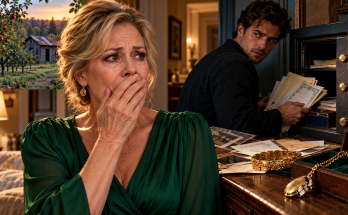
The recording began with the sound of a chair scraping across a floor, followed by a man's irritated voice demanding to know why the quarterly figures had changed. I recognized Martin Bell before he spoke a complete sentence. He had a particular way of pronouncing financial terms, carefully emphasizing each syllable as though precision alone could settle any disagreement. I sat in Miriam Shaw's office, listening through headphones while David Mercer followed a preliminary transcript. Across the table, Emily held her mother's hand. Marianne had insisted on hearing the recording despite Miriam's warning that some of its contents might be deeply upsetting.
The file had been preserved on a small digital recorder Arthur Keene claimed to have kept after a disagreement with Bell. Investigators had obtained the original device through Keene's attorney and were examining its recording history, file structure, and possible alterations. Miriam explained that the preliminary technical review found no obvious interruption in the conversation, but the authentication process was not complete. We were listening to a working copy provided under controlled conditions. Whatever we heard would need to be supported by other evidence before anyone could responsibly treat it as established fact.
Keene's voice came next, lower and less distinct. He asked whether the payments to Seaward Residential Services should continue under the same account reference. Bell answered that the arrangement must remain unchanged until the final property settlements were completed. Then Keene mentioned Marianne. He asked what would happen if she insisted on identifying herself publicly and challenging the trust distributions. A pause followed, broken by the faint clink of glass against wood. Bell's reply was perfectly audible. He said her official absence was the only reason the present accounting arrangement could continue without direct scrutiny from the beneficiary.
Marianne's fingers tightened around Emily's hand. She did not cry. Instead, she leaned forward as though the recording might reveal something that had been withheld from her for twelve years. Bell continued, explaining that any attempt by Marianne to establish her legal identity would trigger questions about the authority under which her inheritance had been administered. Keene asked whether the company could simply settle those claims. Bell dismissed the suggestion. A settlement, he said, would require explaining the earlier transfers and identifying the people who had received the money.
I removed one headphone. "He knew she was alive," I said. Miriam nodded. "The speaker identified as Bell certainly discusses her as a living person. That's important, assuming the recording is authenticated." David pointed to the transcript. "Notice that he's not describing a historical mistake. He's discussing an ongoing arrangement and how to prevent it from being questioned." I looked at the date assigned to the file. It had been recorded four years earlier, eight years after Marianne's supposed death and roughly a year before Emily disappeared.
The conversation turned toward the beneficiary account. Bell referred to administrative expenses, medical costs, and what he called compensation for the people maintaining the arrangement. Keene asked whether some of those charges were excessive. Bell replied that the account had sufficient income and that the distributions could be reconciled when the family dispute was finally resolved. David stopped the playback. "That language matters," he said. "He appears to acknowledge using beneficiary funds for expenses that may not have benefited the beneficiary. But we'll need the accounting records to establish which charges were improper."
I thought of Marianne's years in private medical facilities, unable to contact her daughters, while people associated with Bell collected payments for keeping her there. Some treatment had been necessary and legitimate. She had suffered serious burns and required years of care. Yet the recording suggested that her medical needs had become part of a financial structure designed to preserve Bell's control. Her isolation generated expenses, those expenses justified additional transfers, and the transfers reinforced the appearance that someone was responsibly administering an unfortunate woman's affairs.
Keene then asked whether the younger daughter had learned anything. Marianne lifted her head. On the recording, Bell referred to Clara as a manageable concern because she believed her mother had died and remained occupied with ordinary family responsibilities. Emily, he said, was different. She had inherited Eleanor's habit of examining old documents and asking questions that conventional explanations could not satisfy. Keene responded that Emily's historical research was beginning to overlap with the trust files. Bell said they would need to determine how much she knew before allowing her to continue.
Emily released her mother's hand and pressed her fingers against her mouth. I could see that she was remembering the months before her disappearance: the altered photographs, the suspicious vehicles, and the growing belief that someone was watching her. The recording did not describe those later acts, but it showed that Bell had already identified her as a potential threat. Miriam paused the playback. "Would you like to stop?" she asked. Emily shook her head. "No. I want to hear the rest."
The final minutes concerned Arthur Keene himself. Bell questioned several payments made through a security contractor and complained that Keene's records were unnecessarily detailed. Keene replied that he intended to preserve documentation of the work he had performed. Bell's voice sharpened. He warned that written records could create problems for everyone involved. Keene answered that he was unwilling to accept responsibility for decisions made above him. After another pause, Bell suggested that continued cooperation would be more profitable than an argument about the past.
The recording ended with the sound of a door closing. For several seconds, none of us spoke. Marianne stared at the empty space beyond the conference table. "He talked about us like entries in an account," she whispered. Emily moved closer, but her mother shook her head gently. "I knew he was controlling things. I knew he was frightening me. But I didn't understand that the money was still moving because he kept me hidden." Her voice remained steady until the final sentence. Then she closed her eyes.
Miriam explained that the recording could support several different parts of the investigation. It suggested Bell knew Marianne was alive, understood the effect of her legal status on the trust administration, and discussed keeping the arrangements unchanged to avoid scrutiny. It also provided leads for investigators examining possible coercion, financial misconduct, and false records. But Miriam refused to treat it as a confession to every allegation. Bell had not admitted starting the fire, and the recording alone did not establish precisely who diverted each payment.
That distinction mattered to Marianne. She opened her eyes and looked at Miriam. "I want him held responsible for what he did. I don't want anyone inventing things because they think he deserves punishment." Miriam nodded. "That's exactly how we approach it." I watched Marianne settle back in her chair. For twelve years, other people had described her, represented her, and explained her disappearance without giving her a voice. Even now, when evidence seemed to support her, she insisted that the truth remain separate from what we suspected.
David returned to the transaction schedule. He had identified several payments matching the administrative categories mentioned in the recording. One concerned a security-management fee paid to a company once controlled by Keene. Another involved legal expenses charged to the beneficiary account during periods when Marianne had no independent attorney. A third category contained recurring payments to Northbridge Capital Holdings. "These are the transactions I want to examine first," David said. "The recording gives us a reason to ask whether the expenses served the beneficiary or the people controlling her."
I asked whether the recorded conversation could help challenge the questionable debt against Ashford. David nodded cautiously. "Potentially. If the same entities used the trust income to create or support a loan that Whitmore Development supposedly owed, the underlying records may show that the debt was not an ordinary arm's-length transaction." He drew a line between two accounts on his diagram. "But we still have to establish the precise movement of funds. The existence of related parties doesn't automatically mean every obligation is invalid."
After the meeting, I walked with Emily and Marianne to the courtyard. Marianne stopped beneath a young maple tree whose leaves had begun to turn yellow. She looked exhausted. "I spent years thinking there must be some terrible secret about me that made all this necessary," she said. Emily stood beside her. "There wasn't." Marianne shook her head. "I can see that now. But when you're kept away from everyone who knows you, you begin to believe the explanations you're given. Even the cruel ones."
Emily reached for her mother's hand. Marianne held it tightly. I stepped away, allowing them a moment alone, and called Clara. She answered on the second ring. Rosie was asleep, and Mrs. Dalton was preparing dinner. I told her that the recording appeared to confirm Bell knew Marianne was alive and discussed preventing her from making a direct claim against the trust. Clara remained silent for several seconds. Then she asked, "Does Mom know?" I told her Marianne had heard it herself.
"How is she?" Clara asked. I looked toward the tree. "Upset, but determined." Clara exhaled. "Tell her I want to see her when she gets back. And tell Emily I found another one of Mom's old letters." I promised to pass along the message. Before ending the call, Clara added, "Lucas, thank you for not keeping this from me." The words were simple, but they reminded me how much trust had been damaged by years of protective secrecy. I intended to give her information she was entitled to know, even when it was painful.
That afternoon, Miriam received the authenticated corporate ownership records for the company holding the disputed Ashford debt. The structure was more complicated than the preliminary documents suggested. Arthur Keene had helped establish the original entity, but his interest was later transferred to another company controlled through Northbridge. Bell's professional partnership appeared among the historical beneficial owners. The lender had changed names twice, though the account references remained consistent. David concluded that the creditor's claimed independence required serious examination.
The most troubling discovery concerned the money supposedly advanced to Whitmore Development. The records showed that a substantial portion originated from income generated by properties associated with Margaret's original trust. Those funds passed through several intermediary accounts before being recorded as a loan to the company. It was not yet clear whether the full principal represented money genuinely delivered to Whitmore Development. What was clear was that Bell's network had been positioned on both sides of transactions whose legitimacy depended on independent authorization.
"Margaret intended that income for Eleanor's family," I said. David nodded. "At least some of it, according to the original schedule. If the accounting records are accurate, that income helped fund the entity asserting creditor rights against Ashford." I stared at the diagram. The same property had been taken from Eleanor's inheritance, used to generate money that may have belonged to her descendants, and then placed at risk through a debt created by people controlling those funds. It was a system capable of producing obligations from the very assets it had wrongfully absorbed.
Miriam prepared additional submissions for the court concerning the disputed security interest. The special committee at Whitmore Development agreed to support preservation of the records, although it stopped short of adopting my conclusions about the debt. I understood its caution. The company needed independent advice, and some directors were reluctant to concede that financial statements they had approved for years might be unreliable. Nevertheless, the committee's willingness to cooperate deprived Bell of the simple argument that I was acting alone against the company's interests.
Nathan called me that evening with an unexpected development. "Bell's lawyers have requested a meeting with the special committee," he said. "They say he's prepared to explain the trust arrangements and identify irregularities involving your father's administration." I stopped walking. "He wants to blame Theodore." Nathan hesitated. "He hasn't said that directly, but the memorandum emphasizes decisions made before you became president." I thought of the recorded conversation in which Bell discussed controlling Marianne's status years after my father retired. "Make sure the committee receives the authenticated records before accepting any explanation."
Nathan promised he would. Then he lowered his voice. "There's something else. The investigators have found correspondence showing Bell advised the company to stop sending annual reports directly to Marianne's last known address." I felt a sharp tightening in my chest. "When?" "Shortly after the fire. His office said the beneficiary was deceased and that all future notices should be routed through legal counsel." I looked toward the windows of the building opposite me. For twelve years, official correspondence had followed an instruction Bell knew was based on a false account of Marianne's death.
That night, I returned to the estate and found Theodore waiting in the library. He had been reading Margaret's old correspondence, which Miriam had permitted him to review in copy form. His face was drawn. "Nathan called me," he said. "He warned that Martin may accuse me of directing the trust arrangements." I sat opposite him. "You were involved in concealing the altered schedule." My father nodded. "I know." "But Bell controlled the later payments and Marianne's accommodation. We have records suggesting that." Theodore looked down at his hands.
"I don't want you to lie for me," he said. I studied him. "I'm not going to." "Then tell the investigators everything I did. If Martin wants to blame me, let the evidence decide." His voice was steady, but his fingers trembled slightly. I remembered the man who had taught me to negotiate without showing weakness, who considered uncertainty a flaw in leadership. He looked smaller now, though perhaps more truthful than I had ever known him. "That's what I've been trying to do," I answered.
Theodore reached into a folder and removed a letter written on Whitmore Development stationery. "I found this in the papers from my retirement," he said. "Martin asked me to sign it, but I refused." I examined the document. It described a broad delegation of authority over certain family trust matters, extending Bell's control beyond ordinary legal representation. The signature line remained blank. Beneath it, Theodore had written a short note declining the arrangement until the underlying records were reviewed.
"Why didn't you tell me about this before?" I asked. My father looked ashamed. "Because I never followed up. Martin said he'd resolved the issue another way. I was relieved not to be involved." I studied the date. The letter had been prepared several months before Emily's disappearance. If Bell had failed to obtain Theodore's signature, he might have sought another source of authority. I thought of the disputed approvals bearing my name and the fabricated board minutes. "Did he ever ask me to sign something similar?" I asked.
Theodore shook his head. "Not that I know of." I placed the letter beside the other records. It suggested Bell's control had not developed through a single agreement. He had repeatedly sought authority from people who could legitimize his arrangements, and when one route failed, another appeared. My father's refusal should have triggered an investigation. Instead, it became another unresolved concern buried among the files of a retiring executive. I looked at him. "This may help establish when Bell began using my signature."
The following morning, Miriam's investigator compared the unsigned delegation with the earliest disputed approvals issued under my name. The dates were close. Bell's office had prepared several authorizations soon after Theodore declined the arrangement, including one concerning administrative expenses charged to the beneficiary account. The signatures would still require forensic examination, but the sequence supported a specific theory: Bell needed authority to continue controlling the funds and may have manufactured documents when he could not obtain it legitimately.
Emily joined me at Miriam's office while we reviewed the chronology. She studied the unsigned letter and the later approvals. "He kept trying to make someone else responsible," she said. I nodded. "First my grandfather, then my father, then me." Emily looked toward the window. "And Mom was supposed to stay dead on paper so no one would challenge the distributions." She said it without anger, almost as though she were reading an architectural defect that had finally become visible beneath layers of paint.
Miriam entered carrying a newly received notice from Bell's attorneys. They challenged the authenticity of the recording and argued that Keene had manipulated it to protect himself from responsibility. They also claimed Bell's involvement in the beneficiary account reflected authorized legal services. The response was predictable, but one attachment surprised us. Bell had produced a document purporting to show that Marianne personally confirmed the continuing arrangements several years after the fire.
The document contained a signature bearing Marianne's name and a date from the period when she was living under an assumed identity in a private medical facility. Beneath the signature was a witness certification attributed to Arthur Keene. I studied the page. "Did Marianne sign this?" I asked. Miriam shook her head. "She says she doesn't recognize it. Keene's lawyer says his client has no recollection of witnessing that particular document." The authenticity question would require further examination, but Bell had introduced a new claim that could complicate Marianne's efforts to recover her rights.
Then David noticed a detail near the bottom of the page. The document referred to a revision of the beneficiary account that had supposedly been approved by Margaret Whitmore. He checked the date of the revision against the family records and looked up slowly. "This can't be right," he said. I leaned closer. The purported approval was dated more than a year after Margaret's death. For the first time, Bell had produced a document whose own chronology raised an obvious contradiction. Miriam set it beside the original ledger. "Preserve that," she said quietly. "We may finally have a direct way to test the story his office has been telling."