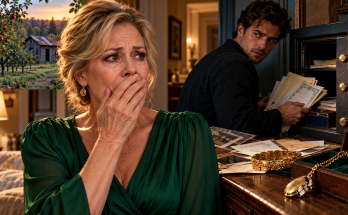
The day Detective Ortiz returned my mother's necklace, I discovered that relief could hurt almost as much as grief. She placed a sealed evidence package on the table between us, explained the paperwork required for its release, and waited while I checked the contents. Through the clear wrapping, I could see the small oval links and the mismatched gold clasp my mother had complained about for years. Beside it lay my anniversary bracelet, its crooked fastening still bearing the mark my husband had accidentally made. I had imagined this moment countless times. Now that it had arrived, my hands were trembling too badly to open the package.
My daughter sat beside me in the same interview room where we had first heard the recording of a stranger pretending to be me. She had brought a soft cloth pouch to protect the jewelry on the journey home. Detective Ortiz explained that the necessary examinations had been completed and that the evidence was documented before release. Several smaller items and part of the stolen cash remained missing. The wooden jewelry box had also been recovered, although its damaged hinge would need repair. I signed the acknowledgment carefully, following each instruction without rushing.
When Ortiz finally handed me the necklace, I rested it across my open palm. The links were cooler than I remembered, and the clasp caught slightly against my skin. I turned it over and found the tiny scratch near the fastening where my mother once caught it against a drawer handle. It was such a small imperfection that no stranger would have understood why it mattered. Yet that scratch carried an entire afternoon from my childhood, when my mother stood before her bedroom mirror and asked me to help untangle the chain.
I began crying without warning. My daughter moved closer, but I shook my head gently when she tried to take the necklace. I wanted to hold it myself. For months, the people involved in the scheme had treated my possessions as documents, security, expenses, and objects to be converted into money. Holding the necklace reminded me that its value had existed long before any of them calculated what they might gain from my mother's property.
Ortiz remained quiet until I recovered. Then she told me that the criminal proceedings were advancing, although not every defendant would face the same process or outcome. Daniel Hale had formally admitted his involvement in obtaining my safe key, assisting the unlawful entry, and disposing of stolen jewelry. Lydia Mercer had acknowledged her role in the false identity verification and fraudulent documentation. The man who entered my house had also admitted his part in removing the safe's contents. Their admissions were being addressed through the courts, with questions of sentencing and restitution still requiring decisions.
I asked whether Daniel had requested another opportunity to contact me. Ortiz said his solicitor had previously submitted the written apology I received, but there was no need for further personal communication. I told her I did not want one. Daniel had already explained enough for me to understand his choices. Whatever affection he appeared to offer on my birthday had been tangled with an assignment he accepted for money. His eventual cooperation mattered to the investigation, but it did not entitle him to another private conversation.
The proceedings concerning Graham Pike took longer. His lawyers continued disputing the allegation that he knowingly directed the fraudulent operation. They argued that North Harbor had relied on intermediaries and that Pike's instructions referred to obtaining legitimate documents. The prosecution presented the original commercial records, communications showing that my consent was missing, payment approvals, the revised progress report, and evidence concerning the arrangements that kept me away from home. Each item was examined for what it established rather than for the story people preferred it to tell.
When I was called to give evidence, my daughter accompanied me to the courthouse but could not answer for me. I entered the witness area with my statement and spoke about the events in the order I remembered them. I described the birthday morning, the silent telephone, the green dress, and the bar where Daniel approached my table. I explained that I chose to spend the evening with him. Then I described the photograph taken while I slept, the missing key, and the empty safe waiting inside my home.
I had feared this testimony more than almost anything else. Yet once the questions began, I discovered that embarrassment diminished when I refused to apologize for something that was not wrong. I had wanted companionship. I had trusted someone who appeared kind. Those facts did not give him permission to steal from me. When Pike's defense questioned whether I had voluntarily accompanied Daniel to the hotel, I answered that I had. Then I explained that agreeing to spend a night with a man was not agreeing to surrender my jewelry, identification, or inherited land.
The courtroom remained still while I spoke. Nobody laughed. Nobody suggested that sixty-two was too old to seek affection or that loneliness made me incapable of judgment. The questions returned to documents, communications, and the conduct of the people involved. I realized that much of the shame I had carried came from imagining other people's reactions rather than anything anyone had actually said to me. The scheme had relied upon that fear, but I no longer intended to carry it for Daniel or Pike.
The prosecution then examined the false verification. Lydia Mercer's recorded voice, claiming my name and describing the orchard incorrectly, was compared with the records showing how the call had been arranged. The discrepancy about the storage shed proved especially important. Mercer had answered from an inaccurate property summary rather than personal experience. The communication directing her to proceed without contacting me was considered alongside my son's earlier message warning Pike that I had not agreed. The false call was no longer an unexplained administrative irregularity.
I listened as the payment records were discussed. The invoices, field-service entries, and scheduling documents connected the birthday operation to the effort to obtain original title papers. The progress report that had been revised after questions arose about my authorization was examined in its different versions. The defense challenged the interpretation of particular entries, but the original records remained. What had seemed to me like a terrifying sequence of unrelated discoveries could now be examined as a connected course of conduct.
When the court eventually reached its decisions, Pike was found responsible for his participation in the fraudulent attempt to obtain control over my property. The court's findings distinguished the proven conduct from allegations that had not been established. Subsequent sentencing proceedings addressed the seriousness of the deception, the planning involved, and the harm caused. Other participants faced penalties reflecting their own roles, admissions, and circumstances. No judgment could restore the months I had lost, but the proceedings made something clear: the deception had not been a misunderstanding about an elderly woman's wishes.
I did not attend every sentencing session. My solicitor and Detective Ortiz kept me informed about the results relevant to me, including restitution arrangements and the status of recovered property. Some financial losses remained difficult to recover, and legal expenses had accumulated despite the protections we obtained. I had once imagined justice as a single moment when someone announced that everything was over. In reality, it arrived through decisions, orders, accounts, and practical steps that continued long after the central facts were established.
My son's proceedings were the hardest to face. He admitted knowingly signing the false witness declaration and site-access authorization and acknowledged that he had represented himself as having authority he did not possess. His cooperation with investigators, including the archived correspondence he eventually disclosed, was considered alongside those acts. The court imposed consequences that included supervision, financial obligations, and required community work. His own debts remained a separate problem he had to address. I was grateful that his cooperation mattered, but I did not ask anyone to pretend his signatures were harmless.
He stood before the court looking exhausted and frightened. I remembered the boy who used to argue about bedtime and the teenager who insisted he could solve every problem without help. For years, I had measured my success as a mother by how quickly I could relieve his distress. That afternoon, I remained seated while he accepted the consequences of decisions I had begged him not to make. I cried afterward, alone in a restroom, but I did not regret telling the truth.
The weeks following his sentencing were difficult for the entire family. His wife continued working through the financial damage and the dishonesty he had concealed from her. Their children knew that something serious had happened, although the adults took care not to burden them with details they were too young to understand. My daughter remained close to both households without pretending that everyone was ready for reconciliation. Family gatherings became smaller, and conversations were sometimes awkward. Nobody could repair years of trust through one apology.
My son began meeting regularly with a debt adviser and following the obligations imposed by the court. He found additional work to help repay what he could. He stopped approaching me for money, and he no longer suggested that selling the orchard might solve his problems. When he telephoned, he asked about my day rather than the value of my property. At first, I suspected that every considerate question was another attempt to earn forgiveness. Over time, the consistency of his behavior mattered more than the words themselves.
Several months after the property ruling, my solicitor confirmed that the disputed registry matters had been addressed and that the false transfer and security documents no longer stood as enforceable claims against my land. Harborstone Lending had closed its disputed application without asserting a valid interest in the orchard. North Harbor's claimed access rights based on the forged authorizations had been rejected. The company could no longer use those papers to direct surveys or development work on my property.
I asked my solicitor to explain the final position twice. She understood why. For months, each encouraging development had been followed by another document or hidden obligation. Now the relevant records had been checked, the disputed claims addressed, and the court's orders implemented. She reminded me that ordinary future offers or planning matters could still arise, but those would require lawful procedures and my genuine consent. The scheme that began with my son's debts no longer controlled the orchard's future.
The following Saturday, my daughter and I returned to the land with permission to remove the orange survey stakes. My son came as well, after asking whether I would be comfortable with him helping. I had considered refusing. Then I decided that allowing him to perform a practical task did not mean everything had been forgiven. I told him he could join us, but that he was there as my son, not as someone making decisions about the property.
We worked along the proposed corridor, pulling the stakes from the ground and collecting the plastic ribbons. Some came out easily. Others required a spade to loosen the compacted earth. My son carried the discarded wood toward the gate, and my daughter filled the holes. I worked near the old shed, where the stakes had come closest to the building my grandfather constructed. The labor was ordinary and slightly uncomfortable. That was exactly why I valued it.
At one point, my son stopped beside the old stone boundary marker. He looked toward the southern lane and said he had finally understood why North Harbor wanted the property so badly. He spoke about the road access, the developer's alternative route, and the financial incentives Pike had hoped to obtain. Then he looked at me and said that none of those reasons gave him the right to sign my name or offer permission in my place.
I nodded. It was the first time he had spoken about the land without describing it as a solution to someone else's problem. We returned to work. There was no dramatic embrace, no promise that the past had been erased. But when the final stake came free, he handed it to me instead of throwing it onto the pile. I took it and placed it beside the others. For once, the decision about what to do with something taken from my land belonged to me.
We repaired the southern gate that afternoon. My son replaced a damaged hinge while my daughter held the frame steady. I supervised the work from a folding chair, occasionally offering advice that neither of them particularly wanted. They teased me about it, and I laughed. The sound surprised us all. For a few minutes, we resembled the family we had once been, not because the betrayal had disappeared, but because ordinary affection could exist without denying it.
The shed roof needed more extensive repairs, so we arranged for a local carpenter to examine it. I also commissioned a modest plan for maintaining the orchard's surviving trees and improving drainage near the southern entrance. The independent valuation remained in my files, and I no longer believed the property should remain unchanged forever. If a future offer made sense, I would consider it. But I would make that decision after obtaining independent advice, not because someone frightened me with deadlines or promised easy money.
As the months passed, my relationship with my daughter became less organized around emergencies. We began meeting for lunch without bringing folders. Sometimes she arrived with the grandchildren and let them run through my garden while we drank tea. We spoke about school, books, recipes, and the small inconveniences of ordinary life. I realized how much of our conversation had been consumed by the investigation. Being able to discuss unimportant things again felt like a form of freedom.
My mother's necklace returned to its old wooden box after the hinge was repaired. But I no longer kept it hidden away indefinitely. I wore it to my granddaughter's school performance and later to a family dinner. Each time, I touched the mismatched clasp and remembered my mother standing before her mirror. The bracelet my husband gave me went back onto my wrist. Its crooked fastening still required patience, but I was grateful that nobody had tried to make it perfect.
The first anniversary of my sixty-second birthday approached more quickly than I expected. My daughter asked whether I wanted a gathering. I told her I would like a simple meal with the family, but I also intended to spend part of the day alone. She looked concerned until I explained that being alone was not always the same as being lonely. I had spent the previous year learning the difference.
On the morning of my sixty-third birthday, my telephone rang shortly after eight. My daughter called first, with the children shouting their wishes behind her. My son telephoned soon afterward. He did not ask about legal matters or money. He wished me a happy birthday and asked whether I had slept well. His voice still carried a certain carefulness when he spoke to me, but it was no longer the strained politeness of someone preparing to conceal a problem. I thanked him and said I would see him at dinner.
Later, I took the green dress from my wardrobe. I had worn it several times since the court proceedings, but it remained connected to that first birthday evening. I considered choosing something else, then fastened my mother's necklace around my neck and stepped before the mirror. My hair was a little grayer, and new lines had settled near my eyes. I looked like a woman who had endured a difficult year. I also looked like someone who had stopped waiting for other people to define her life.
I went into the city by bus. This time, I did not follow a stranger into an unfamiliar bar. I visited the bookstore with the painted blue door, bought a novel, and sat in a quiet café overlooking the street. I ordered coffee and a slice of chocolate cake. Nobody placed a candle in it or asked me to make a wish. I found that I did not mind. I ate slowly, watched people passing outside, and enjoyed the simple fact that the afternoon belonged to me.
I thought about Daniel once, briefly. I remembered the warmth of his voice and how carefully he listened when I spoke about my husband. Those memories no longer made me doubt what happened afterward. He had chosen to deceive me, and the legal consequences of his conduct were his to bear. I did not need to decide that every pleasant moment had been false, nor did I need to preserve his image as a kind man who merely made a mistake. I could accept the complexity without inviting him back into my life.
When I returned home, my daughter had arranged the dining table, and my son was helping prepare supper. The grandchildren had made a birthday card covered in uneven hearts and brightly colored flowers. There was a small cake in the center of the table with candles already waiting. Nobody pretended the previous year had been easy. We simply ate together, talked about ordinary things, and allowed the evening to become a new memory.
After dinner, my son offered to wash the dishes. I watched him standing at the sink where I had waited for birthday calls a year earlier. He moved carefully around the kitchen, asking where things belonged rather than assuming he knew. It was a small behavior, hardly worth noticing under ordinary circumstances. Yet I noticed it. He was beginning to understand that respect sometimes meant asking permission before touching what belonged to another person.
Before he left, he hugged me. I allowed it. The embrace was brief and a little uncertain, but it did not feel false. I told him that I hoped he continued doing the difficult work he had begun. He said he would. I did not ask for another promise, and he did not offer one. We both understood that the future would depend on what he did after walking out the door.
When the house became quiet, I carried the birthday card into the bedroom and placed it beside my husband's photograph. My mother's necklace lay against my collarbone, warm from being worn all day. I looked at the woman in the old river photograph, laughing with a man who loved her, and thought about everything that had happened since his death. I had survived loneliness, betrayal, humiliation, and the fear of losing the things my family entrusted to me.
I had also learned that forgiveness was not a duty owed to anyone who apologized, and that love did not require surrendering judgment. I could continue loving my son while expecting him to live with the consequences of his actions. I could remember the tenderness I believed I felt with Daniel without excusing the deception behind it. I could preserve my mother's land without allowing the dead to make every decision for the living.
I opened the drawer and took out the hotel envelope one final time. Inside was the photograph Daniel had taken while I slept. For months, it represented the moment when my trust was turned against me. I looked at it now without the shame that once made my hands shake. The woman in the picture was not foolish, desperate, or ridiculous. She was simply asleep, unaware that someone beside her had made a terrible choice.
I returned the photograph to its envelope and placed it with the legal records, where it belonged. Then I switched off the bedroom lamp and stood beside the window for a moment. The street was quiet. My house was secure. My mother's orchard remained mine, and its future was no longer being arranged by strangers.
I had once believed the worst part of my sixty-second birthday was that nobody remembered it.
What I finally understood was that being remembered was not the same as being loved, and being wanted was not the same as being respected.
At sixty-three, I no longer needed a stranger to make me feel that my life had value.
I already knew it did.
The End
Read more original stories on Feel Every Story.