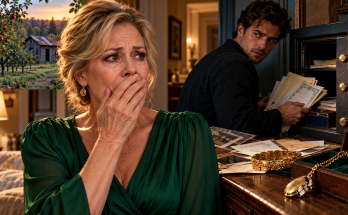
The brass key lay on Miriam's desk beside a photocopy of the deposit agreement, its faded green ribbon coiled against the polished wood. Marianne had carried it for years without knowing whether the box it opened still existed. The original bank had disappeared through a succession of mergers, and the branch where Eleanor rented the box had been converted into a restaurant. Nevertheless, Miriam's investigator had traced the account to a regional institution that maintained records of abandoned and transferred safe-deposit contents. We had an appointment with its legal department that morning.
Marianne insisted on coming. Emily offered to accompany her, but Clara surprised us by asking to join them as well. "I want to know what Eleanor left," she said. "She was my grandmother, whether Whitmore Development acknowledged her or not." Marianne looked at her daughter for several seconds. Since their reunion, Clara had alternated between guarded politeness and questions that seemed to tear open every old wound. This was the first time she had spoken about Eleanor as part of her own family history rather than someone whose inheritance had started a terrible dispute.
We traveled in two cars. Miriam accompanied Marianne and Clara, while Emily rode with me. The drive passed through Boston neighborhoods where old brick buildings stood between modern glass offices. Emily watched the streets in silence until we stopped at a traffic light. "I used to come here with Mom," she said. "Eleanor lived near the old market. She'd take us to a bakery afterward." I glanced at her. "Did you know much about the trust?" Emily shook her head. "Only that she believed something had been taken from her. She never explained the details."
"Did she know Margaret personally?" I asked. Emily nodded. "When she was younger. But by the time Clara and I were old enough to remember, Margaret had died. Eleanor talked about her as someone who had tried to do the right thing while trapped inside a family that valued reputation more than honesty." I thought of my grandmother's portrait and the ledger she had hidden. Her records had survived because she understood how quickly official history could be changed when the people controlling it had something to gain.
At the bank's regional office, a senior records officer named Helen Price met us in a small conference room. She was precise, courteous, and careful not to imply that finding an old deposit box meant the contents could immediately be released. "We have records showing the account was transferred to central custody," she explained. "The original box was closed after the branch merger, and certain contents were placed in sealed storage under an inventory." Miriam provided the documentation establishing Marianne's identity claim and the court orders relevant to the investigation.
Helen examined the papers. "There are questions concerning the authority under which this box was accessed years ago," she said. Marianne leaned forward. "Martin Bell used a power of attorney bearing my name. I never authorized him to take anything from Eleanor's box." Helen looked at her sympathetically but remained professional. "The bank's archived file includes that authorization. We can't determine its validity merely from the document's existence. However, we can provide it to the authorized investigators and respond to the court's directions concerning the contents."
Miriam asked whether the original deposit agreement survived. Helen nodded and produced a certified copy. Eleanor had rented the box in her own name, with Marianne identified as an authorized successor upon proof of Eleanor's death and the relevant estate documentation. The agreement dated from years before Marianne's fire. Beside Eleanor's signature was a handwritten notation referring to a sealed family correspondence packet. Marianne touched the page. "She told me those letters were important," she said. "I didn't understand how important until much later."
Helen then presented the archived power of attorney. It was dated five days after Marianne's fire and purported to authorize Bell to inspect and remove documents from the box. The signature resembled Marianne's, but she stared at it with disbelief. "I was in the hospital," she whispered. "My hands were bandaged. I could barely hold a cup." Emily leaned closer. The signature appeared steady and complete, with none of the irregularities expected from someone recovering from severe burns. Miriam made a note. "We'll obtain the original and the relevant medical records for comparison."
The bank's file also contained a record of the access. Bell had attended with Arthur Keene and presented the authorization to a branch officer. The inventory listed several envelopes and a document packet removed from the box. One sealed packet had remained because the authorization identified only financial and trust records. Helen explained that the remaining contents were transferred to central storage after the branch closed. "The storage seal is intact according to our records," she said. "We can arrange a supervised inspection under the court's direction."
Marianne looked at me. "Eleanor said there was a letter for the girls." Clara lifted her head. "For us?" Marianne nodded. "She wrote it when she became ill. She said it wasn't about money, but she wanted you to have it when you were old enough to understand certain things about our family." Emily looked down. "We never received anything." Marianne's expression tightened. "After the funeral, Bell said the estate papers were complicated. He told me the personal effects would be returned when the trust issues were resolved." I saw the old pattern again: delay presented as protection until people stopped expecting an answer.
The supervised inspection took place later that afternoon at the bank's central storage facility. Miriam attended with the authorized representatives and a court-approved examiner. Marianne, Emily, and Clara were permitted to observe through a nearby glass partition while the seal was documented and opened. I remained beside them. A storage officer lifted out a flat envelope, a small velvet pouch, and a packet wrapped in pale tissue. The contents looked ordinary enough to belong in any family's forgotten drawer, yet the room had become almost painfully quiet.
The envelope was addressed to Emily and Clara in Eleanor's handwriting. Marianne pressed one hand against her mouth. Clara stepped closer to the glass, her eyes fixed on the paper. The examiner recorded the envelope's condition before arranging for it to be opened under the agreed procedure. Inside were two letters, one for each girl, and a third sheet addressed to Marianne. The handwriting was steady, though the lines grew less even toward the bottom. Eleanor had apparently written them while her health was failing.
Clara read her letter later in a private room. I did not ask to see it. Emily remained beside her sister, holding her own unopened envelope. When Clara finally looked up, her face was wet. "She remembered the little blue bicycle," she whispered. Marianne smiled through her tears. "She bought it for you when you turned nine." Clara nodded. "She said I could never steer properly because I kept looking at the people watching me instead of the road." Emily laughed softly. "You rode straight into the hedge." For a moment, the years between them seemed less impossible.
Emily opened her letter next. She read silently for several minutes, then folded the paper carefully. When she looked at me, her expression had softened. "Eleanor said she hoped I'd find work that made me curious," she told me. "She knew I loved old buildings. She wrote that people sometimes forget the hands that built them, but the buildings remember." I felt a familiar ache. Emily had spent her adult life doing exactly what Eleanor encouraged, following traces others overlooked. The same habit had led her into the trust records that changed all our lives.
Marianne's letter was longer. She read it with Miriam nearby because it referred to the family's legal arrangements. Eleanor wrote that Margaret intended certain properties and their income to remain protected for Eleanor and, after her, Marianne and her descendants. She warned that family representatives had resisted acknowledging those rights and urged Marianne to seek independent advice before signing any release. The letter did not itself establish the trust's legal terms, but it showed that Eleanor understood the dispute and tried to protect her daughter from pressure.
The most important document was not among the personal letters. It was a folded memorandum placed inside the velvet pouch, written by Margaret Whitmore years before her death. The paper bore her signature and referred to an independent trustee who had been instructed to maintain copies of the original trust schedule. Margaret stated that Eleanor's beneficial interest was not to be altered by any later agreement among other family members without the legally required consent and procedures. She also recorded that Martin Bell, then a younger attorney assisting the family, had witnessed the original instructions.
I read the memorandum twice. Bell had spent years treating Eleanor's claim as a misunderstanding arising from incomplete records. Yet Margaret's document placed him at the creation of the very arrangement he later helped replace. Miriam examined the signature and the references to the original schedule. "This may be important corroboration," she said, "but we need to verify the document and identify the independent trustee. It doesn't automatically invalidate every later amendment." I nodded. After the forged photographs and disputed signatures, none of us could afford to accept a paper simply because it supported what we wanted to believe.
The memorandum named a small trust company that had ceased operating decades earlier. Miriam's investigator began tracing its successor records. If independent copies of the schedule survived, they might establish Margaret's instructions without relying solely on her handwritten ledger. Marianne looked exhausted but determined. "Eleanor always said there was someone outside the Whitmore family who knew the truth," she whispered. "I thought she meant an old friend." Miriam studied the name. "She may have meant a professional custodian who retained the original records."
By the time we left the bank, the sky had darkened. Clara carried her grandmother's letter in a protective folder, keeping one hand against it as though afraid someone might take it away. Emily walked beside her. Their conversation was quiet, interrupted by long stretches of silence. Marianne followed a few steps behind, leaning lightly on Miriam's arm. I realized how difficult the day had been for all three women. They had recovered pieces of a family history that should have been theirs from the beginning, but each discovery also revealed how deliberately those memories had been withheld.
We returned to the temporary accommodation, where Rosie greeted us by announcing that her wooden horse could walk again. Mrs. Dalton had repaired the missing section of its mane with a small piece of carved wood and painted it a slightly darker brown. Rosie held it up proudly. "Grandma Dot fixed him." Marianne smiled and examined the repair. "She did a good job." Rosie nodded solemnly. "Horses need people who know what they're doing." Clara laughed for the first time that day, and the sound seemed to surprise her.
After dinner, Emily and I sat near the window while the others settled Rosie for bed. She held Eleanor's letter folded between her hands. "I used to think the inheritance was only about money," she said. "Then I saw how much of our family history had been erased." I looked at her. "Your grandmother tried to preserve it." Emily nodded. "Both grandmothers, in different ways. Eleanor kept letters, and Margaret kept accounts." She smiled faintly. "They might have liked each other more than the rest of the family wanted."
I thought of Margaret's portrait above the library fireplace and the woman who had once sat beneath it, carefully recording figures in blue ink. "I wish I'd known what she was trying to do," I said. Emily looked at me. "You were a child." "I was an adult when my father and Bell continued handling those records. I could have asked questions." She shook her head. "You can regret that without pretending you knew everything." Her words were gentle, but they didn't excuse me. They made room for responsibility without turning it into another kind of self-deception.
The following morning, Miriam called with news from the trust company's successor archive. Several boxes of old records had survived a merger and were held by a records-management provider. The archive included correspondence concerning Margaret Whitmore's trust and a reference to the original schedule. Miriam had arranged for the documents to be preserved and reviewed under the proper legal process. "If the records contain what we think they might," she said, "we'll have evidence independent of both your family and Bell's office."
I asked whether Bell had been notified. "He'll receive whatever notice the rules require," Miriam answered. "But the archive is now under a preservation instruction. No one should be able to remove or alter the records without creating a record of the attempt." I looked at the memorandum from Margaret. "Do you think he knew this copy existed?" Miriam paused. "We don't know. But his reaction to the deposit-box letter suggests he understood the danger of independent documentation." Her words reminded me of Keene's account: Bell had become visibly alarmed after reading something removed from Eleanor's box.
That afternoon, the company's special committee issued a statement confirming that Martin Bell's role in advising Whitmore Development had been suspended pending independent review. The announcement did not accuse him of wrongdoing. It described concerns about potential conflicts of interest, disputed authorizations, and the need to preserve records. Bell's office responded immediately, denying improper conduct and describing the allegations as an attempt to undermine legitimate transactions. I read both statements carefully. For years Bell's authority had rested partly on the appearance of professional certainty. Now that certainty was being challenged in public.
Nathan called to tell me employees were anxious. Rumors about missing money and property claims had spread through the company faster than the official explanations. Some feared layoffs. Others worried that projects under construction would lose financing. "People don't know whom to trust," Nathan said. I thought of the workers I'd seen outside the office after the first hearing. "Tell them the independent review is about protecting the company as well as understanding the past," I said. "But don't promise there won't be consequences. We don't know that yet."
Nathan was quiet for a moment. "Would you speak to the staff?" he asked. I hesitated. Administrative leave restricted my role, and I didn't want to interfere with the committee's process. Miriam later advised that any communication should be coordinated through independent counsel and the board. A short written statement was agreed upon. I acknowledged the seriousness of the investigation, expressed support for preserving jobs and ongoing projects where lawful, and made no predictions about the outcome. It was the least reassuring statement I had ever signed, but also one of the most truthful.
That evening, Theodore came to see me at the estate. He had read the summary of Margaret's memorandum and looked shaken. "Martin witnessed the original trust?" he asked. I nodded. "That's what the document says." My father sat heavily in the chair opposite the fireplace. "He told me the replacement schedule reflected her final wishes." I looked at him. "And you believed him." Theodore lowered his eyes. "Yes." I waited, then asked a question that had troubled me since the greenhouse conversation. "Did you ever speak to Eleanor yourself after Margaret died?"
He hesitated. "Once. She came to the office and demanded to see the original records." "What did you say?" Theodore rubbed his hands together. "I told her everything had been settled according to the trust documents. She said I was repeating words I'd been given without understanding them." He looked toward the portrait. "She was right." The admission was quiet. I wondered how different our lives might have been if he had listened to his sister instead of the lawyer who promised to protect the family business.
Before leaving, Theodore handed me an old envelope. "I found this among my father's correspondence," he said. Inside was a letter from Eleanor, written shortly before her death. It asked for a meeting to discuss documents that had been removed from the trust files. My father had written a short note across the top: Refer to Martin. I stared at the words. He had not even answered her himself. Theodore watched me read. "I thought I was being efficient," he said. "I was giving away the responsibility to understand what was happening."
I placed the letter with the records for Miriam. It was not the most legally significant document we possessed, but it revealed the human shape of the failure. Eleanor had asked to be heard. Theodore had directed her back to the man whose work she was challenging. I looked at my father. "You can't undo that," I said. He nodded. "I know." "But you can tell the investigators everything you remember, even if it makes you look worse." He met my eyes. "I will."
Miriam called shortly before midnight. Her investigator had completed a preliminary examination of the archive inventory from the independent trust company. The original schedule was listed, along with correspondence confirming that Margaret's instructions had been delivered to Bell before the disputed replacement was prepared. But there was another entry, one neither of us expected. It referred to a separate account established for the benefit of Eleanor's descendants and described a continuing obligation to distribute income after Eleanor's death.
I sat upright. "A separate account?" Miriam nodded, though I could only hear her voice. "It appears to have been funded through income from properties later transferred into Whitmore entities. We need the underlying records to know whether the account remained active." I thought of the payments David had traced through Northbridge. "Could Bell have diverted those distributions?" "That's one possibility," Miriam answered. "But we can't assume it until the transactions are reconstructed."
She paused before continuing. "Lucas, the archive includes an annual accounting instruction requiring the trustee to notify Eleanor's descendants directly. The last confirmed notice in the inventory was sent years before Marianne's fire. After that, the records show correspondence routed through Bell's office instead." I looked toward the dark library windows. For years, Marianne had lived under false names while the income intended for her family might have been controlled by the same lawyer who kept her hidden.
"What happens now?" I asked. Miriam's voice was steady. "We obtain the records, establish whether the account was misused, and ask why the notices stopped reaching the beneficiaries." I looked at the envelope Eleanor had written to Theodore, still lying beside me. She had tried to ask those questions long before any of us understood the danger. Now the records suggested that the theft had continued through a financial arrangement designed to compensate her descendants. The money had not merely disappeared. Someone had apparently kept collecting it in their name.