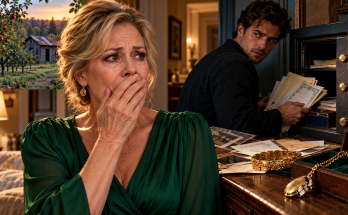
For several seconds after my mother spoke, I heard only the faint sound of traffic on her end of the call. Eleanor was breathing unevenly, as though she had been rehearsing what she wanted to say and suddenly found the words difficult to deliver. I remained seated at the kitchen table, looking at the folder Raymond had left beside my laptop. Upstairs, Sophie was listening to music while she drew. The house was peaceful, but my mother's voice carried a tension I recognized from the years when Arthur's business was failing.
"Your father never accepted the arrangement the way you thought he did," she began.
I waited.
"He signed the papers because he had no choice. But afterward, he kept saying the house was still his in every way that mattered."
I closed my eyes briefly. The statement did not surprise me. Arthur had always treated legal and practical realities as inconveniences when they conflicted with his preferred view of himself. What surprised me was Eleanor's willingness to say it aloud.
"He knew the deed belonged to SV Holdings," she continued. "He knew you were paying the taxes. But he couldn't bear the idea that people might find out his daughter had saved him."
I asked whether she had known about the financial statement he gave Raymond.
My mother hesitated.
"I saw him working on it."
"Did you see the house listed as his asset?"
"Yes."
I felt my jaw tighten. "And you didn't say anything?"
Eleanor began crying softly. She said Arthur had become furious whenever she suggested disclosing the ownership arrangement. He insisted Raymond would lose respect for him and might exclude him from the proposed trust. He told her the family had already endured enough humiliation during the business collapse. If anyone questioned the statement, he believed he could explain the arrangement later.
I looked toward the window, where darkness had begun collecting along the garden fence. "Mom, the deed isn't something he can explain away. He signed it. You both knew what it meant."
"I know," she whispered.
For years, I had accepted my mother's silence as a survival habit developed through marriage to a demanding man. She avoided conflict, softened his language, and tried to keep everyone calm. But silence had consequences. It allowed Arthur's version of events to become the family narrative. When he made a cruel decision, Eleanor's refusal to challenge him helped that decision stand.
"Why are you telling me now?" I asked.
She took a long breath.
"Because Raymond knows. Because your father is terrified. And because I saw Sophie's face when he told her to leave."
The last sentence settled heavily between us.
I remembered asking Sophie whether Eleanor had intervened. My daughter said her grandmother looked at her and turned away. Until now, I had wondered whether my mother heard the conversation clearly or merely understood that something uncomfortable was happening. Eleanor's words removed that uncertainty.
"You knew what he was saying to her."
"Yes."
"And you let her walk out?"
My mother began crying harder. She said everything happened quickly, that relatives were arriving, and that Arthur had been angry about the seating arrangements. She thought Sophie might wait in the kitchen or return after he calmed down. When she realized the girl had left, she was afraid that pursuing her would make the confrontation worse.
I pressed my fingers against my forehead.
"She was sixteen, Mom. She drove home alone in freezing weather. You could have called me. You could have called her. You could have followed her outside."
"I know."
The words were barely audible.
For once, I did not rush to comfort Eleanor. Her distress was genuine, but so was the harm caused by her inaction. I needed her to understand that I could feel sympathy for her difficult marriage without allowing it to become an excuse for abandoning my child.
"Do you know what Sophie asked me?" I said. "She wanted to know whether she would ever have to see Grandpa again. That's what she was thinking about after Christmas Eve. Not presents. Not dinner. Whether she would be forced to face the person who told her she wasn't family."
Eleanor made a small sound, and I heard her set something down.
"I never wanted her to feel that way."
"But you watched it happen."
There was no answer.
I asked why Arthur had suddenly become so concerned with the number of blood relatives at the Christmas gathering. Raymond had told me his trust imposed no such requirement for dinner, yet my father had used the proposed arrangement as his explanation. Eleanor said Arthur had spent weeks worrying about how Raymond might divide future benefits among different branches of the family. He believed any visible uncertainty about Sophie's position could make him appear less successful at preserving the family line.
The phrase made me feel cold.
"Preserving the family line," I repeated.
My mother did not defend it. She said Arthur had always attached too much importance to ancestry, but his anxieties grew after losing the business. He viewed Raymond's trust as an opportunity to restore his standing among relatives. He wanted everyone to see him as the head of a respected household with clear descendants and substantial property.
I thought of Sophie choosing her sweater, wrapping Eleanor's present, and arriving early to help prepare dinner. She had approached the gathering with affection. Arthur had viewed her presence as a threat to an image he was trying to construct.
"Did he plan to exclude her before she arrived?" I asked.
Eleanor remained silent long enough that I understood the answer.
"Mom."
"He told me that morning there might not be a place for her."
I gripped the edge of the table.
"He knew she was coming. He invited her himself."
"I reminded him," Eleanor said. "He told me not to make a scene."
The confession changed the emotional shape of the event. I had imagined Arthur reacting impulsively when Sophie appeared among the guests. Now I understood that he had considered excluding her hours earlier and allowed her to arrive without warning. She walked into that house believing she was welcome because no one had told her otherwise.
"Why didn't you call us?" I asked.
My mother said Arthur insisted he would handle it. She had been afraid of creating another argument before the gathering.
I looked down at my hands. They were resting on the same table where Sophie had eaten breakfast that morning, relieved to learn she was not responsible for her grandparents' financial problems. I had spent years teaching her to speak up when something felt wrong. Meanwhile, the adults who claimed to love her had treated silence as a reasonable response to deliberate cruelty.
Eleanor told me Arthur had become increasingly agitated since Raymond discovered the property discrepancy. He had accused her of failing to support him and insisted I was determined to destroy the family. She sounded exhausted.
"He's barely slept," she said.
Neither had Sophie, I wanted to answer. But I held the words back. My mother was finally telling me something truthful, and I did not want to turn the conversation into another contest over who had suffered most.
I asked whether Arthur had contacted a lawyer.
"He says he will."
"Then he should."
Eleanor sounded startled by my lack of alarm. She had expected me to soften the notice once I understood how frightened they were. Instead, I told her the property dispute needed to proceed through proper channels. My attorney would examine the documents and explain what options were available. I would not negotiate under threats or promises.
She asked whether I intended to force them from the house even if they apologized.
I took a moment before answering.
"I haven't decided what resolution is possible. But an apology isn't a payment that makes everything disappear."
My mother said she understood, though her voice suggested the idea was unfamiliar. She had spent decades smoothing over Arthur's anger with brief expressions of regret. Most disputes in our family ended when the injured person agreed to stop discussing them. I could no longer accept that pattern.
Before ending the call, Eleanor asked whether she might speak to Sophie.
I looked toward the staircase. "Not today."
"Please, Claire."
"She gets to decide when she's ready."
My mother began crying again. She said she feared Sophie would never forgive her. I told her forgiveness belonged to Sophie, not to me. If Eleanor wanted to repair the relationship, she would have to begin by accepting that she could not demand access or reassurance.
After the call, I sat without moving. I could hear Sophie's music faintly through the ceiling. The Christmas lights reflected in the dark window, their small colors floating above my own reflection. I felt exhausted in a way that had little to do with my hospital shifts. My mother's confession had confirmed that the rejection was neither accidental nor unavoidable. Arthur had considered it in advance. Eleanor had known. Both allowed Sophie to enter the house unprepared for what awaited her.
I opened my notebook and recorded the conversation while the details remained fresh. I distinguished Eleanor's admissions from my conclusions and noted that she acknowledged seeing Arthur prepare the financial statement. The habit felt clinical, but I trusted it. In the emergency department, a clear record could preserve information that confusion and emotion might otherwise distort. Our family dispute required the same discipline.
Then I wrote a separate note to myself: Sophie must not become responsible for making adults feel forgiven.
I looked at the sentence for a long time.
When Sophie came downstairs, she found me sitting beside the window. She carried a sketchbook tucked against her chest and asked whether I had been talking to Grandma. I told her yes. She sat across from me, waiting.
"Did she say she was sorry?"
"She said she was sorry she didn't help you."
Sophie lowered her gaze to the sketchbook.
"She saw me."
"I know."
"She looked right at me."
I nodded. "She admitted that."
My daughter was quiet for a while. Then she opened the sketchbook and showed me a drawing of our living room. She had sketched the sofa, the lamp, the bookshelves, and the little Christmas tree near the window. Two mugs sat on the coffee table. The details were so precise that I recognized the chipped rim on my favorite cup.
"Is this from today?" I asked.
She shook her head.
"It's how I want to remember Christmas."
I felt something tighten in my chest. She had chosen to draw the room where we had spent the day together rather than the grand dining room where she had been rejected. She was beginning to decide which memories deserved space in her life.
"It's beautiful," I said.
She smiled faintly.
We talked for a while about the drawing, the books on the shelf, and whether she wanted to add the cat we had owned when she was younger. The conversation was ordinary, and I was grateful for it. I did not tell Sophie every detail of Eleanor's confession. She had a right to know the essential truth, but not to carry the financial worries and marital tensions of her grandparents.
Later that evening, I received a message from my attorney confirming the consultation. The office also requested authorization to obtain an updated title report and review any filings connected to Elm Street. I approved the request.
I had almost put my phone away when another email appeared from a family member. It contained a forwarded message Arthur had apparently sent to several relatives. In it, he described me as unstable from overwork and claimed Sophie had been influenced by my resentment toward traditional family values. He warned that I was attempting to use ownership documents to punish elderly parents.
I read the message slowly. Arthur was no longer merely defending himself. He was trying to discredit me before other relatives could examine the facts.
At the bottom of the forwarded email, he had written that he remained the rightful head of the Elm Street household and would not allow anyone to take his family's property.
I closed the message and looked toward the folder containing his signature on the recorded transfer documents. The contrast was stark. My father knew the legal reality but had chosen to tell the family a different story.
I began drafting a short factual response, then stopped. Any statement I sent in anger could become another object of argument. I saved the email instead and forwarded it to my attorney.
A few minutes later, my phone rang. It was Raymond again.
His voice sounded unusually serious.
"Claire, Arthur has called several people trying to secure money against the house. I don't know how far he's gone, but I think you need to find out immediately."
I stood up from the table.
"What exactly do you mean?"
Raymond explained that Arthur had approached at least one relative about a short-term loan and described Elm Street as property he could use to support repayment. The relative had contacted Raymond because the request conflicted with what he had learned about SV Holdings.
I looked toward the dark window. My father was frightened, angry, and increasingly desperate to preserve the appearance of control. Now he was speaking about a property he did not own as though he might still use it to obtain money.
"Send me whatever you have," I told Raymond.
"I will."
After the call, I opened the folder again. The recorded deed, the occupancy agreement, and Arthur's financial statement lay in front of me. I had believed the central conflict was whether my parents could remain in a house after treating my daughter so cruelly. Now another question had emerged: how far would Arthur go to protect the illusion that the house still belonged to him?