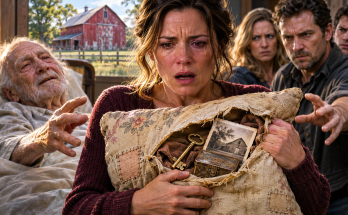
When Nora arrived the following weekend, I recognized her before she reached my front door.
Twelve years had changed her.
Her hair was gray now, and her face carried lines I didn't remember.
But she was wearing a knitted scarf that looked remarkably similar to the ones she used to make when I was younger.
She was pulling a faded blue suitcase behind her.
I opened the door.
She stopped.
For several seconds, neither of us seemed to know what to say.
I had imagined this moment throughout the week.
I thought I might ask her questions immediately.
I thought I might struggle to recognize the woman whose absence had become such a permanent feature of my life.
Instead, I stepped forward.
She released the suitcase and wrapped her arms around me.
“Oh, sweetheart.”
I held her.
I hadn't realized how much I remembered about being hugged by Nora until she was standing there.
She didn't offer a quick, obligatory embrace before moving on to something else.
She held me as though there was nowhere more important she needed to be.
Eventually, we stepped apart.
She wiped beneath her eyes.
Then she smiled.
“Look at you.”
I laughed through my tears.
“Look at you, too.”
Ezra was standing a little farther down the hallway.
He watched us curiously.
I reached for his hand.
“Nora, there's somebody I want you to meet.”
She crouched slightly.
“Hello, Ezra.”
He smiled.
“Are you the aunt with the calculator?”
Nora looked at me.
I laughed.
“I told him about it.”
She turned back toward Ezra.
“I certainly am.”
“Mom said it was her favorite present.”
“Well, your mother was an unusual child.”
He considered that.
“I like calculators, too.”
Nora put a hand against her chest.
“Then I've come to exactly the right house.”
Ezra laughed.
It was such an easy interaction that I felt something painful beneath my happiness.
They could have known each other for nine years.
She could have attended birthdays.
She could have sent him presents and heard his endless questions about airplanes.
Instead, she was meeting him for the first time because a forged witness declaration had finally given me a reason to find her.
I brought her suitcase inside.
She removed her coat and scarf.
Then Ezra asked whether she wanted to see his airplane.
She followed him without hesitation.
I stood in the doorway of the living room while he explained the model.
He showed her the painted wings.
He described the parts he had assembled himself.
He pointed out details that probably appeared insignificant to somebody who didn't understand his enthusiasm.
Nora listened to everything.
She asked which part had been the hardest to put together.
Ezra immediately began explaining.
I went into the kitchen.
For a while, I listened to their voices from the other room.
I hadn't heard that combination of patient questions and excited answers inside my house before.
It made me realize how much Ezra had missed by growing up around relatives who rarely showed interest in anything that didn't directly benefit them.
Nora didn't know much about model aircraft.
That didn't matter.
She wanted to know what mattered to him.
We spent the afternoon together.
There were moments when I caught myself simply looking at her.
Her expressions were familiar.
The way she adjusted her glasses.
The way she listened without interrupting.
The way she laughed when Ezra said something unexpected.
I kept thinking that somebody had deliberately made me believe this woman wanted nothing to do with me.
At dinner, we were talking about airplanes again when Ezra accidentally knocked over his glass of juice.
The liquid spread across the table.
His reaction was immediate.
He pulled his hands back and stared at the mess.
“I'm sorry!”
His voice sounded frightened.
I recognized the expression on his face.
He had worn it in the dining room on Alder Lane.
Before I could respond, Nora reached for a paper towel.
“Well, that's why we keep these handy.”
She handed it to him.
He looked at her.
“You're not angry?”
“About the juice?”
He nodded.
She smiled.
“There's plenty more. Let's get this cleaned up.”
He hesitated before taking the towel.
Then he began wiping the table.
Nora helped him.
Neither of them made a big production out of it.
Within moments, the spill was gone.
The conversation resumed.
I stood beside the kitchen sink, pretending to arrange something on the counter.
My eyes had filled with tears.
It shouldn't have been remarkable that an adult responded calmly when a child spilled a drink.
Yet I felt an overwhelming amount of gratitude.
Ezra was discovering that accidents didn't have to lead to shouting.
That being imperfect didn't make him deserving of humiliation.
That a mistake at the dinner table could end with nothing more serious than a wet paper towel.
I wiped my eyes before returning to my chair.
Nora smiled at me.
She didn't ask why I had stood up.
I suspected she understood.
Later, after Ezra went to bed, we sat at the kitchen table.
Nora brought over the faded blue suitcase.
“I've got some things you should see.”
She opened it.
Inside were folders, envelopes, old photographs, and several notebooks.
Some of the papers were visibly worn.
Others had been carefully organized and protected.
I watched her remove a photograph.
“Remember this?”
It was taken at my college graduation.
I was wearing my blue gown and holding my diploma.
Grandma Ruth stood beside me.
Her smile was enormous.
I ran my thumb along the edge of the photograph.
“I remember that day.”
“She couldn't stop talking about you afterward.”
I smiled.
Grandma had always been proud of my education.
When I told her I wanted to work with financial records, she had never suggested I choose something easier or more practical.
She believed I could do it.
And somehow, knowing she believed it had helped me believe it too.
Nora returned to the suitcase.
“Did anybody ever explain how the rest of your tuition was paid?”
I glanced up.
“What do you mean?”
“The amount that wasn't covered by scholarships.”
“Dad paid it.”
She stopped moving.
“That's what he told you?”
“Yes.”
I explained that Dad had claimed he worked additional hours and that Mom had said they withdrew money from their retirement savings.
Nora closed her eyes briefly.
Then she removed a folder.
“Read these.”
I opened it.
Inside were copies of university payment confirmations.
The first document contained a name I knew immediately.
Ruth Peterson.
I turned the page.
There was another confirmation.
The same name.
And another.
I looked at Nora.
“Grandma paid these?”
“She did.”
“All of them?”
“Everything you couldn't cover with your scholarships.”
I returned to the documents.
There were also records concerning assistance with books and housing.
I recognized the periods involved.
The semesters I had worked so hard.
The years when Dad had occasionally reminded me how expensive everything was becoming.
The times Mom had mentioned how much more comfortable their future would have been if they hadn't needed to help me.
I looked at the payment confirmations again.
The evidence was sitting directly in front of me.
My parents hadn't financed my education.
Grandma had.
“Why didn't she tell me?”
Nora sat beside me.
“She didn't want you worrying about the expense while you were studying.”
“But Dad said he paid.”
“She expected him to explain things properly when you graduated.”
I thought about graduation day.
Grandma standing beside me.
Nora crying.
My father accepting congratulations.
My mother behaving as though my achievement reflected years of personal sacrifice on her part.
The memories hadn't changed.
But my understanding of them had.
I turned another page.
Grandma's name appeared again.
There was something particularly painful about seeing it repeated.
She had done the work quietly.
My parents had taken the credit loudly.
And then they had continued collecting on a debt I had never actually owed them.
I thought about all the expenses I had covered because Dad reminded me that he had once covered mine.
I remembered holidays I hadn't taken.
Weekends I had spent attending to somebody else's emergency.
I remembered calculating how much I could give my parents while still setting aside enough for Ezra.
Whenever I felt resentful, I had reminded myself of what they had supposedly done for me.
After everything we spent on your schooling.
After all the extra hours your father worked.
After the retirement plans we had to put aside.
Those were the phrases that had accompanied me through my adult life.
Now I knew they weren't descriptions of sacrifice.
They were claims to somebody else's generosity.
I placed the paperwork on the table.
For a moment, I couldn't speak.
Nora touched my hand.
“I'm so sorry, Haley.”
I shook my head.
“You didn't tell me those lies.”
“I should have found another way to reach you.”
“You tried.”
She looked down.
“I still wish I'd done more.”
I understood her regret.
I had plenty of my own.
But I didn't want us to spend the evening apologizing to each other for what my parents had deliberately arranged.
I looked at the photograph of Grandma.
“Did she know Mom and Dad were like this?”
Nora didn't answer immediately.
Then she sighed.
“She had concerns.”
“About money?”
“Yes.”
She explained that Grandma and my mother had experienced difficulties over financial matters for years.
At first, the amounts involved had been relatively small.
My mother sometimes helped herself to money or treated Grandma's funds as though she was entitled to borrow them without asking.
The explanation brought back a memory I hadn't considered in years.
I was fourteen.
Grandma and Mom were arguing in the kitchen.
I remembered standing nearby, feeling uncomfortable.
Later, Mom told me Grandma was becoming forgetful.
She suggested Grandma had misunderstood something and become unnecessarily upset.
I had accepted that explanation.
Now I wondered what I had actually witnessed.
“Did Dad know about those problems?”
Nora nodded.
“He usually defended Lorraine.”
“Even when Grandma had evidence?”
“Yes.”
“Why?”
She looked at the old documents.
“Because taking your grandmother's side would have meant admitting what his wife had been doing.”
I understood.
Dad's loyalty to Mom had always appeared absolute when somebody questioned her behavior.
Even when that somebody was his own mother.
Even when it was his daughter.
Even when a frightened child was sitting beside broken porcelain.
I remembered him sitting motionless at the table on Alder Lane.
It hadn't been the first time he had chosen silence because speaking might force him to confront something unpleasant.
Nora reached into another section of the suitcase.
“There is something else.”
She removed an envelope.
The paper looked old.
My name was written across the front in handwriting I recognized before she handed it to me.
I touched the lettering.
Grandma.
“She gave this to me a few months before she died,” Nora explained.
I looked at her.
“It's for me?”
“She wanted you to receive it once everything with the trust had been resolved.”
I held the envelope carefully.
“Why do you still have it?”
“I tried sending it years ago. When my package was returned, I decided to keep the original somewhere safe.”
I looked at the envelope again.
For twelve years, I had lived without knowing there was one more thing Grandma had wanted to tell me.
I opened it slowly.
Inside was a handwritten letter.
The familiar shapes of the letters made my eyes sting before I had read a single sentence.
I could almost hear her voice.
My dear Haley,
You've always been someone I could count on, even when you were a little girl.
I'm proud of the person you're becoming, although I sometimes worry that you expect too much of yourself.
There is a difference between helping people and spending your whole life doing the things they ought to do for themselves.
I hope you'll remember that.
What I've arranged to leave you belongs to you because I love you.
You haven't earned an obligation by receiving it, and you shouldn't feel that you have anything to repay.
I want you to make choices that bring you happiness.
If you become a mother someday, I hope your children grow up understanding something your father has never quite learned.
Caring about another person doesn't give you the right to control that person's life.
With all my love,
Grandma Ruth.
I reached the bottom of the page.
Then I went back to the beginning.
My grandmother had understood something about me that I hadn't recognized in myself.
She knew I would work hard.
She knew I would try to help.
She also knew that those qualities could become dangerous if the people around me decided to exploit them.
I couldn't stop crying.
Nora moved closer.
I pressed the letter against my chest.
It was difficult to describe exactly what I felt.
There was anger about the money.
There was grief about the years I had spent separated from Nora.
There was embarrassment about how willingly I had accepted my parents' stories.
But beneath all of that was an extraordinary sense of relief.
Grandma hadn't expected me to spend my life paying everybody back.
She hadn't considered my education a transaction that entitled her to my future earnings.
She had wanted me to be happy.
Simply happy.
I had spent twelve years attempting to repay an obligation my parents had invented.
Meanwhile, the woman whose generosity had actually made so many things possible had expressly told me there was nothing to repay.
I unfolded the letter again.
Nora watched quietly.
“I wish I'd received this when I was twenty-six,” I said.
“So do I.”
“I might have made some different decisions.”
She nodded.
“You still can.”
I looked at her.
That was the first time during our conversation that I allowed myself to think seriously about the future rather than the past.
I couldn't go back and demand an explanation when Dad first asked me for money.
I couldn't revisit the years when I believed Nora had betrayed Grandma.
I couldn't remove my son from the dining room before the plate left my mother's hand.
But I could decide what happened next.
I placed Grandma's letter beside the university payment confirmations.
Then I looked at the folders Nora had brought.
There were still questions about the trust.
Questions about the apartment building.
Questions about my father's company and the signatures appearing on documents I had never seen.
I wanted to establish the truth of every one of those matters.
Not because recovering money would make everything all right.
It wouldn't.
But because I refused to continue living according to explanations supplied by the people who had benefited from deceiving me.
“I'm going to find out where the inheritance went,” I told Nora.
She reached for my hand.
“I'll help however I can.”
“I don't know what we're going to discover.”
“Neither do I.”
I looked at Grandma's photograph once more.
For the first time, I could imagine investigating my parents without feeling that I was betraying the grandmother who had loved us all.
In fact, I felt that honoring her meant doing the opposite of what my father wanted.
It meant refusing to look away.
Nora and I remained at the kitchen table long after the house became quiet.
The faded blue suitcase sat open beside her chair.
Grandma's letter rested between us.
My son was sleeping upstairs, with his model airplane safely positioned nearby.
I had people in my life worth protecting.
I had responsibilities worth fulfilling.
And I finally understood that neither required me to conceal what my parents had done.