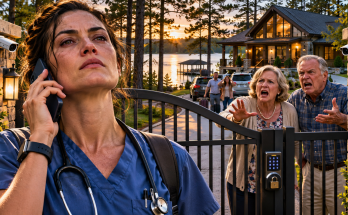
Ezra was still crying when we left Alder Lane.
Not loudly.
He sat in the back seat, taking little uneven breaths and occasionally wiping his cheeks with his sleeve.
I kept looking at him through the rearview mirror.
Every time I saw his face, I felt another wave of anger.
Not the kind of anger that made me want to turn the car around and start shouting.
I wanted distance.
I wanted him somewhere warm, somewhere nobody could reach him, somewhere the sound of breaking porcelain wasn't still hanging in the air.
But there was redness across his chest where the gravy had landed.
I couldn't simply take him home and hope everything was fine.
I contacted his pediatrician's after-hours service and explained what had happened.
They recommended that I have him examined.
A nearby urgent care facility was still accepting patients, so I drove there.
Under the bright lights, Ezra looked even smaller than usual.
He kept pulling the zipper of his jacket up and down.
I sat beside him until the doctor came to examine his skin.
Fortunately, there was no serious burn.
The irritation was expected to clear up without lasting physical damage.
I felt enormous relief.
Then the doctor asked how the incident had occurred.
I could have said it was a dinner accident.
I could have described a dropped plate or spilled food.
My family would certainly have preferred that version.
For years, I had made unpleasant things sound less unpleasant whenever discussing my parents with outsiders.
It was practically automatic.
This time, I told her exactly what my mother had done.
I explained the argument about money, Trevor's reaction to Ezra, and the plate being thrown.
Ezra continued playing with his zipper.
The doctor spoke gently to him.
“Do you feel comfortable going home with your mom?”
He nodded immediately.
“She takes care of me.”
I turned my face away for a moment.
I had always thought of myself as a protective mother.
Yet I had brought him into a house where I knew the adults were capable of humiliating people who disagreed with them.
I had assumed that my position as their daughter was the reason they treated me that way.
I hadn't considered how little protection being their grandson might offer him.
That assumption had ended beside my mother's dining table.
After we left urgent care, I asked Ezra whether he wanted something to eat.
He hadn't finished his dinner.
Neither had I.
We stopped at a roadside diner with a flickering neon light in its window.
The parking lot was dusted with fresh snow.
Inside, there was the familiar smell of coffee, fried potatoes, and pancake batter.
It was warm.
Nobody was shouting.
We found a booth, and Ezra slipped into the seat opposite mine.
A waitress with silver hair tied in a ponytail came over.
She noticed his expression.
“What can I get you two?”
Ezra glanced at me.
“Hot chocolate?”
“Of course.”
The waitress smiled.
“We've got whipped cream, too.”
His mouth moved slightly.
It wasn't quite a smile, but it was closer than anything I had seen since leaving Alder Lane.
When she returned with his drink, she placed the mug carefully in front of him.
The whipped cream rose above the rim.
She looked at the stain on his shirt.
“Looks like it's been a long evening.”
I nodded.
“Very long.”
She turned toward Ezra.
“Well, you've got a good place to start feeling better.”
He picked up his spoon.
I watched him scoop a little whipped cream from the top of his drink.
Then I reached into my work bag.
My corporate ThinkPad was inside.
I opened it on the table and connected securely.
Ezra looked up.
“Do you have to work?”
“No, sweetheart.”
He watched me enter my banking information.
“What are you doing?”
“Taking care of some numbers.”
He knew my job involved numbers.
Apparently satisfied with the explanation, he returned to his hot chocolate.
I opened the section containing my scheduled transfers.
There were several.
Some had been running long enough that I barely thought about them when reviewing my monthly expenses.
I selected the payment for Trevor's truck.
Seven hundred and eighty dollars.
For four months, I had helped him avoid repossession.
Each time, he had assured me his financial circumstances would improve shortly.
Each time, the next payment arrived before those improvements did.
I canceled the transfer.
A confirmation screen appeared.
I accepted it.
That was it.
No argument.
No explanation about why Trevor couldn't make the payment himself.
No obligation to find an alternative way of helping him.
I moved to the next recurring transfer.
Eight hundred dollars for my mother.
She called it household assistance.
I already paid the essential expenses associated with the house, but she regularly insisted they needed additional money for ordinary living costs.
I had transferred it without asking for detailed explanations.
Month after month.
I canceled it.
Then came contributions toward Dad's vehicle insurance.
The telephone reimbursements.
Other optional payments that had accumulated over the years because somebody had asked and I had agreed.
I reviewed each one.
I didn't cancel obligations that legally belonged to me.
I owned the Alder Lane property, and I wasn't about to allow unpaid bills or neglected insurance to damage my financial position.
I knew the difference between protecting myself and acting recklessly.
But Trevor's vehicle was not my vehicle.
My mother's spending money was not an obligation attached to the deed.
My father's personal expenses were not debts I had undertaken.
For the first time, those distinctions mattered more than the possibility of disappointing somebody.
When I finished, I sat looking at the screen.
I expected to feel guilty.
Instead, I noticed how deeply I was breathing.
As though I had been holding my breath for years.
I opened my email.
Daniel Mercer was an attorney who had assisted me with property transactions and estate planning.
I trusted his judgment.
I began writing to him about Alder Lane.
I explained that I no longer wished to continue allowing my parents to occupy the property without rent.
I asked him to determine the proper legal procedure for ending the arrangement.
Then I described what had happened to Ezra.
I attached the photograph I had taken of his gravy-stained shirt.
Seeing the photograph on the screen made my stomach tighten.
I nearly closed the laptop.
Instead, I added another request.
I wanted Daniel to examine the documents and permissions connected to the property.
My parents had occupied the house for six years.
Until that evening, I hadn't seriously questioned whether they might have done anything involving the property without consulting me.
Now I wanted to know exactly where I stood.
I sent the email.
Almost immediately, my phone began vibrating.
Mom.
Then Trevor.
Then Dad.
The screen illuminated, went dark, and illuminated again.
Ezra glanced at it.
I turned the phone over.
For a few minutes, I concentrated on him.
He had found a children's menu and was drawing a dinosaur on the back.
Then I checked the messages.
Trevor wanted to know what I had done.
He demanded that I call him immediately.
Another message explained that his truck payment was due the following day.
Apparently, the consequences of my decision had reached him already.
Mom called again.
This time, I answered.
“What have you done to your brother?”
I looked at Ezra.
“Nothing.”
“He just received a notice about the truck!”
“I stopped my contribution.”
“You need to put it back.”
“No.”
“Haley, you can't suddenly decide not to pay!”
“I can. It isn't my loan.”
Her voice rose so sharply that I moved the phone away from my ear.
“You're willing to ruin everybody's lives because dinner didn't go the way you wanted?”
I stared through the window at the snow.
“Dinner ended because you threw Ezra's plate at him.”
“Oh, don't exaggerate. He wasn't even struck by it.”
I closed my eyes.
She sounded irritated by the distinction.
As if missing his body had made her actions reasonable.
“There was hot food on that plate.”
“He's all right, isn't he?”
“That isn't the point.”
She tried to interrupt.
I continued before she could.
“I've contacted Daniel about Alder Lane.”
Her voice disappeared.
I listened to several seconds of breathing.
“What about the house?”
“I'm going to end the arrangement.”
“What arrangement?”
“You living there without rent.”
She gave a short, disbelieving laugh.
“You wouldn't do that to your parents.”
“Daniel will explain the process.”
“You'd throw your own mother out because of one little—”
I ended the call.
My fingers were trembling.
The conversation had lasted only a few minutes, but my body felt as though I had been arguing for hours.
I set the phone down.
The waitress returned with the coffee pot.
She filled my cup, then looked at me.
“You doing okay over here?”
I glanced at Ezra's drawing.
“We're working on it.”
She brought a little plate of cookies and placed it between us.
“Don't worry about these.”
I thanked her.
She walked away before I could say anything else.
Ezra picked up a cookie and dipped the corner into his drink.
For a while, he concentrated on keeping the softened piece from falling into the mug.
Then he looked up.
“Mom?”
“Yes?”
“Are Grandpa and Grandma going to be really mad at us?”
I felt my throat tighten.
He wasn't asking whether they were sorry.
He wasn't asking whether they would be punished.
He was worried about losing their affection.
I recognized that fear because I had carried it myself for most of my life.
“They might be upset for a while.”
“Because I said about the truck?”
“No, honey.”
He studied my face.
“Uncle Trevor told me to be quiet.”
“I heard him.”
“Should I have been quiet?”
I moved my laptop aside and reached across the table.
“You weren't trying to hurt anybody. You were telling them something you knew.”
He looked down.
“I wanted Grandma to stop saying mean things.”
“I know.”
“Are you angry with me?”
I couldn't remain on the opposite side of the booth after that question.
I moved beside him and wrapped an arm around his shoulders.
“Ezra, you haven't done anything that makes me angry.”
He leaned into me.
“I didn't want her to throw it.”
“Neither did I.”
I held him while he finished crying.
The waitress passed our table without interrupting us.
Outside, headlights moved slowly through the falling snow.
Inside, my coffee cooled.
The ThinkPad remained open beside the children's menu, displaying the banking page where I had canceled the payments.
I looked at the screen and thought about all the previous evenings when I had approved transfers because my mother was angry or Trevor was desperate.
How many times had I put my phone down afterward and felt relieved simply because the demands had stopped?
How often had I mistaken that relief for love?
I hadn't actually purchased peace.
I had purchased temporary silence.
And the price had increased whenever they discovered I was willing to pay it.
Ezra lifted his mug again.
A little whipped cream remained around his mouth.
I wiped it away.
“Better?”
He nodded.
“Can we come here again sometime?”
“Sure.”
He turned his dinosaur drawing around so I could see it.
I admired it and asked him about the teeth.
He explained what kind of dinosaur it was, and for a little while, the conversation sounded like one we might have had on any ordinary evening.
I was grateful for that.
When I looked at my phone again, more messages had arrived.
I didn't open them.
I closed the laptop instead.
My parents could speak to their son about the truck payment.
Trevor could contact his lender.
If they were worried about their living arrangements, Daniel would communicate with them through the proper channels.
None of those problems required me to remain frightened.
None required Ezra to defend me.
I had believed for years that saying no would make me a bad daughter.
Sitting beside my son, I realized what continuing to say yes might make me.
A mother who taught her child that being loved meant accepting whatever treatment other people chose to give him.
I couldn't allow that.
Before we left the diner, I put the drawing Ezra had made with our belongings.
I gathered the ThinkPad and my phone.
The waitress wished us a good night.
Ezra thanked her for the hot chocolate.
Outside, I helped him into his coat and took his hand.
He held mine tightly as we crossed the parking lot.
I knew the cancellations wouldn't end the arguments.
I knew my family would call again.
But I had finally made a financial decision without treating their anger as something I was obligated to prevent.
And when my phone vibrated inside my pocket, I kept walking.