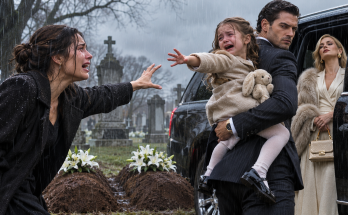
Two years later, I stood in my kitchen looking at white lilies.
Lily had two small bouquets.
I had chosen flowers for each of my parents as well.
It was a bright spring morning.
Nothing like the afternoon of their funeral.
The weather was pleasant, and there was no reason for me to wear the heavy black coat I associated with that terrible period of my life.
Lily seemed comfortable.
She was interested in arranging the flowers so they looked nice when we reached the cemetery.
I watched her adjust one of the bouquets.
Her movements were confident.
She wasn't looking toward me after every little decision.
She wasn't asking whether she had done something wrong.
There had been a time when even dropping a spoon had frightened her.
Now she could become absorbed in something without constantly monitoring my reaction.
I appreciated that change.
It had happened gradually.
There hadn't been a particular morning when she woke up completely free from the fears she had carried.
There had been counseling.
Conversations.
Repeated experiences of being treated with patience.
And countless ordinary moments when she discovered that her home remained secure even if she made a mistake.
I had learned patience too.
At the beginning, I sometimes wanted to reassure her more than necessary.
I wanted to compensate for every painful thing she had experienced.
I wanted to give her enough affection to somehow replace four missing years.
But she didn't need every day to become an emotional occasion.
Sometimes, she needed me to help with homework.
Sometimes, she needed me to remind her about something she had forgotten.
Sometimes, she wanted to be left alone with whatever interested her.
I had learned to respect those ordinary needs.
They were part of being a child.
I didn't want our relationship permanently defined by the fact that we had once been separated.
I wanted us to have something beyond that.
A life.
Lily looked at the flowers.
"Do you think Grandma liked these?"
I smiled.
"I'm sure she would have."
She seemed pleased.
We gathered the bouquets and left for the cemetery.
During the journey, I thought about the last time I had carried flowers there during the most painful period of my life.
I remembered standing on wet ground.
I remembered the smell of the freshly disturbed soil.
I remembered Lily holding my coat sleeve.
I also remembered the moment Jason had approached me with the envelope.
Those memories hadn't disappeared.
But their presence no longer controlled everything I felt about the cemetery.
My parents were buried there.
I wanted visiting them to be about remembering their lives rather than repeatedly experiencing what Jason had done that afternoon.
When we arrived, Lily carried her flowers carefully.
I walked beside her.
We approached the headstones together.
I noticed how different it felt to have her walking beside me.
Four years of separation had begun in that cemetery.
The worst experience I associated with the place had involved watching a vehicle disappear while my daughter cried behind its window.
Now she was here voluntarily.
She was carrying flowers for people she wanted to remember.
There was nobody directing her away from me.
I stood quietly in front of my parents' graves.
Lily moved forward.
She placed one bouquet beside my mother's headstone.
Then she placed the other beside my father's.
She looked at their names for a moment.
"Hello, Grandma."
She moved her attention toward the other grave.
"Hello, Grandpa."
I felt tears gather behind my eyes.
Her voice was gentle.
She didn't sound frightened.
She didn't sound uncertain about whether she was allowed to speak.
She simply sounded like a little girl greeting people she understood were part of her family.
"I've got things to tell you."
I smiled.
Then I listened.
She began talking about school.
She mentioned her friends.
She described things she had enjoyed and things she hadn't found particularly interesting.
There was a science project she had recently completed.
She seemed especially pleased about that.
I had heard her talk about the project before.
Listening to her explain it to my parents made it feel different.
I imagined my father asking questions.
He would have wanted to understand how the project worked.
My mother would have enjoyed seeing how excited Lily became while describing it.
Lily continued talking.
She mentioned wanting us to adopt a dog.
That subject had become increasingly important to her.
I smiled when she brought it up again.
Then she complained about her mathematics homework.
I almost laughed.
My father would have found that particularly entertaining.
He had spent considerable time trying to persuade his teenage daughter that numbers weren't something to be frightened of.
Now his granddaughter was standing beside his grave explaining that mathematics sometimes required more effort than she thought reasonable.
It was such an ordinary complaint.
I loved hearing it.
There was a time when I had worried that Lily might grow up knowing almost nothing about my parents.
The years of separation had prevented me from sharing stories with her.
Her grandparents had become connected to questions about money before she understood very much about the people themselves.
I had wanted to change that.
Now, listening to her speak beside their graves, I realized how much those stories had become part of her understanding of our family.
She knew my mother had liked singing in the garden.
She knew my father had regularly burned Sunday pancakes.
She knew they had disagreed about Christmas decorations.
She knew they had loved her.
Those things mattered.
I didn't want her connection to them to depend entirely on a trust agreement.
The financial provisions were important.
But they weren't the only inheritance my parents had left.
There were habits.
Memories.
Ways of thinking.
Small family stories that could continue being told long after the people involved were gone.
Lily had become part of that continuation.
When she finished talking, she turned toward me.
I expected her to ask something about my parents.
Instead, she asked about a different day.
"Mommy?"
"Yes?"
"Do you remember when I called you?"
I looked at her.
There was no possibility of forgetting which call she meant.
"Of course I do."
She glanced toward the flowers.
"I was frightened."
I moved closer.
"I know, sweetheart."
She stood quietly for a few seconds.
I didn't interrupt.
Whenever Lily chose to discuss difficult memories, I tried not to rush toward an explanation.
Sometimes, she simply needed to express something she had carried.
I wanted her to decide how much she wished to share.
"Vanessa kept saying you didn't want me."
I nodded slowly.
Lily looked down.
"But I thought maybe she wasn't telling me the truth."
I felt something tighten in my chest.
I had often wondered what made her question the explanation she had been given.
Jason had controlled her access to me.
My letters had been intercepted.
Vanessa had shown her a document bearing my name.
For years, the adults around her had reinforced the idea that I had voluntarily disappeared.
Yet something inside Lily had resisted that explanation.
I wanted to understand what it was.
"What made you doubt her?"
Lily looked at me.
"You told me something when I was little."
I waited.
"About getting lost."
I searched my memory.
Then I began remembering.
When Lily was younger, I had wanted her to know what to do if she ever became separated from me.
Like many parents, I had worried about the possibility of losing sight of my child somewhere unfamiliar.
I had wanted her to remember my telephone number.
I had wanted her to understand that being separated from me didn't mean I would stop looking for her.
It had been a simple lesson.
Something intended to help her feel safer.
I hadn't understood how important it might become.
Lily continued.
"You said I should remember your number."
I nodded.
"And you said you'd find me if I got lost."
I felt my eyes fill with tears.
My telephone number.
Those ordinary digits I had once wanted my little girl to memorize.
During four years of separation, they had remained with her.
Through the intercepted letters.
Through the claims that I didn't want her.
Through the efforts to create a new family arrangement that excluded me.
Lily had remembered.
I looked at her face.
There were so many things I wanted to say.
But the words wouldn't come easily.
I had spent years believing that my daughter had received almost nothing from me.
I hadn't known that a small piece of guidance from her early childhood had stayed with her.
It had given her a reason to question what Vanessa was saying.
And when she became frightened about being sent away, she had used it.
I remembered my private telephone ringing that Thursday evening.
I remembered answering.
The silence.
The breathing.
Her tentative voice.
I remembered wondering how she had found my number.
Now, standing beside my parents' graves, she had finally explained it.
I crouched beside her.
"I would never have said that unless I meant it."
She nodded.
Then she wrapped her arms around my neck.
"I knew you'd try to find me."
I held her.
I wanted to tell her how much those words meant.
I wanted to explain how often I had worried that she believed I had failed her.
Instead, I simply held her close.
My daughter had remembered something I had once told her before either of us understood what was coming.
And that memory had survived the efforts of people who wanted her to forget me.
I thought about the fifth birthday card.
The messages I had written.
The photographs Rebecca had preserved.
For years, I had believed those things were my only means of keeping a connection with Lily.
But there had been another connection.
One I hadn't been able to see.
The memories she carried herself.
Nobody had managed to take all of them away.
I closed my eyes.
For a little while, I allowed myself to cry.
Not because I wanted Lily to feel responsible for comforting me.
Because hearing that she had remembered my promise touched something I had been carrying for years.
She loosened her arms slightly.
I wiped my face.
She smiled at me.
I smiled back.
Then we stood.
The white lilies rested beside the headstones.
I looked at my parents' names again.
I wished I could tell them what had just happened.
My mother had taught me that fear didn't need to determine every decision.
My father had taught me to keep examining the truth even when somebody offered a convincing explanation.
Lily had shown something remarkably similar.
She had been frightened.
She had been presented with an explanation she was expected to accept.
Yet she had remembered enough to question it.
And she had reached out.
I was proud of her.
But I also understood that she should never have been required to demonstrate that kind of courage.
She had been a child asking for her mother.
The responsibility belonged to the adults who had placed her in that position.
I didn't want her to grow up feeling that she always needed to be brave.
I wanted her to know she could ask for help before she became desperate.
That she could tell me when something worried her.
That she didn't need to solve complicated problems by herself.
I took her hand.
We stood quietly for a little longer.
There was no need to fill the silence.
I thought about the funeral.
I thought about the envelope that had once been placed in my shaking hands.
And I thought about how certain Jason had been that my parents' deaths meant there was nobody left to support me.
He hadn't understood what they had already given me.
Their knowledge.
Their example.
Their belief in my ability to continue.
Those things hadn't been buried with them.
I had carried them into the rented room.
Into the diner.
Into my first property.
Into the investment company.
Into Daniel's office.
Into the courtroom.
And eventually, into the home where Lily was able to grow up beside me.
I looked down at our joined hands.
There was something particularly comforting about leaving the cemetery together.
I hadn't experienced that the day my parents were buried.
That afternoon, I had walked across the wet ground after a vehicle I couldn't stop.
I had called out until the SUV disappeared.
This time, Lily was beside me.
We walked at an ordinary pace.
There was no reason to hurry.
She began talking about the dog again.
I listened as she explained why she thought having one would be a good idea.
She had clearly given the subject considerable thought.
I couldn't help smiling.
A few minutes earlier, we had been discussing one of the most painful experiences of our lives.
Now she was thinking about something she wanted in the future.
That was exactly what I wanted for her.
The ability to remember without becoming trapped inside the memory.
The ability to speak about fear and then return to the things that made her happy.
When we reached the car, I looked back toward the cemetery.
The flowers remained beside my parents' graves.
I felt sad.
I would always miss them.
But there was something else mixed with the sadness now.
Gratitude.
They had loved us.
They had prepared for Lily's future.
They had taught me things that remained useful long after their deaths.
And their granddaughter had just reminded me that love could survive in the smallest things a person remembered.
I opened the car door.
Lily got inside.
I followed.
For once, leaving that cemetery didn't feel like losing somebody.
It felt like carrying something home.