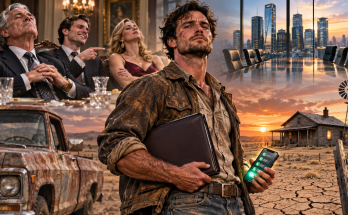
Brooks was the first person to break the silence.
"So what happens now? You buy yourself some overalls and start pretending you're a cowboy?"
Daphne let out a short laugh.
I looked at my brother.
"I'm going to work on the property."
He grinned.
"Of course you are."
My father swallowed his food.
He wiped his mouth with his napkin and turned his attention toward me.
"How much of your savings did you put into this?"
"All of it."
He stared at me.
I could see the disappointment on his face, but there was something else underneath it.
Anger.
He seemed personally offended that I had made a decision involving my own money without consulting him.
"You walked away from a perfectly respectable career for some useless ground in the middle of nowhere?"
"I've thought it through."
"Clearly, you haven't."
I rested my hands against the edge of the mahogany table.
The wood felt smooth beneath my fingers.
I had sat at that table through countless lectures about money, discipline, and ambition.
My father often talked about taking risks.
He liked reminding us that he hadn't become wealthy by working for other people.
Yet the moment I tried to do something independently, he acted as though I had committed an unforgivable offense.
Daphne looked uncomfortable.
Not for me.
For the situation.
"Silus, you could have invested in proper real estate."
I looked at her.
"It is real estate."
She rolled her eyes.
"You know what I mean."
I did.
If the land had contained a swimming pool, an expensive house, or something she could show to wealthy clients, she might have respected the purchase.
Five hundred acres of neglected ranchland meant nothing to her.
Brooks chuckled again.
My father put his knife down.
"I've spent my entire life building something respectable for this family."
I remained quiet.
"And somehow, you've managed to turn every opportunity you've been given into another disappointment."
That sentence hurt.
I wish I could say it didn't.
I had worked hard.
I had paid my own expenses, built a career, and saved a considerable amount of money.
None of those things counted.
He was looking at the single decision he didn't understand and using it to dismiss everything I had ever accomplished.
"You're embarrassing us," he continued.
My mother lowered her eyes.
I waited for her to speak.
She didn't.
I should have known better than to expect anything different.
My father kept going.
He told me that I lacked ambition.
He told me that my judgment was terrible.
He told me that he couldn't understand how someone he had raised could make such an irresponsible financial choice.
Then he said something I had never heard him say so plainly before.
"I don't know where I went wrong with you."
Brooks stopped pretending to hide his amusement.
I could feel my fingers tightening against the table.
There were several things I wanted to say.
I wanted to ask my father how much of Brooks's impressive lifestyle was actually paid for by Brooks.
I wanted to remind him about the damaged sports car.
I wanted to ask my mother whether she had ever once considered defending me.
But I knew how that conversation would end.
My brother would deny everything.
My father would become louder.
My mother would disappear into her silence.
And I would leave feeling ashamed for having tried to defend myself.
I was tired.
My father reached for his coffee.
"Tomorrow morning, I'm speaking to my attorneys."
I looked at him.
"What for?"
"I'm having you taken out of the will."
He said it without hesitation.
I heard a tiny sound from Daphne's direction, but she didn't object.
Brooks looked delighted.
My father continued.
"If this is the life you want, you're going to pay for it yourself."
I almost laughed.
I had already paid for it myself.
That was the whole point.
The money I had invested wasn't his.
The loan obligations weren't his.
The deteriorating house and the broken fences weren't his.
Nothing about the ranch required him to give me a dollar.
But my father believed the possibility of receiving his money was the strongest influence he had over his children.
He expected the threat to frighten me.
I think he wanted me to start apologizing.
For a few seconds, I considered explaining more about the purchase.
I could have told him what I had been studying during my final months at work.
I could have explained why those five hundred acres interested me.
Perhaps I could have changed his opinion.
Then I looked around the table.
My sister was sitting in expensive clothes, judging a property she had never visited.
My brother was amused by the thought of my losing an inheritance.
My mother wouldn't look at me.
And my father had already decided that I wasn't worth including in his family's future.
Why was I trying so hard to earn a place among them?
The question arrived quietly.
There was no dramatic answer.
I simply realized that I didn't have to remain in my chair.
I could stand up.
I could leave.
Nobody could force me to finish that breakfast.
I pushed my chair away from the table.
My father looked irritated.
"Where are you going?"
"Home."
I pushed the chair back into its place.
It was a small habit I had picked up over the years.
Even when I was furious, I didn't like leaving a mess behind me.
Brooks looked up at me.
"What, you're not staying?"
I didn't answer him.
I glanced at my mother one last time.
She still hadn't said anything.
Then I walked out.
I didn't slam the door.
I didn't shout from the hallway.
I didn't announce that one day they would regret how they had treated me.
I simply left the house.
It was the last time I would ever sit at that dining table.
Outside, the air felt different.
Nothing extraordinary had happened to the weather.
I just wasn't breathing as carefully anymore.
I climbed into my old truck and sat behind the wheel.
My clothes were ordinary.
The vehicle was ordinary.
Nothing about me looked like the son of a wealthy businessman.
For once, I was glad.
I started driving.
My phone buzzed before I had gone very far.
It was a message from Brooks.
He had sent me a photograph of bare dirt.
Underneath it, he had written a sarcastic little congratulations about the business empire I had apparently purchased.
He finished by calling me a loser.
I looked at the message.
I didn't respond.
There was a strange comfort in knowing exactly who my brother was.
I no longer had to spend time wondering whether his cruelty was accidental.
He had made the effort to find that picture, write those words, and send them to me after watching our father threaten to disinherit me.
He wanted me to feel worse.
That was the entire purpose of the message.
I put the phone away.
Three days after that breakfast, my father formally removed me from his will.
He had done exactly what he said he would do.
And I had a ranch to look after.
The first time I stood outside the old wooden house with the knowledge that it was now my responsibility, I felt the full weight of my decision.
The building looked even worse when I considered what it would cost to repair.
There were gaps around the windows.
Parts of the fencing were practically falling apart.
The ground was so dry that cracks ran across it in irregular patterns.
There were stretches of dead brush that would take considerable effort to clear.
I had five hundred acres.
Five hundred acres of obligations.
I could understand why an ordinary buyer would have walked away from the place.
There wasn't much about the property that promised an easy life.
I hadn't expected one.
Still, understanding hardship on paper was different from waking up inside it.
The nights were cold.
Wind came through the window frames, and the old house made little noises whenever the weather changed.
Sometimes I would lie awake listening to the boards move.
I missed the simple comfort of being able to close a window and know that the cold would remain outside.
There was nothing luxurious about my new home.
The most valuable thing in it was probably the determination of the man trying to keep it standing.
And some nights, even that determination felt dangerously close to wearing out.
The financial situation was just as difficult as the living conditions.
Putting my savings into the purchase hadn't removed the need to earn money.
The loan payments were substantial.
Property taxes would have to be paid.
Tools, repairs, fuel, and basic necessities all cost money.
The land wasn't producing an income.
I was responsible for keeping everything afloat while I waited.
I couldn't afford to spend my days sitting around hoping that circumstances would improve.
I needed a job.
The work I found was at a lumber mill approximately an hour away.
It was night work.
Heavy work.
Nothing like the office I had left behind.
Nobody there cared that I used to analyze complicated corporate investments.
Nobody was interested in my father's company.
The timber needed moving, and I was being paid to help move it.
There was something refreshingly simple about that.
My work had an obvious purpose.
If I didn't do it, somebody else would have to.
If I did it well, the job got done.
I didn't need to be somebody's favorite son.
I only needed to show up.
During the day, I worked on the ranch.
At night, I worked at the mill.
In between, I tried to sleep.
The schedule looked manageable when I first considered it.
Living through it was another matter.
The hours added up.
So did the aches in my shoulders and the small cuts on my hands.
My old work boots began to deteriorate.
Replacing them seemed like an unnecessary expense when there were so many other things that needed money.
I kept wearing them.
The truck became more important to me than any expensive sports car could ever have been.
It wasn't impressive.
The body was rusty, and I had plenty of reasons to worry about its reliability.
But every time it started, it gave me another chance to make the next payment.
I depended on that truck.
I depended on my own hands.
I depended on my willingness to get out of bed when every muscle in my body wanted me to remain there.
There were no family connections making the situation easier.
I hadn't asked my father for help.
I hadn't called Brooks.
And whenever I felt tempted to explain myself to my mother, I remembered her sitting silently at the breakfast table.
I knew what reaching out would cost me emotionally.
I also knew what it would accomplish.
Very little.
My meals became simple.
Canned beans were cheap and easy.
Black coffee kept me awake through hours when I should have been sleeping.
I stopped thinking of food as something to enjoy.
It was something I needed before I could keep working.
Some mornings, after returning from the mill, I would stand outside the house and look across the property.
There was no luxury vehicle waiting for me.
No beautifully maintained lawn.
No reassuring bank balance.
Just the cracked ground and the same neglected structures I had seen when I bought the land.
It would have been easy to mistake the scene for evidence that my father was right.
I understood that.
If Brooks had been standing beside me, he would have seen nothing but failure.
But he didn't know why I had chosen those particular acres.
My father didn't know, either.
They hadn't asked.
They had been too busy enjoying the opportunity to humiliate me.
I decided I would let them keep their assumptions.
I didn't need to correct every joke.
I didn't need to explain my financial strategy to people who had never shown me basic consideration.
For years, Brooks had made a habit of speaking for me.
He had told our parents what I supposedly did, what I supposedly wanted, and why I supposedly couldn't succeed.
I had exhausted myself trying to correct his stories.
Now I was going to spend that energy differently.
The fence needed work.
The roof needed attention.
And my next shift at the mill was approaching.
I picked up my tools.
For the first time in years, my father's opinion wasn't the most urgent thing in my life.