Chapter 1: The Signature of a Dead Man
The first time I saw my dead husband’s signature after his funeral, I was sitting outside a hospital room where my six-year-old son was being questioned about the woman who had hurt him.
The signature was dated forty-two days after Cole’s death.
Forty-two days after I’d watched his coffin disappear into the ground.
Forty-two days after our little boy had placed a red toy car beside his father’s photograph and whispered, “Daddy, you can borrow it whenever you come home.”
Yet there it was.
Cole Bennett.
Written in the same confident handwriting I’d seen on birthday cards, grocery lists, and love notes tucked into my coat pockets.
My first thought was that somebody had made a mistake.
My second was much worse.
Someone had been using my dead husband’s name.
And when I discovered why, I realized that the cruelty my mother had shown my son at Sunday dinner wasn’t an isolated incident.
It was the first visible crack in a lie that had been swallowing our family for years.
But that night, I didn’t know any of it.
All I knew was that my son was hurting, my mother had crossed a line I could never forgive, and a man named Desmond Hale was waiting for me to make a decision.
A decision that would eventually bring down everyone who had betrayed us.
Including someone I would have sworn was incapable of betrayal.
Six hours earlier, I’d been sitting at my mother’s dining room table, trying to convince myself that this Sunday would be different.
The house smelled of roasted garlic, rosemary, and the expensive candles my mother burned whenever she wanted company to notice how beautifully she lived.
A crystal chandelier hung above the enormous dining table.
The silverware was polished.
The wineglasses matched.
My mother, Marion Vale, sat at the head of the table in a burgundy dress with a pearl necklace resting against her throat.
She looked like a woman who belonged on the cover of a lifestyle magazine.
She also had a remarkable ability to make people feel worthless without raising her voice.
I was thirty-five years old, and I still caught myself sitting straighter whenever she looked at me.
“Whitney, you’re hardly eating,” she observed.
“I’m fine, Mom.”
“You look tired.”
“It’s been a long week.”
She sighed dramatically.
“Well, that’s what happens when a woman insists on doing everything herself.”
Across the table, my younger sister Lorna smiled into her wineglass.
Lorna had always been our mother’s favorite.
She had the right clothes, the right friends, and the right talent for agreeing with everything Marion said.
Her son, Brady, was seven.
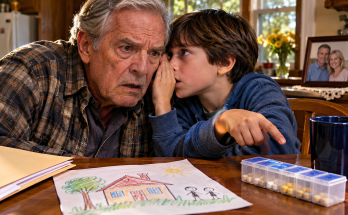
He sat beside her, pushing mashed potatoes around his plate and watching my six-year-old son, Tucker.
Tucker was quiet.
Since losing his father twenty months earlier, he’d become the sort of child who studied a room before speaking.
He could recognize tension in adults faster than most adults could recognize it in themselves.
I hated that.
Children shouldn’t have to become experts in other people’s moods.
But Tucker had learned early.
Under the table, he held a tiny red toy car.
Cole had bought it for him shortly before his death.
The paint was chipped near one wheel, and the little silver bumper had a scratch where Tucker had accidentally dropped it.
To anyone else, it was an ordinary toy.
To my son, it was the last piece of his father he could hold in his hand.
Sometimes he slept with it beneath his pillow.
Sometimes he brought it to school in his backpack.
And whenever he missed Cole especially badly, he rolled it slowly across the kitchen table while telling me stories about things they used to do together.
That evening, Tucker opened his palm to admire it.
Brady noticed.
“Let me see that.”
Tucker hesitated.
“It’s my Daddy’s car.”
“Just give it here.”
Before Tucker could move, Brady grabbed the toy from his hand.
“Hey!” Tucker cried.
He reached for it.
And my mother erupted.
“DON’T YOU TOUCH MY GRANDSON!”
She was out of her chair before I could react.
Her hand shot toward Tucker.
I saw her fingers catch his ear.
Then she pulled.
Hard.
Tucker cried out and stumbled backward, hitting the hardwood floor.
For one terrible second, nobody moved.
He sat there, stunned, pressing one small hand against his ear.
“Mommy?”
His voice was so quiet that I almost didn’t hear it.
Lorna immediately pulled Brady against her.
“Are you okay, sweetheart?”
Brady nodded.
My mother adjusted her dress.
Then she looked at me.
“Whitney, you need to teach your son some manners.”
I stared at her.
“Mom, you hurt him.”
“Oh, please. He was trying to grab something away from Brady.”
“Because Brady took his toy.”
“Children need to learn to share.”
“That car belonged to Cole.”
My mother’s expression changed.
There it was.
That familiar flash of irritation whenever I mentioned my husband.
“You can’t use your dead husband as an excuse for everything, Whitney.”
The entire table went silent.
I felt something cold settle in my chest.
My mother continued.
“Honestly, I don’t know what you’d do without me. I have helped you financially for years.”
“Mom—”
“Without my money, you two would be homeless.”
She said it while Tucker was still sitting on the floor.
My little boy heard every word.
And something inside me finally broke.
I crossed the dining room and lifted him into my arms.
His fingers twisted into my coat.
“Mommy, my ear hurts.”
“I know, baby.”
I kissed his forehead.
“We’re leaving.”
My mother frowned.
“We haven’t even finished dinner.”
“I’m taking Tucker to the hospital.”
Lorna laughed.
“You’re being dramatic. He needs to learn how to share.”
I reached the front door and stopped.
For thirty years, I’d been careful about what I said when my mother was angry.
I knew how to apologize without admitting fault.
How to smile when I wanted to cry.
How to make her feel generous so she wouldn’t punish me with silence.
But I was holding my son.
And for the first time, her approval meant absolutely nothing.
I turned toward her.
“Tucker does need to learn something from today. So does this family.”
Then I opened the door.
Behind me, my mother called my name.
I didn’t turn around.
Not even once.
Chapter 2: The Phone Nobody Knew About
The cold evening air felt like freedom.
But Tucker was trembling against my shoulder.
I carried him to the car, buckled him into his booster seat, and carefully examined his ear beneath the parking light.
The skin was red.
A small mark near the upper edge was beginning to swell.
I used a clean napkin from my purse to gently wipe away a tiny spot of blood.
He winced.
“I’m sorry, sweetheart.”
“It’s okay, Mommy.”
“No,” I whispered. “It isn’t.”
I made sure he had his toy car.
I’d taken it from Brady’s hand on our way out.
Tucker immediately closed his fingers around it.
Then I drove.
My mother’s house disappeared behind us, its beautiful windows glowing like the windows of a place where happy people lived.
For years, I had mistaken that appearance for reality.
A few blocks away, I pulled into a quiet parking lot.
I reached beneath the lining of my coat and removed a second phone.
It was an old black smartphone that I kept switched off most of the time.
Nobody in my family knew about it.
Not my mother.
Not Lorna.
Not even Tucker.
Only two people had ever known that number.
One of them was dead.
The other was Desmond Hale.
Cole’s closest friend.
I switched on the phone and stared at his contact.
Then I called.
He answered almost immediately.
“Whitney?”
I closed my eyes.
“Desmond.”
“What happened?”
“It’s time.”
Silence.
Then his voice became very calm.
“Are you sure?”
I looked into the rearview mirror.
Tucker was sitting perfectly still, studying the little red car in his palm.
“I’m sure.”
“All right,” Desmond said. “I’ll make the calls.”
I disconnected.
I didn’t know that conversation would be the last time I ever trusted him without reservation.
By the time we reached the emergency department, Tucker had stopped crying.
That frightened me more than the tears.
He sat beside me in the waiting room, his little sneakers not quite touching the floor.
When a nurse called his name, he looked up nervously.
“Am I in trouble?”
I knelt before him.
“No, sweetheart.”
“Grandma’s going to be mad.”
My throat tightened.
“Grandma doesn’t get to decide whether you’re allowed to be safe.”
He thought about that.
Then he asked a question that nearly destroyed me.
“Was it my fault because I didn’t let Brady keep Daddy’s car?”
I pulled him into my arms.
“No, Tucker. You didn’t do anything wrong.”
“Grandma says I make trouble.”
“You’re not trouble.”
“She says you already have enough problems.”
I closed my eyes.
Cole had been gone for twenty months.
Twenty months of grief, bills, sleepless nights, and trying to help our son understand that love doesn’t always keep people alive.
I had been so focused on surviving that I hadn’t noticed what was happening whenever Tucker visited my mother.
Or perhaps I’d noticed pieces of it and forced myself not to put them together.
The possibility made me sick.
Dr. Amara Okonkwo examined Tucker.
She was warm, patient, and careful to explain what she was doing before touching his ear.
Thankfully, his eardrum appeared unharmed.
But the bruising and swelling concerned her.
She asked me what had happened.
I told her.
Then she turned toward Tucker.
“Has Grandma ever hurt you before?”
I opened my mouth.
I was about to say no.
Out of habit.
Out of thirty-five years of protecting my mother’s reputation.
But Tucker spoke first.
“She said I’d be in trouble if I told.”
The doctor’s expression didn’t change, but her voice softened.
“What did she tell you?”
Tucker stared at his sleeve.
“That Mommy was already sad because Daddy died. She said if I made Mommy sadder, it would be my fault.”
I felt my entire childhood rising inside my throat.
He told us about Thanksgiving.
About a blue serving bowl Brady had knocked off the kitchen counter.
About how Grandma blamed Tucker.
And how she’d made him sit alone in the laundry room until he agreed to apologize.
“How long were you there?” Dr. Okonkwo asked gently.
Tucker shrugged.
“I counted to a hundred four times.”
Four hundred.
He’d counted to four hundred while waiting for permission to leave a laundry room.
And I hadn’t known.
I reached for his hand.
“I’m sorry, baby.”
He looked confused.
“Why are you sorry?”
Because I should have protected you.
Because I thought having a grandmother was better than not having one.
Because I had confused family loyalty with love.
But I couldn’t put all that on a six-year-old boy.
So I said the only thing he needed to hear.
“Because you deserved better. And from now on, you’re going to get better.”
Dr. Okonkwo documented his injuries and his statements.
She explained that the hospital would follow its reporting procedures and arrange for someone trained to speak with children.
I asked her to record every word Tucker had said.
Every word.
Not because I wanted revenge.
Because I had spent my entire life watching my mother rewrite the truth.
And this time, I wanted the truth written somewhere she couldn’t erase it.
Chapter 3: The Message at 11:40
Tucker was taken to a quiet room with beanbag chairs, crayons, and a specialist who introduced herself as Ms. Elena.
He insisted on bringing his red car.
The specialist promised to keep it safe in a little clear bag while they talked.
I sat in the hallway with a paper cup of coffee that went cold between my hands.
My regular phone wouldn’t stop vibrating.
Mom.
Lorna.
Mom again.
Then came the messages.
You’ve embarrassed this family.
Your sister says you’re blowing everything out of proportion.
You cannot keep Tucker away from me because of one misunderstanding.
And finally:
Remember who helped you when Cole died.
I stared at that last message.
Then I opened my banking app.
After Cole’s funeral, my mother had occasionally sent checks.
Two hundred dollars.
Five hundred.
Once, a thousand.
Every gift arrived with a speech.
How lucky I was.
How difficult it was for her.
How grateful I should be.
I’d deposited every check into a savings account for Tucker.
Not one dollar had been spent.
There was just over eight thousand dollars in it.
My mother believed that money gave her the right to humiliate us.
She had no idea how little of our lives she’d actually paid for.
At 11:40 p.m., my second phone lit up.
A message from Desmond.
BOARD IS ASSEMBLED. WAITING ON YOUR WORD.
I stood and walked to the end of the hallway.
Then I called him.
“How’s Tucker?” he asked.
I told him everything.
He listened until I finished.
“I’m sorry, Whit,” he said softly. “Cole would’ve been furious.”
Hearing my husband’s name nearly broke me.
Cole and Desmond had been friends since college.
They’d started out working on commercial properties together, first repairing neglected buildings and later buying them.
Desmond was charming, ambitious, and always immaculately dressed.
Cole was quieter.
He preferred faded jeans, practical shoes, and solving problems with his hands.
They were an unlikely partnership.
But they had built something substantial.
Harborlight Property Partners.
The company owned several commercial buildings, including the renovated brick property where my mother operated her upscale interior design business.
After Cole died, Desmond had helped with paperwork, insurance questions, and the complicated business matters I hadn’t been emotionally prepared to understand.
He was the one who encouraged me to keep a separate phone.
“Some things are easier to handle without your mother’s interference,” he’d said.
At the time, I’d thought he was protecting me.
Now, standing in the hospital hallway, I still believed it.
“Tell me about the notice,” I said.
Desmond hesitated.
“We’ve been reviewing the lease arrangements for your mother’s company.”
“Okay.”
“She’s been receiving preferential treatment for years. Reduced payments, deferred balances, questionable adjustments. The board has finally agreed that it can’t continue.”
My pulse quickened.
“What does that mean?”
“It means your mother owes Harborlight a substantial amount of money.”
“How substantial?”
“Almost half a million dollars, depending on the final reconciliation.”
I leaned against the wall.
That couldn’t be right.
My mother drove a luxury SUV.
She wore diamond jewelry.
She took expensive vacations.
She had spent years telling everyone how successful she was.
“That doesn’t make sense.”
“There’s more,” Desmond said.
He paused.
“We found a document.”
“What document?”
“A transfer agreement involving Cole’s ownership interest.”
I gripped the phone.
“What kind of transfer?”
“One that appears to have moved his shares into an entity connected to your mother.”
My stomach tightened.
“When?”
Another pause.
Then he said the words that changed everything.
“Six weeks after Cole died.”
For a moment, I couldn’t hear anything except the hum of the fluorescent lights overhead.
“That’s impossible.”
“I know.”
“He couldn’t have signed anything.”
“I know that too.”
“Then somebody forged his signature.”
“That’s what we suspect.”
I stared at the empty hallway.
My husband had spent years building a business.
My mother had spent years claiming she was the only reason Tucker and I had a roof over our heads.
And now someone was using Cole’s name to move money and property after his death.
“Who signed it?” I whispered.
“We’re trying to determine that.”
“What do you need from me?”
“The board can issue an immediate notice and begin freezing the disputed transactions. But because Tucker is a beneficiary of Cole’s estate, there are authorization issues.”
“What kind?”
“Documents you’ll need to sign.”
I closed my eyes.
“Send them.”
“I already have.”
My second phone buzzed.
An email appeared with three attachments.
Desmond lowered his voice.
“Whitney, once we start this, your mother may lose her business.”
I remembered Tucker sitting on the floor.
His hand covering his ear.
My mother’s diamonds flashing above him.
“Then she should have thought about that before she treated my son like he was disposable.”
“Understood,” he replied.
But before hanging up, he added something strange.
“One more thing, Whit.”
“What?”
“Do you still have that little car Cole gave Tucker?”
I straightened.
“Why?”
“Just wondering. Cole was sentimental about things like that.”
I looked down the hallway toward the room where my son was sitting.
“Yes. Tucker has it.”
“Good,” Desmond said.
His tone changed almost imperceptibly.
“Make sure nobody else gets hold of it.”
Then the call ended.
I stood motionless.
I couldn’t explain why, but the conversation suddenly felt wrong.
For the first time that night, I looked at the second phone in my hand and wondered whether it had always been meant to protect me.
Or whether it had been meant to keep someone else informed.
Chapter 4: The Woman Who Learned to Apologize
We didn’t return home until after two in the morning.
Tucker fell asleep in the car.
I carried him inside, removed his shoes, and tucked him into bed.
He held his toy car against his chest.
I sat beside him for a long time.
The house was quiet except for the refrigerator humming in the kitchen.
It wasn’t a large house.
Two bedrooms, a narrow hallway, a small backyard with a wooden swing Cole had installed himself.
We still owed money on the mortgage.
The kitchen needed painting.
One bathroom faucet dripped whenever the weather changed.
But it was ours.
Or rather, it was the place where we’d built our life.
Cole had proposed to me on the front porch with a ring he could barely afford.
We’d brought Tucker home from the hospital through the same front door.
We’d celebrated birthdays, burned pancakes, argued about laundry, and danced barefoot in the kitchen.
My mother called it a starter home.
Cole called it everything we’d ever wanted.
I remembered one evening, shortly before his death, when he’d stood in Tucker’s doorway watching our son sleep.
“Whit?”
“Yeah?”
“If anything ever happens to me, promise you won’t let anybody make you feel small.”
I’d laughed.
“That’s an oddly dramatic thing to say.”
He hadn’t laughed back.
“Promise me.”
I kissed his shoulder.
“I promise.”
I’d forgotten that conversation until now.
Or maybe I’d deliberately pushed it away because remembering hurt too much.
At three in the morning, I sat at the kitchen table and opened Desmond’s attachments.
The first was a proposed notice of financial default addressed to Vale House Interiors, my mother’s company.
The second summarized alleged irregularities in Harborlight’s accounting.
The third was labeled:
Emergency Trustee Authorization and Voting Proxy.
I read the first paragraph.
Then the second.
The language became increasingly complicated.
It discussed temporary governance powers, disputed beneficial interests, and the appointment of a representative authorized to act on behalf of Tucker’s trust.
Desmond’s name appeared several times.
I was exhausted.
I barely understood half the terminology.
And I desperately wanted somebody competent to take over.
That was when I noticed a sentence near the bottom of page seven.
The undersigned agrees to waive any independent objection to actions undertaken by the appointed representative before the date of this authorization.
I read it again.
Then again.
Why would I waive objections to actions that had already happened?
I picked up the second phone.
Desmond had sent another message.
Sign tonight if possible. The timing matters.
I typed:
I need to review this with an independent attorney.
His answer arrived seconds later.
Whit, we don’t have that kind of time.
I didn’t reply.
Instead, I remembered something Cole had once told me.
We’d been discussing a contractor who wanted him to approve a change order without reading it.
Cole had smiled and said, “Never let somebody else’s emergency become your signature.”
I closed the document.
For the first time since my husband’s death, I decided not to let Desmond Hale make a decision for me.
When I was twelve, my grandfather Everett Vale had given me an old brass key.
It hung on a faded blue ribbon.
“What’s it for?” I’d asked.
He’d winked.
“Something that belongs to you.”
“Can I see it?”
“Not yet.”
“Why?”
“Because some things have to wait until you’re old enough to understand their value.”
My grandfather was the gentlest person in our family.
He smelled of tobacco-free pipe polish and peppermint candies.
He repaired clocks as a hobby and believed that children deserved answers even when adults found their questions inconvenient.
My mother said he spoiled me.
He said kindness wasn’t spoiling anyone.
When he died three years later, my mother told me his business interests had been swallowed by medical expenses.
The old family properties were gone.
There was nothing left.
I believed her.
Why wouldn’t I?
She was my mother.
But that night, sitting at my kitchen table, I suddenly remembered something Grandpa Everett had said on the last afternoon we spent together.
He’d squeezed my hand and looked unusually serious.
“Whitney, listen to me.”
“Okay, Grandpa.”
“Don’t ever let someone tell you what you’re worth just because they’re holding the paperwork.”
I hadn’t understood him.
Now, twenty years later, I wondered whether I was finally beginning to.
At sunrise, I opened the drawer where I kept our important documents.
Birth certificates.
Insurance records.
Cole’s death certificate.
Our marriage license.
And in a small envelope at the back, the old brass key on its blue ribbon.
I held it in my palm.
For the first time, I noticed a tiny engraving near the teeth.
E.V. — 17.
I didn’t know what it opened.
But I had a growing suspicion that there were things my family had never wanted me to find.
Chapter 5: A Lawyer Who Didn’t Know My Mother
At nine the next morning, I called an attorney named Mara Chen.
I found her through a colleague at the accounting firm where I worked part-time.
Mara specialized in trusts, commercial disputes, and financial misconduct.
More importantly, she had never met my mother.
That suddenly seemed like the most valuable qualification in the world.
Her office occupied the third floor of an ordinary brick building downtown.
There were no marble floors or enormous oil paintings.
Just bookshelves, a small coffee machine, and a woman with sharp eyes who asked questions without trying to make me feel foolish.
I showed her everything.
The hospital paperwork.
My mother’s messages.
Desmond’s emails.
The proposed emergency authorization.
And the photograph of Cole’s alleged signature that Desmond had forwarded to my second phone while I’d been waiting outside the specialist’s room.
Mara studied the signature.
“You’re certain your husband died before this date?”
I handed her the death certificate.
She compared the dates.
Then she looked at me.
“Whitney, this isn’t a minor accounting discrepancy.”
“I know.”
“No,” she said gently. “I don’t think you understand yet.”
She turned her monitor toward me.
“Who told you that Desmond Hale was authorized to manage your husband’s ownership interest after his death?”
“Desmond.”
“Who told you the company couldn’t release certain records until probate was complete?”
“Desmond.”
“Who recommended that you keep a second phone for business matters?”
I felt my stomach tighten.
“Desmond.”
Mara leaned back.
“Has anyone independently explained the structure of Cole’s trust to you?”
I shook my head.
“Then we’re going to start there.”
She pointed to the emergency authorization.
“Do you see this paragraph?”
I nodded.
“This document does more than allow Mr. Hale to respond to suspected misconduct. It potentially gives him broad authority to act for your son’s trust and limits your ability to challenge previous decisions.”
I stared at her.
“Why would he need that?”
“That’s precisely what we should find out.”
Mara continued reviewing the documents.
Then she asked something unexpected.
“Does your mother own the building where her business operates?”
“She says she does.”
“Have you ever seen the deed?”
“No.”
Mara typed something into her computer.
A few moments later, public property records appeared on the screen.
The building was owned by Harborlight Property Partners.
Not my mother.
My hands went cold.
“Maybe her company owns part of Harborlight,” I suggested.
“Possibly. But that doesn’t make her the owner of this building.”
I remembered the hundreds of times my mother had bragged about her property.
When you own commercial real estate, Whitney, people treat you differently.
One day you’ll understand what real financial security looks like.
Your sister knows how to build a future.
Mara opened another record.
My mother’s business had been leasing the property for years.
But the payment history supplied by Desmond showed irregular credits and unusual reductions.
Some had been approved through internal management resolutions.
Others appeared to have no legitimate supporting documentation.
Mara frowned.
“These adjustments are substantial.”
“How much?”
“Potentially hundreds of thousands of dollars.”
I looked at the company’s name on the screen.
Harborlight.
Cole’s company.
The business he’d built before Tucker was born.
I had spent years listening to my mother explain how generous she was.
And now I was beginning to understand that the money might have been flowing in exactly the opposite direction.
When I left Mara’s office, my regular phone was ringing.
Mom.
I answered.
“Whitney, where have you been?”
“Busy.”
“You’ve been ignoring me.”
“Yes.”
She sounded genuinely offended.
“After everything I’ve done for you?”
I stopped beside my car.
“Mom, I’m not discussing this until Tucker is safe and we’ve had time to process what happened.”
“He’s fine.”
“You don’t get to decide that.”
A pause.
Then her tone sharpened.
“Did you call Desmond?”
My heart gave a sudden, hard beat.
“What?”
“Desmond Hale. Did you speak to him?”
I said nothing.
My mother continued.
“Because I received a very strange email this morning about my lease.”
I gripped my keys.
“Why would you assume I called Desmond?”
Another silence.
Too long this time.
Finally, she said, “I know how vindictive you can be when you’re upset.”
I stared across the parking lot.
“Mom, how well do you know Desmond?”
“Well enough.”
“How well?”
“That’s none of your business.”
I thought about the signature.
The transfer agreement.
The financial records.
“Actually,” I said, “I’m beginning to think it is.”
Her voice dropped.
“Whitney, listen to me very carefully.”
I waited.
“There are things about Cole’s business that you don’t understand. And digging into them will only hurt you.”
Then she hung up.
For a long moment, I stood beside my car.
I had expected anger.
Insults.
Threats about cutting me off.
What I hadn’t expected was fear.
But I’d heard it.
Hidden beneath every word.
My mother was afraid of what I might find.
Chapter 6: The Boy Who Finally Told the Truth
That afternoon, Tucker and I stayed home.
He didn’t want to go outside.
He didn’t want to watch cartoons.
He sat on the living room rug, building a small garage from wooden blocks.
His red car rested inside.
I made grilled cheese sandwiches and cut his into triangles, the way Cole used to.
Tucker ate half.
Then he looked at me.
“Are we going to Grandma’s on Sunday?”
“No, sweetheart.”
“Not next Sunday?”
“No.”
He considered that.
Then he whispered, “Is she going to be mad forever?”
“I don’t know.”
“Can people be mad forever?”
I sat beside him.
“Sometimes people stay angry because they don’t want to admit they’ve hurt someone.”
“That’s silly.”
I smiled sadly.
“Yes. It is.”
He picked up his toy car.
“Daddy didn’t get mad when I made mistakes.”
I swallowed.
“No, he didn’t.”
“He said mistakes are how your brain learns.”
I laughed through tears.
“That sounds like him.”
Tucker pushed the car toward me.
“Can you play?”
I did.
For nearly an hour, we built roads, parking garages, and a pretend gas station.
It was the first time since Cole died that I felt something close to peace.
Then the doorbell rang.
I looked through the window.
Lorna stood on the porch.
Brady was beside her.
My first instinct was to refuse to open the door.
But Brady was holding something in his hands.
A small blue plastic bowl.
I stepped outside, leaving the door partly closed.
“What are you doing here?”
Lorna looked uncomfortable.
“Can we talk?”
“Not if you’re here to defend Mom.”
“I’m not.”
Brady shifted beside her.
Then he held out the bowl.
“It’s for Tucker.”
I frowned.
“What’s this?”
He stared at his sneakers.
“I broke his bowl.”
Lorna touched his shoulder.
“Brady wanted to apologize.”
I crouched.
“What bowl, sweetheart?”
“The one from Thanksgiving.”
The air seemed to disappear.
Lorna’s face tightened.
Brady looked up.
“I broke Grandma’s blue bowl. Tucker didn’t do it.”
I stared at him.
“I know, honey.”
He shook his head.
“No. You don’t.”
His eyes filled with tears.
“Grandma told me not to say anything because Tucker needed to learn a lesson.”
Behind him, Lorna closed her eyes.
Then Brady said something even worse.
“She said Tucker needed to know nobody would believe him if he made trouble.”
My heart began to pound.
“Brady, did Grandma tell you to take Tucker’s car last night?”
He looked at his mother.
Lorna didn’t speak.
Finally, Brady nodded.
“She said if I got the red car away from Tucker, she’d buy me a new game.”
The porch seemed to tilt beneath my feet.
“Why did she want his car?”
“I don’t know.”
“Did she say anything else?”
Brady’s voice dropped.
“She said it was important. She told me not to let Tucker take it back.”
I looked at Lorna.
She was crying.
For the first time in years, I saw my sister without her carefully arranged expression.
“How long have you known?” I demanded.
She shook her head.
“Whitney, I didn’t know she was going to hurt him.”
“That’s not what I asked.”
Her tears spilled over.
“About the car? Since last week.”
I stared at her.
“And you helped?”
“Mom said it belonged to the family. She said Cole had taken something that wasn’t his.”
I felt a cold sensation spread through my chest.
“What did Cole supposedly take?”
Lorna wiped her face.
“She wouldn’t tell me.”
“Then why didn’t you ask?”
“Because you know how she is.”
I almost laughed.
The same excuse.
The same endless justification.
You know how Mom is.
As though her cruelty were a natural disaster.
As though the rest of us had no choice but to stand in its path.
“Brady,” I said gently, “thank you for telling me the truth.”
He started crying harder.
“I’m sorry Tucker got hurt.”
“I know.”
“Grandma said if he cried, she’d make him stop.”
My eyes burned.
I opened the door and asked Tucker whether he wanted to see Brady.
He hesitated.
Then he nodded.
Brady walked inside and stood awkwardly near the rug.
“I’m sorry I took Daddy’s car,” he whispered.
Tucker studied him.
Then he said, “You can look at it. You just have to ask.”
Brady nodded.
“I know.”
And something inside me twisted painfully.
My six-year-old son understood consent, kindness, and accountability better than the adults who had spent years lecturing him about manners.
Before Lorna left, I asked her one final question.
“Why did Mom want Cole’s car?”
She looked away.
“Whitney, please don’t keep digging.”
“Why?”
“Because some things are better left buried.”
I stepped closer.
“Like what?”
She stared at me.
Then, barely above a whisper, she said, “Cole came to Mom’s house two nights before his accident.”
My pulse jumped.
“What?”
“He was furious. I’d never seen him like that.”
“About what?”
Lorna shook her head.
“I only heard part of it.”
“What part?”
She swallowed.
“He told Mom that if anything happened to him, he’d already made sure the truth would come out.”
My blood ran cold.
“Why didn’t you tell me?”
Lorna looked toward the living room, where our boys were quietly playing.
“Because after the funeral, Mom told me that Cole had been under a lot of stress.”
“And?”
“She said he was imagining things.”
I stared at her.
“Do you believe that?”
Lorna didn’t answer.
Then she whispered, “I don’t know what to believe anymore.”
But I knew one thing.
My mother hadn’t wanted Tucker’s toy car because Brady liked it.
She wanted it because she believed Cole had left something inside.
And somehow, I’d walked out of her house carrying exactly what she’d been trying to take.
Chapter 7: The Secret Beneath the Wheels
That night, after Tucker fell asleep, I sat at the kitchen table with his red toy car.
I felt guilty taking it from his room.
Even temporarily.
But Lorna’s confession had changed everything.
Cole loved fixing things.
Old radios.
Broken watches.
Coffee machines.
Once, he’d repaired a neighbor’s lawn mower simply because he couldn’t stand watching someone throw away a machine that still had life in it.
He also loved making tiny modifications to Tucker’s toys.
He’d replace plastic wheels with better ones.
Tighten loose axles.
Add small weights so toy cars rolled smoothly across our slightly uneven kitchen floor.
I’d always thought it was charming.
Sometimes annoying.
Mostly charming.
Now, looking at Tucker’s favorite car, I noticed something unusual.
Three screws held the metal chassis together.
But one screw was slightly different.
Its head was almost invisible beneath a tiny patch of red paint.
I fetched Cole’s old precision screwdriver set.
My hands shook as I removed the first screw.
Then the second.
Then the third.
The bottom of the car loosened.
I lifted it carefully.
At first, I saw nothing.
Just the ordinary interior of a small metal toy.
Then I noticed a thin strip of black tape beneath the rear axle.
I peeled it back.
A tiny memory card was tucked into a specially carved compartment.
Beside it was a folded piece of paper.
I stared.
For several seconds, I couldn’t move.
Then I carefully unfolded the note.
The handwriting was Cole’s.
For Whit. If you’re reading this, I couldn’t tell you myself. Trust what you can prove, not what you’re told.
I pressed the paper against my mouth.
My husband had known something.
Something serious enough that he’d hidden evidence inside a child’s toy.
I sat there trembling, remembering the last time he’d given Tucker that little car.
It had been a rainy Saturday morning.
Cole had come home from his workshop looking exhausted.
Tucker ran toward him.
“Daddy!”
Cole lifted him into the air.
“Hey, little man.”
Then he placed the car in Tucker’s hand.
“Something for my favorite driver.”
Tucker squealed.
Cole had watched him with an expression I couldn’t understand at the time.
Now I wondered whether it had been fear.
I inserted the memory card into an adapter and connected it to an old laptop.
Several folders appeared.
HARBORLIGHT AUDIT
PROPERTY TRANSFERS
TRUST DOCUMENTS
PERSONAL RECORDING
My hands trembled so badly that I accidentally clicked the wrong file twice.
Finally, I opened the recording.
Cole appeared on the screen.
Alive.
Sitting at the workbench in our garage.
Wearing the gray sweatshirt I still kept folded in the back of our closet.
For one impossible moment, I forgot that he was gone.
“Hi, Whit.”
His voice filled the kitchen.
I broke.
A sound escaped my throat that I didn’t recognize.
I covered my mouth and cried so hard I could barely breathe.
For twenty months, I’d longed to hear that voice.
I’d replayed old voicemails until I memorized every word.
I’d watched videos from Tucker’s birthdays just to see Cole smile.
And now he was speaking directly to me.
“Before anything else,” he said, “I need you to know how much I love you.”
I pressed a hand against the screen.
“I love you too,” I whispered.
Cole glanced down.
He looked nervous.
That frightened me.
My husband had been the calmest person I knew.
“I hope you never need this recording,” he continued. “I hope I’m sitting beside you when all this gets sorted out, and we can laugh about how dramatic I was.”
He tried to smile.
It didn’t last.
“But if you’re watching this alone, something has gone very wrong.”
I stopped breathing.
Cole leaned toward the camera.
“Whitney, Desmond has been stealing from Harborlight. And your mother has been helping him.”
The kitchen went silent.
I stared at the screen.
“No.”
Cole continued.
“I’ve been reviewing the company records for months. At first, I thought we had accounting mistakes. Then I found payments to shell companies, false invoices, and property transfers that never should have happened.”
He paused.
“And I found something else.”
His eyes filled with an emotion I recognized immediately.
The expression he wore whenever somebody hurt me.
“Whit, there’s something about your grandfather’s estate that your mother never told you.”
I leaned forward.
“What?”
Cole glanced toward the garage door.
A noise sounded somewhere off-camera.
He stood.
“Hold on.”
The recording stopped.
I clicked the next file.
A spreadsheet opened.
Hundreds of transactions filled the screen.
Names.
Dates.
Property addresses.
Payments.
And one name appeared again and again.
Northstar Civic Trust.
The same entity that had supposedly received Cole’s ownership interest after his death.
My heart hammered.
I opened another file.
It contained emails between Desmond and my mother.
Most were ordinary business discussions.
But one message, sent eleven days before Cole died, made my skin turn cold.
From Desmond:
He knows about the distributions. We need to resolve this before he contacts an outside auditor.
My mother’s reply came twenty minutes later.
You assured me this would never reach Whitney.
Desmond answered:
Then make sure she remains dependent on you. She won’t question anything if she thinks she has nowhere else to go.
I stared at those words.
They hadn’t simply taken money. They had been using my mother’s control over me as part of their plan.
I opened the next message.
It was from Marion to Desmond.
Cole is becoming a problem. He says he’s taking everything to his attorney.
Desmond’s response consisted of one sentence.
Then we’ll have to deal with Cole.
I sat frozen.
Outside, a car passed slowly down our street.
Its headlights swept across the kitchen wall.
I shut the laptop.
For the first time since Cole died, I began to wonder whether the accident that killed him had been an accident at all.
Chapter 8: The Woman in the Mirror
I barely slept.
At six in the morning, I called Mara.
She answered on the third ring.
“Whitney?”
“I found something.”
“What kind of something?”
“A recording from Cole. Financial records. Emails.”
“Where?”
“Inside Tucker’s toy car.”
Silence.
Then Mara said, “Don’t alter anything else. Preserve the original card and the device you used. We need copies made properly.”
“Okay.”
“Has Desmond contacted you?”
“Several times.”
“Don’t tell him what you found.”
I swallowed.
“Mara, I think someone may have done something to Cole.”
Her voice softened.
“Tell me why.”
I explained the messages.
The confrontation at my mother’s house.
The timing of Cole’s death.
Mara listened.
Then she said, “We need to separate what we know from what we suspect. These records may establish financial misconduct, but the circumstances of Cole’s death will require an independent investigation.”
I nodded, even though she couldn’t see me.
“Right.”
“And Whitney?”
“Yes?”
“Do not meet Desmond or your mother alone.”
I spent the morning making breakfast, packing Tucker’s school things, and pretending I wasn’t falling apart.
He had a follow-up appointment that afternoon, so I kept him home.
At eleven, he found me staring at an old photograph of Cole.
“Mommy?”
I turned.
“Yeah, sweetheart?”
“Are you sad again?”
I pulled him onto my lap.
“A little.”
“Because of Daddy?”
“Yes.”
He studied the picture.
“Do you think he misses us?”
I held him closer.
“I know how much he loved us.”
Tucker touched the photograph.
“Sometimes I can’t remember his voice.”
The words shattered me.
I wanted to tell him about the recording.
To play it.
To let him hear his father say hello.
But the video contained things a six-year-old shouldn’t have to carry.
So I opened an old clip from his fourth birthday instead.
Cole was kneeling beside a cake.
“Ready, buddy?”
Young Tucker shouted, “Ready!”
Cole began singing loudly and terribly off-key.
My son burst into laughter.
“That’s Daddy!”
“Yes, baby.”
“He sings funny.”
“He really does.”
We watched it three times.
On the fourth, Tucker leaned against me and whispered, “I think I can remember now.”
I kissed his hair.
For the first time, I understood something important.
I had been searching for a way to fight the people who hurt us.
But my son wasn’t waiting for revenge.
He was waiting for his mother to make the world feel safe again.
I couldn’t forget that.
Not even when the truth became ugly.
That afternoon, Mara arranged for a forensic specialist to preserve the files and verify what could be verified.
The original card was secured.
Copies were examined.
The metadata suggested Cole had created the recording shortly before his death.
The emails appeared consistent with records from an account archive, though Mara warned me that every important item would need independent authentication.
But one discovery caught everyone’s attention.
The original transfer paperwork from Harborlight had been generated before Cole died.
Not signed.
Not completed.
Just prepared.
The document was designed to transfer Cole’s ownership interest into Northstar Civic Trust.
And an internal note named the person who would oversee the process.
Desmond Hale.
I stared at the screen.
“He planned this before Cole died.”
Mara nodded carefully.
“The document indicates preparation. We still have to prove who authorized what.”
Then she opened the agreement itself.
Near the bottom, beneath the signature blocks, was an unusual condition.
The transfer required a written acknowledgement from the independent trustee.
“Who was that?” I asked.
Mara checked the original operating agreement.
Then her expression changed.
“Whitney.”
“What?”
“Your name is listed.”
I leaned forward.
She turned the screen.
There it was.
Whitney Vale Bennett — Independent Trustee and Beneficiary Representative.
I stared at my own name.
“I never signed this.”
“Are you sure?”
“Absolutely.”
Mara opened another page.
A scanned acknowledgement appeared.
It contained my signature.
Or something that looked like it.
Dated nine days after Cole’s funeral.
I felt sick.
“That isn’t mine.”
Mara enlarged the image.
“Take your time.”
Then I remembered.
Nine days after the funeral, my mother had arrived at my house with a folder.
She’d told me the paperwork concerned emergency household expenses.
I’d been barely functioning.
I hadn’t slept properly in days.
Tucker had been asking every morning when Daddy was coming home.
My mother placed papers in front of me.
“Just sign these, Whitney. I’ll handle everything.”
I remembered signing something.
Three pages, maybe four.
My mother had gathered them before I could ask questions.
Then she’d kissed my forehead.
“See? This is why you need me.”
I looked at Mara.
“I signed some papers after the funeral.”
“What did they say?”
“I don’t know.”
My voice broke.
“I trusted my mother.”
Mara didn’t judge me.
She simply slid a box of tissues toward me.
“Then we need to find out exactly what you signed.”
I stared at the photograph of my signature.
For the first time, I understood that my mother might have used the worst moment of my life to steal from me.
And from my son.
My reflection stared back at me from the darkened edge of Mara’s monitor.
I looked exhausted.
Older.
Frightened.
But beneath the fear, something new was beginning to form.
I wasn’t going to be the woman who apologized for discovering the truth.
Not anymore.
Chapter 9: The Sister Who Knew Too Much
Lorna called me that evening.
I almost ignored it.
But something about Brady’s confession still bothered me.
Children rarely invent elaborate financial conspiracies.
They repeat what adults say around them.
And Brady had been frightened.
Not merely ashamed.
Frightened.
I answered.
“Whitney?”
“What is it?”
“Can we meet?”
“No.”
“Please.”
“If this is about Mom—”
“It’s about Cole.”
I went still.
“What about him?”
Lorna’s voice trembled.
“I found something.”
We met at a small coffee shop near the police station.
Mara knew where I was, and I sat at a table within sight of the front windows.
Lorna arrived wearing jeans and an oversized sweater.
No jewelry.
No makeup.
She looked nothing like the polished woman from Sunday dinner.
She sat across from me.
For a long moment, neither of us spoke.
Then she placed her phone on the table.
“Mom called me last night.”
I waited.
“She was furious because you wouldn’t answer. She said you’d finally done what Cole threatened to do.”
My pulse quickened.
“What did she mean?”
“I asked her.”
“And?”
Lorna swallowed.
“She said you were trying to destroy everything Grandpa built.”
I stared at her.
“Grandpa?”
Lorna nodded.
“Whitney, I think Mom lied to us about his estate.”
My hands turned cold.
“What makes you say that?”
Lorna opened a photograph on her phone.
It showed an old man standing outside a brick commercial building.
My grandfather.
Everett Vale.
Beside him stood a much younger Marion.
The building behind them looked familiar.
“That’s Mom’s showroom,” I whispered.
“Before it was her showroom.”
I studied the photograph.
A faded sign above the entrance read:
VALE COMMERCIAL PROPERTIES.
Lorna continued.
“I found this in an old album. When I asked Mom about it years ago, she said Grandpa had sold the company before he died.”
“That’s what she told me.”
“But I remembered something else.”
She took a breath.
“When I was little, I heard Grandpa arguing with Mom. He said she couldn’t keep using your inheritance as collateral.”
I stared at her.
“My inheritance?”
“Yes.”
“Why would he say that?”
“I don’t know.”
I looked out the window.
The evening traffic moved steadily through the intersection.
Ordinary people going home.
Buying groceries.
Picking up their children.
Meanwhile, my entire understanding of my family was collapsing.
Lorna continued.
“After Cole died, Mom told me not to mention Grandpa’s company around you.”
“Why?”
“She said it would reopen old wounds.”
I laughed bitterly.
“How convenient.”
Lorna’s eyes filled.
“I should have told you.”
“Yes. You should have.”
She nodded.
“I know.”
Then she said something that surprised me.
“I’ve spent my whole life doing whatever Mom wanted because I was afraid she’d stop loving me.”
I stared at her.
Lorna looked down.
“Brady’s starting to do the same thing.”
Her voice broke.
“He lied about that bowl because he was afraid of her. Then he watched her hurt Tucker and didn’t know what to do.”
I said nothing.
“He asked me last night whether Grandma would stop loving him if he told the truth.”
Tears rolled down her face.
“And I realized I’d taught my son to be afraid of honesty.”
For years, I’d resented Lorna.
Her perfect clothes.
Her expensive vacations.
Her smug little smiles whenever Mom criticized me.
But sitting across from her, I realized she’d never escaped our mother’s control either.
She’d simply been rewarded for accepting it.
That didn’t erase what she’d done.
But it explained why she’d done it.
“Why are you telling me this now?” I asked.
Lorna wiped her eyes.
“Because I don’t want Brady growing up the way we did.”
Then she opened another photograph.
It showed my mother standing beside Desmond outside a restaurant.
The image was blurry.
But the date was clearly visible.
The evening before Cole died.
I stared at it.
“Where did you get this?”
“Mom sent it to me by accident in a group of vacation photos last year.”
“Why does it matter?”
“Because she told everyone she hadn’t spoken to Desmond for weeks before the accident.”
I studied the photograph.
Desmond’s hand rested lightly against my mother’s elbow.
They looked comfortable together.
Familiar.
Then Lorna leaned forward.
“Whitney, there’s something else.”
I looked up.
“The night Cole came to Mom’s house, I heard him accuse Desmond of stealing.”
I nodded.
“I know about that.”
Lorna went pale.
“How?”
“Keep talking.”
She swallowed.
“Cole said he had proof.”
“Okay.”
“And Mom told him he was making a terrible mistake.”
I felt my pulse beating in my throat.
“What did Cole say?”
Lorna looked directly at me.
“He told her, ‘You don’t get to steal from my wife and then call it love.’”
I couldn’t breathe.
My husband had known.
He’d been trying to protect me.
And two days later, he was dead.
Lorna reached across the table.
“Whitney, please be careful.”
I withdrew my hand.
“Why?”
Her face crumpled.
“Because Mom called me this morning and said something I’ve never heard her say before.”
“What?”
Lorna looked toward the window.
“She said she wished she’d never let Desmond handle Cole.”
I stared at her.
“Handle him how?”
“I asked.”
“And?”
Lorna’s voice dropped to a whisper.
“She started crying and told me to forget she’d said anything.”
Chapter 10: The Key My Grandfather Left Behind
I drove home from the coffee shop feeling as though someone had removed the ground beneath my feet.
For twenty months, I’d believed that Cole’s death was a terrible accident.
A rainy highway.
A truck changing lanes.
A collision that happened too quickly for anyone to prevent.
The police report had described reduced visibility and loss of vehicle control.
I’d read it once.
Then I’d put it away because I couldn’t bear to imagine his final moments.
Now, every detail felt different.
I called Mara.
She listened as I described Lorna’s confession.
Then I mentioned the brass key.
“Where is it?” she asked.
“At home.”
“Can you photograph it?”
I sent her pictures.
The engraving.
The old blue ribbon.
The tiny number seventeen.
Twenty minutes later, Mara called again.
“Whitney, I may have found something.”
My heart jumped.
“What?”
“An archived trust record connected to your grandfather. It references a custodial deposit box at a downtown bank.”
I sat up straighter.
“Box seventeen?”
“Possibly.”
I closed my eyes.
The little brass key suddenly felt enormous.
The next morning, Mara and I went to the bank.
The manager was a gray-haired woman named Mrs. Ellison.
She reviewed the records Mara had obtained, along with my identification and the documentation establishing that I was the named beneficiary entitled to access the box.
There were additional verification steps, but by the following week, the bank had confirmed my rights.
The box had remained active all those years.
Its fees had been paid automatically from a small account associated with the trust.
Mrs. Ellison accompanied us into the vault.
Rows of metal compartments stretched along the walls.
My hands were shaking when she stopped at number seventeen.
She inserted the bank’s control key.
I inserted mine.
The lock turned.
Inside was a long metal box.
We carried it into a private viewing room.
Mara sat beside me.
“Take your time.”
I lifted the lid.
Inside were documents wrapped in brown paper.
A small black jewelry box.
Several photographs.
And an envelope addressed in my grandfather’s handwriting.
For Whitney, when she is ready to know the truth.
My eyes filled immediately.
I opened it.
My darling girl,
If you are reading this, I am no longer there to explain things myself.
I hope you’ve grown into the kind, stubborn, thoughtful woman I always knew you would become.
I have tried to protect what belongs to you, but I know your mother believes control is the same thing as love.
It isn’t.
Love gives people room to become themselves.
Control makes them afraid to leave.
I stopped reading.
Tears fell onto the paper.
Mara waited quietly.
I continued.
Years ago, I placed my controlling interest in Vale Commercial Properties into a trust for you.
Your mother was named to administer it while you were young.
Her responsibilities were temporary.
The ownership was always yours.
My heart began hammering.
I looked at Mara.
“What does that mean?”
She reached for the documents beneath the letter.
We spent the next hour reviewing them.
The corporate structure had changed over time.
Vale Commercial Properties had eventually been reorganized into Harborlight Property Partners.
Other investors had entered.
Some properties had been sold.
Others had been acquired.
But one fact remained.
My grandfather’s trust had retained a fifty-one-percent beneficial ownership interest in Harborlight.
And that trust named me as its beneficiary.
My mother had been authorized to administer the interest during my childhood.
Her administrative authority was supposed to end when I turned thirty.
That had been five years earlier.
I stared at the paperwork.
“Why didn’t anyone tell me?”
Mara turned another page.
“Someone was supposed to.”
The records included a series of notices addressed to me.
Notices I had never received.
Some had been mailed to my mother’s business.
Others had been redirected to a legal contact connected to Desmond.
There was also a document claiming that I’d consented to extend my mother’s control.
A document bearing my signature.
Except I had never signed it.
Mara looked at me.
“Whitney, if these records are authentic and the later changes were unauthorized, your mother may have been controlling assets that legally belonged to you.”
“How much are we talking about?”
Mara studied the available valuation.
“I don’t want to give you an unreliable number before we obtain current financial statements.”
“Just tell me whether it’s significant.”
She looked up.
“Very. Potentially several million dollars.”
I couldn’t speak.
For years, my mother had criticized my little house.
My old car.
My modest job.
She had told me I was financially irresponsible.
She had made me feel ashamed for needing help after losing Cole.
And all that time, she had been managing the income and voting rights of a company that my grandfather intended me to control.
My hands shook as I reached for the next document.
It was a statement showing distributions from the trust.
Year after year.
Thousands of dollars.
Sometimes tens of thousands.
Money I had never received.
Then I noticed a line marked:
Beneficiary Assistance — Whitney Bennett.
The amounts looked familiar.
Five hundred dollars.
Two hundred dollars.
One thousand dollars.
Exactly the amounts my mother had occasionally sent me.
I stared at the page.
My voice came out as a whisper.
“She wasn’t helping me.”
Mara looked over.
“Whitney?”
“Those checks.”
I pointed at the amounts.
“She was giving me tiny portions of my own money and making me thank her for it.”
For a moment, I couldn’t breathe.
Then I began to laugh.
It wasn’t a happy sound.
It was the sound of thirty-five years of manipulation finally becoming visible.
My mother had looked me in the eye and said Tucker and I would be homeless without her money.
But the money had never been hers.
Not the building.
Not the trust distributions.
Not the income she’d used to maintain her extravagant lifestyle.
And certainly not the power she’d held over my son and me.
I looked at my grandfather’s letter.
Then I whispered, “I wish you’d told me sooner.”
Mara placed a hand on my shoulder.
“Now we know.”
I shook my head.
“No.”
I looked at the documents again.
“Now we can prove it.”
Chapter 11: The Meeting Desmond Thought He Controlled
Desmond called me three times that afternoon.
I didn’t answer.
Instead, Mara arranged an emergency meeting with an independent corporate attorney and Harborlight’s outside accountant, Lena Ortiz.
Lena had worked with the company for nearly two decades.
She was a quiet woman in her sixties who seemed genuinely shaken when Mara showed her the trust documents.
“I was told Marion’s authority had been extended,” she said.
“By whom?” Mara asked.
Lena looked uncomfortable.
“Desmond.”
“Did you ever see a valid consent from Whitney?”
“I saw a scanned document.”
“Did you independently verify it?”
Lena lowered her eyes.
“No.”
Mara nodded.
“Thank you for being honest.”
Lena continued reviewing the records.
Then she made another discovery.
Cole had retained a twenty-four-percent ownership interest when he died.
That interest had been placed in an irrevocable trust for Tucker, with me named as trustee.
Together, my son’s interest and mine represented seventy-five percent of the company’s beneficial ownership.
I stared at the figures.
It felt impossible.
A week earlier, I’d believed my mother owned everything and I owned nothing.
Now I was looking at proof that the opposite might be true.
But ownership wasn’t the same as immediate control.
There were disputed signatures, corporate resolutions, and years of questionable transactions to untangle.
Mara warned me not to mistake the discovery for an instant victory.
“We have a strong basis to challenge these actions,” she explained. “But we still need the records authenticated and the court to address the disputed trustee authority.”
I nodded.
“What should I do?”
“Stop allowing Desmond to act as though he’s the only person who understands the company.”
The next board meeting was scheduled for Friday.
Desmond had insisted that I attend.
He wanted the emergency authorization signed before the meeting began.
I agreed to come.
But I didn’t tell him Mara would be with me.
The conference room occupied the top floor of Harborlight’s headquarters.
Glass walls overlooked downtown.
A long table stretched beneath polished ceiling lights.
Desmond stood near the window when I entered.
He smiled.
“Whit.”
Then he noticed Mara.
His smile faded.
“Who’s this?”
“My attorney.”
He looked from her to me.
“That’s unnecessary.”
Mara extended her hand.
“Mara Chen.”
Desmond didn’t take it.
“I’ve already arranged everything, Whitney.”
I sat.
“Then you won’t mind answering a few questions.”
My mother was sitting near the far end of the table.
I hadn’t expected her to attend.
She wore a cream-colored blazer and an expression of carefully manufactured concern.
“Whitney,” she said, “this has gone far enough.”
I didn’t look at her.
Desmond cleared his throat.
“We’re here to resolve the irregularities affecting Marion’s lease and Cole’s former ownership interest.”
“Former?” Mara asked.
Desmond turned.
“Excuse me?”
“Why are you calling Cole’s ownership interest former?”
“Because the shares were transferred.”
“Under an agreement dated after his death?”
The room went silent.
Desmond’s jaw tightened.
“That’s under review.”
Mara opened her briefcase.
“Then perhaps we should also review the original trust agreements.”
She placed copies on the table.
Desmond stared.
For the first time since I’d known him, he appeared genuinely surprised.
My mother leaned forward.
“Where did you get those?”
I looked at her.
“Grandpa Everett.”
Her face changed.
Only for a second.
But I saw it.
Fear.
Then anger.
“You had no right to go looking through his private affairs.”
I almost laughed.
“His private affairs?”
“Whitney—”
“He left those documents for me.”
“Your grandfather didn’t understand how complicated business could become.”
I leaned forward.
“He understood enough to put fifty-one percent of it in my name.”
Nobody spoke.
Desmond reached for a copy.
Mara stopped him.
“Those are for your reference. The originals are secured elsewhere.”
His expression darkened.
“Do you understand what you’re doing?”
I looked directly at him.
“Not entirely.”
He seemed relieved.
Then I continued.
“But I understand enough to know you tried to make me sign away my right to question what happened to my husband’s company.”
The relief disappeared.
Desmond stood.
“This meeting is over.”
Lena spoke from the other end of the table.
“Actually, Desmond, there are matters the board needs to address.”
He turned toward her.
“Stay out of this.”
She didn’t move.
“I’ve requested independent verification of the company’s member records and preservation of its financial documents.”
Desmond’s face reddened.
“You have no authority to—”
“We’ll let the court determine everyone’s authority,” Mara interrupted.
She placed another document on the table.
A petition seeking emergency protection of the disputed trust assets, together with a request for an independent accounting.
Desmond stared at it.
Then he looked at me.
“Whitney, Cole trusted me.”
I felt tears rise.
For twenty months, those words had been enough to silence my doubts.
Not anymore.
“Cole trusted you enough to call you his brother. And you repaid him by putting your name on documents that stole from his son.”
Desmond slammed his palm against the table.
“You don’t know what you’re talking about!”
My mother flinched.
Then something unexpected happened.
Desmond turned toward her.
“Marion, tell her.”
My mother went pale.
“Desmond—”
“Tell her what happened!”
She shook her head.
“Not here.”
He laughed bitterly.
“After everything I’ve done to protect you?”
The room froze.
I looked between them.
“Protect her from what?”
Neither answered.
Desmond gathered his papers.
Then he leaned toward me.
His voice was barely audible.
“You should have left that little red car alone.”
My blood turned to ice.
Mara stood immediately.
“What did you say?”
Desmond straightened.
“Nothing.”
But I’d heard him.
And so had Mara.
He hadn’t simply known about the car.
He knew I’d opened it.
That meant he knew what Cole had hidden.
And if he knew that, there was only one question left.
Why had he been so desperate to get it back?
Chapter 12: The Accident That Wasn’t an Accident
The financial investigation began moving quickly after the board meeting.
Mara helped me obtain independent protection for the trust records.
Lena cooperated with the accounting review.
A court-appointed professional began examining disputed transactions and ownership documents.
Desmond was barred by an interim order from taking certain actions involving the disputed interests while the litigation continued.
My mother called it a personal attack.
Desmond called it a misunderstanding.
The records told a different story.
There were false invoices.
Unauthorized transfers.
Forged acknowledgements.
Payments routed through companies with no meaningful operations.
The deeper the investigators looked, the worse it became.
But the discovery that frightened me most had nothing to do with money.
It concerned the morning Cole died.
Mara arranged for the evidence from Cole’s memory card to be provided to investigators.
She also helped me request a review of the original accident file.
The first detective I spoke with, Daniel Mercer, was careful.
He didn’t promise answers.
He didn’t tell me what I wanted to hear.
He simply asked questions.
“Did your husband ever tell you he believed someone was threatening him?”
“No.”
“Did he express concern about his business partner?”
“Not directly.”
“Did he behave differently before the collision?”
I hesitated.
Then I remembered his sleepless nights.
The way he’d checked the front door.
His sudden insistence that I keep copies of important documents.
And the little red car.
“Yes,” I whispered.
Mercer wrote everything down.
He explained that suspicion wasn’t proof.
But the newly discovered financial evidence gave investigators grounds to examine connections that hadn’t appeared relevant during the original accident investigation.
Several weeks passed.
Then Mercer called.
“Mrs. Bennett, we’d like to speak with you.”
I went to the station with Mara.
Mercer placed a photograph on the table.
It showed Cole’s car at an auto repair shop.
The timestamp was dated the afternoon before his death.
I stared.
“That’s his car.”
“Yes.”
“Why was it there?”
“We’ve been trying to establish that.”
I shook my head.
“Cole did most of his own repairs. He would have told me if something was wrong.”
Mercer slid another document toward me.
A service authorization.
The name on it was not Cole’s.
It belonged to a company controlled by Desmond.
A cold sensation spread through my chest.
Mercer continued.
“We found records indicating that the vehicle was taken to a service facility by someone with access to your husband’s business property.”
“Who?”
“We’re still verifying the individual’s role.”
“What did they do to the car?”
Mercer hesitated.
“An independent examination of the surviving accident evidence has raised questions about a component of the braking system.”
I stopped breathing.
“Are you saying someone tampered with his brakes?”
“I’m saying there is enough concern to investigate that possibility.”
My hands began shaking.
For months after the funeral, I’d blamed the rain.
I’d blamed the truck driver.
I’d blamed myself for not calling Cole one more time that morning.
And now I was sitting across from a detective who was telling me my husband’s death might have been caused deliberately.
I felt sick.
“What about Desmond?”
Mercer closed the file.
“We’re examining the financial and communication records.”
I stared at him.
“Detective, my son lost his father.”
My voice cracked.
“He asks me why Daddy didn’t come home. He asks whether Daddy knew he loved him.”
Mercer’s expression softened.
“I understand.”
“No,” I whispered. “You don’t.”
I looked at the photograph of Cole’s car.
“If somebody did this, I need to know. Not because I want revenge. Because my son deserves the truth about why his father never came home.”
Two months later, investigators found a former mechanic named Paul Redding.
He had left the repair business shortly after Cole’s death.
The initial transaction records connected him to the service appointment.
At first, he denied knowing anything unusual.
Then investigators confronted him with financial records showing a substantial payment from a company linked to Desmond.
Paul eventually obtained an attorney.
His account changed.
He acknowledged that he’d been paid to carry out unauthorized work on Cole’s vehicle.
He claimed he hadn’t understood the full purpose.
But he described instructions that were consistent with what investigators had discovered.
There were photographs.
Messages.
Bank transfers.
Enough evidence for the case to become a formal criminal investigation.
I learned most of this through carefully worded updates.
The authorities didn’t share everything.
And Mara repeatedly reminded me that allegations had to be proved.
But one fact was becoming impossible to ignore.
The man Cole had trusted most was connected to the events surrounding his death.
Then Detective Mercer called again.
This time, his voice was different.
“Mrs. Bennett, we need to discuss something we’ve learned about your mother.”
I gripped the phone.
“What about her?”
“There are communications suggesting she knew the vehicle was going to be interfered with.”
I closed my eyes.
“No.”
“We haven’t established the extent of her knowledge.”
“She couldn’t have known.”
Even as I said it, I remembered my mother’s words.
There are things about Cole’s business you don’t understand.
And Lorna’s confession.
She said she wished she’d never let Desmond handle Cole.
I sat down.
For thirty-five years, I’d told myself my mother was difficult.
Controlling.
Selfish.
Cruel when she didn’t get her way.
But I’d never imagined she might know something about the death of my husband.
I stared at Tucker’s photograph on the mantel.
Then I asked the question I was terrified to hear answered.
“Did my mother know Cole could die?”
Mercer paused.
“That’s what we’re trying to determine.”
Chapter 13: The Price of Being Believed
The months that followed were the hardest of my life.
Not because of the money.
Not even because of the investigation.
But because I finally stopped pretending that my family’s approval mattered more than my son’s peace.
Tucker began seeing a child therapist named Dr. Rebecca Shaw.
At first, he barely spoke.
He drew houses with locked doors.
He drew people standing far away from each other.
Sometimes he drew his father as a tall figure holding a little boy’s hand.
Dr. Shaw explained that healing wasn’t a straight line.
Some days Tucker laughed easily.
Other days, he asked whether Grandma might come to our house.
He worried that he’d made everyone fight.
He worried that Brady would stop being his friend.
And once, while we were making pancakes, he asked something that nearly broke me.
“Mommy, did Grandma hurt me because Daddy isn’t here to stop her?”
I set down the spatula.
Then I knelt beside him.
“No, sweetheart.”
“But Daddy would have stopped her.”
“Yes. He would have.”
“Then why didn’t she do it when Daddy was alive?”
I took a breath.
“Sometimes people behave differently when they think nobody will challenge them.”
Tucker thought about that.
Then he whispered, “But you challenged her.”
I pulled him close.
“Yes.”
“Even though she’s your mommy?”
“Even though she’s my mommy.”
He wrapped his arms around my neck.
“I’m glad you’re my mommy.”
I held him until the pancakes burned.
And I didn’t care.
The hospital report and Tucker’s statements resulted in a separate child welfare investigation.
I cooperated fully.
So did Lorna.
Brady told the truth about the toy car, the Thanksgiving bowl, and what our grandmother had instructed him to say.
It was painful watching two little boys untangle the lies adults had taught them.
But something good came out of it.
Lorna finally stopped defending our mother.
She arranged counseling for Brady.
She admitted she’d ignored warning signs because it was easier to stay in Marion’s good graces than confront her.
“I was wrong,” she told me one evening.
We were sitting on my porch while the boys played in the backyard.
“Yes,” I said.
She nodded.
“I know.”
For a while, we watched Tucker and Brady build a pretend racetrack.
Then Lorna whispered, “Do you think you’ll ever forgive me?”
I considered her question.
“I don’t know.”
She looked down.
“But I want our boys to have a chance to grow up without all this.”
Her eyes filled.
“So do I.”
I reached across the table and touched her hand.
It wasn’t forgiveness.
Not yet.
But it was a beginning.
The business litigation continued.
The disputed signatures were examined.
The company records were reconstructed.
Independent auditors traced years of diverted funds.
Mara helped establish my rightful authority over the interest my grandfather had left me and my legal role as trustee for Tucker’s interest.
The court ordered further accounting and restitution proceedings.
The company’s governance was reorganized.
Desmond lost his management authority.
My mother’s control over the family trust was terminated.
For the first time in years, the business began operating under independent oversight.
When Mara showed me the verified financial statements, I sat quietly for several minutes.
I had spent years worrying about emergency savings.
Car repairs.
School supplies.
Whether I could afford to replace our aging refrigerator.
And all that time, assets worth millions had been held under arrangements I hadn’t been allowed to understand.
The revelation didn’t make me feel rich.
It made me feel robbed.
Of years.
Of confidence.
Of the chance to make decisions for myself.
But the money wasn’t the most painful theft.
That had been the way my mother taught me to doubt my own judgment.
I had believed her when she said I was irresponsible.
I had believed her when she said I was ungrateful.
I’d even believed her when she said I couldn’t survive without her.
Now I knew better.
The greatest thing my mother had stolen wasn’t my inheritance. It was my belief that I could stand on my own.
And that was the one thing I was determined to take back.
Chapter 14: The Confession Nobody Expected
The criminal investigation continued long after the business records were secured.
Eventually, Desmond was charged in connection with the financial fraud.
Additional charges related to Cole’s death followed as investigators developed the evidence surrounding the vehicle.
My mother faced charges arising from the alleged financial misconduct and false documents.
Her knowledge of the events leading to Cole’s death remained a central question.
The first time I saw her in court, she looked smaller.
Not physically.
She still wore expensive clothes.
Her hair was perfectly arranged.
Her posture was straight.
But the certainty that had always surrounded her was gone.
She no longer controlled the room.
She couldn’t silence people by raising an eyebrow.
She couldn’t threaten to withdraw money or affection.
She had to answer questions.
Just like everyone else.
I sat beside Mara.
Lorna was several rows behind us.
Tucker was safely at home with a trusted caregiver.
I had decided long ago that he wouldn’t sit through proceedings about the worst things adults had done to his father.
Some truths belong in courtrooms before they belong in children’s lives.
As the cases progressed, investigators uncovered communications between Desmond and Marion that changed the entire picture.
Desmond had been diverting company money for years.
My mother knew enough to help conceal some of the transactions.
When Cole began asking questions, they realized their arrangement was in danger.
Desmond wanted control of Cole’s remaining ownership interest.
Marion wanted the company records to remain buried.
And both wanted Whitney Bennett to remain dependent, exhausted, and uninformed.
The financial evidence was devastating.
But the most terrible testimony came from Paul Redding.
He described the instructions surrounding Cole’s car.
The payment.
The unauthorized work.
The person who arranged access.
Desmond sat motionless.
My mother stared at the table.
Then the prosecutor introduced messages recovered from an archived account.
One had been sent by my mother.
Cole says he’s going to the authorities. You told me you could stop him.
Desmond’s reply:
I can. But once we do this, there’s no going back.
Another message followed.
My mother wrote:
I only want him frightened enough to keep quiet.
Desmond responded:
Then stop asking questions.
I felt the blood drain from my face.
My mother had known someone was planning to interfere with Cole.
She had accepted the idea of frightening him into silence.
And she’d done nothing to stop it.
I stared at the woman who had given birth to me.
The woman who’d held my hand on the first day of school.
The woman who’d stood beside me at my wedding.
The woman who’d comforted me at Cole’s funeral.
And I realized I didn’t know her at all.
Months later, as the separate cases moved toward resolution, my mother agreed to provide testimony concerning Desmond’s involvement.
Her account included an admission that she’d known about the plan to interfere with Cole’s car.
She claimed she’d believed it was intended only to intimidate him.
She claimed she hadn’t understood the danger.
She claimed she had been afraid of Desmond.
Maybe some of that was true.
But none of it changed what she’d done.
She’d helped create the circumstances that led to Cole’s death.
Then she’d watched me bury him.
And afterward, she’d made me feel grateful for small checks drawn from money that belonged to me.
I thought that was the worst revelation I would ever hear.
I was wrong.
Because in the final stages of the investigation, the authorities recovered one last piece of evidence.
A voicemail.
It had been preserved in an archived business account.
The recording was dated the morning Cole died.
And it was from my mother.
To Desmond.
Her voice trembled.
“Desmond, he just called me.”
A pause.
“Something’s wrong with his car.”
My entire body went cold.
On the recording, my mother began crying.
“He said he was having trouble slowing down. He said he was trying to get off the highway.”
I gripped the edge of my chair.
She continued.
“I told him to call for help.”
Another pause.
Then came the words that would haunt me for the rest of my life.
“Desmond, what did you do?”
The recording ended.
I couldn’t move.
For twenty months, I’d imagined Cole dying instantly.
I’d told myself he never knew what was happening.
That he didn’t have time to be afraid.
Now I knew he’d realized something was wrong.
He’d reached out for help.
And one of the people he’d called was my mother.
The same woman who had been involved in the scheme that put him in danger.
The same woman who’d sat beside me at the funeral.
I began to cry.
Not quietly.
Not gracefully.
I folded forward as grief overwhelmed me.
Mara put an arm around my shoulders.
I couldn’t hear what anyone was saying.
All I could think was that Cole had tried to save himself.
He had wanted to come home.
He had wanted to come home to Tucker and me.
And somebody had taken that chance away from him.
Desmond’s eventual conviction on the fraud and homicide-related charges brought a measure of legal resolution.
The court imposed a lengthy prison sentence.
My mother was also convicted on charges arising from her participation in the financial misconduct and her role in the events surrounding Cole’s death.
She lost her business interests, faced restitution obligations, and received a prison sentence.
There were appeals.
Legal arguments.
Headlines.
People who insisted Marion Vale had always been a wonderful woman.
People who said they couldn’t believe what she’d done.
I stopped reading their comments.
I no longer needed strangers to understand the truth.
The evidence had finally spoken.
But the most important discovery was still waiting for me.
And it had nothing to do with the courtroom.
Chapter 15: The Last Secret Cole Left Behind
Nearly two years after that Sunday dinner, Mara called me with news about the final accounting of my grandfather’s trust.
The financial reconstruction was almost complete.
Recovered assets had been returned.
The corporate ownership records had been corrected.
The restitution process was continuing.
And the independent review had uncovered a sealed letter from Cole’s personal attorney.
It was addressed to me.
The attorney explained that Cole had prepared it shortly before his death.
He had intended to deliver it after resolving the business dispute.
When that never happened, the letter remained in a restricted estate file that Desmond had helped keep out of sight.
Now it was finally mine.
I opened it at home.
The house was quiet.
Tucker was at school.
Sunlight fell across the kitchen table where Cole and I used to drink coffee together.
The envelope contained three pages.
And a photograph.
It showed a much younger Cole standing beside my grandfather outside an old brick building.
I stared.
They knew each other?
My grandfather had died years before Cole and I married.
I’d always believed they had never met.
But there they were.
Cole couldn’t have been more than seventeen or eighteen.
My grandfather had one hand resting on his shoulder.
Both were smiling.
I turned the photograph over.
On the back, in Grandpa’s handwriting, were the words:
A good young man with an honest heart. I hope he finds his way home.
My hands began to tremble.
I unfolded the letter.
Whit,
There’s something I’ve wanted to tell you for years.
Do you remember the summer you were sixteen, when you volunteered at the community repair workshop your grandfather helped fund?
I frowned.
Of course I remembered.
I’d spent most Saturdays there after Grandpa died, helping elderly neighbors bring in broken appliances and household items.
I loved that place.
It smelled of sawdust, machine oil, and fresh coffee.
I remembered a quiet teenage boy who volunteered there.
Tall.
Dark-haired.
Always fixing things.
He’d once repaired an old music box for me after I accidentally dropped it.
I’d forgotten his name.
Cole’s letter continued.
I was that boy.
I stopped breathing.
I read the sentence again.
Then again.
You didn’t remember me when we met years later at the fundraiser. I remembered you immediately.
My eyes filled.
Your grandfather had helped me when my family was struggling. He gave me my first real job and taught me how to repair things instead of throwing them away.
He used to tell me stories about you.
He said you were the kind of girl who would give away her last dollar if someone needed it more.
I pressed the paper against my chest.
Cole continued.
I didn’t fall in love with you because of your grandfather’s company.
I fell in love with you because you argued with a parking attendant about a parking fee that hadn’t been posted, then turned around and gave your umbrella to a stranger who was getting soaked.
I laughed through my tears.
I remembered that day.
Our first date.
Cole had insisted on walking me home in the rain.
We’d ended up sharing a terrible convenience-store sandwich beneath an awning.
He’d told me it was the best dinner he’d ever had.
I kept reading.
For most of our marriage, I didn’t know the details of the trust either.
When I joined Harborlight and began reviewing the old corporate records, I found your grandfather’s name. Later, I realized what had happened.
I wanted to tell you immediately.
But I was afraid that if I spoke before I had proof, Marion and Desmond would destroy the records.
I wanted to put everything in front of you at once.
Your grandfather’s trust.
Your rightful ownership.
The money you should have received.
I wanted to watch you finally understand that you had never been the helpless woman your mother made you believe you were.
My tears blurred the page.
Then I reached the final paragraph.
Whit, if I fail, I need you to remember something.
You were never poor in the ways that mattered.
You gave me a home before we owned a house.
You gave me a family before we had Tucker.
And you gave me a reason to become the kind of man your grandfather believed I could be.
I don’t know what the future holds, but I know this: nobody gets to decide your worth for you.
Not Marion.
Not Desmond.
Not even me.
You are enough.
You always were.
Love, Cole.
I sat at the kitchen table and cried until the afternoon light shifted across the floor.
For years, I’d believed Cole had simply stumbled into my life.
That our meeting had been an ordinary accident of timing.
But he’d carried a small memory of me from our teenage years.
He had known my grandfather.
He had learned kindness from the same man who’d tried so hard to protect me.
And without ever telling me, he’d spent his final months trying to return something that had been stolen.
My freedom.
My inheritance.
My confidence.
My ability to build a future without fear.
Then I looked at the photograph again.
Cole was smiling beside Grandpa Everett.
Two people I’d loved.
Two people I’d lost.
And suddenly I understood the strangest part of the entire story.
My grandfather had spent his last years trying to protect my future, while my husband had spent his last months trying to protect my past.
Neither had known how much I’d need them.
But both had left something behind.
Something my mother couldn’t steal.
The truth.
Chapter 16: The Sunday That Changed Everything
Three years after that terrible dinner, I stood outside the old brick building where my mother had once operated her interior design business.
The sign had been removed.
The expensive furniture was gone.
The windows were no longer filled with designer displays and elaborate decorations.
Instead, a new sign hung above the entrance.
THE COLE BENNETT FAMILY CENTER
The building had been transformed.
One floor housed counseling rooms for children and families recovering from abuse.
Another provided free financial literacy classes and legal information sessions for people navigating financial exploitation.
A community workshop occupied the rear of the property.
People could bring broken bicycles, household appliances, and small electronics to be repaired.
There were classes for teenagers who wanted to learn practical skills.
A little library stood near the entrance.
And every Saturday, volunteers helped families who couldn’t afford expensive repairs.
It was the kind of place Cole would have loved.
The kind of place my grandfather would have understood.
I had used part of the recovered trust income and properly authorized charitable funding to help establish it.
The company continued operating under professional management.
I no longer tried to understand every business decision personally.
I hired qualified people.
Asked questions.
Read documents.
And never signed anything I didn’t understand.
It turned out that financial independence wasn’t about knowing everything.
It was about having the freedom to ask questions without being punished for them.
Tucker was nine now.
Taller.
More confident.
He still missed his father.
Some nights he still asked questions I couldn’t answer.
But he laughed more.
He slept better.
And he no longer apologized whenever someone else became upset.
He had learned something I wished I’d understood much earlier.
Other people’s anger wasn’t automatically his responsibility.
Lorna and Brady arrived just before the center’s opening ceremony.
Our relationship had changed slowly.
There had been difficult conversations.
Boundaries.
Apologies.
Times when we needed distance.
But Lorna had done the work to become someone I could trust again.
Brady was growing into a thoughtful boy.
He and Tucker still argued sometimes, usually about video games or whose turn it was to choose a movie.
But they apologized when they were wrong.
They respected each other’s belongings.
And neither of them had to earn love by taking someone else’s side.
That alone felt like a miracle.
Before the ceremony, Tucker tugged at my sleeve.
“Mom?”
“Yeah, sweetheart?”
“Can I show you something?”
He led me into the community workshop.
On one of the benches sat his little red toy car.
The same car he’d carried to Grandma’s house.
The same car she’d tried to take.
The same car Cole had used to hide the evidence that eventually changed our lives.
Tucker had polished it.
The chipped paint remained.
The scratches were still visible.
But the wheels turned smoothly.
He’d repaired them himself during one of the workshop classes.
“Look,” he said proudly.
He pushed it across the bench.
It rolled perfectly straight.
I smiled.
“Your dad would love that.”
Tucker looked up.
“Do you think so?”
“I know so.”
He studied the car for a moment.
Then he asked, “Mom, can I keep Daddy’s car forever?”
I crouched beside him.
“Of course you can.”
“Even when I’m old?”
“Even when you’re a hundred.”
He laughed.
“Cars probably won’t have wheels when I’m a hundred.”
“Maybe not.”
He picked up the toy.
Then his expression became serious.
“Mom?”
“Yes?”
“Do you think Daddy knew he wasn’t coming home?”
My heart tightened.
I had spent years preparing for questions like that.
And I’d learned that children needed honesty, but not the burden of every terrible detail.
“I think Daddy knew how much he loved us,” I said carefully. “And I know he was trying very hard to come home.”
Tucker nodded.
He looked down at the car.
“Sometimes I wish I could tell him I love him one more time.”
I pulled him into my arms.
“Me too, sweetheart.”
For a while, we stayed like that.
Then Tucker whispered, “Can we tell him anyway?”
I smiled through tears.
“Yes.”
We walked outside to a small garden beside the center.
A bench stood beneath a young maple tree.
A plaque carried Cole’s name.
Tucker sat beside me.
He held the red car in both hands.
Then he looked up at the sky.
“Hi, Daddy.”
His voice trembled.
“We fixed your car.”
He smiled a little.
“Well, my little car.”
I wiped my eyes.
“I’m learning how to fix things like you did.”
He looked at me.
“Mom’s really good at fixing things too.”
I shook my head, laughing softly.
“Not everything.”
Tucker turned back toward the sky.
“She fixed our family.”
That was when I broke.
Because I hadn’t fixed everything.
I couldn’t bring Cole home.
I couldn’t erase the years my mother had stolen.
I couldn’t make Tucker forget the pain he’d experienced.
But I had done one thing.
I’d stopped allowing the people who hurt us to decide what our family was supposed to look like.
And sometimes, that was where healing began.
The opening ceremony started an hour later.
There were families, volunteers, neighbors, and people who’d helped transform the old building.
Mara stood near the front.
Lena was beside her.
Lorna held Brady’s hand.
Tucker stood next to me.
I looked out at the crowd and thought about the woman I’d been three years earlier.
The woman who believed that keeping the peace was the same thing as protecting her child.
The woman who apologized for things she hadn’t done.
The woman who thought her mother’s occasional checks were proof of love.
Then I remembered that Sunday dinner.
The chandelier.
The polished silver.
Tucker sitting on the hardwood floor with his hand pressed against his ear.
My mother saying those awful words.
Without my money, you two would be homeless.
I stepped toward the microphone.
“For a long time,” I began, “I believed that family meant accepting whatever treatment people gave you, as long as they called it love.”
The crowd quieted.
“I believed that being grateful meant never asking questions.”
I glanced toward Tucker.
“And I believed that protecting my family meant keeping everyone together.”
My voice trembled.
“But I learned something important.”
I looked out across the room.
“Sometimes protecting your family means walking away from people who refuse to stop hurting you.”
I paused.
“Sometimes the people who call you ungrateful are angry because you’ve finally stopped allowing them to control you.”
Mara smiled.
“And sometimes the most valuable inheritance isn’t money or property.”
I looked toward the photograph of Cole displayed near the entrance.
“Sometimes it’s the courage someone taught you to have.”
My eyes filled.
“This center is dedicated to my husband, Cole Bennett, who believed broken things deserved a chance to be repaired.”
I took a breath.
“And to my grandfather, Everett Vale, who believed kindness was never a weakness.”
Then I looked at Tucker.
“And to every child who has ever been made to believe that someone else’s cruelty was their fault.”
My voice steadied.
“It wasn’t. And it never will be.”
The room erupted in applause.
But I barely heard it.
Because Tucker was smiling.
A real smile.
The kind he used to have before grief and fear taught him to be careful.
And in that moment, I knew we’d finally begun building the future Cole wanted for us.
Later that evening, after everyone had gone home, I found one last envelope in the box of belongings returned from Cole’s old office.
It was small.
Yellowed at the edges.
On the front, he’d written:
For Whitney, when she finally stops apologizing for being herself.
I smiled through tears.
Inside was a single photograph from our wedding.
We were standing beneath an old oak tree.
Cole had his arms around me.
I was laughing.
On the back, he’d written a sentence.
You were my home long before we ever bought one.
I sat on our porch and held the photograph against my chest.
The evening breeze stirred the leaves.
Inside, Tucker was laughing at something on television.
Our home was warm.
Safe.
Filled with ordinary sounds that had once seemed impossible to imagine again.
I thought about the life we’d lost.
And the life we’d rebuilt.
Then my regular phone vibrated.
A notification from the bank.
The final restitution transfer from the civil proceedings had been completed.
I looked at the amount.
Then I turned the screen off.
Because for the first time in my life, the number didn’t define me.
I no longer needed money to prove that I mattered.
I no longer needed my mother’s approval to believe I was a good daughter.
And I no longer needed to keep people in my life simply because we shared blood.
I had something better.
A son who felt safe.
A home filled with love.
A future nobody else could control.
And the truth about the man I’d loved.
That Sunday, Tucker and I ate dinner together at our kitchen table.
Roasted chicken.
Garlic potatoes.
Green beans.
Nothing fancy.
He told me about school.
About a friend who’d invited him to a birthday party.
About a science project involving magnets.
Then he asked whether Brady could sleep over the following weekend.
“Of course,” I said.
He grinned.
A few minutes later, he looked toward the empty chair where Cole used to sit.
“Mom?”
“Yes?”
“Do you think Dad would like our Sundays now?”
I followed his gaze.
For a moment, I could almost see Cole sitting there.
His sleeves rolled up.
His smile crooked.
His eyes filled with the quiet happiness he’d always found in the smallest things.
I reached across the table and took Tucker’s hand.
“Yes, sweetheart.”
I smiled.
“I think he’d love them.”
And as we finished our dinner, I realized something that would have seemed impossible three years earlier.
My mother had once said that without her money, we would be homeless.
She had been wrong.
Completely wrong.
Because a home was never the mansion with the crystal chandelier.
It wasn’t a building purchased with stolen money.
It wasn’t a place where children were afraid to speak.
Home was the little kitchen where my son could laugh without looking over his shoulder.
Home was the garden where he could tell his father he loved him.
Home was the life we’d rebuilt without fear.
My mother had spent her life trying to make me believe I owed her everything.
But in the end, she taught me one final lesson.
The people who truly love you don’t need to make you feel powerless to keep you close.
And the greatest revenge I ever gave her wasn’t taking back the money.
It wasn’t reclaiming the company.
It wasn’t watching the truth come out in court.
It was something she never expected.
I became happy without her.
And my son finally learned what it felt like to be safe.
THE END.