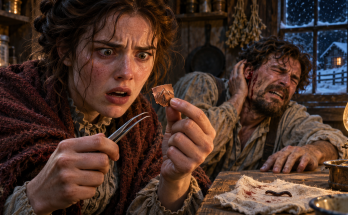
Chapter 1 — The Easter Envelope
The day my father-in-law gave away sixty thousand dollars at his Easter dinner table, my husband received a greeting card worth less than three dollars.
Two years later, that same man would stand in the driveway of our newly purchased farmhouse, screaming at his eighty-eight-year-old mother to stop telling the truth.
By then, however, it was already too late.
The papers were in my hands.
And the man I had married was about to discover that almost everything he knew about his family was a lie.
But on that Easter Sunday, I knew none of it.
All I knew was that my mother-in-law, Judy, had spent the morning preparing a beautiful meal, and I was trying desperately not to cry into my mashed potatoes.
“Natalie, honey, would you pass the gravy?”
I smiled and handed it to her.
Around the dining room table sat my husband’s entire family. Kim, his oldest sister, had brought a lemon cake. Jeff was telling a story about his new truck. Stacy, the youngest, was showing everyone photographs of a house she and her fiancé had recently toured.
My husband, Nate, sat beside me, quietly buttering a dinner roll.
Nate was thirty-four years old, broad-shouldered, hardworking, and possessed of the kind of patience that could make a broken tractor seem like a minor inconvenience.
He repaired farm equipment for a living.
I worked in insurance billing at our local hospital.
We weren’t wealthy, but we paid our bills, loved each other fiercely, and dreamed of owning a little piece of land where we could grow tomatoes, keep chickens, and eventually raise children.
For the time being, we rented a cramped apartment above a hardware store.
The pipes rattled in winter. The kitchen cabinets didn’t close properly. Our bedroom window overlooked a parking lot.
But it was home.
Or at least, it was the closest thing to home we could afford.
After dinner, Judy stood up and tapped her spoon against her coffee cup.
“Before everybody starts on dessert, your father and I have a little surprise.”
Ronald, my father-in-law, leaned back in his chair with a satisfied expression.
“Check underneath your plates.”
Kim found her envelope first.
She tore it open, unfolded the check inside, and gasped.
“Dad!”
Jeff opened his next.
“Twenty thousand dollars? Are you kidding me?”
Stacy started crying before she’d even finished reading hers.
Judy smiled proudly.
“We know how difficult it is for young people to buy houses these days. Your father and I wanted to give you all a little head start.”
Kim jumped up to hug her.
Jeff shook Ron’s hand.
Stacy kept repeating, “I can’t believe it.”
I looked at Nate.
He smiled at his siblings, genuinely happy for them.
Then he opened our envelope.
A greeting card slid into his hand.
On the front was a little bluebird sitting on a branch.
There wasn’t a check.
Nate opened the card.
I leaned closer and read his mother’s handwriting.
You two have always been so resourceful. We’re confident you can manage whatever comes your way. We’re so proud of your independence.
For several seconds, neither of us spoke.
I actually picked up the envelope and looked inside again.
Nothing.
Nate folded the card with extraordinary care and slipped it into his shirt pocket.
His ears had turned bright red.
I knew that particular shade of red.
It was what happened when he was embarrassed or deeply hurt and trying not to show it.
Ron raised his coffee cup.
“Everything written there is true. You ought to be proud of that compliment, son.”
Nate nodded.
“Sure, Dad.”
I forced a smile.
“Thank you. It’s a lovely card.”
Judy looked at me for a moment.
Something passed across her face.
I thought it might have been guilt.
Then Stacy asked whether the check would cover her closing costs, and Judy turned away.
The conversation continued as though nothing unusual had happened.
Kim discussed kitchen renovations.
Jeff talked about interest rates.
Stacy hugged her parents again.
I sat beside my husband, feeling a strange, humiliating emptiness in my chest.
I didn’t believe parents owed their adult children money.
Neither did Nate.
But watching someone deliberately give three children something substantial and exclude the fourth was different.
Especially when that fourth child was the one who had always shown up.
When Ron’s truck broke down, Nate fixed it.
When Judy needed help moving furniture, Nate came over.
When Jeff bought a used lawn mower that wouldn’t start, Nate repaired it without charging him.
When Kim’s water heater failed on Christmas Eve, Nate spent four hours in her basement instead of celebrating with me.
He had never kept score.
And apparently, neither had they.
Or perhaps they had.
Perhaps they had simply decided that the person who asked for the least deserved the least.
We left after dessert.
Nate carried a container of leftover ham to the car because his mother insisted we take it.
He opened my door, walked around to the driver’s side, and started the engine.
For nearly fifteen minutes, the only sound was the tires against the highway.
Finally, he spoke.
“How much have we managed to save?”
“Six thousand two hundred dollars.”
He nodded thoughtfully.
“Then we need to bring in more.”
“Nate, you don’t have to—”
“I know.”
His fingers tightened around the steering wheel.
“I’ll take on more combine repairs during harvest. Maybe some weekend jobs, too.”
I looked out the window.
“And I’ll ask for extra shifts at the diner.”
He glanced at me.
“That’s a lot of hours, Nat.”
“So are yours.”
He gave me a tired smile.
“Guess we’re a couple of stubborn idiots.”
“The best kind.”
He reached across the console and squeezed my hand.
I squeezed back.
Then, so quietly I almost missed it, he said something I would remember for the rest of my life.
“I just wish being their son meant I didn’t always have to prove I could survive without them.”
I turned toward the window before he could see my tears.
Chapter 2 — The Price of Independence
Our new life began the following Monday.
At seven every morning, I reported to the hospital, where I processed insurance claims, corrected billing errors, and spent hours explaining deductibles to frustrated patients.
On Friday and Saturday evenings, I traded my office clothes for a black apron and drove to a truck stop beside the interstate.
Sunday mornings meant another shift.
The diner wasn’t glamorous.
The coffee was strong enough to strip paint.
The jukebox hadn’t worked properly since 1998.
And the regulars had opinions about everything from crop prices to the Dallas Cowboys.
But they tipped generously when they could.
Every dollar went into an envelope I kept inside our bedroom dresser.
Nate worked even harder.
Harvest season brought farmers with machinery that needed fixing immediately. A broken combine could cost someone thousands of dollars in lost crops.
He understood that.
Sometimes he left before sunrise and returned after midnight, his hands black with grease and his clothes smelling of diesel fuel.
I would find him asleep on the couch, one boot still on.
I’d remove it, cover him with a blanket, and leave a plate in the refrigerator.
We barely saw each other some weeks.
When we did, we talked about houses.
“What about a big porch?” I asked one night.
“With a swing?”
“Obviously.”
“Room for chickens?”
“Absolutely.”
“You’re going to name them, aren’t you?”
“Every single one.”
He laughed.
“Then I guess we’re never eating chicken again.”
We made sacrifices without turning them into tragedies.
We canceled streaming subscriptions.
Stopped ordering takeout.
Bought secondhand clothes.
Ate eggs so often that I started inventing ridiculous names for them.
Scrambled eggs became French country breakfast.
Fried eggs became farmhouse specials.
Hard-boiled eggs became emergency protein.
One Saturday, I returned from the diner to find a stranger attaching Nate’s fishing boat to the back of a pickup truck.
I stopped in the doorway.
“Nate?”
He was holding a bundle of cash.
“Sold her.”
The stranger waved and drove away.
Nate watched the boat disappear around the corner.
He’d bought it before we met.
Fishing was the one thing he did entirely for himself.
“You love that boat,” I whispered.
He looked at me.
“I’ll love having a home with you more.”
I wrapped my arms around him.
He held me quietly.
Neither of us mentioned Easter.
We didn’t tell his family how hard we were working, either.
We knew what would happen.
Judy would worry aloud.
Ron would tell us that struggle built character.
Someone might accuse us of fishing for financial assistance.
So we kept our dream private.
Meanwhile, his siblings began purchasing homes.
Kim bought a charming brick house with a finished basement.
Jeff moved into a new development on the edge of town.
Stacy and her fiancé found a ranch-style home with a fenced backyard.
We attended every housewarming party.
We brought presents.
Nate helped move furniture and assemble shelves.
At Stacy’s party, Ron clapped him on the shoulder.
“See? Your turn will come. Hard work pays off.”
Nate smiled.
“That’s the plan.”
I wanted to throw my potato salad at him.
Instead, I helped Stacy wash dishes.
The second winter was particularly difficult.
Our landlord raised the rent.
Nate’s truck needed expensive repairs.
I came down with pneumonia and missed two weeks of diner shifts.
For a while, our savings barely increased.
One night, I sat at the kitchen table staring at our accounts.
Nate found me crying.
“Hey. What’s wrong?”
“I’m tired.”
He pulled out the chair beside me.
“Then we’ll slow down.”
“But we’ll never get there.”
“Sure we will.”
“How do you know?”
He looked around our little apartment.
“Because even if we spend the rest of our lives here, I’ve already got the important part.”
He kissed my forehead.
I laughed through my tears.
“That was unbelievably corny.”
“Worked, though.”
He was right.
It did.
By the following spring, our savings had climbed to approximately forty-two thousand dollars.
It wasn’t enough to buy most houses outright.
But it was enough to make us hopeful.
And then, on a Wednesday afternoon, one of Nate’s customers mentioned the old Miller property.
“You hear the county’s auctioning it?”
Nate looked up from the fuel pump he was repairing.
“The place out on County Road Nine?”
“That’s the one. Delinquent property taxes. Been empty for six years.”
That evening, Nate arrived home holding a newspaper.
He spread it across the kitchen table.
“Nat, look.”
I read the auction announcement.
A neglected farmhouse.
Nearly eight acres.
An old barn.
A detached workshop.
The county had obtained a judgment for unpaid property taxes, and the property was scheduled for public auction.
Pictures of the house accompanied the notice.
It looked terrible.
The porch leaned toward the ground.
Grass had swallowed the driveway.
Some of the windows were boarded over.
But behind the ruined house, there was a beautiful expanse of green farmland bordered by mature oak trees.
I stared at the photograph.
“Can we go see it?”
Nate grinned.
“Already put gas in the truck.”
Chapter 3 — Forty-One Thousand Five Hundred Dollars
The Miller farmhouse looked even worse in person.
Its white siding had peeled away in enormous flakes.
The gutters were rusted.
A section of the porch railing had collapsed.
Weeds reached my waist.
Something scurried beneath an old stack of boards when I approached the barn.
“Please tell me that was a rabbit.”
Nate laughed.
“Definitely a rabbit.”
“You’re lying.”
“Definitely.”
He spent nearly an hour walking around the house, inspecting what he could from the outside.
The auction information described the property’s condition, warned buyers about repairs, and provided records from the county.
We knew it was a risk.
But Nate understood buildings and machinery better than anyone I knew.
Eventually, he crouched beside the foundation, studied the masonry, and stood up.
“Main structure looks good. Roof needs work. Porch is a mess. Electrical’s probably a nightmare.”
“You’re really selling it.”
He looked at me.
“It’s fixable, Nat.”
I walked around the side of the house.
Beyond the barn, the land stretched toward a shallow creek.
A pair of bluebirds darted between two fence posts.
For the first time in years, I could imagine something different from our apartment.
I could imagine opening a window in the morning and hearing birds instead of delivery trucks.
I could imagine a garden.
A Christmas tree beside a fireplace.
Children running through grass.
“How much can we bid?” I asked.
“Forty-two thousand. Not a penny more.”
The auction took place the following Friday outside the courthouse.
The crowd consisted mostly of local farmers, a handful of real estate investors, and people hoping to buy cheap land.
An auctioneer named Dobbs stood behind a folding table.
Nate held my hand.
I could feel his pulse.
When bidding began, several people dropped out quickly.
At thirty-five thousand dollars, only three bidders remained.
At thirty-eight thousand, there were two.
Nate and a gray-haired man wearing a padded vest.
He appeared to be in his late fifties.
He was tall, with weathered skin and broad hands.
Every time Nate increased the bid, the stranger calmly raised his own.
“Thirty-nine thousand.”
The stranger lifted his hand.
“Forty.”
Nate raised his.
“Forty thousand five hundred.”
The stranger barely hesitated.
“Forty-one thousand.”
My stomach tightened.
We were approaching our limit.
Nate glanced at me.
I nodded.
He took a breath.
“Forty-one thousand five hundred.”
Dobbs turned toward the other bidder.
“Forty-two?”
The gray-haired man looked at Nate.
For several seconds, he simply studied him.
Then his eyes moved to me.
He must have seen how tightly I was gripping my husband’s hand.
He looked down at the auction information in his possession.
Finally, he shook his head.
“I’m out.”
Dobbs waited.
“Going once.”
I stopped breathing.
“Going twice.”
Nate squeezed my hand.
“Sold! Forty-one thousand five hundred dollars!”
I screamed.
Actually screamed.
Nate laughed and wrapped me in his arms.
People nearby applauded.
I felt dizzy with happiness.
We presented a cashier’s check for forty thousand dollars and the additional fifteen hundred dollars I’d saved from my diner tips.
The courthouse clerk counted everything twice.
We signed the necessary paperwork and began the process of completing the sale.
When the court confirmed the auction and the county released the property to us, the clerk handed over a ring of tarnished keys that had been left with the property.
I held them like jewelry.
Outside the courthouse, Nate and I encountered the man who had bid against us.
He was standing beside an old pickup.
“Congratulations,” he said.
“Thank you,” Nate replied.
The man nodded toward the paperwork in Nate’s hand.
“You planning to tear it down?”
“No, sir. We’re going to save it.”
Something changed in the man’s expression.
“That’s good.”
He looked at me.
“Place deserves another chance.”
Then he climbed into his truck and drove away.
Nate watched him leave.
“Nice guy.”
“Expensive guy.”
He laughed.
We drove straight to the farmhouse.
That afternoon, we unlocked the front door and stepped inside.
Dust floated through beams of sunlight.
Wallpaper curled away from the walls.
The floorboards creaked beneath our feet.
A kitchen cabinet hung from one hinge.
But the house was ours.
Nate stood in the empty living room and spread his arms.
“Welcome home, Mrs. Whitaker.”
I burst into tears.
He hugged me.
We stood there for a long time, surrounded by dust and broken furniture, laughing like people who had just won the lottery.
Neither of us knew that the stranger at the courthouse had an extraordinary connection to our new home.
Neither of us knew why the farmhouse had been abandoned.
And neither of us knew that our purchase had just destroyed a secret someone had spent thirty-four years protecting.
Chapter 4 — Grandma Opal
We decided not to tell Nate’s family about the farmhouse until we’d made some progress.
It wasn’t revenge.
We simply wanted something that belonged to us.
Something immune to opinions, criticism, and unnecessary advice.
For the next several weeks, every spare hour went into repairs.
Nate rewired rooms after work.
I stripped wallpaper until my thumbs cracked.
We borrowed tools, bought discounted materials, and learned to recognize which demolition jobs were satisfying and which ones were just exhausting.
Underneath layers of ugly wallpaper in the kitchen, I discovered pencil marks on a doorframe.
There were names beside them.
Ronnie.
Anna.
Several dates had faded beyond recognition.
I ran my fingers over the marks.
“Kids used to live here,” I told Nate.
He glanced over.
“Looks like it.”
I took a photograph.
Something about those little marks made me reluctant to cover them.
Then the property transaction appeared among the legal announcements in the local newspaper.
And there was one person in Nate’s family who read every single line of those notices.
His grandmother, Opal.
She was eighty-eight years old.
She walked with a cane, wore lipstick to the grocery store, and could remember the birthdays of people she’d met once in 1974.
She also had very little tolerance for foolishness.
One afternoon, while I was at the hospital, my phone rang.
“Natalie?”
“Hi, Grandma.”
“Come get me after church on Sunday.”
“Of course. Everything okay?”
A brief silence followed.
Then she said, “And don’t tell Ronald anything about it.”
I straightened in my chair.
“Ron? Why?”
“Sunday. After church.”
She hung up.
When Sunday arrived, I picked her up outside the little Methodist church in town.
She wore a lavender cardigan, pearl earrings, and carried an oversized brown purse.
“Drive toward County Road Nine,” she instructed.
I looked at her.
“Grandma, that’s where—”
“I know exactly where it is.”
She buckled her seat belt.
We drove six miles into the countryside.
As we approached the farmhouse, I noticed her gripping the handle of her purse.
“Are you feeling all right?”
She didn’t answer.
The old house came into view.
Opal leaned forward.
Her mouth opened slightly.
“Pull over.”
I slowed.
“Here?”
“Yes. Here.”
I stopped beside the driveway.
For several seconds, she stared at the farmhouse.
Then tears began running down her cheeks.
“Grandma?”
She shook her head.
“Ronald promised me this would never happen.”
A chill ran through me.
“What do you mean?”
She reached into her purse and pulled out a faded photograph.
A young woman stood on the farmhouse porch beside a handsome man holding a little boy.
The porch was freshly painted.
Flowers filled the window boxes.
A wooden swing hung from the ceiling.
“That’s me,” she whispered. “And that’s Frank. Your husband’s grandfather.”
She pointed at the little boy.
“That’s Ronald.”
I stared at her.
“This was your house?”
“For more than fifty years.”
I couldn’t believe it.
Nate had never mentioned that his grandparents owned the Miller property.
In fact, as far as I knew, his family had always lived in town.
“Why didn’t anybody tell us?”
Opal looked toward the house.
“Because some people worked very hard to make sure certain memories stayed buried.”
She reached into her purse again.
This time, she removed a thick yellowed envelope.
“I’ve kept these hidden for years. Ronald doesn’t know I still have them.”
Inside were copies of legal documents, bank statements, and handwritten notes.
The first few pages made little sense to me.
Then I noticed three withdrawals.
All for exactly the same amount.
Twenty thousand dollars.
I looked at the dates.
My heartbeat quickened.
They had occurred shortly before Easter dinner two years earlier.
“Grandma…”
Her fingers closed around my wrist.
“Those checks your in-laws handed out on Easter? Honey, that money was never theirs to give.”
Before I could respond, a familiar pickup truck turned onto the driveway.
Ronald.
He stopped so abruptly that gravel scattered beneath his tires.
The driver’s door swung open.
He climbed out, his face dark with fury.
“What are you doing here, Mother?”
Opal straightened.
“Visiting my granddaughter.”
Ron looked at the papers in my lap.
His expression changed.
“Give me those.”
I instinctively pulled the envelope closer.
“Why?”
“Because you have no idea what you’re looking at.”
Opal opened her door.
I hurried around to help her.
She stepped onto the gravel, leaning against her cane.
For a moment, she seemed small beside her son.
Then she raised her chin.
“Tell her, Ronald.”
“Get in my truck.”
“Tell her why you gave that money to your children.”
“Mother!”
“Tell her why Nate didn’t get any.”
Ron looked from Opal to me.
His jaw tightened.
“That boy has never gone without anything he needed.”
Opal’s voice became sharp.
“That’s not what I asked.”
I had never seen Ron so angry.
But underneath his anger, something else was visible.
Fear.
Pure, unmistakable fear.
He took another step toward me.
“Hand over the envelope, Natalie.”
“No.”
The word surprised even me.
He stopped.
I stood my ground.
“If these are harmless papers, why do you need them so badly?”
For a moment, nobody moved.
Then Opal said something that made the entire world seem to tilt.
“Because the farm was supposed to belong to Nathaniel long before he ever bid on it.”
Chapter 5 — The House We Had Already Owned
I stared at Opal.
“What did you just say?”
Ron answered for her.
“She’s confused.”
His mother gave him a look that could have frozen boiling water.
“I remember the day you were born, Ronald. Don’t stand there and tell me what I remember.”
He exhaled sharply.
“These matters are complicated. You’re upsetting yourself.”
“No. You’re upsetting me.”
I glanced down at the envelope.
My hands were shaking.
“Are you saying Nate inherited this house?”
Opal nodded.
“Frank arranged it before he died.”
Ron stepped between us.
“Natalie, listen to me. There was an arrangement involving the property. Things changed. Your grandmother isn’t aware of all the details.”
“Then explain them.”
He looked toward the farmhouse.
“It’s not something we should discuss out here.”
“Where should we discuss it?”
“At home. As a family.”
I almost laughed.
As a family.
The phrase felt remarkably hollow coming from the man who had handed his son a greeting card while distributing sixty thousand dollars to his other children.
I took out my phone and called Nate.
He answered on the second ring.
“Hey, beautiful.”
“Nate, I need you at the farmhouse.”
His voice changed.
“What’s wrong?”
“Your dad’s here. Grandma Opal’s here. There’s something you need to see.”
“I’ll be there in ten minutes.”
Ron shook his head.
“You don’t have to drag Nathan into this.”
“He’s my husband.”
“And he’s my son.”
Opal looked directly at him.
“Then perhaps you should start behaving like it.”
Ron went completely still.
I helped Opal toward the farmhouse.
The front porch was still unsafe, so we entered through the kitchen.
Nate had placed two folding chairs beside a makeshift table.
I seated Opal and handed her a bottle of water.
Ron followed us inside.
He looked around the room.
At the exposed wiring.
The stripped wallpaper.
The enormous pile of debris waiting to be hauled away.
For the first time, he noticed the pencil marks on the doorframe.
Ronnie.
Anna.
He stared at them.
His expression softened for a fraction of a second before hardening again.
“Should’ve painted over those.”
Opal shook her head.
“Some things deserve to remain.”
Nate arrived twelve minutes later.
He came through the kitchen door wearing work boots and a faded gray T-shirt.
“Nat?”
I stood immediately.
He kissed my forehead and looked from his grandmother to his father.
“What’s going on?”
Opal motioned for him to sit.
“Your grandfather left you something.”
Nate frowned.
“Grandpa Frank? He died nine years ago.”
“I know when he died, sweetheart.”
Ron rubbed his forehead.
“Mother, please.”
Opal ignored him.
“Frank knew you loved working with your hands. He knew you wanted a family and a little land someday. So he arranged for this place to be yours after I was gone. There was money, too.”
Nate glanced at me.
“What money?”
“Eighty thousand dollars,” she replied.
The kitchen fell silent.
Even the wind outside seemed to disappear.
Nate blinked.
“Eighty thousand?”
“Your grandfather saved it. Some came from selling equipment. Some from investments. He put everything into a trust.”
Ron interrupted.
“The trust had expenses.”
Opal turned toward him.
“Then show them the expenses.”
“It’s not that simple.”
“Three checks for twenty thousand dollars each seem simple enough.”
I placed the bank statement on the table.
Nate leaned forward.
His eyes moved across the page.
He studied the dates.
The amounts.
Then he looked up at his father.
“The Easter money?”
Ron said nothing.
“Dad?”
“Your sisters and brother needed help.”
Nate stared at him.
“With my money?”
Ron slammed his palm against the table.
“It wasn’t your money yet!”
Opal flinched.
I reached for her hand.
Nate remained seated.
His expression became strangely calm.
“Okay. Then whose money was it?”
Ron paced toward the window.
“Your grandfather didn’t understand how expensive things were going to get. There were repairs. Insurance. Taxes. Legal fees.”
“Taxes?” I asked. “The county auctioned the property because those weren’t paid.”
He glared at me.
“You don’t know anything about managing an estate.”
“Apparently neither do you.”
The words escaped before I could stop them.
Nate stood.
“Nat.”
Not a criticism.
A warning.
He knew his father’s temper.
I closed my mouth.
Nate turned back to Ron.
“I’m going to ask you one question.”
His voice was low.
“Did Grandpa leave this house for me?”
Ron looked away.
“Answer me.”
A long silence followed.
Finally, Ron muttered, “That was his original intention.”
Nate’s face changed.
I would have given anything not to see it.
He looked toward the ceiling.
Toward the torn walls.
Toward the floor he had spent hours repairing.
Then he looked at his father again.
“Do you understand that I sold my fishing boat to buy this house?”
Ron didn’t answer.
“Do you understand that my wife worked weekends for two years? That she came home with swollen ankles and went back to work six hours later?”
“Nate—”
“We bought it for forty-one thousand five hundred dollars.”
His voice cracked.
“And you’re telling me Grandpa already left it to me?”
Ron crossed his arms.
“You bought a property at a public auction. Nobody forced you to do that.”
Nate stared at him.
For the first time since I’d known my husband, I watched him look at his father as though he were a stranger.
“Get out.”
Ron blinked.
“What?”
“Get out of my house.”
“This is ridiculous.”
“Then it should be easy for you to leave.”
Ron looked toward Opal.
“You’re coming home with me.”
She shook her head.
“No, I’m not.”
“Mother.”
“Natalie can take me.”
He stood completely still for several seconds.
Then he turned and walked outside.
His truck started with a violent roar.
We listened until the sound disappeared down the road.
Nate sat back down.
He picked up the bank statement.
Then he covered his face with both hands.
I went to him.
He didn’t cry immediately.
First he shook.
Then he took one unsteady breath.
And finally, the man who had carried every disappointment quietly for years began to sob.
I held him.
Across the table, Opal cried, too.
“I’m sorry, sweetheart,” she whispered.
“I’m so terribly sorry.”
But when Nate finally looked at her, she wouldn’t meet his eyes.
Because, as we would eventually discover, the stolen inheritance wasn’t the only thing she needed to apologize for.
Chapter 6 — What the County Records Revealed
The following morning, I called an attorney.
Claire Bennett worked in a neighboring town and specialized in estate disputes.
She had a reputation for being direct, thorough, and almost impossible to intimidate.
We brought Opal with us.
Claire examined the documents while the three of us sat across from her desk.
For nearly twenty minutes, she asked questions without expressing an opinion.
Finally, she removed her glasses.
“Let me understand this correctly. Frank established a trust before his death. The farmhouse and investment funds were included. Mrs. Whitaker retained certain rights during her lifetime, and Nathan was designated to receive the remaining property.”
Opal nodded.
“That’s what Frank wanted.”
“And Ronald became the managing trustee?”
“Eventually. I signed some papers seven years ago. My eyesight was getting worse. I trusted my son.”
Claire examined one of the documents.
“These indicate you resigned as co-trustee, but they don’t change the beneficiary.”
Nate leaned forward.
“So how did the county end up selling the house?”
“That’s what we’re going to investigate.”
She turned her computer monitor toward us.
Property records filled the screen.
Claire showed us a deed recorded approximately six years earlier.
It transferred ownership of the farm from the family trust to a company called R.W. Agricultural Holdings.
“Do you recognize that company?”
Opal shook her head.
Nate read the name twice.
“R.W. Ronald Whitaker?”
Claire nodded.
“According to the business registration, your father controlled it.”
My stomach sank.
“He transferred the farmhouse to himself?”
“To his company. We need the complete trust records and transaction documents before we determine whether he had authority to do that or whether proper consideration was paid.”
She opened another record.
“After the transfer, property taxes began falling behind. Eventually, the county initiated foreclosure proceedings against the company.”
Nate rubbed his mouth.
“Why wouldn’t he just pay them?”
Claire looked at him.
“Sometimes people move assets between businesses to address financial problems. Sometimes the resulting problems become worse.”
“Can he take the house away from us?”
“That’s a separate question.”
She explained that our purchase had been completed through a court-confirmed tax foreclosure process and that the recorded documents supported our ownership. She would still review the notices, the judgment, and the sale carefully before offering any definitive legal opinion.
For now, however, she saw no reason for us to surrender possession.
Nate exhaled.
I realized how terrified he had been that even our modest victory might be taken from him.
Claire studied the financial records.
“Where did you get these statements, Mrs. Whitaker?”
Opal looked down.
“Judy gave them to me.”
Nate lifted his head.
“Mom?”
“Two years ago. She showed up at my house one afternoon looking like she’d been crying. She said Ronald had taken money out of the trust. I asked her why. She wouldn’t tell me everything, but she brought these.”
“Did she know the money was meant for Nate?”
Opal nodded slowly.
Claire made a note.
“Did you confront Ronald?”
“I tried.”
“And?”
“He told me I’d misunderstood. Said Frank had made mistakes with the paperwork. Then he started threatening to put me in a nursing home if I couldn’t manage my affairs properly.”
My mouth fell open.
“He threatened you?”
She nodded.
“I was living in a small house he owned. He controlled the money that paid for my groceries and medication. I was eighty-six years old, Natalie. I was scared.”
I took her hand.
Nate stared at the floor.
Opal continued.
“I hid the statements. I knew they mattered, but I didn’t know what to do. Then I saw your names in the newspaper.”
She wiped her eyes.
“And I realized he’d let you pay for your own inheritance.”
Claire closed the folder.
“First, we’ll request a formal accounting. We’ll also contact the attorney who prepared the trust. We need complete copies of the documents, not just selected pages.”
She looked at Opal.
“Mrs. Whitaker, where are you living now?”
“In the same house.”
“Do you feel safe there?”
Opal hesitated.
Nate answered.
“She’s staying with us.”
Our apartment had one bedroom.
The farmhouse was barely habitable.
But he said it as if there were no other possibility.
Claire smiled faintly.
“Good. We’ll make arrangements to protect her financial interests, too.”
As we stood to leave, she examined the copy of Frank’s trust again.
“One thing puzzles me.”
I turned.
“What?”
“Your grandfather had four grandchildren. Why did he specifically designate Nathan to receive this property and the investment account?”
Nate shrugged.
“He always knew I liked fixing things.”
“Possibly.”
She tapped the document.
“But the language here seems unusually deliberate. He didn’t merely name you as a beneficiary. He explicitly prohibited the trustee from substituting another beneficiary or distributing your designated assets among other descendants.”
She paused.
“That’s the kind of provision someone requests when they’re worried about a specific person interfering.”
Opal looked away.
Nate noticed.
“Grandma?”
She stood slowly.
“I think I’d like to go home now.”
Chapter 7 — The Family Takes Sides
By the time we returned to town, Ronald had already told his version of the story.
Kim called me first.
“What the hell are you doing?”
I held the phone away from my ear.
“Excuse me?”
“Dad says you’re accusing him of stealing money.”
“We’re asking him to account for money from a trust.”
“That sounds like stealing.”
“Then perhaps he should explain where it went.”
She inhaled sharply.
“You’re seriously going to tear our family apart over twenty thousand dollars?”
I looked around our apartment.
At Nate’s work boots.
At the cheap dishes.
At the old coffee table we’d rescued from the curb.
“Kim, you don’t understand.”
“Oh, I understand perfectly. You were bitter about Easter. Now you’ve found a way to punish everybody.”
She hung up.
Jeff called Nate that evening.
I heard only his side of the conversation.
“No, I didn’t ask her to go through Grandma’s papers.”
A pause.
“Because Grandpa left them to me.”
Another pause.
“No, Jeff. I’m not asking you for your house.”
He listened.
Then his face fell.
“Is that really what you think of me?”
He set the phone down.
I didn’t ask immediately.
He told me a few minutes later.
“He said I was always Grandpa’s favorite. Said maybe Dad was trying to make things fair.”
I sat beside him.
“Do you believe that?”
Nate shook his head.
“I don’t know what to believe anymore.”
Stacy was different.
She arrived at our apartment the following afternoon carrying a grocery bag and looking miserable.
“Can we talk?”
I let her inside.
She sat at our kitchen table.
For a while, she picked at the edge of a paper napkin.
“Did my check come from Nate’s trust?”
“We believe so.”
Her eyes filled.
“Mom said they refinanced the house to give us that money.”
I stared at her.
“That’s what she told you?”
“That’s what they told all of us.”
She looked toward the living room, where Nate was assembling a borrowed bed for Opal.
“I wouldn’t have taken it if I’d known.”
I believed her.
“What am I supposed to do?” she whispered. “We used it for the down payment. We don’t have twenty grand sitting around.”
“Nobody’s asking you to write a check today.”
She began crying.
“I feel like I’ve stolen from my brother.”
Nate appeared in the doorway.
“You didn’t steal anything, Stace.”
She stood and threw her arms around him.
“I’m so sorry.”
He hugged her.
“We’ll figure it out.”
I turned away to give them privacy.
Later, after Stacy left, Nate said, “Whatever happens, I don’t want their kids losing their homes.”
I stared at him.
“Even if Kim keeps calling us greedy?”
“Even then.”
There were times when his kindness frustrated me.
Not because it was weakness.
Because I knew how often people exploited it.
That night, Judy called.
I handed Nate the phone.
He went into the bedroom and closed the door.
Forty minutes later, he emerged.
His face was pale.
“What did she say?”
“She wants us to stop talking to the lawyer.”
“Of course she does.”
“She says Dad made some bad decisions, but he was trying to help the family.”
I shook my head.
“And you?”
He stared at the wall.
“She says Dad always knew I’d be okay.”
I felt anger rise through my chest.
“Nate, that isn’t an explanation.”
“I know.”
He walked to the kitchen.
Opened the refrigerator.
Closed it without taking anything.
Then he said, “She told me that when I was little, I was the easiest child to love because I never needed much.”
I couldn’t speak.
He laughed once.
It was a terrible sound.
“Maybe I should’ve been more difficult.”
I crossed the room and held him.
“You should’ve been allowed to be a child.”
He rested his forehead against mine.
Outside, rain began tapping against the apartment windows.
On the couch, Opal pretended to sleep.
But I saw her wipe her cheeks.
Chapter 8 — The Woman in the Wallpaper
Two weeks later, Claire located the attorney who had prepared Frank’s trust.
His name was Walter Keene.
He was retired and living with his daughter three counties away.
He remembered Frank immediately.
“Stubborn man,” he told Claire over the phone. “Very particular about those documents.”
His office files had been transferred to another practice upon his retirement.
Retrieving them would take time.
Meanwhile, the formal accounting request had been delivered to Ron.
His response arrived through an attorney.
It was short, aggressive, and filled with complaints about privacy, family harassment, and supposedly improper access to financial information.
There was no accounting.
That weekend, I returned to the farmhouse alone.
I needed somewhere to breathe.
The repairs had barely progressed since the confrontation.
Every time Nate stepped through the door, he seemed to remember something new about his father’s betrayal.
I started stripping wallpaper in the upstairs hallway.
Underneath the first layer was a faded floral pattern.
Under that was another layer with blue and yellow flowers.
I peeled until a section near the staircase revealed a small square of pale paint.
Someone had drawn a bluebird on the wall.
It was simple but beautiful.
The bird sat on a thin branch, its head tilted slightly upward.
Below it, in tiny letters, was a name.
Anna.
I called Opal.
“Grandma, who was Anna?”
The silence on the other end was immediate.
“Where did you see that?”
“Upstairs. There’s a drawing on the wall.”
She breathed deeply.
“Anna was my daughter.”
I stopped scraping.
“Nate’s aunt?”
“Yes.”
I knew almost nothing about her.
Nate had once mentioned that his father had a sister who died young.
There were no photographs of her in Judy’s living room.
Nobody told stories about her at Christmas.
She seemed to exist only as a vague sadness that occasionally surfaced in family conversations.
“What happened to her?”
Opal’s voice grew distant.
“She died when she was twenty-two.”
“I’m sorry.”
“She was a beautiful girl. Always drawing something.”
I looked at the bird.
“She liked bluebirds?”
A small sound escaped Opal.
Almost a laugh.
Almost a sob.
“Oh, honey. She loved them.”
That night, I told Nate about the drawing.
He shrugged.
“Grandpa mentioned Aunt Anna sometimes. Said she could draw anything.”
“Do you know how she died?”
“Car accident, I think. Before I was born.”
I looked at him.
“You’re sure?”
“That’s what Dad told me.”
The following day, Judy arrived at the farmhouse.
Neither of us had invited her.
She stood in the driveway wearing jeans and an old sweater, her hair tied back.
She looked ten years older than she had at Easter dinner.
“I brought sandwiches,” she explained.
Nate was replacing a section of damaged wiring.
He looked down from the ladder.
“Thanks.”
She set the bag on the kitchen counter.
Her eyes wandered around the room.
When she saw the pencil marks on the doorframe, she touched them.
“Frank measured the kids here every birthday.”
I watched her.
“You spent a lot of time at this house?”
“Before Ronald and I were married, yes.”
She looked toward the stairs.
“Did you go upstairs?”
“Of course.”
Nate climbed down.
“Mom, we bought the place.”
She nodded.
“I know.”
Something about her expression made me uneasy.
I took her upstairs and showed her the bluebird.
Judy stared at it.
The color drained from her face.
“Anna drew birds everywhere,” she whispered.
“Grandma told me.”
Judy looked away.
Then I remembered something.
The Easter card.
I hurried downstairs, retrieved my phone, and found a photograph of the card Nate had received.
I’d taken a picture of it shortly after dinner because I couldn’t believe what had happened.
I enlarged the bluebird.
The bird on the card and the bird on the wall weren’t identical.
But they shared the same distinctive style.
The same unusual curl at the end of the branch.
The same upward tilt of the head.
I showed Nate.
“Look.”
He stared at the picture.
Then at his mother.
“Where did you get that card?”
Judy’s eyes filled.
“From an old box of stationery.”
“Whose?”
She wouldn’t answer.
“Mom?”
Finally, she whispered, “Anna’s.”
Nate looked confused.
“Why did you give me a card my aunt made?”
Judy pressed her lips together.
“I thought…”
She stopped.
“What?”
She shook her head.
“It doesn’t matter.”
Nate took a step toward her.
“Mom, what aren’t you telling me?”
Judy began crying.
“I’m sorry, Nathan.”
“For the money?”
She looked at him.
Her eyes were filled with an anguish I couldn’t understand.
“For everything.”
Then she walked downstairs, got into her car, and drove away.
We stood in front of the little bluebird.
For the first time, I wondered whether the inheritance was connected to something much bigger than money.
Chapter 9 — The Letter That Never Reached Him
Claire called on a Thursday morning.
“We have the complete trust file.”
I was halfway through a conversation with a patient’s insurance company.
“Is there something wrong?”
“I’d prefer to discuss it in person. Please bring Nate.”
Her tone frightened me.
“Should we bring Opal?”
A pause.
“Not initially.”
I called Nate.
He canceled his afternoon repair appointments, and we drove to Claire’s office together.
She was waiting in the conference room.
Several folders were spread across the table.
The first was labeled with Frank’s name.
The second contained property records.
The third was much thinner.
Claire pointed to the first folder.
“The trust is exactly what your grandmother described. The farmhouse was to be maintained during her lifetime. The investment funds were intended for your benefit. Frank specifically authorized distributions to assist you in buying a home.”
Nate looked at her.
“So I could have been helped at Easter?”
“Yes. Assuming the fund was intact, that would have been an entirely appropriate reason to make a distribution.”
He nodded slowly.
Claire continued.
“The attorney also retained a copy of a letter Frank prepared for you. He entrusted delivery of the original to Ronald.”
She opened the third folder.
“It was supposed to be delivered on your thirtieth birthday.”
Nate frowned.
“My thirtieth birthday?”
“Yes.”
“I never got a letter.”
“I assumed as much.”
She placed the document in front of him.
Nate unfolded it.
I moved my chair closer.
The letter began in Frank’s distinctive handwriting.
Dear Nathaniel,
If you’re reading this, I’m probably gone. There are things I should have told you while I was still alive. I hope someday you understand why I found them so difficult.
First, I want you to know that you have brought me more joy than you can possibly imagine.
Every time you take something broken and make it work again, I see someone I loved very dearly.
Nate smiled faintly.
Then he continued reading.
His smile disappeared.
I’ve watched you grow into a kind young man. I know you believe kindness means never making trouble for others. That’s something your family has taught you, and I’m afraid I’ve helped teach it.
But sometimes the truth is worth making trouble for.
You deserve to know where you came from.
You deserve to know why the Miller house means so much to me, and why it is important that it eventually belongs to you.
It was the place where your mother grew up.
Nate looked at me.
“Mom grew up in town.”
Claire remained silent.
He returned to the letter.
Your mother used to draw birds on the upstairs walls. She wanted to become an artist. She had your stubbornness, your kindness, and your terrible habit of apologizing when someone else had hurt her.
His breathing became uneven.
I felt my fingers turn cold.
The next sentence was short.
Your mother’s name was Anna Louise Whitaker.
Nate stopped reading.
He stared at the page.
Then he looked at Claire.
“No.”
She said nothing.
“No, that’s not right.”
I reached for his hand.
He pulled it away—not from anger, but because he needed both hands to hold the letter.
“Anna was Dad’s sister.”
“Yes,” Claire replied gently.
“She was my aunt.”
Claire folded her hands.
“According to Frank’s letter and the adoption documents he retained, she was your biological mother.”
Nate shook his head.
He stood so quickly his chair scraped against the floor.
“No. No, my mom is Judy.”
“Judy is the woman who raised you. Nothing here erases that.”
He began pacing.
“Anna died before I was born.”
Claire looked at him.
“The documents indicate that she died three days after your birth.”
I covered my mouth.
Nate stopped beside the window.
Nobody spoke.
Outside, cars passed along the street.
Someone on the sidewalk laughed.
A delivery driver carried a package into the building next door.
The world continued functioning as though my husband’s hadn’t just collapsed.
After a while, Nate turned around.
“Did my father know?”
Claire’s expression told us everything.
“Ronald and Judy adopted you when you were an infant.”
Nate sat down.
His eyes were empty.
“Thirty-four years.”
He said it again.
“Thirty-four years.”
I took his hand.
This time, he let me.
Claire gave him the remainder of Frank’s letter.
He read silently until he reached the final paragraph.
Then he handed it to me.
The house isn’t being left to you because you’re my favorite grandchild. It’s being left to you because your mother loved it, because she never had the chance to receive what I intended to give her, and because I want you to have a place that connects you to the life you were born into.
Ronald has already received what I intended him to have. You owe him nothing for this gift.
Please don’t let anyone convince you otherwise.
I looked at Nate.
Tears were running down his face.
All those years of believing his father loved his siblings more.
All those years of quietly accepting unequal treatment.
The Easter card.
The compliments about being independent.
The endless expectation that he would never ask for anything.
Suddenly, every small wound had a different shape.
And yet the revelation didn’t explain one crucial detail.
“Who was his biological father?” I asked.
Claire reached for another folder.
“Frank’s letter mentions a man Anna intended to marry. There are some old photographs and correspondence.”
She looked at Nate.
“Would you like to see them now?”
He stared at the table.
“Not yet.”
His voice was barely audible.
“First, I need to talk to my mother.”
Chapter 10 — The Mother Who Raised Him
Judy answered the door wearing an apron.
She smiled when she saw Nate.
Then she saw the expression on his face.
Her smile vanished.
“What’s wrong?”
Nate held up Frank’s letter.
“Who was Anna?”
Judy gripped the doorframe.
“Oh, Nathan.”
“Tell me.”
She looked at me.
“Come inside.”
Ron wasn’t home.
We sat in the living room where we’d celebrated countless birthdays and Christmases.
Family photographs covered the walls.
Pictures of Kim at graduation.
Jeff in his football uniform.
Stacy at prom.
Nate as a little boy, holding a fishing pole beside Ron.
I wondered how many memories were about to become unbearable.
Judy sat opposite us.
For a moment, she seemed incapable of speaking.
Finally, she whispered, “She was your mother.”
Nate closed his eyes.
Hearing it from Claire had been devastating.
Hearing it from the woman who had tucked him into bed as a child was something else entirely.
“Why didn’t you tell me?”
Judy began crying.
“We thought it was better.”
“Better for whom?”
She looked down.
“Anna was young. She was pregnant. Ronald was furious about it, but your grandfather told him to leave her alone.”
“Why was Dad furious?”
“Because he didn’t like the man she was seeing. He thought Anna deserved someone with money and a respectable career.”
Nate gave a bitter laugh.
“Of course.”
Judy continued.
“She went into labor several weeks early. There were complications. You were born, and for a little while we thought everything was going to be okay.”
Her face crumpled.
“But Anna got very sick.”
I swallowed.
“What happened?”
“She died three days later.”
Nate looked toward the family photographs.
“Where was my father?”
Judy hesitated.
“Ronald said he’d abandoned her.”
“Did he?”
“I don’t know.”
“Mom.”
“I didn’t know then.”
She covered her mouth.
Nate leaned forward.
“What do you know now?”
Judy began trembling.
“Years later, I found a letter from him. He was asking Ronald where the baby had been buried.”
My heart lurched.
“Buried?”
She nodded.
“He thought you’d died, too.”
Nate stared at her.
“Who told him that?”
Judy said nothing.
She didn’t have to.
I felt physically sick.
Nate stood.
“Dad?”
Judy began sobbing.
“Oh, sweetheart…”
“Did Dad tell him I was dead?”
She nodded.
Nate walked to the far side of the room.
He rested both hands on the back of an armchair.
For several seconds, he struggled to breathe.
Then he asked, “And you adopted me?”
“Yes.”
“Knowing I had a father?”
“We believed he wanted nothing to do with Anna. Ronald handled everything. Your grandfather and grandmother wanted you to stay in the family. I’d recently lost a pregnancy, and…”
She paused.
“And I wanted you.”
Nate turned around.
“Did you love me?”
The question broke me.
It was so simple.
So painfully childlike.
Judy stood.
“Of course I did!”
“Then why didn’t you tell me?”
“Because I was afraid!”
“Of what?”
“That you would stop being my son!”
He stared at her.
For a moment, neither of them spoke.
Then Nate shook his head.
“You didn’t have to be my biological mother to be my mom. But you had to be honest with me.”
Judy reached for him.
He stepped back.
She lowered her hands.
“I found more letters when you were older,” she confessed. “I wanted to tell you. Then Frank started asking Ronald questions, and everything became terrible. Ronald told me we’d lose you if you knew.”
“Grandpa knew?”
“He eventually found out your father hadn’t simply disappeared. He was furious. That’s part of why he made the arrangements with the trust.”
Nate looked at her.
“And Easter?”
Judy’s face fell.
“Ronald said the money belonged to the family. That Frank had been unfair. I knew he was using the trust, but he convinced me he was allowed to.”
“Did you believe him?”
Silence.
“Mom.”
“No.”
She began crying again.
“Not really.”
I felt anger gathering in my throat.
“Then you watched Nate open an empty envelope while everyone else got twenty thousand dollars?”
Judy looked at me.
“I didn’t know how to stop Ronald.”
“You could have told us.”
“I know.”
“You could have told Grandma.”
“I tried.”
“You could have refused to participate.”
She nodded miserably.
“I know.”
Nate looked toward the fireplace.
“Why Anna’s card?”
Judy wiped her face.
“I found a box of cards she made. I thought if I gave you one, you’d have something of hers.”
“You could have given me the truth.”
She closed her eyes.
I had never seen anyone look so ashamed.
After a while, Judy went upstairs.
She returned carrying a small wooden box.
There was a bluebird carved into the lid.
She placed it on the coffee table.
“These belonged to Anna.”
Inside were sketches, photographs, dried flowers, and several letters tied with a ribbon.
There was also a tiny hospital bracelet.
Nate picked it up.
Thirty-four years had faded the writing.
But the name was still visible.
Baby Boy Whitaker.
He ran his thumb across the plastic.
Judy sat beside him.
“Your mother held you before she died.”
He stopped moving.
“She did?”
“She asked everyone to leave the room. I stayed because she could hardly sit up. She held you against her chest and sang to you.”
Nate’s eyes filled.
“What did she sing?”
Judy smiled through her tears.
“That old song about sunshine.”
He bowed his head.
The bracelet disappeared into his trembling fist.
We stayed for another hour.
There were questions.
Explanations.
Apologies.
But no easy forgiveness.
Before we left, Nate stood at the doorway.
“Mom?”
Judy looked up hopefully.
“I need some time.”
She nodded.
“I understand.”
He hesitated.
Then he added, “You don’t get to decide how much.”
She lowered her head.
We walked back to the truck.
Nate placed the wooden box on his lap.
As we drove away, I saw him lift the hospital bracelet to his lips.
He had spent his entire life believing a woman named Anna was a distant aunt he had never met.
Now he knew she had held him.
Had sung to him.
Had loved him before he even understood what love was.
And the people who had raised him had allowed her to disappear from his life.
Chapter 11 — The Man Who Walked Away
Opal didn’t deny anything when we confronted her.
She sat at our apartment window with a blanket over her knees.
Nate placed Frank’s letter in front of her.
She read the first page.
Then she began crying.
“I wanted to tell you,” she whispered.
“Why didn’t you?”
“At first, Ronald said your father had left Anna. We believed him. Judy wanted you. Your grandfather thought keeping you close was the best thing.”
“And later?”
She stared out the window.
“Later, Frank found out that Ronald had lied. He wanted to find your father. Ronald threatened to cut us off from you if we interfered.”
Nate sat beside her.
“Grandma, you let me think my own mother died before I was born.”
“I know.”
“Every Mother’s Day. Every birthday.”
“I know.”
She began sobbing.
“I was afraid of losing you, Nathaniel. And because I was afraid, I helped you lose something much more important.”
He stared at her.
Then, slowly, he put his hand over hers.
He didn’t tell her everything was forgiven.
But he didn’t leave her alone, either.
That was Nate.
Even when people disappointed him beyond words, he struggled to stop seeing their humanity.
The following week, Claire helped us examine Anna’s letters.
The man she loved was named Daniel Hale.
He had worked with Frank for several harvest seasons and was training as a heavy-equipment mechanic.
He was twenty-three when Anna became pregnant.
According to the letters, he had taken a temporary job in Colorado to save enough money for their wedding and a place to live.
Anna had written to him regularly.
One letter contained a sketch of a farmhouse porch with two rocking chairs.
Another included a little bluebird.
In the margins, she had written:
Our baby is going to grow up knowing that home isn’t something you have to earn.
Nate read that sentence over and over.
Claire eventually located Daniel through a business directory.
He owned a small equipment-repair company in the neighboring county.
He was fifty-seven.
Still alive.
Still living less than a two-hour drive away.
Nate stared at the phone number Claire had written down.
For three days, he didn’t call.
“What if he doesn’t want me?” he asked one evening.
I reached across the kitchen table.
“Then we’ll get through that, too.”
“What if Grandma’s wrong? What if he really didn’t want anything to do with me?”
“Then you’ll know.”
He looked at the number again.
Finally, he dialed.
A man answered.
“Daniel Hale.”
Nate swallowed.
“Mr. Hale, my name is Nathan Whitaker. You don’t know me, but I’m calling about Anna.”
There was a long silence.
“Anna Whitaker?”
“Yes, sir.”
“What is this about?”
Nate glanced at me.
“I think we need to talk in person.”
Daniel agreed.
They arranged to meet at the Miller farmhouse the following Saturday.
When the day arrived, Nate was so nervous that he cleaned the kitchen three times.
He moved the folding chairs.
Then moved them back.
Then checked the driveway every few minutes.
I stood beside him.
“You don’t have to impress anybody.”
He gave me a weak smile.
“Old habit.”
At eleven fifteen, a pickup truck appeared at the end of the driveway.
It stopped beside the barn.
The driver’s door opened.
A tall, gray-haired man stepped out.
He wore a padded vest.
I froze.
“Nate.”
My husband turned toward the window.
The man walked toward the house.
Nate’s mouth opened.
“No way.”
We stepped outside.
The man looked at us.
Recognition crossed his face immediately.
“You’re the couple from the courthouse.”
My heart slammed against my ribs.
Nate stared at him.
“You’re Daniel Hale?”
“That’s right.”
The man smiled uncertainly.
“I didn’t realize you were the one who called.”
I looked from him to my husband.
Suddenly, the resemblance was impossible to miss.
Their broad shoulders.
The shape of their hands.
The way each tilted his head when confused.
Even their expressions when trying not to reveal what they were feeling.
Daniel looked around the farmhouse.
“You’ve been doing some work.”
Nate nodded.
“Trying.”
Daniel smiled again.
“Looks better already.”
Neither of them seemed able to move closer.
Finally, I said, “Would you like to come inside?”
We sat around the makeshift kitchen table.
Daniel removed his vest.
He seemed uncomfortable.
Not unfriendly.
Just frightened.
I placed Anna’s photograph in front of him.
He picked it up.
For several seconds, his eyes remained fixed on her face.
“Where’d you get this?”
“From her family,” Nate replied.
Daniel nodded slowly.
“She was something else.”
His voice softened.
“Used to draw birds on everything.”
Nate looked toward the stairs.
“We found one under the wallpaper.”
Daniel smiled sadly.
“That sounds like her.”
Then he looked directly at Nate.
“So why am I here?”
Nate took a breath.
“Mr. Hale, what happened between you and Anna?”
Daniel leaned back.
His eyes became distant.
“We were going to get married.”
“Her family says you left her.”
Daniel frowned.
“I left for a job. We needed money. I was supposed to come back before the baby was born.”
He looked down at his hands.
“But the baby came early. Ronald called me.”
I could barely breathe.
“What did he say?”
Daniel swallowed.
“He told me both of them were dead.”
Nate closed his eyes.
Daniel continued.
“I drove back as fast as I could. The funeral was already over. Ronald said Anna had been buried and that they’d taken care of the baby’s arrangements privately. He told me the family didn’t want me around.”
“Did you believe him?” Nate asked.
“What else was I supposed to believe?”
His voice cracked.
“I was twenty-three. I thought I’d lost everything. I kept writing to Ronald because I wanted to know more about the baby. He finally told me to leave the family alone.”
He wiped his eyes.
“I did.”
Nate reached into his pocket.
He removed the hospital bracelet.
His hands shook so badly that I helped him place it on the table.
Daniel stared at it.
“What’s that?”
Nate opened his mouth.
Nothing came out.
He tried again.
“The baby didn’t die.”
Daniel’s face went utterly still.
“What?”
“Anna died. The baby survived.”
Daniel looked at me.
Then at Nate.
Then back at the bracelet.
His lips parted.
He began shaking his head.
“No.”
Nate nodded.
Daniel’s chair scraped backward.
He stood.
Sat down again.
His eyes moved across my husband’s face as though searching for something he had lost decades earlier.
“How old are you?”
“Thirty-four.”
“When’s your birthday?”
Nate told him.
Daniel covered his mouth.
Tears filled his eyes.
“Oh, my God.”
Nate was crying now, too.
Daniel looked at him.
“Are you telling me…”
He couldn’t finish.
Nate nodded.
“I think I’m your son.”
For a moment, the room contained nothing but silence.
Then Daniel stood and walked around the table.
He stopped a few feet from Nate.
His arms rose slightly.
“Can I?”
Nate stood.
Daniel wrapped him in an embrace.
And there, inside the farmhouse where Anna had grown up, a father held the son he had spent thirty-four years believing was buried.
I turned away, crying so hard I could barely see.
Daniel kept repeating the same words.
“My boy.”
Over and over.
“My boy.”
Eventually, they sat down again.
Both were embarrassed by how much they had cried.
Neither apologized.
Daniel looked around the kitchen.
Then he turned to Nate.
“I came to that auction because I wanted to buy this place. I hadn’t been here since Anna died. When I heard it was being sold, I thought maybe I could save the house. Keep a little piece of her.”
Nate stared at him.
“Why’d you stop bidding?”
Daniel gave a tearful laugh.
“Because I looked at you two, and I remembered what it was like to be young and trying to build a life together.”
He looked at me.
“You were holding his hand so tight I thought you’d break his fingers.”
I laughed through my tears.
Daniel turned back to Nate.
“I figured a young couple deserved it more than an old man looking for a memory.”
Nate covered his face.
I felt the full weight of that moment settle over us.
The man who had surrendered the farmhouse to us at the courthouse wasn’t a random investor. He was Nate’s real father.
Without knowing it, Daniel had stepped aside so the son he believed was dead could purchase the home where his mother had lived.
Ronald had spent decades separating them.
And somehow, a neglected farmhouse had brought them back together.
Chapter 12 — Ronald’s Last Defense
The DNA results arrived several weeks later.
They confirmed what everyone already knew.
Daniel Hale was Nate’s biological father.
Nate read the report at our apartment kitchen table.
He looked at it for a long time.
Then he folded it and placed it beside Frank’s letter.
“How do you feel?” I asked.
He considered the question.
“Like I’ve been missing somebody my whole life without knowing who.”
Daniel didn’t try to become his father overnight.
He didn’t ask Nate to change his last name.
Didn’t criticize Judy.
Didn’t demand holidays or birthdays or years of attention to compensate for everything he’d lost.
He simply began showing up.
Sometimes he brought tools to the farmhouse.
Sometimes he brought lunch.
Sometimes he called Nate to ask about a mechanical problem, even though I suspected he already knew the answer.
They had thirty-four years of conversation to catch up on.
One afternoon, I found them in the barn working on an old lawn tractor.
They were arguing cheerfully about a carburetor.
Their voices were so similar that I couldn’t always tell who was speaking.
I stood in the doorway and smiled.
Then my phone rang.
Claire.
“We received the accounting.”
My smile disappeared.
“How bad is it?”
“Bad enough that Ronald’s attorney has proposed settlement discussions.”
The records confirmed that Frank’s trust had contained eighty thousand dollars in financial assets in addition to the farmhouse.
Ron had transferred sixty thousand dollars toward the checks for Kim, Jeff, and Stacy.
The remaining twenty thousand dollars had ultimately gone toward debts associated with his own business.
The transfer of the farmhouse to his agricultural holding company hadn’t produced the payment the trust should have received.
Property taxes went unpaid.
Ron had apparently assumed he could address the problem before the county foreclosed.
Instead, Nate and I had purchased the property ourselves.
Every dollar Frank had set aside for his grandson had been redirected elsewhere. Even the house had been taken from him.
Claire explained that the financial records supported serious claims against Ron for his handling of the trust.
She filed the appropriate petition seeking his removal, restitution, and a complete review of the transactions.
An independent fiduciary would eventually assume responsibility for managing what remained and recovering what was owed.
Ron requested a family meeting before the proceedings went further.
Nate agreed on one condition.
Daniel would be there.
The meeting took place in Claire’s conference room.
Kim, Jeff, and Stacy attended.
Judy sat beside Ron.
Opal came with us.
Daniel arrived quietly and took a seat near Nate.
Ron walked into the room carrying a leather folder.
Then he saw Daniel.
He stopped.
His face turned white.
Daniel rose.
“Hello, Ronald.”
For several seconds, Ron couldn’t speak.
Finally, he muttered, “What are you doing here?”
“Meeting my son.”
Kim looked confused.
Jeff glanced at Nate.
Stacy’s mouth fell open.
Ron turned toward Judy.
“You told them?”
She looked at the table.
“I told Nathan the truth.”
Ron slammed his folder down.
“You had no right!”
Nate stood.
“She had every right.”
“This doesn’t concern him!” Ron shouted, pointing at Daniel.
Daniel’s voice was steady.
“You told me my child was dead.”
Ron looked toward Claire.
“This is a private family matter.”
Claire closed the folder in front of her.
“Mr. Whitaker, the discussion about the trust can proceed with your counsel. But your family has apparently chosen to address some other matters first.”
Ron looked around the room.
Nobody came to his defense.
Kim was staring at Judy.
“Mom, what is happening?”
Judy took a breath.
“Anna was Nathan’s biological mother.”
Jeff laughed.
Not because anything was funny.
Because the idea seemed impossible.
“What?”
Judy repeated herself.
“And Daniel is his biological father.”
Stacy began crying.
Kim stared at Nate.
“But you’re our brother.”
Nate nodded.
“I still am, if you want me to be.”
She covered her mouth.
Ron paced the room.
“This is unbelievable. After everything I’ve done for this family.”
Daniel stepped forward.
“Why did you tell me he died?”
Ron turned on him.
“You couldn’t provide for him!”
“I had a job.”
“You were a hired hand.”
“I loved Anna.”
“You got her pregnant!”
Daniel’s jaw tightened.
“We were going to marry.”
“She was my sister!”
“And he was my son!”
The room fell silent.
Daniel’s voice broke.
For the first time, he looked genuinely angry.
“You let me spend thirty-four years believing I had a dead child. Thirty-four years, Ronald.”
Ron looked away.
Daniel continued.
“I visited Anna’s grave every year when I was still living here. I used to bring flowers for the baby, too, because you told me he’d died. Do you understand that?”
Judy began sobbing.
Ron closed his eyes.
For a moment, I thought he might finally apologize.
Instead, he said, “We gave him a good life.”
Nate stepped forward.
“Did you?”
Ron looked at him.
“You had food. Clothes. A roof over your head. We paid for school supplies, doctors, everything you needed.”
“That’s what parents do.”
“And I did it!”
Nate nodded.
“Yes. You did.”
Ron spread his hands as though he’d won an argument.
Then Nate continued.
“But you also took the house Grandpa left me. You spent the money he saved for me. You watched my wife and me struggle. You told me to be proud of surviving without your help while you gave my inheritance to everybody else.”
Ron shook his head.
“Frank was unfair.”
“How?”
“He gave you something he didn’t give the others.”
Opal spoke from her chair.
“Frank gave you the business, Ronald.”
Everyone turned toward her.
“He gave you equipment, helped with your first house, and paid more debts than I could count. He spent his whole life helping you.”
Ron stared at her.
She continued.
“The farm was supposed to be Anna’s someday. After she died, Frank wanted Nathan to have it. You knew that.”
Ron pointed at her.
“You’re making me sound like some kind of monster.”
Opal’s eyes filled.
“No, son. I’m telling you what you did.”
Kim slowly stood.
“Did you use Nate’s money for our houses?”
Ron looked at her.
“I helped my children.”
Jeff leaned forward.
“That’s not what she asked.”
Ron appeared stunned.
For years, Kim and Jeff had accepted everything he said.
Now they were looking at him with expressions he couldn’t control.
Kim’s voice trembled.
“You told us you refinanced your house.”
Ron said nothing.
Jeff looked at Claire.
“Did he?”
Claire shook her head.
“Not for those payments. The records show funds coming from the trust.”
Jeff sank back into his chair.
Kim began crying.
“Oh, God.”
Ron looked around desperately.
“Nobody seems to understand the position I was in.”
Nate studied him.
Then he asked a question none of us expected.
“Did you ever love me?”
Ron stopped pacing.
His expression changed.
For several seconds, the man who always had an answer couldn’t find one.
Finally, he said, “Of course I did.”
Nate nodded slowly.
“I wanted to believe that.”
“Nathan…”
“But somewhere along the way, loving me became less important than making sure I never knew what you’d done.”
Ron opened his mouth.
Nate raised a hand.
“No. I’m finished listening.”
He looked at Claire.
“Do whatever we need to do legally. I don’t want my siblings’ children displaced. I don’t want revenge. I want Grandpa’s wishes respected. I want Grandma protected.”
He turned toward Ron.
“And I want you to leave us alone.”
Ron stared at him.
“You’re walking away from your father?”
Nate looked toward Daniel.
Then back at Ronald.
“I’m walking away from the man who spent my whole life convincing me I didn’t deserve what was already mine.”
He took my hand.
We left the conference room together.
Daniel followed.
Behind us, Judy was crying.
Kim was asking questions.
Jeff demanded to see the statements.
Ron remained seated.
He had spent decades controlling what his family knew.
Now everyone knew enough to ask questions.
And for once, he couldn’t make them stop.
Chapter 13 — What Justice Actually Looks Like
The legal proceedings took months.
They weren’t dramatic in the way television makes them seem.
There were no surprise courtroom confessions or police officers waiting outside the courthouse.
There were documents.
Meetings.
Financial reviews.
Negotiations.
More documents.
Through a court-approved resolution, Ronald resigned as trustee and agreed to make restitution.
An independent fiduciary took over the trust.
Some of Ronald’s business assets were sold. Additional money came from refinancing property he still owned.
The settlement also established a repayment arrangement for the outstanding obligations.
Our ownership of the farmhouse was reviewed separately, and nothing in the dispute overturned our confirmed purchase.
For the first time since the auction, Nate stopped worrying that someone might take the keys away from him.
Kim and Jeff eventually apologized.
Kim showed up at the farmhouse one Saturday carrying a toolbox and a casserole.
She stood in the kitchen, looking uncomfortable.
“I said some awful things to Natalie.”
Nate nodded.
“You did.”
She looked at me.
“I’m sorry. I really thought Dad was telling the truth.”
“I know.”
“I should have listened.”
“Yes.”
She wiped her eyes.
Then she asked, “What can I do?”
I handed her a paint scraper.
She laughed through her tears.
For the next four hours, she helped me remove wallpaper.
Jeff came the following weekend.
He brought a trailer, several friends, and enough equipment to clear years of debris from the barn.
He walked up to Nate.
“I’m sorry, man.”
Nate shook his hand.
They stood awkwardly for a moment.
Then Jeff hugged him.
“I’m serious,” he whispered.
“I know.”
Stacy brought meals, helped with Opal, and insisted on contributing whatever she could toward restoring the money through the settlement process.
The siblings’ relationships didn’t become perfect overnight.
Trust takes longer to rebuild than walls.
But eventually, we began speaking without anger.
We celebrated birthdays again.
Made new memories.
And slowly learned how to be a family without pretending that the person at the head of the table was always right.
Judy separated from Ronald.
For a while, she stayed with Kim.
Then she rented a small apartment of her own.
She wrote Nate a letter.
Not a card.
A letter.
Six handwritten pages acknowledging the things she had known, the things she had refused to question, and the ways she had helped Ronald maintain his secrets.
At the end, she wrote:
I was so afraid of losing my little boy that I forgot my responsibility was to help him become his own person.
You don’t owe me forgiveness. I hope someday I can earn your trust again.
Nate read it twice.
Then he placed it in the wooden box containing Anna’s belongings.
He wasn’t ready to forgive her completely.
But eventually, he agreed to meet her for coffee.
The first meeting lasted twenty minutes.
The second lasted an hour.
By the third, they were discussing things that had nothing to do with Ronald.
It wasn’t the relationship they had before.
It was a different one.
More honest.
Perhaps, with time, stronger.
Ron made several attempts to contact Nate.
Most began with some version of the same sentence.
I’m sorry things turned out this way.
Nate never responded to those.
“That’s not an apology,” he told me.
“He’s apologizing for being caught.”
One afternoon, Ron sent a different message.
I lied. I stole from you. I hurt people who trusted me. I don’t expect you to forgive me.
Nate stared at it for a long time.
Then he typed:
Thank you for finally saying it.
He didn’t add anything else.
And that was his choice.
Meanwhile, the farmhouse changed.
Daniel repaired the barn roof with Nate.
We rebuilt the porch.
Installed new plumbing.
Refinished the original hardwood floors.
I painted the kitchen a warm cream color.
The pencil marks on the doorframe remained untouched.
So did Anna’s bluebird upstairs.
We protected both.
Opal visited almost every afternoon.
When the bedroom downstairs was finally finished, Nate showed it to her.
There was a brass bed.
A rocking chair.
A quilt in soft shades of blue.
The windows overlooked the garden.
She looked around.
“Whose room is this?”
Nate smiled.
“Yours, Grandma. Whenever you want it.”
She sat on the bed and began crying.
He sat beside her.
For a long time, they held hands.
Later, I heard her whisper, “Your mother would be so proud of you.”
Nate looked toward the ceiling.
For a moment, he smiled.
“I hope so.”
Chapter 14 — The Father He Never Knew
One evening in late summer, I returned from the grocery store to find something unexpected parked beside the barn.
A fishing boat.
It wasn’t new.
The paint was scratched, and one of the seats had a tear.
But I recognized it immediately.
Nate’s boat.
The one he had sold two years earlier.
He stood beside it with his mouth open.
Daniel was leaning against his pickup truck.
“Found the fellow who bought it,” he explained.
Nate shook his head.
“Danny, you didn’t have to do that.”
Daniel smiled.
“Well, I need somebody to go fishing with.”
Nate stared at him.
Then he laughed.
He climbed into the boat, opened the little storage compartment, and discovered his old tackle box inside.
Apparently, the buyer had barely used it.
“I can’t believe you found it.”
Daniel shrugged.
“Took a few phone calls.”
Nate looked at him.
“How much?”
“Don’t worry about it.”
“No, seriously.”
Daniel’s expression softened.
“Son.”
Nate stopped.
Daniel continued.
“Will you do me a favor?”
“Sure.”
“Let me do something nice for you once in a while without trying to pay me back.”
Nate didn’t answer.
His eyes filled.
Daniel walked over and put an arm around his shoulders.
I stood near the porch, holding two bags of groceries, crying again.
There were moments when the smallest kindnesses seemed to undo years of damage.
That was one of them.
The next morning, father and son went fishing.
They left before sunrise and returned smelling like lake water and mosquito repellent.
They’d caught two fish.
Neither was impressive.
But Nate couldn’t stop smiling.
In the weeks that followed, Daniel told us stories about Anna.
How she used to steal strawberries from Frank’s garden.
How she once painted a tractor bright yellow because she thought farm equipment looked too boring.
How she could whistle louder than any man working in the fields.
He told Nate about their first date.
Their first argument.
The night Anna told him she was pregnant.
“I was terrified,” Daniel admitted.
“Of being a dad?”
“Of being a bad one.”
Nate looked down.
“Yeah. I understand that.”
Daniel smiled.
“Your mom told me the best thing I could give our child wasn’t money. It was a place where they never had to wonder if they belonged.”
Nate remained quiet for a long time.
Then he said, “She sounds like Nat.”
Daniel looked at me.
“That’s a pretty high compliment.”
I smiled.
“I’ll take it.”
By autumn, the farmhouse was livable.
Not perfect.
There were still repairs waiting.
The barn needed additional work.
Some windows would have to be replaced.
But our bedroom was finished.
The kitchen was beautiful.
And there was a newly rebuilt porch across the front of the house.
Nate installed a wooden swing.
On the first cold evening of the season, we sat outside wrapped in blankets.
He put his arm around me.
“Remember our apartment?”
“Unfortunately.”
He laughed.
“Remember how we used to talk about sitting on a porch just like this?”
“Every night.”
He looked across the fields.
“We really did it.”
I rested my head on his shoulder.
“Yes, we did.”
He was quiet.
Then he said, “I wouldn’t trade those two years.”
I lifted my head.
“Seriously?”
“Don’t get me wrong. I wish Dad hadn’t done what he did. I wish you hadn’t had to work yourself half to death.”
He looked toward the barn.
“But we did something together that nobody can take away from us.”
I thought about the eggs.
The double shifts.
The broken truck.
The night he sold his boat.
The humiliation at Easter.
Then I looked at our house.
Our restored porch.
Our garden.
They had tried to make our independence a reason to give us less. In the end, it became the very thing that led us to the truth.
I kissed him.
“You’re getting corny again.”
He smiled.
“Still works.”
And it did.
Chapter 15 — The Final Bluebird
Easter came around again.
This time, dinner was at our farmhouse.
We set up two long tables beneath the oak tree.
Stacy brought macaroni and cheese.
Kim made lemon cake.
Jeff attempted to barbecue and burned the first batch of rolls.
Judy arrived carrying flowers.
Opal sat in her favorite chair wearing pearl earrings and giving everyone instructions.
Daniel stood beside Nate at the grill.
Watching them together, I sometimes wondered how I hadn’t recognized the resemblance at the courthouse.
They laughed the same way.
Moved the same way.
Both had an unfortunate tendency to wipe their hands on their jeans.
Ron didn’t attend.
He had been told that we needed more time, and for once, he respected the boundary.
Before dinner, Nate stood at the head of the table.
He looked uncomfortable.
“I guess I should say something.”
Stacy grinned.
“You better. I made enough macaroni for a wedding.”
Everyone laughed.
Nate smiled.
Then his eyes moved across the table.
“Some pretty difficult things happened to get us here.”
The laughter faded.
“I’m still figuring a lot of it out. I probably will be for a long time.”
He looked at Judy.
Then Opal.
Then Daniel.
“But I want this house to be a place where we tell the truth. Even when it’s uncomfortable.”
He took my hand.
“And nobody sitting at this table is going to be loved less because they need help.”
Opal began crying.
Kim looked down.
Judy wiped her eyes.
Daniel raised his glass.
“To that.”
We ate until sunset.
After dinner, Opal called Nate over.
She presented him with an envelope.
He stared at it.
Everyone laughed nervously.
“Grandma, you know I have a complicated relationship with envelopes.”
She grinned.
“Open it, smart aleck.”
Inside was a photograph.
Anna stood beside a young Daniel in front of the farmhouse.
He had his arm around her waist.
She was visibly pregnant.
Both were laughing.
Nate studied it.
“Where did you find this?”
“Old album.”
He smiled.
“Thank you.”
But Daniel was watching the photograph strangely.
“That was the day before I left for Colorado.”
Opal nodded.
“I remember.”
Daniel reached into his jacket.
“I brought something today, too.”
He produced an old cassette tape.
A strip of masking tape crossed its case.
On it, someone had written:
For Danny. And our little bluebird.
Nate looked at him.
“What’s this?”
Daniel sat down.
“Your mother made it for me while I was away. She said letters weren’t enough because she missed hearing my voice, and she figured I missed hers.”
He turned the cassette over.
“I haven’t played it in years.”
Opal covered her mouth.
“Daniel.”
“I thought it was time.”
Jeff found an old cassette player in the barn that Frank had once used while working.
Naturally, it didn’t work.
Naturally, Nate and Daniel fixed it.
By the time they finished, everyone had gathered in the living room.
I sat beside Nate on the couch.
Daniel inserted the cassette.
Pressed play.
There was a hiss.
A crackle.
Then a young woman’s voice filled the room.
“Hello, handsome.”
Daniel immediately began crying.
Judy covered her face.
Opal reached for his hand.
The voice continued.
“If you’re listening to this, I hope you’re remembering to eat something other than gas station sandwiches.”
A laugh followed.
Bright.
Warm.
Alive.
Nate stared at the cassette player.
His mother had been gone for thirty-five years.
He had never heard her speak.
Until now.
Anna talked about the weather.
The garden.
Something ridiculous a neighbor had done.
Then her voice changed.
“I went to the doctor yesterday. Everything’s looking good. Baby’s kicking so much I’m starting to think we’ve got ourselves a little football player.”
Nate laughed through his tears.
Anna continued.
“I’ve been thinking about names.”
Daniel closed his eyes.
“If it’s a girl, I like Elizabeth. And if it’s a boy…”
The recording crackled.
Someone in the background called Anna’s name.
She laughed again.
Then she said, “If it’s a boy, I want to call him Nathaniel.”
Nate went completely still.
Judy looked at him.
He looked back.
For the first time, I understood.
Even his name had come from Anna.
The recording continued.
“Grandma says it’s too long, but she can get over it. Nathaniel Hale. Doesn’t that sound nice?”
Daniel covered his face with both hands.
Nate wept silently.
Then Anna said something none of us were prepared for.
“Sometimes I get scared, Danny. Not about the baby. About all the things grown-ups do that make children feel like they need to earn their place in the world.”
The tape hissed.
“I don’t want our baby to ever feel that way.”
Nate reached for my hand.
Anna’s voice softened.
“So here’s a promise for our little bluebird, whether you’re Nathaniel or Elizabeth, whatever you turn out to be.”
There was another brief pause.
Then she said:
“You don’t have to be useful to be loved. You don’t have to be strong to be loved. You don’t have to grow up and prove anything to anybody. You’re already enough, and you’re not even here yet.”
I began sobbing.
Nate leaned forward, his face in his hands.
All those years.
All those sacrifices.
All those occasions when he had been praised for needing nothing.
And thirty-five years earlier, a woman he had never been allowed to know had recorded the very words he needed to hear.
On the tape, Anna laughed softly.
“All right, Danny. I love you. Come home safe.”
A moment of silence followed.
Then she began singing.
“You are my sunshine, my only sunshine…”
Judy cried harder.
Opal closed her eyes.
Daniel reached for Nate.
My husband moved into his arms.
And for the first time in his life, Nathan Whitaker heard his mother sing to him.
Epilogue — A Home That Couldn’t Be Stolen
Three years after we bought the Miller property, I stood on the porch holding our newborn daughter.
We named her Anna Elizabeth.
She had Nate’s eyes, a surprising amount of dark hair, and a determination to remain awake whenever her exhausted parents desperately wanted to sleep.
Daniel adored her.
He arrived with toys, diapers, and unsolicited mechanical advice concerning her stroller.
Opal, who was now ninety-one, declared that the baby was exceptionally intelligent because she smiled at her.
Judy visited regularly.
She was gentler now.
More willing to listen.
Less concerned with keeping everyone quiet and comfortable.
She sometimes told our daughter stories about the woman whose name she carried.
Nate allowed it.
Not because he’d forgotten the past.
Because he didn’t want the next generation to inherit its silence.
The restitution process had restored a substantial portion of what was owed to the trust, with repayment obligations continuing under the settlement.
We used some of the recovered funds, with the independent trustee’s approval, to finish essential repairs and establish financial security.
Nate reduced his evening work.
I finally left my weekend diner shifts.
The first Saturday night I spent at home, I walked around the house feeling strangely guilty.
Nate found me folding laundry that didn’t need folding.
He laughed.
“Nat, you’re allowed to relax.”
I smiled.
“I’m adjusting.”
“So am I.”
We sat together on the porch and watched the sunset.
Our daughter slept against his chest.
A bluebird landed on the fence.
Nate noticed it.
He smiled.
“Hey, Mom.”
I felt tears sting my eyes.
He looked down at Anna Elizabeth.
“Your grandma would’ve loved you.”
I took his hand.
For a while, neither of us spoke.
Then Nate stood and carried our daughter inside.
We passed the old kitchen doorframe.
Ronnie.
Anna.
Beneath the faded marks were newer ones.
Kim’s children.
Jeff’s children.
Stacy’s children.
And soon, our daughter’s height would be added, too.
Upstairs, the original bluebird remained visible beneath a protective frame.
Beside it hung a photograph of Anna and Daniel standing in front of the farmhouse.
And beside that was the little greeting card Nate received on Easter Sunday.
People sometimes asked why we kept it.
After everything that had happened, why preserve something associated with so much pain?
Nate always gave the same answer.
“Because my mother drew that bird.”
He had separated her artwork from the cruelty of the message written inside.
He had taken back the memory that belonged to him.
On our daughter’s first birthday, Daniel arrived early.
He carried a small wrapped package.
Inside was a new greeting card decorated with a hand-painted bluebird.
Nate opened it.
There wasn’t any money.
Just a message.
For a second, the scene reminded me of that terrible Easter afternoon.
But when Nate read the words, his eyes filled with tears.
He handed the card to me.
It said:
Dear Nathaniel,
Thirty-five years ago, I thought I had lost the chance to be your father.
Then one day, standing outside a courthouse, I stepped aside and watched a young man buy the house I had dreamed of returning to.
I thought I was giving up my last connection to the woman I loved.
I had no idea I was giving my son his way home.
Thank you for letting me be part of your life.
Love, Dad.
Nate looked at Daniel.
Then he crossed the room and hugged him.
“Love you, Dad.”
Daniel closed his eyes.
Those three words seemed to contain an entire lifetime.
Outside, sunlight poured across the fields.
Children played in the grass.
The porch swing moved gently in the breeze.
I looked around the house we had fought so hard to purchase.
For years, I’d believed we were saving enough money to buy ourselves a home.
But it turned out we were buying something far greater.
We were buying the chance to discover a mother who had never stopped mattering.
A father who had never abandoned his child.
A grandfather whose final gift had survived the greed of another man.
And a family that could finally begin telling the truth.
For $41,500, we bought an abandoned farmhouse.
What we found inside was thirty-four years of stolen love waiting to be returned.
And no inheritance, no check, and no amount of money could ever have been worth more than that.
THE END