

My sister was on her honeymoon when I discovered that she had buried me at her wedding.
Not in the ground. Brynn had always hated getting her hands dirty.
She had done it with a silver picture frame, a white candle, and a small engraved card beside a vase of roses.
My son was in the frame, too.
But ten days before she came home to find twenty-eight cardboard boxes on my lawn, I knew none of that. I was standing in my kitchen in Rockaway Beach, holding three new brass keys, still trying to understand how a woman could accept a place in your home while denying you a place at her wedding.
Then my phone buzzed.
The photograph arrived from Maui at 2:17 on a Sunday afternoon. Brynn was sitting beneath a striped umbrella, wearing enormous sunglasses and the pleased expression she used to get when our mother let her open a Christmas present early. A wedding album lay open on the table beside her cocktail.
The message underneath read:
Mom, you were right about the memorial. He cried. He won’t ask about them again.
I read it twice before I understood that it hadn’t been meant for me.
Then I enlarged the photograph.
There we were, Cole and I, smiling on the beach three summers earlier. His arm around my shoulders. My hair blowing across my mouth. Beside our picture, printed in elegant black script, were our names.
In loving memory of Karen and Cole Mercer. Forever part of this family.
The keys slipped out of my hand.
They struck the tile so loudly that I flinched.
For several seconds, I stood listening to the refrigerator hum. Somewhere outside, a gull screamed over the dunes. My son was twenty-four, an electrician aboard a research vessel off Alaska. I had spoken to him on Thursday. He had complained about the coffee and asked whether the tomatoes in my kitchen window had survived.
We were both alive.
My sister had put us on a memorial table anyway.
The photograph vanished from the conversation.
A second message appeared.
Wrong person. Don’t make this into something.
I stared at those words until my screen dimmed.
Then I picked up the keys.
The day before, I had thought my greatest problem was getting to a wedding on time.
I had traded seven hospice shifts to keep that Saturday free. Seven favors, seven rearranged evenings, seven promises to cover Thanksgiving nights or school concerts later in the year. My midnight-blue dress hung from the bedroom door with its store tag still attached. I had ironed it twice.
Brynn had told me the invitation was coming.
Then she had told me the venue was changing.
On Friday evening, she had said, Just keep your phone close. Everything is moving so fast.
I kept it beside my coffee cup all Saturday morning.
At noon, I sent her a heart.
At two, I wrote, Still need the address, sweetheart.
At four, I stopped looking at the dress.
My mother called on Sunday morning while I was rinsing a cup I hadn’t used.
“Brynn tied the knot yesterday at the Thorne estate,” she said brightly.
I turned off the faucet.
“Yesterday?”
“They kept it intimate for his people. His family is old money, sweetie. You understand.”
I looked into the living room. Boxes stood against the wall beneath a picture of my late husband, Eli, holding a fish too small to justify his expression.
“Was Cole invited?”
“Oh, not Cole either, honey. It simply wasn’t that sort of afternoon.”
She sent me a photograph before I could answer.
Brynn stood on an emerald lawn, wearing ivory silk. The house behind her had pale stone walls and tall windows. My mother was walking her down the aisle, one hand around her elbow.
For years, Brynn had said I would do that.
When our father left, I was thirteen and she was five. I had packed her school lunches. Sat through parent conferences when Mom couldn’t get away. Learned to braid hair from a library book because Brynn wanted to look like the other girls on picture day.
When she was nineteen, she’d hooked her arm through mine outside the courthouse where I had helped her fight a landlord over a stolen deposit.
“When I get married, you’re giving me away,” she had said. “You practically raised me.”
I had laughed because hearing it said out loud made me uncomfortable.
I hadn’t forgotten.
“Isn’t she beautiful?” Mom asked.
“Yes.” My throat hurt. “Tell her congratulations.”
“You’ve always been such a wonderful sport, Karen.”
After we hung up, I counted the boxes.
Twenty-eight.
Brynn had brought the last six over on Wednesday, along with a list of things she hoped I could move before she and Grant returned from Hawaii.
My sewing machine. Eli’s reading chair. The table where Cole had done his homework.
“Just temporarily,” she had said. “We need room to breathe while we figure out our next chapter.”
I had agreed to six weeks. No rent, because they were newlyweds. They would save for a place while I worked nights and tried to keep my footsteps quiet in the mornings.
I had even bought new towels.
That was when I called the locksmith.
“Lost a key, ma’am?” he asked when he arrived.
“No. I know the exact location of every single key.”
He glanced at my face and got to work.
I stood beside him while he replaced the deadbolts on the front door, the back door, and the little door from the garage into the kitchen. Each turn of his screwdriver gave me time to reconsider.
I thought of Brynn at seven, asleep against my shoulder on a bus.
I thought of Brynn at thirty-nine, letting me wait all afternoon in a dress she knew I would never wear to her wedding.
When the locksmith placed the keys in my palm, my hands were steady.
An hour later, the photograph from Maui arrived.
Until that moment, I had thought I was changing the locks because my sister had humiliated me. I hadn’t understood that someone had already begun removing me from my own life.
I called Cole three times.
Each call went to the same recording. The ship had unreliable service, and I knew that. Knowing didn’t help.
I left a message that sounded almost normal.
“Hi, love. Call when you can. Nothing’s happened. I just need to hear your voice.”
Then I called Leah.
She answered with, “If this is about switching another shift, I am moving to another state.”
Leah and I had worked together for eleven years. She had held my hand in the hospital corridor when Eli’s surgeon came out without his cap on. She knew what my silence sounded like.
“Karen?”
“My sister got married.”
“I know. How was—”
“She told them Cole and I were dead.”
Leah arrived twenty minutes later with grocery-store soup and her reading glasses. She sat at the kitchen table and examined my phone without speaking.
I had taken a screenshot before Brynn deleted the photograph. I couldn’t explain why. Perhaps twenty-six years of nursing had taught me to preserve the thing that looked wrong before someone covered it up.
Leah enlarged the memorial card.
“What does her husband know about you?”
“Almost nothing. I’ve never met him.”
“You’ve never met the man who is moving into your house?”
The question made me look away.
Brynn had met Grant eight months earlier. There had always been a reason a dinner couldn’t happen. He traveled. I worked. His family valued privacy. Brynn wanted to keep the relationship protected from outside opinions.
She had shown me photographs. Grant on a sailboat. Grant outside the estate. Grant beside a long black car.
“She said we’d have plenty of time after the honeymoon.”
Leah lowered the phone.
“We’re going to eat this soup,” she said. “Then you’re going to call your mother.”
Mom answered on the fourth ring.
“Karen, I’m just heading out.”
“Why was there a memorial to my son at Brynn’s wedding?”
Silence.
In the living room, the wall clock ticked. Eli had bought it at a yard sale for three dollars. It had always run four minutes slow.
“You weren’t supposed to see that,” Mom said.
Leah closed her eyes.
“That’s your answer?”
“Brynn was trying to avoid a difficult conversation.”
“About what?”
“Your accident. Everything you’ve been through. Grant is very family oriented, and he couldn’t understand why you weren’t involved.”
Eighteen months earlier, Cole and I had been hit by a delivery truck outside Salem. He had broken his wrist. I had fractured my pelvis and spent seven weeks learning to walk without a frame.
It was an ugly memory. It wasn’t a death certificate.
“So you told him we died?”
“It started as a misunderstanding.”
“And then you bought a candle.”
“Lower your voice.”
I looked at Leah. Her face had gone very still.
“Did you stand there while people offered condolences about my son?”
Mom exhaled impatiently.
“You don’t understand the pressure Brynn was under. There are expectations in that family.”
“Did you?”
“Yes, Karen. All right? Yes. I accepted their condolences. What would you have had me do? Ruin her wedding?”
Something in me went quiet.
Not peaceful. Quiet the way a room becomes quiet after a window breaks.
“You could have invited us.”
“You always make everything sound so simple.”
I ended the call.
For a minute, neither Leah nor I moved.
Then I said, “I paid for her shoes.”
It was a ridiculous thing to say. Of all the things to hurt about, that shouldn’t have mattered.
But I had taken Brynn shopping for those shoes. She had stood on a velvet stool and looked at her reflection, and I had thought about the little girl whose sneakers I once dried over a heating vent.
I had paid four hundred and eighty dollars to help her walk away from me.
Leah reached across the table.
“You can love the child she was,” she said, “and still lock the door on the woman she has become.”
That was when I finally cried.
The next morning, my mother sent six messages before seven o’clock.
The first said Brynn was devastated.
The second said Grant must never find out.
The third explained that the memorial had been intended as a loving gesture.
By the sixth, I was apparently threatening the future of the entire family.
I saved them all.
Then I made coffee and walked through my house.
It was a small cottage, weathered gray with white trim. Two bedrooms, one bathroom, a back porch that needed scraping every other summer. Salt found its way into everything. The kitchen drawer stuck when it rained.
Eli and I had bought it seven years earlier, when Cole was finishing high school. We had put down money saved in an account labeled ROOF SOMEDAY, because for twelve years there had always been a roof to fix before we could buy one of our own.
Eli died three years after we moved in.
A burst vessel in his brain. A phone call from a hardware store. A morning that opened with an argument about milk and ended with me giving permission to stop a machine.
For months, I kept buying the cereal he liked.
Brynn had been good to me that first week. She had slept on the couch, answered the door, put food in front of me.
I wanted to remember that honestly. She had not always been cruel. People rarely arrive in our lives wearing a sign that says what they will eventually cost us.
But afterward, when I began working extra shifts, she began needing things.
A loan to finish a design course. A deposit on an apartment. Help with a car payment because a client hadn’t paid. Mom called each time to explain that Brynn was sensitive about asking.
I didn’t keep a total.
That morning, for the first time, I wished I had.
I started moving boxes into the garage, where they wouldn’t block the living room. I wrote numbers on strips of masking tape. One through twenty-eight.
The seventeenth box had a split seam. When I lifted it, a folder slid onto the floor.
I saw my house before I saw the words.
A photograph of the cottage, taken from across the road.
A photograph of the kitchen.
A photograph of my bedroom.
Across the top of the first page was printed:
Mercer Coastal Property — Preliminary Disposition and Renovation Schedule.
I put the box down.
There was a floor plan underneath. Someone had labeled my bedroom principal suite and the smaller room nursery. A red line ran through the wall between the kitchen and dining room.
At the bottom, in Brynn’s handwriting, were four words.
Karen’s things out first.
I sat on the garage step.
For weeks, I had been imagining toast in the morning, perhaps a little awkwardness around the bathroom, the ordinary kindnesses people offer family starting out.
They had been imagining my absence.
I called the number printed on the folder.
A woman answered with the name of a property agency in Portland.
“I’m calling about the Mercer cottage,” I said.
“Certainly. Are you with the buyers?”
“What buyers?”
She paused.
“May I ask who’s speaking?”
“Karen Mercer. I own the house.”
This silence was different from my mother’s.
It had alarm in it.
“Mrs. Mercer,” the woman said carefully, “I think you should speak to our managing broker.”
By noon, I was sitting across from Saira Patel in an office above a bakery.
I knew her because I had cared for her father during the last eleven nights of his life. She knew me because on the twelfth morning, after he died, I had driven back to the house with the hearing aid he had insisted was missing, although it had been beneath his pillow all along.
She had once told me to call if I ever needed a lawyer.
I had never imagined this would be why.
Saira looked through the messages, the photographs, and the folder. She asked questions without making me feel foolish for the answers.
No, Brynn had never lived in the cottage.
No, she hadn’t paid rent or received mail there.
Yes, I had said she could stay after the honeymoon.
No, I had never agreed to sell, transfer, give away, refinance, or leave the house to her.
“Did you give your mother authority to handle anything while you were recovering from the accident?”
“Banking. Paying bills. It was supposed to last until I could drive again.”
“Do you have a copy?”
I did. In a blue folder at home, behind my hospital discharge papers.
Saira nodded.
“We’re going to look at what you actually signed. Then we’ll deal with what other people claim it means.”
I gripped the strap of my handbag.
“Could she sell my house?”
“From what you’ve described, she has no authority to give your property away. But I want the documents before I promise you anything.”
The directness steadied me.
We called the broker together.
The cottage wasn’t publicly listed, he explained. Grant Thorne had asked for a private assessment and approached a buyer interested in a coastal rental. A signed authorization had arrived through my mother. The broker had requested further verification before proceeding.
“I was told Mrs. Mercer was abroad and preferred communication through the family,” he said.
Saira glanced at me.
“Please send the authorization.”
It arrived eleven minutes later.
My signature was on the last page.
At least, something intended to be my signature was.
The K leaned the wrong way. The last name was written slowly, each letter separate. Mine ran together because I signed medication charts for a living.
“That isn’t mine,” I said.
Saira put her pen down.
“All right.”
Not Are you sure?
Not Perhaps you forgot.
Just All right.
I hadn’t realized how much I needed to hear someone believe me.
We spent the afternoon sending notices, securing accounts, and withdrawing every permission I had ever given my mother. Saira arranged for the questionable documents to be preserved. She told the broker there would be no sale.
For Brynn and Grant, she drafted a simple notice: permission to stay had been withdrawn. Their belongings would remain safe and available for collection by arrangement.
“I wanted to put them on the lawn,” I admitted.
“You can have them brought out for a scheduled pickup,” she said. “Keep them dry. Keep someone with them. Let this be about getting their property back, not damaging it.”
I looked down at my hands.
“I don’t want to become cruel.”
“Setting a limit won’t do that.”
On the drive home, I pulled over above the beach.
The ocean was the flat gray of a spoon. A man in a yellow coat was throwing a ball for a dog that believed each throw was the most astonishing event of its life.
I sat there until my breathing slowed.
Then I sent the notice.
Brynn responded twelve minutes later.
You cannot seriously be punishing me for having a small wedding.
I wrote one sentence.
You held a memorial for my living son, and you tried to sell my home.
The three dots appeared.
Disappeared.
Appeared again.
No answer came.
Cole called just after midnight.
I answered before the first ring finished.
“Mom? What’s wrong?”
Behind him, I could hear machinery and the low wash of other voices.
“You’re all right?” I asked.
“Yes. You said nothing happened. Did something happen?”
I closed my eyes.
There had been a moment after our accident when I couldn’t see him. The car was tilted against a ditch, and blood from a cut over my eyebrow had run into one eye. Cole had been outside, trying to open my door with one hand hanging uselessly at his side.
For those few seconds, I had believed I had lost him.
His voice on the telephone brought that terror back so sharply that I couldn’t speak.
“Mom?”
“I’m here.”
I told him everything.
He didn’t interrupt. That frightened me more than shouting would have.
When I finished, he said, “Send me the photograph.”
“You don’t have to look at it.”
“Yes, I do.”
I sent it.
For a long time, there was only the sound of the ship.
“That was my birthday,” he said finally.
“What?”
“The picture. We took it on my twenty-first birthday. Dad had bought those ridiculous crab sandwiches.”
Eli’s last summer.
I pressed my hand over my mouth.
“She took one of our last good days with him,” Cole said, “and used it for that.”
“I’m sorry.”
His voice changed.
“No. You don’t apologize for this.”
“I didn’t know how to tell you.”
“You tell me. That’s how.”
I cried again, quietly, sitting beneath the kitchen light.
“My rotation ends next Monday,” he said. “Maya will pick me up. We’ll come straight down.”
Maya was his girlfriend, a school librarian who sent him photographs of misspelled signs and carried emergency granola bars for everyone else’s emergencies. She had spent Christmas with us and washed dishes while Cole tried to persuade a string of lights to work.
“Don’t cut anything short.”
“I’m coming home on the day I’m supposed to come home. And you’re going to let me.”
I managed a small laugh.
“You sound like your father.”
“Good.”
Then, more softly, he said, “I need you to promise me something.”
“What?”
“When she cries, don’t give her the keys back.”
On Tuesday, I went back to work.
People imagine hospice as a place of constant solemnity. Sometimes it is. Sometimes it is also a woman demanding a particular brand of peanut butter, a grandson bringing a dog through the wrong entrance, or two nurses discovering that a man who hasn’t spoken all morning has saved his energy to insult the lunch.
I liked the ordinary parts. They helped people remain themselves.
Irene Bell was eighty-three and furious that her body had become a committee in which she no longer held the deciding vote.
“They’ve brought me decaffeinated tea,” she announced when I entered her room.
“An outrage.”
“At this stage, what exactly are they worried the caffeine will do?”
I found her the tea she wanted.
Her daughter had placed photographs along the windowsill. Irene at a school concert. Irene beside a husband dead for seventeen years. Irene on a mountain, glaring at whoever had persuaded her to climb it.
“You look tired,” she told me.
“I didn’t sleep well.”
“Somebody being difficult?”
I adjusted her blanket.
“Something like that.”
She watched me with eyes that had lost none of their intelligence.
“When my son wanted me to mortgage my house for his restaurant, I said no.”
I glanced up.
“He didn’t speak to me for eleven months. Told everybody I’d chosen money over family.”
“Did the restaurant succeed?”
“For six weeks.”
Irene took a careful breath.
“Eventually he came back. Had to learn to look at me without seeing a rescue operation.”
“And you forgave him?”
“Eventually. I didn’t mortgage the house to celebrate.”
I smiled despite myself.
She caught my wrist with surprising strength.
“Don’t spend the whole of your life proving you’re worth loving,” she said. “You’ll miss the people who already think you are.”
Later, I sat in my car behind the building and listened to a voicemail from Brynn.
She was crying.
“I can’t believe you’re doing this during my honeymoon. Grant thinks something terrible has happened. Mom says you called a lawyer. A lawyer, Karen. Over a family misunderstanding.”
A pause. A breath.
“I didn’t invite you because I knew you’d make me feel small. You would have talked about your shifts and how much everything costs, and I wanted one day where I didn’t feel like your poor little sister.”
I looked down at my uniform. There was a small stain near the pocket where Irene’s tea had splashed.
“You don’t know what it’s like,” Brynn whispered. “Having everyone think you’re the one who needs help.”
The message ended.
For years, I had thought helping her made the distance between us smaller.
I hadn’t understood that she was using the distance to measure me.
I forwarded the voicemail to Saira.
Then I went back inside because Irene wanted her hair washed, and that was something I could do without being ashamed of what I wore.
Grant called on Wednesday afternoon.
His voice was exactly what I had expected from the photographs: warm, measured, accustomed to having people listen.
“Mrs. Mercer?”
“Karen.”
“I hardly know how to begin. I’ve just been told you’re alive.”
I sat down at the table.
“It came as less of a surprise to me.”
He gave a small, uncomfortable laugh.
“I deserve that. I was told you and Cole died after the accident. I wouldn’t have allowed that memorial if I’d known.”
“Who told you?”
“Your mother. Brynn. Both, at different times.”
“And when did you learn I wasn’t dead?”
“Today.”
I watched a drop of water work its way down the outside of my glass.
“The broker was told I was abroad.”
There was a pause.
“Your mother handled that side of things. I’ve been trying to untangle several contradictory accounts.”
It sounded reasonable. Everything about Grant sounded reasonable.
“I’m sorry,” he continued. “This must have been deeply upsetting.”
“My son’s photograph was displayed at a memorial. Upsetting is a small word for it.”
“Of course. Of course. Is the house definitely in your sole name?”
I stopped watching the glass.
“Why?”
“Only because I’ve been told so many things. I thought the cottage had passed to Brynn. There are financial arrangements based on that understanding.”
“Then someone should have checked.”
“Yes. I agree.”
He sighed, a careful, tired sound.
“Perhaps we could all sit down when we return. Your mother tells me you’ve had difficulty since your husband’s death. I don’t want this to become more distressing than it needs to be.”
There it was.
My grief, brought out like a medical chart that could explain away an inconvenient symptom.
“My husband died four years ago,” I said. “I am grieving. I am also capable of owning a house.”
“I wasn’t suggesting otherwise.”
“Any discussion about the house goes through my lawyer.”
“Surely family can—”
“You have never met me.”
He stopped.
“You’re right,” he said finally. “I hope we can put that right.”
Afterward, I wrote down what I remembered while it was fresh.
When I reached the question about the deed, I underlined it.
He had asked who owned my house before he had asked whether my son was all right.
By Friday, the story had escaped into the wider family.
My cousin Anna called from Eugene.
“Your mother says you’re having some sort of breakdown.”
“Did she mention my funeral?”
“Your what?”
I sent her the photograph.
She called back so quickly that I was still holding the phone.
“Karen.”
Just my name. No explanations for anyone. No instruction to rise above it.
“She told us you didn’t want to come,” Anna said. “That you’d been drinking and Cole was staying away until you got help.”
I stood very still.
Mom had told Grant we were dead.
She had told our cousins we were estranged.
She had told the broker I was abroad.
To me, she had said it was an intimate wedding.
My mother hadn’t been managing a misunderstanding. She had been assigning each of us a different story.
Anna offered to call everyone.
“Not yet,” I said. “Please. I need to know what I’m dealing with first.”
I was learning how much of the last few years I had accepted because asking a second question felt disloyal.
That afternoon, I asked second questions about everything.
I went through bank statements and old messages. I made a list of loans I had never called loans. Tuition. Dental work. A security deposit. Three months of my mother’s expenses while she waited for an insurance settlement that, apparently, had arrived before she asked for help.
The total made my hands cold.
It wasn’t enough to make me wealthy if it returned. It was enough to explain why my bathroom still had a cracked basin and why I had gone three years without a proper vacation.
At the bottom of a message thread, I found a photograph Brynn had sent in May.
A banking screen showing a pending transfer from something called the Ferncliff Family Trust. Two million, four hundred thousand dollars.
Grant’s first distribution, she had written. Can you imagine? Soon I’ll finally be the one helping you.
The next message, three days later, asked whether I could cover the deposit on her wedding dress because the trust paperwork was taking longer than expected.
I had sent the money during my lunch break.
I looked back at the banking screen.
For the first time, I noticed that the figure was centered differently from the numbers beneath it.
I sent that to Saira, too.
My mother came on Saturday morning.
I was in the kitchen when I heard a key scrape inside the front lock.
Once.
Twice.
Then the handle rattled.
I stood looking at the door. For years, that sound had meant I needed to put the kettle on and make room for whatever she wanted.
This time, I waited for her to knock.
When I opened the door, she was holding the old silver key between two fingers.
“What is this?”
“A lock.”
“Don’t be clever.”
Her hair was perfectly arranged. Her coat had a velvet collar. She had dressed for authority.
“I need to get a few things.”
“Brynn’s belongings are safe.”
“Some of my papers are in those boxes.”
“What papers?”
“Personal papers.”
“Tell me what belongs to you. I’ll arrange a time for you to collect it.”
She looked over my shoulder.
I stepped outside and closed the door behind me.
Her expression changed so quickly that I almost missed it.
“You can’t possibly be serious.”
“I am.”
“I’m your mother.”
“I know.”
“I took care of you after the accident.”
“You helped for eleven days. Then Leah took leave to stay with me.”
Her mouth tightened.
“You were a very difficult patient.”
“You told people I died.”
“I have apologized.”
“You haven’t.”
She looked toward the street, checking for witnesses.
“Do you know what Grant has done for this family? Do you understand what you’re throwing away?”
“What has he done?”
“He has connections.”
“That’s not an answer.”
“Brynn finally has a chance to live without worrying about every dollar.”
“Then why does she need my house?”
Mom stared at me.
I could almost see her choosing among the old responses. Hurt. Indignation. Tears. A reminder that I had always been the strong one.
“Your sister deserves something beautiful,” she said at last.
The words entered me with a terrible familiarity.
Brynn deserved the bigger bedroom because she was artistic. Brynn deserved the trip because she was struggling. Brynn deserved the money because she hadn’t had my advantages.
My advantages had been a job at sixteen, a child at twenty-three, and the ability to keep standing when nobody offered a chair.
“I bought something beautiful,” I said. “It’s behind this door.”
“A house is just a house.”
“Then she won’t mind finding another.”
For a moment, my mother looked almost frightened.
Then she leaned close.
“You think that lawyer cares about you? People like that charge for every minute. When the money runs out, all you’ll have left is us.”
I looked at the woman who had taught me to measure safety by how little I needed.
“Then I’d better stop giving my money away.”
She slapped me.
It wasn’t hard enough to knock me down. It was hard enough to silence the gulls in my head and leave the whole world sharp around the edges.
We stared at each other.
She looked as surprised as I felt.
“Karen, I—”
I opened the door.
“Leave.”
“You pushed me.”
“Leave.”
My voice was quiet. I had used it with frightened patients, angry relatives, people having the worst day of their lives.
I had never used it with her.
She went down the steps without another word.
I locked the door and called Leah.
I didn’t tell her I was fine.
That was new, too.
Saira came to the house that evening.
Leah photographed the mark on my cheek before it faded. I hated the photograph, but I let her take it.
We sat at the dining table while the sun lowered behind the houses across the road.
“The bank has your revocation,” Saira told me. “The broker has stopped all activity. The authorization and the messages are now part of the report we’ve made.”
I nodded.
“There’s something else.”
She laid two pages in front of me.
The first was the authority I had actually given my mother after the accident. Limited. Temporary. Nothing to do with selling my home.
The second was a different document, supplied to the broker as supporting paperwork.
The signature page had been copied from the first.
The pages before it had been changed.
I looked at my own name and felt suddenly cold.
“She kept the original in case anyone checked,” Saira said. “Someone made a version that looked broader.”
“Someone?”
“We need evidence before we assign every part of this to a particular person.”
That was why I trusted her. She didn’t fill uncertainty with whatever would make me feel better.
Leah made fresh tea.
I went into the garage and returned with a slim white envelope I had found tucked beneath the property folder. It had my address on it and a lender’s name in the corner.
“I thought it might be more of the same.”
Inside was a proposed short-term loan, dependent on the cottage being transferred and then sold. Nothing had been funded. A note explained that ownership and identity checks remained outstanding.
The borrower was Grant Thorne.
The estimated proceeds from the cottage were listed as his means of repayment.
Saira read it twice.
Then she took out the photograph of the trust distribution I had sent her.
“Did you ever see evidence of this money beyond the screenshot?”
“No.”
“Did Brynn?”
“I don’t know.”
She looked from one page to the other.
“I’m going to make some inquiries.”
“Do you think he lied to her?”
“I think everybody involved has given us reasons to check.”
On Monday afternoon, Cole walked through my back door with a duffel bag over one shoulder.
He dropped it before he reached me.
For a long time, I could feel his heart against mine.
He smelled of cold air, laundry soap, and the peppermint gum he chewed when he was tired. He had a little scar on his chin from falling off a bicycle at nine. My living son, solid and warm, holding me so tightly I could barely breathe.
“Let me look at you,” he said.
He touched my cheek with two fingers.
I caught his hand.
“It’s gone.”
“It happened.”
I nodded.
Maya came in carrying groceries and the expression of a woman determined to be useful without making a performance of it.
“I bought enough for six,” she said. “I didn’t know how many furious people we’d be feeding.”
I laughed so unexpectedly that it hurt.
We ate pasta at the kitchen table. Cole asked to see the paperwork. He listened while I explained what had happened and what hadn’t.
“Nothing’s been sold,” I told him. “No loan went through.”
He nodded, then looked around the room.
“Did Aunt Brynn ask you to move Dad’s chair?”
“Just into the garage.”
He set his fork down.
I wanted to make it smaller for him. A temporary arrangement. A misunderstanding. Something that wouldn’t make him look at his childhood differently.
But I had spent too many years softening the truth so other people could touch it without discomfort.
“Yes,” I said.
Cole pushed back his chair.
He went into the garage and returned carrying Eli’s old armchair.
Maya moved the little table out of his way.
He put the chair beside the window, exactly where it had stood before.
Then he sat on the floor beside me, as he used to when he was small and pretending he wasn’t sleepy.
“I need to tell you something,” he said.
My stomach tightened.
“Maya and I found a place in Astoria. A little duplex. We were going to tell you after the wedding.”
I blinked.
“That’s wonderful.”
“I wasn’t sure you’d think so.”
“Why wouldn’t I?”
He rubbed his palms on his knees.
“Because every time someone leaves, you make a room for whoever needs something next.”
The kitchen went very still.
“I don’t want you to think moving out means moving away from you,” he said. “I want my own life. I also want you in it. Those things aren’t opposites.”
I looked at my son, and something I had been carrying for so long that it felt like part of my spine began to loosen.
I hadn’t known how badly I needed someone to leave me without abandoning me.
“I would love to see your duplex,” I said.
“Good. There’s a drawer that sticks. Dad would have hated it.”
I smiled through tears.
“He would have fixed it badly and insisted it had character.”
“Exactly.”
Maya put her hand over his.
For the first time in eight days, I looked at the future and saw something besides a locked door.
They were due home on Wednesday.
Saira confirmed a collection time with Brynn in writing. Noon until two. Belongings only. No access to the house.
Brynn replied with a thumbs-up, as though we had arranged the return of a borrowed casserole dish.
On Tuesday evening, a woman called me from Portland.
“My name is Rosa Thorne,” she said. “I believe you spoke with someone at the estate.”
Saira had been making inquiries about Grant’s proposed loan and the property he claimed supported his finances. I had expected another person in an office, another careful voice discussing an authorization.
Instead, the woman on the telephone sounded as though she had been crying.
“I’m Grant’s mother.”
I sat up.
“I’m sorry we haven’t met.”
“So am I,” she said. “For several reasons.”
She asked whether she could come the next day. There were things, she explained, that she wanted her son to answer in front of her. She had also been promised the return of some borrowed wedding items packed among Brynn’s belongings.
I gave her the time.
Then she asked, hesitantly, “Your boy. He really is all right?”
Through the kitchen doorway, I could see Cole and Maya arguing cheerfully over the correct way to stack plates.
“He’s all right.”
Rosa let out a long breath.
“Thank God.”
I stayed on the phone with her for another half hour.
When we finished, I went into my bedroom and took the blue dress down from the door.
I cut off the tag.
Wednesday arrived bright and cold, with a wind that flattened the dune grass toward the sea.
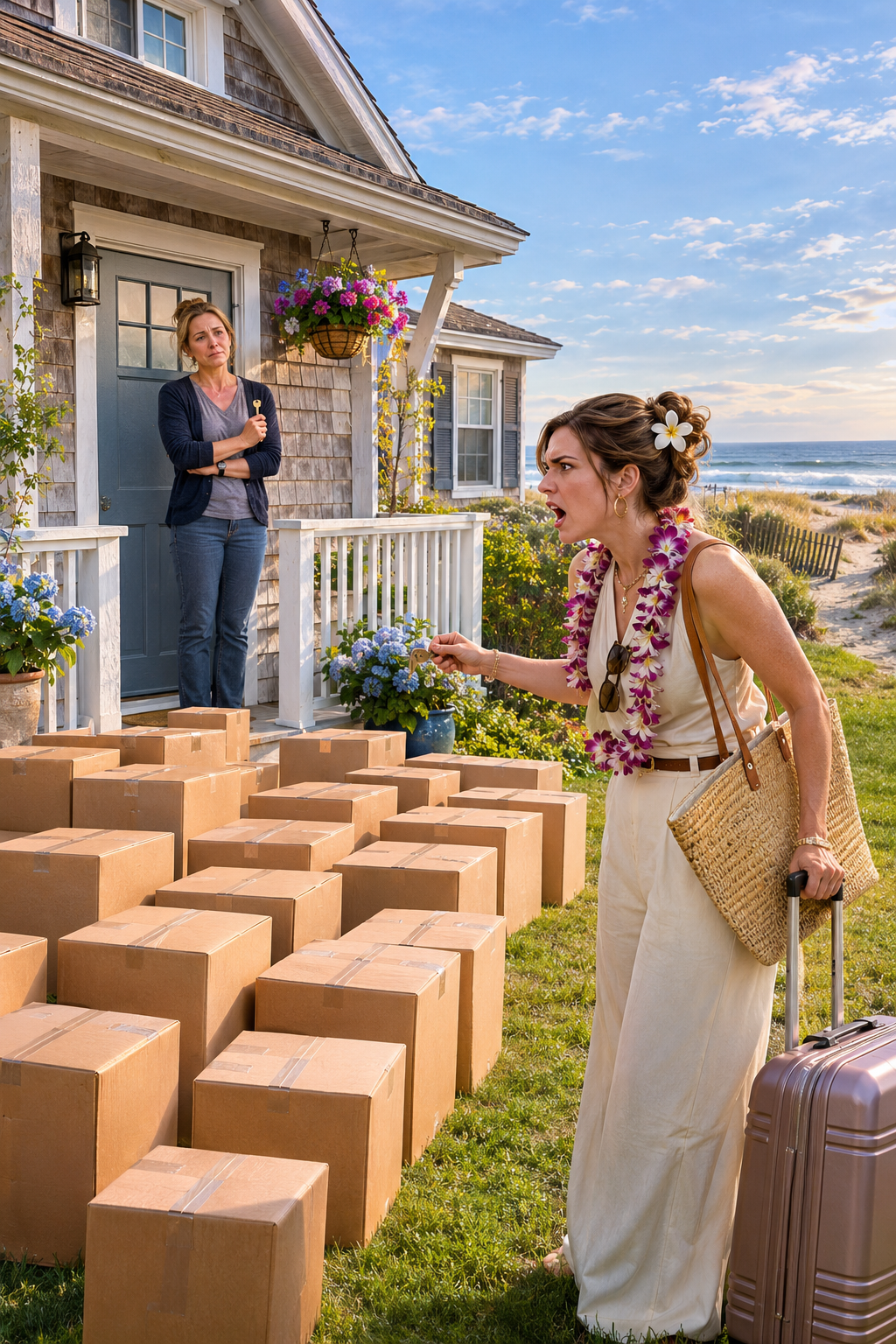
Cole and my neighbor Dennis carried the boxes out beneath a borrowed canopy. We put them on a clean groundsheet, away from the wet grass. Twenty-eight, numbered and photographed. Nothing broken. Nothing missing.
I had packed the towels I bought for Brynn into the last box.
I didn’t want to keep them.
Leah came with sandwiches nobody ate. Saira arrived at eleven-thirty, carrying a plain leather folder. Maya filled the kettle and set cups on the kitchen counter.
“You don’t have to dress up,” Cole told me when I came out of the bedroom.
“I know.”
He looked at the midnight-blue dress, then at my face.
“You look beautiful, Mom.”
I thanked him without explaining how much I had paid for it.
At twelve-forty, a black car stopped outside.
Not a long car with a driver in a uniform. An ordinary hired car with a cracked plastic sign on the dashboard.
Brynn got out first, wearing white trousers and a cream sweater, her skin warm from the sun. Grant followed with two suitcases. He was taller than he looked in photographs, his face handsome in a slightly tired way.
They saw the boxes.
Brynn stopped.
Grant said something I couldn’t hear.
She came up the path with her handbag gripped against her ribs. Without looking toward the kitchen window, she climbed the steps and put her silver key in the lock.
It wouldn’t turn.
She tried again.
Then she stepped back and called me.
I answered from the other side of the door.
“Karen, what the hell have you done?”
Her voice was so loud I could hear it twice. I had warned her in writing. She had simply never believed that one of my warnings could become something she had to live with.
“Your things are ready.”
“My things are on the lawn!”
“Under cover. As arranged.”
“Open this door.”
I ended the call.
For a moment, I rested my hand on the new deadbolt.
Cole stood beside me.
“Ready?” he asked.
I wasn’t. Not in the way people mean when they imagine fear disappearing.
But I opened the door anyway.
Brynn’s mouth fell open when she saw the dress.
Grant looked at me, then past me at Cole.
“Karen,” Brynn said, in a smaller voice.
I had imagined saying many things. Clever things. Cruel things. Sentences that would make her understand, all at once, what she had done.
When the moment came, I wanted only the truth.
“Before you ask about your boxes,” I said, “look at my son.”
She glanced at him.
“Look properly.”
Cole stepped onto the porch.
“I’m not a photograph, Aunt Brynn.”
Her face changed.
For one instant, I saw the child who used to run to him when he came home from school, delighted that there was someone in the house younger than she was.
Then she looked toward Grant.
“This isn’t the time.”
Cole gave a short, disbelieving laugh.
“When’s a good time to explain why you told people I was dead?”
Grant moved forward.
“I think we all need to lower the temperature.”
“You can start,” I said, “by stepping off my porch.”
He looked surprised.
Then he stepped down.
My mother’s car arrived before Brynn could answer. She parked badly, one wheel against the curb, and hurried up the path.
“I told you not to do anything until I got here.”
“You told a lot of people a lot of things,” Cole said.
Mom ignored him.
“Karen, take those boxes inside. The neighbors are watching.”
From across the road, Dennis raised his coffee cup.
“They certainly are,” I said.
Saira came to stand in the doorway.
“There are chairs beside the garage if you’d like to discuss the outstanding documents. Otherwise, you’re free to collect your property.”
Mom looked at her with undisguised hatred.
“This is family business.”
“It’s my client’s home,” Saira said.
I had thought I might need to bring them inside to feel strong enough to speak. Standing there, I realized I didn’t.
I didn’t have to offer tea to every person who hurt me.
We moved to the chairs beneath the canopy.
I remained standing.
Grant began with the expression of a man reluctantly taking control of a room full of unreasonable people.
“I’ve been misled, too,” he said. “I understood Brynn had inherited the property. Then Diane told me there were complications because her sister had survived but wasn’t in a position to handle her affairs.”
“You told me you found out I was alive last Wednesday.”
His jaw tightened.
“The details were confused.”
“You were very clear on the telephone.”
Brynn turned to him.
“You said you didn’t know.”
“I didn’t know what to believe.”
Saira opened her folder.
“We can establish some dates. The private property inquiry began six weeks before the wedding. The authorization submitted with it used Karen Mercer’s name and a purported current signature. You supplied the broker with Diane’s contact information.”
“I trusted the family.”
“You also applied for financing dependent on proceeds from this property.”
“A preliminary application. Nothing improper about exploring options.”
I looked at Brynn.
“Did you know about selling the cottage?”
She was staring at her hands.
“Brynn.”
“It wasn’t going to happen like that.”
“How was it going to happen?”
“Grant said the house needed too much work. We were going to sell it and buy something better. You could have had a little place closer to work.”
My mother nodded, almost eagerly.
“Exactly. You wouldn’t have had the maintenance. We were thinking of you.”
The sea moved behind the dunes. Somewhere in the house, the kettle clicked off.
“You chose my next home,” I said.
“Only as an idea,” Brynn whispered.
“You chose what I could keep. You decided I didn’t need my husband’s chair. You told people my son was dead. And you were going to tell me it was kindness.”
She began to cry.
My body reacted before my mind did. I wanted to step forward. Find a tissue. Tell her we could sort it out.
Cole’s hand touched the back of my arm.
I stayed where I was.
“I’m your sister,” she said.
“Yes.”
“Doesn’t that mean anything?”
“It meant so much that I never thought to check what you were doing with it.”
A white van turned into the street.
Grant looked up sharply.
The woman who got out wore dark trousers, practical shoes, and a brown coat with one cuff neatly mended. She carried a canvas bag and walked as if her knees hurt.
I recognized her from the wedding photograph.
Front row. Navy jacket. Pearls.
The woman Brynn had called Mrs. Thorne of the Thorne estate.
“Mom?” Grant said.
Rosa looked at him, then at Cole.
Her eyes filled.
“You have your mother’s smile,” she told my son.
Brynn straightened, wiping quickly beneath her eyes.
“Rosa, I’m so sorry you have to see this. There’s been a terrible—”
“I know,” Rosa said.
She set her bag on an empty chair.
Grant stood.
“We should talk privately.”
“We’ve done a great deal privately.”
Her voice wasn’t loud. It stopped him anyway.
Brynn looked between them.
“I don’t understand.”
Rosa drew a breath.
“Neither did I, until Ms. Patel called the estate office.”
My mother folded her arms.
“Perhaps your family can explain why your son started a property transaction without the money he promised.”
Rosa turned to her.
“What money?”
Brynn gave a nervous laugh.
“The trust distribution. The delay with the trustees.”
Rosa looked at Grant.
He said, “Don’t.”
Just that.
One word, stripped of charm.
Rosa’s face crumpled for a moment. She put a hand against the chair until it steadied.
Then she looked at Brynn.
“There is no trust distribution,” she said. “My son doesn’t own the Thorne estate. He worked there.”
Nobody moved.
Brynn blinked as though a bright light had struck her eyes.
“What?”
“His grandfather was related to the family that owned it once. A distant relation. The property was sold before Grant was born. It’s an events venue now. You rented it.”
“No.”
“I worked in its laundry for thirty-eight years. His father maintained the grounds. Grant worked in bookings and event sales.”
The wind lifted the corner of the groundsheet.
Cole bent and weighted it with an empty flowerpot.
Such a small, ordinary action. I remembered it afterward because everything else felt impossible.
Brynn turned to Grant.
“The people at our wedding.”
He looked toward the hired car, whose driver had long since left.
“Friends,” Rosa said. “Colleagues. People who have known him for years.”
“You said they were your family’s people.”
“They are my people,” Grant snapped.
It was the first honest thing I had heard him say.
My mother sat down so suddenly the folding chair creaked.
Brynn shook her head.
“The cars. The boat.”
Rosa closed her eyes.
“Photographs taken at events.”
“Your pearls.”
Rosa touched her bare throat.
“Borrowed. Grant said I should look a certain way. I thought he was ashamed of me.”
Her voice broke.
“He told me your family was wealthy. That you were giving him a home. That your sister had died and you’d been left with more than you knew how to manage.”
Brynn stared at her.
I watched the understanding move through my sister’s face.
Slowly.
Terribly.
She had married him for the fortune he didn’t have. He had married her for the house she didn’t own.
And between them, they had chosen my life to pay the difference.
For a moment, all I could hear was the canopy snapping in the wind.
Then Brynn said, “You lied to me.”
Grant laughed once, without humor.
“That’s an interesting complaint coming from you.”
“You made me believe—”
“You made me believe your sister was dead.”
“You knew she wasn’t!”
“Eventually.”
He turned to my mother.
“Tell her. Tell her how this actually happened.”
Mom’s face had lost its color.
“I was trying to keep things from falling apart.”
“You told me Karen would agree,” he said. “You said she always agreed.”
Those words landed harder than the slap.
My mother had sold a stranger my willingness.
Not my signature, at first. Not my house.
The old, familiar certainty that if she pushed long enough, I would eventually make room.
“You said we could adapt the paperwork,” Mom shot back. “You told me it was just a formality until Karen came around.”
Saira looked at her.
“Diane, I suggest you get independent legal advice before you say anything further.”
But Mom was already pulling out her phone.
She had spent so many years winning arguments by producing the version that suited her that she hadn’t recognized the kind of argument we were having now.
“Here,” she said, jabbing the screen. “Here. Tell me you didn’t write this.”
Grant reached for the phone.
She pulled it away.
“Don’t you dare put this all on me.”
She read aloud, her voice rising.
“‘If Karen is still the registered owner, we’ll need the authorization updated before a buyer can proceed. Keep her away from the wedding. The memorial will stop the questions, and we can resolve the property afterward.’”
Brynn looked ill.
“You suggested the memorial?”
Grant said nothing.
“You cried in front of it.”
He looked at her with naked impatience.
“Your mother told me you’d already said they were dead. I was trying to make the story hold together.”
I remembered the message from Maui.
He cried. He won’t ask about them again.
He hadn’t needed to ask.
He had known.
The man my sister had been protecting from the truth had been helping arrange the lie.
Rosa sat down, her hands folded tightly in her lap.
Nobody looked grand now. Nobody looked like old money. They looked like three people who had each mistaken another person’s greed for a guarantee.
“Karen,” my mother whispered.
I waited.
She glanced at Saira, then at the house.
“We can still sort this out.”
“No,” I said. “You can answer for it.”
Brynn stepped toward me.
“I didn’t know about all of it.”
“You knew about enough.”
“I thought once the money came through, I’d make it right.”
“You cannot buy back what you did to Cole.”
She turned to him.
“I’m sorry.”
He looked at her for a long time.
“I believe you’re sorry this happened,” he said. “I don’t know yet if you’re sorry you did it.”
She had no answer.
Grant picked up a suitcase.
“We’ll need somewhere to stay.”
Nobody spoke.
He looked at Rosa.
She shook her head.
“I have one room. You’ve known that all your life.”
Then he looked at me.
It was astonishing, really. The endurance of expectation.
“No,” I said.
Just one word.
No explanation tucked behind it. No promise to help find a motel. No money slipped into a palm so I could stop feeling the weight of someone else’s disappointment.
Grant wheeled his suitcase down the path.
Brynn stayed beside the boxes until Mom stood and began making calls.
Eventually, another car came. Then a rental van. The boxes went into it, one after another, while Dennis checked off the numbers.
Rosa found the borrowed linens and a silver frame among the wedding decorations.
Not the memorial frame. Another one, empty.
She held it for a moment, then put it in her bag.
Before Brynn left, she stopped at the bottom of the steps.
“Did you really have to wear the dress?”
I looked down at the blue fabric moving against my knees.
“I bought it for a day when I thought my family would be happy to see me.”
Her face twisted.
“Karen—”
“They are,” I said.
Behind me, Cole opened the door.
I went inside.
There was no instant justice.
I wish I could tell you the police arrived as the last box entered the van, or that the clouds split open and delivered exactly the punishment each person deserved.
What came instead were appointments. Statements. Requests for documents I had already supplied. Weeks in which nothing seemed to happen, followed by one telephone call that left me shaking for the rest of the day.
Saira kept copies of everything.
The property never changed hands. No lender advanced money against it. Those facts mattered more to me than any dramatic scene could have.
My mother eventually admitted her part in the altered documents. The messages she had preserved to protect herself made it difficult for Grant to deny his involvement. There were other financial questions around him, other people waiting for money, other promises that had looked substantial only from a distance.
I learned the outcome of each matter through Saira. I stopped trying to supervise the consequences. That had been another form of taking care of them.
Brynn left Grant before the month ended.
She called it a betrayal when she spoke to Anna.
Anna asked which one.
I wasn’t there to hear it, but I loved my cousin for asking.
By winter, my mother and sister were sharing a two-bedroom apartment outside Portland. For the first time in years, their bills arrived at an address that wasn’t mine, and I didn’t help pay them.
My mother sent a letter saying she hoped I would remember the sacrifices she had made.
I put it in a drawer.
Brynn sent three apologies before she wrote one without the words but, pressure, or you have to understand.
I answered that one.
I read your letter. I’m glad you’re beginning to understand. I’m not ready to see you.
She didn’t like it.
I survived her not liking it.
That, too, was new.
Irene died on a Thursday morning in November.
Her daughter was there, holding one hand. I held the other because Irene had made me promise not to let anybody fuss with her blankets at the end.
Afterward, her daughter asked whether she had been afraid.
“She knew you were here,” I said.
It wasn’t the same answer. It was the one I could give honestly.
I drove home in the rain and sat in Eli’s chair without turning on the lights.
There were people I could not keep. There were people I could not change. Loving them didn’t grant me either power.
For most of my life, I had treated that as a failure.
That evening, it felt like a fact I might finally learn to live beside.
Rosa came for dinner the following Sunday.
She brought a lemon cake in a tin with one loose hinge and asked if she should take her shoes off.
I told her to do whatever made her comfortable.
We spoke about work. About bad knees. About the peculiar tricks grief played with shopping lists.
After a while, she said, “I keep thinking I should have known.”
“So do I.”
“It’s different. He’s my son.”
I looked toward the photograph of Cole on the mantel.
“Yes,” I said. “I know it’s different.”
I didn’t tell her to stop loving Grant. I didn’t tell her that caring for him required letting him use her.
She came back the next month. Then again.
Some friendships begin because you have everything in common. Ours began because we had both stood on a lawn and discovered that someone we loved had made a costume of our lives.
We found other things to talk about eventually.
In April, Cole and Maya invited me to lunch at their duplex.
The drawer still stuck.
There were herbs on the windowsill, two bicycles in the hallway, and a rug Maya insisted was red while Cole maintained it was orange.
After we ate, he slid a cream envelope across the table.
Inside was an invitation.
Their names. A date in June. A small garden ceremony at a friend’s house.
Below the details, Maya had written something by hand.
Karen Mercer, mother of the groom. Front row. No excuses.
I laughed, then cried, which embarrassed neither of them.
Cole came around the table and kissed the top of my head.
“Will you wear the blue dress?”
“Are you sure?”
“I like that dress.”
Maya reached for my hand.
“So do I.”
In June, I wore it beneath an apple tree while my son married a woman who looked at him as though being known was something to welcome.
Leah sat beside me. Rosa sat on my other side.
Nobody asked me to make myself smaller.
When Cole walked toward us after the ceremony, I saw Eli for a moment in the tilt of his smile. It hurt, and it made me happy, and I was learning that a heart could hold both without breaking all over again.
At home that evening, I hung the dress carefully in my closet.
The house smelled of salt air and the cake Leah had insisted I bring back. Eli’s chair stood beside the window. The little table was where it had always been.
My phone lit up with a photograph from Maya.
Cole and I beneath the apple tree, his arm around my shoulders, my hair blowing across my mouth.
For a moment, I couldn’t breathe.
Then I read the message.
My two favorite Mercers. Very much here.
I saved the photograph.
Outside, the wind rose. I went to the front door and turned the new brass lock.
For years, I had thought a locked door meant someone was being abandoned on the other side.
That night, I rested my palm against the wood and listened to my own quiet house.
At last, I understood that I was allowed to be the person it protected.

