
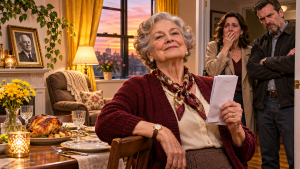
Six months after my husband died, my daughter asked my whole $1,380 pension for her garage apartment. “Plus you’d pick up the kids and cook supper. That’s only fair,” her husband said. They had it typed up for me to sign. I folded that paper into my purse and said I’d pray on it. Two weeks later, I invited them to supper at my new place, and when my daughter walked in,
Stephanie walked in, looked around at my yellow curtains and my new recliner and the window full of sunset.
Then she stopped so suddenly that Brett nearly walked into her.
“Mama?”
I smiled.
“Come on in, honey. Supper’s almost ready.”
She didn’t move.
Her eyes traveled across the room, taking in the polished wooden floors, the little dining table set for three, and the bookshelf beneath the window.
Then she noticed something sitting on the mantel.
Calvin’s old photograph.
The one taken when he was thirty-two, standing beside his favorite horse with his hat tipped back and that crooked smile I had fallen in love with.
Stephanie’s voice changed.
“How did you get all this here?”
“Wynell helped me.”
“Wynell from the diner?”
“The very same.”
Brett set the box of dishes on my kitchen counter.
He looked less impressed than suspicious.
“How much is this costing you?”
I removed the pot roast from the oven.
“Six hundred and fifty dollars a month.”
He blinked.
“That’s impossible.”
“Not according to the lease I signed.”
“Two bedrooms for six hundred and fifty?”
“Upstairs from an old diner isn’t everybody’s idea of luxury, Brett.”
I placed the roast on the counter.
“But I like it.”
Stephanie walked toward the window.
From there, you could see the highway, the distant grain elevators, and the low hills where the sun was settling into the evening.
“Mama, you can’t live above a restaurant.”
“Why not?”
“Because you’re seventy-one!”
I looked at her.
“I was seventy-one when you offered me a garage apartment with a hot plate.”
She opened her mouth.
Then closed it.
Brett cleared his throat.
“Well, this is certainly unexpected.”
I smiled.
“Most good things are.”
He glanced at Stephanie.
“Delia, I think there’s been a misunderstanding. We weren’t trying to make you uncomfortable.”
“Of course not.”
“We were offering security.”
I set the carving knife beside the roast.
“For thirteen hundred and eighty dollars.”
He shifted his weight.
“That’s a fair market rate.”
“With five afternoons of childcare and five suppers included?”
“Those were family contributions.”
I turned toward him.
“Then the rent should have reflected them.”
He didn’t answer.
Stephanie pulled out a chair.
“Mama, we were trying to keep you close.”
I looked at my daughter.
That was the sentence I’d been waiting for.
“Then why was my name already typed on a lease before you asked what I wanted?”
Her cheeks reddened.
Brett stepped forward.
“Look, we didn’t come here to argue.”
“Neither did I. I cooked supper.”
I carried the pot roast to the table.
And for the first time in my seventy-one years, I didn’t feel obligated to make everyone comfortable before I sat down.
We ate in silence for several minutes.
The roast was tender.
The potatoes were buttery.
And Wynell’s pecan pie sat waiting beneath a clean dish towel.
Stephanie barely touched her food.
Finally, she looked at the envelope beside her plate.
“What’s this?”
“Something I wanted you to have.”
She opened it.
Inside was a copy of the lease Brett had handed me.
Across the bottom, in my own handwriting, I’d written:
DECLINED.
Below it was a second sheet.
An itemized estimate.
Stephanie frowned.
“What is this?”
“Just something I worked out.”
Brett leaned over her shoulder.
The first line read:
Garage apartment rent: $1,380 per month.
The second:
School pickup and after-school supervision, twenty hours weekly: $1,200 per month.
The third:
Weeknight dinner preparation, including cleanup: $600 per month.
Then I had written a total.
$3,180 in monthly housing charges and labor value, before groceries or transportation costs.
Stephanie stared at the numbers.
“You’re charging us to see your grandchildren?”
“No, honey. I’m showing you what you expected me to give away.”
Brett laughed sharply.
“Those numbers are ridiculous.”
“Maybe so. I called two local childcare providers and a meal-preparation service to get an idea of what the work would cost.”
I folded my napkin.
“You wanted every dollar of my pension and most of my weekdays. I just wanted you to see what you were actually asking.”
Stephanie looked down.
“We wouldn’t have made you work that hard.”
“Then why did Brett include the school schedule in the lease?”
Her eyes moved toward her husband.
He stared at his plate.
I continued.
“Tuesday and Thursday soccer practice. Wednesday music lessons. Dinner by six thirty. And a note saying weekend babysitting would be arranged as needed.”
Stephanie blinked.
“You put weekend babysitting in there?”
Brett shifted.
“It was a draft.”
She turned toward him.
“You told me Mama could decide whether she wanted to help on weekends.”
He cleared his throat.
“Stephanie, we can discuss that later.”
I watched my daughter carefully.
For the first time that evening, she wasn’t looking at me like an old woman who needed managing.
She was looking at the document her husband had prepared.
And realizing she hadn’t understood all of it.
I took a sip of sweet tea.
“There’s something else you ought to know.”
Brett sighed.
“Now what?”
I looked directly at him.
“I don’t need anyone to support me financially.”
He gave a small, dismissive laugh.
“Delia, with all due respect, thirteen hundred and eighty dollars doesn’t go very far.”
“That’s true.”
I reached into my purse.
Then I placed a small bank envelope beside my plate.
“But Calvin and I didn’t spend forty-two years putting money away just to hand our retirement over to somebody else.”
Stephanie stared at the envelope.
“What money?”
I smiled sadly.
“Your daddy’s coffee cans.”
The room went quiet.
Stephanie knew about those coffee cans.
When she was little, Calvin kept an old Folgers tin on top of the refrigerator.
He dropped spare change inside it every evening.
Sometimes a dollar.
Sometimes five.
Sometimes a twenty if he’d received extra pay for helping with a difficult calving season.
Stephanie used to shake the can and beg him to let her count the coins.
He always laughed.
“One day, honey, this is going to buy your mama something pretty.”
What she didn’t know was that the coffee can had eventually become a running joke between us.
Calvin would come home from selling a calf he’d raised with the ranch owner’s permission and announce that he’d found another fifty dollars for the coffee can.
Sometimes the amount was five hundred.
Sometimes two thousand.
Over the years, the ranch owners paid him bonuses for keeping cattle losses low and managing difficult seasons.
I also worked whenever I could.
I cleaned houses.
Waited tables.
Sold homemade preserves at the county fair.
For fourteen years, I kept books part-time for a local feed store.
We didn’t have much, but we saved.
And when Calvin suggested keeping cash in coffee cans forever, I insisted on moving it into the bank.
Later, a financial adviser helped us organize the accounts.
We never talked about the total with our children.
Not because we didn’t trust them.
Because Calvin had watched too many families fall apart when money became an expectation instead of a gift.
I opened the envelope.
Inside was a recent account summary.
I turned it toward Stephanie.
She read the first line.
Then the second.
Then she looked at me.
“Mama…”
Brett leaned forward.
His eyes widened.
The balance was $286,417.63.
That wasn’t all the money we’d ever saved, and it wasn’t some miraculous fortune.
But it was enough.
Enough to live modestly.
Enough to handle emergencies.
Enough that I didn’t have to surrender my pension for a bedroom above somebody else’s garage.
Stephanie put a hand over her mouth.
“Daddy saved all this?”
“We saved it,” I said gently.
Brett reached for the statement.
I slid it back into my envelope.
“That information isn’t for anybody to manage but me.”
He leaned away.
“I wasn’t going to—”
“I know, Brett.”
I looked at both of them.
“And I don’t intend to discuss my exact finances again.”
Stephanie’s eyes filled with tears.
“Why didn’t you tell us?”
I thought about Calvin.
The way he’d come home dusty and exhausted, empty his pockets into a little metal can, and kiss my forehead before washing up for supper.
“Because your daddy wanted us to have something that belonged to us.”
Brett cleared his throat.
“Well, if that’s the case, you could probably buy a place outright.”
“I could.”
“Then why rent?”
“Because I haven’t decided where I want to spend the rest of my life.”
That seemed to confuse him more than the money.
He stared at me.
“You don’t have a plan?”
I smiled.
“For once, I don’t need to have everything figured out before I enjoy it.”
Stephanie began crying.
Not loudly.
Just little tears slipping down her cheeks.
“I thought you were scared, Mama.”
“I was.”
“Then why didn’t you come to me?”
“I did, honey. I came to you six months after your daddy died. And you handed me a lease that left me nothing to live on.”
She looked at the paper.
Then at Brett.
And finally at me.
“I didn’t think of it that way.”
“I know.”
That was the saddest part.
I believed her.
She hadn’t thought about what would happen if I needed new shoes.
Or a prescription.
Or a visit to the dentist.
Or simply a little money to buy myself lunch without asking anyone’s permission.
She had looked at my entire monthly income and seen a convenient solution to her household problems.
Not a seventy-one-year-old widow who still had a life to live.
Brett pushed his plate away.
“I think you’re being unfair.”
I set down my fork.
“Which part?”
“We offered you a home.”
“For my whole pension.”
“You’d be near family.”
“And working for that privilege.”
He crossed his arms.
“You make it sound like we were taking advantage of you.”
I looked at him for a long moment.
Then said, “Brett, if you weren’t my daughter’s husband, what would you call a landlord who charged an elderly tenant her entire income and required her to provide unpaid childcare and cooking?”
He didn’t answer.
Stephanie stared at her napkin.
Finally, Brett stood.
“I think we should go.”
I nodded.
“There’s pie if you’d like some before you leave.”
He looked offended that I wasn’t upset.
Stephanie remained seated.
“Brett, go warm up the car.”
He turned toward her.
“What?”
“I want to talk to Mama.”
He hesitated.
Then grabbed his jacket and left.
I heard his footsteps on the outside stairs.
The front door closed.
For a few seconds, Stephanie and I sat quietly.
Then she whispered, “Did you really think I wanted to take all your money?”
I looked at my daughter.
The little girl I’d taught to braid her hair.
The teenager I’d helped through heartbreak.
The young woman who had cried against my shoulder on her wedding morning.
“I think you wanted a solution that was easy for you,” I said. “And you forgot to ask whether it would be good for me.”
She wiped her eyes.
“Brett said you’d be lonely if you stayed by yourself.”
“Sometimes I am lonely.”
Her expression softened.
“Then come live with us. We can change the agreement.”
I reached across the table and took her hand.
“Stephanie, loneliness isn’t the same thing as helplessness.”
She started crying harder.
“I just don’t want something to happen to you.”
“Then call me. Visit me. Have lunch with me. Ask me how I’m feeling.”
I squeezed her hand.
“But don’t take away my independence and call it protection.”
She looked toward the window.
The highway lights were beginning to glow beneath the darkening sky.
After a while, she said, “Daddy would have loved this place.”
I smiled.
“He would have complained about the stairs.”
She laughed through her tears.
“He certainly would.”
“And then he would have sat by that window for three hours watching trucks go by.”
We both laughed.
For a moment, I could almost hear him.
Then Stephanie reached across the table and hugged me.
Not because she needed anything.
Just because she wanted to.
I hadn’t realized how much I’d missed that.
The next morning, Brett called.
I was having coffee downstairs at the diner with Wynell.
He didn’t bother with good morning.
“Delia, I think we ought to revisit our arrangement.”
“There isn’t an arrangement, Brett.”
“Well, Stephanie’s upset.”
“I’m sorry to hear that.”
“She feels you think we’re trying to exploit you.”
I looked at Wynell, who was polishing the same clean coffee mug for the third time.
“Is that what she said?”
“Something like that.”
I waited.
Then he added, “Look, now that we know you’re financially comfortable, perhaps we could work out something more practical.”
There it was.
I had been waiting for that sentence.
“What did you have in mind?”
“Well, the garage apartment needs some work. We were thinking maybe you could help us pay to renovate it, and then we could reduce your rent.”
I nearly laughed.
“You want me to pay to renovate your garage?”
“It would benefit everyone.”
“Brett, I already have a home.”
“It’s a rented apartment above a diner.”
“And I’m perfectly happy here.”
He sighed.
“You’re being stubborn.”
I looked toward the window.
A delivery truck was pulling into the parking lot.
Wynell was cutting a slice of lemon pie for a customer.
The whole world seemed wonderfully ordinary.
“Maybe I am,” I said.
Then I ended the call.
Wynell leaned across the counter.
“What did Mr. Insurance Salesman want?”
“To improve his garage with my money.”
She put down the coffee mug.
“Well, bless his little calculating heart.”
I laughed so hard I nearly spilled my coffee.
It felt good to laugh.
Calvin had been gone six months, and there were still mornings when I woke up reaching for the space beside me.
But there were also mornings when the sun came through my yellow curtains and I felt something I hadn’t expected to feel again.
Curiosity.
About tomorrow.
About next week.
About the places I’d never seen.
About who I might become now that the ranch no longer determined where I lived.
I was beginning to understand that grief and possibility could exist together.
A week later, I visited the ranch to collect the last of my belongings.
The new foreman, a young man named Daniel, helped carry boxes to my truck.
He’d worked under Calvin for eight years.
Before I left, he handed me an envelope.
“Mr. Whitcomb asked me to give you this.”
Mr. Whitcomb owned the ranch.
He was eighty-two and had known Calvin since they were boys.
Inside the envelope was a handwritten letter.
“Dear Delia,
Calvin gave this ranch forty-two good years. He kept it standing through drought, storms, and years when the cattle market nearly broke us. You stood beside him through all of it.
I’ve been thinking about what I can do to honor that.
There’s a small cottage on the east side of the property. It hasn’t been occupied in years. If you’d like to live there, I’d be happy to arrange a modest lease.
There’s no obligation. I simply wanted you to know the door is open.
With gratitude,
Walter Whitcomb.”
I stood beside my truck reading the letter twice.
The cottage.
I knew it well.
It sat near a cottonwood grove, overlooking the creek where Calvin used to take Stephanie fishing.
It had two bedrooms, a screened porch, and a little patch of land where someone had once planted roses.
Years earlier, I’d told Calvin it was the prettiest place on the ranch.
He’d laughed.
“Maybe when I retire, we’ll ask Walter if he’ll let us rent it.”
But Calvin never retired.
There was always another fence to repair.
Another calving season.
Another winter storm.
And then his health began failing.
I folded the letter carefully.
For the first time since his death, I felt a little excited about something that connected me to the ranch without requiring me to work for it.
I called Mr. Whitcomb that afternoon.
“Walter, this is Delia.”
His voice brightened.
“Delia Mae! Did Daniel give you my letter?”
“He did.”
“Good. What do you think?”
I took a breath.
“I’d like to see the cottage.”
He chuckled.
“Then let’s go have a look.”
The cottage needed work.
The porch railing was loose.
The kitchen cabinets were old.
One bedroom smelled like cedar and dust.
But the windows faced the creek.
And when I stepped onto the screened porch, I knew.
I could imagine myself drinking coffee there.
Growing tomatoes.
Watching deer move through the cottonwoods.
Living quietly without feeling trapped.
Walter stood beside me.
“I can have the place fixed up by spring.”
I looked at him.
“What would you charge?”
He named a figure considerably lower than most rentals in the county.
I smiled.
“Walter, I don’t want charity.”
He shook his head.
“It’s not charity, Delia. It’s a business arrangement, and I’d rather have someone living here who appreciates the place.”
We discussed maintenance, utilities, repairs, and the length of the lease.
I told him I wanted everything written down properly.
He laughed.
“Calvin always said you were the sensible one.”
I smiled.
“He said a lot of things.”
Walter became serious.
“Delia, your husband was a good man. But I also know you gave up plenty living out here. You don’t owe this ranch another forty years.”
I looked toward the creek.
“I know.”
He nodded.
“Then don’t make your decision because of Calvin. Make it because of what you want.”
I thought about that all the way back to town.
Over the next few months, I discovered I enjoyed having choices.
Imagine that.
At seventy-one.
I took a watercolor class at the library.
I joined a Wednesday morning walking group.
I went to a Christmas concert with Wynell and wore a red coat Calvin had always said was too bright.
I even bought a little used Honda sedan.
Nothing fancy.
Just something I could park easily and drive without climbing into the ranch truck.
I named her Ruby.
Wynell said I’d lost my mind.
Then asked if she could borrow Ruby to go shopping in Amarillo.
We laughed like girls again.
Some afternoons, Stephanie stopped by the diner.
At first, she came with a reason.
A school schedule.
A question about Christmas.
A request for one of Calvin’s old tools.
But eventually, she started coming just to visit.
One Thursday, she sat across from me with two cups of coffee.
“Mama, can I tell you something?”
“Of course.”
She twisted her wedding ring.
“Brett was counting on your pension.”
I set down my cup.
“I suspected that.”
“He told me if you moved in, we’d finally have enough money to pay down our credit cards.”
I looked at her.
“And you agreed?”
She nodded slowly.
“I thought it was temporary. I thought we’d take care of you, and you’d help us.”
“Stephanie, there is nothing wrong with family helping family.”
She looked up.
“But there is something wrong when one person doesn’t get a choice.”
Tears filled her eyes.
“I know.”
She reached into her purse and pulled out a folded piece of paper.
It was the original lease.
The one with my name typed at the top.
“I found another copy in Brett’s desk.”
I watched her unfold it.
“He’d written notes in the margins.”
She showed me.
Beside the rent amount, Brett had written:
GUARANTEED MONTHLY INCOME.
Beside the childcare schedule:
SAVINGS — AFTER-SCHOOL PROGRAM.
Beside the meal-preparation requirement:
REDUCE TAKEOUT COSTS.
My stomach tightened.
He hadn’t been planning a home for me.
He’d been building a household budget around my existence.
Stephanie wiped her cheeks.
“I didn’t know he’d calculated everything like this.”
I looked at her for a long moment.
Then said, “Honey, a marriage is something you have to manage from the inside. I’m not going to tell you what to do about Brett.”
She nodded.
“But I will tell you this. Don’t let anybody convince you that the people you love are just numbers on a spreadsheet.”
She began crying.
I moved beside her and put my arm around her shoulders.
For once, I wasn’t rescuing her.
I was simply being her mother.
By February, Stephanie and Brett had started working with a financial counselor.
They sold their second vehicle.
Cut back on unnecessary spending.
And found a tenant for the garage apartment.
A young schoolteacher named Melissa moved in.
She paid nine hundred dollars a month.
No childcare.
No cooking.
No school pickups.
No unpaid labor.
When Stephanie told me, I raised an eyebrow.
“Nine hundred?”
She looked embarrassed.
“That’s what the rental agent said was reasonable for the space.”
I smiled.
“Imagine that.”
She laughed.
Then she reached across the table and squeezed my hand.
“You were right, Mama.”
I didn’t say I told you so.
I didn’t need to.
In March, the cottage was ready.
But I faced a decision.
I loved my apartment above the diner.
I loved listening to the breakfast crowd downstairs.
I loved knowing Wynell was only a flight of stairs away.
And I loved the freedom of living in town.
The cottage offered something different.
Quiet.
Space.
Memories.
A garden.
A place where I could watch the seasons change.
For two weeks, I went back and forth.
Then Wynell sat me down.
“Delia Mae, you’re acting like choosing one means losing the other forever.”
I looked at her.
“Doesn’t it?”
She laughed.
“Lord, woman. You’ve got money, a car, and enough sense to run a cattle auction. Why not rent the cottage for a year and see how you like it?”
I blinked.
I hadn’t thought of that.
For forty-two years, every decision I’d made had seemed permanent.
Calvin’s job determined our home.
The ranch determined our schedule.
The cattle determined our vacations.
I had forgotten that sometimes a person could simply try something.
So I did.
I thanked Wynell for giving me my first real home of my own.
I moved into the cottage in April.
And I promised to come to the diner every Thursday for coffee.
Wynell said I’d better.
Otherwise, she’d charge me for all the advice.
The first morning in the cottage, I woke before sunrise.
Old habits.
For a moment, I expected Calvin to be beside me.
I almost called his name.
Then I remembered.
The room was quiet.
The curtains moved gently in the breeze.
Outside, a bird sang somewhere near the creek.
I lay there for a long time.
Missing him.
Missing the sound of his boots on the porch.
Missing his terrible jokes.
Missing the way he always left his hat on the kitchen chair.
But I didn’t feel lost.
Not anymore.
I got up.
Made coffee.
Carried it to the screened porch.
And watched the sun rise over the cottonwoods.
For the first time in years, the morning belonged entirely to me.
No breakfast to prepare for a ranch crew.
No schedule to follow.
No cattle to worry about.
No one waiting for me to prove my usefulness.
Just Delia.
And the sunlight.
And a life I had almost forgotten I was allowed to enjoy.
That summer, my grandchildren came to visit.
Not because their parents needed free childcare.
Because I invited them.
I taught my granddaughter how to make biscuits.
My grandson helped me plant tomatoes.
We walked along the creek and watched dragonflies hover over the water.
One afternoon, my granddaughter asked why I hadn’t moved into their garage.
I considered my answer.
Then I said, “Because Grandma needed a home that was hers.”
She looked confused.
“But you could have lived with us.”
“I could have.”
“Didn’t you want to?”
I smiled.
“I love you very much. But grown-ups need to make choices about where they live, just like children need choices about what games they play.”
She thought about that.
Then nodded.
“I’m glad you live here. You have better cookies.”
I laughed.
“Well, that’s something.”
That evening, Stephanie came to pick them up.
She stood on the porch watching the children chase fireflies.
“You look happy, Mama.”
I smiled.
“I am.”
She put her arm around me.
“Daddy would have loved seeing you here.”
I looked toward the creek.
“I think so too.”
Then she said something that stayed with me.
“I don’t think I realized you had dreams of your own.”
I turned toward her.
“Neither did I, honey. Not for a long time.”
On the first anniversary of Calvin’s death, I visited his grave.
I brought yellow wildflowers from the field near the cottage.
He’d always liked yellow.
Said it reminded him of summer.
I sat beside the headstone and talked to him.
Told him about Ruby.
About Wynell.
About the cottage.
About the watercolor painting I’d made of the creek.
I told him Stephanie was doing better.
That the grandchildren were growing too fast.
That I had learned how to use the banking app Brett assumed was beyond me.
I laughed at that.
Then I cried.
Because forty-two years is a long time to love somebody.
And even when the marriage was difficult, even when the work was exhausting, even when the years blurred together, there were things I missed so much it hurt.
Before leaving, I touched his name on the stone.
“You took care of us the best way you knew how,” I whispered.
“And I took care of you.”
I stood slowly.
“Now I’m going to take care of me.”
That Christmas, Stephanie invited me to dinner.
Not to cook.
Not to babysit.
Not to bring groceries.
Just to come.
When I arrived, Brett opened the door.
He looked uncomfortable.
“Delia.”
“Brett.”
He stepped aside.
“We’re glad you’re here.”
I nodded.
“Thank you.”
The house smelled of roasted turkey and cinnamon.
The grandchildren ran to hug me.
Stephanie had set the table with her good dishes.
And there, beside my plate, was a little envelope.
I looked at her.
“What’s this?”
She smiled nervously.
“Open it.”
Inside was a handwritten letter.
“Mama,
Last year, I thought taking care of you meant deciding what was best for you.
I was wrong.
You spent your whole life taking care of us, and when you finally needed room to make your own choices, I tried to take that away.
I’m sorry.
You are always welcome in our home.
Not because you can cook.
Not because you can watch the kids.
Not because you can help us pay the bills.
Just because you’re my mother.
Love,
Stephanie.”
I read it twice.
Then I folded it carefully.
My eyes were wet.
“Thank you, sweetheart.”
Brett cleared his throat.
“I owe you an apology too.”
I looked at him.
He swallowed.
“I treated your pension like income we could count on. I shouldn’t have done that.”
“No,” I said gently. “You shouldn’t have.”
He nodded.
“I was wrong.”
It wasn’t a grand speech.
But it was honest.
And sometimes that’s where change begins.
We sat down to dinner.
The children laughed.
Stephanie served the turkey.
Brett washed the dishes afterward.
And nobody asked me to do anything.
I simply sat at the table and enjoyed being part of the family.
Today, I’m seventy-two.
I still live in the cottage by the creek.
I still drive Ruby.
I still meet Wynell for coffee every Thursday.
And I still have my pension.
Every single dollar of it.
Most months, I don’t need to spend very much.
I pay my rent.
Buy groceries.
Take care of my little car.
And occasionally treat myself to something I’ve always wanted.
Last month, I bought a train ticket to New Mexico.
I’ve never been.
Always wanted to see the mountains.
Wynell says she’s coming with me.
I told her she’d better bring comfortable shoes.
People sometimes ask whether I regret not moving in with Stephanie.
Whether I should have accepted their offer because family is supposed to look after family.
I tell them something I’ve learned the hard way.
There is a difference between being cared for and being controlled.
There is a difference between helping someone and taking advantage of them.
And there is a difference between being needed and being loved.
When Brett handed me that lease, he saw an elderly widow with thirteen hundred and eighty dollars a month.
He saw a solution to his childcare problems.
He saw someone who would cook supper, drive children, and quietly surrender every dollar she received.
What he didn’t see was a woman who had spent forty-two years building a life.
A woman who knew how to work.
How to save.
How to survive.
And how to start over.
He thought I had nowhere else to go.
But I had something more valuable than a garage apartment.
I had choices.
And I finally understood that I was allowed to make them.
Sometimes I sit on my porch at sunset and think about Calvin’s coffee cans.
Those old tins were never really about money.
They were about security.
About freedom.
About having enough set aside that a person could say no when no was the right answer.
Calvin used to say he was saving for a rainy day.
Well, the rainy day came.
It came six months after we buried him, when our own daughter handed me a lease that would have taken everything I had.
But because of those coffee cans, I didn’t have to sign.
I didn’t have to beg.
I didn’t have to surrender my independence in exchange for a roof over my head.
I simply folded that paper, put it in my purse, and went looking for a different door.
And when I found one, I opened it myself.
At seventy-one, I thought I was losing the only home I’d ever known.
Instead, I discovered that home isn’t always the place where you’ve spent the most years.
Sometimes it’s the first place where nobody expects you to earn your right to stay.
Sometimes it’s a little apartment above a diner.
Sometimes it’s a cottage beside a creek.
And sometimes it’s simply the peace that comes from knowing your life still belongs to you.
My daughter thought she was giving me a place to live.
But the greatest gift I ever received was realizing I didn’t need anyone’s permission to choose one.
And every morning when I open my curtains and see the sunlight moving across the creek, I thank Calvin for those coffee cans.
Then I thank myself for having the courage not to sign.
Because I may be seventy-two.
I may be a widow.
And I may have spent forty-two years being known as Calvin’s wife.
But I’m still Delia Mae.
And believe me, I’m not finished living yet.
the end

