
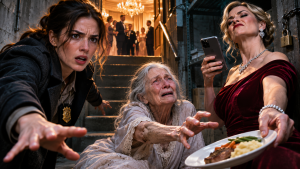
At 8:37 p.m., nearly two hundred guests were raising champagne glasses inside my father’s mansion in Pittsburgh, Pennsylvania.
They were celebrating thirty years of Bennett Holdings, praising Richard Bennett for his generosity, and congratulating him on building one of the city’s most successful family businesses.
Upstairs, a string quartet played beneath crystal chandeliers.
Downstairs, my eighty-two-year-old grandmother was begging for food.
“Please,” she whispered. “Just a little.”
I stopped halfway down the basement stairs.
Rose Bennett was sitting on the cold concrete floor in a thin nightgown. Her silver-gray hair hung loosely around her face, and her hands shook as she reached toward a white dinner plate.
My stepmother, Celeste, deliberately pulled it away.
“Again,” Celeste said, raising her smartphone. “Cry again. Let the doctors see how unstable you are.”
Grandma tried to stand.
Her knees buckled.
Celeste continued filming.
“Come on, Rose. Show everyone how crazy you’ve become.”
My grandmother began crying harder.
I had returned home early because of a telephone call I’d received that afternoon.
Grandma had sobbed my name, whispered something I couldn’t understand, and then the line had gone dead.
For weeks, my father had insisted she was receiving excellent care. He claimed her dementia had worsened and that she was becoming difficult to manage.
Now I saw a cold basement, an empty drinking glass, damp slippers, and a heavy padlock hanging from the storage-room doorframe.
There was no blanket on the chair beside her.
Grandma kept glancing at Celeste’s phone as though it were another instrument of punishment.
“Put the phone down,” I said.
Celeste spun around.
“Ava?”
Her expression changed from cruel satisfaction to irritation.
“You’re supposed to be out of town.”
I stepped between her and Grandma.
“Move away from her.”
“Don’t be ridiculous. She’s confused.”
Up close, I could see how much weight Grandma had lost. Her cheekbones stood out sharply, and the wedding ring she’d worn for more than fifty years hung loosely on her finger.
She looked at me without recognition.
“I’m sorry,” she whispered. “I didn’t mean to make a mess. Please don’t lock it again.”
Something inside me broke.
This was the woman who had stayed awake beside my bed whenever I was sick.
The woman who had packed my lunches, helped me with homework, and held me when I cried for my mother.
After Mom died, Grandma had been the one person who never made me feel unwanted.
Now she was apologizing for being hungry.
I removed my coat and wrapped it around her shoulders.
“It’s okay, Grandma. I’m here.”
Celeste grabbed my sleeve.
“She ate an hour ago,” she snapped. “You’re making a scene over nothing.”
I looked at the untouched food in her hand.
“Then you can explain that to the paramedics.”
I reached for my phone.
My father appeared before I finished giving the emergency dispatcher the address.
Richard Bennett stood at the bottom of the staircase in an expensive dark suit, looking more offended than concerned.
“Do you have any idea who’s upstairs tonight?” he demanded.
“Yes,” I answered. “And I know who’s been locked down here.”
His face darkened.
“Don’t start with me, Ava.”
“Your mother needs medical attention.”
“She needs discipline. She’s become impossible.”
I stared at him.
“She’s eighty-two. She has dementia.”
“And I’m the one paying for everything!”
He seized my wrist and pulled me toward the staircase.
I resisted long enough to tell Grandma I would be right back.
Then my father marched me into the ballroom.
The music stopped.
Nearly two hundred guests turned toward us.
A waiter froze with a silver serving tray in his hands.
My father raised his voice.
“I spent thirty-four years raising a useless daughter!”
The room fell silent.
“A poor little cop who thinks she can tell me how to run my own house!”
A few guests looked away.
Others stared openly.
Celeste hurried in behind us, arranging her face into an expression of wounded patience.
“Please forgive us,” she told the guests. “Rose has dementia. We’ve done everything possible for her. Ava simply doesn’t understand how difficult it’s become.”
I could have shouted.
I could have told everyone exactly what I’d seen in the basement.
Instead, I looked toward the waiter who had come from the kitchen and the woman standing near the staircase.
Both had witnessed part of what happened.
I spoke clearly enough for them to hear.
“My grandmother needs medical attention. Please make room for the paramedics when they arrive.”
Dad’s grip loosened.
For the first time, he appeared to notice several guests holding up their phones.
He stepped back.
“You’re embarrassing this family.”
I looked him directly in the eyes.
“No, Dad. You did that yourself.”
When the ambulance arrived, Grandma was frightened and confused.
She clung to my hand as the paramedics moved her toward the front door.
“Don’t let them take me away again,” she begged.
“I’m taking you somewhere safe,” I promised. “You’re going to the hospital.”
Behind us, Celeste leaned close to Richard.
She thought I was too far away to hear.
“The transfer is already arranged,” she whispered. “She has to be gone by morning.”
My father answered without hesitation.
“Then make sure our daughter doesn’t interfere.”
I continued walking beside Grandma’s stretcher.
I had witnessed cruelty that night.
But the terror in my grandmother’s voice told me something worse had been planned long before I came home.
At the hospital, Grandma repeatedly asked whether she would be punished for leaving the basement.
Each time, I reassured her.
“No one is taking you back there tonight.”
The physician documented dehydration, poor nutrition, and indications that her care had been neglected for longer than one evening.
I gave a detailed statement about what I’d witnessed.
A hospital social worker contacted the appropriate adult-protection authorities. Arrangements were made to keep Grandma somewhere safe while her situation was evaluated.
I was a criminal detective.
But this case involved my own family.
I knew better than to investigate it using my own police authority.
Instead, I provided the information I had and asked for an independent investigation.
Later that evening, the social worker showed me the transfer application my parents had submitted.
It named a private residential care facility.
Most of the fees had already been paid.
But not by Richard.
And not by Celeste.
The payment came from an outside company.
“Who approved this?” I asked.
“That still needs to be verified,” the social worker replied. “There are discrepancies in the family-contact information, too.”
I leaned closer.
Several details about Grandma’s living relatives were incorrect.
Then Grandma stirred.
Her thin fingers closed tightly around mine.
“They paid to take me,” she whispered.
I bent toward her.
“Who did, Grandma?”
Her eyes filled with fear.
She opened her mouth, but no answer came.
A moment later, she seemed to forget what she’d been saying.
I returned to the application.
Beneath the scheduled transfer time was a typed instruction:
Complete the move before the police-officer granddaughter returns.
I stared at the words.
Someone had known when I was coming home.
Someone had wanted Grandma removed before I arrived.
And whoever had written that instruction appeared more afraid of me than my father was willing to admit.
By morning, Richard had called eight times.
I didn’t answer.
Grandma remained under medical supervision, and the independent investigation had begun.
The company listed on the transfer paperwork was called Havenridge Care Management.
Its website showed smiling nurses, manicured gardens, and elderly residents enjoying comfortable surroundings.
Everything looked reassuring.
But investigators soon uncovered troubling details.
Several elderly people had been transferred through arrangements resembling Grandma’s.
Afterward, companies connected to Havenridge had gained control over portions of their financial affairs.
There wasn’t yet enough evidence to prove that every arrangement was fraudulent.
But there was more than enough reason to investigate.
The next discovery immediately caught my attention.
The man behind Havenridge’s financing was Graham Heller.
I knew that name.
Graham had been my father’s business partner for as long as I could remember.
At Christmas, he sent expensive gifts.
At company celebrations, he stood beside Dad like a second brother.
He was wealthy, influential, and deeply involved in several charitable organizations.
Why would he secretly pay to have my grandmother removed from her home?
I went to see my father.
Richard was in his office, sitting behind a polished mahogany desk.
He didn’t invite me to sit.
“Why is Graham paying for Grandma’s care?” I asked.
His expression changed.
“Stay out of my business, Ava.”
“Grandma isn’t your business. She’s your mother.”
“She belongs in a facility.”
“Then why didn’t you tell me about the arrangements?”
He stood abruptly.
“Because you always interfere in things you don’t understand.”
Celeste appeared in the doorway.
“Graham was only being generous,” she said.
Richard turned toward her.
“That’s enough, Celeste.”
She went silent.
They exchanged a look neither intended me to see.
I recognized it immediately.
Fear.
Not fear of losing Grandma.
Fear of what I might discover.
Later, investigators uncovered an old financial agreement between Richard and Graham.
It had been signed twenty-five years earlier.
The agreement referenced a group of accounts associated with elderly clients.
One page was missing from the archived copy.
Whatever Graham feared Grandma might remember had begun twenty-five years ago.
And that was the same year my mother died.
Grandma was having a difficult afternoon when I visited her.
She didn’t recognize me.
Instead, she sat beside the window, rubbing her hands together and whispering the same words.
“The red door. Don’t open the red door.”
I sat beside her.
“What red door, Grandma?”
She stared past my shoulder.
“Someone was crying.”
“Who was crying?”
Her breathing quickened.
“No. No, don’t open it.”
I stopped questioning her.
Dementia had already taken so much from her. I wasn’t going to frighten her into supplying an answer she couldn’t reliably remember.
But I wrote down her words.
That evening, I began examining photographs of properties Bennett Holdings had owned twenty-five years earlier.
One showed a three-story office building that had since been demolished.
At the end of its second-floor hallway stood a heavy red door.
My pulse quickened.
The room was identified in old property records as a restricted financial archive.
According to the documents, only authorized employees were permitted inside.
Richard and Graham were among those with access.
Working through the independent investigators, I located a former employee who had worked in that building.
He remembered the room immediately.
“Mr. Bennett and Mr. Heller kept that door locked,” he told us.
“Did anything unusual happen there?” I asked.
He hesitated.
“There was a woman. She discovered something in the accounting records.”
“What happened to her?”
“She argued with your father. Loud enough for several people to hear.”
He remembered her carrying a folder when she left.
She never returned to work.
“Do you remember her name?”
The man looked at me strangely.
“Miss Bennett, I assumed you already knew.”
He retrieved an old employee photograph.
My breath stopped.
Standing outside the red door was a young woman with dark hair and a familiar smile.
Laura Bennett.
My mother.
The mother I’d buried twenty-five years earlier.

