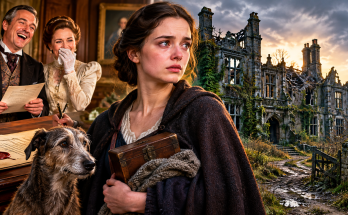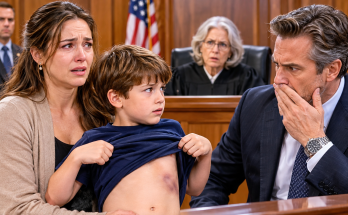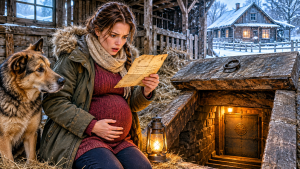
Chapter 1: The Letter From a Dead Man “TO THE ONE WHO STAYS.”
Svetlana stared at the five words written across the yellowed envelope.
For several moments, she couldn’t move.
Outside, snowflakes drifted silently past the barn’s narrow windows.
The old wooden walls creaked in the cold, and beside her,
Cossack stood perfectly still,
his reddish ears raised as though he understood that something extraordinary was about to happen.
Svetlana had spent the last several weeks wondering
whether she had made the worst decision of her life.
She had purchased this abandoned farmhouse for five
rubles because it was the only place she could afford.
She had slept beneath a leaking roof,
chopped firewood until her hands blistered,
and gone to bed hungry more nights than she wanted to admit.
All while carrying a child whose father had thrown her
out without a second thought. Now,
kneeling on the freezing floor of a forgotten barn,
she held a letter from a man who had been dead for nearly three years.
Her fingers trembled as she broke the seal.
Inside was a single sheet of paper, covered in careful,
old-fashioned handwriting. To whoever has found this letter:
If you are reading these words, the first snow has already fallen,
and you are still here.
That means you have endured what frightened away everyone before you.
Perhaps you came because you had nowhere else to go.
Perhaps the world treated you cruelly.
Perhaps you are simply stubborn enough to believe that
something abandoned can become beautiful again.
Whatever brought you here, I ask you to believe one thing.
This farm was never worthless.
And neither are the people who arrive here with nothing.
Svetlana swallowed hard.
There was something almost unbearable about reading those words.
A dead stranger had somehow offered her more kindness in
five sentences than her own husband had shown her in five years.
She continued. My name is Stepan Kovalev.
For forty-seven years, I lived on this land.
Most people believed I was a poor, eccentric farmer who had lost his mind.
I allowed them to believe it.
There are things hidden beneath this barn that greedy
people have spent years trying to find.
I have guarded them since the winter my wife died.
But I am old now, and a man cannot carry his promises into the grave.
If you wish to discover what I have left behind,
go to the third cattle stall on the eastern wall.
Beneath the feeding trough, you will find an iron ring. Pull it.
But before you do, remember this warning:
not everyone who smiles at you is your friend.
And if a man named Pavel Krestov ever comes asking about this property,
do not tell him what you have found.
He already knows more than he should.
— Stepan Kovalev Svetlana read the final lines twice. Pavel Krestov.
The name meant nothing to her.
But the warning sent an unexpected chill through her body.
She folded the letter carefully and placed it inside her coat.
Then she looked toward the eastern wall.
Three old cattle stalls stood beneath a row of dusty windows.
The third stall was half buried beneath rotting straw.
“Cossack,” she whispered. “What did your master leave here?”
The dog gave a low whine.
Then he walked directly toward the third stall. Svetlana followed.
She pulled away the straw, revealing an ancient wooden feeding trough.
It was heavy, built from thick oak boards blackened by decades of use.
She tried moving it. Nothing.
She pushed again, bracing one hand against her swollen stomach.
Pain shot through her lower back. She stopped immediately.
“Easy,” she whispered to the baby. “Mama has to be careful.”
She rested for several minutes,
then found an iron crowbar among the abandoned tools.
Using the bar as a lever, she slowly shifted the trough away from the wall.
Beneath it was a square stone slab.
And embedded in the center was a rusted iron ring.
Her heartbeat quickened.
She crouched down, wrapped both hands around the ring, and pulled.
The slab didn’t move. She pulled again.
A faint scraping sound echoed beneath the floor. On the third attempt,
the stone lifted just enough for her to slide the crowbar underneath.
She pushed down with all the strength she dared use. The slab rose.
A breath of cold, stale air escaped from the darkness below.
Beneath her feet was a narrow stone staircase descending into the earth.
Svetlana stared. This wasn’t an ordinary cellar.
Someone had deliberately concealed an entire underground entrance.
And judging by the carefully built stone walls, it had been there for decades.
Cossack stepped toward the opening, sniffed the air, and wagged his tail.
Svetlana found an old lantern hanging near the barn door.
After several attempts, she managed to light it.
Holding the lantern in one hand and gripping the staircase railing with the other,
she began descending. One step. Then another. The air grew colder.
At the bottom, she found a heavy iron door.
A small brass plate was fastened at eye level.
It carried an inscription:
“WHAT IS BURIED HERE WAS NEVER MEANT FOR THOSE WHO TAKE.
IT BELONGS TO THOSE WHO KNOW HOW TO GIVE.” Svetlana frowned.
Beside the inscription was a keyhole.
She reached into her pocket for the enormous iron key
the elderly neighbor had given her. It was too large.
Then she remembered the wooden chest. She carefully climbed back up,
opened it again, and searched beneath the envelope.
Hidden inside the lining was a small brass key attached
to a faded blue ribbon. She returned to the underground door.
The key slipped into the lock perfectly.
There was a deep metallic click. She pushed. The door opened.
And Svetlana’s lantern illuminated something so
astonishing that she forgot to breathe.
Chapter 2:
The Room That Shouldn’t Have Existed The underground chamber was enormous.
Its ceiling was supported by thick oak beams,
and its walls were lined with carefully fitted stone.
Unlike the dusty barn above,
everything below had been preserved with extraordinary care.
Shelves stretched from floor to ceiling.
Dozens of sealed wooden crates stood in orderly rows.
An antique desk occupied one corner,
surrounded by leather-bound books and framed photographs.
A hand-operated ventilation system was built into the wall.
And in the far corner stood an enormous steel safe.
Svetlana stared at it. The safe was almost as tall as she was.
Its black surface was covered in intricate brass decorations,
and above the handle were the initials: S. K. Stepan Kovalev.
For a moment, she wondered whether she was dreaming.
How could a man who had supposedly lived in poverty
possess something like this? She approached the desk.
An old photograph stood beside a neatly stacked pile of documents.
It showed a younger Stepan standing with a beautiful
dark-haired woman in front of the farmhouse. They were smiling.
Between them stood a little girl, perhaps six years old,
holding a bouquet of wildflowers. On the back of the photograph,
someone had written: Stepan, Vera, and our little Anya. Summer, 1979.
Svetlana traced the names with her fingertip.
The family looked so happy. Where had they gone?
Why had Stepan spent his final years alone? She turned toward the safe.
An envelope had been placed on top of it.
Across its front were three words: Read this first. She opened it.
If you have reached this room,
then you have discovered the first of my secrets.
But the contents of this safe are not the greatest thing I have hidden.
To understand why I built this chamber,
you must understand what happened to my family.
And to understand that, you must open the blue ledger on the desk.
Svetlana turned. There, beneath a small brass paperweight,
lay a thick notebook bound in faded blue leather.
She opened the first page.
At the top was a date from more than thirty years earlier.
And beneath it, written in Stepan’s unmistakable handwriting,
was a sentence that made her blood run cold. “Today,
I learned that the man who destroyed my family is coming back for what I refused to sell him.”
Chapter 3:
The Winter That Destroyed Everything Svetlana sat at the antique desk and began turning the pages of the blue ledger.
At first, the entries seemed ordinary. Harvest records.
Expenses for livestock. Repairs to the farmhouse.
Notes about irrigation channels and the river.
But as the years passed, the handwriting became increasingly desperate.
One entry described a terrible winter nearly three decades earlier.
The village had been buried beneath the heaviest snowfall in forty years.
Stepan’s wife, Vera, had fallen dangerously ill.
A doctor from the district hospital had promised to come,
but the road had not been cleared.
The village’s only snowplow had been redirected to a
private logging operation owned by Pavel Krestov.
Krestov was a wealthy businessman who had been trying to
purchase Stepan’s land for years. Stepan had refused every offer.
The farmhouse stood beside the only reliable freshwater spring in the valley,
and Stepan believed the spring belonged to the village as much as it belonged to him.
Pavel wanted control of that water.
Not because he cared about the villagers.
But because a commercial bottling company had offered
him a fortune if he could secure the surrounding land.
When Stepan refused to sell, strange things began happening.
Fences were destroyed. Livestock disappeared. Equipment was stolen.
Then came the winter when Vera became ill.
For three days, Stepan begged the district authorities to clear the road.
For three days, nobody came.
On the fourth morning, Vera died in his arms.
Svetlana covered her mouth. The next page contained only one sentence.
I had enough money to buy a hundred doctors,
but not enough power to bring one to my wife.
Tears blurred the handwriting. Below it,
another entry described how Stepan’s daughter, Anya,
left the village soon afterward. She had been twenty-one.
She couldn’t bear to remain in the place where her mother had died.
Stepan never blamed her.
But after she moved to the city, their relationship grew distant.
Then Svetlana found an entry written years later.
Anya has finally written. She says she is married and has a little boy.
She asks me to leave this place and come live with them.
I cannot. Not because I love this land more than my daughter.
But because I promised Vera I would never let another
family suffer the way ours did. One day, perhaps Anya will understand.
Svetlana turned another page. There were sketches of underground pipes,
detailed maps of the property, and plans for a small medical clinic.
Stepan had wanted to build a clinic on the farm.
He had even drawn a room for mothers and newborn babies.
But repeated attempts to obtain permission had failed.
Several applications had been rejected by the same district official.
Pavel Krestov. Svetlana looked up from the ledger.
“What kind of man was he?” she whispered.
Cossack lay beside the desk, watching her. She continued reading.
The final pages revealed something even more disturbing.
Stepan had collected documents proving that Pavel’s
company had illegally diverted water from the village
spring and falsified land surveys.
He had also obtained financial records showing payments
made to officials who had helped Pavel pressure local
farmers into selling their properties.
Stepan had kept copies of everything.
But before he could present the evidence to a regional investigator,
he suffered a stroke. His health never fully recovered.
The documents remained hidden. Pavel had spent years searching for them.
And now Svetlana understood why Stepan had warned her.
The contents of this underground room weren’t merely valuable.
They were dangerous to someone powerful. She turned to the final page.
There, in handwriting that shook with age, Stepan had written:
If Krestov finds this ledger,
the truth about Vera will disappear forever.
And if he finds what is inside the safe,
he will finally have the money and the documents he needs to steal the spring.
Svetlana slowly closed the notebook. Outside, the wind howled.
She placed one hand over her stomach.
For the first time since arriving at the farm,
she felt something other than fear and loneliness.
She felt responsibility.
A dead farmer had left behind a battle he had never been able to finish.
And somehow, she had become part of it.
Chapter 4:
The Fortune Behind the Iron Door The safe stood beneath a hanging oil lamp.
Its heavy black door was covered in scratches,
but the brass handle had been polished until it shone.
Svetlana examined the lock.
There was a circular dial beneath the initials S. K.
She looked through the documents on the desk, searching for instructions.
Finally, tucked inside the back cover of the ledger,
she found a narrow strip of paper.
The happiest day of my life was the day Vera became my wife.
Beneath it was a date. September 14, 1971.
Svetlana entered the numbers into the dial. Nothing happened.
She tried them again, beginning with the year.
A faint click sounded inside the mechanism. She turned the brass handle.
The safe opened. And for several seconds, Svetlana could only stare.
Inside were three shelves.
The top shelf held neat rows of old gold coins wrapped in soft cloth.
The second contained small velvet boxes filled with antique jewelry,
silver ornaments, and several precious stones.
The bottom shelf held thick envelopes, bank certificates,
and a heavy folder tied with red ribbon.
Svetlana reached for one of the coins.
It felt unusually heavy in her palm. She turned it toward the lantern.
Its surface carried the profile of a long-dead emperor.
She had never held anything so valuable.
In another compartment, she found a handwritten inventory.
There were one hundred and eighty-six gold coins.
Thirty-seven pieces of antique jewelry.
Several old investment certificates.
And documents identifying the contents of two bank
accounts Stepan had established decades earlier.
One envelope contained proof of the origin of his wealth.
Before withdrawing from public life,
Stepan had owned a successful agricultural equipment business with his brother.
They had developed irrigation pumps and machinery used
by farms across several regions.
After his brother died, Stepan sold the business and invested the proceeds.
He had continued receiving income for years.
The village believed he was poor because he dressed like a poor man,
repaired his own clothes, and refused to replace the old farmhouse.
But the truth was astonishing. Stepan had lived simply by choice.
He had spent almost nothing on himself. Instead,
he had preserved his wealth for a promise that had remained unfulfilled for decades.
Svetlana sank onto an old wooden chair.
She couldn’t begin to calculate the value of what she was seeing.
Even if only a portion belonged to her legally, it could change her life.
There was enough here to repair the farmhouse.
Enough to buy food, warm clothing, and everything her baby would need.
Perhaps enough to ensure she would never again have to
beg a cruel man for a place to sleep. Her eyes filled with tears.
For weeks, she had been surviving on potatoes, bread,
and whatever vegetables remained in the cellar.
She had been afraid to use the last of her money.
And now she was sitting in a room filled with treasure.
She gave a small, disbelieving laugh. Then she began to cry.
Not because she was greedy.
Not because she imagined expensive dresses or luxurious houses.
But because, for the first time in months,
she could picture her baby sleeping in a warm room without hunger or fear.
“Maybe we’ll be all right,” she whispered,
pressing her palm against her stomach. The baby kicked gently.
Svetlana laughed through her tears. “Yes, little one.
Maybe we really will.” Then she noticed something unusual.
The bottom shelf extended farther back than the others.
She reached inside and felt along its wooden lining.
There was a small metal latch.
When she pulled it, a hidden compartment opened.
Inside was a folded document bearing an official seal.
It was Stepan’s will.
Attached to it was a letter from a notary and several
instructions concerning the property. Svetlana read carefully.
Stepan had made provisions for his daughter, Anya, years earlier.
He had also signed documents setting aside a substantial
portion of his remaining personal wealth for the
eventual owner who restored the abandoned farm. His intention was clear.
The person who brought the farm back to life would be
entrusted with preserving the land and fulfilling his
dream of creating a medical center.
But his instructions would have to be examined by a lawyer.
There was one final envelope.
Its handwriting was less steady than the others.
My dear stranger, I do not know your name. I do not know your story.
But I know what kind of person it takes to spend a winter in this house.
I have seen strong men abandon this valley because the
road was difficult and the nights were cold.
If you have remained, perhaps you understand something they never did.
A home is not valuable because of what it costs.
It is valuable because of the love that survives inside it.
I have enough money to build the clinic I promised Vera.
What I no longer have is enough time.
If the law permits these gifts to reach you,
use what you need to live with dignity.
Then, if you can, help another person who has nowhere to go.
That would make me a richer man than all the gold in this room.
Svetlana pressed the letter against her chest.
For the first time in her life,
she felt as though a stranger had trusted her without demanding anything in return.
But as she rose to leave, a sound echoed from somewhere above.
Three sharp knocks. Then a man’s voice. “Hello? Is anybody here?”
Svetlana went completely still. Cossack raised his head.
The dog began to growl.
Chapter 5: The Man at the Gate Svetlana extinguished the lantern.
The underground chamber fell into darkness.
Above her, footsteps crossed the barn floor. “Hello?”
the man called again. “Mrs. Sokolova? I know you’re here.”
Svetlana’s blood turned cold. Mrs. Sokolova. That was her married name.
Very few people in the village knew it.
She had introduced herself simply as Svetlana when she first arrived.
Cossack growled louder. She placed a hand gently on his neck.
“Quiet, boy,” she whispered.
The footsteps stopped directly above the hidden staircase.
Then the man spoke again. “There’s no need to hide.
I’m from the district administration.” Svetlana waited.
A moment later, the footsteps moved away. The barn door creaked.
Then silence. She remained underground for nearly twenty minutes
before daring to climb the stairs. The barn was empty.
But outside, fresh footprints marked the snow.
A large black vehicle stood near the farmhouse gate.
Beside it was a tall man wearing an expensive dark coat and leather gloves.
He looked to be in his late sixties,
with silver hair and a face that seemed permanently arranged into a polite smile.
She stopped several yards away
She stopped several yards away. “Can I help you?” “Perhaps.
I’m Pavel Krestov.” Her heart lurched. The name from Stepan’s letter.
The name in the ledger. The man who had destroyed Stepan’s family.
Pavel smiled. “I understand you’ve recently acquired this property.”
“That’s right.” “Quite an unusual purchase. Five rubles, wasn’t it?”
Svetlana said nothing. Pavel looked past her toward the stone barn.
“I knew the previous owner very well.” “So I’ve heard.”
“Poor old Stepan. A difficult man. Suspicious of everyone.
He believed people were always trying to steal from him.”
Svetlana kept her expression neutral. “Was he wrong?”
For a fraction of a second, Pavel’s smile disappeared.
Then he laughed softly. “Well, you certainly have spirit.”
He reached into his coat and produced a folded document.
“I’m prepared to make you a generous offer.” He handed her the paper.
Svetlana unfolded it. The number printed on the page made her stare.
One million rubles. For a farmhouse she had purchased for five.
Pavel watched her reaction carefully. “Not bad, is it?”
“Why would you pay that much for an abandoned property?”
“Business opportunities.” “What kind?”
“Nothing you need to worry about.” Svetlana folded the document.
“I’m not selling.” Pavel blinked. “I beg your pardon?”
“I’m not interested.” His smile tightened.
“My dear girl, I don’t think you understand. You are expecting a child.
This place is isolated. Winter has barely begun.
You could take my money and live comfortably somewhere civilized.”
Svetlana looked directly into his eyes. “I’ve already made my decision.”
For several seconds, neither spoke. Then Pavel lowered his voice.
“Do you know what happened to Stepan’s daughter?” “No.”
“She left this place and never returned.
Even his own family couldn’t bear living here.”
“That doesn’t concern me.” “It should.
This farm has a way of destroying people who become attached to it.”
Cossack stepped in front of her. His fur bristled.
Pavel glanced at the dog. “Still alive, I see.” “Do you know him?”
“Unfortunately.” Cossack bared his teeth. Pavel took a step backward.
Then he smiled again. “Think about my offer, Mrs. Sokolova.
I would hate for something unfortunate to happen to a
woman in your condition.” He returned to his vehicle.
As the engine started,
Svetlana noticed something that made her stomach tighten.
Pavel wasn’t looking at the house. He was staring at the barn.
And the expression on his face was no longer polite. It was hungry.
Chapter 6: The Woman Who Knew Stepan’s Secret That evening,
Svetlana went to the elderly neighbor who had delivered the key.
The woman’s name was Anna Mikhailovna.
She lived half a mile away in a small wooden cottage
surrounded by birch trees.
When Svetlana arrived, Anna was making cabbage soup over a wood-burning stove.
The old woman took one look at her face and put down the spoon.
“You opened it,” she said. Svetlana nodded. “And Pavel came.”
Anna’s expression darkened. “Sit down, child.”
Svetlana sat at the kitchen table while Anna poured her a bowl of hot soup.
“Did you know what Stepan kept beneath the barn?” Svetlana asked.
“I knew there was something. He never told me exactly what.”
“There’s gold down there, Anna Mikhailovna.
Old coins, jewelry, documents. Enough to make someone very rich.”
Anna closed her eyes. “Then he finally found someone.” “Someone?”
“Someone who didn’t come looking for riches.” Svetlana looked confused.
Anna sat opposite her. “Stepan was a stubborn old fool.
A kind fool, but stubborn. After Vera died, he trusted almost nobody.
He believed Pavel had people watching him.” “He was right.”
“I know.” Anna stirred her soup slowly.
“People tried to buy the farm many times. Some offered good money.
Others came pretending to be relatives.
One man even broke into the barn.” “What happened?”
“Cossack nearly took his hand off.”
Despite everything, Svetlana smiled faintly. Anna continued.
“When Stepan knew he was dying,
he made arrangements with a lawyer and wrote instructions for the village authorities.
He wanted the house offered through the rural
restoration program rather than left empty.” “Why five rubles?”
“He wanted someone desperate enough to need a home,
but determined enough to rebuild one.”
“That’s a strange way to choose a person.” “It was.
Stepan was a strange man.” Anna smiled sadly.
“He couldn’t choose who would buy the house.
He couldn’t know whether the next owner would be honest or cruel.
But he believed that anyone who stayed through the first
snow might understand what the place meant.”
Svetlana stared into her soup.
“Why didn’t he simply give the money to the village?”
“Because Pavel controlled too many people.
Stepan feared that if the money passed through the wrong hands,
it would disappear before a single brick was laid for the clinic.”
Anna leaned closer. “Listen to me carefully.
You must not tell anyone else about the safe until
you’ve spoken to an independent lawyer.” Svetlana nodded.
“Do you know one?” “My nephew works in the regional capital.
He knows a woman named Marina Belova.
She handles inheritance disputes and property cases.
I’ll telephone him tomorrow.” “Thank you.”
Anna reached across the table and took Svetlana’s hand.
“There’s something else you should know.” “What?”
“Stepan had a daughter. Anya.” “I read about her.” “She’s still alive.”
Svetlana looked up sharply. “She is?” “Yes. She lives in Kazan.
Stepan left her money years ago,
but she refused to return here after her mother’s death.”
“Does she know about the barn?” “I don’t believe so.”
Anna looked toward the window.
“And if there’s one person who deserves to know what her father was trying to do,
it’s her.” Svetlana sat silently for a long moment.
Then she asked a question that surprised even herself.
“Do you think she’ll hate me for buying her father’s house?”
Anna smiled. “That depends on what kind of woman you decide to become.”
Svetlana looked down at her swollen stomach. The answer came quietly.
“I want to become the kind of mother my child will never
have to be afraid of.” Anna squeezed her hand.
“Then you’ve already begun.”
Chapter 7:
The First Real Fight Three days later,
Marina Belova arrived at the farmhouse.
She was a sharp-eyed woman in her forties,
with short dark hair and a practical gray coat.
She had driven nearly four hours through worsening winter weather.
After examining Svetlana’s purchase documents, Stepan’s letters,
and the inventory from the safe, Marina removed her glasses.
“This is complicated,” she said. Svetlana’s stomach sank.
“Does that mean the treasure isn’t mine?”
“It means we must establish exactly which assets belong to whom.
Stepan had legal heirs,
and some of his instructions concern property that was later transferred to the municipality.
We can’t simply assume everything in the cellar belongs to you.”
Svetlana nodded. “I understand.” Marina studied her.
“Most people would have asked how quickly they could sell the gold.”
“I’ve spent enough time with someone who thought money
was more important than people.” Marina smiled slightly.
“Then perhaps Stepan made a good choice.” She opened another folder.
“Your title to the farmhouse itself appears valid.
The municipality transferred it under the restoration program.
But Pavel Krestov has filed an objection.”
Svetlana felt her chest tighten. “On what grounds?”
“He claims the land contains a protected commercial
water source and that the original boundaries were
recorded incorrectly.” “Is that true?” “The water source exists.
The boundary claim appears questionable.” Marina pointed to a faded map.
“Stepan’s original surveys show that the spring outlet
and its access route lie within the farm boundaries.
The water continues toward the village through an old natural channel.”
“Why does Pavel want it?”
“Because access to the spring could support a major bottling operation.
There are investors involved. If he can acquire this property,
he gains control over an important part of the proposed project.”
Svetlana swallowed. “And if I refuse?” Marina looked at her steadily.
“Then you should expect pressure.”
“He’s already offered me a million rubles.”
“That tells me he believes the land is worth considerably more.”
Marina examined the blue ledger.
As she turned the pages, her expression changed.
She read several entries twice. Then she looked up.
“Where did you find this?” “In the hidden room.”
“Are these original documents?” “As far as I know.”
Marina drew a long breath.
“Svetlana, this is more serious than a property dispute.”
She pointed to several payment records.
“Stepan documented transfers from Krestov’s company to
officials who approved land seizures and water permits.
There are names, dates, and account numbers.”
“Can you prove what happened?” “Not with this ledger alone.
But we may be able to obtain independent records and confirm the payments.”
She turned another page. “And if these surveys are authentic,
someone deliberately altered the boundaries of several village properties.”
Svetlana thought of Anna’s little cottage. Of the river.
Of the families who had lived here for generations.
“What happens to them if Pavel gets the land?” Marina hesitated.
“That depends on the project.
But the plans I’ve seen could restrict village access to
water and change the river’s flow during dry seasons.”
Svetlana looked toward the window.
Beyond the frost-covered glass, the river moved slowly between banks of snow.
She remembered walking beside it during her first morning at the farmhouse.
It had been the only beautiful thing she could see through her despair.
Now someone wanted to turn it into another source of profit.
“What can we do?” she asked. Marina closed the ledger.
“First, we protect the documents. Then we confirm the will,
contact Stepan’s daughter, and investigate the land records.”
“Will that be enough?” “Perhaps.” “And if it isn’t?”
Marina’s expression became grim. “Then we fight.”
For the first time since Igor had thrown her out,
Svetlana didn’t feel helpless. She was frightened.
But she was no longer alone.
Chapter 8:
The Husband Who Came Back By January, the farmhouse had begun to change.
With Marina’s assistance,
Svetlana had been able to establish access to a small sum that Stepan had legally designated for emergency restoration of the property.
Most of the gold and other valuables remained securely
stored while the inheritance questions were resolved.
Svetlana refused to touch anything that might rightfully belong to Anya.
But the funds she could legally use were enough to repair the kitchen stove,
replace several broken windows, and purchase proper winter clothing.
Anna’s nephew helped bring firewood.
A local carpenter repaired the front steps. And for the first time,
the farmhouse smelled of fresh bread instead of damp wood.
Svetlana was now in her seventh month of pregnancy.
Her belly had grown round and heavy.
Every evening, she sat beside the stove, knitting tiny woolen socks.
Cossack slept at her feet. Sometimes she spoke to her baby.
“You’re going to love this place,” she whispered.
“When spring comes, we’ll plant flowers beneath the kitchen window.”
She had almost begun to believe the worst was behind her.
Then, one freezing afternoon, a familiar voice shattered the peace.
“Svetlana?” She looked up from her knitting. Igor stood in the doorway.
He was wearing a fashionable black coat and carrying a
bouquet of expensive roses. For a moment, she couldn’t speak.
The last time she had seen him,
he had been pushing her suitcases into the hallway while another woman walked through their kitchen wearing her slippers.
Now he was standing in her home as though nothing had happened.
“What are you doing here?” she asked. Igor smiled nervously.
“I’ve been looking everywhere for you.” “Why?”
“Because we need to talk.” He stepped forward.
Cossack rose immediately and positioned himself between them.
Igor stopped. “Can you control that dog?” “He doesn’t like strangers.”
Igor’s smile faded. “I’m not a stranger, Svetlana. I’m your husband.”
She felt something cold settle inside her. “No, Igor.
You’re the man who threw me out while I was carrying his child.”
He looked away. “Things were complicated.” “Complicated?”
“I made mistakes.” She said nothing. He placed the roses on the table.
“Alina and I aren’t together anymore.” Svetlana looked at the flowers.
The younger woman’s name was Alina.
Until that moment, Svetlana hadn’t even known it.
“That’s unfortunate,” she said quietly. Igor blinked.
“That’s all you have to say?” “What would you like me to say?”
He sighed dramatically. “I’ve come to apologize. I know I hurt you.
But we’re having a baby, Svetlana. Doesn’t that mean anything?”
She rested a protective hand on her stomach.
“It means everything to me.” “Then let me make things right.”
He moved toward her. Cossack growled. Igor stopped again.
“Look, I heard about this place. People are talking.
Apparently you bought some old farm and discovered something valuable.”
Svetlana’s blood went cold. There it was. The real reason.
She looked directly at him. “Who told you that?” “Does it matter?”
“Yes.” He shrugged. “A businessman I know. Pavel Krestov.”
Svetlana felt a terrible certainty settle over her.
Pavel had brought Igor here. He knew exactly which weakness to exploit.
Igor reached for her hand. She pulled it away.
“I’ve spoken to a lawyer,” he continued. “We’re still legally married.
That means we should discuss our financial situation together.”
“Our financial situation?” “There’s no reason to be hostile.
If there’s money involved, we can work something out.” Svetlana stood.
The movement was slow because of her pregnancy, but her voice was steady.
“Get out.” Igor stared. “What?” “Leave my house.” His face hardened.
“You always were ungrateful.” She didn’t flinch. “Get out, Igor.”
He stepped closer. “Don’t forget who supported you all those years.”
Svetlana laughed once, without humor. “Supported me?
You emptied our savings account, brought another woman into our home,
and told me to go to my mother when you knew she was dead.”
Igor’s expression changed. He hadn’t expected her to say it aloud.
“You were emotional,” he muttered. “No.
I was pregnant, frightened, and betrayed.” He pointed toward the window.
“You think this miserable farm makes you better than me?”
“No.” She looked him in the eyes.
“But surviving what you did taught me that I don’t need you.”
Igor’s jaw tightened. “You’ll regret this.” Svetlana opened the door.
“Maybe. But I won’t regret choosing peace.”
For a moment, she thought he might refuse.
Then Cossack stepped forward and let out a deep, warning bark.
Igor backed away. He grabbed his coat and stormed into the snow.
At the gate, he turned. “This isn’t over, Svetlana!” She didn’t answer.
She closed the door. Locked it.
Then she sat beside the stove and began to shake.
Only when the tears came did she realize how hard she
had been trying to hold herself together.
Cossack rested his head on her knees. She stroked his ears.
“I’m all right,” she whispered.
And this time, although she was frightened, she believed it.
Chapter 9: A Daughter Returns Two weeks later,
an unfamiliar woman arrived at the farmhouse.
She was tall and slender, with gray beginning to appear in her dark hair.
She carried a small travel bag and stood uncertainly at the gate.
When Svetlana opened the door, the woman spoke quietly.
“My name is Anna Kovaleva.” Svetlana stared. “Anya?” The woman nodded.
“I’m Stepan’s daughter.” Svetlana stepped aside immediately.
“Please come in.” Anya entered slowly. Her eyes moved over the kitchen.
The stove. The wooden table. The old blue curtains.
She touched the back of a chair with trembling fingers.
“My mother made these curtains,” she whispered.
Svetlana looked toward the window. “I was going to replace them.”
“Please don’t.” Svetlana shook her head. “I won’t.”
For several moments, Anya stood in silence. Then she began to cry.
Not loudly. Not dramatically. Just the quiet,
exhausted tears of someone who had carried regret for far too long.
Svetlana guided her to a chair.
“I should have come back,” Anya whispered. “Your father loved you.”
Anya closed her eyes. “Did he?” “Very much.”
“I thought he loved this farm more than he loved me.”
Svetlana went to the bedroom and returned with the blue ledger.
She placed it on the table. “He wrote about you constantly.”
Anya opened the notebook.
Page after page contained small references to her life.
Anya’s birthday today. I wonder whether she still likes cherry cake.
Received a letter from Anya. My grandson is learning to walk.
Anya sent a photograph.
She looks so much like Vera that I couldn’t stop staring.
Perhaps this spring I will visit her. Perhaps next year.
Anya pressed a hand over her mouth. Tears fell onto the pages.
“He never came,” she whispered. “He was afraid to leave the farm.”
“I thought he was punishing me.” Svetlana sat beside her.
“Maybe he was punishing himself.” Anya looked up.
Svetlana explained everything she had discovered. The hidden room.
The plans for the clinic. The documents concerning Pavel.
The will. The safe. Anya listened without interrupting.
When Svetlana finished, Anya wiped her eyes.
“My father was a fool,” she whispered. Svetlana didn’t know what to say.
Then Anya smiled through her tears. “A stubborn, wonderful fool.”
She reached for Svetlana’s hand. “Marina told me about your situation.
About your husband. About the baby.” Svetlana lowered her eyes.
“I’m sorry you had to learn about it.” “Don’t be.”
Anya squeezed her hand. “Do you know what my father used to say?”
Svetlana shook her head.
“He said the strongest people aren’t the ones who never fall.
They’re the ones who still know how to be kind after
life has knocked them down.” Svetlana swallowed.
Anya glanced toward her stomach. “When are you due?” “Early March.”
“Then we’d better make sure you aren’t stranded here
when the baby decides to arrive.” Svetlana smiled faintly.
“Anna Mikhailovna keeps telling me the same thing.”
Anya looked around the kitchen. “I trained as a nurse before I married.
I worked in maternity care for twelve years.” Svetlana blinked.
“Really?” “Really.” Anya laughed softly.
“Perhaps my father wasn’t the only one in this family
who was supposed to help mothers.”
It was the first time Svetlana had seen her smile.
Over the following days, Anya stayed at the farmhouse.
She helped organize the documents and contacted a
maternity specialist in the district hospital. She also met with Marina.
Together,
they examined Stepan’s will and the arrangements he had made before his death.
Anya confirmed that her father had provided for her
separately and that she wanted his remaining designated
funds used to restore the farm and build the clinic.
When Marina explained that some of the valuables still required formal inventory and legal distribution,
Anya agreed without hesitation. “Do everything properly,” she said.
“I don’t want anyone accusing Svetlana of stealing from my father.”
Then she turned to Svetlana.
“And when this is finished, I want to help you build the clinic.”
Svetlana stared at her. “You do?” Anya nodded.
“My mother died because nobody could reach her in time.
My father spent the rest of his life trying to make sure
that didn’t happen again.” Her voice broke.
“I couldn’t help him while he was alive.” She drew a breath.
“But I can help him now.”
Chapter 10:
The Offer That Revealed the Truth By early February,
Pavel Krestov was becoming desperate.
Marina had filed formal requests for the original land surveys.
She had also submitted Stepan’s financial records to regional investigators.
Several officials were questioned.
Two former employees of Pavel’s company agreed to provide statements.
One admitted that old property maps had been altered at Pavel’s direction.
equipment had repeatedly been diverted to Pavel’s
equipment had repeatedly been diverted to Pavel’s
business operations without proper authorization.
The investigation was still in its early stages,
but Pavel could sense control slipping away.
Then he learned something worse.
The bottling company considering his proposal had suspended negotiations.
Without the spring, the deal could collapse.
And without the deal, Pavel’s debts would become impossible to hide.
One evening, Pavel met Igor in a roadside restaurant.
Igor had been drinking.
He was angry, humiliated, and increasingly desperate for money.
Alina had left him after discovering he had lied about his finances.
His business had accumulated debts.
And the wife he had thrown away was now living on
property that might be worth millions.
Pavel placed a folder on the table.
“Your wife is causing serious problems.” Igor laughed bitterly.
“My wife? She’s always been stubborn.”
“She has documents that don’t belong to her.” “What documents?”
“Private business records.” Igor leaned forward. “Are they worth money?”
Pavel studied him. “Possibly more than you can imagine.”
Igor’s expression changed. “What do you want me to do?”
Pavel slid a photograph across the table. It showed the stone barn.
“There’s a hidden room beneath this building.” Igor stared.
“How do you know?”
“Because Stepan once told me there was something under the barn,
during an argument many years ago.
I spent the rest of his life trying to learn what it was.”
Igor picked up the photograph. “What if Svetlana has already found it?”
“Then you need to convince her to give you access.”
“And if she refuses?” Pavel’s eyes hardened. “You’re still her husband.”
Igor hesitated. “Not for much longer. She’s filed for divorce.”
“Then you have very little time.”
Pavel placed another paper on the table. It was a proposed agreement.
If Igor helped Pavel acquire the property,
Pavel would pay him a substantial commission.
Enough to cover Igor’s debts. Enough to start over.
Igor stared at the number. For a long moment, neither man spoke.
Then Igor reached for the pen. He signed.
And in doing so, he made the worst mistake of his life.
Chapter 11:
A Village Begins to Wake Up While Pavel and Igor plotted,
something remarkable was happening around the farmhouse.
The villagers began visiting Svetlana.
At first, they came because they were curious.
A young pregnant woman had purchased the abandoned
Kovalev farm for five rubles. She had survived the first snow.
She had repaired the stove.
And she had refused a fortune from Pavel Krestov.
People wanted to know why. Then they began hearing about Stepan’s plans.
About the clinic he had dreamed of building.
About the documents he had preserved.
And about the possibility that the village might finally
regain control of its water. One afternoon,
a retired schoolteacher named Galina arrived carrying a basket of potatoes.
“I heard you’re expecting a baby,” she said. Svetlana smiled.
“Yes.” “Then you shouldn’t be living on bread alone.”
The next day, a farmer brought fresh milk.
Another neighbor delivered firewood.
An elderly man repaired a broken fence without asking for payment.
Soon,
people who had barely spoken to one another for years were gathering around Svetlana’s kitchen table.
Anya brought out her father’s old drawings.
Marina explained the proposed community clinic. Anna made tea.
And Svetlana listened as the villagers described what they had lost.
A young mother told them about giving birth in the back
of a truck because the road had been blocked by snow.
An elderly man remembered carrying his sick wife nearly
five miles to reach an ambulance.
A farmer explained that his son had left the village
because there were no reliable medical services nearby.
One by one, they spoke. And Svetlana began to understand something.
Stepan’s greatest dream had never been about owning the land.
It had been about giving people a reason to stay. One evening,
after everyone had gone home,
Anya found Svetlana standing beside the barn. Snow covered the orchard.
The river shimmered beneath the moonlight. “You’re quiet,” Anya said.
Svetlana smiled faintly.
“I was thinking about what my husband said when he threw me out.”
“What did he say?” “He told me I was useless.
That I would never survive without him.”
Anya looked toward the farmhouse. “And now?”
Svetlana watched warm light glowing through the windows.
“Now people come here because they believe something good can happen.”
Anya put an arm around her shoulders.
“Then perhaps you’ve already proved him wrong.” Svetlana smiled.
But neither woman noticed the dark vehicle parked far down the road.
Inside, Pavel Krestov watched the farmhouse through the windshield.
He had heard about the village meetings.
He had heard about the investigation.
And he knew that if he didn’t act soon,
the land might slip beyond his reach forever.
He turned to the man sitting beside him. “Tomorrow night,” Pavel said.
Igor swallowed. “Are you sure?” Pavel stared at the barn.
“Tomorrow night, we finish this.”
Chapter 12:
The Night of the Blizzard The storm began shortly after sunset.
At first, it was only a light snowfall. Then the wind changed.
By nine o’clock, snow was blowing sideways across the yard.
The trees bent beneath the force of it.
The road disappeared beneath a white blanket.
Inside the farmhouse, Svetlana sat beside the stove while Anya prepared tea.
Anna had returned to her cottage before the weather worsened.
Marina was in the regional capital,
preparing documents for a meeting with investigators.
Svetlana was almost eight months pregnant.
Her baby had been unusually active all evening.
“Someone’s in a hurry,” Anya said, smiling. Svetlana rubbed her stomach.
“Hopefully not too much of a hurry.”
Anya poured hot water into two cups. “How are you feeling?”
“Tired. My back hurts.” “Any regular pains?” “No. Just uncomfortable.”
Anya nodded. “Then tonight you rest.” Svetlana smiled. “Yes, nurse.”
They were laughing when Cossack suddenly lifted his head.
His ears stood upright. Then he began to growl.
Anya looked toward the window. “What is it, boy?”
Cossack rushed to the door.
A moment later, something metallic clanged outside. Svetlana stood.
The sound had come from the barn. Anya moved toward the window.
Through the blowing snow, she saw two figures crossing the yard.
One carried a flashlight. The other held something long and dark.
“Someone’s outside,” she whispered. Svetlana’s heart began to race.
She approached the window.
A flash of light illuminated one of the men’s faces. Igor.
Her stomach tightened. “What is he doing here?”
Anya reached for her phone. There was no signal.
The storm had apparently interrupted service.
“Stay inside,” Anya ordered.
But Svetlana was already reaching for her coat.
“The documents are in the barn.” Anya grabbed her arm.
“Those papers aren’t worth your life.” Svetlana froze. Anya was right.
She had promised herself she would never again risk her
safety to satisfy someone else’s demands.
She stepped away from the door. “We’ll call for help.”
Anya checked the old emergency radio Stepan had kept in the kitchen.
The battery-powered unit crackled.
After several attempts, they reached the neighboring farm.
Anna’s nephew answered. Anya quickly explained what was happening.
“Call the police,” she said.
“And tell them two men are trying to enter the barn.” The radio hissed.
Then the voice replied. “We’ll send someone. Stay inside.”
Outside, the barn door slammed open. Cossack began barking furiously.
Svetlana moved to the window.
She watched Igor disappear into the building.
A moment later, Pavel followed. They had brought tools.
They were breaking into the hidden chamber.
Svetlana’s first instinct was to run after them. Then her baby kicked.
She pressed a hand against her stomach. “No,” she whispered.
“Not this time.” She turned toward Anya. “We stay here.”
But fate had other plans.
A few minutes later, a sharp explosion echoed across the yard.
The farmhouse windows trembled.
Then orange light flashed behind the barn. Anya rushed to the door.
“Fire!” Svetlana looked outside. Flames were rising from the barn roof.
And Cossack was running toward the burning building.
Chapter 13:
The Fire Beneath the Snow For one terrible moment,
Svetlana couldn’t move. The barn was burning.
The place that had held Stepan’s secrets for decades was
disappearing beneath a storm of sparks and snow.
Anya rushed to the emergency radio. “Fire at the Kovalev farm!”
she shouted. “The barn is burning! Send help immediately!”
Static crackled. Then a voice answered. “We’re coming!”
Outside, the flames spread rapidly.
The old timber inside the barn had been dry for years.
Once the fire reached the hay stored near the rear wall,
it moved frighteningly fast. Svetlana could hear Cossack barking.
Not from the yard. From inside the barn. Her heart stopped.
“He went in!” Anya turned. “What?” “Cossack!”
Svetlana reached for the door. Anya caught her. “No!” “But he’s inside!”
“Listen to me. You cannot go into a burning building. Not like this.”
Svetlana struggled to breathe.
The dog had been waiting for her when she arrived at the farm.
He had kept her warm on lonely nights.
He had led her to the hidden room. He had protected her from Igor.
She couldn’t bear the thought of losing him. But Anya was right.
Svetlana was carrying a child. And her child needed her alive.
Tears streamed down her cheeks. “Cossack!”
she screamed through the window.
Outside, a section of the barn roof collapsed.
The sound was like thunder.
Then, through the storm, a man’s voice shouted. “Help!”
Svetlana recognized it immediately. Igor.
He had gone into the barn intending to steal. Now he was trapped.
For several seconds, she could hear him screaming. Then another voice.
Pavel. “Open the door! The stairs are blocked!”
Svetlana stared toward the flames.
They had apparently entered the underground chamber.
And now the burning structure had trapped them beneath it.
Anya grabbed her coat.
“I’m going to see whether there’s a safe way out for them.”
“No,” Svetlana whispered. “I’m not going inside. I’m checking the yard.
You stay here.”
Anya stepped outside and disappeared into the blowing snow.
Svetlana pressed herself against the window. The fire was getting worse.
Suddenly, she remembered something. The underground maps.
Stepan had drawn a second passage.
It led from the cellar toward an old drainage tunnel near the river.
She had seen it marked in the ledger.
But she hadn’t understood its purpose. Now she did.
She rushed to the kitchen desk,
where Marina had left copies of the survey drawings.
Her fingers shook as she spread them across the table. There.
A narrow passage labeled Emergency Exit.
It ran beneath the orchard and ended at a stone hatch near the riverbank.
Svetlana grabbed the emergency radio. “Anya! Can you hear me?”
A burst of static. Then Anya’s voice. “Yes!” “There’s another way out!
A tunnel from the cellar to the river!” “Where?”
“Below the eastern orchard! Near the old willow tree!”
Anya shouted something to someone nearby. Then her voice returned.
“I see lights! The neighbors are here!” Svetlana looked outside.
Through the snow, she saw three tractors approaching from the road.
Their headlights cut through the blizzard.
Behind them came a small emergency vehicle.
Anna’s nephew had gathered the neighboring farmers.
They had brought ropes, shovels, and tools. Anya ran toward them.
Within minutes, several men were working near the riverbank.
They found the stone hatch exactly where Stepan’s map indicated.
But it was frozen shut. Two men attacked the ice with crowbars.
Another brought a heavy chain. At last, the hatch broke free.
A narrow opening appeared beneath the snow. Smoke drifted out.
One of the men shouted into the darkness. “Can anybody hear me?”
For several seconds, there was nothing. Then a faint voice answered.
“Help!” Igor. The rescuers lowered a rope. One man,
a volunteer firefighter,
carefully entered the tunnel with protective equipment.
The others waited.
Inside the farmhouse, Svetlana stood beside the window, praying.
She didn’t love Igor anymore. She didn’t want him back.
But she didn’t want him to die. No matter what he had done.
A minute passed. Then another.
Suddenly, a figure emerged from the tunnel. Pavel.
His expensive coat was torn. His face was blackened with soot.
He staggered toward the snow, coughing violently.
The rescuers pulled him clear.
Then the firefighter returned underground.
A moment later, Igor appeared. He could barely stand.
His hands were burned. His coat was smoking.
Two men supported him as he stumbled into the freezing air.
He fell to his knees. And began sobbing. Svetlana watched silently.
The man who had once ordered her out of his home was now
alive because strangers had risked themselves to rescue him from hers.
But there was still one problem. Cossack had not come out.
The barn was collapsing. Smoke poured from the hidden passage.
The volunteer firefighter shook his head.
“It’s too dangerous to go back.” Svetlana’s heart shattered.
Then she heard it. A bark. Faint. Distant.
Coming from somewhere near the river. Everyone turned. Another bark.
Anya rushed toward a pile of snow-covered branches beside the riverbank.
“Cossack!” The reddish dog was trapped between two fallen wooden
beams near the drainage outlet.
He had apparently found his way into the old tunnel
through an opening beneath the barn.
But when the beams collapsed, he couldn’t get out.
Anna’s nephew and another farmer lifted the timber.
Cossack scrambled free. He stumbled once. Then shook snow from his fur.
Svetlana cried out in relief.
Through the farmhouse window, she saw him running across the yard.
Straight toward her.
She opened the door just wide enough to let him inside.
The dog leaped against her knees, whining and licking her hands.
She sank into a chair and wrapped her arms around his neck.
“You came back,” she sobbed. “You came back.”
Then a sharp pain seized her lower abdomen. Svetlana gasped.
Her hands tightened around the dog’s fur. The pain passed.
She tried to stand. Another contraction followed. Stronger.
Then she felt a sudden warmth. Her face went white. “Oh, no.”
Anya rushed through the doorway. “Svetlana?” Svetlana looked at her.
Her voice was barely a whisper. “I think the baby’s coming.”
Chapter 14:
A Life Between Fire and Snow Anya’s expression changed immediately.
She crossed the kitchen in three quick steps. “Sit down.
Slowly.” Svetlana gripped the back of a chair.
Another contraction tore through her. She cried out.
Anya caught her before she could fall. “Look at me,” she said firmly.
“Breathe.” Svetlana tried. But fear overwhelmed her. “It’s too early.”
“I know.” “The baby isn’t supposed to come for weeks.”
“I know, sweetheart. But babies don’t always follow calendars.”
Anya helped her onto the bed.
Outside, firefighters were battling the flames.
The storm continued to rage. The nearest hospital was many miles away.
And the road was nearly impassable. Anya called for the emergency crew.
A paramedic entered the farmhouse carrying a medical bag.
After examining Svetlana, he looked concerned.
“She’s in premature labor.” “Can you take her to the hospital?”
Anya asked. “We’re trying to arrange transport,
but the bridge road is blocked by fallen trees.”
Svetlana heard every word. Her eyes filled with terror.
She remembered Stepan’s wife. Vera.
The woman who had died because no doctor could reach her.
Was history about to repeat itself?
Was she going to lose her baby on the same farm? “No,” she whispered.
Anya took her hand. “Listen to me. We have help. We have a radio.
We’re getting a doctor here.” “What if she dies?”
Anya’s eyes filled with tears. “Don’t say that.” “What if my baby dies?”
Anya leaned closer.
“Then we’re going to do everything we can to prevent it.”
She squeezed Svetlana’s hand.
“My father spent thirty years trying to make sure no
woman was left alone in a moment like this.” Her voice trembled.
“And I am not going to let his dream end tonight.”
Outside, the firefighters worked beside the burning barn.
Anna’s nephew organized the farmers.
Two tractors began clearing the road.
Another man contacted the district hospital by radio.
A maternity doctor named Yelena Morozova agreed to come
with an emergency team. But the journey would be dangerous.
The road was covered in deep snow. The river bridge was frozen.
And the wind was still rising.
Inside the farmhouse, Svetlana’s contractions became stronger.
She cried out, clutching Anya’s hand. “I can’t.” “Yes, you can.”
“It hurts.” “I know.” “I’m scared.”
Anya brushed the hair from her forehead. “I know you are.”
Svetlana began sobbing.
“I don’t want my baby to grow up without a father.” Anya looked at her.
“Listen carefully. A child doesn’t need a perfect family.
A child needs people who love her and make her safe.”
Svetlana closed her eyes. All she could see was Igor’s face.
His cold expression. The suitcases in the hallway.
The younger woman wearing her slippers.
The terrible moment when she had realized she meant
nothing to the man she loved. Then she remembered something else.
Anna bringing soup. The villagers delivering firewood.
Marina fighting for the farm. Anya sitting beside her.
Cossack sleeping at her feet. People who had asked for nothing.
People who had stayed. Another contraction came. Svetlana screamed.
Anya held her hand. “You’re not alone,” she whispered.
And for the first time, Svetlana truly believed it.
Nearly an hour later, the emergency radio crackled.
The doctor was approaching.
The farmers had managed to clear enough of the road for
the ambulance to reach the farm’s entrance. When Dr.
Morozova finally stepped inside, snow covered her coat and eyelashes.
She immediately examined Svetlana.
Then she spoke calmly to the paramedic.
“We need to prepare for delivery here if we can’t transfer her safely.”
Svetlana stared at her. “Here?” The doctor nodded.
“We have the equipment we need for an emergency birth,
and we’ll continue trying to arrange transport.”
Svetlana began to cry again. Dr. Morozova took her hand.
“Look at me, Svetlana. We’re going to help you and your baby.”
For the next two hours, the farmhouse became a makeshift delivery room.
The doctor and paramedic worked carefully.
Anya stayed beside Svetlana, encouraging her through every contraction.
Outside, snow fell over the burned remains of the barn.
The farmers kept the road open. The emergency vehicle remained ready.
And Cossack lay outside the bedroom door, refusing to move.
Finally, just before dawn, the doctor looked at Svetlana.
“One more push.” Svetlana shook her head weakly. “I can’t.”
Svetlana drew a trembling breath
Svetlana drew a trembling breath. “She’s almost here,” Anya whispered.
“One more time.” With the last of her strength, Svetlana pushed.
And suddenly— A cry filled the room. A tiny, fragile cry.
Then another. Svetlana went completely still.
The doctor lifted a small, red-faced baby into view. “It’s a girl.”
For a moment, Svetlana couldn’t comprehend the words.
Then the baby cried again. And Svetlana began to sob. “She’s alive?”
The doctor smiled. “She’s alive.” Because the baby was premature,
the medical team immediately checked her breathing, temperature,
and vital signs. She needed extra monitoring and hospital care.
But she was breathing. Her heart was beating. And she was fighting.
Just like her mother.
When the doctor allowed Svetlana a brief moment to touch her daughter’s tiny hand,
the baby curled her fingers around Svetlana’s thumb.
It was the smallest touch Svetlana had ever felt. And the most powerful.
“Hello, my love,” she whispered. Tears ran down her face.
“I’ve been waiting for you.” Anya stood beside the bed, crying silently.
Outside, the first pale light of dawn appeared beyond the snowy orchard.
And in that little farmhouse,
where a woman had once feared she might die alone,
a new life had entered the world surrounded by people who cared.
Chapter 15: The Price of Greed By morning, the storm had begun to weaken.
The firefighters had saved the farmhouse.
But the barn was badly damaged. The roof was gone.
Several walls had collapsed.
Most of the old farming equipment had been destroyed.
Fortunately, the underground chamber had survived.
Its heavy stone construction and iron door had protected
much of its contents from the flames.
The firefighters had found signs of deliberate ignition.
A fuel container. A broken padlock.
And tools used to force open the hidden entrance.
Investigators quickly established that the fire had not started accidentally.
Pavel Krestov and Igor were both taken to the hospital
for treatment and questioned afterward.
At first, Pavel denied everything.
He claimed he had gone to the farm to speak with
Svetlana about a business proposal. According to him,
Igor had accidentally started the fire while trying to light a lantern.
Igor told a different story.
He insisted Pavel had ordered him to open the underground room.
He said Pavel had promised him a large payment in
exchange for obtaining the documents and valuables.
When Igor hesitated, Pavel threatened to leave him with nothing.
Investigators compared their statements with the physical evidence.
They found a fuel container near the barn.
They also recovered messages between the two men.
And in Pavel’s vehicle,
they discovered copies of several forged property documents.
The evidence was devastating.
But the most important discovery came several days later.
Marina had already placed authenticated copies of
Stepan’s documents in secure storage. When investigators examined them,
they found detailed records of illegal payments, falsified surveys,
and transactions connected to Pavel’s company.
Several former employees agreed to testify.
One former district administrator confirmed that Pavel
had pressured officials to redirect snow-clearing
equipment during the winter when Vera died. The investigation expanded.
Bank accounts were frozen. Properties were searched.
Additional officials were questioned.
Pavel had spent decades building his fortune through
intimidation and corruption. Now that fortune was beginning to collapse.
Igor faced his own consequences.
The messages on his phone showed that he had knowingly
agreed to help Pavel enter the barn without Svetlana’s permission.
He had expected to receive money. He had helped force the lock.
And he had remained silent when Pavel brought the fuel
container into the building.
Investigators also examined Svetlana’s complaint
concerning the money Igor had removed from their shared account.
Marina helped her pursue the funds through the proper legal process.
For the first time, Igor couldn’t solve his problems by shouting,
threatening, or blaming someone weaker.
He had to answer for what he had done.
And there was one thing he couldn’t bear. Svetlana had survived.
She had given birth. And she no longer wanted anything from him.
Chapter 16: The Letter He Never Expected Three weeks after the fire,
Svetlana received a letter. She was recovering in the district hospital,
where her premature daughter had been receiving specialized care.
The baby had grown stronger each day. Her breathing had stabilized.
She was beginning to gain weight. And the doctors were optimistic.
Svetlana spent hours sitting beside her little crib,
watching the tiny rise and fall of her chest.
Every breath felt like a miracle.
One afternoon, Anya arrived carrying a sealed envelope.
“It’s from Igor,” she said. Svetlana looked at it.
For a long time, she didn’t move. Then she took the letter.
Inside was a single page. Sveta, I heard the baby survived.
I’m glad.
I know you’re angry with me, but I never wanted any of this to happen.
Pavel lied to me. He said the papers belonged to him.
I didn’t know the fire would spread. I’ve lost my business.
Alina left me. The police are investigating everything. I have nothing.
I keep thinking about how things used to be before you became pregnant.
We had a good life, didn’t we?
Maybe if you could forgive me, we could start again.
I know I made mistakes. But I’m still your husband.
And I’m still the baby’s father. Please don’t shut me out forever.
Svetlana read the letter twice. Then she folded it carefully.
Anya watched her. “Are you going to answer?” “Yes.” “Are you sure?”
Svetlana nodded. That evening, she wrote a response. Not in anger.
Not in revenge.
But with the calm certainty of someone who had finally learned her own worth.
Igor, Our daughter is alive. She is small, but she is strong.
She has already survived more than any baby should have to survive.
You say you want to start again.
But you are asking me to return to a life that nearly destroyed me.
When you threw me out, I was pregnant, frightened, and alone.
You knew my mother was dead. You knew I had nowhere to go.
You took our savings and gave another woman my place in our home.
Now you say you have nothing. I know exactly how that feels.
But there is one difference.
When I had nothing, I did not try to steal from someone else.
I found an abandoned house and tried to build a life.
You came to that house and tried to take it away. I do not hate you.
I hope one day you take responsibility for what you’ve done.
But I will not come back. Our daughter deserves a peaceful home.
She deserves to grow up without watching her mother live in fear.
Any future relationship with her will have to be handled responsibly,
legally, and with her safety first. I am filing for divorce.
You once told me I would never survive without you. You were wrong.
Svetlana. She placed the letter in its envelope.
Then she looked toward the crib. Her daughter was sleeping peacefully.
Svetlana smiled. For years,
she had believed forgiveness meant giving someone another opportunity to hurt her.
Now she understood.
She could let go of bitterness without reopening the door to cruelty.
And she could protect her daughter without teaching her to hate.
That was the kind of strength she wanted her child to learn.
Chapter 17:
The Secret That Changed the Village Spring arrived slowly that year.
The snow melted from the orchard. The river rose.
Wildflowers began appearing along the banks.
And on a bright April morning,
Svetlana returned to the farmhouse carrying her daughter in her arms.
The baby had finally been discharged from the hospital
after weeks of careful monitoring. She was healthy enough to come home,
although she would need regular medical checkups.
Svetlana had named her Nadezhda. Hope. Everyone called her Nadya.
When the car stopped in front of the farmhouse,
Anna was waiting beside the gate. Anya stood next to her.
Several neighbors had gathered in the yard.
And Cossack was sitting on the front steps,
his tail sweeping excitedly across the wood.
Svetlana stepped out of the car. For a moment, she simply stared.
The farmhouse looked beautiful. Someone had painted the front door blue.
The broken fence had been replaced. The path had been cleared.
And beneath the kitchen window, a row of early flowers had been planted.
Svetlana covered her mouth. “Who did all this?” Anna smiled.
“People who love you.” Svetlana began to cry.
Anya approached and gently touched the baby’s tiny hand.
“Welcome home, little Nadya.” The villagers gathered around.
They had brought blankets, clothes, food, and small handmade gifts.
The schoolteacher had knitted a yellow cardigan.
The carpenter had built a wooden cradle. Anna had baked a cherry cake.
And someone had painted a sign above the front door.
WELCOME HOME, NADEZHDA. Svetlana looked at the sign.
Then at the people surrounding her.
She remembered arriving at this same house months earlier.
She had been exhausted. Pregnant. Almost penniless. Terrified.
She had walked six miles carrying everything she owned.
And there had been nobody waiting except a lonely reddish dog.
Now she had an entire village. She held her daughter closer.
“Thank you,” she whispered. Anna embraced her. “No, child.
Thank you.” Svetlana laughed through her tears. “For what?”
Anna looked around.
“For reminding us that this place is still worth loving.”
Over the following months,
the legal disputes surrounding Stepan’s estate were gradually resolved.
Anya’s rights as his daughter were formally recognized.
The valuables were inventoried and evaluated.
The portions designated for the farm’s restoration and
community health project were released through the
appropriate legal arrangements.
The gold coins and antique jewelry proved extremely valuable.
Some were sold through licensed specialists.
Others were preserved as family heirlooms.
The financial records confirmed that Stepan had been far
wealthier than anyone in the village had imagined.
But there was an even more important outcome.
The investigation into Pavel’s land dealings uncovered
enough evidence to challenge several fraudulent property transfers.
The original spring boundaries were restored in the
official records following the legal proceedings.
The village’s access to its water was protected.
Pavel’s proposed bottling operation collapsed.
And after a lengthy criminal case,
Pavel and Igor were convicted for their roles in the barn break-in and fire.
Pavel also faced penalties arising from the corruption investigation.
Svetlana did not attend every hearing. She didn’t need to.
Her victory wasn’t watching them suffer.
Her victory was watching her daughter grow.
It was waking up in a house where nobody shouted at her.
It was opening the front door without fear.
It was knowing that the past could no longer decide her future.
But there was still one promise left to fulfill. Stepan’s clinic.
Chapter 18: The Promise Beneath the Barn One warm morning in June,
construction began. The damaged barn was carefully dismantled.
Its old stone walls were preserved wherever possible.
The underground chamber was inspected, reinforced, and secured.
A new building was planned on the nearby land.
It would contain a small medical clinic, examination rooms,
emergency supplies, a maternity consultation room,
and a heated space where patients could wait safely for transport.
Marina helped establish the necessary legal arrangements.
Anya worked with the district health authorities to
arrange qualified medical staff. Dr.
Morozova agreed to provide periodic maternal health consultations.
The villagers volunteered what they could. Some donated labor.
Others supplied materials.
The local farmers helped improve access to the road.
And Svetlana used the resources entrusted to her to
ensure that the project could continue. It was not a simple process.
There were permits to obtain. Inspections to pass.
Medical equipment to purchase. And trained professionals to recruit.
But for the first time, the village had something it had lacked for years.
A shared purpose. By autumn, the building was ready.
On opening day, hundreds of people gathered in the yard.
A blue ribbon stretched across the entrance.
Above the doorway hung a wooden sign.
VERA KOVALEVA COMMUNITY HEALTH CENTER In Memory of Those We Lost,
and in Hope for Those Yet to Come.
Svetlana stood beside Anya, holding eight-month-old Nadya.
The baby wore a little white dress and a knitted hat.
Cossack rested proudly beside the steps.
Anna stood in the front row, wiping her eyes with a handkerchief.
Marina smiled from beside the entrance.
When it was time to speak, Svetlana stepped forward.
She had prepared a long speech. She had written pages about Stepan,
Vera, the barn, the fire,
and the extraordinary people who had helped her.
But when she looked at the crowd, the words disappeared.
Instead, she spoke from her heart.
“Less than a year ago, I came to this farm because I had nowhere else to go.”
Her voice trembled. “I was pregnant. I was frightened.
And I had almost nothing.” She looked toward Anna.
“When I arrived, I thought I had bought a broken house.”
A few people smiled. “But I was wrong.” She glanced at Anya.
“I found a home filled with memories.
I found people who knew what it meant to lose someone.
I found a village that had been waiting for a reason to
believe in itself again.” She looked toward the new clinic.
“And I found a promise made by a man who loved his wife
so deeply that he spent the rest of his life trying to
make sure other families wouldn’t suffer the way his did.”
Anya lowered her head. Tears rolled down her cheeks. Svetlana continued.
“Stepan Kovalev left behind gold, documents, and things of great value.”
She paused.
“But the greatest thing he left behind was an unfinished act of kindness.”
The crowd fell silent. “Now we have the chance to finish it.”
She looked down at Nadya. “My daughter was born during a terrible storm.
She came into this world surrounded by people who refused to give up on us.”
Her voice broke.
“I want every mother in this village to know that when she needs help,
she won’t have to face that fear alone.” She took a trembling breath.
“That’s what this place is for.” For several seconds, nobody spoke.
Then Anna began clapping. Anya joined her.
Soon the entire crowd was applauding. Svetlana turned toward Anya.
“Would you like to cut the ribbon?” Anya shook her head.
“Together.” They stood side by side. Anya held one side of the scissors.
Svetlana held the other.
Nadya watched from her grandmotherly neighbor Anna’s arms.
And together, they cut the ribbon. The doors opened.
The clinic was no longer a dream. It was real.
Chapter 19:
One Last Discovery That evening, after the celebration ended,
Svetlana returned to the farmhouse. Nadya had fallen asleep.
Cossack was curled beside the cradle. Anya and Anna had gone home.
The kitchen was quiet.
For the first time all day, Svetlana had a moment to herself.
She made a cup of tea and sat beside the window.
Outside, the first autumn leaves drifted across the yard.
She thought about Stepan.
About the strange letter that had started everything.
About his old photograph with Vera and Anya.
About the promise he had carried for so many years.
Then she remembered something. During the restoration work,
the builders had found a small wooden box hidden inside a hollow section of the barn wall.
It had been wrapped in oilcloth.
They had given it to her, assuming it belonged with Stepan’s papers.
She hadn’t opened it. Not yet.
Now she took the box from the cupboard and placed it on the table.
It was small. Plain.
Unlike the enormous safe beneath the barn, it looked almost worthless.
There was no lock. Only a faded ribbon tied around the lid.
Svetlana untied it.
Inside lay a woman’s gold wedding ring, a dried flower, and a folded letter.
The envelope carried a name. For Anya. Svetlana froze.
The handwriting was Stepan’s.
She looked at the letter for a long moment. Then she made a decision.
She would not open it. It belonged to Anya.
The next morning, she invited Anya to the farmhouse.
When Anya arrived, Svetlana placed the box in front of her.
“The builders found this in the barn.” Anya stared at the envelope.
Her hands began to tremble. “That’s my father’s handwriting.”
Svetlana nodded. “It’s addressed to you.” Anya sat down slowly.
She opened the envelope.
Inside was a letter written only months before Stepan’s death.
My dearest Anya, If you are reading this,
then perhaps you have finally returned home.
I hope you have forgiven me for all the years I could
not bring myself to leave this place.
I know you believed I chose the farm over you.
The truth is that I stayed because I couldn’t bear to
abandon the place where your mother was happiest.
Every corner reminded me of her. The kitchen where she made cherry pies.
The orchard where she taught you to climb trees.
The river where we walked together on summer evenings.
I know now that grief made me selfish. I should have come to you.
I should have held my grandson.
I should have told you every day that I loved you.
There is nothing in this world I regret more than the years we lost.
Anya pressed the letter to her chest.
Svetlana quietly took Nadya into the next room, giving her privacy.
After a while, Anya continued reading.
I have spent my life collecting things I thought might make the world better.
Money. Land. Documents. Plans. But as I grow older,
I understand that none of those things can replace a single evening spent with the people you love.
If I could have one more day,
I would not spend it counting coins or arguing with Pavel.
I would sit at the kitchen table with you. I would make tea.
I would ask about your life.
And I would tell you how proud I am of the woman you became.
I hope the farm finds someone who can love it without
being imprisoned by its memories.
And I hope you will visit one day and see that the place
where we lost so much can still become a place where
something beautiful begins. Your mother would have wanted that.
All my love, Papa. Anya finished reading.
For a long time, she sat motionless.
Then she picked up the wedding ring. She recognized it immediately.
It had belonged to her mother.
Vera had worn it every day of her married life.
Anya closed her fingers around it. And began to cry.
Svetlana returned quietly. Anya looked up. “He knew,” she whispered.
“What?” “He knew I might come back.” Svetlana sat beside her.
“He hoped you would.” Anya looked around the kitchen.
At the blue curtains. At the old table.
At the window overlooking the orchard.
For years, she had believed this house contained nothing but pain.
Now she could see something else. Love.
Unfinished, imperfect, sometimes terribly misguided love.
But love nonetheless. Anya reached for Svetlana’s hand.
“Thank you for bringing me home.” Svetlana squeezed her fingers.
“You never stopped belonging here.” Anya smiled through her tears.
“May I hold my little namesake of hope?” Svetlana…
“May I hold my little namesake of hope?” Svetlana laughed.
“Of course.” She brought the baby into the kitchen.
Anya took her carefully. Nadya opened her eyes, blinked,
and wrapped one tiny hand around Anya’s finger. Anya smiled.
“Hello, little one.” The baby gurgled. Anya kissed her forehead.
“You know something? Your mother is a very remarkable woman.”
Svetlana shook her head. “I’m just trying to do my best.”
Anya looked at her. “That’s usually how remarkable things begin.”
Chapter 20:
The Day He Finally Understood Nearly two years after Svetlana first arrived at the farmhouse,
Igor saw her again.
It happened on a clear summer afternoon outside the district courthouse.
The divorce proceedings had long since been completed.
Igor had served his sentence for his involvement in the
barn fire and was now subject to restrictions and
financial obligations arising from the case. He had lost his business.
Most of his former friends had disappeared.
And he was living in a rented room above a small repair shop.
Svetlana had come to town for a routine legal appointment concerning the farm.
Nadya was nearly two years old.
She walked beside her mother, clutching a small stuffed rabbit.
Svetlana wore a simple blue dress.
Her hair was tied loosely behind her head. She looked peaceful.
Not wealthy in the showy way Igor had once admired.
Not dressed in expensive jewelry. Not trying to impress anyone.
Just peaceful. And that disturbed him more than anything.
He had spent months imagining that she would eventually regret leaving him.
That she would grow lonely.
That she would struggle to raise their daughter.
That she would realize how much she needed him.
But the woman standing across the square looked happier
than he had ever seen her. And the little girl beside her was laughing.
Igor took a hesitant step forward. “Svetlana.” She turned.
For a moment, she simply looked at him. Then she nodded.
“Hello, Igor.” His eyes moved toward the child. “Is that…?”
“Yes. This is Nadya.” He stared at the little girl.
She had Svetlana’s eyes. And a small,
serious expression that reminded him painfully of his own childhood photographs.
Nadya looked at the unfamiliar man and moved closer to her mother.
Svetlana took her hand. Igor swallowed. “She’s beautiful.”
“Thank you.” He looked at Svetlana. “I heard about the clinic.”
She nodded. “It’s doing well.” “And the farm?” “Better than ever.”
He lowered his eyes. For several seconds, he seemed unable to speak.
Then he said quietly, “I made a terrible mistake.”
Svetlana looked at him. “Yes, you did.”
“I thought you couldn’t live without me.” “I know.” His voice cracked.
“And now I see that I was the one who didn’t know how to
live without someone else to blame.” Svetlana said nothing.
He glanced at Nadya. “Can I…?” He stopped.
He seemed to understand that he had no right to demand anything.
“Can I speak to my daughter someday?”
Svetlana’s expression softened, but her voice remained firm.
“That will depend on whether you can demonstrate that
being in her life will be safe and good for her.
Any contact must follow the legal arrangements and professional guidance.”
Igor nodded slowly. For once, he didn’t argue.
He didn’t raise his voice. He didn’t try to frighten her.
He simply accepted the answer. Then he looked toward the little girl.
“Goodbye, Nadya.” She stared at him curiously.
Then hid behind Svetlana’s skirt. Igor stepped back.
Svetlana turned to leave. After several paces, he called her name again.
“Svetlana?” She stopped. He looked at her with tears in his eyes.
“Do you ever think about what would have happened if I hadn’t thrown you out?”
She considered the question. Once, it would have broken her heart.
Now, the answer came easily. “Sometimes.” He waited.
Then she said softly:
“I think I would have spent the rest of my life trying to become small enough for you to love.”
Igor’s face crumpled. Svetlana continued.
“But you gave me something you never intended to give me.”
“What?” “A chance to discover how much life I had left to live.”
She took Nadya’s hand. “Goodbye, Igor.”
And this time, she walked away without looking back.
Chapter 21: The House That Nobody Wanted Five years passed.
The farmhouse changed with the seasons. The orchard grew healthy again.
Apple trees that had once been tangled in weeds now
produced baskets of fruit each autumn. The riverbanks were cleared.
The roof was repaired. The old barn had been rebuilt,
its surviving stones incorporated into the new structure.
And the little farmhouse that nobody wanted had become
one of the most beloved places in the valley.
The Vera Kovaleva Community Health Center expanded its services.
A visiting doctor came several days each week.
A nurse lived in the village permanently.
Emergency transport arrangements were improved.
Pregnant women could receive regular prenatal care
without traveling such long distances.
Families no longer had to rely entirely on luck when
someone became ill during winter.
The clinic couldn’t solve every problem.
But it had already made a difference.
One winter, a farmer suffered a severe allergic reaction.
The clinic staff stabilized him until an ambulance arrived.
Another year,
an elderly woman fell on an icy path and received immediate care.
And one spring morning, a young mother went into labor earlier than expected.
This time, she wasn’t alone.
The clinic staff provided urgent assistance and arranged
safe transfer to the district hospital. The mother and baby survived.
When Svetlana heard the news, she cried. She thought of Vera.
Of Stepan. Of the night Nadya was born.
And she knew that the promise made so many years earlier
had finally been fulfilled.
But perhaps the greatest change wasn’t the clinic.
It was what happened around it. A few abandoned houses were restored.
Young families began returning.
A small cooperative opened near the main road, selling honey,
preserves, and produce from local farms.
The village school gained new pupils.
And the old river path became a place where children
rode bicycles on summer evenings.
Svetlana worked with Anya to manage the farm and support the health center.
She also created a small emergency assistance fund for
women and families facing sudden hardship.
Sometimes the help was as simple as a week’s groceries.
Sometimes it was temporary accommodation.
Sometimes it was transportation to a hospital or a lawyer’s office.
But every person who came was treated with dignity.
One afternoon, a young woman arrived at the farmhouse carrying a baby.
She looked exhausted. Her coat was too thin for the weather.
She stood at the gate for several minutes before finding the courage to knock.
Svetlana opened the door. “Can I help you?”
The young woman began to cry. “I heard you sometimes help people.”
Svetlana stepped aside. “Come in.” “I don’t have any money.”
“That’s all right.” “I don’t know where to go.”
Svetlana looked at the baby. Then at the woman’s frightened face.
For a moment, she saw herself. The same exhaustion. The same shame.
The same desperate hope that perhaps someone, somewhere,
might show a little kindness. She opened the door wider.
“Come inside,” she said gently. “It’s warm here.”
The young woman hesitated. “Why would you help me?
You don’t even know me.” Svetlana smiled.
“Someone once helped me before they knew me, too.” She made tea.
She found blankets.
She contacted the appropriate local support services and
helped arrange safe temporary accommodation. And she listened.
Without judgment. Without asking why the woman hadn’t left sooner.
Without telling her she should have made different choices.
Just as Svetlana had once wished someone would listen to her.
That evening, after the young mother and her baby were safely settled,
Svetlana went outside. The sun was setting over the orchard.
Cossack, now an old dog with a graying muzzle, lay beneath the apple tree.
Nadya was playing nearby. She was six years old. Bright-eyed.
Curious. Full of questions. “Mama!” she called. Svetlana turned.
“Yes, sweetheart?” “Come see what I found!”
Nadya held up a small, smooth stone. It was shaped almost like a heart.
Svetlana smiled. “That’s beautiful.”
Nadya placed it in her mother’s palm. “You can keep it.”
“Why?” “Because you always give things to other people.”
Svetlana felt her throat tighten. She knelt beside her daughter.
“Do you know something, Nadya?” “What?”
“Sometimes the smallest things are the greatest treasures.”
Nadya frowned thoughtfully. “Even a rock?” “Even a rock.”
The little girl smiled. “Then this one is worth a million rubles.”
Svetlana laughed. “At least.”
Nadya wrapped her arms around her mother’s neck. “I love you, Mama.”
Svetlana closed her eyes. “I love you more than anything in the world.”
And for one perfect moment, everything was exactly as it should be.
Chapter 22: The True Meaning of Five Rubles Years later,
Nadya would ask her mother the same question many times.
“Mama, why did you buy this house?”
At first, when she was small, Svetlana gave simple answers.
“Because it needed someone to love it.”
Or: “Because it was waiting for us.”
But when Nadya grew older, Svetlana told her the entire story.
She told her about Igor.
About the night she had been forced to leave her home.
About the fear of carrying a baby with nowhere to go.
About the government announcement offering the farmhouse for five rubles.
About the six-mile walk. About the reddish dog waiting by the gate.
About the locked barn. The first snowfall. The iron key.
The secret staircase.
And the dead farmer who had spent his life protecting a promise.
Nadya listened with wide eyes. “So Grandpa Stepan wasn’t really poor?”
Svetlana smiled. “No. He had more money than most people could imagine.”
“Then why did he live in an old house?”
“Because money wasn’t what mattered most to him.”
Nadya thought about this. “Was he happy?”
Svetlana looked toward the orchard. “Sometimes, I think.
But he was also very sad.” “Because his wife died?” “Yes.”
Nadya looked down. “That’s terrible.” “It is.”
For a while, they sat quietly. Then Nadya asked another question.
“Mama?” “Yes?”
“Do you think Grandpa Stepan knew you were going to come?”
Svetlana smiled sadly. “No, sweetheart. I don’t think he did.”
“Then why did he leave the letter?” “Because he believed that one day,
someone would come who needed this place as much as he had.”
Nadya considered that.
Then she asked: “Did the treasure make you happy?” Svetlana paused.
It would have been easy to say yes. The treasure had given her security.
It had helped restore the farm.
It had allowed her to raise her daughter without
constant fear of hunger or homelessness.
But the real answer was more complicated.
“The treasure helped us,” she said. “Very much.” Nadya waited.
“But it wasn’t what made me happy.” “What did?”
Svetlana looked toward the kitchen window.
Anya was inside preparing dinner.
Anna, now very old, sat beside the stove.
Cossack’s favorite blanket lay beneath the table,
although the faithful dog had passed away peacefully the previous winter.
His photograph hung beside the door.
Outside, the orchard was filled with warm evening light.
Svetlana smiled. “This.” Nadya looked around. “The farm?”
“The life we built here.” Nadya leaned against her mother.
After a moment, she whispered: “I’m glad Papa Stepan left you the house.”
Svetlana kissed the top of her head. “So am I.”
Then Nadya asked one final question.
“If he was so rich, why did he want someone to stay until the first snow?”
Svetlana looked toward the old barn.
For a long moment, she thought about how to answer.
Then she said: “Because winter shows us what we’re willing to protect.”
Nadya frowned. “I don’t understand.” Svetlana smiled.
“You will one day.” ### Epilogue:
The Treasure That Was Never Buried On the tenth anniversary of the farmhouse’s restoration,
the village organized a celebration. People came from surrounding towns.
Former patients returned with their children. Doctors, nurses,
farmers, teachers, and families gathered beneath the apple trees.
A commemorative plaque was placed near the rebuilt barn.
It carried the names of Stepan and Vera Kovalev.
Below them were words chosen by Svetlana.
“A PERSON’S TRUE WEALTH IS NOT MEASURED BY WHAT THEY KEEP,
BUT BY WHAT THEY LEAVE BEHIND IN THE HEARTS OF OTHERS.” By then,
the little farmhouse had become known throughout the region as the House of Hope.
Families visited to hear the extraordinary story of a
pregnant woman who had purchased an abandoned farm for five rubles.
Many came expecting to see the treasure beneath the barn.
Some imagined mountains of gold.
Others dreamed of secret tunnels and hidden jewels.
But Svetlana rarely spoke about the coins anymore.
Instead, she showed them the clinic. The orchard.
The restored farmhouse.
And the photographs of children whose families had
received help during difficult times.
On one wall of the clinic hung the original photograph of Stepan, Vera,
and little Anya. Beside it was another photograph.
Svetlana holding newborn Nadya.
And beneath them, a photograph taken on the day the health center opened.
Three generations. Three different lives.
Connected by a promise that had outlived the man who made it.
That evening, after the celebration ended,
Svetlana walked alone toward the river. She was older now.
There were faint lines around her eyes.
Her hair carried a few strands of silver. But her face was peaceful.
She stopped beneath the old willow tree.
The same tree that had marked the emergency tunnel on the night of the fire.
The river moved gently past the bank.
Beyond the orchard, the farmhouse glowed with warm yellow light.
Svetlana reached into her pocket. She took out a small object.
The original five-ruble coin she had received in change
after paying the purchase fee years earlier.
She had kept it all this time. It wasn’t valuable. It wasn’t rare.
It wasn’t made of gold. But to her,
it was worth more than anything Stepan had hidden beneath the barn.
She held it between her fingers. And she remembered.
The woman who had stood in the hallway while her husband
pushed her suitcases out the door.
The woman who had believed she was worthless.
The woman who had walked six miles through the
countryside because she had nowhere else to go.
The woman who had cried herself to sleep in an abandoned farmhouse,
praying that her unborn baby would survive.
If she could have spoken to that frightened young woman now,
she knew exactly what she would have said. Keep walking.
The road is hard, but it doesn’t end here. One day,
the house you bought because nobody wanted it will become the place where people go when they need hope.
One day, the child you’re carrying will laugh beneath the apple trees.
One day,
you will understand that being abandoned did not make you unworthy of love.
And one day, you will stop asking why someone could throw you away.
Because you will finally know that you were never
something to be thrown away in the first place.
A soft voice interrupted her thoughts. “Mama?” Svetlana turned.
Nadya stood a few steps behind her. She was sixteen now.
Tall, bright-eyed,
and carrying the same gentle determination her mother had once discovered in herself.
“Everyone’s looking for you,” Nadya said. Svetlana smiled.
“I’m coming.” Nadya approached. “What are you doing?” “Remembering.”
“Something sad?” Svetlana glanced at the coin. “Something important.”
Nadya looked at it. “Is that the five-ruble coin?” “Yes.”
“You still carry it?” “Always.” Nadya smiled.
Then she slipped her arm through her mother’s. “Come on.
Aunt Anya saved you some cherry cake.” Svetlana laughed.
They began walking toward the house. Halfway there, Nadya stopped.
“Mama?” “Yes?” “I’ve decided what I want to do after school.”
Svetlana looked at her. “Oh?” “I want to study medicine.”
Svetlana’s heart gave a small, unexpected leap. “Medicine?”
Nadya nodded. “I want to become a doctor.
Maybe I’ll come back here afterward and work at the clinic.”
Svetlana couldn’t speak. Nadya continued.
“People helped us when I was born, didn’t they?”
“Yes,” Svetlana whispered. “Then I want to help people, too.”
Tears filled Svetlana’s eyes.
For a moment, she saw Stepan standing beside the barn.
Not as an old man burdened by regret.
But as the smiling farmer from the photograph. His wife beside him.
His little daughter holding flowers.
A dream he had carried through decades of sorrow.
Finally finding its way into the future.
Svetlana pulled Nadya into her arms.
“I’m so proud of you,” she whispered. Nadya hugged her back.
“Why are you crying, Mama?” Svetlana laughed softly.
“Because sometimes life gives us more than we ever dared to ask for.”
They walked back to the farmhouse together. The kitchen windows glowed.
Voices and laughter spilled into the evening.
Inside, people were waiting for them. People who loved them.
People who had become family.
And Svetlana realized that the greatest treasure of her
life had never been buried beneath the barn.
It hadn’t been locked inside a steel safe.
It hadn’t been hidden behind an iron door.
It had begun the moment she refused to let cruelty
decide what her life was worth.
Her husband had thrown her out when she was five months
pregnant because he believed she had nothing to offer.
She had purchased an abandoned farmhouse for five rubles
because she believed she had nowhere else to go.
And a dead farmer had left behind a secret that gave her far more than money.
It gave her a place to belong. A purpose worth fighting for.
A daughter who would grow up knowing that love should never require fear.
And an opportunity to turn her own suffering into hope for others.
That night, before going to bed,
Svetlana placed the old five-ruble coin inside the wooden chest where she kept Stepan’s first letter.
She unfolded the yellowed paper one last time. There,
in the dead farmer’s handwriting,
were the words that had changed her life: This farm was never worthless.
And neither are the people who arrive here with nothing.
Svetlana smiled.
Then she carefully folded the letter and closed the chest.
Outside, the river whispered through the darkness.
The apple trees swayed in the gentle wind.
And the farmhouse that had once stood forgotten and abandoned was filled with the warm,
ordinary sounds of a family at peace. THE END.
Sometimes, the people who abandon us believe they’re leaving us with nothing.
But they may actually be opening the door to a life we
never would have found if we’d stayed.
Svetlana didn’t become strong because she discovered a fortune.
She discovered her strength because she had to survive
before she knew the fortune existed.
And the most beautiful part of her story wasn’t that she
found treasure beneath an old barn.
It was that she used what she found to make sure other
people would never have to face their darkest moments alone.
If you believe that kindness, courage,
and second chances can change a person’s life,
leave the word “HOPE” in the comments. Because sometimes,