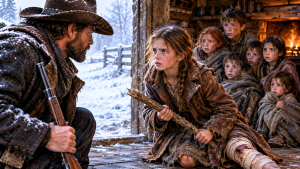
Clara Whitmore dragged herself across the frozen floor before I had taken three steps inside the cabin.
One leg trailed uselessly behind her.
Her hands slipped on boards slick with melted snow, ash, and filth, but she kept coming until her thin body stood—or rather knelt—
as the only barrier between my rifle and seven frightened children crowded around a dying fire.
“Stay back.”
Her voice shook.
Her eyes did not.
I stopped.
For a moment, all I could hear was the storm battering the warped cabin walls.
Snow hissed through gaps between the logs.
Wind shoved smoke back down the chimney.
Somewhere in the dark behind the children, a little one coughed with the dry, exhausted sound of somebody who had been cold for too many days.
I lowered the barrel of my rifle.
“I’m not here to hurt you.”
“That’s what the last men said.”
Clara’s fingers closed around a broken piece of firewood.
The stick was hardly thicker than my thumb.
She held it like a club.
“They took our food.”
I looked toward the shelves beside the hearth.
Empty.
A flour sack lay torn open on the floor, flattened and licked clean.
A broken jar rested beneath the table.
One corner of the room held three overturned trunks, their contents scattered as though somebody had searched them.
Someone had robbed starving children.
I had seen cruel men before.
I had fought beside some and buried others.
But something about that empty flour sack made my jaw tighten harder than any battlefield memory ever had.
Outside, fifty yards from the cabin, lay the frozen body of a woman I had uncovered beneath a drift.
One stiff arm still reached toward this door.
I had nearly ridden past her.
The storm had buried everything in white—fence posts, rocks, old wagon ruts, even the horizon itself.
Soldier had balked at the drift, snorting and pulling at the reins.
That was the only reason I saw the hand.
A gray hand.
Bare.
Reaching.
I had climbed down and scraped snow away until I found the woman beneath it.
She was wrapped in what had once been a brown wool coat.
Her face was turned toward the cabin.
She had been crawling.
That was how I knew someone might still be inside.
Now I stood there with snow melting off my shoulders, looking at eight children who seemed to be waiting quietly for death to finish what winter had begun.
I knew death.
I knew the smell of a room where people had stopped expecting rescue.
My wife, Martha.
My twin boys, Daniel and Thomas.
Fever had taken all three in eight days.
Daniel first.
Thomas two days later.
Martha lasted five more.
I had buried them myself because the nearest preacher was fifty miles away and the ground did not care how badly a man’s hands shook.
I had thought that was the worst thing I would ever see.
Then I saw Clara Whitmore staring at me over a broken piece of firewood.
I slowly crouched.
The children flinched anyway.
I kept several feet between us.
“My name is Jacob Mallister,” I said.
“I keep a ranch south of here.”
No response.
The oldest boy stood behind Clara.
Fourteen, perhaps.
Tall for his age, but famine had carved his cheeks hollow.
His left sleeve was torn.
He watched my hands.
Beside him stood a red-haired girl who might have been eight.
Three younger boys were huddled under one blanket.
Another girl with dark braids leaned against the wall.
And in the corner sat the smallest child, a brown-haired girl staring at nothing.
She did not look at me.
She did not look at anyone.
I turned back to Clara.
“I found a woman outside.”
For the first time, something broke through her defiance.
“Mrs.
Henderson?”
I had been asked questions before where a lie would have been kinder.
I had learned that kindness and lying were not always the same thing.
“She didn’t make it.”
The red-haired girl covered her mouth.
The oldest boy shut his eyes.
One of the younger boys began to cry without making any sound.
Clara only stared at me.
Several seconds passed.
Then she whispered, “That makes three.”
My stomach tightened.
“Three what?”
“Grown-ups.”
She swallowed.
“Mr.
Callow died first.
Fever.
Mr.
Henderson went after the wagon train.”
Her eyes flicked toward the door.
“He never came back.”
“And Mrs.
Henderson?”
“She went for help yesterday.”
Yesterday.
I glanced at the dead hearth.
At the nearly empty room.
At the little girl in the corner.
The woman outside had probably known she would die.
She had gone anyway.
“How long have you been here?”
Clara shook her head.
“We stopped counting.”
“Where are your parents?”
“Dead.”
The answer came flat.
Too practiced.
She looked over her shoulder at the others.
“Everyone’s are.”
Eight children.
The oldest no more than fourteen.
The youngest perhaps six.
Clara looked ten.
Yet every one of them watched her before making the smallest move.
If she shifted, they shifted.
If she tightened her grip on that ridiculous piece of wood, the boys behind her straightened.
If she breathed easier, they did too.
I understood then.
She was the one holding them together.
Not because she was oldest.
Because somebody had needed to.
I placed my rifle on the floor.
Then I pushed it away from myself.
That got her attention.
“I have food,” I said.
“A warm house.
A partner named Gus Ortega.
Enough beds, blankets, and floor space to get you out of this place.”
Clara narrowed her eyes.
“Why?”
One word.
No gratitude.
No relief.
A challenge.
And suddenly I saw Daniel in the fever room asking me why I could not make him better.
I saw Thomas holding his brother’s hand because neither of them wanted to die alone.
I saw Martha turning her face toward the wall when she realized the second boy was gone.
“Because my sons would have been near your age if they’d lived.”
Clara’s expression softened for half a heartbeat.
Then it closed again.
“And because if I ride away now,” I said, “some of you won’t live through another night.”
She glanced toward the hearth.
There were perhaps six glowing coals left.
No stacked wood.
No food I could see.
No real choice.
But I could tell from the way she held herself that if I treated her like she had no choice, she would fight me anyway.
So I gave her one.
“You decide.”
Her brow creased.
“You want me gone, I go.
You want help, I’ll get every one of you to my ranch.”
“What happens after?”
“We get you warm.”
“After that.”
“We eat.”
“After that.”
Despite myself, I nearly smiled.
“You ask difficult questions, Miss—”
“Clara Whitmore.”
“Miss Whitmore, I don’t know what happens after that.”
Her eyes sharpened.
“Then don’t promise what you don’t know.”
The words struck me with embarrassing force.
How many promises had I made beside three sickbeds?
You’ll be all right.
Morning will be better.
Your mother is resting.
Your brother is sleeping.
I had believed some of them when I said them.
That had not made them true.
“All right,” I said.
“I promise only this.
I won’t leave you here to freeze.”
Clara held my eyes.
Then she turned.
“Will?”
The oldest boy straightened.
“I can walk.”
“You carry Patty.”
He moved toward the silent little girl.
She did not resist when he lifted her.
“Rosie?”
The red-haired girl wiped her face.
“I can walk too.”
“Sam, Ben, Eli—stay together.”
The three boys nodded.
The dark-haired girl rose from the wall.
“Maggie?”
“I’m coming.”
She glared at me.
“I don’t trust him.”
“Neither do I,” Clara replied.
I raised an eyebrow.
Clara looked directly at me.
“But staying here kills us for certain.”
There it was.
Not surrender.
Judgment.
A child making a calculation adults had forced upon her.
“We go,” she said.
Nobody argued.
The children began gathering what little they owned.
There was not much.
A tin cup.
Two blankets.
A wooden horse with one leg missing.
A small Bible.
A comb.
A cloth doll whose face had been rubbed almost blank.
Will found a photograph beneath an overturned trunk and tucked it inside his shirt.
Rosie took a blue ribbon from a nail in the wall.
Ben tried to carry an iron skillet until I told him I had six at the ranch.
He hesitated.
Then set it down.
Clara pointed toward the door.
“Mrs.
Henderson.”
I understood.
“I’ll protect her body until the ground can be worked.”
“I want her buried properly.”
“She will be.”
“With words.”
“With words.”
Clara nodded once.
Then she planted both hands on the floor and tried to stand.
Only then did I understand how bad her leg was.
Her right foot turned inward sharply.
The knee did not straighten.
Whether she had been born that way or injured long ago, I could not tell.
She made it halfway upright.
Then the leg folded beneath her.
I moved without thinking and caught her before her head struck the boards.
She went rigid in my arms.
Not frightened.
Furious.
“I can walk.”
“I believe you.”
“Put me down.”
I did.
Immediately.
That surprised her.
Most adults, I would later learn, had not listened when Clara said stop.
They had lifted her when she did not want lifting.
Dragged her when she wanted to crawl.
Spoken over her.
Answered for her.
Decided for her.
I looked beside the hearth and found a length of wood straight enough to bear weight.
I tested it against the floor.
“We can make something better later.
For now, use this.”
I handed it to her.
I did not reach for her again.
That mattered.
I could see it mattered.
She wedged the wood beneath her arm.
Her face tightened.
Slowly she stood.
Unsteady.
Painfully.
But under her own power.
“All right,” she said.
The way she said it told me she was not thanking me.
She was giving me permission to continue.
I picked up my rifle.
Every child tensed.
So I opened the chamber, showed Clara it was empty, and slung it over my shoulder.
Then I opened the cabin door.
The cold struck us like a hammer.
Snow came sideways.
Soldier stood thirty feet away with his back to the wind, reins hanging loose, his dark coat powdered white.
The children stopped at the threshold.
For one awful second, I understood that the cabin had become a prison simply because it was the only shelter they knew.
Outside was the thing that had killed Mrs.
Henderson.
Outside was where men had vanished.
Outside was where the wagon train had gone without them.
Clara stepped first.
Her makeshift crutch sank deep.
She nearly fell.
Then Will came after her.
The others followed.
“Little ones ride,” I shouted over the wind.
Clara shook her head.
“Patty and Rosie first.”
“You’re riding too.”
“I can—”
“Fifteen miles.”
That silenced her.
I lifted Patty onto Soldier.
She weighed almost nothing.
Rosie climbed behind her.
Then I looked at Clara.
I did not touch her.
“May I?”
She hesitated.
The storm whipped her hair across her face.
Finally she held out her arms.
“Yes.”
Only then did I lift her.
She was lighter than Daniel had been the summer before he died.
The thought hit so suddenly that my throat closed.
I settled Clara in front of the others.
“Hold the saddle horn.”
“I know how to ride.”
“Good.”
“I used to ride better than my brother.”
“Then today you can teach the horse.”
She looked at me suspiciously, uncertain whether I was making fun of her.
I was not.
Soldier blew steam through his nostrils.
I took the reins and turned south.
Will carried Patty whenever we had to rotate riders.
Sam, Ben, Eli, and Maggie walked.
We stepped into the storm.
For the first mile, nobody spoke.
For the second, Ben began stumbling.
By the third, Eli’s lips had gone blue.
I broke trail until every breath burned my lungs.
Whenever a child fell, the others stopped.
Whenever I ordered them forward, Clara twisted in the saddle and counted.
“One.”
Will.
“Two.”
Maggie.
“Three.”
Rosie.
“Four.”
Sam.
“Five.”
Ben.
“Six.”
Eli.
“Seven.”
Patty.
Then, quietly, “Eight.”
Herself.
Always eight.
At first I thought she was only making certain we had not lost anyone in the whiteout.
Later I understood.
People had been disappearing from Clara’s life for weeks.
Parents.
Neighbors.
Wagons.
Mr.
Callow.
Mr.
Henderson.
Mrs.
Henderson.
Counting was how she fought the terror that another person might vanish when she looked away.
Darkness had begun swallowing the plains when the ranch buildings finally appeared through the snow.
My house.
The barn.
The cattle shed.
A thin line of smoke from the chimney.
I had lived there eleven years.
For the last four, it had felt like a grave with a roof.
“There!”
I shouted.
Nobody cheered.
They had learned too well what hope could cost.
But they moved faster.
The door of the ranch house opened.
Gus Ortega came running into the storm without a coat.
“Jacob!”
Then he saw the procession behind me.
He stopped dead.
His eyes moved from one child to the next.
Then to Clara on Soldier.
Then back to me.
“Madre de Dios.”
“No questions yet,” I said.
“Food.
Blankets.
Fire.”
Gus did not ask a single one.
He threw open the door.
“Inside.
All of you.”
Warm light spilled across the snow.
The younger children stared at it.
I watched something like hunger pass over their faces—not hunger for stew.
Hunger for warmth.
For walls that did not shake.
For a door opened toward them instead of shut against them.
“Go,” Clara told them.
Will carried Patty.
Rosie followed.
Sam, Ben, Eli, and Maggie disappeared through the doorway.
I reached for Clara.
She stopped me.
“I want to walk in.”
Her face was white with exhaustion.
I looked at the hundred feet remaining.
Then at her.
And I understood what she was asking.
Not whether she could endure the distance.
Whether the first step into whatever came next could belong to her.
I handed her the wooden crutch.
Clara slid from Soldier.
Her good foot sank into the snow.
She planted the crutch.
Then she started forward.
I walked beside her.
I did not touch her.
Ten feet.
Twenty.
Thirty.
Her breathing grew rough.
Halfway there, her bad leg buckled.
She caught herself.
I offered my hand.
She looked at it.
For a long second, pride fought exhaustion.
Then she took it.
Her fingers were ice.
Together we crossed the last stretch.
At the threshold, Clara stopped so suddenly I nearly walked past her.
Inside, seven children waited.
Gus stood beside a roaring fire.
Steam rose from a pot of stew.
Every lamp in the house seemed to be burning.
Clara’s fingers tightened around mine.
Her voice had been fierce inside the cabin.
Fierce through fifteen miles of snow.
Fierce while deciding whether eight children should trust a stranger with a rifle.
Now, with warmth touching her face, it finally broke.
“Please don’t leave us.”
I looked down at her.
I had spent four years believing the worst thing a man could do after losing his family was keep living as though he still had one.
So I had stopped using the boys’ room.
Stopped sitting in Martha’s chair.
Stopped planting flowers beside the porch.
Stopped inviting neighbors for supper.
Stopped expecting anything from tomorrow.
I had thought that was loyalty.
Then this half-frozen little girl pulled on my hand.
And I stepped across the threshold with her.
Chapter 2: ALWAYS EIGHT
That first night nearly killed two of them.
Not from cold.
From eating.
Gus had put bowls on the table before I could stop him.
Stew.
Bread.
Milk.
The smell alone changed the children.
Ben lunged for the bread.
Rosie tried to hide two pieces inside her dress.
Sam shoved stew into his mouth so quickly he choked.
Will stood behind the others, waiting to see if there would be enough.
Clara did not sit.
She counted portions.
“Slow,” I said.
Nobody listened.
I took Ben’s bowl away after his third mouthful.
His face changed instantly.
Not anger.
Terror.
“No!”
He grabbed for it.
“You’ll get it back.”
“You said food!”
“You have food.”
“You’re taking it!”
His voice rose until Patty started crying.
I crouched so we were eye to eye.
“If you eat too much after starving, you can get sick.”
“I don’t care.”
“I do.”
“Give it back!”
He came at me with both fists.
A grown man could have stopped him with one hand.
I let him hit my chest twice.
Then Clara said, “Ben.”
He froze.
She had lowered herself into a chair by the fire.
Her hands shook.
“Sit.”
“He took it.”
“He said he’ll give it back.”
“The men said—”
“I know.”
Those two words changed the room.
I know.
Not a command.
Not comfort.
Recognition.
Ben stared at her.
Then slowly sat.
I put the bowl on the table where he could see it.
“You get half now,” I said.
“More in an hour.”
His eyes never left the bowl.
“All of us?”
“All of you.”
Clara watched me.
“And tomorrow?”
“Yes.”
“And the next day?”
“Yes.”
“How much food do you have?”
Gus looked at me.
I looked at him.
He sighed.
“Enough beans to make me hate beans by spring.”
A tiny sound came from Rosie.
It took me a second to realize she had laughed.
The first laugh in the house.
Gus heard it too.
His face softened.
“We have beef,” he continued.
“Potatoes.
Cornmeal.
Flour.
Dried apples.
Some bacon if Jacob has not been secretly eating it.”
“I haven’t.”
“You look guilty.”
“I always look like this.”
“That is true.”
Rosie laughed again.
Even Clara’s mouth twitched.
We fed them slowly.
Half portions.
Then more.
Warm water instead of too much milk.
I sent Gus to heat stones near the stove while I pulled every blanket we owned from trunks.
We made pallets in front of the fire.
The children refused to separate.
I told them they did not have to.
Will took the spot nearest the door.
Clara noticed.
“You can sleep,” she told him.
“So can you.”
“I am.”
“You’re sitting.”
“So?”
Will looked at me.
For the first time, I saw something other than suspicion in his face.
Exhaustion.
“Does the door lock?”
“Yes.”
“From inside?”
“Yes.”
I showed him.
He checked it himself.
Then he dragged his blanket closer to Patty.
One by one, the children lay down.
Except Clara.
She sat in Martha’s old rocking chair, staring into the flames.
I had not seen anyone sit there since Martha died.
I should have felt something sharp.
Instead, the sight only made the room look less empty.
Gus stood beside me in the kitchen.
He kept his voice low.
“Where did you find them?”
“North cabin near Dry Creek.”
His expression darkened.
“The wagon route?”
I nodded.
“I thought everyone came through before the storm.”
“So did they.”
He looked toward the children.
“What happened?”
“Later.”
Gus rubbed both hands over his face.
“You went to check fence posts.”
“I know.”
“You came back with eight children.”
“I know.”
“There are easier ways to avoid fixing fence.”
Despite everything, I almost laughed.
Then Patty began screaming.
Not crying.
Screaming.
She woke as if something had seized her.
Will grabbed her.
Rosie sat up.
Sam and Ben bolted awake.
Maggie reached for the poker.
Clara slid from the chair and hit the floor on both knees.
She crawled to Patty faster than I could cross the room.
“Patty.”
The little girl thrashed.
“Don’t leave me!
Don’t leave!
Mama!”
Clara took her face in both hands.
“Patty.
Look at me.”
The screaming continued.
“Patty.”
Clara pressed her forehead against the girl’s.
“One.”
Patty gasped.
Clara whispered, “One.”
Will answered.
“Two.”
Maggie understood.
“Three.”
Rosie: “Four.”
Sam: “Five.”
Ben: “Six.”
Eli: “Seven.”
Clara held Patty tighter.
“Eight.”
The screaming stopped.
Patty’s eyes opened.
She looked around the room.
At the fire.
At the blankets.
At me.
Then she buried her face against Clara.
That was the first time I heard them count together.
It was not a game.
It was proof.
We are still here.
All of us.
I stood by the fire long after they fell asleep.
Gus joined me.
Neither of us spoke for a while.
At last he said, “Your boys used to count fence posts.”
I stared into the flames.
“Daniel cheated.”
“Thomas always caught him.”
“Yes.”
Gus folded his arms.
“They can use the boys’ room.”
My throat tightened.
“No.”
He looked at me.
I hated how quickly I had answered.
“No,” I repeated, quieter.
“Not yet.”
Gus did not argue.
That was one of the reasons he had remained my friend after Martha died.
He knew when silence was kinder.
I slept in a chair beside the door.
At dawn, Clara woke before me.
I opened my eyes and found her on the floor beside my rifle.
My hand moved instinctively.
Then stopped.
She was not touching the weapon.
She was studying my boots.
“What are you doing?”
She looked up.
“Seeing if you left.”
“I’m right here.”
“I can see that.”
“Then why are you studying my boots?”
“To see if they were wet.”
I sat up slowly.
“Wet?”
“If you had gone outside while we slept, they’d be wet.”
I understood.
“You thought I might leave.”
“I thought you might decide we were too much trouble.”
Something inside me shifted.
Not because she said it sadly.
Because she said it as if she were discussing weather.
A practical possibility.
People leave.
Check the evidence.
Prepare.
“I told you I wouldn’t leave you to freeze.”
“That was last night.”
“I meant longer than one night.”
“You didn’t say that.”
There was no accusation in it.
That somehow made it worse.
I leaned back.
“All right.”
She waited.
“I’m not leaving today.”
Her shoulders eased.
A little.
“What about tomorrow?”
“I expect I’ll still own the ranch tomorrow.”
“That isn’t what I asked.”
“No.”
I looked toward the sleeping children.
Then at her twisted leg stretched awkwardly beside her.
“I’m not leaving tomorrow either.”
Clara studied me.
“You keep changing the promise.”
“You keep improving the question.”
That earned me the smallest smile I had yet seen.
Then she pointed at my rifle.
“Can you teach Will to use it?”
I blinked.
“Why?”
“In case those men come back.”
The warmth left the room.
“What men?”
“The ones who took the food.”
I sat forward.
“How many?”
“Three.”
“When?”
“Two days before Mrs.
Henderson left.”
“Were they from the wagon train?”
“No.”
“You know that?”
“They had horses.”
“That doesn’t mean—”
“Our people’s horses were dead or gone.”
Her voice hardened.
“They asked if anyone had money.
Mr.
Callow was already dead.
Mrs.
Henderson told them we only had children.”
“What happened?”
“They searched everything.”
“Did they hurt you?”
Clara said nothing.
My hands curled.
“Clara.”
“They pushed Will down when he tried to stop them.”
“Anything else?”
“They laughed.”
Her eyes moved away from mine.
“At my leg.”
The room seemed to narrow.
“They said I wouldn’t need food long anyway.”
I had believed I understood anger.
I had been wrong.
“What direction did they go?”
“Southwest.”
“Did they say where?”
“No.”
“Names?”
“No.”
“What did they look like?”
She shook her head.
“Why?”
“So I know them if I see them.”
Her eyes snapped back.
“You’re going after them.”
It was not a question.
“No.”
She clearly did not believe me.
“Then why do you care?”
“Because they know children were in that cabin.”
“And?”
“And men willing to steal from starving children sometimes decide they forgot something.”
Fear entered her face.
I regretted the sentence the moment I saw it.
“I’m not saying they’ll come here.”
“But they could.”
“Yes.”
She looked toward the others.
I knew what was happening.
She was counting risks.
Again.
“Then teach Will.”
“I’ll teach both of you.”
Clara frowned.
“My leg doesn’t stop my hands.”
“I noticed.”
Before she could answer, Gus came in carrying an armload of split wood.
He looked from me to Clara.
“What did I miss?”
“She’s organizing the ranch.”
“I assumed that would happen.”
“I am not.”
Gus put down the wood.
“Good.
Jacob needs organizing.”
“I do not.”
“You came home with eight children and forgot to close the barn door.”
I stood.
“The barn door is closed.”
“Because I closed it.”
Clara looked between us.
Then, to my surprise, she smiled again.
That morning, we learned their names properly.
Will Carter, fourteen.
Maggie Bell, twelve.
Clara Whitmore, ten.
Rosie Flynn, nine.
Sam Dyer, nine.
Ben Mercer, eight.
Eli Brooks, seven.
Patty Cole, six.
Eight children from six families.
Their parents had joined a westbound wagon company in late summer.
Some were headed for Oregon.
Some for Washington Territory.
Some simply wanted land.
The company had been slowed by sickness, broken axles, bad weather, and an early freeze.
Then came fever.
The dead were buried along the trail.
The weak were placed together in the cabin near Dry Creek under the care of the Hendersons and Mr.
Callow, with the promise that the wagon party would send help from the next settlement.
Help never came.
Whether the wagon master had died, become trapped, or chosen survival over returning, none of the children knew.
I did not call it abandonment.
Clara did.
“They left us.”
Will stared at the table.
“They said they’d come back.”
“They didn’t.”
“They might’ve tried.”
“They didn’t come back.”
“Clara.”
“What?”
“Enough.”
“No.”
Her face flushed.
“Everybody keeps saying enough when they mean stop telling the truth.”
The room went silent.
Will’s eyes lowered.
I recognized the look on his face.
Guilt.
Not because he had left them.
Because he was the oldest and thought that meant he should have prevented everyone else from leaving.
“You two don’t have to settle that today,” I said.
Clara turned on me.
“Who says?”
“I do.”
Her chin lifted.
“This is your house,” she said.
It sounded like an accusation.
“Yes.”
“So you decide everything.”
“No.”
She seemed more confused by that answer than she would have been by anger.
“I decide whether the roof gets repaired,” I said.
“I decide how much hay gets fed to the cattle.
Gus decides he’s always right about coffee.”
“I am always right about coffee,” Gus said.
“The rest, we figure out.”
Clara stared at me.
It would be weeks before I understood how dangerous kindness looked to her.
Cruelty had rules.
Cruelty made sense.
Kindness could disappear.
Kindness could change its mind.
Kindness could promise to return.
And not.
That afternoon, while the storm still buried the ranch, I built Clara a crutch.
A proper one.
I found seasoned ash in the barn.
Cut it to her height.
Wrapped the top with leather.
Added a small brace where her hand would rest.
She watched from the doorway, wearing one of Martha’s old shawls.
I nearly told her to stay inside.
Then I remembered who I was dealing with.
“You could sand this,” I said.
She came closer.
“You trust me with a knife?”
“It’s a sanding block.”
“That wasn’t my question.”
I handed her my small carving knife.
“Don’t cut toward your thumb.”
She sat on an overturned bucket and began trimming a rough edge.
After a while she said, “Did your boys live here?”
I kept working.
“Yes.”
“Where?”
I nodded toward the house.
“Back room.”
“Why don’t we sleep there?”
My hands stopped.
Clara noticed.
“You said there were enough beds.”
“There are.”
“But not for us?”
“It isn’t that.”
“What is it?”
I could have told her she asked too many questions.
Instead I put down the file.
“I haven’t opened that room properly since they died.”
Clara looked toward the house.
“Oh.”
No apology.
I was grateful for that.
People had apologized to me for four years.
I had come to hate the softness in their voices.
After a minute she asked, “Were they twins?”
“Yes.”
“How old?”
“Six.”
“Same as Patty.”
“Yes.”
She returned to the crutch.
I waited for the next question.
It did not come.
When the crutch was finished, she stood using it.
The difference was immediate.
Her shoulders no longer twisted as sharply.
She could place the crutch farther forward without slipping.
She took three steps.
Then four.
Then six.
Gus came from the barn carrying kindling.
“Well?”
Clara turned.
“It works.”
I pretended to inspect a notch.
“That almost sounded like praise.”
“It wasn’t.”
“I’m relieved.”
She took another step.
Then stopped.
“Thank you.”
She said it so quietly I might have missed it.
I looked at her.
“You’re welcome.”
That evening, I opened the door to my sons’ room.
Dust moved in the lamplight.
Two narrow beds stood beneath the window.
A wooden box of marbles remained under Daniel’s bed.
Thomas’s coat still hung from a peg.
For four years I had avoided the room because I believed entering it meant losing them again.
Now eight children slept on the floor near the fire because I was afraid of two empty beds.
I stood there a long time.
Then I heard Clara behind me.
She had not entered.
She leaned on her new crutch at the threshold.
“You don’t have to.”
I looked back.
It was the first time she had offered me the choice I kept offering her.
I breathed slowly.
“Yes,” I said.
“I do.”
By nightfall, Will and Sam had taken one bed.
Ben and Eli the other.
The girls slept in Martha’s old sewing room after Gus and I moved in two mattresses.
Patty insisted on staying beside Clara.
Nobody objected.
The house became crowded.
Boots appeared where boots had not been.
Wet mittens hung beside the stove.
Someone broke a cup.
Someone spilled water.
Ben snored.
Rosie talked in her sleep.
Eli asked for more bread three times.
Maggie complained that Gus’s stew had too much salt.
Gus looked personally wounded.
Clara counted everyone before bed.
One.
Two.
Three.
Four.
Five.
Six.
Seven.
Eight.
Then she looked at me.
For one strange second I wondered whether she was about to say nine.
She did not.
But she looked at my boots before she went to sleep.
And the next morning, she checked them again.
Chapter 3: WHAT WINTER TAKES
The storm lasted four days.
By the second day, the children stopped jumping every time the roof creaked.
By the third, Ben stole bread even though food sat openly on the table.
By the fourth, Patty spoke her first full sentence.
“Clara snores.”
Clara nearly dropped her spoon.
“I do not.”
Patty nodded gravely.
“You sound like a bear.”
Rosie giggled.
Maggie laughed.
Even Will smiled into his bowl.
Clara looked betrayed.
“I kept you alive.”
“You still snore.”
That was how healing entered my house.
Not with some grand moment.
Not with tears.
With an accusation about snoring.
But the cold remained.
So did fear.
The children hoarded.
Food vanished into pockets.
Blankets disappeared beneath beds.
Sam kept three pieces of firewood beside his mattress.
Will woke before dawn to check the barn.
Maggie jumped whenever Gus raised his voice, even when he was shouting at a stubborn cow.
Patty followed Clara everywhere.
And Clara never stopped watching the door.
On the fifth morning, the sky cleared.
The world outside looked newly made.
Blue shadows stretched across untouched snow.
Sunlight turned the drifts almost painful to look at.
I saddled Soldier.
Clara came onto the porch.
“Where are you going?”
“To the cabin.”
Her fingers tightened around the crutch.
“Why?”
“Mrs.
Henderson.”
She went still.
“I told you I’d see to her.”
“I’m coming.”
“No.”
The word came out too quickly.
Her eyes hardened.
“I promised a proper burial,” I continued.
“You promised me.”
“Yes.”
“So I’m coming.”
“It’s fifteen miles.”
“I know.”
“The cold—”
“I rode it before.”
“You were half dead when you got here.”
“And now I’m not.”
I stared at her.
There were battles a man could win only by admitting they were not his to fight.
“Fine,” I said.
“You ride.”
“I know.”
Gus appeared behind her.
“I am coming too.”
I looked at him.
He shrugged.
“You will dig like an angry buffalo and hurt your back.”
“My back is fine.”
“That is what old men say immediately before they discover their back is not fine.”
“I’m forty-one.”
“To Clara, that is ancient.”
Clara nodded solemnly.
“Very old.”
I pointed at both of them.
“I regret this entire arrangement.”
We left Will in charge of the younger children with Maggie.
Rosie tried to come.
Clara told her no.
For once, somebody obeyed Clara as reluctantly as Clara obeyed me.
The ride north was slow.
Snow had erased the worst evidence of our journey.
But Clara remembered every place.
“Ben fell there.”
A mile later: “Eli’s lips went blue near that tree.”
Then: “That’s where Patty started shaking.”
I had not noticed the landmarks during the storm.
She had.
When the cabin appeared, Clara stopped speaking.
The door still stood open from our departure.
Snow had blown halfway across the floor.
I had covered Mrs.
Henderson’s body with a tarp and weighted the edges with stones before leaving.
Now we carried her to a rise east of the cabin.
The ground was too frozen to dig properly.
We built a grave by cutting into the shallow earth with picks, then covering the body with stones until spring would allow something deeper.
Clara insisted on helping.
I tried not to watch every time she swung the small shovel.
She noticed anyway.
“Stop.”
“Stop what?”
“Looking like I’m going to break.”
“You look tired.”
“I am tired.”
“That was my point.”
“No.
Your point was you think tired means stop.”
“Sometimes it does.”
“Not yet.”
Gus coughed into his glove to hide a laugh.
I gave him a look.
He found the horizon very interesting.
When the grave was covered, Clara stood beside it.
The wind had weakened.
Nothing moved across the white plains.
“You said words,” she reminded me.
I took off my hat.
Gus did the same.
I had not prayed aloud since I buried Martha.
Not because I no longer believed in God.
Because I had been angry with Him.
There is a difference.
I looked down at the stones.
I had never known Mrs.
Henderson.
Only the shape of her body beneath snow.
Only the direction of her hand.
Only what the children had told me.
What words could I offer for that?
Then Clara spoke.
“Her first name was Abigail.”
I looked at her.
“She liked cinnamon,” Clara said.
“When we still had sugar, she put too much in coffee.”
Gus smiled faintly.
“She sang badly,” Clara continued.
“Very badly?”
“The worst.”
“What songs?”
“Church songs.”
“Maybe that made up for it.”
“It didn’t.”
Her mouth trembled.
“She gave Patty her coat the first cold night.”
I looked toward the grave.
That explained why Abigail Henderson had died wearing only a thin wool dress under the brown coat I had found on her.
No.
I remembered.
The coat had been too large around her shoulders.
Maybe it had been Mr.
Henderson’s.
Clara drew a breath.
“She told us she’d come back.”
Her voice changed.
The others always told us that.
I understood what she did not say.
Her parents.
The wagon company.
Mr.
Henderson.
Anyone who stepped through the cabin door.
“I think she tried,” I said.
Clara’s jaw tightened.
“She died.”
“Yes.”
“So trying didn’t matter.”
I looked at the stones.
“When I found her, she was facing the cabin.”
Clara did not move.
“One arm was reaching toward the door.”
Her eyes filled.
I went on carefully.
“She did not wander away.
She did not change her mind.
She was trying to get back to you.”
Clara stared at the grave.
A tear slid down her cheek.
She wiped it away angrily.
“Then say that.”
So I did.
“Abigail Henderson kept her promise as far as a human being could keep it.
She walked into a blizzard for eight children who were not her own.
She died trying to return to them.”
My throat tightened.
I looked at Clara.
“And I reckon there are worse things to have said over a grave.”
Gus murmured, “Amen.”
Clara whispered it too.
“Amen.”
We stood there until the cold forced us back.
Before leaving, I went inside the cabin.
The room looked smaller empty.
I found an old ledger beneath the overturned table.
The first pages recorded supplies.
Flour.
Coffee.
Salt pork.
Lamp oil.
Later pages contained names.
Deaths.
Dates.
Short notes in different handwriting.
November 3 — James Flynn, fever.
November 5 — Elizabeth Mercer.
November 7 — Sarah Whitmore.
I stopped.
Clara stood behind me.
“You found my mother.”
I closed the ledger halfway.
“You don’t need to read this.”
“Yes, I do.”
I gave it to her.
She lowered herself onto the bench.
Her finger moved down the page.
Sarah Whitmore.
November 7.
Below it:
Andrew Whitmore.
November 9.
Clara’s father.
She stared.
I waited.
“She died first,” Clara said.
“Yes.”
“He told me she was sleeping.”
I said nothing.
“I knew.”
Her finger stayed on her father’s name.
“He kept saying the wagon would send help.”
She swallowed.
“He said I had to keep everyone calm.”
“How old was he?”
“Thirty-five.”
“No.
I mean when he told you that.”
She looked confused.
“You.”
Her face changed.
“You were ten.”
“I am ten.”
“That’s what I mean.”
She looked down.
I sat across from her.
“Your father asked too much.”
Her chin came up.
“He was dying.”
“I know.”
“He needed me.”
“I know.”
“You weren’t there.”
“No.”
Anger flashed across her face.
“So don’t tell me what he should’ve done.”
I nodded.
“All right.”
Her breathing slowed.
Then her shoulders sagged.
“He told me to count them.”
I stayed still.
“The night he got bad.”
Now I knew.
“He said, ‘Clara, count everyone.’”
Her eyes remained on the ledger.
“So I did.”
“One through eight.”
She nodded.
“He said if I could count us, then I’d know who needed me.”
My chest hurt.
“After he died, Will said I didn’t have to.”
“But you kept doing it.”
“If I stop…”
She could not finish.
I knew anyway.
If I stop, someone disappears.
If I stop, someone dies.
If I stop holding everything together, it all falls apart.
I had lived four years by my own version of the same lie.
If I stop grieving, I betray them.
If I laugh, I forget them.
If I open the room, I erase them.
If I love something living, I lose what died.
“Clara.”
She would not look at me.
“You can keep counting.”
Her head lifted.
“But you don’t have to keep everybody alive by yourself.”
A bitter little laugh escaped her.
“Who else will?”
“I will.”
She stared at me.
I had not planned to say it.
The words were already between us.
I could not take them back.
“I will,” I repeated.
Her eyes searched my face.
“Today?”
“No.”
Her expression tightened.
“Not just today.”
I heard my own voice as if it belonged to somebody else.
“I’ll help tomorrow too.”
“And after?”
“As long as you need.”
She looked terrified.
Not relieved.
Terrified.
Because long promises were the most dangerous kind.
“What if you change your mind?”
“I suppose you’ll make my life unbearable.”
“I could.”
“I believe you.”
A sound came from the doorway.
Gus was pretending very badly not to listen.
He sniffed.
“Cold air.”
“Of course,” I said.
“Very irritating cold air.”
Clara looked at him.
“Are you crying?”
“No.”
“You are.”
“Snow blew into my eye.”
“We’re inside.”
Gus glared at me.
“You taught her this disrespect.”
“I met her five days ago.”
“Then she has natural talent.”
On the ride home, Clara carried the ledger inside her coat.
I brought back the broken cloth doll from the cabin for Patty.
And the little wooden horse for Eli.
That evening, Clara read every name aloud.
The children gathered around the table.
Parents.
A brother.
A sister.
Neighbors.
Mr.
Callow.
The Hendersons.
We did not pretend reading the names made anything better.
We simply refused to let winter erase them.
When she finished, Clara closed the book.
Then came a knock on the door.
Every child froze.
Will stood.
Maggie seized the iron poker.
Ben ducked behind Gus.
Clara’s face went white.
I reached for my rifle.
Another knock.
Three slow blows.
Someone stood outside.
And for the first time since I brought the children home, Clara did not count.
She looked at me.
Because I had told her she did not have to face everything alone.
So I opened the door.
Chapter 4: THE HOUSE THAT HAD BEEN EMPTY
The man outside was not one of the thieves.
He was our nearest neighbor, Ezra Pike, half frozen and cursing the weather.
His mare had thrown a shoe three miles west.
He needed shelter for the night.
The relief that moved through the room was so strong I could almost feel it.
But Ezra saw the children.
Then saw my face.
He removed his hat.
“Well,” he said slowly.
“I missed something.”
“You usually do.”
He ignored me.
His eyes settled on Clara.
“Ma’am.”
Clara looked suspiciously at him.
“Why did you call me ma’am?”
“Because you look like the one in charge.”
Gus burst out laughing.
I regretted allowing Ezra inside.
But his arrival gave us something we needed.
News.
The trail west had suffered badly in the early storms.
Several wagon companies had split.
One group had reached a settlement near Helena with losses.
Another had turned south.
No rescue party had been reported.
No one Ezra had heard from knew eight children had been left at Dry Creek.
Clara sat very still while he spoke.
Will kept asking questions.
“Did they mention a wagon captain named Harland?”
Ezra shook his head.
“A green wagon with a yellow wheel?”
“No.”
“A preacher named Collins?”
“No.”
Each answer closed another door.
Finally I stopped him.
“That’s enough.”
Will looked angry.
“I need to know.”
“You need to sleep.”
“I’m not a child.”
“You’re fourteen.”
“That’s old enough.”
“For what?”
His chair scraped backward.
“For something!”
The word cracked across the room.
Patty flinched.
Will looked ashamed immediately.
Then more angry because he was ashamed.
“For finding them,” he said.
“For going after them.
For knowing why they didn’t come back.”
“You can’t ride half the territory in winter.”
“I can try.”
“And leave the others?”
His face went hard.
The wrong question.
I knew it too late.
“That’s what everybody says,” he whispered.
Then he went into the boys’ room and slammed the door.
I followed.
He stood beside Daniel’s old bed.
“I’m not Clara.”
“I noticed.”
“She can sit there and wait.”
“That is not what she does.”
“She acts like she can decide everything.”
“She’s scared.”
“So am I.”
The honesty of it stopped me.
Will turned away.
“I was supposed to go.”
“Go where?”
“With Mr.
Henderson.”
His hands clenched.
“When he left to find the wagons.”
“You were fourteen.”
“I was the oldest.”
“Those are not the same thing.”
“He told me to stay.”
“Then you stayed.”
“I should’ve gone.”
“And if you’d died?”
“I might’ve found someone.”
“You might’ve left seven younger children without you.”
“Clara handled them.”
“She shouldn’t have had to.”
He looked at me.
Neither of us spoke.
Then I understood the shape of his guilt.
Clara believed she had to keep everyone.
Will believed he had failed because he had not saved everyone.
Both of them had mistaken surviving for wrongdoing.
I sat on the edge of Thomas’s bed.
“After my boys died,” I said, “I spent about a year thinking of every decision I should have made differently.”
Will remained standing.
“Different doctor.
Different medicine.
Ride sooner.
Ride farther.
Notice the fever sooner.
Keep them apart.
Keep Martha away from them.”
He glanced at me.
“Would it have mattered?”
“I don’t know.”
“That seems important.”
“It was.”
I rubbed my palms together.
“Then one day Gus asked whether I planned to spend the rest of my life putting dead people on trial.”
Will frowned.
“What does that mean?”
“I wasn’t judging the doctor.
Or the fever.
Or God.”
I looked around the room.
“I was judging myself.”
The boy said nothing.
“Mr.
Henderson told you to stay.”
“Yes.”
“So you stayed.”
“Yes.”
“And seven children are alive partly because you did.”
His eyes filled.
He looked furious about that too.
“What if he could’ve lived if I went?”
“You don’t know.”
“What if the wagon came back and couldn’t find the cabin?”
“You don’t know.”
“What if—”
“You don’t know.”
I did not raise my voice.
I did not need to.
The words landed harder quiet.
“You can destroy yourself with things you don’t know.”
Will sank onto Daniel’s bed.
For a while he stared at his hands.
Then he asked, “Does it stop?”
“What?”
“Thinking about it.”
I considered lying.
“No.”
His face fell.
“But it changes.”
“How?”
“You stop believing every memory is an order.”
He looked at me.
I was not sure I had understood that until I said it.
The next morning, I began teaching Will and Clara how to handle a rifle.
Not because I expected the thieves.
Because knowledge gave fear somewhere useful to go.
Clara sat on a crate in the barn.
I showed her the unloaded Winchester.
“This is not courage.”
She frowned.
“What?”
“The rifle.”
“I didn’t say it was.”
“Good.
Some people think holding a gun makes them brave.”
I showed her how to check the chamber.
“It makes you armed.
That’s different.”
Will watched closely.
I taught them safety first.
How to carry it.
How to know whether it was loaded.
How not to place a finger on the trigger until they intended to fire.
How fear made hands stupid.
How anger made them worse.
Clara learned faster.
Will hated that.
“You’re rushing,” she told him.
“I am not.”
“You are.”
“Your shoulder is wrong.”
“My shoulder is fine.”
“You nearly hit the lantern.”
“I did not.”
“The lantern disagrees.”
I turned away so they would not see me smiling.
During the following weeks, the ranch changed.
Not quickly.
Not cleanly.
Healing was not a straight road.
Ben still hid food.
So instead of punishing him, Gus gave him a small box beside his bed and put two biscuits inside every night.
“You don’t have to steal what belongs to you,” he said.
The first week, Ben hid six more.
The second week, three.
The third, none.
Rosie began helping Gus bake bread.
She talked so much he claimed he needed ear protection.
Maggie took over feeding the chickens and somehow made them obey her better than they obeyed me.
Eli carried the wooden horse everywhere.
Patty began following me when Clara was busy.
At first, she never spoke.
Then one afternoon while I repaired harness, she asked, “Did your little boys have a mama?”
I nearly dropped the buckle.
“Yes.”
“Where is she?”
“With them.”
She considered that.
“Under the ground?”
“Yes.”
“Does that make you sad?”
“Yes.”
She nodded.
“My mama is under the ground too.”
“I’m sorry.”
“She hated onions.”
I looked at her.
“What?”
“My mama.”
A tiny smile appeared.
“She hated onions.
She said they were God’s mistake.”
I laughed.
I had not meant to.
The sound burst out of me.
Patty giggled.
Then I heard silence behind us.
Clara stood in the barn doorway.
Her face was unreadable.
For one terrible second, guilt struck me.
I had laughed.
In the same barn where Daniel used to chase chickens.
Four years after I had buried him.
I waited for the familiar shame.
It came.
But something else came with it.
Martha laughing because Thomas had once put a frog in her wash basin.
Daniel laughing when Soldier stole my hat.
The memories were not angry.
They did not accuse me.
They were simply there.
Patty tugged my sleeve.
“Why’d you stop?”
I looked down.
“Forgot how.”
She accepted that answer.
“Do it again.”
So I did.
That night I sat alone on the porch after everyone slept.
Clara came outside.
She wore Martha’s shawl.
“You laughed today.”
“I did.”
“Patty told everybody.”
“That sounds like Patty.”
She lowered herself onto the bench.
For a while we watched snow slide from the barn roof.
Then she asked, “Did it hurt?”
I knew exactly what she meant.
“Yes.”
“Why?”
“Because for a second I felt happy.”
She frowned.
“That’s bad?”
“I used to think so.”
“Why?”
“Because Martha and the boys can’t.”
Clara stared at me as if I had said something absurd.
“That makes no sense.”
I laughed once.
“Probably not.”
“My mother liked apple cake.”
I waited.
“If I eat apple cake, she doesn’t get less dead.”
There was no cruelty in the sentence.
Only Clara’s terrible clarity.
“No.”
“If I hate apple cake, she still stays dead.”
“Yes.”
“So you being miserable doesn’t help your boys.”
I looked at her.
“You really do ask difficult questions.”
“That wasn’t a question.”
“Even worse.”
She pulled the shawl closer.
Then she said, “You can tell me their names.”
My throat tightened.
“You know their names.”
“Daniel and Thomas.”
“Yes.”
“But you can tell me things.”
I stared across the moonlit yard.
I had not told stories about my sons in years.
People stopped asking because my face taught them not to.
“Thomas hated carrots.”
Clara waited.
“He used to feed them to Daniel under the table.”
“Did Daniel like carrots?”
“No.”
“What did Daniel do with them?”
“Fed them to the dog.”
Clara smiled.
“So the dog liked carrots.”
“Apparently.”
“What else?”
And I told her.
Not everything.
Not that night.
But enough.
I told her Daniel could not whistle.
Thomas could.
Daniel hated that.
Thomas was afraid of thunder but pretended he was not.
Daniel once slept in the barn because he thought a calf looked lonely.
Martha found both boys there by morning.
Clara listened.
When I finished, she said, “See?”
“See what?”
“They’re still yours when you laugh.”
I turned toward her.
Sometimes wisdom enters a house wearing a preacher’s collar.
Sometimes it drags one useless leg behind it and is ten years old.
Spring was still months away.
The children still woke from nightmares.
We still did not know whether relatives might be found.
We did not know what the law would eventually require.
We did not know whether the wagon party had abandoned them deliberately or died trying to return.
But I began to understand what Clara had asked on our first night.
What happens after?
Warmth had been easy.
Food had been easy.
After was harder.
After meant deciding whether people were temporary.
One evening, a blizzard rose again.
Not as fierce as the first, but enough to shake the windows.
Clara stopped eating.
I noticed.
“What?”
“Nothing.”
“Clara.”
She stared toward the door.
“What if someone is out there?”
The room quieted.
“What?”
“What if someone is out there like we were?”
I understood immediately.
“So we check.”
Gus looked at me.
“In this?”
“We check the near road.”
Will stood.
“I’m going.”
“No.”
His jaw tightened.
Then I added, “You stay here because someone needs to keep the fire going and help Gus.”
He sat again.
Not happy.
But not humiliated.
I put on my coat.
Clara struggled upright.
“You’re not coming.”
“You don’t know—”
“I’m not leaving.”
The words stopped her.
Her face changed.
“I’m going to the road and coming back.”
“How long?”
“An hour.”
“What if—”
“I’m coming back.”
She looked at my boots.
At the door.
At me.
Then nodded.
“All right.”
I stepped into the storm.
We found no travelers.
No frozen wagon.
No desperate hand beneath a drift.
Only snow.
When I returned fifty-two minutes later, Clara was sitting beside the door.
She tried to pretend she had not been waiting.
I took off my wet boots.
She looked at them.
Then at me.
“You came back.”
“Yes.”
A month earlier, she would have said nothing.
This time she smiled.
“I know.”
Chapter 5: THE PROMISE AFTER WINTER
The deepest cold came in January.
Then February.
The ranch settled into a life I had never planned.
Eight children turned every task into a campaign.
Feeding cattle required arguments about who carried what.
Collecting eggs became a competition.
School lessons took over the kitchen table because I refused to let winter steal that too.
Gus handled arithmetic.
I handled reading.
Clara corrected both of us.
“You skipped a word.”
“I did not.”
“You did.”
“I have been reading longer than you’ve been alive.”
“That only means you’ve had longer to practice wrong.”
Will choked on his milk.
Gus nearly fell out of his chair.
I stared at Clara.
She returned the look calmly.
“What word?”
“‘Through.’”
I checked.
I had skipped it.
Nobody let me forget.
Clara’s leg remained a problem.
The cold made it ache until sometimes I found her awake at night, jaw clenched, refusing to make a sound.
She hated being carried.
So I built handrails along the porch.
A lower stool near the wash basin.
A second crutch for bad days.
Gus altered a saddle so she could ride without putting pressure on the twisted leg.
The first time she saw it, she stood speechless.
“What?”
I asked.
“You ruined a good saddle.”
“I improved an average saddle.”
“It was yours.”
“I have another.”
She ran her hand over the new strap.
“You did this for me.”
“I did it because watching you fight the old saddle was irritating.”
She looked at me.
“I know when you’re lying now.”
“That is unfortunate.”
When the snow softened enough to ride, I took her to the south pasture.
Soldier moved gently beneath her.
At first I held the lead rope.
Clara glared down.
“I told you I can ride.”
“And I told you I believe you.”
“You’re holding him.”
“I’m holding the rope.”
“That is the same thing.”
“No.”
“Yes.”
“No.”
“Jacob.”
It was the first time she used my name without Mister.
I noticed.
She noticed me noticing.
Neither of us mentioned it.
I released the rope.
“All yours.”
Clara looked forward.
Then nudged Soldier.
He walked.
She adjusted.
He trotted.
I tensed.
She laughed.
The sound carried across the snow.
“Clara!”
“I’m fine!”
“You’re too fast.”
“You’re too old!”
She urged Soldier faster.
I ran three steps before remembering I had another horse standing ten yards away.
Gus laughed so hard from the fence he had to lean against a post.
I mounted and followed.
By the time I caught her, Clara’s cheeks were red and her hair had escaped its braid.
She looked alive in a way I had never seen.
Not surviving.
Alive.
That difference mattered.
Spring arrived slowly.
First came dripping eaves.
Then dark earth.
Then patches of dead grass.
Then birds.
The day the ground finally softened enough, Clara came to me while I repaired fence.
“Mrs.
Henderson.”
I knew.
We returned to Dry Creek with all eight children.
No one stayed behind.
We dug the grave deeper.
Moved Abigail Henderson carefully.
Set a marker.
Then another for Mr.
Callow.
The children asked whether we could place stones for the parents buried farther along the trail.
We could not reach every grave.
So we made one marker with all the names from the ledger.
Gus carved them.
Will sanded the wood.
Maggie painted the letters with black wagon paint.
Rosie tied the blue ribbon she had saved around the top.
Clara stood before it when we were finished.
The cabin behind her leaned more badly than before.
Snowmelt had exposed broken crates and abandoned wheel tracks.
The place looked nothing like the monster it had become in memory.
Just a cabin.
Wood.
Stone.
Mud.
A place where terrible things happened.
Not the terrible thing itself.
Clara touched her mother’s name.
Then her father’s.
Will stood beside her.
For months, the two had avoided speaking about the wagon party.
Now Will said, “I think some of them meant to come back.”
Clara did not answer.
He continued.
“I think some didn’t.”
Her jaw tightened.
“That doesn’t change what happened.”
“No.”
“I was angry at you for saying that.”
“I know.”
“I thought if anybody had a reason, then I had to forgive them.”
Will looked at her.
“Do you?”
“No.”
A pause.
“Not yet.”
He nodded.
“That’s fair.”
Clara looked toward the horizon.
“I don’t want to wait for them anymore.”
Something shifted in Will’s face.
“Neither do I.”
That was the end of it.
Not forgiveness.
Not certainty.
Release.
They had spent a winter listening for wheels that never came.
Now they turned away from the road.
On our final trip through the cabin, I noticed scratches on the wall near the hearth.
Eight short vertical lines.
Then another set.
Then another.
Marks for days, perhaps.
Clara saw me looking.
“I started counting days.”
“Before you stopped?”
She nodded.
“Then I lost track.”
“Good thing.”
“I didn’t think so then.”
“What do you think now?”
She looked around the room.
“I don’t need to know how long we were here anymore.”
Outside, Patty called her name.
Clara turned toward the door.
Then stopped.
“Jacob?”
“Yes?”
“If we leave this place…”
Her voice became quiet.
“Does that mean we’re leaving them?”
She glanced at the ledger in my hand.
The dead.
Her parents.
Mrs.
Henderson.
Everyone the cabin held in memory.
I thought of the boys’ room.
Of Martha’s chair.
Of four years spent guarding ghosts.
“No,” I said.
“How do you know?”
“Because I tried staying.”
She looked at me.
“It didn’t bring anybody back.”
After a moment, she nodded.
Then she walked out.
Under her own power.
I followed.
By May, neighbors knew about the children.
People brought clothes.
Books.
Seeds.
Two milk goats.
An astonishing number of pies.
Gus complained bitterly that nobody had brought us pies before we had children.
“Apparently grief is less delicious,” I told him.
He pointed his fork at me.
“You make jokes now.”
“Clara says misery is useless.”
Clara looked up from across the table.
“I didn’t say useless.”
“You implied it.”
“I said being miserable doesn’t help dead people.”
“That is almost exactly what I said.”
“No, it isn’t.”
The table erupted into argument.
For the first time in years, noise did not feel like an invasion of my house.
It felt like the house doing what houses were meant to do.
Then one afternoon, I returned from the north field and found Clara sitting alone on the porch.
A folded paper lay in her lap.
I stopped.
“What is it?”
“Ezra brought it.”
My stomach tightened.
“From where?”
“Town.”
I sat beside her.
The paper was a notice sent through the territorial office after inquiries had been made about survivors of the wagon company.
A few relatives had been located.
Not parents.
An aunt of Rosie’s in Missouri.
A married sister of Will’s father somewhere in Iowa.
A cousin who might be related to Ben.
Names.
Possibilities.
Questions.
Clara handed me the paper.
“What happens now?”
The question.
The same one she had asked in the cabin.
After warmth.
After food.
After safety.
After winter.
I read the notice again.
“I don’t know.”
She nodded slowly.
At least I had learned not to lie.
“Will says maybe we get split up.”
“It might happen.”
“Do you want it to?”
“No.”
The answer came so fast she looked at me.
I folded the paper.
“No.”
“Why?”
I stared across the yard.
Ben and Eli were chasing a chicken.
Maggie shouted at them to stop frightening it while simultaneously laughing.
Rosie hung laundry with Gus.
Patty sat in the dirt making what she claimed was soup from mud and grass.
Will repaired a gate.
Eight children.
My house.
My ranch.
My life.
“Because this is your home now.”
Clara’s face changed.
I kept going before fear could stop me.
“If any of you have family who love you and can care for you, we’ll hear them.
We won’t hide you.
We won’t pretend they don’t exist.”
Clara nodded.
“But?”
“But nobody gets sent anywhere without being heard.”
Her eyes narrowed.
“Even us?”
“Especially you.”
“What if they say children don’t decide?”
“They may.”
“What will you say?”
“That the people making decisions should spend five minutes trying to make you do something you don’t want.”
She smiled despite herself.
Then the smile disappeared.
“What if they take me?”
The words were small.
I turned fully toward her.
“Clara.”
“What if they say my leg means I need somewhere else?”
There it was.
A fear she had never named.
The thieves had laughed at her leg.
Adults had carried her without asking.
The trail had taught her usefulness could determine who was worth saving.
She thought being difficult to move meant she was easier to leave.
“They won’t.”
“You don’t know.”
“No.”
She was right.
So I corrected myself.
“I won’t let anybody speak about you as if you’re a burden.”
Her eyes filled.
“And if they make me go?”
I looked at the paper.
Then toward the graves on the hill beyond the ranch where Martha and my boys lay beneath cottonwoods.
I had learned something since the storm.
Promises were not dangerous because they might hurt.
They were dangerous because sometimes keeping them required becoming a different man.
“Then I go with you as far as I’m allowed.”
She stopped breathing.
“If they put you on a train, I stand at the platform.”
Her lower lip trembled.
“If they send you to relatives, I write.”
I leaned closer.
“If they let you come back, the door opens.”
A tear rolled down her cheek.
“If they don’t?”
“Then you still know where home is.”
That broke her.
Clara Whitmore, who had faced armed thieves with a piece of firewood.
Who had crossed fifteen miles of blizzard.
Who had buried adults.
Who had counted children through hunger and darkness.
Who had refused to cry at her mother’s name.
She leaned against me and sobbed.
Not quietly.
Not politely.
She cried like a child.
At first my hands stayed awkwardly at my sides.
Then I put one arm around her.
She clutched my coat.
“I don’t want to go.”
“I know.”
“I don’t want anybody to go.”
“I know.”
“I’m tired of people going.”
“I know.”
I held her while the afternoon sun warmed the porch.
One by one, the other children noticed.
Patty came first.
She climbed onto the bench and pressed herself against Clara.
Rosie followed.
Then Ben.
Eli.
Sam.
Maggie.
Will stood in the yard for several seconds trying to decide whether fourteen was too old to join.
Gus solved it by grabbing the back of his shirt and pulling him in.
Soon I had eight children around me.
Gus stood behind us.
“This is ridiculous,” he muttered.
His voice was thick.
“You can go away,” I said.
“No.”
“Then stop complaining.”
“I complain because I care.”
“That explains a lot.”
Clara laughed through tears.
Months later, some relatives answered.
Rosie’s aunt wrote first.
She was elderly, already caring for three grandchildren, and confessed she could not take another child but wanted contact.
Will’s distant family wrote that they had no means to bring him east.
Ben’s possible cousin turned out not to be related at all.
No one claimed Clara.
No one came to separate them.
Time did what time does.
It turned fear into routine.
The children stayed.
Not because the world formally declared us a family in one grand moment.
Because breakfast kept happening.
Winter became spring.
Spring became summer.
Clothes wore out and were replaced.
Birthdays came.
Arguments came.
Chores came.
Schoolwork came.
So did laughter.
Clara stopped checking my boots every morning.
I did not notice when she stopped.
That hurt more than I expected.
Not because I wanted her afraid.
Because one day trust had become ordinary enough that neither of us saw it happen.
Summer brought grass high around the south fence.
Will grew nearly an inch.
Maggie learned to rope.
Rosie planted flowers beside the porch where Martha once had.
I nearly told her not to.
Then I helped.
Ben no longer hid biscuits.
Eli added four legs to his wooden horse and painted it black like Soldier.
Patty decided onions were, in fact, God’s mistake.
Gus took this as a personal insult to his cooking.
And Clara rode.
Every chance she got.
We built a stronger brace for her leg with help from a doctor passing through town, but there was no miracle.
Her leg remained twisted.
She still had pain.
She still needed the crutch.
She still fell.
The difference was that nobody looked away when she did, and nobody rushed to seize her before she asked.
One evening in September, nearly a year after I found them, Clara and I rode toward the north ridge.
She had grown.
Not much.
Enough.
From the hilltop, we could see most of the ranch.
The barn roof.
The house.
Gus walking toward the chicken yard.
Seven children scattered across the property.
Clara began counting.
“One.”
Will by the fence.
“Two.”
Maggie near the corral.
“Three.”
Rosie beside the clothesline.
“Four.”
Sam carrying water.
“Five.”
Ben behind him.
“Six.”
Eli on the porch.
“Seven.”
Patty running toward Gus.
Then Clara stopped.
I waited.
She looked at me.
“Eight.”
“Herself?”
“No.”
She smiled.
“You.”
For a second I could not speak.
“And you?”
I managed.
She frowned.
“I’m nine.”
“That isn’t how counting works.”
“It is now.”
I looked back at the ranch.
Nine.
I had spent years believing my life had ended with three graves.
I had continued breathing.
Working.
Eating.
Sleeping.
But I had mistaken existence for living.
Then a dead woman’s hand led me to a cabin.
A girl with a twisted leg dragged herself between my rifle and seven children.
And everything I thought was finished began again.
That evening, after supper, Clara walked onto the porch.
She did not use her crutch for the first few steps.
I noticed but said nothing.
She hated being watched when she practiced.
At the edge of the porch she stopped beside me.
“Do you remember the cabin?”
“Yes.”
“When I asked you not to leave us?”
“I remember.”
“I thought you would.”
“I know.”
“I kept waiting.”
“For what?”
“For you to get tired of us.”
I looked through the open doorway.
Gus was arguing with Maggie about dishes.
Ben had somehow gotten flour on the ceiling.
Rosie was helping Patty braid a doll’s hair.
Will and Sam were playing checkers badly and accusing each other of cheating.
Eli was asleep beneath the table.
The house glowed gold in the lamplight.
“Clara.”
“Yes?”
“I am tired of you.”
She stared at me.
Then saw my face.
“You are awful.”
“Sometimes.”
“I’m serious.”
“So am I.
Eight children are exhausting.”
She shoved my arm.
I laughed.
Then she laughed too.
When the laughter faded, I said, “Being tired of someone isn’t the same as leaving.”
She became quiet.
“I didn’t know that before.”
“Neither did I.”
The sun dropped behind the mountains.
Cool air moved through the grass.
Clara leaned against the porch rail.
“Do you ever think about what would’ve happened if you hadn’t seen Mrs.
Henderson?”
“Yes.”
“So do I.”
“Try not to.”
“Why?”
“Because it ends the same every time.”
She looked at me.
“And we already know this ending.”
She considered that.
Then nodded.
Inside, Gus shouted, “Jacob!
Explain to these savages that flour does not belong on a ceiling!”
Ben yelled, “It was an accident!”
Maggie shouted, “It was not!”
Clara sighed.
“You should go.”
“You coming?”
“In a minute.”
I opened the door.
Warmth spilled onto the porch.
Before I crossed the threshold, Clara said my name.
I turned.
She looked very much like the girl from the cabin.
Same steady eyes.
Same stubborn chin.
Same twisted leg.
But she was not holding a broken piece of firewood now.
She was not freezing.
She was not counting the minutes until another adult disappeared.
“Jacob?”
“Yes?”
“You kept your promise.”
I thought of the words I had given her that first night.
I won’t leave you here to freeze.
At the time, I had meant a cabin.
A storm.
One night.
I had not understood that there were other ways to freeze.
A house could freeze around grief.
A man could freeze inside it.
A child could become so afraid of abandonment that she stopped believing warmth could last.
Maybe saving them had never been only about getting eight bodies through a blizzard.
Maybe it had been about teaching all of us that a door could stay open.
“I’m still keeping it,” I said.
Clara smiled.
Then she took my hand.
Just as she had on the first night.
Only this time she did not beg me to cross the threshold.
She knew I was coming.
Together we went inside.
And behind us, for the first time in years, I did not hear the wind.
I heard home.