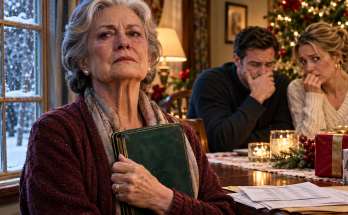
I sat at my kitchen table with the phone against my ear.
Robert was still speaking.
I heard him.
But for a few seconds, I couldn't make sense of what he was telling me.
My signature.
On Derek's loan application.
I had never approved that loan.
I had never signed a document allowing Derek to use my villa to support his borrowing.
I had never told anyone that he owned the property.
Yet Robert was saying that a paper carrying my name existed.
I looked at the paint samples Donna had left on the table.
Earlier that day, I had been upset because someone had chosen new colors for my bedroom.
Now I was facing something much more serious.
Someone might have used my identity to support a financial transaction.
I asked Robert to explain again.
He told me the application requested one hundred eighty thousand dollars.
It included the villa among the financial information presented to the lender.
Derek's signature appeared on it.
And another signature appeared to be mine.
I felt cold.
I asked how that could be possible.
Robert didn't pretend to know.
He explained that the actual document would need to be examined.
We would have to determine how the signature had been obtained.
Whether it was genuinely mine.
Whether it had been copied or written by somebody else.
Nothing should be assumed before the evidence was checked.
I appreciated his caution.
But I knew one fact with complete certainty.
I had not signed the application.
I said that clearly.
Robert understood.
He told me we needed to examine the documents carefully.
I looked through the kitchen window.
Arthur's porch swing was outside.
Only a few hours earlier, Derek had been sitting beside me on that porch.
He had told me about his business problems.
He had admitted he owed eighty thousand dollars.
He had said he believed the villa could provide a place for his wife and her parents while they saved money.
I had listened.
I had tried to understand.
And now I was hearing that a loan application bearing my name had been submitted months earlier.
The timing troubled me.
Derek had not simply made a sudden decision when the Proctors needed somewhere to live.
The loan application suggested he had already been making financial plans involving my property.
I didn't yet know everything those plans involved.
But I knew I couldn't ignore what Robert had found.
I took a breath.
"Robert, I need copies of everything."
He agreed.
I told him I wanted to know exactly what had been submitted.
Every page.
Every supporting document.
Every signature.
I didn't want another explanation from Derek that left important questions unanswered.
I wanted records.
Robert said he would make sure we could review the information.
I looked down at my hands.
They were trembling.
I hadn't felt that way when the deputy examined the deed.
I hadn't felt that way when Derek admitted the debt.
This was different.
My son had been dishonest about ownership.
He had concealed serious financial trouble.
Those things were painful enough.
But the possibility that somebody had signed my name without permission frightened me.
It meant the problem might extend beyond family arguments.
Beyond an unwanted move.
Beyond a dispute about where people should live.
I had never imagined needing to protect myself from anything like that.
Especially not when my own child was involved.
I asked Robert to help establish exactly what had happened.
He said he would.
I ended the call.
For a while, I remained at the table.
I could hear the quiet sounds of the house.
Nothing was moving outside.
Nobody was arguing in the driveway.
Nobody was unloading boxes.
The villa had returned to something close to its normal silence.
But I couldn't feel comfortable.
I kept thinking about the document.
My name.
My signature.
I tried to remember every occasion when Derek had asked me to sign something involving the property.
I remembered the quitclaim deed.
I remembered trusting him.
At the time, I hadn't expected a fight over ownership.
I had never imagined him telling me I was no longer welcome in the home Arthur and I had built.
Yet that was exactly what had happened.
I had trusted him because he was my son.
That was the explanation I kept returning to.
I didn't have a better one.
I knew Derek had grown into an adult with responsibilities of his own.
I knew he had been married before.
I knew he had experienced disappointment.
I knew his business wasn't always easy.
But none of those things had prepared me to believe he might use my property without my consent.
For years, I had thought my trust in him was simply part of loving him.
Now I was beginning to understand that love and legal protection could not be treated as the same thing.
I stood up.
I went into my bedroom.
The room still bothered me.
The gray curtains didn't belong.
The partly covered coral walls reminded me that my wishes had been ignored.
But I wasn't there to look at the paint.
I opened the place where I kept the original trust documents.
I took them out.
Then I carried them back to the dining table.
I placed them beside Arthur's photograph.
For a moment, I stood looking at both.
The photograph reminded me of the life we had worked for.
The papers reminded me of a decision I had made six years earlier.
At the time, placing the villa into the Vivien A. Ivers Revocable Living Trust had been a way of protecting the property.
I was the only trustee.
I was also the beneficiary.
The transfer had been recorded.
Those details mattered.
They had mattered enormously that morning when Derek produced the photocopy of his unrecorded quitclaim deed.
I thought again about the deputy examining Robert's certified copy.
I remembered the change in Derek's face.
He had expected his paper to be enough.
He had expected me to accept what he claimed.
He hadn't been prepared for the official records to tell a different story.
I was grateful that the trust had been established.
Without that recorded ownership, the situation could have been even more difficult.
I didn't know how things would have unfolded.
I didn't want to imagine it.
I looked at Arthur's photograph.
He wasn't there to advise me.
He wasn't there to help me understand what had happened to our son.
I had grown accustomed to making decisions without him.
But that evening, his absence felt especially sharp.
I thought about the old truck I had sold.
The money had gone toward the roof.
At the time, it had seemed like a practical sacrifice.
The house needed work.
I had a way to pay for it.
I had done what was necessary.
I thought about the weekends I had worked.
Nearly a year of them.
I hadn't enjoyed every hour.
But I had kept going because the villa mattered to me.
When I finished something, I could still imagine Arthur standing there.
Still imagine him smiling at what we had managed to build.
Those memories were tied to the place.
They weren't things I could pack into a box and carry somewhere else.
And yet Derek had assumed I could move into the apartment permanently.
He had assumed his in-laws should occupy the villa.
He had assumed my years of work were less important than his present financial trouble.
I sat beside the photograph.
I felt angry.
I didn't try to deny it.
There had been so many moments when I had turned my frustration into concern for Derek.
When he struggled, I worried.
When he needed money, I looked for ways to help.
When he asked for something, I considered how difficult it would be for him if I said no.
I had done that for years.
Even after Arthur died.
Especially after Arthur died.
I thought a good mother should always offer her child somewhere to go when life became difficult.
I still believed that kindness mattered.
But I no longer believed kindness required me to surrender my home.
Derek had not merely asked for shelter.
He had informed me that I was no longer welcome.
The difference was enormous.
I looked down at the trust documents again.
I remembered how Robert had explained their importance.
The recorded transfer was what established the ownership.
Not Derek's confidence.
Not Megan's photocopy.
Not Ray and Donna's plans.
The official record.
I had been protected by a decision made six years earlier.
A decision Derek hadn't understood.
And now Robert was investigating a loan application that might reveal more.
I wished I could have said the matter was finished.
The moving truck had gone.
The unwanted occupants had left.
The deputy had reviewed the ownership papers.
That should have been enough for one day.
But it wasn't.
The questions about Derek's borrowing remained.
I could not stop wondering what else might be hidden in the documents.
I didn't know whether the signature had been forged.
I didn't know who might have written it.
I didn't know how many people had seen it and believed it was genuine.
I only knew I had not authorized it.
That fact was clear.
And I intended to keep it clear.
Over the next days, I thought often about the conversation on the porch.
Derek had looked so much like the boy I remembered.
He had told me he had made a mistake.
He had asked whether we could repair the damage.
For a moment, I had wanted nothing more than to believe him.
I still wanted to believe that my son understood what he had done.
I wanted him to care about more than embarrassment.
I wanted him to understand why the house mattered.
But I also had to remember his words.
He hadn't expected me to resist.
That was what troubled me most.
He had believed I would accept the arrangement because I was his mother.
He had expected the same pattern we had followed for years.
He needed something.
I would provide it.
He would move forward.
I would deal with the cost.
Only this time, the thing he wanted was the place Arthur and I had built together.
I couldn't accept that.
Not for him.
Not for Megan.
Not for her parents.
And not because anyone thought I was too old or too comfortable financially to object.
By Monday morning, I was ready to see the papers.
I went to Robert Hayes's office.
I sat across from his desk.
He had the loan application in front of him.
I looked at it before he began speaking.
The pages seemed ordinary.
Printed sections.
Financial information.
Signatures.
The kind of paperwork people might review without thinking much about the person behind the name.
But my name was there.
And that made every line important.
Robert had marked several parts for me.
He began with the ownership information.
The application identified Derek Ivers as the owner of the Gulf Shores villa.
I stared at the words.
The property had never been recorded in his name.
The trust owned it.
I knew that.
Robert knew that.
The public records showed it.
Yet the loan application presented a different claim.
I looked up at Robert.
He waited while I read.
Then I moved to the valuation.
Eight hundred seventy-five thousand dollars.
That was the approximate value listed for the villa.
I had spent years thinking of the house in terms of work.
Rooms.
Repairs.
Arthur's porch.
The roof I had paid for after selling his truck.
Seeing it reduced to a number on a loan application unsettled me.
I understood that property had financial value.
Of course it did.
But Derek had listed that value as though it belonged to him.
As though my life's work were available to strengthen his borrowing position.
I looked back at Robert.
He pointed to the signature section.
There it was.
Vivien A. Ivers.
At first glance, it looked like something I might have written.
I leaned closer.
The V had the familiar curve.
The I had a long stroke.
Even the little movement at the end of my surname looked like the way I sometimes lifted my pen.
I stared at it.
Then I looked away.
My stomach tightened.
It wasn't merely that my name appeared on the page.
It was how closely the signature resembled my handwriting.
I knew what my signature looked like.
I had written it thousands of times.
I knew the familiar movements of my hand.
And I knew I had not signed this application.
I looked up.
"Robert, how did this get here?"
He folded his hands on the desk.
He explained that the lender had supplied the application.
They were still seeking the original supporting records.
A qualified forensic document examiner would be needed to examine the signature.
I looked back at the paper.
I wanted an immediate answer.
I wanted Robert to tell me exactly who had written my name.
But he wouldn't claim certainty without evidence.
I understood that.
I also understood that the document could not be ignored.
I asked whether Derek knew we had discovered the discrepancy.
Robert told me Derek had been contacted about it.
I tried to picture him receiving that message.
I wondered whether he had been surprised.
Whether he had an explanation.
Whether he would try to describe this as another misunderstanding.
I couldn't know.
And I was tired of guessing.
I asked Robert what would happen if the signature proved to be unauthorized.
He told me it would be serious.
The lender and the appropriate authorities would need to be informed.
But first, the evidence had to be reviewed.
No accusations should replace proper examination.
I nodded.
That was fair.
I didn't want to accuse anyone without proof.
Even Derek.
Especially Derek.
Because he was my son, and I knew the consequences could be severe if wrongdoing were established.
I looked at the signature again.
It was difficult to believe something so small could carry so much weight.
A few strokes of a pen.
A familiar name.
A document I had never approved.
And the possibility that someone had tried to make it appear I had agreed.
I thought about the day before the moving truck left.
Derek had been sitting on the chair beside my porch swing.
He had told me about the debts.
He had told me the business was struggling.
He had told me how difficult things had become.
At the time, I had believed I was finally hearing the reason he wanted the villa.
Now I wasn't sure I had heard the whole reason.
The application had been submitted three months earlier.
Long before the confrontation in my driveway.
Long before the moving truck was forced to leave.
Long before I had sat at my kitchen table looking at gray paint samples while Robert called with the news.
That earlier date mattered.
It meant Derek had already been presenting the villa as his property while I was still living with the belief that my son would respect what Arthur and I had built.
I didn't know how far his plans went.
I didn't know whether he had intended to use the property in other ways.
I wasn't going to invent answers simply because I was frightened.
I had documents to examine.
I had a lawyer helping me.
And I had a trust whose recorded ownership had already protected the villa.
Those were the facts I could rely on.
I looked at Robert.
Then I looked down at the signature one more time.
For twenty years, I had tried to be the parent who solved everything.
I had believed love meant never leaving Derek without help.
Now I was facing a problem I couldn't solve for him.
Nor should I.
If he had acted without my permission, he would have to account for it.
I couldn't take that responsibility away from him.
I couldn't make the signature genuine by wishing it were.
I couldn't pretend he owned the villa when the records established otherwise.
And I couldn't return to a relationship built on the assumption that my consent wasn't necessary.
I sat quietly.
Robert gave me time.
Finally, I asked the question that had followed me since the phone call.
"Why would Derek do something like this to me?"
Robert didn't offer a comforting explanation.
He didn't pretend to know what Derek had been thinking.
He simply allowed the question to remain unanswered.
I appreciated that more than I expected.
I had heard enough excuses.
Enough assumptions.
Enough people explaining what Derek needed.
What I needed now was the truth.
I looked again at the signature.
It resembled mine.
But I hadn't written it.
That was where the investigation had to begin.
And for the first time, I accepted that protecting my home might require learning things about my son that I had never wanted to know.