Never married.
No children.
Died two years earlier.
Then I saw the photograph.
Silver hair.
Red lipstick.
That same sharp expression I remembered from childhood.
Below her obituary was an address.
Hawthorn Ridge Road.
Uphill.
I stared at the screen.
Then I searched the address.
The property had been sitting vacant for almost two years.
Small house.
Built in 1938.
Two bedrooms.
Stone chimney.
Severe deferred maintenance.
Unpaid municipal fees.
No active utilities.
The county had taken possession after the estate declined to maintain it.
At the bottom of the listing was something called an abandoned-property rehabilitation transfer.
Minimum administrative payment: seventy dollars.
I read it three times.
Seventy.
Not seventy thousand.
Seventy dollars.
There were conditions.
The buyer had to secure the property.
Begin repairs within ninety days.
Keep it from becoming a public nuisance.
Assume future taxes.
No one had applied.
The photographs explained why.
The hillside had nearly swallowed the driveway.
Moss covered half the porch.
One shutter hung sideways.
Vines climbed the stone chimney.
The roof sagged near the rear addition.
It looked less like a home than a house the mountain had begun digesting.
I called the number.
A tired county employee named Mrs. Sanders answered.
“You interested in Hawthorn Ridge?”
“I think so.”
“You seen it?”
“Online.”
She laughed once.
“See it in person.”
“Why?”
“Because online pictures don’t show smell.”
I almost laughed too.
Almost.
“Can I get inside?”
She paused.
“Property’s sealed.”
“No one has opened it?”
“Not officially. Estate representative surrendered it after Ms. Pike died. County boarded one rear window and changed the front lock. Nobody’s had reason to enter since.”
“How long?”
“Twenty-three months.”
My hand tightened around the phone.
“Can I see it today?”
By eleven thirty, I was standing on Hawthorn Ridge.
The house was worse than the pictures.
And somehow more beautiful.
It sat alone beneath two enormous maple trees, facing a valley of dark green ridges.
The porch railing was leaning.
Moss coated the front steps.
One gutter had collapsed and curled downward like a metal ribbon.
There was a rusted mailbox beside the road.
No neighbors close enough to see clearly through the trees.
Mrs. Sanders met me with a county maintenance worker.
She wore khaki pants and carried a clipboard.
“You Rebecca?”
“Yes.”
She looked at my Honda loaded with suitcases.
Then at me.
She was polite enough not to ask.
“This one scares most people off.”
“I’ve had a difficult week.”
She studied me for half a second.
“House may improve it.”
The maintenance worker cut the county seal.
The lock resisted.
Then the door opened.
Cold, stale air rolled out.
Dust.
Old wood.
Mildew.
Something faintly sweet.
The house had been frozen in time.
A coffee cup sat beside the sink.
A faded calendar still hung on the kitchen wall.
A knitted blanket covered the back of a chair.
Books leaned sideways on shelves.
A pair of reading glasses rested on an end table.
Mrs. Sanders walked carefully.
“Family took valuables after she died.”
“She had family?”
“Nephew in Ohio, I think. Didn’t want the property.”
I moved into the kitchen.
There were empty cabinets.
Rust along the sink.
Mouse droppings in one corner.
Then I noticed something strange.
A blue enamel flour canister sat on top of the refrigerator.
Everything else valuable or portable had been removed.
But that remained.
“Was that inventoried?”
Mrs. Sanders looked up.
“Probably junk.”
I pulled over a chair.
Inside the canister was no flour.
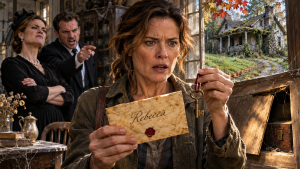
There was a brass key tied to a faded red string.
Under it was an envelope.
My name was written across the front.
REBECCA HALE.
I stopped breathing.
Mrs. Sanders saw my face.
“You all right?”
I took the envelope down.
The paper was yellowed around the edges.
The handwriting was firm.
I opened it.
There were only three lines.
Rebecca,
If your mother sent you here, then things became worse than she hoped.
Before you sign anything concerning the Hale property, open the west wall.
—Eleanor Pike
Mrs. Sanders read it over my shoulder.
Neither of us spoke for several seconds.
Finally she asked, “You know this woman?”
“I knew her when I was little.”
“Well.”
She looked around the dead, dusty kitchen.
“Seems she knew you better.”
I bought the house that afternoon.
Seventy dollars.
Mrs. Sanders tried to make sure I understood what I was doing.
I signed the rehabilitation agreement.
I paid the fee.
I received temporary possession papers pending recording.
By four twenty, I owned the most broken house I had ever seen.
And for the first time in four days, I had somewhere legal to sleep.
Before sunset, I drove to a hardware store.
I spent my last thirteen dollars on a flashlight, work gloves, a pry bar and a package of batteries.
Then I returned to Hawthorn Ridge.
The west wall was in the dining room.
I knew because Eleanor had penciled tiny compass letters beneath the molding.
N.
S.
E.
W.
Someone had thought this through.
I moved the old sideboard.
Behind it, one section of wood paneling had slightly different nails.
I inserted the pry bar.
The board loosened.
Behind it was plaster.
Behind the plaster was a narrow cavity.
Inside the cavity was a metal document box.
The brass key fit.
My hands were steady when I opened it.
That frightened me more than if they had been shaking.
There were four folders.
A cassette tape.
A small recorder wrapped in cloth.
A photograph of my mother and Eleanor standing together beside my father.
And a sealed envelope marked:
IF MARGARET’S CHILDREN DISPUTE HER INTENTIONS, GIVE THIS TO COUNSEL BEFORE SPEAKING TO THEM.
I sat down on the dusty floor.
Outside, the last sunlight disappeared behind the ridge.
I put the cassette in the recorder.
For several seconds there was only static.
Then my mother’s voice filled the room.
Not the weak voice from hospice.
A stronger voice.
Recorded years earlier.
“My name is Margaret Hale. Today is September seventeenth, 2018. I am making this recording because Eleanor has warned me that papers have begun disappearing from Thomas’s estate file.”
My heartbeat slowed.
Not because I was calm.
Because every instinct I had was suddenly focused.
Mom continued.
“Rebecca does not know I am doing this.”
There was a pause.
“If she ever hears it, something has gone wrong.”
I lowered myself onto the floor.
The tape continued.
My father had died in 2016.
Everyone knew he had left our mother the family home.
What I had never known was that he also owned sixty-eight acres of wooded hillside and spring land behind it.
Land our family had treated as nearly worthless for decades.
Except it was no longer worthless.
A regional development company had approached Dad months before his death.
The ridge contained the only practical route for an access road connecting two expanding commercial areas.
Dad refused to sell.
He wanted the woods preserved.
After his death, Mom inherited his interest.
But the recording said something else.
Before he died, Dad had created a family land trust.
Not because he expected millions.
Because he knew his children.
Colin was good with appearances and terrible with money.
Denise had always believed property was valuable only when converted to cash.
And me?
Dad apparently knew something about me I had spent years forgetting.
He knew I would stay.
The trust gave Mom use of everything during her lifetime.
After her death, the family home could be sold and divided.
But control of the ridge property passed differently.
Forty percent to me.
Thirty percent to Denise.
Thirty percent to Colin.
More importantly, any sale of the ridge required my written consent.
Dad had appointed me managing trustee after Mom.
I listened to that sentence three times.
Not because forty percent made me rich.
Because my father had placed something in my hands years after I had begun believing he thought I was the least successful of his children.
He hadn’t chosen me because I had no family.
He had chosen me because he believed I would protect one.
Ours.
The recorder clicked.
Then Eleanor’s voice came through.
“If you’re hearing this, Rebecca, verify everything independently.”
I leaned closer.
“Do not confront your siblings yet.”
A chill moved across my shoulders.
“Original instruments are included in the red folder. Certified copies were deposited separately. Your mother instructed me not to provide locations on this recording.”
Another pause.
“Your father was not afraid of his children stealing money.”
Her voice hardened.
“He was afraid they would sell something they did not understand.”
The tape ended.
I looked at the folders.
The red one contained the trust agreement.
Signatures.
Notary stamps.
Parcel maps.
Correspondence.
The blue folder contained letters between my mother and Eleanor.
The black folder contained copies of documents I recognized only vaguely.
Deeds.
Title reports.
An easement.
And one letter from Eleanor dated eight months before she died.
Rebecca,
If Margaret is still alive when you read this, take these documents to independent counsel.
If Margaret has died, do the same before discussing them with Colin, Denise, Brent, or anyone representing Ridgeway Development.
That name made me sit straighter.
Ridgeway Development.
I had heard Brent mention Ridgeway once.
Maybe twice.
Always casually.
A company buying property outside town.
Building distribution facilities.
Warehouses.
Access roads.
I took out my phone.
One bar of service.
I searched.
Ridgeway had announced a major commercial project six months earlier.
Planned investment: eighty-six million dollars.
The article described one unresolved problem.
Road access.
The proposed eastern route crossed “privately held ridge parcels.”
I looked at the map in the black folder.
Our land.
The next morning, Denise texted me.
Need you to sign some estate papers. Can meet tomorrow at Brent’s office. Won’t take long.
I stared at the message.
Then I smiled for the first time since Mom died.
Not because anything was funny.
Because when someone thinks you know nothing, they become careless.
I wrote back:
Okay.
She responded within eleven seconds.
10 a.m.
I did not go to Brent’s office first.
I went to a legal aid clinic.
The receptionist almost turned me away because they were overloaded.
Then I showed her the first page of the trust.
Twenty minutes later, I was sitting across from a lawyer named Laura Bennett.
She was fifty-something, wore no-nonsense glasses, and read faster than anyone I had ever seen.
When she reached the third document, she stopped.
“Where did you get these?”
“A house I bought yesterday.”
She looked at me over her glasses.
“For seventy dollars.”
“That part sounds ridiculous when I say it out loud.”
“No.”
She returned to the papers.
“The ridiculous part is everything else.”
She asked questions.
Dates.
Deaths.
Names.
Whether I had signed anything.
Whether Mom had suffered cognitive decline.
Whether anyone had power of attorney.
Colin had.
For financial matters.
Six months before Mom died.
Laura’s jaw tightened.
“Who prepared that?”
“A lawyer Colin knows.”
“Name?”
I told her.
She wrote it down.
Then she showed me something in the trust.
“This is important.”
“What?”
“Your father’s trust may have been amended later. We need the courthouse record and complete chain of title.”
“Does this prove anything?”
“It proves enough that you should not sign a single page anyone puts in front of you.”
She flipped to the easement.
“And this…”
She leaned closer.
“What?”
“This house on Hawthorn Ridge.”
“My house?”
“It sits on parcel 18-B.”
“So?”
“Parcel 18-B controls a recorded right-of-way running from the county road to the western edge of the Hale ridge.”
I stared at her.
She tapped the paper.
“Ridgeway may need two things from your family. Ownership rights in the ridge and access across this parcel.”
“Which I bought yesterday.”
“For seventy dollars.”
The room became very quiet.
Laura looked at me carefully.
“Rebecca, do your siblings know you own Hawthorn?”
“No.”
“Keep it that way for twenty-four hours.”
I arrived at Brent’s office at 10:03.
Denise was irritated.
“You’re late.”
“Traffic.”
Colin sat at the conference table.
Brent stood near the window.
Beside him was a man in a gray suit I had never met.
“Rebecca,” Brent said, suddenly friendly. “This is Daniel Moore. He’s helping with some estate matters.”
Daniel extended his hand.
“Sorry for your loss.”
I shook it.
On the table was a document with yellow tabs.
SIGN HERE.
INITIAL HERE.
SIGN HERE.
I sat.
Denise pushed it toward me.
“Basic estate administration.”
I picked it up.
Laura had told me not to behave as though I understood everything.
So I didn’t.
I read slowly.
Page one.
Page two.
Page three.
Colin’s knee bounced under the table.
By page seven, Denise sighed.
“You don’t have to read every word.”
“I’m signing it.”
“It’s routine.”
“Then reading it shouldn’t hurt.”
Brent smiled without warmth.
Daniel said nothing.
Page eleven contained the phrase.
Release of any present or future claim, beneficial interest, equitable interest, trust interest, easement interest or unrecorded title interest relating to the Margaret Hale Estate or associated parcels.
There it was.
Not routine.
Not harmless.
A surrender.
In exchange for twelve thousand dollars.
I looked up.
“Twelve thousand?”
Denise leaned forward.
“That’s generous, Becca.”
“Generous?”
“You lived rent-free for eleven years.”
Colin stared at the table.
There was the moral math.
They had turned caregiving into debt.
Mom’s medication reminders.
Her bathing chair.
Her chemo appointments.
Her insurance fights.
Her final months.
All of it erased by the square footage of a bedroom.
I looked at Colin.
“Is that what you think too?”
He rubbed his thumb against the edge of his watch.
“You got benefits from living there.”
“Did I?”
“You didn’t have a mortgage.”
“No.”
“You didn’t have kids to support.”
“No.”
“You didn’t have—”
He stopped.
I waited.
He looked away.
The silence grew uncomfortable.
Brent finally said, “This is business.”
I nodded.
“Then I have one business question.”
Daniel Moore looked at me.
“What question?”
“Why does a simple estate release mention easements?”
Nobody moved.
It lasted maybe two seconds.
But it was enough.
Brent recovered.
“Standard language.”
“Which easements?”
“Rebecca,” Denise snapped, “stop trying to make yourself important.”
There it was.
Not greed.
Not exactly.
Something older.
She needed me to remain the sister who had stayed behind.
The sister without the impressive job.
The sister who bought Mom’s groceries while Denise posted vacation photos.
If I mattered legally, then perhaps I had mattered all along.
And that would force her to reconsider too many years.
I closed the document.
“I want a copy.”
Brent’s expression hardened.
“These papers are for execution, not distribution.”
Daniel glanced at him.
Interesting.
I stood.
“I’ll have a lawyer review them.”
Denise laughed.
“A lawyer?”
“Yes.”
“With what money?”
I put the document back on the table.
“That sounds like a question you should have asked before you put me out.”
I walked toward the door.
Colin spoke behind me.
“Becca.”
I stopped.
His voice was lower.
“You really want to drag this out over twelve grand?”
I turned.
“You really think this is about twelve grand?”
His face went pale.
That was the first mini-payoff.
Not victory.
Recognition.
He knew I knew something.
By noon, Laura had filed notice of my claim with the estate court.
By three, she had found the recorded trust memorandum.
Not the entire trust.
But enough.
Thomas Hale Family Land Trust.
Created 2015.
Margaret Hale, lifetime trustee.
Rebecca Hale, successor trustee.
That document had been public for eleven years.
No one had bothered telling me.
The next discovery was worse.
Six months before Mom died, a deed had been prepared transferring the ridge acreage out of the trust and into a new entity called Hale Ridge Holdings LLC.
Members: Colin Hale and Denise Mercer.
The deed supposedly carried Mom’s signature.
It was notarized.
It had never been fully recorded because a title examiner flagged a conflict with Dad’s trust.
That title examiner?
Eleanor Pike.
Even in retirement, she had apparently been helping Mom keep track of the property.
The letter in the black folder explained why the house had been used as a hiding place.
Eleanor believed someone had removed trust documents from Mom’s home.
She did not know who.
But she knew people had begun asking about Ridgeway access before Dad’s estate had even closed.
She wrote one sentence in red ink.
If they ever tell Rebecca she has no standing, they are counting on her ignorance, not the law.
I read that line several times.
Then I drove back to Hawthorn House.
For the first time, I cleaned the kitchen.
I swept two years of dust from the floor.
I opened windows.
I carried ruined curtains outside.
I found a camping stove at a thrift store for six dollars.
Mrs. Sanders from the county returned with two donated blankets and an extension cord long enough to reach a temporary utility box.
“You look different,” she said.
“Do I?”
“Yesterday you looked homeless.”
I glanced at the house.
“What do I look like today?”
She smiled.
“Busy.”
That night I slept on the floor in a sleeping bag someone from the county office had loaned me.
Rain hit the roof.
The chimney clicked as it cooled.
Wind moved through the trees.
The house still smelled old.
But it had a lock.
My lock.
At 8:12 the next morning, Denise called.
I let it ring.
She called again.
Then Brent.
Then Colin.
At 8:35, Laura called.
“Ridgeway’s attorney contacted me.”
“That was fast.”
“They were scheduled to close on preliminary acquisition rights Friday.”
“How much?”
She paused.
“The numbers aren’t final. But based on the documents I received, your siblings appear to have negotiated approximately four-point-six million dollars for the ridge interests and access package.”
I sat on the porch step.
Four-point-six million.
For land Dad had bought piece by piece while working double shifts at a machine shop.
For woods where Colin and I built forts.
For the creek where Denise broke her arm at twelve.
For the hillside Mom could see from her bedroom window.
Laura continued.
“They believed they controlled everything.”
“They don’t.”
“No.”
“Because of the trust?”
“And Hawthorn.”
I looked back at my seventy-dollar house.
“The access?”
“Yes.”
“It’s really that important?”
“Without an alternate route, very.”
I laughed once.
I couldn’t help it.
Laura didn’t.
“There’s another issue.”
My smile disappeared.
“What?”
“The signature on the transfer deed.”
“Mom’s?”
“The date is August fourth.”
“Yes.”
“Where was your mother August fourth?”
I knew immediately.
“Raleigh Memorial.”
“You’re sure?”
“I slept in the chair beside her.”
“Could she sign documents?”
“No.”
“Why?”
“She had suffered a stroke on August second.”
Silence.
“She couldn’t use her right hand,” I said.
“The signature appears smooth.”
“She couldn’t hold a spoon.”
Laura exhaled slowly.
“That may become a criminal issue.”
I looked across the valley.
My family had not simply decided I deserved less.
Someone may have tried to manufacture a reality in which I legally did not exist.
The next two weeks changed everything.
A judge issued a temporary order preventing transfer of the disputed ridge property.
Ridgeway suspended negotiations.
The title company froze the transaction.
Colin and Denise hired separate lawyers.
That told me more than any family meeting could have.
People united by innocence tend to stand together.
People united by exposure often begin calculating which chair is farthest from the fire.
Denise sent me a message.
Mom wanted us to share. You’re destroying this family.
I replied with one sentence.
Then why did you need my release?
She didn’t answer.
Colin drove to Hawthorn House two days later.
I saw his truck climbing the road while I was replacing porch boards.
He got out wearing clean jeans and work boots he rarely used.
He stared at the house.
“You bought this?”
“Yes.”
“How?”
“Seventy dollars.”
He almost smiled.
Then he realized I wasn’t joking.
“Jesus.”
I kept measuring the board.
He walked closer.
“You found Eleanor’s things.”
It was not a question.
I set down the tape measure.
“So you knew she kept things.”
Colin’s face tightened.
“I knew Mom talked to her.”
“About Dad’s trust?”
“Rebecca—”
“About Dad’s trust?”
He looked toward the valley.
“Some.”
“Did Denise know?”
“Yes.”
There was no point pretending anymore.
“Why didn’t anyone tell me?”
Colin rubbed both hands over his face.
“Because everything got complicated.”
“No. Complicated is a leaking roof. Try again.”
He looked at me.
I had never spoken to him like that.
Or maybe I had never made him listen.
He sat on the porch railing.
For a while, neither of us spoke.
Then he said, “Denise and Brent approached Ridgeway first.”
That surprised me.
“Why?”
“Debt.”
I waited.
“Brent’s business is worse than people think. Denise refinanced twice. They owe money everywhere.”
“And you?”
His jaw tightened.
“I invested in one of Brent’s projects.”
“How much?”
“Enough.”
There was the motive.
Not evil.
Fear wearing expensive clothes.
He continued.
“They found out what the ridge might be worth. Brent started digging into Dad’s records. He said the trust was old, that Mom could move the land out.”
“Could she?”
“Not without conditions.”
“And my consent.”
He looked at me.
“Yes.”
“So you decided not to ask.”
“We thought…”
“What?”
His voice cracked slightly.
“We thought you’d say no.”
I picked up the new porch board.
“Dad thought so too.”
He stared at me.
“That’s why he picked you.”
I stopped.
Colin looked almost angry when he said it.
“He told me once. Years ago. He said you were the only one who understood that owning something and deserving to sell it were different things.”
For some reason, that hurt more than the eviction.
Because I had spent half my adult life believing Dad saw me as the daughter who never launched.
Apparently he had seen something else.
“Did you forge Mom’s signature?”
Colin stood immediately.
“No.”
“Do you know who did?”
“No.”
“Did you see her sign?”
He hesitated.
That was enough.
I stepped closer.
“Colin.”
“Brent brought papers to the hospital.”
“When?”
“August third.”
“She had a stroke August second.”
“He said the attorney had already discussed everything with her.”
“Did you see her sign?”
“No.”
“Did Denise?”
“I don’t know.”
I watched him.
“You’re lying.”
His eyes flashed.
“You think this is easy for me?”
“I washed our mother’s body after she died because the hospice nurse was forty minutes away.”
He went still.
“You want to talk about difficult?”
He looked down.
I lowered my voice.
“I’m not asking whether this is easy. I’m asking whether you saw Mom sign.”
“No.”
The word came out barely above a whisper.
“Thank you.”
He looked at me.
“For what?”
“For finally giving me something true.”
The hearing took place five weeks later.
By then, Hawthorn House had electricity.
The roof no longer leaked.
Mrs. Sanders had somehow recruited three retired men from a church repair group to stabilize the back porch.
I found part-time bookkeeping work with a small medical supply company.
I bought a mattress.
Not a good mattress.
But a mattress.
The first night I slept on it, I woke at three in the morning because my body was confused by softness.
Meanwhile, the family house remained unsold.
Denise blamed me.
Brent blamed the lawyers.
Colin stopped blaming anyone publicly.
At the courthouse, Denise wore navy blue.
Brent wore a dark suit.
Colin looked twenty years older.
Laura placed Eleanor’s original documents on the table.
The judge listened.
No shouting.
No dramatic confession.
Real disasters rarely arrive with speeches.
They arrive in dates.
Signatures.
Bank transfers.
Email chains.
Metadata.
Hospital charts.
A notary log.
That was what broke them.
The notary who supposedly witnessed Mom’s signature had not been at Raleigh Memorial on August fourth.
Her electronic access records placed her at a closing seventy miles away.
Mom’s hospital chart showed she had significant right-side paralysis.
The signature attributed to her had been produced with her right hand.
Then came the email.
Brent to the drafting attorney.
Need this cleaned up before Ridgeway title gets another look. Margaret is declining quickly. Once she passes, Rebecca may become a problem.
Not a criminal confession.
Not exactly.
But enough to turn every head in the courtroom.
Denise stared straight ahead.
Colin closed his eyes.
Brent leaned toward his attorney.
Laura touched my arm once.
Stay calm.
I was calm.
I had been calm on the porch.
I had been calm in the Walmart parking lot.
I had been calm when I opened Eleanor’s wall.
People mistake calm for weakness when they are accustomed to power being noisy.
The judge ruled the attempted transfer invalid.
The trust remained controlling.
I was confirmed as successor trustee.
The disputed ridge could not be sold without my approval.
The estate release my siblings had tried to make me sign was placed into the court record.
The judge also referred the signature issue for further review.
Brent’s face changed when he heard that.
Until then, this had been money.
Suddenly it was something else.
Denise found me outside the courtroom.
She moved quickly.
“Rebecca.”
I kept walking.
She grabbed my arm.
I looked at her hand.
She released me.
“You got what you wanted.”
I turned.
“What do you think I wanted?”
“The land.”
“No.”
“The money?”
“No.”
“Then what?”
People moved around us on the courthouse steps.
Lawyers.
Families.
A deputy drinking coffee.
Traffic passing beyond the lawn.
I looked at my sister.
“I wanted Mom to be allowed to have meant what she said.”
Denise’s face changed.
Only slightly.
I continued.
“You turned her illness into an opportunity.”
“That’s not fair.”
“Neither was putting my suitcase in the rain three days after we buried her.”
“You were going to fight us anyway.”
“I didn’t know there was anything to fight over.”
“You always acted like you were the only one who cared about her.”
“No.”
My voice stayed soft.
“I acted like I was the one who was there.”
She looked away.
That distinction hurt her.
Good.
Some pain is simply truth entering a place that resisted it.
Ridgeway came back with another offer.
Higher.
Much higher.
Six-point-one million for the ridge and access package.
My lawyer expected me to reject it.
Instead, I asked for changes.
Twenty-two acres containing Dad’s favorite woods would be placed permanently into a conservation trust.
The family cemetery would remain untouched.
The spring would be protected.
A public walking trail would follow part of the old logging road.
The development company could purchase only the portion needed for access and commercial use.
And a separate fund would be established to restore the creek bank damaged by construction.
The revised deal paid less than the maximum we could have extracted.
But it preserved what Dad had cared about.
My share was still more money than I had ever imagined possessing.
Denise and Colin received theirs too.
I did not try to cut them out.
That surprised everyone.
Especially Denise.
At the final mediation she stared at me across the table.
“You could have punished us.”
“I could have.”
“Why didn’t you?”
“Because Dad didn’t create the trust to punish you.”
She had no answer.
Then I added, “The court can handle the rest.”
Brent looked at me sharply.
For the first time, Denise seemed to realize that winning the inheritance dispute did not erase how they had tried to win it.
Three months later, Brent was charged with offenses related to falsified estate documents and fraudulent notarization.
The drafting attorney denied knowing the signature was false and cooperated.
The notary surrendered her commission while investigators examined several transactions.
Denise was not charged.
Neither was Colin.
But both gave statements.
Their marriages did not survive the year.
That was not my doing.
Some houses collapse because the foundation was already gone.
Colin called me the following spring.
He asked whether he could come to Hawthorn.
I said yes.
He arrived carrying two coffees.
We sat on the repaired porch.
The valley was turning green.
“I’m sorry,” he said.
I said nothing.
“I know that isn’t enough.”
“No.”
“I don’t expect you to forgive me.”
“Good.”
He almost laughed.
Then his eyes filled.
Mine didn’t.
That did not mean I hurt less.
It meant we hurt differently.
“I convinced myself you’d already gotten your inheritance,” he said.
“What inheritance?”
“Time with Mom.”
I looked at him.
He winced immediately.
“That sounded terrible.”
“It was terrible.”
“I know.”
I drank my coffee.
After a while, I said, “You know what time with Mom looked like?”
He waited.
“It looked like changing sheets at two in the morning because she was embarrassed she couldn’t reach the bathroom.”
He stared at his cup.
“It looked like cutting pills in half at the kitchen table.”
I looked across the ridge.
“It looked like calling insurance companies while she slept.”
He nodded once.
“It looked like hearing her ask for Dad after he’d been dead seven years.”
His eyes closed.
“And yes,” I said. “Sometimes it looked like sitting beside her while she laughed at an old game show. Sometimes she remembered me. Sometimes she squeezed my hand. Sometimes I got pieces of her no one else got.”
I paused.
“That was a gift.”
He looked up.
“But don’t ever call the price I paid for it free.”
He nodded.
“I won’t.”
That was the closest we came to forgiveness that day.
It was enough.
Denise took longer.
Almost a year.
Her first letter was defensive.
Her second was shorter.
Her third contained no excuses.
I kept that one.
Not because everything was repaired.
Some things should not return to their original condition.
A repaired thing should show where it broke.
Otherwise people forget what nearly destroyed it.
I used part of my settlement to renovate Hawthorn House.
Not into a mansion.
I didn’t want one.
I kept Eleanor’s bookshelves.
I restored the stone chimney.
I had the blue enamel flour canister cleaned but left the scratches.
The hidden space in the west wall stayed.
I installed a small brass plaque inside it.
Not outside.
I didn’t want strangers seeing it.
It read:
FOR THE THINGS PEOPLE HIDE WHEN THE TRUTH ISN’T SAFE YET.
I also established the Margaret and Thomas Hale Caregiver Grant through a local nonprofit.
It provided emergency money to people caring for elderly relatives who had left work or reduced their hours.
The first recipient was a fifty-nine-year-old woman taking care of her husband after a stroke.
The second was a twenty-seven-year-old man caring for his grandmother with dementia.
The third was a mother of three who had moved her father into her dining room because there was nowhere else to put a hospital bed.
That mattered more to me than the check from Ridgeway.
Because the biggest secret inside Eleanor’s wall had never been that the land was worth millions.
The biggest secret was that my father had seen the labor everyone else treated as invisible.
My mother had seen it too.
Eleanor had protected their intentions when they could no longer protect them themselves.
The money changed my bank account.
The documents changed the story of my life.
There is a difference.
For eleven years, I had been described as the daughter who “never left home.”
The truth was that I had built my life around someone who needed me.
For eleven years, people said I was lucky not to pay rent.
The truth was that round-the-clock care would have cost more than the house ever did.
For eleven years, I was treated like the sibling with the smallest life.
The truth was that my life had held another human being upright.
And when they finally pushed me out, they believed they were removing the weakest person from the equation.
They never understood that I had spent eleven years learning patience.
Medication schedules teach patience.
Hospice teaches patience.
Dementia teaches patience.
Grief teaches patience.
Watching people underestimate you teaches patience best of all.
Two years after I slept in that Walmart parking lot, I went back.
Same store.
Same far corner.
Same bright parking lights.
I parked my repaired Honda in roughly the place where I had spent those four nights.
For a while, I just sat there.
People pushed shopping carts past me.
A teenager collected carts.
A family loaded groceries into an SUV.
Nothing looked sacred.
Nothing looked tragic.
That was the strangest part.
The worst night of your life can happen in a place where everyone else is buying cereal.
I remembered sitting there with my coat pulled over my chest.
I remembered checking the locks every hour.
I remembered calculating whether I could afford coffee.
I remembered Mom’s voice.
Go uphill.
I had thought she was telling me where to find shelter.
She was telling me where to find the truth.
My phone rang.
It was Laura.
“Are you sitting down?”
“I am.”
“The state investigator finished the document review.”
My fingers tightened around the phone.
“And?”
“They recovered something from Brent’s old office computer.”
“What?”
“A scanned draft.”
I waited.
“Rebecca, it predates your mother’s stroke.”
“So?”
“It includes a different signature page.”
“Mom’s?”
“No.”
A pause.
“Yours.”
My breath stopped.
“What are you talking about?”
“Someone had prepared a version of the land transfer that made it appear you consented.”
For the first time in a long time, I felt cold all the way through.
“But I never signed anything.”
“I know.”
“When was it created?”
“Four years before your mother died.”
I stared through the windshield at the fluorescent Walmart sign.
Four years.
This had started four years earlier than I knew.
“Who created it?”
“That’s the problem.”
“What problem?”
“The file didn’t originate on Brent’s computer.”
I said nothing.
Laura continued.
“It was forwarded to him.”
“By who?”
“They’re working on that.”
I closed my eyes.
Then another memory surfaced.
Dad’s funeral.
A stack of paperwork.
Colin telling me he needed my signature “just to close an old account.”
Denise standing beside the refrigerator.
Mom crying upstairs.
Brent holding a pen.
I had signed something.
Hadn’t I?
Not the land transfer.
Something else.
But they had my signature.
They had possessed it for years.
I opened my eyes.
“Laura.”
“Yes?”
“Did investigators compare the fake signature to anything?”
“They did.”
“And?”
“It appears traced from a document executed shortly after your father died.”
The parking lot seemed to go silent.
I knew exactly which document she meant now.
The old account.
The harmless paper.
The thing I had signed without reading because my father had been dead for forty-eight hours and I trusted my family.
That night, I drove directly to Colin’s house.
His truck was outside.
He opened the door wearing sweatpants and an old West Virginia University sweatshirt.
His expression changed the moment he saw me.
“Becca?”
I held up my phone.
“Laura called.”
His face drained.
He stepped outside and pulled the door shut behind him.
“What happened?”
“The investigators found a draft with my forged consent.”
He stared at me.
“I didn’t know that.”
“Four years before Mom died.”
“I swear to you—”
“They traced my signature from the paperwork after Dad’s funeral.”
He stopped speaking.
Rain had begun falling lightly.
Almost exactly like the night Denise put my suitcase outside.
I watched my brother’s face.
Not his words.
His face.
And then I saw it.
Recognition.
Not guilt.
Recognition.
He knew what document they had used.
“Colin.”
He swallowed.
“What did I sign after Dad died?”
“You signed several things.”
“Which one had my full signature?”
He looked toward the dark street.
“Colin.”
His shoulders lowered.
“There was a waiver.”
“What waiver?”
“For Dad’s business account.”
“And?”
“That’s what we told you.”
The world narrowed.
“What was it actually?”
He closed his eyes.
I stepped closer.
“What did I sign?”
“It was connected to the estate.”
“How?”
He opened his eyes.
“Dad had another asset.”
I stared at him.
“The ridge?”
“No.”
“Then what?”
He looked sick.
“A company.”
I said nothing.
“He owned part of a manufacturing company with two partners. Quietly. For years.”
“How much?”
“I don’t know what it was worth then.”
“What is it worth now?”
His silence answered first.
“Colin.”
“Maybe twenty million.”
For one strange second, all I could hear was rain hitting leaves.
Then I laughed.
Not because it was funny.
Because there are moments when reality becomes so absurd that laughter is simply the body refusing to break.
“Whose company?”
“I don’t know everything.”
“You knew enough to keep it from me.”
“Mom knew too.”
That hurt.
He saw it.
“She wanted to tell you.”
“When?”
“After everything settled.”
“Everything settled?”
“She was afraid.”
“Of what?”
He hesitated.
Then he said the one name I had not expected.
“Eleanor.”
I stared at him.
“What about Eleanor?”
“She didn’t hide those documents just from us.”
My heartbeat slowed again.
That dangerous calm returned.
“What does that mean?”
Colin leaned against the porch post.
“There’s another box, Rebecca.”
“Where?”
“I don’t know.”
“You expect me to believe that?”
“I know she told Mom there were two.”
Two boxes.
The metal box in Hawthorn’s west wall had contained the land trust.
The cassette.
The letters.
The warning.
One box had turned a seventy-dollar house into the doorway to everything my family had tried to erase.
Now Colin was telling me there had been another.
“Why didn’t you tell me before?”
“Because I didn’t think it existed.”
“What changed?”
“That draft with your signature.”
I waited.
He looked at me.
“Eleanor said once that if anybody ever tried to use one of Dad’s old waivers against you, the second file would explain why.”
There it was.
Another legal seed planted by a dead woman who had expected the living to behave badly.
I stepped backward.
Colin said my name.
I turned toward my car.
“Rebecca.”
I stopped at the walkway.
“Where are you going?”
“Home.”
“To Hawthorn?”
“Yes.”
He followed me two steps.
“Why?”
I looked back at him.
“Because Eleanor hid the first box in the west wall.”
“So?”
I opened the car door.
“So before she died, she wrote compass letters under every room in that house.”
His expression changed.
I got in.
The drive to Hawthorn took twenty-seven minutes.
I made it in twenty-three.
The house stood warm and lit against the dark hillside.
My house.
Seventy dollars.
Mossy steps.
Broken gutters.
A place no one had opened for almost two years.
A place everyone had dismissed because they assumed value always announced itself from the outside.
I entered the dining room.
The west wall was already open.
I checked north.
Nothing.
East.
Bookshelves.
South.
The fireplace.
I stared at it.
Stone chimney.
Original.
Restored.
And suddenly I remembered something the contractor had said months earlier.
There’s a strange dead pocket beside this flue. Too small for a closet. Probably old construction.
I grabbed my flashlight.
Twenty minutes later, I found a removable stone behind the mantel.
Behind it was darkness.
I reached inside.
My fingers touched metal.
A second box.
Smaller than the first.
Black.
Locked.
No key.
Taped to the top was an envelope.
REBECCA.
I opened it standing beside the fireplace.
Inside was a single sheet in Eleanor Pike’s handwriting.
If you found this box, then they tried to use your father’s death against you twice.
Do not open it alone.
Do not call Denise.
Do not call Colin.
Call counsel.
Then ask Colin one question before investigators do.
I read the final line.
Once.
Twice.
Three times.
Outside, a car engine climbed Hawthorn Ridge Road.
Headlights moved through the trees.
Someone was coming.
I folded Eleanor’s note.
Put the second box under my arm.
And for the first time since my sister had thrown my suitcases into the rain, I understood that the seventy-dollar house had never been abandoned.
It had been waiting.
Waiting for the person everyone underestimated.
Waiting for the daughter who stayed.
Waiting for the one person patient enough to open the right wall.
The headlights stopped outside.
A car door slammed.
I stood in the dining room with the box against my chest.
Then I called Colin.
He answered on the first ring.
“Rebecca?”
I looked toward the front door.
A shadow crossed the porch.
My voice was almost gentle when I asked him the question Eleanor had written.
“Colin… when Dad died, why did you need my signature before anyone had even read his will?”
The knock came three seconds later.
And this time, I already knew better than to open the door.