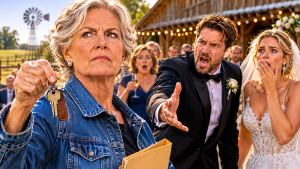
The room became so quiet that I could hear the ice shifting inside someone’s glass.
I unfolded the email completely.
Derek stood beside Britney, staring at the paper in my hand. His expression was a mixture of confusion and irritation, as though he still believed I was the one who owed everyone an explanation.
I looked at my son.
The boy I had raised.
The boy whose scraped knees I had bandaged, whose school lunches I had packed, whose tears I had wiped away when his father died.
Then I began reading.
“To Ridgerest Development,
My fiancé’s family owns approximately 1,100 acres of valuable agricultural property in Gallatin County. After our wedding, we expect to have control over the property because Georgia Morrison is getting older and will eventually need to step aside.
We are interested in discussing a residential development project, potentially including luxury homes, private roads, and commercial space.
We believe the land could generate a substantial return, especially if the current owner can be persuaded to transfer management rights.”
I stopped reading.
Nobody moved.
Britney’s mother, Sandra, was standing near the dessert table. Her champagne glass was halfway to her mouth.
Derek turned toward his wife.
“What is she talking about?”
Britney blinked.
“She’s twisting things.”
I looked down at the paper.
“Would you like me to continue?”
Nobody answered.
So I did.
The next paragraph was worse.
“Once the wedding has taken place, we expect to convince Georgia that maintaining the property is becoming too difficult for her. Derek will then assume responsibility for operations, allowing us to move forward without unnecessary delays.”
I lowered the paper.
“Without unnecessary delays,” I repeated.
Derek stared at Britney.
“Did you write this?”
She reached for his arm.
“Baby, listen to me. It’s not what it looks like.”
He pulled away.
“Did you write this?”
Her lips parted, but no answer came.
I had spent nearly forty years learning how to read people. I knew when a rancher was hiding a debt, when a buyer was lying about his cattle, and when someone was trying to sell me something I didn’t need.
I recognized fear.
Britney was terrified.
But I wasn’t finished.
I reached into my purse and removed another document.
“This is the property ownership record. And this is the Morrison Family Land Trust, established seven years ago.”
I placed both documents on the table.
“Every acre of Morrison Ranch belongs to the trust. I am its sole acting trustee. Derek has never owned a single acre.”
Sandra finally found her voice.
“That’s ridiculous. He’s your only son!”
I turned toward her.
“Being my only son doesn’t make him the owner of everything I worked my entire life to build.”
“You’re going to leave him with nothing?” she snapped.
I looked at her for several seconds.
“No, Sandra. I’m simply refusing to let someone take what was never theirs.”
The room remained silent.
Then Derek did something I hadn’t expected.
He walked toward me.
“Mom, can we talk privately?”
For a moment, I wanted to believe him.
I wanted to believe that somewhere beneath the expensive suit and the expensive wedding, my son was still there.
But then I remembered his fingers gripping my arm.
I remembered the two hundred guests watching him throw me out.
I remembered driving home alone.
I remembered feeding the cattle because they were the only living creatures that needed me without asking what I owned.
“There’s nothing private left to discuss,” I said.
His face hardened.
“You can’t seriously be doing this to me.”
I folded the email.
“I’m not doing anything to you, Derek. I’m protecting myself.”
And for the first time in his adult life, my son had absolutely nothing to say.
THE WOMAN WHO BUILT EVERYTHING
To understand what happened next, you need to understand Morrison Ranch.
It wasn’t simply a property.
It was my life.
My husband, Frank, and I bought the original two hundred acres in 1990.
We weren’t rich.
We weren’t connected.
We weren’t the kind of people who could call a banker and receive a million-dollar loan because of a family name.
Frank had a battered pickup, a toolbox, and an unreasonable belief that almost anything could be repaired.
I had a teaching degree, a small savings account, and a determination that sometimes frightened even me.
Our first home was a single-wide trailer.
In winter, the kitchen pipes froze. In summer, the roof became so hot that sleeping felt like lying inside an oven.
We raised cattle, repaired fences, planted hay, and sold whatever we could.
Frank used to say that land was like a marriage.
“You can’t expect it to love you just because you own it,” he told me once. “You have to take care of it.”
I laughed at him.
“You’re comparing our marriage to a field?”
He smiled.
“Both require patience.”
Then he kissed my forehead and went back outside.
Those were good years.
Hard years, but good ones.
Our son, Derek, was born the following spring.
Frank adored him.
He built him a little wooden horse, taught him how to recognize animal tracks, and let him ride on the tractor even when I told him the boy was too young.
Derek’s childhood smelled like hay, fresh coffee, and the leather seats of his father’s pickup.
But everything changed when Derek was ten.
Frank died in an accident in the east field.
A broken mower overturned while he was repairing it.
By the time I reached him, the ambulance was already on its way.
I remember the doctor standing in front of me.
I remember Derek crying against my shoulder.
I remember looking toward the ranch house and realizing that Frank would never walk through that door again.
The insurance company paid me $120,000.
People told me to sell the ranch.
My brother said I couldn’t raise a boy and run a farm alone.
My neighbors offered to buy the cattle.
One man even suggested I move to town and find a smaller house.
But every time I considered selling, I remembered Frank standing beside the iron ranch sign.
MORRISON RANCH.
The M leaned slightly to the left.
I couldn’t abandon it.
So I stayed.
I bought another three hundred acres when a neighboring rancher retired.
Then another hundred.
I went back to teaching during the day and worked the ranch before sunrise and after sunset.
I learned to repair tractors.
I learned to negotiate with feed suppliers.
I learned to pull calves in the middle of winter.
I learned that grief didn’t disappear.
It simply became part of your daily routine.
Twenty-two years later, Morrison Ranch covered 1,100 acres.
We had nearly four hundred cattle, modern barns, upgraded irrigation, and a certified organic operation.
I had employees.
I had contracts.
I had a reputation.
And I had built it without anyone handing me anything.
Except the one thing I had never learned how to do.
Say no to my son.
THE SON WHO THOUGHT EVERYTHING WAS HIS
Derek had always been a good child.
At least, that’s what I remembered.
When he was fourteen, a premature calf was born during a snowstorm.
He spent six hours in the barn holding it against his chest.
The calf didn’t survive.
Derek cried harder than I had ever seen him cry.
I held him and told him that sometimes loving something meant doing everything you could, even when the outcome wasn’t in your hands.
I thought he understood.
When he finished college, I welcomed him back to the ranch.
I gave him the guest cottage.
I paid his utilities.
I bought him a pickup truck because he said his old car wasn’t reliable enough for work.
I gave him money when he needed help.
And when he told me he wanted to start a livestock consulting business, I allowed him to use one of our storage buildings as an office.
I never charged him rent.
I told myself it was what a mother did.
Then Britney arrived.
She was beautiful, confident, and very skilled at making every conversation sound like a business negotiation.
The first time she visited, she walked around the property taking photographs.
“Eleven hundred acres,” she said. “Georgia, this is incredible.”
I smiled.
“It took a long time.”
She looked at the hills.
“Have you ever considered selling?”
I thought she was joking.
“No.”
She laughed.
“Well, you should at least know what it’s worth.”
I changed the subject.
But the questions continued.
How much money did the ranch generate?
Who handled the accounts?
Did I have a retirement plan?
Was I planning to work forever?
One evening, she asked whether I had considered moving into a retirement community.
I looked at her.
“I’m sixty-eight, Britney. Not ninety-eight.”
She smiled.
“Of course. I only mean that you deserve to relax.”
I should have recognized the warning.
Instead, I tried harder to make her feel welcome.
When Derek announced their engagement, I congratulated him.
When Britney planned the wedding, I offered our renovated barn.
She refused.
Then they asked me for $15,000 toward their wedding.
I wrote the check.
I didn’t ask for anything in return.
I didn’t know that I was helping pay for the event where my own son would humiliate me.
THE FIRST LEGAL WARNING
After the cattlemen’s association dinner, I returned home with a strange feeling in my stomach.
I wasn’t angry anymore.
I was alert.
The following morning, I called Harrison Webb.
Harrison had been our attorney for nineteen years.
He had helped Frank and me establish our original business agreements, and he had handled the paperwork when I expanded the ranch.
He was seventy-one, wore old-fashioned glasses, and had the habit of listening longer than most people thought necessary.
I placed the emails on his desk.
He read them twice.
Then he removed his glasses.
“Georgia, how long has Derek been living in the guest cottage?”
“Six years.”
“Does he pay rent?”
“No.”
“Does he have access to the business accounts?”
“He has access to some operational information. Nothing concerning ownership.”
“Has he signed any documents giving him authority over the land?”
“Not that I know of.”
Harrison nodded.
“Good.”
He opened the trust documents.
“Your husband wanted to protect this property. You remember that conversation?”
I did.
Frank had always worried about what would happen if something happened to me.
He didn’t trust distant relatives, business partners, or people who appeared during difficult times offering convenient solutions.
He wanted Morrison Ranch to remain protected.
Harrison continued.
“The trust is clear. You control the property as trustee. Derek is not a beneficiary with immediate ownership rights. He cannot sell, transfer, subdivide, or mortgage the land.”
“Could he try?”
“He could try anything. That doesn’t mean he has the authority.”
I handed him another printed email.
“This one mentions management rights.”
Harrison studied it.
Then his expression changed.
“Georgia, I want you to do something for me.”
“What?”
“Don’t confront them again without speaking to me first.”
“Why?”
“Because this looks more organized than a family disagreement.”
He tapped the page.
“They’ve been speaking with developers for months. We need to find out whether they’ve made any representations about ownership or signed anything.”
For the first time, I felt something close to fear.
Not fear of losing my land.
Fear of discovering how far my son had gone.
THE SECRET THEY HAD BEEN HIDING
Harrison hired an independent property consultant to examine the development correspondence.
Within a week, we had a clearer picture.
Ridgerest Development had been considering a project covering almost half the ranch.
Their preliminary proposal included:
-
Three hundred luxury residential lots.
-
A private road system.
-
A small commercial center.
-
A recreational lake.
-
A gated community with private security.
The estimated gross development value was between six and nine million dollars.
But there was another problem.
The developer had received documents that appeared to show Derek as the future property manager.
One document even contained a preliminary signature bearing his name.
Harrison placed it on his desk.
“Did you authorize this?”
“No.”
“Did you sign it?”
“No.”
“Then we need to establish exactly where it came from.”
He instructed me not to alter anything, not to delete messages, and not to contact the developer directly.
He also recommended securing the ranch’s physical access points and reviewing every person who had access to its business records.
The next afternoon, I changed the locks.
Not because I wanted to punish Derek.
Because I had finally understood that kindness without boundaries could become an invitation to be exploited.
THE DAY MY SON CAME BACK
Three days later, Derek arrived at the ranch.
I was repairing a water line near the north pasture when I heard his truck.
He parked beside the house.
He got out wearing sunglasses and an expensive jacket.
“Mom!”
I continued tightening the pipe.
“Morning, Derek.”
He walked toward me.
“We need to talk.”
“Your lawyer can contact Harrison.”
His expression darkened.
“Why are you involving lawyers?”
I stood up.
“Because you involved developers.”
He removed his sunglasses.
“You’re making this into something it isn’t.”
“Then explain the emails.”
He looked away.
“Britney was exploring possibilities.”
“With my land?”
“Our land.”
I stared at him.
“No. My land.”
He sighed.
“Mom, you’re not going to live forever.”
The words landed harder than he probably intended.
I looked at him for a long time.
Then I said something I had never said before.
“Neither was your father.”
Derek went quiet.
I continued.
“When he died, I could have sold this place. I could have taken the insurance money and moved to town. But I stayed because this was our home. I raised you here. I built this place while working two jobs. I buried your father here. I planted trees here. Every building on this property has a story.”
He rubbed his forehead.
“Nobody is asking you to forget Dad.”
“You’re asking me to surrender everything he helped build.”
“We’re trying to create a future.”
“Whose future?”
He didn’t answer.
I looked toward the house.
“Your belongings are packed in the guest cottage. Harrison will arrange a time for you to collect them.”
His mouth opened.
“You’re kicking me out?”
I shook my head.
“You stopped living here as my son a long time ago. You were simply enjoying the free accommodation.”
He stared at me as if he had never heard the word no.
Then he climbed into his truck and drove away.
BRITNEY’S BIGGEST MISTAKE
I thought that would be the end of it.
I was wrong.
Two days later, I received a call from a woman named Elaine Porter.
She was the project manager at Ridgerest Development.
She introduced herself politely and asked whether I was available for a meeting.
I told her I wasn’t interested in selling.
There was a pause.
Then she said something that made me sit down.
“Mrs. Morrison, we were under the impression that your son had permission to negotiate on your behalf.”
“He doesn’t.”
Another pause.
“May I ask whether you’re aware of the documents we received?”
“I am.”
Elaine lowered her voice.
“Then I think you should know that we have suspended all discussions. Our legal department is reviewing the information we were given.”
“Thank you.”
Before ending the call, she added:
“There is one more thing. We received a financial proposal from someone claiming to represent the future ownership of Morrison Ranch. It included an anticipated payment structure.”
“What kind of payment structure?”
“An initial consulting payment of $85,000, followed by a development management fee.”
My stomach tightened.
“Who was the recipient?”
She hesitated.
“Britney Keller.”
I thanked her and hung up.
Then I called Harrison.
When he arrived, I told him everything.
He sat quietly for several minutes.
Finally, he said:
“This may no longer be a simple property dispute. We need to preserve all correspondence and have the appropriate authorities review any potentially fraudulent documents.”
I agreed.
I wasn’t interested in revenge.
I wanted the truth.
And I wanted my ranch protected.
THE LETTER THAT CHANGED EVERYTHING
A week later, a certified letter arrived.
It was from Derek.
I recognized his handwriting immediately.
I opened it at the kitchen table.
Mom,
I know you’re angry, but I think we’ve both made mistakes.
Britney and I were trying to plan our future. We thought you would eventually want to retire, and we believed the ranch could provide opportunities for everyone.
You have to understand that I’m your only child.
Everything you own will eventually come to me anyway.
Why make this difficult?
We should be able to work something out.
I read the letter twice.
Then I placed it beside Frank’s old coffee mug.
Everything you own will eventually come to me anyway.
That sentence told me everything.
My son didn’t see the ranch as my home.
He saw it as his future inheritance.
He had forgotten that an inheritance was something given freely after a person’s life.
It wasn’t something a child could demand while their parent was still alive.
I called Harrison.
“I want to make some changes.”
“What changes?”
“I want the trust reviewed. I want the succession plan updated. And I want to make sure nobody can use my age or my son’s name to interfere with this property.”
Harrison nodded.
“That’s entirely your decision.”
For the next month, we worked carefully.
We reviewed every document.
We strengthened the trust’s governance provisions.
We appointed an independent successor trustee.
We documented the ranch’s ownership history and its business assets.
We also established clear rules regarding access to property, financial records, and management authority.
Derek would not inherit control simply because he was my son.
Any future benefit would depend on the terms I chose, not on promises he imagined I had made.
And for the first time in years, I felt that the future belonged to me again.
THE PHONE CALL AT MIDNIGHT
At 11:46 one night, my phone rang.
It was Derek.
I almost let it go to voicemail.
But something made me answer.
“Hello?”
“Mom?”
His voice sounded different.
Not angry.
Not demanding.
Afraid.
“What’s wrong?”
“Britney left.”
I sat up in bed.
“What do you mean?”
“She took some of her things. She went to her mother’s house.”
I remained silent.
He continued.
“She’s saying the developer is blaming her. They’re asking for documents. She’s saying I gave her permission to handle everything.”
“Did you?”
He didn’t answer.
“Derek?”
“I didn’t know she was going to ask for money.”
I closed my eyes.
“Did you know about the development?”
“Yes.”
“Did you know she was telling them you would take control of the ranch?”
A long silence followed.
Then he whispered:
“Yes.”
I felt my throat tighten.
“Why?”
“She said it was normal. She said families do these things all the time. She said you would eventually understand.”
I looked toward the window.
The ranch was dark.
Somewhere in the distance, cattle shifted in the pasture.
“Derek, did you ever ask me what I wanted?”
He began crying.
“I thought you would give it to me.”
“Why?”
“Because I’m your son.”
I waited.
Then I said:
“Being my son gave you a home, a childhood, an education, and every opportunity I could afford. It did not give you ownership of my life.”
He cried harder.
“Mom, I don’t know what to do.”
For a moment, the mother in me wanted to rescue him.
But I had learned something important.
You cannot save an adult child from every consequence without teaching them that consequences are optional.
“Talk to your lawyer,” I said gently. “Tell the truth. Don’t sign anything else without understanding it.”
“Will you help me?”
“I’ll help you find the right people to speak to. But I won’t lie for you.”
He went quiet.
Then he asked:
“Do you hate me?”
That question nearly broke me.
“No, Derek. I don’t hate you.”
“Then why won’t you forgive me?”
I looked at Frank’s photograph on the bedside table.
“Because forgiveness doesn’t mean giving someone another opportunity to hurt you.”
And I ended the call.
THE LAST ATTEMPT TO TAKE THE RANCH
Three weeks later, Derek and Britney appeared at the front gate together.
I watched them from the kitchen window.
They were arguing.
Britney was waving her hands. Derek was standing with his arms crossed.
Eventually, they approached the house.
I opened the front door but remained on the porch.
“Good afternoon.”
Britney smiled.
It was the same polished smile she had worn at our first dinner.
“Georgia, we need to clear up a misunderstanding.”
I said nothing.
She continued.
“Things have gotten out of control. We never intended to hurt you.”
Derek looked exhausted.
“Mom, can we please talk?”
I stepped aside enough to let them enter the porch, but not the house.
Britney began immediately.
“The development company has misunderstood our proposal. We were only exploring potential opportunities.”
“Then why did you say you expected to take control of my land?”
Her smile disappeared.
“That was just business language.”
“Why did you request $85,000?”
She looked at Derek.
He stared at the ground.
“That was a consulting arrangement,” she replied.
“Why did you describe me as someone who would eventually need to step aside?”
She didn’t answer.
I nodded.
“That’s what I thought.”
Derek stepped forward.
“Mom, I made a mistake.”
I looked at him.
“Yes.”
“I should never have let this happen.”
“No.”
“I should never have treated you like that at the wedding.”
I felt my eyes grow hot.
“You’re right.”
He swallowed.
“Can we start over?”
I studied his face.
He looked older.
Smaller.
Not like the confident young man who had grabbed my arm in front of two hundred guests.
But I needed to know something.
“Tell me the truth, Derek. If I had no ranch, no money, and no property to inherit, would you still be standing on this porch?”
He opened his mouth.
Nothing came out.
I nodded slowly.
“That’s the answer I needed.”
Britney stepped forward.
“This is ridiculous. You cannot let one disagreement destroy your family.”
I looked directly at her.
“You didn’t destroy my family, Britney. You showed me what you believed my family was worth.”
Her cheeks flushed.
Derek turned toward her.
“Stop.”
She stared at him.
“What?”
“Just stop.”
For the first time, I saw him stand up to her.
It didn’t erase what he had done.
But it was the first honest thing I had seen from him in months.
Britney turned and walked back toward the car.
Derek remained.
“Mom, I really am sorry.”
I looked at the iron ranch sign beyond the gate.
The M still leaned slightly to the left.
“Your father would have been disappointed,” I said.
Derek lowered his head.
“I know.”
“But he would have wanted you to become a better man.”
I paused.
“That part is still your choice.”
He nodded.
Then he walked away.
THE DAY THE TRUTH BECAME PUBLIC
The investigation into the development proposal continued.
Ridgerest Development cooperated with the review and provided the correspondence it had received.
The documents established that Britney had presented herself as someone who expected future control of the ranch.
They also revealed that Derek had participated in several preliminary discussions.
No development agreement was completed.
No property was transferred.
And no one received permission to sell or subdivide the land.
The attorneys handled the legal questions from there.
I never attended another meeting with Britney.
I didn’t need to.
A few months later, I heard that she and Derek had separated.
Their marriage had lasted less than a year.
I wasn’t happy about it.
I wasn’t celebrating.
I knew divorce was painful, even when a relationship had been built on bad intentions.
But I also understood that I wasn’t responsible for saving their marriage.
My responsibility was to protect my home.
And that’s exactly what I did.
THE SURPRISE I NEVER EXPECTED
Six months after the wedding, I received a package.
It was addressed to me in Derek’s handwriting.
Inside was a photograph.
It showed Derek at fourteen, sitting in the snow-covered barn with the premature calf in his arms.
I remembered that day immediately.
On the back, he had written:
Mom, I found this while cleaning my things. I remember how hard I cried when the calf died. You told me that loving something meant doing everything you could, even when the outcome wasn’t in your hands.
I think I forgot that lesson.
I forgot that the ranch wasn’t just land. It was Dad’s life, your life, and the home where I grew up.
I don’t expect you to give me anything.
I don’t expect you to let me move back.
I only want you to know that I’m sorry.
I read the letter several times.
Then I placed the photograph in the drawer beside Frank’s old gloves.
I didn’t call Derek immediately.
Not because I wanted him to suffer.
Because I needed time.
A month later, he came to visit.
This time, he didn’t bring Britney.
He didn’t ask about the acreage.
He didn’t mention money.
He parked outside the gate and waited until I came out.
“Hi, Mom.”
“Hello, Derek.”
He looked at the sign.
“Dad did a good job with that.”
I smiled faintly.
“He always said it didn’t need to be perfect. Just needed to last.”
Derek nodded.
We stood quietly for a moment.
Then he asked:
“Would you mind if I helped with the fence?”
I looked at him.
“Which fence?”
“The north pasture. I remember you said the posts were leaning.”
I studied his face.
There was no promise of money.
No talk of inheritance.
No mention of the developer.
Just a son asking whether his mother needed help.
I handed him a pair of gloves.
“There’s a hammer in the shed.”
He smiled.
“Okay.”
We worked for almost three hours.
We didn’t talk much.
At one point, he asked about his father.
I told him stories he hadn’t heard before.
How Frank once drove twenty miles to rescue a neighbor’s tractor.
How he hated sweet coffee.
How he sang terribly while repairing fences.
Derek laughed.
And for the first time in a very long time, I heard something that sounded like my old son.
It wasn’t a miracle.
Trust doesn’t return because someone says sorry.
But it was a beginning.
WHAT HAPPENED TO MORRISON RANCH
I am seventy years old now.
The ranch is still standing.
The cattle still graze in the northern pasture.
The barns still smell of hay and fresh-cut wood.
The iron sign still hangs above the front gate.
And the M still leans slightly to the left.
I haven’t sold the property.
I haven’t subdivided it.
I haven’t moved into a retirement community.
Instead, I hired an experienced ranch manager and reduced my daily workload.
I still walk the fields most mornings.
I still drink coffee from Frank’s chipped green mug.
And I still keep his old leather gloves in my truck.
Derek has slowly started rebuilding his life.
He works for a livestock supply company in town.
He rents a small apartment.
He pays his own bills.
He visits occasionally, sometimes bringing groceries or helping repair equipment.
We are not the family we were before.
Perhaps we never will be.
But our conversations are becoming easier.
He has apologized more than once.
And I have learned to accept an apology without pretending that nothing happened.
One afternoon, he asked me a question while we were sitting on the porch.
“Mom, have you decided what you’re going to do with the ranch when you’re gone?”
I looked toward the pasture.
For years, that question would have frightened me.
I would have felt obligated to give him an answer.
I might even have promised him the land just to make him feel secure.
But not anymore.
“I have a plan,” I said.
He nodded.
“Does it include me?”
I took a slow breath.
“It includes the future of the ranch. Whether you’re part of that future will depend on the kind of man you choose to become.”
He looked down.
Then he nodded again.
“That’s fair.”
I smiled.
“Your father would have liked that answer.”
He laughed softly.
“I think Dad would have told me to fix the fence before asking about the land.”
I laughed too.
For a moment, the years disappeared.
And I could almost see Frank standing in the doorway, wiping his hands on an old towel.
THE FOUR WORDS THAT CHANGED EVERYTHING
Sometimes people ask me whether I regret changing the locks.
Whether I regret refusing to give my son access to the ranch.
Whether I regret exposing Britney’s emails in front of the cattlemen’s association.
My answer is always the same.
No.
I regret that it became necessary.
I regret that my son believed he could humiliate his mother in front of two hundred people and still demand the keys to her home the next morning.
I regret that I confused generosity with responsibility.
And I regret waiting so long to understand that love does not require surrender.
The morning after my son’s wedding, he called and demanded the keys to my 1,100-acre ranch.
He thought he was asking for his inheritance.
He thought I was an old woman who would eventually give in.
He thought the property belonged to him simply because he was my son.
But I had spent thirty years building Morrison Ranch.
I had buried my husband there.
I had raised my child there.
I had survived winters, droughts, debts, and loneliness there.
And I wasn’t going to surrender it because someone decided my age made me easy to replace.
My four words were simple.
“I changed the locks.”
But those words meant something much bigger.
They meant I was no longer afraid of disappointing people who had no problem disappointing me.
They meant I was done apologizing for protecting what I had earned.
And they meant that being a mother did not mean being someone’s property.
Today, when I drive through the front gate, I sometimes stop beneath the old iron sign.
I remember Frank.
I remember Derek as a little boy.
I remember the wedding.
And I remember the woman who drove home alone that night without shedding a tear.
She thought she had lost her son.
But what she had really lost was the belief that loving someone meant allowing them to take everything.
I still love Derek.
I probably always will.
But the ranch is mine.
My choices are mine.
And my life belongs to me.
Because an inheritance is a gift, not a debt. And no mother should have to surrender her dignity to prove that she loves her child.
THE END.