The hardest thing to accept was that finishing the tunnel did not finish the suffering.
For months, I had imagined one moment.
The moment when I carried water into my kitchen without opening the door.
I thought reaching that moment would make everything feel safe.
It did not.
The tunnel worked.
The well continued giving water.
But the valley was still trapped beneath snow.
People remained cold.
Some were sick.
Others had burned parts of their furniture to keep fires alive.
And Tobías still needed care.
I had done something useful.
Something important.
But I had not solved winter.
That was the truth I had to live with.
On the mornings when people came to the door, I tried to remember it.
I could offer water.
I could give them a place to warm themselves for a while.
I could tell them what I knew about the conditions outside.
But I could not promise that every journey through the storm would be safe.
I could not promise that fever would disappear because a child had something to drink.
I could not promise that the mountain pass would open before supplies ran out.
I had to be careful with hope.
I had learned that underground.
Now I was learning it above ground, too.
Don Baltazar remained with his grandson while the storm made travel dangerous.
He no longer spoke about purchasing my property.
He no longer told me what a young woman could or could not do.
Sometimes he helped tend the fire.
Sometimes he carried empty containers.
Sometimes he simply sat beside Tobías, frightened and quiet.
I watched him without pretending I knew what was happening inside him.
I wanted to believe he understood the harm he had caused.
He had admitted he was wrong.
That mattered.
But the words alone could not change everything.
He had tried to take my home when I was grieving.
He had made hunger part of his bargain.
He had encouraged people to see my work as madness.
Those things remained true.
I did not need to hate him forever.
But I also did not need to forget.
I began to understand that forgiveness and trust were not the same thing.
I could give water to his grandson.
I could allow him to warm himself beside my fire.
I could listen when he admitted he had been wrong.
But I did not have to place my future in his hands.
My home remained mine.
The well remained where my father had built it.
And the tunnel remained beneath my kitchen floor.
That was enough.
Eulogio continued helping whenever the weather allowed him to reach the house.
He understood the passage better than anyone except me.
We checked the wooden supports.
We examined the ventilation.
We made sure the rope and bell remained usable.
The work did not stop simply because the tunnel was finished.
A passage underground needed care.
I knew that now.
I had nearly died because I forgot it once.
I would not forget again.
Sometimes people waiting for water grew impatient.
I understood.
They had cold houses.
Empty containers.
Families who needed them.
But I refused to rush through the tunnel.
I had learned that a dangerous shortcut could destroy the very thing people depended on.
So I moved carefully.
One bucket.
Then another.
I rested when my hands became unreliable.
I checked the roof when the soil shifted.
I stopped if the lantern flame behaved strangely.
I kept doing the ordinary work that made the extraordinary result possible.
The people waiting above rarely saw those checks.
They saw water arriving.
I had once wanted them to understand every hidden part of the tunnel.
Now I knew they did not need to.
They needed the water.
I needed to keep the passage safe.
That was our arrangement.
During the storm, I asked often about the elderly couple who had been unable to leave their beds.
I worried about them.
I worried about Jacinta.
I worried about the families whose wells had frozen.
Eulogio told me what he knew.
Sometimes the news was reassuring.
Sometimes it was not.
I learned that helping people did not mean I would always receive an answer about what happened afterward.
Someone might carry water down the hill.
I could not see every doorway it reached.
Someone might tell me a child was ill.
I could not know whether the fever would break.
That uncertainty was difficult.
But I had to accept it.
My father had spent his life digging wells for people.
He could not follow every bucket afterward.
He could not control every winter.
He could only do the work well.
I thought about that whenever I began feeling helpless.
There was still work I could do.
And there were things beyond me.
The storm had already lasted longer than any I remembered.
The snow covered the path.
The fence was nearly lost beneath it.
I could barely see the well's frame through the window.
But the water remained beneath the ground.
That was the miracle, if there was one.
Not something supernatural.
Not an impossible gift.
Just a deep well built carefully enough to remain useful when everything around it failed.
My father had known what he was doing.
I had known enough of what he taught me to find a way back to it.
And Eulogio had helped me make that way safe.
I thought about those three things often.
Knowledge.
Work.
Help.
I had once believed the first two were enough.
Then the tunnel collapsed.
For two days, I could barely approach the opening.
I was frightened.
Ashamed.
Certain that the villagers had been right.
Then Eulogio came with oak beams.
He brought flour.
He brought firewood.
He fitted the bell.
He did not tell me that I was foolish for needing him.
He simply helped.
That changed more than the tunnel.
It changed what I believed about myself.
At nineteen, I had wanted to prove I could survive alone.
I thought independence meant refusing to depend on anyone.
Now I understood how small that idea was.
My father had depended on the earth.
On his tools.
On the knowledge of people who worked beside him.
On neighbors when the work required more hands.
He had never been less capable because of that.
Neither was I.
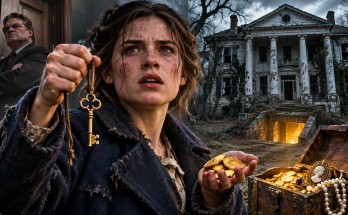
One day, while I was preparing another bucket of water, I noticed Don Baltazar looking at the place where his coins had once rested.
I knew exactly what he was remembering.
He had offered me money to leave.
I had refused.
Then he had offered less.
He believed hunger and cold would force me to return.
But winter had arrived, and I was still in the house.
The well was still mine.
The tunnel worked.
And people were knocking because they needed what lay beneath my floor.
He looked toward me.
"I treated you badly."
I stopped.
He had said he was wrong about the tunnel before.
This was different.
He was speaking about how he had treated me.
I waited.
He did not make excuses.
He did not mention business.
He did not pretend that he had been helping me by lowering the price.
He simply looked ashamed.
I felt something inside me loosen.
Not completely.
But enough.
"You did," I said.
He nodded.
Then he looked toward Tobías.
I followed his gaze.
The boy had been the reason he came.
Not regret.
Not admiration.
Fear for someone he loved.
I knew that.
But sometimes fear showed people what they had refused to see.
I could not know whether Don Baltazar would behave differently in the future.
I could only judge what he did.
For the moment, he was no longer trying to take my home.
He was helping with the work he once mocked.
And he had admitted that he wronged me.
I accepted those facts without making them larger than they were.
The snow did not last forever.
No winter does.
Eventually, the storm that had buried Valdeondo began to ease.
The change came gradually.
The wind stopped striking the house with the same force.
The sky became easier to see.
The snow no longer fell so thickly that the village disappeared.
I stood at the window and looked downhill.
At first, I could make out only rooftops.
Then more of the houses appeared through the changing light.
The valley was still covered in snow.
The pass was not suddenly open.
The wells were not instantly repaired.
But the storm no longer held everything in the same way.
I felt relief.
Then exhaustion.
For weeks, I had been measuring each day by what people needed.
Water.
Warmth.
A safe passage.
A bucket carried carefully through the tunnel.
Now I had time to feel how tired I was.
My shoulders ached.
My hands were rough.
The bruises from the collapse had faded, but I still remembered the pain.
I sat at the kitchen table and looked around.
The room had changed beyond recognition.
The table had been moved.
The floor was open.
The tools stood near the wall.
The bell hung beside the passage.
The kitchen was no longer the room I had known while my father lived.
For a moment, that made me sad.
I remembered him sitting in his chair.
I remembered the ordinary sound of him sharpening a tool.
I remembered the smell of wet boots near the fire.
I wanted those things back.
But I knew I could not return the kitchen to the past by placing the floor stone where it had been.
The house had changed because I had changed.
I had become responsible for it.
Not in the way Don Baltazar expected.
Not by leaving.
By learning how to remain.
When the weather allowed safer movement, the people of Valdeondo could begin dealing with the damage winter had caused.
Frozen wells would need attention.
The broken pump would need repair.
Homes would need fuel and supplies.
The sick would need proper care.
I could not say how quickly any of that would happen.
I could only hope the easing weather would make help easier to reach.
I thought about Tobías.
His grandfather had brought him through a blizzard because he was desperate.
I had given him shelter and water.
I had done everything I reasonably could.
But I would not claim that the water alone cured him.
His illness had needed care beyond my skills.
I knew that.
What mattered to me was that I had not turned him away.
I had not punished a child for his grandfather's cruelty.
I had given him what I could.
That was a decision I could live with.
I thought about the elderly couple.
I thought about all the people who had carried water away from my kitchen.
I did not know every outcome.
But I knew the well had remained available when other sources failed.
I knew the tunnel had made it possible to fetch water without crossing the exposed yard.
I knew people had come asking.
And I had answered.
That was enough to understand why the work mattered.
One afternoon, Eulogio sat beside the hearth while I checked the tools.
He looked toward the tunnel opening.
"Your father would have been proud."
I kept my eyes on the shovel.
I had imagined hearing those words for months.
I thought they would make me happy.
Instead, my throat tightened.
"I made mistakes."
Eulogio nodded.
"Yes."
I almost laughed.
He had never been a man who softened the truth unnecessarily.
"I nearly died down there."
"I know."
"I rushed."
"You did."
I set down the shovel.
"Sometimes I think he would have been angry."
Eulogio looked at me.
"Probably."
I turned toward him.
He smiled slightly.
"Then he would have made you repair it properly."
I looked toward the oak supports.
He was right.
That was exactly what my father would have done.
He would not have pretended the collapse was unimportant.
He would not have told me courage excused carelessness.
He would have shown me what went wrong.
Then he would have made certain I understood how to prevent it.
I felt tears in my eyes.
For once, I did not try to hide them.
Eulogio sat quietly.
Then he looked toward the window.
"The well is still giving water."
I nodded.
"Because he built it well."
"And because you reached it."
I looked at the floor.
The tunnel stretched beneath us.
Forty paces of earth.
A detour around stone.
A repaired section.
An opening through three carefully removed stones.
At the far end, my father's initials remained carved into the wall.
F.
A.
I thought about the first day I found them.
I had been so overwhelmed that I could barely speak.
Now I understood why.
I had spent months trying to reach something my father left behind.
And when I finally touched those letters, I realized his work had not ended with his death.
It had continued through what he taught me.
Through what Eulogio remembered.
Through the water the villagers carried home.
Through the choices I made when someone knocked.
I had once believed my father's last act was the defining story of his life.
He had gone outside to fetch water.
He had fallen eleven paces from home.
That terrible ending had filled my thoughts for months.
But it was not the whole story.
He had spent years finding water for people.
He had taught me to read the ground.
He had built a well that endured the worst winter Valdeondo could remember.
He had helped a shepherd who later helped me.
Those things mattered, too.
I had been looking at the place where he died so often that I nearly forgot to look at everything he had built.
That realization stayed with me.
Later, when I was alone, I went to the kitchen window.
The snow had begun settling into a quieter landscape.
I could see more of the fence now.
The place where my father had fallen was still there.
Eleven paces from the door.
I counted them.
One.
Two.
Three.
I stopped before reaching the end.
I did not need to count all eleven again.
I already knew the number.
I had known it every day since I found him.
But I no longer wanted it to be the only number I remembered.
There were eighty-six days of digging.
Nine days lost going around the rock.
Two days of fear after the collapse.
Three stones removed from the well.
Nineteen days of falling snow.
And more buckets of water than I could count.
Those numbers belonged to the story, too.
They reminded me that grief had not stopped my life.
It had changed what I needed to learn.
I turned away from the window.
I went to the kitchen opening.
I checked the lantern.
I tested the bell.
One clear ring.
Then I lowered myself into the passage.
I traveled slowly through the tunnel.
Past the supports.
Around the stone.
Through the repaired section.
Toward the well.
At the far end, I placed my hand against the carved initials.
The stone was cold.
I stayed there for a moment.
I did not imagine my father answering me.
I knew he was gone.
But I could remember him without expecting the memory to hurt in the same way forever.
I lowered the bucket.
It touched water.
I drew it up.
Then I carried it home.
Through the passage.
Past the oak beams.
Around the stone.
Toward the kitchen.
When I climbed out, the hearth was still warm.
The door was closed.
The wind was outside.
I placed the bucket beside the table.
Then I looked around the room.
It was still my home.
It had nearly been taken from me.
It had nearly become my grave.
It had sheltered people who once laughed at me.
And it had held a frightened grandfather and his feverish grandson through a terrible storm.
I had not planned any of that when I lifted the first stone from the floor.
I had only wanted to avoid the forty paces that killed my father.
But the tunnel had taught me something I never expected.
Safety was not always something one person could build alone.
Sometimes it began with a father's knowledge.
Sometimes with a child's loaf of bread.
Sometimes with an old shepherd's oak beams.
And sometimes with opening the door to someone who had given you every reason to keep it closed.
I looked toward the water.
Then toward the empty chair where my father used to sit.
I still missed him.
I knew I always would.
But I no longer felt that surviving meant leaving him behind.
His work was beneath my feet.
His lessons were in my hands.
And his well was still giving water.
I sat beside the hearth.
For the first time in a long while, I did not count the distance to the door.
I listened to the fire.
I watched the water settle in the bucket.
Then I rested.
I had stayed.
The End
Read more original stories on lastestdrama.