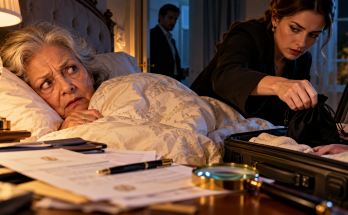
The fifth time my husband spent the entire night away with his secretary, I didn’t call and ask where he was
The fifth time my husband spent the entire night away with his secretary, I didn’t call and ask where he was.
Instead, at 3:17 in the morning, I opened the Moretti Holdings group chat and publicly told more than five hundred employees that their billionaire CEO was welcome to live with his secretary permanently.
My name is Claire Bennett Moretti.
I was thirty-one years old, married to one of Chicago’s wealthiest businessmen, and sitting alone in a penthouse that had begun to feel more like a beautifully furnished prison than a home.
Outside, rain struck the enormous windows overlooking Lake Michigan.
Inside, the dining table was still set for two.
The candles had burned down to crooked little pools of wax.
The salmon I had prepared was cold.
And the chair across from mine remained empty.
Again.
Vincent Moretti had promised to be home by eight.
At nine, I sent him a message.
At ten, I called.
At eleven, his secretary answered.
“Mr. Moretti is occupied, Mrs. Moretti.”
Sophia Carter always said my married name with a peculiar sweetness, as though she enjoyed reminding me that a title meant very little when its owner had stopped being loved.
“Occupied with what?” I asked.
“A private business matter.”
“At eleven at night?”
“I’m afraid I can’t discuss confidential company affairs.”
Then she hung up.
I stared at my phone.
Three years earlier, Vincent would have crossed Chicago in a snowstorm just to bring me coffee when I was sick.
Now his secretary could dismiss me with six words.
I had endured four previous nights like this.
The first time, Vincent claimed an emergency acquisition required his attention.
The second, he said a foreign investor had arrived unexpectedly.
The third, Sophia answered his phone from what sounded unmistakably like a hotel room.
The fourth, I found a restaurant receipt in his jacket.
Two dinners.
One bottle of expensive champagne.
A dessert I knew Vincent hated.
That receipt had been dated on our third wedding anniversary.
I remembered holding it beneath the kitchen lights while Vincent stood beside the refrigerator, drinking water as though nothing extraordinary had happened.
“Did you enjoy dinner?” I asked.
He glanced at the paper.
His expression hardened.
“Claire, don’t start.”
“Start what?”
“Another interrogation.”
I looked at the receipt.
“You told me you were in New York.”
“I had a change of plans.”
“With Sophia?”
“She’s my executive secretary. She goes where I need her.”
I waited for him to explain.
He didn’t.
Instead, he set down his glass.
“You knew what my life was like when you married me.”
That sentence had become his favorite weapon.
It transformed every broken promise into something I had supposedly agreed to tolerate.
For months, I wondered whether I was demanding too much.
Perhaps billionaires really did work through the night.
Perhaps Sophia’s perfume on his collar came from crowded elevators.
Perhaps the lipstick mark on his shirt was an accident.
Perhaps I was becoming the suspicious wife he accused me of being.
But at 3:17 that morning, something inside me finally became quiet.
Not peaceful.
Finished.
I opened the Moretti Holdings executive communication group.
Five hundred and thirty-eight members.
Senior managers.
Department directors.
Legal staff.
Executive assistants.
Regional officers.
And Vincent himself.
My fingers hovered over the keyboard.
Then I typed.
“Good morning. This is Claire Moretti.
Thank you, Miss Carter, for taking such excellent care of my husband.
Starting today, Vincent is welcome to stay with you permanently. I’ve changed the door code, and his belongings will be delivered to company reception.
Please direct any future questions concerning his overnight accommodations to Miss Carter.
Best regards,
Claire.”
I read the message twice.
Then I pressed send.
For one second, nothing happened.
Then the read count began climbing.
Twelve.
Forty-seven.
One hundred eighty.
Three hundred twelve.
Four hundred eighty.
My phone rang.
Vincent.
I declined.
He called again.
I declined.
A third call arrived.
Then a message.
“DELETE THAT RIGHT NOW.”
Another.
“CLAIRE, WHAT THE HELL ARE YOU DOING?”
Then Sophia wrote privately.
“Mrs. Moretti, you have completely misunderstood the situation.”
I stared at her message.
Three years of swallowing humiliation had taught me that people who enjoyed hurting you often became remarkably concerned about misunderstandings when witnesses appeared.
I replied with four words.
“Then explain it publicly.”
She didn’t answer.
Vincent called again.
This time, I picked up.
“What?” I asked.
“Have you lost your mind?”
His voice was sharp enough to make me pull the phone away from my ear.
In the background, I heard a door closing.
“Where are you?” he demanded.
“At home.”
“Then why aren’t you answering my calls?”
“Because I’m busy.”
“Doing what?”
“Ending our marriage.”
Silence.
Then he laughed.
Not because anything was funny.
Because Vincent had always believed that if he refused to take something seriously, it couldn’t possibly threaten him.
“Claire, you’re being ridiculous.”
“Probably.”
“Delete the message.”
“No.”
“Do you understand what you’ve done to my reputation?”
I looked at the untouched dinner.
“Do you understand what you’ve done to our marriage?”
“Don’t turn this around.”
“Goodbye, Vincent.”
“Claire—”
I ended the call.
Then I switched off my phone.
For several minutes, I sat completely still.
The rain continued falling.
A distant ambulance passed somewhere below.
Nothing dramatic happened.
No lightning struck the building.
No glass shattered.
The world simply continued.
And that was when I realized something devastating.
**I had spent three years believing my marriage would collapse if I stopped holding it together.**
**But the moment I let go, I discovered I had been holding nothing at all.**
I walked into our bedroom.
Vincent’s side of the bed was perfectly made.
His expensive watches sat inside their velvet-lined case.
His collection of tailored suits occupied most of the walk-in closet.
I pulled two large suitcases from the storage shelf.
Then I began packing.
Navy suits.
White shirts.
Silk ties.
Italian leather shoes.
Silver cuff links.
I worked methodically, folding each item as carefully as I had folded his clothes during the first months of our marriage.
Back then, I believed small acts of devotion could create a happy home.
I had learned his favorite coffee.
Memorized his schedule.
Waited up during late meetings.
Attended corporate dinners where powerful men discussed billion-dollar deals while their wives smiled beside them.
I had abandoned my position at my father’s architectural foundation because Vincent said he wanted us to travel together.
Then the traveling stopped.
The dinners stopped.
The conversations stopped.
Eventually, even his apologies stopped.
I reached the bottom drawer of his dresser and found a small black jewelry box.
Inside was a delicate diamond bracelet.
For one foolish second, my heart lifted.
Our anniversary had passed only two weeks earlier.
Perhaps he had bought it and forgotten to give it to me.
Then I noticed the engraving.
“S.C.”
Sophia Carter.
I closed the box.
My hands began trembling.
Not because I was surprised.
Because there was something particularly cruel about discovering proof of betrayal inside the home where you had spent months begging yourself not to believe it.
I placed the bracelet on top of his folded shirts.
He could explain it to someone else.
At five thirty, I called the building’s security desk.
“Good morning, Mrs. Moretti,” the overnight supervisor answered.
“I need the access code to my residence changed.”
“Of course. Should Mr. Moretti retain access?”
“No.”
There was a pause.
“Ma’am?”
“His access is revoked.”
“Understood.”
I showered, dressed in a cream blouse and charcoal trousers, and tied my hair back.
In the bathroom mirror, I studied my reflection.
My eyes looked tired.
But I recognized myself.
That surprised me.
For months, I had felt like a ghost moving through someone else’s expensive life.
Now, with two suitcases beside the bedroom door, I finally felt solid.
At seven fifteen, I arrived at Moretti Holdings headquarters.
The forty-eight-story building stood in Chicago’s financial district, all reflective glass and polished stone.
I had attended its grand reopening shortly after our wedding.
Vincent had held my hand in front of photographers.
“This is my wife,” he had announced proudly. “The best decision I ever made.”
I wondered when he had changed his mind.
The receptionist, a young woman named Emily, looked up as I approached.
“Mrs. Moretti?”
Her eyes dropped to the suitcases.
“Good morning, Emily.”
“Can I help you?”
“These belong to Vincent.”
I placed a large white envelope on top of the luggage.
“And these are divorce papers.”
Her mouth fell open.
Behind her, two employees stopped walking.
Someone near the elevators whispered my name.
I smiled politely.
“Please make sure his office receives everything.”
“Of course, Mrs. Moretti.”
I turned toward the exit.
Then Emily spoke softly.
“Mrs. Moretti?”
I stopped.
She hesitated.
“I just wanted to say…”
Her eyes moved toward the envelope.
Then she lowered her voice.
“You deserve better.”
Something tightened in my chest.
It was the first kindness I had received from anyone connected to Vincent’s company in months.
“Thank you, Emily.”
Outside, the October air was cold enough to sting my cheeks.
I turned on my phone.
Sixty-three messages.
Twenty-seven missed calls.
Four messages from Sophia.
Nine from Vincent.
And one from Richard Moretti.
Vincent’s father.
The message contained only six words.
“Call me as soon as possible.”
I called.
Richard answered immediately.
“Claire.”
“Good morning, Richard.”
“I’ve heard what happened.”
“I assumed you would.”
His voice was controlled.
Unlike Vincent, Richard rarely raised it.
That made his anger more intimidating.
“My son has been staying away overnight, five hundred employees are discussing your marriage, and you delivered divorce papers to his office?”
“Yes.”
“Do you understand how serious this is?”
“Very.”
“Then explain why you chose to embarrass the entire family.”
I watched a taxi move through traffic.
“Your son embarrassed the family. I simply stopped hiding it.”
Richard said nothing.
Then he exhaled.
“Both of you are coming to the estate today.”
“Why?”
“Because I want the truth from both of you.”
I almost laughed.
For three years, nobody in the Moretti family had asked whether I was happy.
Nobody questioned why Vincent stopped bringing me to dinners.
Nobody noticed when I began attending family gatherings alone.
Now that the humiliation had become public, everyone suddenly wanted explanations.
“All right,” I said.
“Four o’clock.”
“I’ll be there.”
“Claire?”
“Yes?”
“Don’t make any decisions you can’t reverse.”
I looked at the courthouse envelope reflected in the glass beside me.
“I already made one.”
After hanging up, I called Nathan Brooks.
Nathan had been my closest friend during college.
He was now a partner at one of Chicago’s most respected law firms.
We had spoken occasionally since my wedding, although Vincent disliked him.
According to my husband, men never remained friends with women without ulterior motives.
I had once asked whether that principle applied to him and Sophia.
He hadn’t appreciated the question.
Nathan answered on the second ring.
“Claire?”
“I need your help.”
His voice changed immediately.
“What happened?”
“I want a divorce.”
There was a long silence.
“Where are you?”
“Outside Moretti Holdings.”
“Are you safe?”
The question nearly made me cry.
Not because Vincent had physically threatened me.
Because Nathan’s first concern was my well-being.
Not the company.
Not the Moretti name.
Me.
“I’m safe.”
“Come to my office. I’ll clear my afternoon.”
At two o’clock, I sat across from Nathan in a conference room overlooking the Chicago River.
He looked older than I remembered, with faint lines beside his eyes and a few strands of gray at his temples.
But his expression remained familiar.
Patient.
Careful.
Kind.
He studied the paperwork I had brought.
“These are draft divorce documents,” he said. “You haven’t filed them yet.”
“I know.”
“Good. We need to examine the financial arrangements before anything is formally submitted.”
“I don’t want Vincent’s money.”
Nathan looked up.
“That’s not the question.”
“It matters to me.”
“Then tell me what you do want.”
“Only what was mine before the marriage.”
“What property?”
“My father gave me a riverside mansion on the North Shore as a wedding gift. The deed is entirely in my name.”
Nathan began writing.
“The Bennett estate?”
“Yes.”
He paused.
“Claire, your father owned that property for decades.”
“I know.”
“Do you still have the original deed?”
“Of course.”
“Where?”
“In my father’s old study at the mansion.”
Nathan leaned back.
“Has Vincent ever asked you to transfer it?”
“No.”
Then I remembered something.
“Actually, he asked me to sign a property management authorization last spring.”
Nathan’s pen stopped moving.
“What kind of authorization?”
“He said the family office needed permission to coordinate maintenance and insurance.”
“Did you sign?”
“No. I told him my father’s attorney handled everything.”
Nathan looked at me for several seconds.
“Did Vincent seem upset?”
“Very.”
He closed his notebook.
“Claire, I want you to bring me every document relating to that property.”
“Why?”
“Because I don’t like coincidences.”
Before I could answer, my phone rang.
Richard.
I declined the call.
Nathan glanced at the screen.
“The family estate?”
“Four o’clock.”
“Do you want me there?”
“No. I need to do this myself.”
He hesitated.
“Then promise me something.”
“What?”
“Don’t sign anything.”
I gave him a tired smile.
“After three years with Vincent, I think I’ve finally learned that lesson.”
But Nathan didn’t smile.
He was studying the copy of my marriage agreement.
His expression had become strangely tense.
“Claire,” he said slowly, “who prepared this agreement?”
“Vincent’s family attorney.”
“Did your father review it?”
“Yes.”
“Was he present when you signed?”
“No. He was recovering from surgery.”
Nathan turned another page.
Then another.
“What is it?” I asked.
He pointed toward a paragraph near the bottom.
“There’s a reference here to a separate property schedule.”
“I’ve never seen one.”
“Neither have I.”
He reached for his phone.
“Let me make a call.”
Twenty minutes later, Nathan returned from his private office.
He looked troubled.
“Claire, I need you to be extremely careful at the estate.”
“Why?”
“Because the Moretti family has recently made inquiries about the Bennett property.”
My stomach tightened.
“What kind of inquiries?”
“Ownership records. Development restrictions. Transfer procedures.”
“Why would they do that?”
“I don’t know yet.”
At three forty-five, I arrived at the Moretti family estate in Lake Forest.
The mansion stood behind iron gates and a long driveway lined with century-old trees.
I had always disliked the place.
Everything about it felt designed to remind visitors that the Morettis were powerful enough to make ordinary rules irrelevant.
A housekeeper led me into the formal drawing room.
Vincent was already there.
So was Sophia.
I stopped in the doorway.
Sophia wore a pale blue dress and a pearl necklace.
She sat beside my husband on the velvet sofa.
Not across from him.
Beside him.
Vincent stood immediately.
“Claire.”
I looked at Sophia.
“How thoughtful. You brought your overnight accommodations.”
Sophia’s cheeks reddened.
Vincent stepped forward.
“Enough.”
“That’s an interesting word coming from you.”
Richard stood near the fireplace.
His wife, Eleanor, sat in an armchair, twisting a handkerchief between her fingers.
“Sit down,” Richard ordered.
I remained standing.
“I’d rather hear what you have to say.”
Richard studied me.
Then he turned toward Vincent.
“Tell your wife why Sophia has been spending nights with you.”
Vincent’s jaw tightened.
“Dad—”
“Tell her.”
Sophia suddenly looked frightened.
And that frightened me more than anything else.
Because until that moment, she had always seemed completely confident.
Richard opened a leather folder on the table.
Inside were several documents.
He removed one sheet and held it toward me.
“Claire,” he said, “before you decide whether to divorce my son, there’s something you need to understand about your father’s property.”
I stared at him.
“What does my father’s house have to do with my marriage?”
Richard looked directly into my eyes.
“Everything.”
Then he slid a document across the table.
At the bottom was a signature.
My signature.
Except I had never signed it.
And above it were the words:
IRREVOCABLE TRANSFER OF BENEFICIAL OWNERSHIP.
For several seconds, I couldn’t hear anything except the faint ticking of the antique clock above Richard Moretti’s fireplace.
I stared at the document.
My name appeared at the bottom in elegant blue ink.
Claire Bennett Moretti.
The signature looked almost perfect.
Almost.
My father had taught me to sign legal documents with my full middle name.
Claire Elizabeth Bennett Moretti.
I had followed that habit since I was nineteen.
The signature before me omitted Elizabeth.
I lifted my eyes.
“Who forged this?”
Vincent took a step forward.
“Claire, calm down.”
“Who forged my signature?”
Richard’s expression hardened.
“Nobody is accusing anyone of forgery.”
“I am.”
Sophia shifted on the sofa.
Her hands were clasped so tightly that her knuckles had turned white.
I looked at her.
“Did you prepare this?”
“No.”
The answer came too quickly.
Vincent moved between us.
“Stop interrogating her.”
I laughed.
A short, disbelieving sound.
“You brought your secretary into a family meeting about my marriage, and now you’re protecting her from questions?”
“She’s here because she understands the situation.”
“What situation?”
Richard placed both hands on the table.
“Moretti Holdings is negotiating a major waterfront development.”
I looked at him.
“The Bennett property isn’t for sale.”
“Nobody said it was.”
“Then why is my name on a transfer agreement?”
Richard hesitated.
Vincent answered.
“Because the property is part of a larger financing arrangement.”
I turned toward him.
“What?”
“It’s complicated.”
“Then simplify it.”
He rubbed his forehead.
“Last year, the company entered negotiations with Northstar Capital. They required additional collateral for a development loan.”
“And?”
“The Bennett estate was listed as a potential asset.”
The room seemed to tilt.
“You offered my father’s house as collateral?”
“It wasn’t that simple.”
“Did you?”
Vincent looked away.
That was answer enough.
My father, Thomas Bennett, had purchased the riverside property long before he became wealthy.
He had been a young architect with almost no money when he found the abandoned mansion overlooking the North Shore riverfront.
Its roof leaked.
Its windows were broken.
Its gardens had become a wilderness.
But he saw beauty where everyone else saw decay.
He spent thirty years restoring it.
After my mother died, the house became the place where he taught me everything he believed mattered.
How to draw.
How to notice the way sunlight moved across a room.
How to distinguish something valuable from something merely expensive.
When I married Vincent, my father gave me the estate.
“Your mother loved this house,” he told me. “I want you to have somewhere that belongs entirely to you.”
He died eighteen months later.
And now my husband had apparently treated that final gift as an asset available for corporate financing.
I looked at Richard.
“Did you know?”
His silence was immediate and terrible.
Eleanor whispered, “Richard, please.”
I turned toward her.
“You knew too?”
She began crying.
Vincent reached for my arm.
I stepped away.
“Don’t touch me.”
“Claire, listen.”
“No. You listen.”
My voice rose for the first time.
“That house belonged to my father. He restored it with his own hands. He gave it to me because he wanted me to have something no one could take away.”
Vincent’s expression flickered.
For one moment, I thought he understood.
Then he said, “It’s just a house.”
I stared at him.
And something inside me broke cleanly.
**”To you, everything is just something you can put a price on.”**
He looked offended.
“That’s unfair.”
“No. What’s unfair is using a dead man’s gift to secure a loan without asking his daughter.”
Richard struck the table with his palm.
“Enough!”
The room fell silent.
He pointed toward the document.
“The transfer was never completed.”
I looked at him sharply.
“Then why does this exist?”
“Because someone prepared it.”
“Who?”
Richard glanced at Vincent.
Vincent glanced at Sophia.
And Sophia looked down.
I understood then that the three of them knew far more than they were admitting.
I took out my phone and photographed the document.
Richard moved forward.
“Claire, those are confidential papers.”
“They concern my property.”
“You can’t simply photograph company documents.”
“Watch me.”
I took another photograph.
Then I reached for the page.
Vincent caught my wrist.
“Leave it.”
I looked at his hand.
“Let go.”
“You’re not thinking clearly.”
“Let go of me, Vincent.”
He released me.
I folded the document and placed it inside my handbag.
Richard’s face darkened.
“That paper stays here.”
“No.”
“You have no idea what you’re doing.”
“Then I suggest you start explaining.”
A long silence followed.
Finally, Sophia spoke.
“Mr. Moretti, perhaps we should tell her about the deadline.”
Vincent turned toward her so quickly that she flinched.
“Sophia.”
But the damage was done.
“What deadline?” I demanded.
Richard closed his eyes.
Vincent said nothing.
Sophia whispered, “Friday.”
It was Wednesday.
“Friday what?”
Richard answered reluctantly.
“Northstar Capital expects final confirmation of the collateral package.”
I stared at him.
“You’re planning to transfer my property in two days?”
“No transfer can occur without valid authorization,” he said.
“Then why are we having this conversation?”
Nobody answered.
I looked at Vincent.
“You expected me to sign something today.”
His silence confirmed it.
The family meeting had never been about discovering the truth.
It had been about controlling me long enough to obtain what they needed.
I stepped backward.
“That’s why you demanded I come here.”
Richard straightened.
“We wanted to resolve this privately.”
“You wanted my signature.”
“We wanted your cooperation.”
“With fraud?”
“Choose your words carefully, Claire.”
I looked at him.
“Then choose your actions carefully, Richard.”
I turned toward the door.
Vincent followed.
“Claire, wait.”
I stopped in the hallway.
He looked exhausted.
His tie was loosened, and dark shadows marked the skin beneath his eyes.
For a moment, I saw the man I had loved.
The man who once brought me flowers after a difficult day.
The man who had stood beside my father’s hospital bed and promised to take care of me.
“Please,” he said quietly.
I waited.
He glanced toward the drawing room.
Then lowered his voice.
“There’s more going on than you understand.”
“Then tell me.”
“I can’t.”
“Can’t or won’t?”
He looked miserable.
“Both.”
I shook my head.
“Goodbye, Vincent.”
“Claire, if you leave now, things could get much worse.”
I turned back.
“Are you threatening me?”
“No.”
“Then what are you doing?”
He swallowed.
“Trying to protect you.”
I almost laughed again.
“From whom?”
His eyes moved toward the drawing room.
But before he answered, Richard appeared in the doorway.
“Vincent.”
One word.
My husband immediately fell silent.
I walked out.
Outside, the evening air smelled of wet leaves and approaching winter.
I sat inside my car for several minutes before calling Nathan.
He answered immediately.
“What happened?”
“I think someone forged my signature.”
His tone sharpened.
“Tell me everything.”
I described the document.
The financing arrangement.
The Friday deadline.
The way Vincent and Sophia behaved.
Nathan listened without interrupting.
When I finished, he said, “Drive directly to my office.”
“It’s almost six.”
“I’ll be here.”
“Should I go to the mansion first?”
“No.”
“Why?”
“Because if someone is trying to use your property without authorization, we need to establish what has already been recorded.”
I looked toward the estate gates.
“Nathan?”
“Yes?”
“Vincent said he was protecting me.”
Nathan was silent for a moment.
“People sometimes say that when they’re protecting themselves.”
At six forty, I arrived at his office.
Nathan had already contacted a real estate attorney named Rebecca Shaw.
She was in her forties, sharply dressed, and carried herself with the confidence of someone who had spent years arguing with men who underestimated her.
She examined the photograph of the transfer document.
“This is not a recorded deed,” she said.
Relief swept through me.
Then she continued.
“But it may be part of a fraudulent financing package.”
“What does that mean?”
“It means someone could be representing to a lender that they have rights they don’t actually possess.”
“Can they take my house?”
“Not simply because someone signed a fake paper. But a forged instrument can create expensive and dangerous complications.”
Nathan leaned forward.
“We need to protect the title immediately.”
Rebecca nodded.
“We’ll request a title search, notify the lender that any purported authorization is disputed, and prepare emergency relief if necessary.”
I looked between them.
“How much time do we have?”
“Possibly less than forty-eight hours.”
Nathan opened his laptop.
“There’s another issue.”
He turned the screen toward me.
A corporate filing appeared.
Bennett Riverside Development LLC.
The company had been formed eight months earlier.
Its registered manager was Sophia Carter.
I stared at the name.
“Why does Sophia have a company named after my father’s property?”
Rebecca scrolled downward.
“That’s what we’re going to find out.”
The company listed a business address in downtown Chicago.
A private office suite.
Nathan recognized the building.
“That’s where Moretti Holdings keeps its special-purpose entities.”
My stomach tightened.
“So Vincent knows.”
“Probably.”
Rebecca looked at me carefully.
“Claire, has anyone ever asked you for copies of your identification documents?”
I thought back.
Last spring, Sophia had contacted me about renewing the family health insurance.
She asked for a copy of my driver’s license and passport.
I had sent them.
“Yes.”
“When?”
“Eight months ago.”
Nathan and Rebecca exchanged a glance.
I felt cold.
“What?”
Nathan spoke gently.
“Those documents could have helped someone imitate your identity.”
I remembered Sophia’s cheerful message.
“Thank you, Mrs. Moretti! You’re always so helpful.”
I had replied with a smiley face.
Now the memory made me sick.
Rebecca began preparing formal notices.
Nathan asked me to write a detailed timeline of every suspicious event.
I spent the next hour listing things I had once dismissed.
Sophia’s sudden promotion.
Vincent’s increasingly frequent absences.
The property authorization he wanted me to sign.
The bracelet engraved with Sophia’s initials.
The night he missed our anniversary.
Then I remembered something else.
A week before my father died, Vincent visited him alone.
At the time, I was grateful.
My father had been weak, and Vincent said he wanted to reassure him about our future.
But when I returned to the hospital room, my father looked upset.
“Claire,” he whispered, “never sign anything you haven’t read yourself.”
I thought he was confused from medication.
Now I wondered what Vincent had said to him.
Nathan noticed my expression.
“What is it?”
I told him.
He became very still.
“Did your father have an attorney?”
“Harold Whitman.”
“Is he still practicing?”
“I think so.”
“Call him tomorrow.”
At nine that evening, I left Nathan’s office.
My phone rang before I reached the parking garage.
Sophia.
I almost ignored it.
Then curiosity won.
“What do you want?”
Her voice was trembling.
“Mrs. Moretti, please don’t hang up.”
“Why?”
“Because I need to explain something.”
“Then explain.”
“I never wanted any of this to happen.”
I stopped walking.
“What does that mean?”
“Vincent told me everything was legal.”
My heart began pounding.
“What was legal?”
“The property documents.”
I gripped my phone.
“You prepared them?”
“I only handled administrative paperwork.”
“You forged my signature?”
“No!”
Her voice cracked.
“Someone else did that.”
“Who?”
Silence.
“Sophia.”
“I can’t tell you over the phone.”
“Why not?”
“Because I think they’re monitoring my calls.”
I looked around the nearly empty garage.
“Who is?”
She began crying.
“Please. Meet me tomorrow morning.”
“Where?”
“There’s a café near the river. I’ll send you the address.”
“Why should I trust you?”
“Because Vincent isn’t the person you think he is.”
I closed my eyes.
“I already know that.”
“No,” she whispered.
“You don’t.”
The call ended.
A moment later, an address arrived.
I forwarded it to Nathan.
He called immediately.
“Don’t meet her alone.”
“I wasn’t planning to.”
“Claire, this could be a trap.”
“I know.”
“Then why go?”
I looked at Sophia’s message.
“Because she knows who forged my signature.”
Nathan exhaled.
“All right. I’ll arrange for someone to be nearby.”
That night, I stayed at the Bennett mansion.
I hadn’t slept there since my father’s funeral.
The house stood beside a quiet stretch of river, surrounded by old maple trees.
When I opened the front door, the familiar smell of cedar and polished wood brought tears to my eyes.
My father had loved this place.
Every room carried his presence.
His drafting table remained in the study.
His books filled the shelves.
A faded photograph of my mother stood beside the fireplace.
I walked through the house slowly, touching familiar surfaces.
Then I entered the study.
The original property deed was inside a locked cabinet.
I opened it with the key my father had given me.
The documents were still there.
So was a sealed envelope.
My name was written across the front.
Claire.
I stared at it.
I had never noticed it before.
The handwriting was unmistakably my father’s.
Inside was a short letter.
“My darling Claire,
If you are reading this because someone has questioned your ownership of this house, contact Harold Whitman immediately.
There are things I wanted to explain before the wedding, but I hoped I would never need to.
Trust the records, not the promises.
Love,
Dad.”
My hands shook.
I read the letter again.
Then I called Nathan.
He answered sleepily.
“Claire?”
“I found something.”
I read him the letter.
He became fully alert.
“Where are you?”
“At the mansion.”
“Lock the doors.”
“Why?”
“Because your father clearly anticipated a dispute.”
I looked toward the dark windows.
A car moved slowly along the road beyond the gates.
Its headlights disappeared behind the trees.
Nathan continued.
“Call Whitman first thing tomorrow.”
“I will.”
“Promise me you won’t confront Vincent tonight.”
“I promise.”
After hanging up, I placed the letter beside my father’s photograph.
Then I noticed something strange.
The bottom drawer of his drafting table was slightly open.
My father had always kept it locked.
I pulled it out.
Inside was an empty folder.
On the cover, in his handwriting, were three words.
“MORETTI — PRIVATE INVESTIGATION.”
My breath caught.
My father had investigated Vincent.
Before our wedding.
I searched the drawer again.
Nothing.
The folder had been emptied.
Then my phone vibrated.
A message from an unknown number.
“Stop looking into the Bennett property. You are putting yourself in danger.”
I stared at the screen.
A second message arrived.
“Your father tried to warn you.”
Then a photograph appeared.
It showed Vincent standing outside a hotel with Sophia.
The image was dated the previous night.
But they weren’t embracing.
Sophia was crying.
Vincent had one hand on her shoulder.
And beside them stood a third person.
Richard Moretti.
I enlarged the photograph.
Richard was handing Sophia a thick envelope.
My phone rang.
Unknown number.
I answered.
A woman’s voice whispered, “Mrs. Moretti?”
“Who is this?”
“Someone who worked for your father.”
My heart slammed against my ribs.
“What do you want?”
“To tell you why he was investigating the Morettis.”
I gripped the edge of the desk.
“Then tell me.”
The woman hesitated.
Then she said something that made the room spin.
“Your father discovered that Vincent’s family was planning to take your inheritance before you ever married him.”
For a moment, I couldn’t speak.
The woman on the phone waited while I stared at my father’s empty investigation folder.
“Who are you?” I finally whispered.
“My name is Margaret Ellis.”
I recognized it.
Margaret had been my father’s administrative assistant for nearly fifteen years.
She retired shortly before his final illness.
I remembered her as a quiet woman who wore colorful scarves and brought homemade lemon cookies to the office.
“Margaret?”
“Yes, Claire.”
“Why are you calling me now?”
“Because I saw what happened at Moretti Holdings.”
My stomach tightened.
“You saw the message?”
“Everyone in Chicago seems to have seen it.”
She hesitated.
“Then I heard about the property documents.”
“How?”
“An old colleague contacted me.”
I looked at the photograph of Vincent, Sophia, and Richard.
“Margaret, what did my father discover?”
She inhaled slowly.
“Your father hired a private investigator six weeks before your wedding.”
“Why?”
“Because he was worried about Vincent’s family.”
I closed my eyes.
My father had never openly opposed the marriage.
He had been polite to Vincent.
Warm, even.
But I remembered moments of tension.
Questions about corporate debt.
Questions about the Moretti family trust.
Questions Vincent dismissed as old-fashioned concerns.
“Did Dad think Vincent was after my money?”
“Not exactly.”
“What does that mean?”
“Your father believed Richard Moretti wanted something much more specific.”
“The mansion.”
“Yes.”
I sat down.
Margaret continued.
“The Bennett property borders a river corridor that developers have wanted for years. Your father refused every offer.”
“I know.”
“Richard’s company tried to purchase it twice.”
I stared at the phone.
“When?”
“Before you met Vincent.”
My chest tightened.
“Why didn’t Dad tell me?”
“He wanted proof before accusing anyone.”
“Did he find it?”
“Some.”
“What kind?”
“Internal correspondence. Financial records. Evidence that a Moretti subsidiary was quietly acquiring neighboring parcels.”
I remembered Nathan mentioning the development company.
“Where are those records?”
“Your father gave copies to Harold Whitman.”
I looked toward the window.
The river beyond the garden reflected a thin silver line of moonlight.
“Margaret, did my father think Vincent married me because of the house?”
A long silence followed.
Then she answered.
“He was afraid that might be true.”
The words hurt more than I expected.
I had already accepted that Vincent betrayed me.
But the possibility that our entire marriage began as a calculated deception was something different.
It meant the first kiss might have been a lie.
The proposal.
The wedding.
The promises whispered in the dark.
Everything.
“Claire,” Margaret said gently, “your father never stopped hoping he was wrong.”
I pressed my fingers against my eyes.
“Neither did I.”
Margaret gave me Harold Whitman’s private number.
Before hanging up, she added one more thing.
“Your father left instructions that certain records should be released only if someone attempted to transfer the property without your permission.”
“Why?”
“Because he believed the documents could protect you.”
“From Richard?”
“From anyone involved.”
After the call, I sat in my father’s study until nearly dawn.
I remembered my wedding day.
Vincent standing beneath white roses.
His hands trembling slightly as he placed the ring on my finger.
The way he whispered, “You’re the only person who makes this life feel real.”
Had he meant it?
Or had he simply learned exactly what I needed to hear?
At eight thirty, I called Harold Whitman.
He answered after three rings.
“Claire Bennett?”
His voice was warm but cautious.
“Mr. Whitman, I found a letter from my father.”
Silence.
Then he said, “I’ve been waiting for this call.”
I closed my eyes.
“You knew?”
“I knew your father was concerned.”
“About Vincent?”
“About the Moretti family’s interest in your property.”
I told him about the forged transfer document.
His tone changed immediately.
“Do not sign anything.”
“I won’t.”
“Have you retained counsel?”
“Nathan Brooks.”
“Good. Ask him to contact me.”
“Mr. Whitman, what did my father find?”
He paused.
“Enough to make him create safeguards.”
“What safeguards?”
“Come to my office with Mr. Brooks. I’ll explain everything.”
At ten o’clock, I arrived at the café where Sophia wanted to meet.
Nathan had insisted on coming.
He sat at a table near the entrance, pretending to review emails while I waited by the window.
Sophia arrived twelve minutes late.
She wore sunglasses and a gray coat.
Her usual polished confidence was gone.
She looked exhausted.
“Mrs. Moretti.”
“Sit down.”
She glanced toward Nathan.
“Is that your attorney?”
“Yes.”
“I asked to meet privately.”
“And I decided otherwise.”
Sophia lowered herself into the chair.
Her hands trembled as she removed her sunglasses.
There were dark circles beneath her eyes.
For the first time, I wondered whether she was frightened of something more serious than public embarrassment.
“What do you want to tell me?” I asked.
She looked toward the entrance.
Then leaned forward.
“Richard made me create Bennett Riverside Development.”
I remained still.
“Why?”
“To hold preliminary development rights.”
“Rights to property he doesn’t own?”
“He said the family had an agreement.”
“With whom?”
“Vincent.”
My heart tightened.
Sophia swallowed.
“Vincent told me you had agreed to contribute the property after the wedding.”
“I never agreed.”
“I know that now.”
“How?”
“Because I saw the forged signature.”
I stared at her.
“When?”
“Three weeks ago.”
“Who forged it?”
Sophia’s eyes filled with tears.
“I don’t know who physically signed it.”
“But you know who ordered it.”
She nodded.
“Richard.”
I felt a terrible, cold certainty settle inside me.
“Did Vincent know?”
Sophia looked away.
“Answer me.”
“He knew the company wanted the property.”
“Did he know about the forged document?”
“I don’t know.”
I studied her.
“You’re lying.”
“I’m not.”
“You’ve spent five nights with my husband.”
Sophia flinched.
“We weren’t doing what you think.”
I almost laughed.
“Then explain the bracelet.”
She looked confused.
“What bracelet?”
“The diamond bracelet engraved with your initials.”
Her expression changed.
“Oh.”
“Yes. Oh.”
Sophia rubbed her forehead.
“Vincent bought it.”
“I know.”
“But he didn’t give it to me.”
I stared at her.
“Then why was it in his drawer?”
“Because I refused it.”
The answer surprised me.
Sophia continued.
“He tried to give it to me after I threatened to resign.”
“Why?”
“He said I had been under enormous pressure and deserved something for my loyalty.”
I leaned back.
“That sounds convenient.”
“I know.”
She looked miserable.
“But it’s true.”
I watched her carefully.
“Are you having an affair with my husband?”
Sophia’s eyes met mine.
“No.”
I wanted to believe her.
But wanting had become dangerous.
“Then why did you stay overnight with him?”
She lowered her voice.
“Because Richard has been holding emergency meetings outside the office.”
“At hotels?”
“Yes.”
“With Vincent?”
“Yes.”
“Why couldn’t he tell me?”
Sophia looked toward Nathan.
“Because the company is in trouble.”
I felt my pulse quicken.
“How much trouble?”
She hesitated.
Then whispered, “Moretti Holdings may be insolvent.”
I stared at her.
“That’s impossible.”
“That’s what everyone thinks.”
She opened her handbag and removed a small flash drive.
“Richard borrowed heavily against several subsidiaries. The waterfront development was supposed to generate enough money to stabilize the group.”
“And my property was part of that plan.”
“The most important part.”
I looked down at the drive.
“Why?”
Sophia leaned closer.
“Because your land provides the only practical access route between the acquired parcels and the river.”
I remembered my father refusing developers.
He had always said the river should remain accessible to the community.
Now I understood why Richard wanted it so badly.
Without the Bennett property, the entire project might become financially unworkable.
Sophia pushed the drive toward me.
“These are copies of the records I could access.”
“Why give them to me?”
“Because Richard is going to blame Vincent.”
I stared at her.
“What?”
“He wants the board to believe Vincent authorized everything.”
“Did he?”
Sophia’s face tightened.
“Some of it.”
“Which parts?”
“I don’t know exactly.”
I looked at her for a long moment.
Then I asked the question that had been burning inside me.
“Why did Vincent let me believe you were sleeping together?”
Sophia’s eyes filled.
“Because he thought that if you hated him enough, you’d leave before everything collapsed.”
I shook my head.
“No.”
“Mrs. Moretti—”
“No. That is not an explanation. That’s another excuse.”
Sophia lowered her eyes.
“Maybe it is.”
I picked up the flash drive.
“Then tell me something useful.”
She looked up.
“What?”
“Does Richard know you’re here?”
Her expression turned white.
“No.”
At that moment, Nathan stood.
He had noticed something outside.
A black SUV had stopped across the street.
Sophia saw it too.
“Oh God.”
“What?”
“That’s one of Richard’s security vehicles.”
Nathan approached our table.
“We need to leave.”
Sophia grabbed my hand.
“Please don’t let them take the drive.”
I pulled away.
“Come with us.”
She shook her head.
“If I disappear, Richard will know.”
“He already knows something.”
Sophia looked toward the window.
The SUV door opened.
A man in a dark coat stepped onto the sidewalk.
Nathan took my elbow.
“Claire. Now.”
We left through the café’s rear exit.
My heart hammered as we crossed a narrow alley and reached Nathan’s car.
He drove directly to his office.
Neither of us spoke for several minutes.
Finally, I asked, “Do you believe her?”
Nathan kept his eyes on the road.
“I believe she’s frightened.”
“That’s not the same thing.”
“No.”
“Do you think Vincent was trying to protect me?”
Nathan sighed.
“I think Vincent has made terrible choices. Whether he made them out of fear, greed, or some confused idea of protection remains to be seen.”
I looked down at the flash drive.
“How do we find out?”
“Evidence.”
At his office, a forensic accountant named Daniel Price examined the files.
The drive contained spreadsheets, internal emails, loan summaries, and scanned agreements.
Some documents were incomplete.
Others were heavily redacted.
But several were devastating.
One email from Richard to a senior finance officer stated:
“Secure Bennett access rights before lender review. No exceptions.”
Another referred to “the marital channel” as the preferred method of obtaining cooperation.
I stared at those words.
“The marital channel?”
Nathan’s expression darkened.
“It appears they intended to use your relationship with Vincent.”
I felt sick.
Daniel opened another file.
A payment schedule appeared.
The Bennett property had been assigned an estimated development value of eighty-four million dollars.
I almost laughed.
My father had given me the house because it held memories.
Richard valued it because it could save his business.
Then Daniel found something stranger.
A payment had been made from a Moretti subsidiary to a private investigation firm.
The date was six weeks before my wedding.
The same period when my father had hired an investigator.
Nathan frowned.
“Why was Richard paying investigators then?”
Daniel opened the invoice.
The description read:
“Background assessment — Claire Bennett.”
My stomach dropped.
They had investigated me.
Before the wedding.
I looked at Nathan.
“Vincent knew who I was before we met.”
Nathan said nothing.
I remembered the charity auction where Vincent first approached me.
He had seemed charmingly surprised when I mentioned my father’s architectural foundation.
Now I wondered whether he had known everything.
My favorite books.
My work.
My family.
The property.
Perhaps even the places I liked to visit.
A courtship carefully designed to feel accidental.
At noon, we met Harold Whitman.
His office occupied the top floor of a modest brick building.
He greeted me with tears in his eyes.
“You look so much like your mother.”
I hugged him.
For a moment, I felt like the young woman who used to accompany her father to legal meetings.
Harold led us into a conference room.
On the table sat a sealed metal document case.
“Your father left this with me,” he said.
He entered a combination and opened it.
Inside were original letters, financial records, and a signed statement.
Harold handed me the statement.
My father’s handwriting appeared beneath the typed text.
I began reading.
The statement described Richard Moretti’s attempts to purchase the Bennett property.
It documented pressure from intermediaries.
It mentioned suspicious inquiries into my personal life.
Then I reached a paragraph that made my hands go cold.
“On the evening of March 14, Vincent Moretti met privately with me and acknowledged that his father had encouraged the relationship with my daughter because of her ownership interests.”
I stopped breathing.
Nathan leaned forward.
“Claire?”
I continued reading.
“Vincent insisted his feelings for Claire were genuine. He stated that he no longer intended to participate in his father’s plan.”
Tears blurred the page.
I had wanted so desperately to believe Vincent loved me.
And now I had proof that he knew about the scheme before our wedding.
But the statement continued.
“My concern is that Vincent may lack the courage to oppose his father when the consequences become serious.”
I closed my eyes.
My father had understood him perfectly.
Harold spoke softly.
“Your father wanted to tell you everything.”
“Why didn’t he?”
“Because Vincent promised to abandon the arrangement, and your father feared that accusing him without conclusive proof would destroy your happiness.”
I looked at the statement.
“He should have told me.”
“Perhaps.”
Harold’s expression was full of regret.
“But he believed he was giving Vincent a chance to become the man you thought he was.”
I wiped my eyes.
“Did he?”
Harold said nothing.
That afternoon, Nathan arranged a meeting with Vincent.
I insisted it take place in his office.
No family estate.
No Richard.
No Sophia.
Just Vincent and me.
He arrived at five.
His face was pale.
When he saw the documents on the table, he stopped.
“Where did you get those?”
“From my father’s attorney.”
He sat slowly.
I pushed the statement toward him.
“Did your father encourage you to marry me because of the Bennett property?”
Vincent stared at the paper.
For a long time, he said nothing.
Then he whispered, “Yes.”
The word seemed to split the room open.
I gripped the arms of my chair.
“Did you know before you proposed?”
“Yes.”
“Before our first date?”
He closed his eyes.
“Yes.”
I looked away.
Three years of memories suddenly became unbearable.
“Was any of it real?”
Vincent’s voice broke.
“Claire, I loved you.”
“That’s not what I asked.”
“I still love you.”
I stood.
“Then why did you lie?”
“Because I thought I could fix everything.”
“By taking my father’s house?”
“No.”
“By allowing your secretary to humiliate me?”
“No.”
“By disappearing for five nights?”
He looked down.
I stepped closer.
“You don’t get to call silence protection when the person you’re supposedly protecting is the one suffering.”
Tears filled his eyes.
“I know.”
I had never seen Vincent cry.
Not at my father’s funeral.
Not when his mother became ill.
Not even when we fought.
Now he looked utterly defeated.
Then he reached into his briefcase.
“I came here because there’s something you need to see.”
He removed a sealed envelope.
Inside was a copy of a board resolution.
I scanned the first page.
Then the second.
My blood turned cold.
The document authorized a special committee to investigate financial misconduct.
Vincent’s name appeared repeatedly.
But so did mine.
I looked up.
“Why am I named?”
Vincent’s expression twisted.
“Because Richard is preparing to accuse you of participating in the fraudulent transfer.”
I stared at him.
“That’s absurd.”
“I know.”
“Then why would he do it?”
Vincent swallowed.
“Because if he can make the board believe you signed the agreement willingly, he can claim the entire dispute is a marital conspiracy.”
I looked at Nathan.
His face had gone rigid.
Vincent continued.
“Claire, the company is collapsing. My father needs someone to blame.”
“Then tell the board the truth.”
“I tried.”
“What happened?”
Vincent looked at me with naked fear.
“He threatened to release evidence that makes it look as though you received money from the development company.”
I shook my head.
“I never received anything.”
“I know.”
“Then where is the money?”
Vincent’s voice dropped.
“In an account opened under your name.”
Nathan stood immediately.
“What account?”
Vincent slid another document across the table.
It was a bank statement.
A private account.
My name.
My date of birth.
My old address.
And a balance of twelve million dollars.
I stared at the page.
Then I saw the transaction history.
Three deposits.
All from companies connected to Moretti Holdings.
And one withdrawal.
Made that morning.
For eleven million eight hundred thousand dollars.
The recipient was an offshore entity.
Nathan leaned over the table.
“Vincent, who authorized this?”
My husband looked at me.
His eyes were filled with horror.
Then he whispered the words that changed everything.
“According to the bank records, Claire did.”
I stared at the bank statement until the numbers blurred.
Eleven million eight hundred thousand dollars.
Transferred from an account I had never opened.
Authorized under a name that belonged to me.
Nathan took the paper from my trembling hands.
“Vincent, when did you discover this?”
“Yesterday.”
“Why didn’t you tell Claire immediately?”
Vincent looked exhausted.
“Because I was trying to find out who controlled the account.”
Nathan’s expression hardened.
“That was not your decision to make.”
“I know.”
I stood.
“No, you don’t.”
Vincent looked up.
“You keep saying you know. You knew about your father’s plan. You knew about the forged property documents. You knew someone was using my identity.”
My voice shook.
“And every time, you decided I was better off ignorant.”
“Claire—”
“Stop.”
He fell silent.
I pointed toward the bank statement.
“Someone is trying to turn me into a criminal, and you still think you get to decide what I should know?”
Vincent lowered his eyes.
Nathan examined the documents.
“We need to contact the bank’s fraud department and preserve every record connected to this account.”
“I already requested information,” Vincent said.
Nathan looked sharply at him.
“Through whom?”
“An independent compliance attorney.”
“Good. Give me the contact information.”
Vincent hesitated.
Then handed over a business card.
I watched them discuss legal procedures.
For the first time, Vincent wasn’t the most powerful person in the room.
He couldn’t command Nathan.
Couldn’t intimidate him.
Couldn’t purchase his cooperation.
Nathan treated him like what he was.
A man who had information relevant to a serious investigation.
Nothing more.
At six thirty, Vincent left.
Before reaching the door, he turned toward me.
“Claire.”
I looked up.
“I never wanted you to lose the house.”
I studied his face.
“Then you should have told me the truth before we married.”
He nodded slowly.
“You’re right.”
For once, he didn’t argue.
After he left, Nathan sat beside me.
“How are you holding up?”
I stared at the empty chair.
“I don’t know.”
“That’s understandable.”
“I keep thinking about the first time Vincent brought me to the mansion.”
Nathan waited.
“He said he loved how peaceful it was. He sat beside the river with me for hours.”
My throat tightened.
“I thought he understood why it mattered.”
Nathan spoke gently.
“Maybe part of him did.”
I shook my head.
“Does that make it better?”
“No.”
I looked at him.
“Then why does it hurt so much?”
“Because loving someone doesn’t make their betrayal less real.”
I began crying.
Not quietly.
Not elegantly.
I cried with the helplessness of someone mourning a life that had never existed in the way she believed.
Nathan remained beside me.
He didn’t touch me until I reached for his hand.
Then he held it.
Nothing more.
That simple kindness nearly undid me.
The following morning, everything accelerated.
Rebecca filed an emergency notice disputing the authenticity of the purported property authorization.
Nathan contacted the bank’s fraud investigators.
Harold supplied my father’s records.
Daniel Price began tracing the offshore transfers.
By noon, we had established that the account had been opened using copies of my identification documents.
The same documents I had sent Sophia eight months earlier.
But the application also included an electronic signature certificate.
Rebecca examined it carefully.
“This certificate was issued through a corporate document platform.”
“Which company?” I asked.
“Moretti Holdings.”
I felt cold.
“Who had access?”
“Several authorized administrators.”
“Could Sophia have used it?”
“Possibly.”
“Could Vincent?”
“Yes.”
I looked away.
Every answer seemed to lead back to the same people.
At one o’clock, Nathan received a call from the lender’s legal department.
He listened for several minutes.
Then his expression darkened.
“What happened?” I asked when he hung up.
“Northstar Capital is freezing the pending collateral approval.”
Relief rushed through me.
“That’s good.”
“It protects your property from the immediate transaction.”
“But?”
Nathan looked at me.
“The lender has also notified federal authorities about suspected fraud.”
I sat down.
“Am I under investigation?”
“Your identity appears in the records. That doesn’t mean investigators believe you committed a crime.”
“But they might.”
“We’ll cooperate fully and provide evidence.”
I nodded.
I had done nothing wrong.
Yet I had never felt so vulnerable.
My name had become a weapon someone else could use.
At three, Richard called.
I almost ignored him.
Then Nathan nodded.
“Answer. Put it on speaker.”
I did.
“Claire.”
“Richard.”
“I understand you’ve contacted Northstar Capital.”
“Yes.”
“You’ve created an extraordinary problem.”
I looked at Nathan.
“Your company created the problem.”
Richard’s voice sharpened.
“You have no idea how many people depend on Moretti Holdings.”
“Then perhaps you should have considered them before committing fraud.”
“Careful.”
“No.”
I surprised myself with the firmness of my voice.
“I’ve spent three years being careful. Careful not to embarrass Vincent. Careful not to upset you. Careful not to ask questions.”
I inhaled.
“I’m finished being careful with people who were never careful with me.”
Richard was silent.
Then he said, “Come to the estate tonight.”
“No.”
“I can make this disappear.”
Nathan’s eyes narrowed.
“How?”
Richard paused.
“I didn’t realize your attorney was listening.”
“He is.”
“Then perhaps he can explain the consequences of refusing a reasonable settlement.”
Nathan leaned forward.
“Mr. Moretti, any proposal should be directed to my office in writing.”
Richard ignored him.
“Claire, if you cooperate, I can protect you.”
I felt a chill.
“From what?”
“From the allegations surrounding that bank account.”
I stared at the phone.
“Are you threatening to frame me?”
“Don’t be dramatic.”
“Answer the question.”
Richard’s voice turned icy.
“You’re not as untouchable as you think.”
Then he hung up.
Nathan immediately saved the call recording from the conference system.
“That was useful,” he said.
I looked at him.
“Useful?”
“He just connected your cooperation with protection from allegations.”
I exhaled shakily.
“He’s not even hiding it anymore.”
“No.”
At five, Sophia appeared at Nathan’s office.
She had arrived without an appointment.
The receptionist called upstairs.
Sophia was crying when she entered.
“Mrs. Moretti, I’m sorry.”
I stood.
“What happened?”
“Richard fired me.”
I stared at her.
“Why?”
“Because he found out I gave you the drive.”
Nathan closed the conference room door.
“Did he threaten you?”
Sophia nodded.
“He said I would be blamed for everything.”
I folded my arms.
“Were you involved?”
“Yes.”
The answer was immediate.
I felt my chest tighten.
Sophia wiped her eyes.
“I helped prepare documents. I managed the development company. I processed payments.”
“Did you know my signature was forged?”
“Not at first.”
“When did you know?”
“Three weeks ago.”
“And you did nothing?”
“I confronted Richard.”
“What did he say?”
“He told me that if I exposed anything, he’d accuse me of stealing company funds.”
I looked at her.
“And the nights with Vincent?”
Sophia lowered her head.
“Vincent was trying to collect evidence against his father.”
I stared.
“Why didn’t he tell me?”
“Because Richard threatened to accuse you of participating.”
I laughed bitterly.
“So everyone decided lying to me was the safest solution.”
Sophia began crying harder.
“I know how it sounds.”
“It sounds like three people treating me as though I were too weak to hear the truth.”
She nodded.
“You’re right.”
I hadn’t expected that.
Sophia looked up.
“And I need to tell you something else.”
Nathan moved closer.
“What?”
“Vincent didn’t know about the offshore account until this week.”
“How can you prove that?” I asked.
Sophia opened her handbag.
She removed a small notebook.
Inside were handwritten dates, meeting locations, and names.
“I started keeping records when I realized Richard was preparing to blame Vincent.”
Nathan examined the pages.
“Why handwritten?”
“Because I was afraid the company monitored our systems.”
She turned to a page marked with a red tab.
“Richard met with the bank intermediary three months ago.”
I leaned forward.
“Who?”
“A man named Oliver Grant.”
Nathan’s expression changed.
“Grant?”
“You know him?” I asked.
“He’s a consultant who has appeared in several financial misconduct investigations.”
Sophia nodded.
“He arranged the account.”
“Under my name?”
“Yes.”
“Who instructed him?”
Sophia looked directly at me.
“Richard.”
I closed my eyes.
There it was.
The answer we had been searching for.
But Sophia wasn’t finished.
“Richard also ordered the forged property authorization.”
“Do you have proof?”
She hesitated.
“Not here.”
“Where?”
“In Vincent’s possession.”
My eyes opened.
“What?”
“Vincent recorded one of their meetings.”
Nathan straightened.
“Does Richard know?”
“I don’t think so.”
I stared at Sophia.
“Why hasn’t Vincent given it to us?”
She looked frightened.
“Because the recording contains something that could destroy him too.”
I felt a familiar exhaustion settle over me.
Another secret.
Another excuse.
Another decision made without me.
“What did Vincent admit?”
Sophia swallowed.
“That he originally agreed to pursue you because of the property.”
I closed my eyes.
I already knew.
But hearing it from another person made the wound fresh.
Sophia continued.
“He told Richard that he loved you and refused to take the house.”
I looked at her.
“Then why did he stay silent?”
“Because Richard threatened to expose how the relationship began.”
I laughed sadly.
“So Vincent chose to destroy our marriage slowly rather than risk losing it all at once.”
Sophia said nothing.
That evening, Nathan contacted Vincent.
He agreed to deliver the recording.
But before he arrived, Richard’s attorneys filed an emergency civil action.
They alleged that I had improperly interfered with a corporate financing transaction.
They also claimed I had previously agreed to provide development rights.
Rebecca read the filing aloud.
My hands grew cold.
“They’re suing me?”
“Yes.”
“For refusing to give them my house?”
“Essentially.”
Nathan looked furious.
“This is pressure litigation.”
“What happens now?”
“We respond. We challenge the evidence. We seek sanctions if the allegations are knowingly false.”
I stared at the filing.
Richard wasn’t trying to win a fair dispute.
He was trying to exhaust me.
Financially.
Emotionally.
Publicly.
He wanted me frightened enough to surrender.
At nine, Vincent arrived.
He looked worse than he had the previous day.
His eyes were bloodshot.
His face was unshaven.
He carried a laptop and a sealed envelope.
Nathan led him into the conference room.
Vincent placed the laptop on the table.
“The recording is here.”
“Play it,” I said.
He hesitated.
“Claire—”
“Play it.”
He pressed a key.
Richard’s voice filled the room.
“You married her because we needed access to that property.”
Vincent answered.
“That’s how it started.”
My chest tightened.
Richard continued.
“And now you’re going to ruin everything because you’ve developed feelings?”
Vincent’s voice rose.
“She’s my wife.”
“She’s an obstacle.”
“Don’t call her that.”
“Then get her signature.”
“No.”
A long silence followed.
Then Richard said something that made my blood run cold.
“If you refuse, I’ll make sure she loses the house anyway.”
Vincent answered quietly.
“Then I’ll expose everything.”
Richard laughed.
“You think anyone will believe you? You were part of this from the beginning.”
The recording ended.
I sat motionless.
Vincent looked at me.
“I should have told you.”
“Yes.”
“I was ashamed.”
“You should have been.”
He nodded.
“I know.”
I stared at him.
“Did you ever plan to tell me?”
His eyes filled.
“Every day.”
I shook my head.
“That’s not the same as doing it.”
He looked down.
“I know.”
Nathan copied the recording and began documenting its source.
Then Vincent removed another envelope from his briefcase.
“This is my resignation.”
I stared at him.
“From Moretti Holdings?”
“Yes.”
“My father is going to try to remove me anyway. I’d rather leave on my own terms.”
Nathan examined the document.
“Have you submitted it?”
“Not yet.”
“Don’t. We need to coordinate the timing with the investigation.”
Vincent nodded.
Then he turned toward me.
“Claire, I know you won’t forgive me.”
I said nothing.
“But I want you to know I’m going to testify.”
“Against your father?”
“Yes.”
“Even if it means admitting what you did?”
He looked directly at me.
“Especially then.”
For the first time in weeks, I believed he was telling the truth.
It didn’t erase anything.
But it mattered.
The next morning, I returned to the Bennett mansion.
I needed to retrieve additional records from my father’s study.
The house was quiet.
Sunlight fell across the polished floors.
For a few minutes, I allowed myself to imagine that everything might finally be resolved.
Then I heard a vehicle outside.
A black sedan had stopped at the gate.
Two men stepped out.
One carried a leather folder.
The other wore a dark suit.
I opened the front door cautiously.
“Mrs. Moretti?”
“Yes.”
“We’re here regarding a court order.”
My stomach dropped.
“What court order?”
The man handed me a document.
I read the first paragraph.
Then the second.
Richard’s attorneys had obtained a temporary order preserving the disputed property while the litigation proceeded.
The order did not transfer ownership.
But it restricted certain transactions and required me to preserve records.
My hands shook.
“Does this mean I have to leave?”
“No, ma’am. You’re permitted to remain in possession.”
Relief rushed through me.
Then the man continued.
“But there’s another matter.”
He handed me a second document.
A notice of an emergency hearing.
The bank had identified additional transactions connected to the fraudulent account.
The authorities wanted records.
And Richard’s lawyers were claiming I had personally directed the transfers.
I stared at the page.
Then my phone rang.
Nathan.
“Claire, where are you?”
“At the mansion.”
“Don’t speak to anyone without me.”
“What’s happened?”
His voice was urgent.
“Richard has produced a video.”
I froze.
“What video?”
“Security footage from a private bank office.”
I gripped the phone.
“What does it show?”
Nathan hesitated.
Then said, “A woman who looks exactly like you signing documents.”
My breath stopped.
“That’s impossible.”
“I know.”
“Who is she?”
“We’re trying to find out.”
I looked toward the river.
Then Nathan spoke again.
“Claire, there’s something else.”
“What?”
“The woman used your identification.”
I closed my eyes.
“And?”
Nathan’s voice dropped.
“The bank’s original witness statement says Vincent Moretti accompanied her.”
For several seconds, I couldn’t move.
I stood inside my father’s house with the court documents in one hand and my phone pressed against my ear.
Vincent had accompanied the woman who impersonated me.
The words repeated in my mind.
Again.
And again.
“Claire?” Nathan said.
“I’m here.”
“Listen carefully. We don’t know whether the witness statement is accurate.”
I stared at the sunlight falling across my father’s desk.
“Vincent was there?”
“That’s what the preliminary statement says.”
My throat tightened.
“After everything he told me?”
“We need to verify the evidence.”
I closed my eyes.
I had finally begun to believe Vincent might be trying to correct his mistakes.
Now another piece of evidence threatened to destroy even that fragile possibility.
“What do you want me to do?”
“Stay at the mansion. Rebecca and I are coming.”
I hung up.
Then I sat in my father’s chair.
For a long time, I looked at the framed photograph of my parents.
My mother was laughing.
My father stood beside her with one arm around her shoulders.
They looked ordinary.
Happy.
Safe.
I remembered something my father once told me.
“Claire, when people show you something beautiful, enjoy it. But when they ask you to sign something, read every word.”
I had laughed at the time.
Now I wished I could hear his voice again.
An hour later, Nathan and Rebecca arrived.
Nathan carried a laptop.
Rebecca had a thick folder.
They sat across from me in the study.
“We’ve obtained a copy of the bank footage,” Nathan said.
My stomach tightened.
“Show me.”
He opened the video.
The image was grainy but clear enough to show a private banking office.
A woman entered wearing a cream coat.
Her dark hair was tied back.
She carried a handbag similar to mine.
Beside her walked a tall man in a charcoal suit.
I leaned closer.
The woman turned slightly.
My breath caught.
She looked remarkably like me.
Same height.
Similar hair.
Similar profile.
But something was wrong.
I couldn’t identify it immediately.
Then the man turned.
I stared.
“That’s not Vincent.”
Nathan paused the video.
“You’re sure?”
“Absolutely.”
The man’s hair was darker.
His shoulders were narrower.
And when he moved, he favored his left leg.
Vincent had no limp.
Rebecca leaned forward.
“The witness statement identified him as Vincent Moretti.”
“Then the witness was mistaken.”
Nathan nodded.
“Or someone wanted the witness to make that identification.”
He enlarged the image.
The man’s face remained partially obscured.
But his profile looked familiar.
I stared for several seconds.
Then remembered Sophia’s notebook.
“Oliver Grant.”
Nathan looked at me.
“What?”
“The consultant. The one who arranged the account.”
Rebecca opened her folder.
She removed a photograph.
Oliver Grant.
A middle-aged man with dark hair and a narrow face.
I looked between the photograph and the paused video.
The resemblance was unmistakable.
“It’s him.”
Nathan nodded slowly.
“That gives us a strong lead.”
Then I looked at the woman.
“Who is she?”
Rebecca opened another document.
“We may have an answer.”
She handed me a photograph.
The woman was younger than me, perhaps twenty-eight.
She had dark hair, brown eyes, and a similar facial structure.
Her name was Elena Marquez.
She worked for a private corporate services firm.
And according to the records Rebecca had obtained, she had been paid through a company connected to Richard Moretti.
I stared at the photograph.
“She impersonated me?”
“That’s what the evidence suggests.”
“Why would she agree?”
“We don’t know yet.”
Nathan closed the laptop.
“But investigators have identified her, and we’re preserving the evidence.”
I exhaled shakily.
For the first time, the impossible mystery had a human face.
Someone had deliberately copied my appearance.
Used my documents.
Opened an account under my name.
And moved millions of dollars through it.
Richard had not merely tried to steal my property.
He had tried to manufacture evidence that I was involved in his financial scheme.
Rebecca looked at me.
“Claire, there’s another development.”
“What?”
“Northstar Capital has formally suspended the waterfront financing.”
I felt a wave of relief.
“Then the property is safe?”
“The immediate transaction has stopped. The title dispute still needs to be resolved, but the lender is no longer relying on the disputed authorization.”
Nathan added, “And the authorities have opened a formal investigation into the fraudulent documents and transfers.”
I looked down at my father’s desk.
For the first time in days, I felt something resembling hope.
But it was not over.
Richard still controlled a powerful company.
He still had attorneys.
Money.
Connections.
And an extraordinary willingness to destroy anyone who stood between him and what he wanted.
That afternoon, Nathan arranged a meeting with federal investigators.
I brought every document I possessed.
My father’s letter.
The forged authorization.
The bank statements.
Sophia’s notebook.
The recording Vincent had provided.
I answered questions for nearly three hours.
Where had I been on the date the account was opened?
Had I ever met Oliver Grant?
Had I authorized Sophia to use my identification?
Did I know Elena Marquez?
Had Vincent ever asked me to sign financial documents?
I answered carefully.
Truthfully.
When the interview ended, one investigator, Agent Melissa Ward, closed her notebook.
“Mrs. Moretti, I want you to understand something.”
I looked at her.
“Yes?”
“Your identity appears in several records, but the evidence you’ve provided is consistent with identity fraud.”
I felt my eyes fill.
“Does that mean you believe me?”
“It means we’re following the evidence.”
For the first time, those words sounded comforting.
Because the evidence was finally beginning to tell the truth.
Two days later, Elena Marquez agreed to cooperate with investigators.
I learned the news from Nathan.
He called while I was standing beside the river.
“Claire, they found her.”
I gripped the phone.
“Did she confess?”
“She’s given a statement.”
“What did she say?”
“She was hired through a corporate services intermediary. She was told she would be participating in a confidential identity verification exercise for a private client.”
I stared at the water.
“She thought pretending to be me was legitimate?”
“That’s what she claims. Investigators are checking her account.”
“Did she know Richard?”
“She says she never met him directly.”
“Then who hired her?”
“Oliver Grant.”
I closed my eyes.
“And who hired Oliver?”
Nathan paused.
“Investigators have obtained records connecting his firm to a Moretti subsidiary.”
I looked toward the mansion.
“Richard.”
“That’s where the evidence is pointing.”
The following week, the Moretti Holdings board called an emergency meeting.
Vincent attended with independent counsel.
Richard arrived with his attorneys.
Sophia appeared under a formal cooperation agreement.
And I attended as the property owner whose identity and assets had been used without authorization.
The meeting took place in the same headquarters where I had delivered Vincent’s suitcases.
I remembered Emily’s shocked expression.
The whispers.
The divorce envelope.
It felt like another lifetime.
Nathan walked beside me through the lobby.
“Are you ready?”
I looked toward the elevators.
“No.”
He smiled faintly.
“That’s allowed.”
I inhaled.
“Let’s go.”
The boardroom occupied the forty-sixth floor.
Its enormous windows overlooked the Chicago skyline.
Richard sat at the head of the table.
He looked older than I remembered.
His face was pale.
But his expression remained cold.
When I entered, his eyes narrowed.
“Claire.”
“Richard.”
Vincent sat halfway down the table.
He stood when he saw me.
I nodded once.
Then took my seat beside Nathan.
The board’s independent chairwoman, Margaret Caldwell, opened the meeting.
“We are here to address serious allegations involving unauthorized financial transactions, disputed property documents, and potential misconduct by company officers.”
Richard leaned back.
“These allegations are exaggerated.”
Margaret looked at him.
“Then you’ll have an opportunity to respond.”
An independent forensic accountant presented the findings.
The first documents showed the creation of Bennett Riverside Development.
Then the disputed property authorization.
Then the bank account opened under my name.
Then the transfers.
Finally, the payment records connecting Oliver Grant’s firm to a Moretti subsidiary.
Richard listened without expression.
When the accountant finished, Margaret turned toward him.
“Mr. Moretti, can you explain why a company under your supervision paid a consultant who appears to have facilitated fraudulent transactions using your daughter-in-law’s identity?”
Richard folded his hands.
“Those matters were handled by subordinates.”
Sophia looked up.
Margaret continued.
“Which subordinates?”
Richard glanced toward her.
“Miss Carter managed much of the administrative work.”
Sophia’s face went white.
I watched her carefully.
She had made mistakes.
Serious ones.
But I recognized the expression on her face.
It was the look of someone realizing she had become disposable.
Margaret turned toward Sophia.
“Miss Carter?”
Sophia opened a folder.
“I followed instructions from Richard Moretti’s office.”
Richard laughed sharply.
“That’s absurd.”
Sophia placed several printed emails on the table.
“These are the instructions.”
The room became silent.
Richard’s attorney leaned forward.
“We object to the characterization of these communications.”
Margaret raised a hand.
“This is a board investigation, not a courtroom. The documents will be reviewed.”
Sophia’s voice trembled.
“I was told the property owner had consented. When I discovered the signature was forged, I raised concerns.”
Richard stared at her.
“You ungrateful little—”
“Richard,” Margaret interrupted.
“Enough.”
Vincent stood.
“I have something to say.”
Every head turned.
He looked at his father.
Then at me.
“I knew my father wanted the Bennett property before I began dating Claire.”
The room fell completely still.
Vincent swallowed.
“I allowed him to encourage the relationship because I believed I could keep business and personal matters separate.”
He looked down.
“I was wrong.”
Richard’s face darkened.
“Vincent, sit down.”
“No.”
It was the first time I had ever heard my husband openly defy his father.
Vincent continued.
“I fell in love with Claire. I promised her father I would never use our marriage to obtain the property.”
His voice shook.
“But when the company began experiencing financial problems, I allowed my father to pressure me into silence.”
I stared at him.
He looked directly at me.
“I failed my wife.”
The words hurt.
But they also mattered.
Because for three years, Vincent had defended himself against every accusation.
Now he was finally taking responsibility.
He turned toward the board.
“I did not authorize the forged transfer. I did not open the fraudulent account. But I knew the development plan depended on property we did not own, and I failed to stop the pressure being placed on Claire.”
Richard slammed his palm against the table.
“You’re destroying this family!”
Vincent looked at him.
“No, Dad.”
His voice was quiet.
“You did that when you decided everyone else existed to serve your ambitions.”
Richard stood.
“Everything I built was for you!”
Vincent shook his head.
“You built a company. Then you became willing to destroy people to keep it.”
Richard’s face turned crimson.
Margaret ordered a recess.
During the break, Nathan received a call.
He listened carefully.
Then approached me.
“Claire, the investigators have obtained additional records.”
“What kind?”
“Communications between Richard and Oliver Grant.”
My pulse quickened.
“What do they show?”
Nathan looked at me.
“Direct instructions to create the fraudulent account and make the transactions appear connected to you.”
I closed my eyes.
There it was.
The evidence we had needed.
Not suspicion.
Not inference.
Instructions.
Richard’s own words.
The board reconvened twenty minutes later.
Margaret announced that the independent committee had received sufficient evidence to recommend Richard’s immediate suspension from all executive authority.
The board voted.
The motion passed.
Richard sat motionless.
For the first time since I had known him, he had nothing to say.
Within days, he was formally removed from his leadership positions.
Authorities continued their investigation, and criminal charges followed after further review of the financial evidence.
Oliver Grant was also charged in connection with the fraudulent transactions.
Elena Marquez cooperated and faced consequences determined through the legal process.
Sophia provided testimony and records. Her cooperation did not erase her involvement, but it helped investigators reconstruct the scheme.
Moretti Holdings entered a difficult restructuring process under independent leadership.
The waterfront project was abandoned in its original form.
And the Bennett property was removed from every financing proposal.
The court eventually dismissed the claims against me.
The disputed authorization was declared invalid.
The restrictions affecting my property were lifted.
My ownership remained intact.
I stood inside my father’s study when Nathan called with the final news.
“It’s over, Claire.”
I closed my eyes.
“Completely?”
“The property case is resolved. Your title is clear.”
I looked at my father’s photograph.
For several seconds, I couldn’t speak.
Then I began crying.
Not because I was frightened.
Because I could finally stop being frightened.
The house was still mine.
The river still moved beyond the garden.
The trees still bent in the wind.
My father had given me something he believed would protect me.
And in the end, it had.
Not because the house was worth millions.
But because the documents he preserved helped expose the truth.
Two months later, Vincent and I met at a quiet restaurant overlooking the Chicago River.
Our divorce proceedings were nearing completion.
He arrived early.
When I entered, he stood.
“Claire.”
“Vincent.”
He looked different.
Less polished.
Less certain.
The expensive watch he always wore was gone.
He had resigned from Moretti Holdings and was cooperating with the continuing investigation.
For the first time in his adult life, he was living without the authority his family name had given him.
We ordered coffee.
For several minutes, neither of us spoke.
Then Vincent said, “I’m sorry.”
I looked at him.
He continued.
“I know I’ve said it before. But I need you to understand that I’m not asking you to forgive me.”
I waited.
“I lied to you from the beginning. I let my father influence how we met. I convinced myself that loving you afterward somehow erased what I had done.”
His eyes filled.
“It didn’t.”
“No,” I whispered.
“It didn’t.”
He looked down.
“I thought keeping you away from the company’s problems would protect you.”
“Instead, you left me alone with questions you refused to answer.”
He nodded.
“I know.”
I studied his face.
For years, I had wanted him to admit that I mattered.
Now he was finally doing it.
But the timing changed everything.
“Vincent, I loved you.”
His eyes lifted.
“I know.”
“No. I don’t think you understood.”
My voice trembled.
“I loved the man who brought me soup when I was sick. The man who sat beside my father in the hospital. The man who promised me that our marriage would always be a partnership.”
Tears slipped down my cheeks.
“But I couldn’t keep loving someone who made me feel foolish for asking where he spent the night.”
Vincent covered his face.
“I’m sorry.”
I let the silence settle.
Then I said, “I believe you.”
He looked up hopefully.
“But believing you’re sorry doesn’t mean I can trust you again.”
His expression crumpled.
“I understand.”
We sat quietly.
Then he reached into his jacket.
He removed a small velvet box.
My heart tightened.
“I found this while packing the last of my things,” he said.
Inside was my wedding ring.
I had left it on the dresser after changing the door code.
Vincent placed the box between us.
“I thought you might want it.”
I looked at the ring.
Three years earlier, I had worn it with enormous pride.
Now it seemed like a beautiful object belonging to someone I used to be.
“Thank you.”
I closed the box.
Vincent swallowed.
“Will you be happy?”
The question surprised me.
I thought about the mansion.
The river.
My father’s study.
The architectural foundation I had begun rebuilding.
The friends I had neglected.
The ordinary mornings I was learning to enjoy again.
“I think so.”
He nodded slowly.
“Good.”
When we stood to leave, Vincent hesitated.
“Claire?”
“Yes?”
“I did love you.”
I looked at him for a long moment.
Then answered quietly.
“I believe that too.”
His eyes filled.
“But love without honesty wasn’t enough.”
He lowered his head.
“I know.”
We said goodbye outside the restaurant.
No dramatic embrace.
No last-minute reconciliation.
No promise to try again.
Just two people standing beneath the autumn sky, finally accepting that the marriage they had once imagined was over.
Six months later, I reopened the Bennett Architectural Foundation.
I moved its headquarters into the riverside mansion.
The first floor became a gallery for young designers.
The old library became a scholarship office.
My father’s study remained exactly as he had left it.
We created a program that helped students from low-income families pursue architecture and historic preservation.
I named it the Thomas Bennett Fellowship.
At the opening ceremony, dozens of guests gathered beneath the old maple trees.
Nathan stood beside me as I prepared to speak.
“Nervous?” he asked.
“Terrified.”
He smiled.
“Good. That means it matters.”
I laughed.
For months, Nathan had helped me rebuild more than my legal affairs.
He reminded me to eat when I forgot.
Called when difficult hearings ended.
Listened when grief arrived unexpectedly.
He never asked me to become someone else.
Never suggested that my pain was inconvenient.
And never confused kindness with ownership.
Our friendship remained exactly what I needed.
Safe.
Honest.
Uncomplicated.
At least for now.
I stepped toward the microphone.
The river glittered behind the guests.
I looked at the mansion.
At the windows my father had restored.
At the gardens my mother had loved.
At the people who had come to celebrate something built from a painful ending.
Then I began.
“My father believed buildings could tell stories.”
I paused.
“He believed that when something beautiful was damaged, we shouldn’t always tear it down.”
My eyes filled.
“Sometimes, we should restore it.”
I looked toward the house.
“But he also taught me something else.”
The guests grew quiet.
“He taught me that restoration requires honesty. You cannot repair a foundation by pretending the cracks aren’t there.”
Nathan smiled.
I continued.
“For a long time, I believed strength meant enduring whatever life placed in front of me.”
My voice steadied.
“I thought loyalty meant remaining silent. I thought love meant forgiving things that kept hurting me.”
I looked at the people gathered beneath the trees.
“But I learned that protecting your peace is not selfish.”
A breeze moved through the branches.
“And sometimes, the bravest thing you can do is stop begging someone to treat you with respect.”
Applause rose around me.
I stepped away from the microphone.
For the first time in years, I felt completely at home.
That evening, after the guests had gone, I walked alone to the river.
The mansion glowed warmly behind me.
I carried my father’s final letter.
I had read it so many times that the paper had begun to soften along the folds.
“Trust the records, not the promises.”
I smiled through tears.
“You were right, Dad.”
The water moved quietly.
I thought about the woman I had been on that rainy night in Chicago.
Sitting alone beside a cold dinner.
Watching the clock.
Wondering whether she was asking too much.
I wished I could reach backward through time and tell her something.
That she wasn’t asking too much.
That she didn’t need to compete with another woman for her husband’s attention.
That she didn’t have to sacrifice her dignity to preserve a marriage.
That the life waiting beyond her fear was larger than anything she could imagine.
I folded the letter and returned it to my pocket.
Then I walked back toward the house.
My phone vibrated.
A message from Nathan.
“Did you remember to eat dinner?”
I laughed.
Then replied.
“Not yet.”
His answer came immediately.
“There’s soup in your refrigerator. And before you argue, yes, you deserve to be taken care of too.”
I stood beneath the porch light, smiling.
For three years, I had measured my worth by whether Vincent came home.
Now I understood how wrong that had been.
My happiness had never depended on convincing someone to choose me.
It depended on finally choosing myself.
I opened the front door.
Warm light spilled across the hallway.
Somewhere inside, the old grandfather clock began striking eight.
I stepped into the house my father had saved, the life I had reclaimed, and a future that belonged entirely to me.
The night I told my husband he never needed to come home again was the night I finally found my own way home.