PART 1: The Woman Who Answered My Lonely Heart
The day I brought my future bride home, I mistook the way she held her stomach for nervousness, never imagining that one hidden truth could destroy the family I had spent thirty-eight years dreaming of.
My name is Nathaniel Cole, and by the autumn of 1884, I had learned that a man could own nine hundred acres of Wyoming land and still have absolutely nothing waiting for him when he returned home.
I had cattle grazing across rolling pastures, horses strong enough to carry me through the worst winters, and a timber house I had built with my own hands.
Other ranchers respected me, merchants trusted my word, and nobody in Casper questioned whether I had earned my place on that unforgiving frontier.
Yet every evening, when I closed my front door, the silence seemed to swallow everything I had accomplished.
There was no wife humming beside the stove, no children arguing over supper, and no small footsteps racing toward me when I returned from the fields.
For years, I had told myself that hard work was enough to fill a man’s life.
Then one winter evening, after eating another lonely supper beside a dying fire, I finally admitted that I had been lying to myself.
The truth was that I wanted a family more desperately than I had ever wanted land, money, or respect.
Unfortunately, I had been carrying a medical verdict since childhood that made such a dream seem impossible.
When I was eleven, a terrible fever nearly killed me, leaving me bedridden for weeks while my mother prayed beside me.
I survived, but years later, after another examination, a physician explained that the illness had likely left me unable to father children.
He spoke gently, as though kindness could soften the meaning of words that would follow me for the rest of my life.
I remembered asking whether he was certain, and I remembered the sadness in his expression when he told me that medicine could offer no guarantees.
For most men, that uncertainty might have been something to cling to, but I had watched hope disappoint too many people to build my future upon it.
As the years passed, I buried my disappointment beneath fences, cattle drives, and seasons of relentless work.
I stopped attending gatherings where mothers introduced their daughters, and I learned to smile politely whenever neighbors announced another birth.
Sometimes I watched fathers lifting their children onto horses and felt an ache so sharp that I had to turn away.
Nobody knew how much those ordinary moments wounded me, because I had become exceptionally good at hiding anything that resembled weakness.
Then, six weeks before my life changed, I placed a marriage advertisement in a Cheyenne newspaper.
I wrote every word myself, refusing to disguise the truth that had frightened me away from marriage for so many years.
“Rancher, thirty-eight, seeks a wife for honest partnership and frontier life; a physician has told me I will likely never father children, and I seek a woman willing to build a life with me regardless.”
After reading the advertisement several times, I nearly burned the paper before sending it.
I imagined strangers laughing at my confession and respectable women wondering why any man would announce such a private disappointment.
Still, I mailed it because I was tired of allowing fear to make every important decision for me.
Three weeks passed without an answer, followed by another week in which I stopped expecting anything at all.
Then one Monday afternoon, the postmaster handed me a small envelope addressed in a careful feminine hand.
The return address was unfamiliar, and the name written beneath it was Adeline Foster.
I waited until I reached my ranch before opening it, although my fingers seemed determined to tear the envelope apart during the entire journey.
Sitting alone at my kitchen table, I unfolded the letter and read its first four words.
“I accept your offer.”
I stared at that sentence until the fire beside me had burned almost completely to embers.
Adeline explained that she was twenty-seven, accustomed to work, and willing to live far from the conveniences most women expected.
She admitted that she possessed little money and no grand expectations, but she believed kindness, honesty, and shared labor could make a decent marriage.
She had read my advertisement carefully, she wrote, and nothing in it had discouraged her.
Her final paragraph affected me more deeply than anything else.
“I do not believe a home is measured only by the children born inside it, Mr. Cole, and I hope you will not consider yourself less worthy of happiness because of what your doctor told you.”
I read those words so many times that I nearly memorized them.
Nobody had ever spoken about my condition without either pitying me or trying to convince me that the physician must have been mistaken.
Adeline had done neither.
She had simply offered to share a life with the man I already was.
Her letter said she could arrive on Tuesday’s afternoon stage, provided I still wanted her.
I stood beside my kitchen window that night, watching cold wind move through the cottonwoods, and whispered a prayer I had not dared speak in years.
“If this is a second chance, please don’t let me waste it.”
I barely slept.
Before sunrise, I cleaned the house from top to bottom, polished the kitchen table, carried fresh firewood inside, and changed the bedding in the small bedroom across the hall.
I even found myself examining the curtains, wondering whether a woman might consider them too plain.
By the time I drove toward Casper, my cleanest shirt felt uncomfortably tight around my throat.
The afternoon stage arrived beneath a low gray sky, its wheels splattered with mud and its horses steaming in the cold.
Passengers climbed down stiffly, collecting parcels and luggage while the driver shouted instructions over the noise of the crowded depot.
I stood near my wagon, searching every unfamiliar face with a nervousness I had not experienced since boyhood.
Then I saw her.
Adeline Foster stood beside the stage holding a worn carpetbag, her back straight despite the cold wind tugging at her modest brown traveling dress.
Her hair was the color of wheat beneath autumn sunlight, and a few loose strands moved across her cheeks as she looked around the platform.
She was beautiful, but it was the uncertainty beneath her composed expression that made me want to approach her carefully.
When our eyes met, she tightened her grip on the carpetbag.
“Mr. Cole?”
I removed my hat so quickly that I nearly dropped it.
“Miss Foster, I’m Nathaniel Cole.”
Her smile appeared slowly, almost cautiously, as though she had been preparing herself for disappointment.
“I’m glad to finally meet you.”
I wanted to tell her that her letter had made my empty house feel alive before she had even arrived.
Instead, I asked whether the roads had been difficult and whether she had eaten anything since morning.
She thanked me for asking, insisting she was merely tired from traveling.
I noticed that she seemed pale, but I assumed the long journey had taken more out of her than she cared to admit.
When I reached for her carpetbag, she hesitated before surrendering it.
“It’s heavier than it looks.”
“I’ve carried stubborn calves that weighed considerably more.”
She laughed, and the sound caught me so completely off guard that I forgot whatever I had intended to say next.
The ride to my ranch took nearly an hour beneath an enormous Wyoming sky.
Adeline watched the distant hills while I guided the horses along the rutted road, painfully aware of how little we knew about each other.
I had prepared dozens of questions, yet every one of them seemed foolish when I imagined asking it aloud.
Finally, I told her about the cattle, the house, and the difficult winters that sometimes buried the fence posts beneath snow.
She listened closely, occasionally asking practical questions about cooking, water, and how far the nearest neighbors lived.
There was something reassuring about her interest in ordinary responsibilities rather than the size of my property.
After a long silence, I gathered enough courage to explain the arrangements I had made.
“You’ll have a room of your own, Adeline.”
She turned toward me.
“I won’t expect anything from you before you’re comfortable, and we can take whatever time we need before making our marriage official.”
Her fingers loosened around the folds of her skirt.
“That means more than you know, Nathaniel.”
Hearing my given name spoken so gently made something inside my chest ache.
I glanced toward her, hoping she could not see how deeply those few words had affected me.
She smiled again, but there was sadness behind her eyes that I could not understand.
When our wagon finally reached the ranch, she studied the house with an expression that seemed almost disbelieving.
It was a sturdy building, with thick timber walls, a stone chimney, and a wide porch facing the eastern pasture.
I had always considered it too large for one man and somehow too small for the life I wanted.
Adeline climbed down slowly, one hand briefly resting against her middle as she steadied herself.
I offered my arm, and she accepted it with such visible relief that I wondered how long she had been carrying her burdens alone.
Inside, I showed her the kitchen, the sitting room, and the bedroom I had prepared.
She ran her fingers across the polished wooden bedframe and looked toward the clean quilt folded at its foot.
“You did all this yourself?”
“I didn’t know what you’d like.”
“It’s lovely.”
I had heard compliments about my ranch before, but none had ever made me feel the way her quiet approval did.
That evening, we cooked supper together, discovering that she knew how to make an ordinary meal feel like a celebration.
I cut potatoes while she prepared biscuits, and we kept getting in each other’s way inside a kitchen designed for one person.
At one point, I reached past her for a bowl and accidentally knocked flour across the table.
She stared at the white cloud settling over my shirt before bursting into laughter.
I laughed with her, surprised by how easily the sound came.
For the first time in years, supper felt like something I wanted to prolong rather than finish.
We spoke about her childhood, my ranch, the weather, and the peculiar ways lonely people become accustomed to their own company.
When I asked about her family, her expression changed.
“My parents are gone, and there isn’t anyone waiting for me back home.”
I apologized, but she shook her head.
“You couldn’t have known.”
I wanted to ask whether there had been anyone else important in her life, but something about her lowered eyes persuaded me to remain silent.
Later, I carried her carpetbag to the bedroom and stopped at the doorway.
“If you need anything during the night, just call.”
She studied me for a long moment.
“You’re a very kind man, Nathaniel.”
I shrugged because compliments had never come easily to me.
“I try to be decent.”
Her eyes glistened.
“Sometimes that’s rarer than you think.”
I wished her goodnight and returned to my own room, where sleep refused to come.
I could hear the faint movement of her footsteps across the hall and the gentle closing of a drawer.
Those small sounds filled the house with a warmth no fire had ever provided.
For the first time, I allowed myself to imagine sharing winters with someone, growing older beside her, and having another person remember the ordinary details of my days.
The following morning, Adeline was already awake when I entered the kitchen.
She had tied an apron over her dress and was preparing coffee beside the stove.
I stopped in the doorway, astonished by how natural she looked standing there.
“You don’t have to work before breakfast.”
She glanced over her shoulder.
“Neither do you, but I suspect the cattle haven’t learned that yet.”
I smiled, taking the coffee she offered.
During the following days, we settled into a rhythm that surprised us both.
She helped with meals, mended torn work shirts, and insisted on learning how everything on the ranch operated.
I showed her where we stored grain, how to recognize an approaching storm, and which horses could be trusted around unfamiliar riders.
She was not afraid of hard work, although I noticed that she tired more quickly than I expected.
Once, while carrying a basket of laundry, she stopped beside the porch railing and closed her eyes.
I hurried toward her.
“Are you feeling all right?”
She opened her eyes immediately.
“Just a little dizzy.”
I reached for the basket.
“Then let me carry that.”
She protested, but I took it anyway.
I told myself that she simply needed time to recover from her journey.
Another morning, I found her standing near the kitchen window with a hand pressed against her mouth.
She said the smell of frying bacon had unsettled her stomach.
I opened the window and removed the pan without asking questions.
She thanked me so earnestly that I felt embarrassed.
Still, small details began accumulating in my mind.
She avoided certain foods, grew unusually quiet whenever children were mentioned, and sometimes rested her palm against her stomach when she believed I wasn’t watching.
One afternoon, while we repaired a torn curtain together, she asked whether I had ever imagined raising a child who was not biologically mine.
The question surprised me.
“I suppose every man has imagined helping a neighbor’s child.”
She shook her head.
“I mean loving a child as your own.”
I considered the question carefully.
“I don’t know that blood determines everything a man feels.”
She lowered her sewing needle.
“Do you truly believe that?”
“I’d like to think so.”
Her lips trembled, but she turned toward the window before I could ask why.
Later that evening, she asked whether I regretted being honest in my marriage advertisement.
I admitted that I had almost destroyed it rather than let strangers know something so personal.
She looked at me with an expression I could not decipher.
“Sometimes telling the truth is the most frightening thing a person can do.”
I agreed, never realizing she was trying to gather the courage to tell me her own.
By the end of our first week together, I had begun looking forward to the smallest moments of each day.
I waited for her laughter at breakfast, listened for her voice when I came inside, and found myself noticing which flowers still grew beside the creek because I thought she might enjoy them.
Nothing between us had been hurried, and I had kept every promise about allowing her space.
Yet the affection growing inside me frightened me more than any winter storm.
I had already begun thinking of her as my future wife.
Then, on Sunday evening, everything changed.
We were clearing the supper dishes when Adeline suddenly gripped the edge of the table.
Her face drained of color.
I reached her before her knees could give way.
“Adeline!”
She leaned against me, breathing carefully, and insisted that she merely needed to sit.
I guided her into a chair and brought her water, but my concern grew when I saw tears gathering in her eyes.
“Tell me what’s wrong.”
She stared at the cup between her hands.
“Nathaniel, there’s something I should have told you before I came.”
I knelt beside her.
“Whatever it is, you can tell me.”
She shook her head as though she wanted desperately to believe that.
“You were honest with me from the beginning.”
I felt an unfamiliar coldness spread through my chest.
“Yes.”
“And I wasn’t entirely honest with you.”
I stood slowly, suddenly afraid of the words she was struggling to find.
She pressed both hands against her stomach.
For a terrible moment, I understood nothing.
Then she looked directly into my eyes, tears slipping down her cheeks, and spoke the sentence that would divide my life into everything before it and everything after.
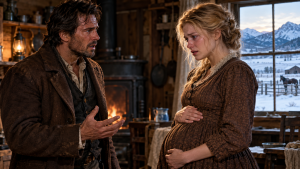
“Nathaniel, I’m already expecting a child.”
PART 2: The Truth Beneath Her Silence
I stared at Adeline’s hands resting against her stomach, unable to understand how the woman I was beginning to love could have carried such an enormous secret into my home.
The kitchen seemed unnaturally quiet, although the fire still crackled and the wind continued pressing against the windows.
For several seconds, I could not make myself speak.
Adeline watched my face with the terrified attention of someone waiting for a door to close.
“Please say something.”
I stepped away from her chair.
“How long have you known?”
“Several weeks before I answered your advertisement.”
Her answer struck me harder than I expected.
I had assumed, foolishly perhaps, that her silence might have come from uncertainty or a discovery made after arriving.
Instead, she had crossed Wyoming knowing exactly what she was concealing.
“You knew when you wrote that letter?”
She nodded, lowering her eyes.
“Yes.”
I turned toward the window because I could not bear to watch her cry while my own thoughts were tangled with hurt.
She had thanked me for my honesty, praised my courage, and allowed me to believe we were beginning our partnership without secrets.
Now I wondered how much of our brief happiness had been real.
“Why didn’t you tell me?”
“I was afraid.”
“Of me?”
“Of losing the only chance I thought I had.”
I looked at her.
“Adeline, I gave you my word that I would never expect children from you, but that wasn’t permission to hide the truth about a child you were already carrying.”
She flinched, and I immediately regretted the sharpness in my voice.
Still, the hurt remained.
I asked whether the baby’s father knew.
“He knows.”
“Where is he?”
She tightened her hands around the cup.
“I don’t know where he is now.”
I waited as she struggled to continue.
She explained that before leaving her former town, she had trusted a man who spoke of marriage and made promises she had believed.
When she discovered she was pregnant, she told him because she thought the news would make their future more certain.
Instead, he withdrew from her life.
She had waited for an explanation, then for a letter, and finally for any indication that he intended to return.
Nothing came.
As the weeks passed, she found herself facing a future that frightened her more than she had admitted to anyone.
“I made a terrible mistake trusting him.”
I shook my head.
“Trusting someone isn’t the terrible part.”
Her eyes filled again.
“I should have told you before traveling here.”
“Yes, you should have.”
She accepted those words without arguing.
That quiet acceptance made my anger harder to hold.
I walked to the stove and added another piece of wood, needing something ordinary to do with my hands.
When I returned, she was staring at the floor.
“I never intended to claim this child was yours.”
I looked at her sharply.
“I know that.”
“I meant to tell you when we met.”
“Then why didn’t you?”
She lifted her face.
“Because you were kind to me.”
I had expected excuses, but not that answer.
She explained that from the moment I took her carpetbag at the depot, she had felt the difference between being welcomed and merely being tolerated.
Each day in the house had made the confession more frightening because she had begun caring about what I thought of her.
“I thought I would tell you before we made our vows.”
“That doesn’t make the silence right.”
“No.”
Her voice broke on that single word.
I pulled out the chair opposite her and sat down.
For the first time, I noticed how exhausted she looked beneath the steady expression she had tried so hard to maintain.
I asked whether she had been ill during the journey.
“Only a little.”
“And the dizziness?”
“It comes and goes.”
I felt ashamed remembering how casually I had dismissed her discomfort.
“You need a physician.”
“I haven’t enough money for that.”
“That wasn’t what I asked.”
She stared at me as though my concern were somehow more painful than my anger.
I told her that whatever happened between us, I would not let her suffer because she was afraid to ask for help.
Her shoulders began trembling.
For several minutes, neither of us spoke.
Eventually, I asked the question that had been growing inside me since her confession.
“Did you ever want to marry me, Adeline?”
She looked startled.
“Yes.”
“Or did you just need somewhere safe to stay?”
She pressed her lips together.
“At first, I needed somewhere safe.”
The honesty wounded me, although it was precisely what I had demanded.
I stood and walked toward the door.
“Then perhaps I misunderstood your letter.”
She rose quickly.
“Nathaniel, please.”
I stopped without turning.
“You spoke as though you believed we could build something together.”
“I did believe that.”
“Then explain why you chose me.”
She was silent long enough for me to hear the wind scraping against the porch.
Finally, she approached the table and picked up the newspaper advertisement I had kept beside her original letter.
Her fingers moved over the folded paper.
“I read those words more times than I could count.”
I waited.
“You said you wanted a partnership instead of a perfect woman.”
“That’s true.”
“And you said you would probably never have children of your own.”
A terrible suspicion stirred inside me.
She looked up, tears shining in her eyes.
“I thought a man who had been told he could never father a child might understand what it meant to feel that life had already decided your happiness for you.”
I felt the first part of her explanation soften something inside me.
Then she continued.
“I thought perhaps you might want the family I was bringing, because I had already begun to love this baby and was terrified that nobody else ever would.”
The words struck directly at the oldest wound I carried.
I had spent years believing I could never give a woman a family, and Adeline had come because she hoped I would accept the child another man had abandoned.
I wanted to hear compassion in her confession, but all I could hear was the fear that my loneliness had made me useful.
“Adeline, did you choose me because you wanted me, or because I couldn’t be the child’s father?”
She covered her mouth.
For one agonizing moment, she could not answer.
Then she whispered the truth I had been most afraid to hear.
“When I wrote that first letter, Nathaniel, I thought those were the same thing.”
PART 3: The Family I Was Afraid To Claim
I felt as though Adeline had reached inside my chest and touched the one place I had spent twenty-seven years protecting.
Her words had not been cruel, but they made me wonder whether she had seen a husband when she read my advertisement or merely a man desperate enough to accept anything.
I looked toward the bedroom across the hall.
Until that evening, the sight of her belongings had made my house feel complete.
Now I was frightened by how quickly that happiness might disappear.
“Do you understand how that sounds?”
She nodded.
“I do now.”
I rubbed a hand across my face.
“I didn’t put that advertisement in the paper because I wanted someone to pity me.”
“I never pitied you.”
“Then why did you believe my condition made me the right man?”
She stepped closer.
“Because you told the truth about something that hurt you, and I thought a man capable of that honesty might understand someone carrying her own shame.”
I wanted to believe her.
Instead, I asked whether she would have answered the advertisement if she had not been pregnant.
She stood very still.
“I don’t know, Nathaniel.”
Her answer was honest enough to hurt us both.
I turned away, and she quietly walked to her bedroom.
That night, I remained beside the cold fireplace long after the house had fallen silent.
I thought about the fever, the physician, and every occasion when I had watched another man’s children grow while pretending not to care.
For years, I had imagined fatherhood as something that began with blood and resemblance.
Now there was a child sleeping beneath my roof who had done nothing wrong, yet I was allowing my wounded pride to determine whether that child deserved a home.
The realization shamed me.
The following morning, I found Adeline preparing breakfast despite the exhaustion beneath her eyes.
I told her we would ride into Casper because I wanted a physician to examine her.
She tried to protest the expense, but I reminded her that she was already part of the household.
Her expression changed.
“Am I?”
I looked at her helplessly.
“I haven’t asked you to leave.”
“That isn’t quite the same thing.”
I could not argue.
We traveled into town beneath a sky threatening early snow.
At the physician’s office, I remained outside while Adeline was examined, giving her the privacy she deserved.
When she emerged, she looked relieved.
The doctor had found no immediate cause for alarm and advised her to rest whenever she felt unwell.
I thanked him and paid the fee before Adeline could reach for her purse.
She waited until we were outside to speak.
“You didn’t have to do that.”
“I wanted to.”
“You’re making it very difficult for me to know what you feel.”
I understood because I was having the same difficulty.
We stopped at the general store for supplies, and I noticed a woman watching Adeline with unnecessary curiosity.
When the woman asked whether our wedding had already taken place, Adeline’s face reddened.
I answered that we had not yet decided upon a date.
The woman’s gaze moved briefly toward Adeline’s waist before she turned away.
I recognized that look.
Frontier towns could be generous in times of disaster and merciless when someone failed to satisfy their expectations.
For the first time, I understood how alone Adeline must have felt before answering my advertisement.
On the journey home, she remained unusually quiet.
I finally asked what was troubling her.
“People will talk about you because of me.”
“People have been talking about me for years.”
“This will be different.”
I glanced toward her.
“Perhaps.”
She looked down at her hands.
“I won’t let your name become something people laugh at.”
I wanted to tell her that my name had never warmed my kitchen or sat beside me through a lonely winter.
Instead, I said nothing.
Over the following weeks, we continued sharing the ranch, but the easy warmth between us had changed.
Adeline remained helpful and considerate, yet she stopped allowing herself to linger in the kitchen after supper.
She no longer laughed freely at my foolish jokes, and she thanked me for ordinary kindnesses as though she were a guest preparing to depart.
I noticed every difference.
One evening, I found her carefully mending a tiny piece of fabric beside the fire.
She tried to hide it when I entered, but I recognized the small garment in her hands.
“Is that for the baby?”
She nodded.
“I had a little cloth left over.”
I sat across from her.
“May I see it?”
She hesitated before passing me the tiny shirt.
It was so small that both sleeves fit inside one of my hands.
For the first time, the child ceased being merely a painful secret between us.
There would be an actual baby in this house, needing warmth, food, protection, and someone to hold them when the world became frightening.
I ran a thumb along the unfinished stitching.
“You’re good with a needle.”
She smiled faintly.
“My mother taught me.”
I handed the garment back.
“She taught you well.”
For a moment, the old tenderness returned.
Then Adeline quietly asked whether I thought a child could be happy with a man who had not fathered it.
I remembered my own childhood, when my father had spent long days working yet always found time to teach me something after supper.
I remembered being sick and frightened, hearing his boots cross the bedroom floor as he brought another armful of wood.
What had mattered was never whether I resembled him.
What mattered was that he came when I needed him.
“I think a child needs someone who stays.”
Adeline looked at me hopefully.
“Do you mean that?”
“Yes.”
“Could you stay for mine?”
Her question frightened me because answering it meant admitting that the life I had mourned might be standing directly in front of me.
I looked toward the fire.
“I don’t know whether I’d be enough.”
Her hopeful expression collapsed.
She returned the little shirt to her sewing basket.
That night, I heard movement in the spare bedroom long after midnight.
At dawn, I discovered her carpetbag beside the kitchen door.
Adeline stood near the window wearing the brown traveling dress she had worn when we first met.
My heart began pounding.
“What are you doing?”
She turned toward me with swollen eyes.
“There’s a stage leaving Casper tomorrow, and I intend to be on it.”
I reached for the back of a chair.
“Adeline, don’t make a decision while we’re both hurting.”
She shook her head.
“I’ve spent weeks hoping you might love this child, but I cannot make a baby grow up wondering whether the man raising them wishes they had never been born.”
I tried to answer, yet my throat closed around the words.
She picked up her carpetbag.
“I love you, Nathaniel, and that’s why I have to go before my child learns to love a father who cannot promise to stay.”
PART 4: The Promise That Winter Put To The Test
Adeline’s confession left me standing in my own kitchen, staring at the carpetbag that suddenly seemed capable of carrying away everything I had ever wanted.
I had believed my greatest fear was that no woman would choose a man who could not father children.
Now I understood that a woman had chosen me, and my fear of being inadequate was driving her away.
I stepped between Adeline and the door.
“Please put the bag down.”
She looked exhausted.
“Nathaniel, I can’t keep hoping for an answer you aren’t ready to give.”
“Then let me give you the truth.”
She waited without moving.
I took a breath and forced myself to say what I had been hiding beneath anger and uncertainty.
“When you told me about the baby, I felt foolish because I thought I had finally been chosen for myself.”
Her eyes filled.
“You were.”
“At first, you needed safety, and I was ashamed that a part of me wondered whether that was all I could offer.”
I moved closer.
“But every morning since you came here, I’ve looked for you before I’ve looked out at my own land.”
She began crying silently.
“I’ve spent more evenings waiting to hear you laugh than I ever spent thinking about the cattle.”
I reached toward her carpetbag but stopped before touching it.
“The truth is that I’m terrified of being a father because I have spent my whole life being told I could never become one.”
She whispered my name.
“I cannot promise I’ll know everything a child needs, Adeline, but I can promise that I will never make this baby feel unwanted.”
Her hands loosened.
I continued before fear could silence me again.
“And I don’t want you to stay because you need protection or because you feel grateful for what I have.”
I looked directly into her eyes.
“I want you to stay because I love you.”
She covered her face and began sobbing.
I waited, understanding that one declaration could not erase the pain my hesitation had caused.
After a long moment, she stepped forward and placed her forehead against my chest.
“Are you sure?”
I rested my hands carefully against her shoulders.
“I’m frightened, but I’m sure.”
She looked up.
“Those aren’t the same thing.”
“No, but I think a man can be frightened and still keep his word.”
She held me then, and for the first time since her confession, I felt her stop preparing herself for rejection.
We did not pretend the past weeks had been easy.
Instead, we talked honestly about the fear that had brought her to my ranch and the shame that had kept me from reaching for the family she offered.
I admitted that I had sometimes confused being a biological father with being worthy of fatherhood.
She admitted that she had allowed her desperation to excuse withholding a truth I deserved to know.
Neither confession erased the other, but they gave us a beginning built upon something stronger than silence.
Two weeks later, we married in a modest ceremony attended by a few neighbors who had shown us kindness.
Adeline wore the same brown dress she had arrived in, altered with a simple white collar she had sewn herself.
When I promised to love and protect her, I included the child she carried in my heart even though the vows did not require me to speak of the baby.
She understood without needing an explanation.
Winter settled over Wyoming shortly afterward, bringing deep snow, frozen water troughs, and long nights when the wind made the house tremble.
As Adeline’s pregnancy progressed, I found myself becoming strangely fascinated by the ordinary changes I once believed I would never witness.
I helped her arrange a small cradle near our bedroom and carved a wooden horse from a piece of pine.
Sometimes I caught her watching me work with an expression that made me feel both humble and extraordinarily fortunate.
One evening, she placed my hand against her stomach.
I froze when something moved beneath my palm.
“Was that the baby?”
She laughed softly.
“Yes.”
I kept my hand there, hardly daring to breathe.
For years, I had imagined fatherhood as a door permanently closed against me.
Now a child I had not created was announcing their existence beneath my own roof.
I lowered my head and whispered something I had wanted to say for longer than I could remember.
“Hello, little one.”
Adeline’s tears fell onto my sleeve.
The months passed, bringing moments of happiness alongside the ordinary worries of an approaching birth.
We arranged for Mrs. Bell, an experienced local midwife, to help when the time came.
She visited whenever the weather allowed, examining Adeline and explaining what supplies we should keep ready.
I listened carefully, making notes because I was determined that ignorance would not become another reason to disappoint the woman I loved.
Then, late one winter night, Adeline woke me with a sharp gasp.
Her hand gripped my arm.
“Nathaniel, I think the baby’s coming.”
I rose so quickly that I knocked over the chair beside our bed.
Outside, snow was falling heavily enough to erase the fence line.
I helped Adeline sit upright, then hurried to light the lamps and prepare the water Mrs. Bell had instructed us to keep ready.
Fortunately, the midwife had arrived earlier that evening because the weather had begun turning dangerous.
She came immediately when I called.
For hours, I remained beside Adeline while she endured one painful contraction after another.
Mrs. Bell worked calmly, offering instructions and occasionally sending me for fresh water or clean cloths.
I had never felt so helpless.
The woman who had brought laughter into my home was suffering, and all I could offer was my hand and the promise that I would not leave.
As the hours passed, Adeline grew exhausted.
She gripped my fingers so tightly that I lost feeling in them.
“Please don’t go.”
I leaned close.
“Not for anything.”
Her next contraction bent her forward, and Mrs. Bell moved quickly to help her.
The room filled with urgent instructions and the sound of Adeline struggling for breath.
Then, after a final terrible effort, the baby was born.
For one suspended moment, I felt relief rush through my entire body.
But the cry I had been waiting to hear never came.
Mrs. Bell lifted the tiny child into the lamplight and immediately began rubbing the baby’s back with a clean cloth.
Adeline reached weakly toward her.
“Why isn’t my baby crying?”
I looked at the motionless little face in the midwife’s hands.
Mrs. Bell worked faster, her expression turning grave.
Then she looked at me and spoke with an urgency that drained every trace of warmth from the room.
“Nathaniel, I need you to help me now, because this baby isn’t breathing.”
PART 5: The Child My Heart Had Been Waiting For
I had faced blizzards, stampeding cattle, and winters when the cold threatened to take everything I owned, but nothing had ever terrified me like the sight of that silent newborn.
Mrs. Bell placed the baby on a clean, warm cloth and instructed me to bring another from beside the stove.
I moved immediately, nearly stumbling over the basin as I hurried back.
Adeline lay trembling against the pillows, her eyes fixed on the child.
“Nathaniel, what’s happening?”
I wanted to promise that everything would be all right, but I had spent too many years learning the importance of honesty to offer a certainty I did not possess.
“Mrs. Bell is helping the baby breathe.”
The midwife cleared the newborn’s mouth and nose as needed, then continued drying and stimulating the tiny body.
I stood beside her holding the warm cloth, silently begging a child I had not yet met to remain with us.
Adeline began crying.
“Please, Nathaniel.”
I leaned toward the baby, hardly recognizing my own voice.
“Come on, little one, your mother’s waiting.”
Mrs. Bell kept working.
The seconds felt longer than any winter night I had endured.
I remembered the doctor who had told me that I would likely never father children.
I remembered the advertisement I had almost destroyed and the frightened young woman standing alone beside a muddy stagecoach.
I remembered every moment when I had questioned whether another man’s child could truly become mine.
Now those doubts seemed unbearably small beside the possibility of losing this tiny life.
I touched the baby’s hand with one trembling finger.
“You’ve got a home here.”
Mrs. Bell shifted the child slightly.
“Come on, sweetheart.”
I bent closer.
“And you’ve got a father who’s waiting for you.”
A faint movement crossed the baby’s face.
Then came a small, struggling breath.
Mrs. Bell continued her careful work while I stood frozen, afraid to believe what I had witnessed.
The next breath came stronger.
And suddenly, the little room filled with a thin, furious cry.
Adeline began sobbing.
Mrs. Bell released a breath of her own and smiled with exhausted relief.
“That’s what we wanted to hear.”
My knees nearly gave way.
I gripped the bedframe and closed my eyes, overcome by gratitude so enormous that I could not immediately speak.
When I looked again, the midwife was examining the baby carefully and making certain the breathing continued steadily.
Only when she was satisfied did she wrap the child warmly and bring the tiny bundle to Adeline.
“It’s a little girl.”
Adeline reached out with shaking hands.
The moment our daughter settled against her chest, something in her expression changed.
All the fear, pain, and loneliness she had carried seemed to give way to a tenderness that made my own eyes burn.
I sat beside them, unable to stop looking at the tiny face peeking above the blanket.
She had dark hair, delicate fingers, and a determined little mouth that opened whenever she wanted the world to know she was uncomfortable.
She was absolutely beautiful.
Adeline looked toward me.
“Would you like to hold her?”
I hesitated.
Not because I doubted that I wanted her, but because I had never held anything that seemed so precious or so fragile.
“What if I do it wrong?”
Mrs. Bell showed me how to support the baby’s head and keep her close.
When Adeline placed our daughter in my arms, I felt my entire life rearrange itself around the small weight resting against my chest.
The little girl moved her mouth and curled one hand against my shirt.
I stared down at her, overwhelmed by a love I had spent years believing belonged to other men.
“Hello, sweetheart.”
She made a tiny sound.
I laughed through my tears.
“I’ve been waiting a long time to meet you.”
Adeline watched me silently.
Then she asked the question I knew had been resting in her heart since the evening she confessed her secret.
“Do you truly think of her as yours?”
I looked at the woman I loved.
There had been a time when I believed the answer depended upon whether the child carried my blood.
But blood had not kept me awake through Adeline’s pregnancy, built the cradle beside our bed, or made me pray through the darkest hour of that night.
Love had done those things.
Choice had done those things.
And whatever the future brought, I knew I would spend my remaining years answering this child’s needs.
“She’s our daughter, Adeline.”
Her lips trembled.
“Even knowing everything?”
“Especially knowing everything.”
I held the baby a little closer.
“I can’t change how she came into this world, but I can make certain she never doubts that she belongs here.”
Adeline reached for my free hand.
For a long moment, neither of us spoke.
Mrs. Bell quietly finished her work and reminded Adeline that both mother and baby needed rest.
Once the midwife was satisfied that they were recovering, she left us together beside the warm stove.
Outside, the storm continued sweeping across the pastures.
Inside, my house sounded different.
There were soft breaths, a baby’s occasional whimper, and Adeline’s gentle voice whenever our daughter stirred.
The silence that had haunted me for years was gone.
Later that morning, as pale sunlight began appearing through the windows, Adeline asked what we should name the baby.
I told her I had been too afraid to suggest anything before the birth.
She smiled.
“I’ve always liked Clara.”
I repeated the name while looking down at our daughter’s sleeping face.
“Clara Cole.”
Adeline’s eyes filled again.
“Are you certain?”
I understood what she was asking.
She wanted to know whether I was willing to give this child my family name without hesitation or conditions.
I kissed her forehead.
“Clara Cole sounds exactly right.”
In the weeks that followed, our lives became more exhausting and more beautiful than anything I had imagined.
I learned how to warm blankets, soothe frightened cries, and carry a sleeping baby without waking her.
Sometimes Clara refused to settle until I walked slowly around the kitchen with her resting against my shoulder.
On those nights, I remembered how I once wandered through the same rooms with no company but my own footsteps.
Adeline often watched from the doorway, smiling at the sight of the two of us.
We still disagreed occasionally, and I still made mistakes as I learned how to be a husband and father.
But neither of us returned to the silence that had nearly separated us.
When something hurt, we spoke about it.
When fear returned, we faced it together.
And when Clara began recognizing my voice, reaching toward me whenever I entered the room, I felt a happiness no physician’s verdict could diminish.
One spring afternoon, I found the old Cheyenne newspaper advertisement tucked inside the drawer where I had kept Adeline’s first letter.
I carried both papers to the porch and sat beside my wife while Clara slept in her arms.
Adeline read the advertisement and smiled sadly.
“Would you change anything?”
I considered the question while looking across the green pastures.
There was one sentence I might have written differently, but I understood that the honesty of those original words had brought Adeline to me.
“No.”
She looked surprised.
“Not even the part about never fathering children?”
I reached over and gently brushed Clara’s cheek.
“The doctor may have been right about what my body could do.”
I turned toward Adeline.
“But he couldn’t have known what my heart would be given the chance to become.”
She rested her head against my shoulder.
For a long while, we watched the afternoon sunlight spread across the land I had once believed was all I would ever possess.
Then Clara stirred, opened her eyes, and reached one tiny hand toward me.
I lifted her from Adeline’s arms and held her close.
For thirty-eight years, I had believed that becoming a father required giving a child life.
But as my daughter settled against my chest and my wife smiled beside me, I finally understood something the lonely man who wrote that marriage advertisement could never have imagined.
I had not given Clara her first heartbeat, but I could spend the rest of my life making certain she always had someone to come home to.
And when she was old enough to call me Father, I would answer every single time.