PART 1 : The Night My Family Celebrated Getting Rid of Me
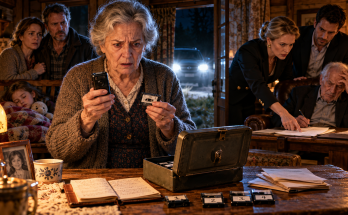
The night I moved out of my parents’ house, my mother invited thirty-seven relatives over for dinner.
She called it a family gathering.
My brother called it an eviction party.
And my father stood in the driveway watching me carry the last cardboard box to my car.
He didn’t offer to help.
He didn’t ask where I was going.
He just folded his arms and said something I would remember for the rest of my life.
“Don’t come crawling back when you realize how expensive the real world is.”
My name is Evelyn Brooks.
I was thirty-two years old, worked as a payroll manager for a manufacturing company in Ohio, and had spent the previous eleven years believing I was the biggest disappointment in my family.
That belief hadn’t happened overnight.
My parents had worked hard to make sure I understood exactly where I stood.
My younger brother, Nathan, was the successful one.
At least, that was what everyone said.
He owned a construction company, drove a black Mercedes, and posted photographs of expensive vacations with captions about hard work and ambition.
My parents talked about him constantly.
Nathan had bought another investment property.
Nathan had secured another contract.
Nathan was building a legacy.
Meanwhile, I was the daughter who still lived at home.
They never explained why.
They never mentioned that I paid the mortgage every month.
They never told anyone that I had replaced the roof, paid the property taxes, and covered most of the household bills.
They certainly never mentioned the $84,000 I had transferred into their accounts over the years whenever Nathan’s business supposedly needed rescuing.
Instead, my mother introduced me as the daughter who hadn’t quite figured out adulthood.
Sometimes she laughed when she said it.
Other people laughed too.
And I smiled because arguing only made things worse.
I had learned that lesson when I was nineteen.
Back then, I had received a scholarship to attend a university three hours away.
I was excited.
I had already chosen my courses and purchased a secondhand suitcase.
Then my father developed a serious back problem and couldn’t work for several months.
My mother cried at the kitchen table.
Nathan was still in high school.
There were bills to pay.
So I deferred my admission, took a local job, and promised to enroll the following year.
The following year became another year.
Then another.
Eventually, I finished my accounting degree through evening classes while working full-time.
My father recovered.
Nathan went to college.
But somehow, my temporary sacrifice became my permanent responsibility.
Whenever I mentioned leaving, my mother reminded me how much they had done for me.
Whenever I asked why I was paying so many expenses, my father accused me of keeping score.
And whenever I tried to explain that I wanted my own life, Nathan rolled his eyes.
“You’re thirty-two, Evie. Nobody’s keeping you here.”
He was right about one thing.
Nobody had physically locked the door.
They had simply convinced me that walking through it would make me a terrible daughter.
That changed on a Thursday afternoon in September.
I had come home early because our office’s internet connection was down.
As I walked into the kitchen, I heard my mother talking to Nathan.
They didn’t know I was there.
“Once Evelyn starts paying more, we can handle the new loan,” my mother said.
Nathan laughed.
“She won’t complain. She never does.”
My mother lowered her voice.
“Your father thinks we should tell her it’s for repairs.”
“What repairs?”
“The foundation. Something expensive enough that she won’t question it.”
I stood motionless beside the refrigerator.
Nathan opened a can of soda.
“How much are we getting from her?”
My mother answered without hesitation.
“Twenty-five thousand to start.”
He whistled.
“Nice.”
Then he said something that changed everything.
“Imagine being thirty-two and still believing you’re helping your family when you’re really just paying for everyone else’s lifestyle.”
My mother laughed.
I had heard them insult me before.
But hearing them discuss how easily they could manipulate me was different.
It was like watching someone remove a curtain from a window I had spent years avoiding.
That evening, I contacted a landlord about a small apartment fifteen minutes from work.
The rent was $1,180 a month.
There was no balcony.
The kitchen was narrow.
The bathroom tiles were old.
I loved it immediately.
Two weeks later, I signed the lease.
I told my parents over dinner.
My father put down his fork.
“You’re moving?”
“Yes.”
My mother looked at me as if I had announced I was leaving the country.
“Why?”
“Because I want to live independently.”
Nathan laughed from the other end of the table.
“You finally found somebody willing to rent to you?”
I ignored him.
My father asked who would pay the mortgage.
I looked directly at him.
“I thought you owned the house.”
He stared at me.
“Of course I own the house.”
“Then the mortgage is your responsibility.”
His face turned red.
For a moment, nobody spoke.
Then my mother started crying.
Not quietly.
Not privately.
She pressed a tissue to her face and announced that I was abandoning them after everything they had sacrificed.
My father said I was selfish.
Nathan called me ungrateful.
By the end of dinner, I was apparently responsible for destroying the family.
I moved out ten days later.
And my mother decided to celebrate.
When I carried my final box outside, I could hear relatives laughing through the dining room windows.
Nathan stepped onto the porch holding his phone.
“Wait, Evie.”
I turned.
He lifted the camera.
“One last picture of our favorite freeloader.”
I told him to put the phone away.
He took the photograph anyway.
Behind him, my mother appeared in the doorway.
She smiled at the screen.
“Make sure everybody knows she’s finally leaving.”
That evening, Nathan posted the photograph on Facebook.
The caption said:
After eleven years, the family parasite has finally found another host.
By midnight, the post had received more than two hundred reactions.
Some relatives laughed.
Others congratulated my parents.
One uncle commented that I needed to learn what responsibility looked like.
I sat on the floor of my new apartment, surrounded by unpacked boxes, reading every word.
Then I turned off my phone.
I cried for nearly an hour.
Not because I wanted to return.
Because part of me still wondered whether they were right.
The next morning, I opened a savings account my family couldn’t access.
I redirected my paycheck.
I canceled the automatic transfers I had set up years earlier.
And for the first time since I was twenty-one, I bought groceries without calculating how much money would be left for my parents.
It felt strange.
Almost dishonest.
Two weeks later, my mother called.
She didn’t ask how I was settling in.
She didn’t ask whether the apartment was safe.
She asked why the mortgage payment hadn’t arrived.
I told her I was no longer paying it.
She became furious.
“You can’t just stop supporting your own family.”
I looked around my apartment.
There were two plates in the cabinet.
One chair at the kitchen table.
A small plant beside the window.
And nobody shouting at me.
“I can,” I said.
Then I ended the call.
I thought that was the beginning of my new life.
I had no idea that six weeks later, a letter from a bank would uncover a secret worth hundreds of thousands of dollars.
PART 2 : The Letter That Was Never Supposed to Reach Me
The envelope arrived on a rainy Tuesday.
It was addressed to Evelyn Margaret Brooks.
My full legal name.
The return address belonged to a regional mortgage lender I had never used.
At first, I assumed it was an advertisement.
Then I noticed the words Notice of Incomplete Authorization.
Inside was a letter explaining that the lender could not proceed with a proposed $310,000 refinancing of a property because one of the recorded owners had not completed the required verification process.
The property address was my parents’ house.
I read it three times.
Then I called the number printed at the bottom.
A woman named Denise answered.
I explained that I had never applied for a mortgage.
She asked me to verify my identity.
After several questions, her voice became noticeably more careful.
“Ms. Brooks, according to the documentation submitted with this application, you hold an ownership interest in the property.”
I stared at the kitchen wall.
“That’s impossible.”
She paused.
“Are you saying you were unaware of your ownership interest?”
“Yes.”
There was another silence.
Then she said something that made my hands turn cold.
“Someone submitted an authorization form bearing your signature.”
I had signed nothing.
I told her that immediately.
She explained that the application had been suspended pending further review.
She also advised me to contact an attorney.
I wrote down everything she said.
After the call, I sat at my kitchen table staring at the envelope.
My father had always said the house belonged to him.
He had used that fact whenever he wanted to end an argument.
His house.
His rules.
His decisions.
So why was a lender contacting me?
And why had someone submitted documents using my name?
I searched the county property records online.
The first result showed a deed filed eleven years earlier.
I opened it.
There were several pages of legal descriptions, signatures, and recording stamps.
Then I saw my name.
Evelyn Margaret Brooks.
Beside it were words I didn’t fully understand.
Undivided one-half interest.
I searched for the phrase.
Then I called my aunt Patricia.
She was my late grandmother’s younger sister, and one of the few relatives who had never joined in the family jokes about me.
When she answered, I asked whether Grandma Margaret had ever owned part of my parents’ house.
Patricia went quiet.
“Why are you asking?”
I explained the letter.
She didn’t interrupt.
When I finished, she asked me to come over.
That evening, I drove to her little brick house on the edge of town.
She was waiting at the kitchen table.
There was a folder in front of her.
She looked frightened.
“I’ve been wondering when this would happen,” she said.
I sat down.
“What would happen?”
She pushed the folder toward me.
Inside was an old photograph of my grandmother standing outside my parents’ house.
I recognized the porch.
The white railing.
The large maple tree near the driveway.
My grandmother had been smiling.
Patricia touched the photograph.
“Your grandparents helped your parents purchase that property. When your grandfather died, your grandmother retained an interest in it.”
I listened without moving.
“Years later, she became worried about your father’s debts. She wanted to make sure part of the family property would remain protected.”
Patricia opened another document.
“She transferred her interest to you.”
I stared at the paper.
“Why didn’t anyone tell me?”
“She intended to.”
“What happened?”
Patricia looked down.
“Your father asked her to wait until you finished college. He said knowing about the property would distract you.”
My chest tightened.
“But Grandma died before I finished.”
Patricia nodded.
“Yes.”
I remembered my grandmother’s funeral.
I remembered my father telling me she hadn’t left much behind.
I remembered asking whether I could have her old sewing box.
My mother said it had already been donated.
Now I was staring at a document that suggested my grandmother had left me half a house.
“Did my father know?”
Patricia’s expression answered before she spoke.
“He signed the acknowledgment.”
I felt physically sick.
For eleven years, my father had allowed me to pay for a property he knew I partly owned.
For eleven years, he had called me a dependent.
For eleven years, I had believed I was living in his house by his generosity.
And now someone had tried to borrow $310,000 against it.
I contacted an attorney the next morning.
Her name was Allison Price.
She specialized in property disputes and financial misconduct.
When I explained the situation, she asked me to send the deed and bank letter immediately.
Two days later, we met in her office.
She had already obtained certified copies of the recorded documents.
She explained that the deed appeared to establish a genuine ownership interest in my name, although she would need to examine the full title history before giving me a definitive conclusion.
Then she placed another document on the table.
It was the authorization submitted to the mortgage lender.
At the bottom was a signature.
My signature.
Except it wasn’t mine.
The E looked wrong.
The letters were too tightly connected.
And the date was a Saturday when I had been attending a payroll conference in Cincinnati.
Allison asked whether anyone in my family had access to examples of my signature.
I almost laughed.
My mother had kept copies of my tax returns for years.
My father had handled old insurance paperwork.
Nathan had once asked me to sign several business forms when I helped him reconcile his accounts.
“All three of them,” I answered.
Allison nodded.
“We’re going to need to examine more than this mortgage application.”
She requested copies of my credit reports.
While we waited, she asked me a question I hadn’t expected.
“Have you ever checked whether your parents opened financial accounts in your name?”
I told her no.
She didn’t look surprised.
“Then we should start there.”
That afternoon, I downloaded my credit reports.
I had always believed I had excellent credit.
I paid my bills on time.
I carried very little debt.
I had never financed a car.
But my report listed several accounts I didn’t recognize.
A business credit card.
A personal line of credit.
And a loan connected to a company called Brooks Development Group.
Nathan’s company.
I scrolled to the balances.
The total exceeded $96,000.
I called Allison.
She asked me to send screenshots and stop contacting family members until we understood what had happened.
I sat in my apartment staring at the screen.
My parents hadn’t simply hidden property from me.
Someone had been using my identity.
And every account seemed to lead back to my brother.
PART 3 : The Secret Account Behind My Brother’s Success
The first time Allison showed me the financial records, I couldn’t understand what I was seeing.
There were transfers between accounts.
Business payments.
Credit-card withdrawals.
Several transactions labeled as management fees.
And my name appeared repeatedly.
Allison had hired a forensic accountant named Daniel Reeves to help trace the money.
Daniel was a quiet man who wore reading glasses on a cord around his neck.
He explained the findings without raising his voice.
“Your brother’s company experienced serious cash-flow problems approximately five years ago.”
I nodded.
I remembered.
Nathan had told everyone that a major contractor had delayed payment.
My parents had asked me for $12,000 to help cover payroll.
I had borrowed money from my savings.
Daniel turned the page.
“During that period, someone opened a credit line using your personal information.”
I looked at the account.
The original credit limit was $40,000.
It had later increased.
Payments had been made regularly enough to keep the account active.
But the source of those payments was another account.
An account I recognized.
My parents’ household account.
Daniel pointed to several deposits.
“Your monthly transfers helped maintain these obligations.”
I stared at the dates.
For years, I had been sending money to my parents believing I was helping with groceries and utilities.
Some of it had been used to pay debts taken out in my name.
The rest appeared to move through Nathan’s company.
My father had effectively been using my money to service debt created with my identity.
I asked Daniel whether he was certain.
He shook his head slightly.
“We have a strong paper trail. But we need original account-opening records, authentication logs, and statements before assigning responsibility for each transaction.”
Allison agreed.
“Evidence first. Conclusions afterward.”
I appreciated that.
I needed someone who cared about facts more than family appearances.
Then Daniel opened a spreadsheet containing eleven years of transactions from the household records I had been able to supply.
He had calculated my contributions.
Mortgage payments.
Utilities.
Insurance.
Repairs.
Emergency transfers.
The total was far higher than I expected.
I had directly contributed more than $190,000.
That didn’t include groceries, furniture, or countless smaller purchases.
I covered my mouth.
“That can’t be right.”
Daniel showed me the calculations.
It was right.
I thought about every vacation I had refused because money was tight.
Every old winter coat I had worn for another season.
Every time I had skipped meeting friends because my mother said the electric bill was overdue.
Nathan had been flying business class to Florida while I was repairing my shoes with glue.
Then Allison asked me about my grandmother.
I told her everything Patricia had said.
Allison looked through a separate folder.
“There may be another issue.”
She had located references to a family investment arrangement created after my grandfather’s death.
The paperwork mentioned an account designated for my benefit.
I had never heard of it.
According to the preliminary records, the account had held approximately $48,000 when my grandmother died.
My father had been listed as an administrator.
Allison requested further documentation.
Three weeks later, the records arrived.
Most of the money was gone.
The withdrawals had occurred over several years.
Some payments went toward the house.
Others moved into accounts associated with my father.
Several large transfers appeared to benefit Nathan’s company.
I felt numb.
My grandmother had died believing she was helping secure my future.
And the money had apparently been used for everyone except me.
That evening, my phone rang.
It was Nathan.
I almost ignored the call.
Then I answered.
“What do you want?”
He sounded irritated.
“What’s this nonsense about lawyers?”
I didn’t respond.
“Dad says you’re challenging the mortgage.”
“Someone used my signature.”
He sighed.
“Evelyn, do you know how business works?”
I looked at the phone.
“No. Explain it.”
“Sometimes families have to cooperate financially.”
“Did I authorize that loan?”
He hesitated.
“You’re being dramatic.”
“Did I authorize it?”
Another pause.
Then he said, “Dad handled the paperwork.”
I wrote the sentence down.
“Did you know my name was on the application?”
“Look, the house is family property.”
“That’s not what I asked.”
His voice hardened.
“You realize this could destroy my company.”
I thought about the hundred nights I had stayed awake worrying about their bills.
“Then perhaps you shouldn’t have involved me without asking.”
He began shouting.
I ended the call.
Five minutes later, my mother called.
Then my father.
Then Nathan again.
I turned off the phone.
The next morning, I received a message from my cousin Laura.
It contained a screenshot.
My mother had posted another statement on Facebook.
She accused me of trying to steal my parents’ home.
She said I had become obsessed with money.
She claimed my new lawyer was encouraging me to destroy the family.
Underneath were dozens of comments.
Some people called me selfish.
Others said I should be ashamed.
One relative suggested I needed psychiatric help.
I stared at those words for several minutes.
Then I sent the screenshots to Allison.
She told me to preserve them.
I asked whether I should write a public response.
She advised me not to discuss disputed facts online while the investigation continued.
So I said nothing.
That silence frustrated my family more than any argument could have.
They were accustomed to me defending myself.
Apologizing.
Explaining.
Offering another payment.
This time, I let their accusations stand while the evidence accumulated.
Two days later, Patricia called.
She had found something.
A small metal box that had belonged to Grandma Margaret.
Inside were old photographs, receipts, and an envelope marked with my name.
Patricia asked me to come immediately.
The envelope contained a handwritten note.
My grandmother had written it during the final months of her life.
She said she hoped the property and savings she had arranged would someday allow me to choose where I lived, what work I pursued, and whom I trusted.
She also mentioned something that made me stop reading.
A blue ledger.
She had written that the ledger contained a record of promises my father had made.
Patricia looked confused.
“I remember that book.”
“Where is it?”
“Your grandmother kept it in the bottom drawer of her sewing cabinet.”
I felt my stomach drop.
The cabinet my mother claimed had been donated after the funeral.
I called Allison.
She listened carefully.
Then she said, “Do you know whether your parents still have that cabinet?”
I did.
I had seen it in their basement only a month before moving out.
PART 4 : What We Found in Grandma’s Blue Ledger
I didn’t go back to the house alone.
Allison arranged a formal request to retrieve my grandmother’s personal effects.
My parents resisted.
They claimed the sewing cabinet belonged to them.
They said the papers inside were private.
My father even suggested that Patricia was confused because of her age.
But the existence of my grandmother’s letter changed the conversation.
Eventually, their attorney agreed to a supervised inspection of the cabinet.
The appointment was scheduled for a Friday morning.
I barely slept the night before.
When I arrived, my father’s car was in the driveway.
Nathan’s Mercedes was parked behind it.
My mother opened the door.
She looked smaller than I remembered.
For a moment, I wanted to hug her.
Then she looked past me at Allison and said, “I can’t believe you’re bringing strangers into our home.”
I didn’t answer.
We went downstairs.
The sewing cabinet stood beside the washing machine.
It was made of dark walnut with three drawers and a small brass handle.
My grandmother used to keep peppermint candies in the top drawer.
When I was little, she would pretend she didn’t notice me taking them.
I opened that drawer first.
It was empty.
The second contained buttons and loose thread.
The bottom drawer was locked.
My father crossed his arms.
“We don’t have the key.”
Allison asked whether he would consent to having it opened by a locksmith.
He looked at our attorney, then at Nathan.
Finally, he nodded.
The locksmith arrived twenty minutes later.
The small lock opened with a quiet click.
Inside was a blue notebook wrapped in a faded dish towel.
There was also a photograph of me at nineteen, wearing the yellow dress I had chosen for my scholarship interview.
I picked it up.
On the back, Grandma had written the date.
Then I opened the notebook.
The first pages contained household expenses.
Receipts for roof repairs.
Property tax payments.
Records of money Grandma had contributed.
Then the entries changed.
They became detailed notes about loans my father had requested.
Promises to repay.
Dates.
Amounts.
Signatures.
One entry concerned a $35,000 loan to help Nathan purchase equipment.
Another mentioned money withdrawn from the investment account intended for me.
Several pages contained my father’s initials.
Allison photographed the pages.
My father stepped forward.
“Those are personal family records.”
Allison replied evenly.
“We’ll preserve them and determine their relevance through the appropriate process.”
He looked at me.
“You’re really doing this?”
I closed the notebook.
“Did you know Grandma wanted me to have this?”
He didn’t answer.
“Did you know she left me part of the house?”
His jaw tightened.
“She made some arrangements that complicated things.”
“Did you know?”
“Yes.”
The word was barely audible.
I looked at my mother.
She stared at the floor.
I turned back to him.
“And you let me believe I was living here because you were doing me a favor.”
He exhaled sharply.
“You don’t understand what it takes to maintain a household.”
“I paid the mortgage for years.”
“Because you lived here.”
“I also paid for your son’s business.”
Nathan stepped forward.
“Leave me out of this.”
I looked at him.
“Then why is my name on your company’s credit accounts?”
His face changed.
Only slightly.
But I saw it.
The confidence disappeared.
My father interrupted before Nathan could answer.
“This conversation is over.”
Allison calmly agreed.
“We have what we came for.”
I carried the notebook upstairs.
At the front door, my mother touched my arm.
“Evelyn.”
I stopped.
Her eyes were wet.
“We never meant for things to get so far.”
I looked at her hand.
The same hand that had comforted me as a child.
The same hand that had taken my paycheck contributions without asking whether I could afford them.
“Then when did you mean to stop?”
She began crying.
But she didn’t answer.
I left.
Over the following weeks, Allison and Daniel examined the notebook alongside the banking records.
They identified transactions that appeared to corroborate many of Grandma’s notes.
The disputed mortgage application became part of a broader financial investigation.
The bank demanded additional documentation from my parents.
Lenders reviewed the credit accounts connected to my identity.
Nathan’s business accounts came under scrutiny.
My father hired a second attorney.
And for the first time in my life, my family stopped asking me for money.
Instead, they began asking me for mercy.
Nathan sent a message saying his employees would suffer if the investigation continued.
My mother said my father wasn’t sleeping.
My father left a voicemail claiming his blood pressure had become dangerously high.
I forwarded the messages to Allison.
Then I returned to my ordinary life.
I went to work.
I cooked dinner.
I visited Patricia.
I bought a small bookshelf for my apartment.
I started saving for a holiday.
It felt almost wrong to continue living while the family was in crisis.
Then I remembered something Grandma had written.
She hadn’t asked me to spend my life rescuing people who refused to take responsibility for their choices.
She had wanted me to have choices of my own.
Several months later, mediation began.
My parents initially demanded that I surrender my property claim in exchange for what they described as family reconciliation.
Allison rejected that proposal.
The second proposal recognized my ownership interest but offered no compensation for the disputed use of the property.
We rejected that too.
Finally, after additional financial disclosures, the negotiations became more serious.
The bank’s review had identified major discrepancies.
The credit disputes were progressing.
And Nathan’s company was facing consequences unrelated to anything I had personally requested.
For years, my father had controlled the family by insisting he knew best.
Now he couldn’t control the documents.
The truth existed independently of his approval.
That was something he had never prepared for.
PART 5 : The Price of My Silence
The settlement meeting lasted six hours.
My father sat across from me wearing the gray suit he usually reserved for weddings and funerals.
My mother kept twisting her wedding ring.
Nathan arrived late.
He didn’t look at me.
Allison sat beside me with several folders arranged neatly across the table.
My parents’ attorney explained their proposal.
They wanted to resolve the property dispute through a buyout of my ownership interest.
The amount would be based on an independent valuation, adjusted for the legal issues surrounding the disputed refinancing.
There would also be a separate accounting and recovery process for the money withdrawn from the investment arrangement.
The credit accounts would remain subject to independent review.
I listened carefully.
For the first time, nobody referred to me as a freeloader.
Nobody said I should be grateful for a roof.
Nobody suggested I was too immature to understand money.
They were speaking to me as a legal owner.
And the difference was almost painful.
My father finally looked up.
“Evelyn, I hope you understand we’re trying to keep the family together.”
I studied his face.
He seemed older.
There were lines around his eyes I hadn’t noticed before.
For a moment, I remembered him teaching me to ride a bicycle.
He had run beside me down the sidewalk, holding the back of the seat.
When I finally balanced on my own, he had cheered.
I wondered when that father had disappeared.
Or whether I had simply been too young to recognize everything else about him.
“I didn’t ask for the family to break apart,” I said.
He leaned forward.
“Then help us fix it.”
I looked at the papers.
“That’s what I’ve been doing for eleven years.”
Nobody spoke.
I continued.
“I paid bills you told everyone you were paying. I helped Nathan when his company struggled. I postponed my own plans because you convinced me the family needed me.”
My mother started crying.
“But every time I asked for a little independence, you treated it like betrayal.”
Nathan shook his head.
“You’re acting like you didn’t get anything out of living there.”
I turned toward him.
“I got a bedroom, Nathan. You got a company financed in part through accounts I never authorized.”
His mouth opened.
Then closed.
I looked back at my father.
“I don’t want revenge. I want my name cleared, my property rights respected, and a truthful accounting of what happened.”
My father rubbed his forehead.
“You’ll ruin us.”
I thought about all the times he had accused me of being responsible for his problems.
Then I answered quietly.
“No. I’m refusing to be ruined with you.”
We didn’t reach a final agreement that day.
There were more documents to review.
More calculations.
More difficult conversations.
But the direction had changed.
Over the following months, my parents agreed to a settlement that recognized and compensated my property interest.
The unauthorized credit accounts were investigated, and the fraudulent balances were removed from my reports as the lenders completed their reviews.
The investment funds became part of a separate recovery agreement.
Nathan eventually closed his construction business after creditors demanded repayment of obligations he couldn’t sustain.
My parents faced further legal scrutiny over the financial documents.
None of it happened overnight.
There was no single dramatic courtroom speech.
There was no moment when a judge struck a desk and declared that I had won everything.
Real life was slower.
There were certified letters.
Appointments.
Financial statements.
More waiting than I ever expected.
But each small resolution gave me back something I had lost.
My name.
My credit.
My savings.
My ability to make decisions without asking permission.
And, eventually, my peace.
About eight months after the first bank letter arrived, Patricia invited me to lunch.
We went to the little bakery Grandma used to love.
Patricia ordered two coffees and a cinnamon roll.
She cut the pastry in half and pushed one piece toward me.
“Your grandmother would have liked this,” she said.
I smiled.
Then she reached into her handbag.
She placed a tiny brass key on the table.
It had a faded blue ribbon tied around it.
“What’s this?”
“The key to your grandmother’s sewing cabinet.”
I laughed softly.
“We already opened it.”
“I know.”
Patricia looked at the key.
“But I found it in one of her old coats. I thought you should have it.”
I turned it over in my fingers.
It was such a small thing.
A cheap brass key.
Almost nothing.
Yet it reminded me of how carefully Grandma had tried to protect what she wanted me to have.
Not just money.
Not just property.
A future.
I put the key in my purse.
And for the first time in months, I felt hopeful without feeling afraid of what might happen next.
PART 6 : The House I Finally Chose for Myself
One year after leaving my parents’ house, I stood in the kitchen of a small townhouse with pale yellow walls.
The place had two bedrooms.
A little garden.
A narrow wooden staircase.
And a back porch that caught the afternoon sun.
It wasn’t grand.
It didn’t have marble counters or expensive furniture.
But it belonged to me.
I had purchased it with my own savings and funds I was legally entitled to use.
No one had contributed money in exchange for control.
No one could threaten to throw me out.
No one could tell me I was lucky to be allowed through the door.
On the day I moved in, Patricia arrived carrying a housewarming gift.
It was Grandma’s old sewing cabinet.
The walnut had been polished.
The brass handles had been cleaned.
And the broken lock had been replaced.
I placed it in the living room beside the window.
Patricia watched me run my fingers along the wood.
“There’s something else you should know,” she said.
I looked at her.
“Your grandmother worried about you more than anyone realized.”
I nodded.
“She told me once that you were the child who would give away her last dollar if someone said they needed it.”
I smiled sadly.
“She wasn’t wrong.”
“No,” Patricia said. “But she also said she hoped someday you’d learn that being generous didn’t mean you had to disappear.”
I looked toward the window.
Outside, sunlight fell across the little garden.
I thought about the woman I had been a year earlier.
I had been frightened of upsetting anyone.
I apologized when I was tired.
I apologized when I needed money.
I apologized when I wanted to leave a room.
My family had called me dependent while depending on me for almost everything.
They had called me irresponsible while spending money tied to my name.
And they had called me selfish the moment I stopped cooperating.
But I no longer needed to prove them wrong.
The evidence had already done that.
Several months after I moved into the townhouse, my mother sent me a letter.
It wasn’t an apology.
Not exactly.
She said she missed having me around.
She said the house felt empty.
She said she wished our family could return to the way things had been.
I read the letter twice.
Then I placed it in a drawer.
Because the way things had been was precisely what I never wanted again.
My father wrote once too.
His letter was shorter.
He said he had made decisions he regretted.
He didn’t explain them.
He didn’t ask for forgiveness.
I appreciated the restraint.
I wasn’t ready to rebuild a relationship with him.
Maybe I never would be.
Nathan didn’t contact me.
I sometimes heard about him through relatives.
He had found work managing construction projects for another company.
He no longer drove the Mercedes.
He no longer posted speeches about self-made success.
I didn’t celebrate that.
I hoped he would eventually understand why his choices mattered.
But his understanding was no longer my responsibility.
On the anniversary of the night I moved out, I found Nathan’s old Facebook photograph saved on my computer.
There I was in the driveway.
Holding a cardboard box.
Looking exhausted.
Behind me stood the house my grandmother had tried to protect for me.
The caption had called me a parasite.
I stared at it for a long time.
Then I opened my own camera roll.
I chose a photograph Patricia had taken that morning.
I was standing on my back porch holding a cup of coffee.
The little garden was behind me.
Grandma’s sewing cabinet was visible through the window.
I looked happy.
Not triumphant.
Not wealthy.
Just happy.
I posted the photograph without tagging anyone.
A few relatives commented.
Some congratulated me.
A few apologized for believing what my parents had said.
I thanked them politely.
But I didn’t feel the need to explain my entire story.
I had spent too many years asking people to believe I deserved kindness.
I wasn’t doing that anymore.
Later that evening, I sat outside as the sky turned orange.
My phone rang.
It was Patricia.
“How does it feel?” she asked.
“How does what feel?”
“Having your own place.”
I looked through the open doorway.
At the little kitchen.
At the bookshelf I had assembled myself.
At the photograph of Grandma on the mantel.
At the brass key resting in a small dish.
“It feels quiet,” I said.
Patricia laughed.
“Quiet is good.”
“Yes,” I answered.
“It really is.”
After we hung up, I sat there a little longer.
I thought about everything I had lost.
The trust I once had in my parents.
The relationship I thought I shared with my brother.
The years I had spent trying to earn a place in a family that treated my existence like a debt.
Then I thought about what I had gained.
The courage to leave.
The ability to say no.
The knowledge that love without respect could become another kind of prison.
And a home where nobody kept a running total of what I supposedly owed them.
I stood up and went inside.
Before closing the back door, I looked one last time at the evening sky.
For eleven years, I had believed my family was keeping a roof over my head.
I hadn’t understood that I was helping keep the roof over theirs.
They called me a parasite when I finally walked away.
But the moment I stopped paying for their lives, they discovered who had really been carrying whom.
And that was the part of the truth they could never forgive.
I didn’t need their forgiveness.
I had finally learned how to live without their permission.
THE END