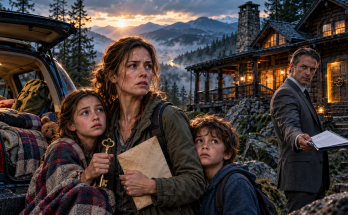
The envelope opened more easily than I expected.
The paper was old, but it hadn't become brittle.
I separated the flap with my thumb.
Then I slid out a single folded sheet.
Nothing else.
No photographs.
No map.
No second key.
Just a letter.
I recognized Walter's handwriting immediately.
The same narrow letters.
The same heavy pressure on certain words.
The same way he crowded sentences toward the right edge of the paper.
I had spent months reading that handwriting.
I could almost hear him when I looked at it.
Short sentences.
Very little explanation.
He had never been a man who used ten words when three would do.
I unfolded the sheet.
My name was written at the top.
Claire.
I stopped there.
For years, Walter had hardly ever written to me.
Birthday cards sometimes.
A few words inside.
A signature.
Nothing personal.
Nothing that suggested he'd spent much time wondering about my future.
Now I was sitting in his hidden archive, holding a letter addressed to me.
I looked at the name again.
Then I read the next line.
Walter said that if someone had placed recent photographs inside the black box, the danger connected to the Harrow family had never been the whole story.
I stared at the words.
I read them again.
Then a third time.
I wanted to believe I'd misunderstood.
I hadn't.
Walter wasn't warning me about another forged deed.
He wasn't telling me to check an old survey.
He was saying the matter we'd spent nearly a year investigating wasn't the greatest danger associated with Black Ridge.
I looked at the photographs.
The first showed the Subaru at Walmart.
The last showed my children through the kitchen window.
Someone had placed them in the compartment.
Someone had known where the compartment was.
And Walter had anticipated that someone might do exactly that.
My mouth felt dry.
I set the letter down for a moment.
I looked toward the door.
The hallway remained quiet.
I thought about the old brass warning plate.
The strange message engraved beside the steel door.
When we'd first arrived, I'd struggled to understand it.
It referred to the land coming for its owner.
I had eventually assumed Walter meant the land dispute.
The legal records.
The Harrows.
The road and spring rights.
That explanation had seemed to fit.
Now I wasn't so sure.
I returned to the letter.
Walter explained that the steel room had been sealed in 1948 to protect evidence.
That matched everything we'd discovered.
Thomas's affidavit.
The maps.
The timber contracts.
The ledger.
The altered deeds.
I had seen those records myself.
Historians had authenticated them.
The courts had relied on them.
I knew that part was real.
Then Walter added something I'd never heard before.
The evidence wasn't limited to stolen property.
I stopped breathing for a moment.
I read the sentence again.
The room wasn't only about land.
It had never been only about land.
I thought about the entire year.
How many times had I told Mara we were finally beginning to understand Walter?
How many times had Eli explained another survey reference?
How many pages had we photographed, copied and filed?
We had searched so carefully for evidence related to ownership that we'd begun thinking every mystery in the cabin belonged to that same dispute.
Now Walter was telling me we'd missed something fundamental.
I looked around the archive.
Hundreds of files.
Old metal containers.
Map tubes.
The drafting table.
The camera.
I had once believed the room was full of treasures.
Then I'd learned its value was historical.
Legal.
Practical.
Now I couldn't stop looking at the walls.
I wondered how much of what we'd found was only the part Walter wanted us to find first.
The thought made me uncomfortable.
I didn't like imagining my grandfather planning something so complicated.
But the hidden key had been deliberate.
The envelope warning me about Harrow had been deliberate.
The ledger entry directing us toward the mine house had mattered.
And the black box beneath the floor had been hidden deliberately too.
There was a pattern.
Walter hadn't simply forgotten to tell us things.
He had left clues.
I looked down at the letter again.
The next sentence concerned Thomas.
Walter wrote that his brother had discovered something beneath the cabin.
I read those words slowly.
Beneath the cabin.
Not in the forest.
Not at Bennett Gap.
Not inside the old mine-house cellar.
Beneath the building where my children were sleeping.
I stared toward the floor.
The boards beneath my feet were dark and worn.
The cabin had been built against a slope.
There was a root cellar.
A stone foundation.
A fireplace.
We had inspected the structure.
The electrician had examined the wiring.
Workers had repaired windows and other parts of the house.
I'd walked through the rooms hundreds of times.
Nobody had mentioned another space.
Nobody had reported an unusual opening beneath the cabin.
I remembered the first inspection.
The electrician had told me the structure was sound.
The lower floors had seemed solid.
The old cellar had needed cleaning.
But we hadn't found anything suggesting a larger underground area.
I had been relieved.
At the time, all I wanted was confirmation that the house wouldn't fall apart around us.
Now I wished I'd asked more questions.
I looked at the letter.
Walter didn't explain exactly what Thomas had found.
That was the part that made my hands cold.
He said it was something people had been willing to kill for in 1948.
And something their descendants might still kill for.
I put the sheet on the table.
Then I stood.
My chair moved backward with a scraping sound.
I looked toward the hallway.
I expected nothing.
I saw nothing.
Still, the house seemed different.
A few minutes earlier, the archive had been a room containing old records.
Now the letter suggested something beneath the very foundation.
Something Walter had hidden.
Something dangerous enough that men might have killed to obtain it.
I thought about Thomas.
His disappearance.
His signed statement.
His decision to leave North Carolina.
For months, I'd believed he fled because he uncovered land fraud.
That was what his affidavit described.
That was what the federal investigation had addressed.
But if he had found something beneath the cabin, the land fraud might not have been the only reason he feared for his life.
I couldn't prove any connection beyond Walter's words.
I knew that.
Still, the possibility wouldn't leave me alone.
I sat down again.
Then I forced myself to read carefully.
Walter wrote that he'd covered the entrance before my mother was born.
I stopped.
My mother.
The sentence placed the hiding place in a part of family history I'd barely understood.
Walter had concealed the entrance long before I was alive.
Long before Eric and I met.
Long before Lily and Ben were born.
Even before my mother's birth.
The knowledge made the cabin feel older than it had before.
Not because the building itself had changed.
Because I was suddenly aware of how many years people had lived with this secret.
Walter had known.
Thomas had known.
Possibly others.
And no one had told me.
I tried to remember anything my mother had said about Black Ridge.
Nothing useful came to mind.
Walter had kept the subject closed.
Whenever I asked as a girl, he changed the conversation.
Sometimes he simply stopped speaking.
I'd assumed he was being stubborn.
Now I thought about how much he might have been hiding.
I wasn't angry with him.
Not exactly.
But I wished he had trusted someone.
I wished he'd found a way to explain before he died.
I looked at the six photographs again.
Whatever the old secret was, somebody had found a way to connect it to my family.
That was no longer a matter of historical interest.
Lily and Ben were visible in those pictures.
Someone had taken them.
Someone had entered the archive or otherwise gained access to the hidden compartment.
The photographs hadn't been there when Walter died.
I knew that with certainty.
I had to understand why they were there now.
I returned to the next line of the letter.
Walter warned me against trusting anyone who wore a silver elk.
I froze.
Dean Harrow.
The pin.
I could see it as clearly as if he were sitting across from me again.
His gray jacket.
His expensive watch.
The little silver animal fastened to his lapel.
I'd noticed it the morning he offered two million dollars.
I'd noticed its absence when he returned with the eight-million-dollar agreement.
I had never understood why that detail stayed with me.
Now my grandfather's letter was telling me it mattered.
I looked toward the fifth photograph.
Dean stood beside his vehicle.
The silver pin caught the light.
I picked up the picture and held it closer.
It was small.
Easy to overlook.
I had assumed it belonged to his family or company.
A decorative emblem.
Something meant to make him appear important.
I hadn't investigated it.
Why would I?
We'd had maps to examine.
Courthouse records.
Water rights.
A break-in.
An entire criminal investigation.
A lapel pin had seemed irrelevant.
I put down the photograph.
Then I read the next part of Walter's warning.
The silver elk was not a Harrow family emblem.
It belonged to the people Charles Harrow had worked for.
I read the sentence twice.
Then I looked at the name in my grandfather's ledger.
Charles Harrow.
The man whose company had been linked to forged deeds and timber seizures.
The man whose family had spent decades trying to acquire Black Ridge.
I had assumed he was among the people directing the old scheme.
Walter's letter suggested something different.
Charles had been working for other people.
People identified by the silver elk.
I sat very still.
The room was silent.
I could hear my own breathing.
I thought about Dean's first warning.
He had told me I didn't understand what I was becoming involved in.
At the time, I assumed he was bluffing.
Then he'd threatened me indirectly by mentioning the children.
I thought he was trying to protect his development plans.
Maybe he was.
But the letter raised another possibility.
Dean might have represented interests beyond his own company.
That didn't excuse what he'd done.
It didn't erase Raymond's break-in.
It didn't change the financial disclosures.
It simply meant the story might involve people I'd never met.
People whose names weren't on the documents we'd examined.
I didn't know whether any of them were still alive.
I didn't know whether the organization Walter referred to still existed.
I didn't know whether the silver elk was being used for the same purpose decades later.
I knew only what the letter said.
And I knew Dean had worn that pin.
I forced myself not to go further than the evidence allowed.
It would have been easy to imagine a hundred explanations.
I had no proof for any of them.
I looked at the photograph of our kitchen.
That was proof.
The picture existed.
My children were in it.
Someone had watched us recently.
Someone had placed it with five older photographs inside Walter's hidden box.
And Walter had left a warning for the person who discovered them.
I rubbed my eyes.
It had been a long day.
We'd hosted a gathering.
The children had played outside.
Mara and Eli had come.
Noah and his wife had eaten dinner with us.
Janet had brought pies.
I'd hung Walter's key beside the front door.
I remembered Lily telling me her great-grandfather had saved us.
I'd told her he'd given us the opportunity.
That saving ourselves had been our responsibility.
At the time, I believed we'd reached the end of the difficult part.
The court case was settled.
The conservation agreement was complete.
We had a home.
Now I was sitting in the archive, wondering whether the most dangerous part had been hidden beneath our feet all along.
I looked at the letter again.
There was more writing near the bottom.
I hadn't reached the final sentence.
I moved my hand toward the page.
Then I heard a floorboard creak above me.
I looked up.
The sound came from upstairs.
The children were sleeping there.
At least, they had been when I checked on them.
I waited.
No second sound followed immediately.
I told myself it could have been one of them turning in bed.
Ben often got up at night.
Lily sometimes moved around her room.
Old houses made noise.
I knew that better than anyone.
I leaned forward.
Then another sound reached me.
Not from upstairs.
Not from the hallway.
Somewhere behind the fireplace.
Lower.
Deeper.
I stopped moving.
It was a scraping sound.
Stone against stone.
I had heard wood settling before.
I had heard branches strike the roof.
I had heard the old stove click as it cooled.
This was different.
I listened.
Then I heard it again.
Slow.
Heavy.
Close enough that I could feel my body reacting before I'd decided what to do.
I looked toward the archive doorway.
Beyond it stood the hallway.
Beyond that, the front room.
And the stone fireplace.
I thought about Walter covering an entrance before my mother was born.
I thought about Thomas discovering something beneath the cabin.
I looked down at the final sentence of the letter.
There was something more my grandfather wanted me to know.
And the sound coming from below the house made me understand why I needed to read it.
Source: blog.tramavandon.net