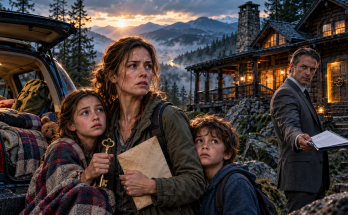
I had been inside Walter's archive so many times that I thought I knew every inch of it.
The shelves.
The drafting table.
The old camera.
The typewriter.
The places where dust collected behind the metal boxes.
I knew which floorboards creaked.
I knew which drawer stuck when the weather was damp.
I knew where Walter had stored the old survey notebooks.
At least, I thought I did.
That night, after everyone left, I went inside to put away the remaining documents.
The house was quiet.
Lily and Ben were asleep upstairs.
The porch lights were off.
The kitchen had been cleaned.
Everything felt settled.
I carried a small stack of papers to the drafting table.
Most of the original records had already been placed in archival sleeves.
Digital copies had been made.
The important documents connected to the ownership case were preserved.
But a few working copies were still lying where I'd left them.
I wanted the room tidy.
Walter would have appreciated that.
I put the papers in order.
Then I checked a box containing copies of the spring-right filings.
The dates were familiar.
1952\.
1967\.
1981\.
I smiled when I saw them.
Those documents had helped prove that the water beside our porch was part of the Bennett property rights.
I remembered the first day Ben put his fingers beneath the cold stream.
He'd laughed.
I hadn't known whether we could even stay in the house.
Now the same spring was protected under the conservation agreement.
I closed the box.
Then I moved toward the next shelf.
The old ledger was there.
I opened it for a moment.
Walter's handwriting filled the pages.
Payments.
Dates.
Initials.
The entry about Thomas and the mine house.
I touched the edge of the page.
That little note had led us to the hidden cellar.
To Thomas's statement.
To proof that he had planned to disappear.
I still wondered about him.
Whether he'd lived a long life somewhere else.
Whether he'd had children.
Whether Walter had ever discovered he survived.
The federal records had confirmed the evidence reached investigators.
But they hadn't answered every personal question.
I had learned to live with that.
History didn't always provide complete explanations.
Sometimes all that remained was paper.
A name.
A date.
A choice somebody made under pressure.
I closed the ledger.
Then I looked toward the photographs on the wall.
The old survey crews.
The trucks.
The mountain roads.
Walter had preserved them for decades.
I wondered how often he had stood in that room before sealing it.
Then I remembered he'd kept it closed after 1948.
The thought made me stop.
He had sealed the room.
Yet the brass warning plate outside looked as though someone had polished it repeatedly.
I had noticed that on our first visit.
At the time, I assumed Walter had maintained the exterior while leaving the archive untouched.
Maybe he had.
The cabin itself had been preserved carefully.
The shutters.
The covered furniture.
The tools.
The stored blankets.
There were explanations for many things.
Still, I had never understood why he made the room so difficult to enter.
The records inside were important.
But the rest of the cabin had remained accessible with ordinary keys.
The archive required a hidden key inside an envelope.
A steel door.
Four bolts.
And a warning that sounded more like something from an old family story than an instruction.
I looked toward the door.
It stood open.
The hallway beyond was dark.
I could hear the faint ticking of the kitchen clock.
I wasn't frightened.
Not anymore.
The room had stopped feeling dangerous months earlier.
It was simply where our family's history had been kept.
I walked back toward the drafting table.
A few empty archival sleeves were lying beside it.
I gathered them.
One slipped from my hand.
It floated to the floor.
Then slid partly beneath the table.
I sighed.
I was tired.
It was late.
I almost left it there.
Then I imagined Walter seeing the untidy floor.
I smiled to myself.
I knelt down.
Reached beneath the table.
And stopped.
Something looked wrong.
There was a narrow gap between two floorboards.
I had seen plenty of uneven boards in the cabin.
Old wood moved.
Settled.
Warped.
But this one was different.
The edge sat slightly higher than the boards beside it.
I shifted the flashlight.
The gap ran along one side.
It was narrow.
Almost invisible from standing height.
I leaned closer.
The wood looked darker along the edge.
I placed my hand on it.
The board moved a fraction beneath my fingers.
I sat back.
For a moment, I stared.
Then I looked around the room.
The drafting table had stood in the same place when we first opened the archive.
We had moved papers.
Boxes.
Maps.
But we had never taken the table apart or lifted every floorboard.
There had been so much evidence to preserve.
So many questions to answer.
I had never thought to inspect the floor beneath my feet.
I stood and went to the workshop.
The house was quiet.
I found a small screwdriver.
Then I returned to the steel room.
I knelt beside the drafting table again.
I slipped the tip into the gap.
The board resisted.
I adjusted the angle.
Then lifted gently.
It came free.
I stared into the opening.
Beneath the floor was a narrow compartment.
Not deep.
Not large.
But carefully constructed.
The wood around it looked different from the ordinary floor supports.
Someone had made a space beneath the room.
On purpose.
I held the flashlight closer.
Inside was a small black metal box.
I didn't touch it immediately.
I looked at the compartment.
Then at the surrounding floor.
The box was positioned neatly.
Not wedged in.
Not forgotten beneath fallen debris.
It looked as though someone had placed it there carefully.
I thought about Walter's other hiding places.
The steel key inside the envelope.
The mine-house note in the ledger.
The old documents sealed behind the door.
He had never made anything easy to find.
But he had left enough information for someone determined to keep looking.
I wondered whether this box was another part of that pattern.
I reached into the compartment.
The metal felt cool.
I lifted it out.
It was lighter than I expected.
I placed it on the drafting table.
Then I looked at my fingers.
There was almost no dust on them.
That bothered me.
The floorboards were old.
The compartment was hidden.
Most of the archive had collected decades of dust.
Yet the box looked clean.
I turned it beneath the light.
Its surface was smooth.
There were no thick layers of dirt around the hinges.
No old dust gathered along the latch.
I touched the lid.
Clean.
I looked toward the open door.
Then back at the box.
I tried to think of a reasonable explanation.
Perhaps it had been protected from dust by the compartment.
Maybe the floorboard fitted tightly enough to keep the space sealed.
That seemed possible.
But the other containers in the archive had still gathered dust.
This one looked different.
I examined the latch.
It wasn't locked.
I could see no obvious damage.
I lifted it carefully.
Then opened the lid.
There were photographs inside.
Six of them.
I stared.
For a moment, I didn't understand what I was seeing.
I had expected more old maps.
Another letter.
Maybe something belonging to Thomas.
But the first photograph showed a car.
A Subaru.
My Subaru.
I recognized the dent near the rear bumper.
I recognized the worn roof rack.
I recognized the parking lot.
It was the Walmart outside Asheville.
The place where we'd slept during the weeks after losing our home.
I sat down.
My chair scraped across the floor.
I held the photograph closer to the light.
The image had been taken from a distance.
The Subaru was parked beneath a light.
There were other vehicles nearby.
I remembered that parking lot.
The way I used to choose a space far enough from the entrance that nobody would bother us.
The way I watched security vehicles.
The way I woke whenever someone walked past.
Someone had taken a photograph of us there.
I looked inside the box again.
Five photographs remained.
I picked up the second.
Lily and Ben were entering a motel.
I recognized the building.
The faded sign.
The entrance.
It was one of the places we'd stayed when I had enough money.
The children were carrying their bags.
Lily had her jacket half-zipped.
Ben was holding his blanket.
I remembered that evening.
We had been tired.
I had been relieved to afford a room.
I hadn't noticed anyone watching.
I put the photograph beside the first.
Then I picked up the third.
It showed me walking toward Mara Collins's office.
The morning of the inheritance meeting.
I was carrying my old handbag.
My coat was buttoned.
I remembered how nervous I had been.
I had gone there expecting paperwork.
I hadn't known Dean Harrow would be waiting.
Someone had photographed me before I entered the building.
I stared at the image.
Then looked at the date printed on the back.
The timing matched.
I picked up the fourth photograph.
It showed me standing on the porch of Black Ridge Cabin.
The angle came from the trees.
I could see the edge of the railing.
Part of the driveway.
The front door.
I remembered that day too.
The children's excitement.
The cold spring water.
The dust inside the house.
The steel door.
The county SUV arriving.
I looked at the trees visible in the photograph.
Someone had been standing among them.
Watching.
I felt a slow tightness in my chest.
Not panic yet.
Something quieter.
I turned over the fifth photograph.
Dean Harrow was leaving the cabin.
His black SUV stood beside the porch.
I recognized the scene.
It was the day he confronted me after I opened the archive.
I had recorded him from the window.
He had warned me about the mountain.
Then driven away.
Someone else had photographed him leaving.
I looked toward the steel door.
The hallway was empty.
The cabin was silent.
I reached for the final photograph.
It was different.
More recent.
I recognized the kitchen window.
The repaired frame.
The light above Walter's oak table.
Then I saw the people inside.
Lily.
Ben.
Me.
We were eating dinner.
The photograph had been taken from outside the house.
From somewhere among the trees.
I brought it closer.
There was no question.
It was our kitchen.
Our table.
Our family.
The image was only a few days old.
I stared at it.
Someone had been watching us after the court case.
After Dean's company entered receivership.
After the conservation agreement was signed.
After I'd begun believing the worst was behind us.
Someone had stood outside our house and photographed us through the window.
My first thought was the children.
They were upstairs.
Asleep.
I wanted to go to them immediately.
Then I looked inside the box again.
There was something beneath the photographs.
An envelope.
Old paper.
Yellowed at the edges.
I recognized the handwriting before I picked it up.
Walter Bennett.
My grandfather.
I stared at the words on the front.
The envelope was addressed to whoever found the new photographs.
I read the message again.
Then I looked at the six pictures spread across the table.
They had been taken long after Walter died.
He couldn't have seen them.
He couldn't have known exactly what they showed.
Yet he'd left an envelope intended for someone who discovered recent photographs in that hidden box.
I felt the room change around me.
Not physically.
The shelves were still there.
The maps.
The drafting table.
The old camera.
But the certainty I'd felt inside the archive was gone.
I had spent months believing I understood why Walter sealed the room.
The forged deeds.
Thomas's disappearance.
The Harrow family's efforts to acquire the mountain.
Now someone had placed modern photographs inside a hidden compartment in the very room I'd believed was secure.
I looked toward the hallway.
Then toward the ceiling.
The children were asleep above me.
I wanted to wake them.
I wanted to call Noah.
I wanted to leave everything where it was.
But I also needed to know what Walter had written.
I took out my phone.
I photographed the box.
The compartment.
The photographs.
The envelope.
I remembered how Noah had documented the metal tube in the mine-house cellar.
Slowly.
Carefully.
I placed everything back on the table in the order I'd found it.
Then I sat down.
I looked at Walter's handwriting once more.
His warning about Harrow had helped me avoid selling the mountain.
His ledger had led us to Thomas's statement.
His records had helped prove our ownership.
Every clue had mattered.
Now another envelope sat in front of me.
And the photographs beside it showed that somebody had been watching my children.
I didn't open the envelope immediately.
I picked up my phone and prepared to call Noah.
Whatever Walter had left inside, I was no longer going to examine it as though this were only a matter of old family history.
The photographs were recent.
The danger was not.
And for the first time in months, I understood that the locked steel room might still contain something we had never truly investigated.
Source: blog.tramavandon.net