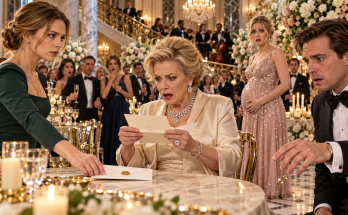
I used to think being a good wife meant knowing when to stay quiet.
That belief followed me into almost every difficult conversation with Ethan.
If his mother insulted me, I waited until we were alone.
If he dismissed my feelings, I tried to explain them more carefully.
If an argument became uncomfortable, I apologized just to end it.
I told myself I was protecting the marriage.
I didn't realize how much of myself I was giving away.
Now I sat in Naomi's office, with the divorce behind me and an enormous celebration ahead.
And I could still hear Ethan's familiar request.
Please don't make things difficult.
He had said something close to it that morning.
I remembered his expression.
His mother was standing above me.
My luggage was on the sidewalk.
And he wanted me to avoid causing a scene.
As though I were the one behaving badly.
As though the problem was my response to humiliation rather than the humiliation itself.
I looked at Naomi.
"There's something I keep thinking about."
She raised her eyes.
"Ethan never had to shout at me."
I paused.
"He could make me stop talking with one sentence."
Naomi listened.
"He'd ask me not to upset his mother."
I looked down.
"And I'd feel guilty."
That was how it worked.
Margaret would say something cruel.
I would react.
Ethan would ask for peace.
And suddenly I was responsible for making everyone comfortable again.
The original insult became irrelevant.
The only thing that mattered was whether I could stop being upset.
I had lived inside that pattern for years.
And the worst part was how normal it had become.
I no longer needed Margaret or Ethan to tell me to be quiet.
I began telling myself.
Before family gatherings, I would think about what subjects to avoid.
Before speaking to Ethan about his mother, I would rehearse the least offensive way to begin.
Before making financial decisions, I would wonder whether Margaret would object.
She didn't even have to be in the room.
Her influence was already there.
I hated admitting that.
But I couldn't change a habit I refused to recognize.
Naomi looked toward my notebook.
"That's part of why you started writing things down."
"Yes."
I remembered how frightened I had been the first time I wrote about a disagreement.
Not because the act was dangerous.
Because writing it made the event seem real.
I couldn't immediately soften the memory.
I couldn't tell myself Margaret had probably meant well.
I couldn't pretend Ethan hadn't heard.
The words sat there.
On the page.
And when I looked at them later, I could see the pattern.
I had been trying to solve the same problem repeatedly.
And the solution I chose was always some version of making myself smaller.
I closed my eyes briefly.
The downstairs powder room came back to me.
The sound of the faucet.
The ache in my ribs after crying.
The notebook on the counter.
I remembered writing the date.
I didn't know then that one small decision would change how I handled the rest of my marriage.
I only knew I couldn't keep allowing every disagreement to become a question about my character.
I needed to remember what actually happened.
So I wrote it down.
At first, that was all.
Then I began paying attention to other things.
The way decisions were made.
The way Ethan avoided questions.
The way Margaret spoke about the house.
The way everyone accepted her authority without asking where it came from.
I didn't understand all of it immediately.
Some discoveries took time.
Some involved documents I hadn't known to look for.
Some required help from Naomi.
But little by little, the story became clearer.
And the more I understood, the harder it became to continue pretending.
I opened my eyes.
Naomi had moved the deed closer.
I read the address again.
14 Linden Lane.
Fourteen Linden Lane had been my home.
But it had never been a place where I could speak freely.
That realization hurt.
I remembered ordinary mornings when I hesitated before going downstairs.
Not because I expected a particular confrontation.
Because I didn't know what mood Margaret might be in.
Some days she ignored me.
Some days she criticized something small.
Some days she behaved pleasantly in front of Ethan, then made a cutting remark when he wasn't paying attention.
I had learned to anticipate those moments.
To prepare myself.
To stay alert.
That wasn't how I had imagined marriage.
I thought marriage would give me a partner.
Someone who knew my weaknesses and treated them gently.
Someone who would disagree with me privately but defend my dignity in public.
Someone who would make home feel like a place where I could stop being careful.
For a while, I believed Ethan was that person.
Then I began noticing the difference between how he treated me when we were alone and how he behaved around Margaret.
He could be affectionate privately.
He could comfort me.
He could say he understood.
But when his mother challenged me, he became silent.
And afterward, he wanted the matter forgotten.
I kept telling myself he was caught in a difficult position.
It took me years to recognize that he was choosing the position most comfortable for him.
He didn't have to confront Margaret.
He didn't have to defend me.
He only had to ask me to tolerate it.
And I usually did.
I looked at Naomi.
"I thought if I stopped complaining, the marriage would get better."
She waited.
"It didn't."
I said the words plainly.
They didn't need decoration.
I had made myself quieter.
Margaret had become no kinder.
Ethan had become no more willing to defend me.
And the problems had continued.
Then came Vanessa.
I had discovered her messages six months earlier.
Even now, the memory made my stomach tighten.
At first, I wanted to find an innocent explanation.
I looked for one because accepting the obvious would mean changing everything.
The marriage.
The future.
The story I had told myself about the last seven years.
But the messages were there.
I couldn't make them disappear by wanting them to mean something else.
I remember how quiet I became afterward.
Not because I had nothing to say.
Because I suddenly understood how much I didn't know.
I had spent years assuming the problems in my marriage were visible.
Margaret's interference.
Ethan's silence.
Our grief.
Our growing distance.
Then I discovered there had been another relationship happening beyond my knowledge.
A whole part of Ethan's life that I hadn't been allowed to see.
That discovery changed the way I approached everything.
I stopped assuming that if I didn't know about something, it wasn't happening.
I stopped accepting vague explanations simply because Ethan sounded sincere.
And I became more careful about facts.
That was where Naomi helped me.
She didn't tell me what I wanted to hear.
She asked what could be established.
She made me distinguish suspicion from evidence.
She reminded me that being hurt didn't automatically make every conclusion correct.
Sometimes I found her questions exhausting.
I wanted comfort.
She gave me clarity.
Eventually, I understood why that mattered.
I had spent too many years trying to win arguments with people who could change the subject whenever they pleased.
Documents didn't work that way.
A date remained a date.
A recorded transfer remained a recorded transfer.
A named beneficiary remained a named beneficiary unless the applicable documents and legal circumstances changed it.
I didn't have to persuade Margaret to remember something differently.
I could point to what was written.
That didn't mean every legal question was simple.
Naomi had never promised that.
But it meant I was no longer depending entirely on somebody else's willingness to tell the truth.
I looked at the trust agreement.
Harold Brennan.
Trustee.
Claire Whitmore, née Sullivan.
Successor trustee.
Sole beneficiary.
I read each designation carefully.
It mattered that I understood the difference.
I wasn't going to stand in front of Margaret and make claims larger than the documents supported.
I had spent too long being dismissed as unreasonable.
I wanted every statement I made to be something I could defend.
Naomi noticed where I was looking.
"You're remembering the wording."
"Yes."
"Good."
I paused.
"I don't want to make a mistake."
She nodded.
"Then don't guess."
That was another simple instruction.
One I wished I had followed years earlier.
Whenever Margaret made a confident declaration, I used to assume she knew more than I did.
Whenever Ethan gave me a vague explanation, I filled in the missing details with whatever made him look better.
I had guessed constantly.
Usually in their favor.
Now I wanted to stop.
If I knew something, I would say it.
If I didn't know, I would admit it.
And if Margaret tried to replace the documents with insults, I didn't need to follow her.
I looked toward the window.
The hours were moving.
The party was getting closer.
I imagined the mansion being prepared.
The imported flowers arriving.
The caterers working.
The orchestra getting ready.
Margaret checking details.
I knew she would want everything perfect.
She valued appearances too much to leave anything important to chance.
But she had never paid the same attention to how she treated people.
At least not people she considered beneath her.
I thought of the landscaper.
The person she had instructed to put my suitcases outside.
I wondered whether he had felt uncomfortable doing it.
I didn't know.
I wasn't angry with him.
He had carried out Margaret's order.
The choice belonged to her.
And to Ethan, who had watched without intervening.
I remembered asking for help with one suitcase.
A simple request.
Perhaps I had made it because I wanted proof that Ethan still cared.
Even then.
Even after signing the divorce papers.
Perhaps I wanted him to do one small decent thing.
Looking back, that possibility embarrassed me.
But it was true.
I had wanted something from him.
Not reconciliation.
Not love.
Just evidence that seven years hadn't left him completely indifferent.
Instead, he had asked me not to create a problem.
I let out a slow breath.
I couldn't keep asking Ethan to become the man I needed.
The marriage was over.
Whatever kindness he might show in the future would be his decision.
It could no longer be the condition for mine.
I turned toward Naomi.
"I think I know what will be hardest tonight."
"What?"
"Not Margaret."
She waited.
"Ethan."
I looked at my hands.
"If he asks me to leave, part of me will still want to listen."
Naomi's expression softened.
"That doesn't mean you have to."
I nodded.
I knew she was right.
Habits could survive long after the reasons for them disappeared.
I might hear Ethan's voice and feel the old urge to make things easier.
I might see his discomfort and want to protect him.
I might even feel guilty for interrupting a celebration.
But I could notice those feelings without obeying them.
That was new.
For years, I had treated every uncomfortable emotion as an instruction.
Guilt meant apologize.
Fear meant stay quiet.
Sadness meant try harder.
Now I was learning that feelings could be real without deciding my actions.
I looked at the papers.
The deed had been recorded four years earlier.
The trust agreement named me.
The necessary filings had been completed.
Those facts didn't become less important because Ethan might be upset.
I put my hand over the notebook inside my purse.
I thought of the woman who had written the first date two years ago.
She hadn't known whether she could change anything.
She had only known she needed to stop forgetting.
Now I was facing a different decision.
Would I stay quiet again because Ethan might disapprove?
I knew the answer.
No.
I wasn't going to spend the first evening after my divorce obeying the same silence that had damaged my marriage.
I had kept the peace long enough.
And the peace had never really belonged to me.
Source: us.hinhcute.net