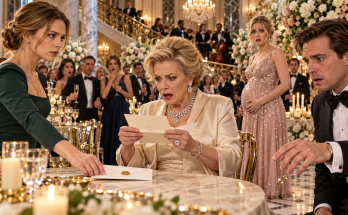
CHAPTER 1 — THE CREDIT CARD THAT ENDED AN EMPIRE
At exactly 10:17 on a Tuesday morning, Eleanor Whitmore experienced the greatest humiliation of her privileged life.
It happened inside Bergdorf Goodman, one of Manhattan’s most exclusive department stores.
She was standing beneath magnificent crystal chandeliers, wearing a cream-colored designer suit and a diamond necklace worth more than most Americans earned in a year.
Three sales associates surrounded her.
On the counter lay a collection of luxury handbags, silk scarves, and an elegant emerald bracelet.
The total came to $47,860.
Eleanor smiled as she removed a platinum credit card from her crocodile-leather wallet.
“Put everything on this,” she instructed.
The young saleswoman took the card and ran it through the terminal.
A sharp beep interrupted the pleasant music drifting through the department.
The screen displayed two words.
TRANSACTION DECLINED.
The saleswoman hesitated.
“I’m terribly sorry, ma’am. Would you happen to have another card?”
Eleanor frowned.
“Run it again.”
The woman obeyed.
Declined.
A third attempt produced the same result.
Eleanor’s cheeks turned crimson.
“That is impossible! Do you know who I am?”
Several nearby customers turned their heads.
The department manager approached with the practiced smile of someone accustomed to dealing with wealthy, difficult clients.
“Mrs. Whitmore, perhaps there’s been a misunderstanding with your bank.”
“My bank?” Eleanor nearly shrieked. “I have more money than everyone in this department combined!”
Unfortunately for Eleanor, that was not entirely true.
The platinum card did not belong to her.
It belonged to me.
My name is Colonel Marissa Bennett.
And less than twenty-four hours earlier, my divorce from Eleanor’s son, Anthony Whitmore, had become final.
For five years, I had paid for virtually everything Eleanor wanted.
Her designer clothes.
Her luxury vacations.
Her expensive beauty treatments.
Her exclusive memberships.
Even the extravagant birthday celebrations she organized for herself every year.
She had spent my money without hesitation.
But she had never once treated me like a member of her family.
At dinner parties, Eleanor would introduce me as “Anthony’s unfortunate choice.”
Whenever I entered a room, she would find some excuse to criticize my appearance, education, or supposedly ordinary upbringing.
She told her friends I was lucky her son had married me.
What she never mentioned was that I had purchased their family home when Anthony’s business nearly collapsed.
She never told anyone I had quietly paid off $380,000 of her personal debts.
And she certainly never acknowledged that most of her glamorous lifestyle depended on me.
But our divorce had changed everything.
At 9:03 that morning, I had called my bank and canceled every authorized-user card associated with my former husband’s family.
It took less than six minutes.
I had expected Anthony to become angry.
I had not expected what came next.
My telephone rang at 10:26.
His name illuminated the screen.
I answered.
“What the hell have you done, Marissa?”
His voice was so loud that I instinctively moved the phone away from my ear.
“Good morning, Anthony.”
“Don’t you dare act innocent! My mother is standing in Bergdorf Goodman while everyone stares at her because her card was declined!”
I looked toward the morning sunlight spreading across my Manhattan apartment.
Then I smiled.
“That’s unfortunate.”
“Unfortunate? You’ve humiliated our entire family!”
“No, Anthony. I’ve stopped financing it.”
He went silent.
I continued.
“The divorce was finalized yesterday. Your mother’s credit card was attached to my account. I canceled it. That’s all.”
“She depends on that card!”
“Then perhaps she should ask her son to support her.”
“Marissa, you can’t just cut her off!”
“I can. And I did.”
He lowered his voice.
“You’ll regret this.”
I set my coffee cup down.
“Is that a threat?”
“It’s a promise.”
I waited.
Then I answered calmly.
“Be very careful what you promise, Anthony.”
I ended the call and blocked his number.
For the first time in five years, my apartment was completely peaceful.
Or so I thought.
Because the following morning, at 6:42, someone began pounding on my door.
And the nightmare my former husband had created was about to become much bigger than either of us understood.
CHAPTER 2 — THE WOMAN THEY THOUGHT WAS WEAK
BANG!
BANG!
BANG!
“OPEN THE DOOR, MARISSA!”
Eleanor’s shrill voice echoed through the hallway of my thirty-eighth-floor apartment.
I woke immediately.
Twelve years in the United States Army had taught me how to recognize danger before my mind was fully awake.
I reached for the security monitor beside my bed.
There they were.
Eleanor, dressed in a fur-trimmed coat, was attacking my door with both fists.
Anthony stood behind her, holding his phone.
His expression was frighteningly familiar.
It was the expression he wore whenever he believed he could intimidate me.
During our marriage, I had usually avoided confrontation.
Not because I feared him.
But because I had seen enough conflict in my professional life to refuse to bring unnecessary battles into my home.
Anthony had mistaken my restraint for weakness.
Eleanor had mistaken my generosity for stupidity.
And neither knew the truth about my career.
My official civilian business was Beacon Ridge Advisory, a legitimate consulting and investment-management firm established years before my marriage.
I had approved outside professional activities, experienced accountants, and a carefully managed separation between my private assets and military responsibilities.
Anthony believed that consulting explained my unusual schedule and financial independence.
He never asked serious questions about my government work.
And because he had never shown any interest in my achievements beyond what they could buy for him, I had never volunteered the details.
I was a colonel in the United States Army, serving in a sensitive strategic assignment.
My career involved years of operational leadership, overseas deployments, and responsibilities that required considerable discretion.
But standing inside my apartment that morning, none of those accomplishments mattered as much as one simple fact.
I was finally free.
I pressed the intercom.
“Anthony, Eleanor, leave immediately.”
Eleanor lunged toward the camera.
“You greedy little nobody! You think you can throw this family away after everything we’ve done for you?”
“Everything you’ve done for me?”
I nearly laughed.
“Name one thing.”
She opened her mouth.
Nothing came out.
Anthony stepped forward.
“Open the door. We need to discuss the financial situation.”
“There is nothing to discuss.”
“You don’t understand how serious this is.”
“I understand perfectly.”
His jaw tightened.
“Mom has connections. Powerful connections. You’re making enemies you can’t afford.”
Then Eleanor said something that made every instinct I possessed sharpen.
“Tell her about the accounts, Anthony!”
He turned toward her.
“Mom, be quiet.”
But Eleanor was too furious to stop.
“She thinks she can hide her money from us! Tell her what we know about her company! Tell her how long we’ve had access!”
My blood went cold.
Access?
To Beacon Ridge Advisory?
That company had accounts Anthony was never permitted to touch.
“Anthony,” I said slowly, “what accounts is your mother talking about?”
His expression changed.
For the first time since arriving, he seemed uncertain.
“Just open the door.”
“What accounts?”
“Marissa, don’t make this difficult.”
I turned off the intercom.
Then I walked to the dining room, opened a black leather folder, and called my attorney.
“Daniel,” I said when he answered, “we have a problem.”
CHAPTER 3 — THE BLACK FOLDER
Daniel Mercer had represented me throughout the divorce.
He was a careful attorney with a quiet voice and a remarkable ability to recognize dishonesty.
He knew Anthony was manipulative.
He knew Eleanor was greedy.
But even Daniel had not understood how far they might have gone.
“They’re outside your apartment?” he asked.
“Yes.”
“Don’t open the door.”
“I wasn’t planning to.”
“What happened?”
I explained Eleanor’s comments about my company’s accounts.
Daniel fell silent.
Then he asked a question that changed the course of everything.
“Marissa, are you certain your former husband never had access to your business finances?”
“Absolutely.”
“Did he ever handle your laptop?”
“Occasionally.”
“Your phone?”
“Yes.”
“Your passwords?”
I hesitated.
Early in our marriage, Anthony had helped me replace a stolen personal phone.
He had assisted in setting up several ordinary applications.
At the time, it had seemed insignificant.
Now I remembered something else.
Three months before our separation, Beacon Ridge’s finance manager had complained about an unfamiliar login.
We had reset the credentials.
My accountant had recommended a complete review.
But the divorce proceedings had consumed so much attention that the investigation was still ongoing.
“Daniel,” I said, “I think Anthony may have done more than take money.”
“Preserve everything. I’ll contact the forensic accountant.”
Outside, the pounding resumed.
This time I called building security.
Two officers arrived within minutes.
I watched the encounter through the hallway camera.
“Sir, this resident has declined your visit,” one guard told Anthony.
Anthony straightened his jacket.
“Do you know who you’re talking to?”
“Someone who needs to leave.”
Eleanor pointed furiously toward my door.
“She owes us money!”
The guard remained calm.
“That is not a reason to threaten a resident.”
Anthony looked up at the camera.
He smiled.
“This isn’t over, Marissa.”
I activated the speaker one last time.
“You’re right, Anthony.”
His smile widened.
Then I finished.
“Because now I’m going to find out exactly what you’ve been doing.”
For the first time, his confidence wavered.
The elevator swallowed them moments later.
I returned to the dining table.
Inside my black folder were years of receipts, financial statements, suspicious transfers, and written communications.
Originally, I had collected those documents to understand the financial damage from my marriage.
I had never intended to use my military position against Anthony.
A private financial dispute belonged in civilian legal channels.
But his apparent unauthorized access to my company created another concern.
If my personal accounts had been compromised, I needed to determine whether any work-related security risk existed.
I contacted my designated military security representative and explained the situation without exaggeration.
Then I called the bank.
The fraud specialist who answered introduced herself as Natalie Brooks.
After verifying my identity, she began reviewing the company’s transaction history.
At first, her voice was routine.
Then she stopped speaking.
“Colonel Bennett?”
“Yes?”
“I’m seeing several transactions that require immediate attention.”
My fingers tightened around the phone.
“What transactions?”
“Over the last eighteen months, approximately $2.8 million has been transferred from accounts associated with Beacon Ridge Advisory.”
I stared at the wall.
“Transferred where?”
“To multiple companies. One appears to be called Whitmore Strategic Holdings.”
I closed my eyes.
Whitmore.
Anthony’s surname.
“Was I listed as the authorizing party?”
Another pause.
“That’s the problem, ma’am.”
“What problem?”
“According to the records, the transfers were approved using documents bearing your signature.”
The room seemed to become very quiet.
Because I had never signed those documents.
And suddenly, I understood why Anthony had been so desperate to get inside my apartment.
He wasn’t simply angry about his mother’s credit card.
He was afraid I was about to discover what he had stolen.
CHAPTER 4 — THE SIGNATURE THAT WASN’T MINE
“Two million, eight hundred thousand dollars?”
I repeated the amount because my mind refused to accept it.
“Approximately,” Natalie replied. “We’re still reviewing the records.”
I had spent twelve years serving my country.
I had worked through sleepless nights, dangerous deployments, difficult command decisions, and responsibilities that most people would never fully understand.
I had built my private investments slowly and carefully.
Yet somehow, during the five years I had spent married to Anthony Whitmore, nearly three million dollars had disappeared through transactions I had never authorized.
“Freeze every suspicious account connected to this activity,” I instructed.
“We can initiate fraud restrictions and an investigation immediately,” Natalie said. “But we will need documentation from your attorney.”
“You’ll have it.”
“There’s something else.”
I waited.
“One of the documents lists your husband as an authorized executive officer of Beacon Ridge Advisory.”
My stomach tightened.
“That’s impossible.”
“According to the paperwork, the appointment occurred fourteen months ago.”
I remembered that month.
Fourteen months earlier, Anthony had taken me to dinner at an elegant restaurant overlooking Central Park.
He had surprised me with flowers.
He had apologized for his mother’s behavior.
He had even promised that things would change.
I remembered thinking, foolishly, that perhaps our marriage could still be saved.
Now I understood why he had been so affectionate.
He had been celebrating something.
And I had unknowingly paid for the celebration.
“Please send everything to my attorney through the bank’s secure process,” I said.
After hanging up, I sat at the table for a long moment.
Anger came first.
Then disbelief.
Finally, something colder and far more useful settled into place.
Clarity.
I opened my laptop and began reviewing old correspondence.
Anthony had always presented himself as a successful businessman.
He drove expensive cars.
He attended exclusive charity events.
He spoke confidently about investments, property development, and international partnerships.
But behind the designer suits, his financial situation was often unstable.
Whenever one of his projects failed, he found another explanation.
A difficult market.
An unreliable partner.
A temporary cash-flow problem.
And whenever he needed help, he came to me.
“Just until next month, sweetheart.”
“It’s an investment in our future.”
“We’re married. What’s yours is mine.”
That last sentence had once seemed like an expression of love.
Now it sounded like a warning I should have recognized years earlier.
At eleven that morning, Daniel arrived.
He placed a thick envelope on my table.
“Marissa, I want you to understand something. We may be dealing with forged corporate authorizations, identity theft, and bank fraud.”
I looked at him.
“How long have you suspected?”
“That money was missing? Since we began reviewing the divorce disclosures.”
“And forgery?”
“Not until today.”
He slid a photocopy toward me.
It showed a corporate authorization document.
At the bottom was my signature.
Or something resembling it.
Beneath the signature was a date.
I stared at it.
Then I stood.
“Daniel.”
“What?”
“On that date, I wasn’t in New York.”
“Where were you?”
“Overseas on military duty.”
He looked up.
“Can you prove it?”
I met his eyes.
“With official records, through the appropriate legal process.”
Daniel’s expression changed.
For the first time that morning, he smiled.
“Then Anthony may have just made a very expensive mistake.”
CHAPTER 5 — THE WOMAN WHO KNEW TOO MUCH
By the following afternoon, Daniel had engaged a forensic accounting team.
My personal bank accounts were secured.
The company’s access credentials had been replaced.
Every known device was being reviewed.
And the bank had preserved its records while investigating the disputed transfers.
Then my phone rang.
The number was unfamiliar.
I almost ignored it.
Something made me answer.
“Hello?”
A woman’s voice trembled.
“Is this Marissa Bennett?”
“Speaking.”
“My name is Rachel Kim. I used to work for Anthony.”
I recognized the name immediately.
Rachel had been an administrative assistant at Whitmore Strategic Holdings.
She had attended several of Anthony’s extravagant business dinners.
Quiet.
Polite.
Always taking notes.
“What can I do for you, Rachel?”
She hesitated.
“I saw what happened to Mrs. Whitmore at Bergdorf Goodman.”
I waited.
“Everyone at the office has been talking about it.”
“Why are you calling me?”
Her breath caught.
“Because I think your ex-husband is going to do something terrible.”
A cold sensation moved through my chest.
“Explain.”
Rachel lowered her voice.
“Yesterday, Anthony told his accountant to destroy several boxes of records.”
I became completely still.
“What records?”
“Financial statements. Company files. Copies of signed authorizations.”
“How do you know?”
“Because he asked me to arrange the disposal.”
I opened my notebook.
“Did you?”
“No.”
“Why not?”
For several seconds, I heard only her uneven breathing.
Then she whispered, “Because my father spent thirty years working as a police officer. He taught me that destroying evidence doesn’t make someone innocent.”
Something in her voice softened me.
“Rachel, listen carefully. Don’t put yourself in danger. I want you to speak with my attorney.”
“There’s more.”
“What?”
“I heard Anthony talking to his mother.”
“When?”
“Last night.”
I leaned forward.
“What did he say?”
Rachel swallowed.
“He told her you were getting too close.”
I said nothing.
“And Mrs. Whitmore said they needed to make sure nobody believed you.”
“How?”
Rachel began crying.
“They’re planning to accuse you of stealing money from a charity.”
My heart seemed to stop.
“What charity?”
“The Veterans Future Foundation.”
I closed my eyes.
The Veterans Future Foundation had been established in memory of my father.
He had served in the military long before I earned my first commission.
He believed that helping injured veterans and their families was a responsibility, not a favor.
After he died, I had used part of my personal investment income to support a small scholarship and emergency assistance program in his name.
Anthony had always dismissed the foundation.
“A sentimental waste of money,” he once called it.
But now he intended to use it against me.
Rachel continued.
“He said that if the public thinks you’ve been stealing from wounded veterans, your career will be finished before anyone checks the facts.”
I inhaled slowly.
“Rachel, are you somewhere safe?”
“Yes.”
“Good. I’m giving your number to Daniel. Please tell him everything you know.”
Before hanging up, she said something I would remember for the rest of my life.
“Mrs. Bennett?”
“Yes?”
“I’m sorry I didn’t speak up sooner.”
I looked at the photograph of my father on the bookshelf.
“You’re speaking up now, Rachel. That’s what matters.”
When the call ended, I understood the full scale of Anthony’s desperation.
He wasn’t only trying to protect the money he had taken.
He was preparing to destroy my reputation to keep it.
And he had chosen the one cause that meant more to me than my career.
My father’s legacy.
CHAPTER 6 — THE LIE THAT SPREAD ACROSS MANHATTAN
The first accusation appeared online at 8:14 the following morning.
A society gossip account published a photograph of me leaving a downtown office building.
The headline read:
WEALTHY CONSULTANT ACCUSED OF MISUSING VETERANS’ CHARITY FUNDS FOLLOWING BITTER DIVORCE.
No documents supported the accusation.
No official charges existed.
But that did not stop people from sharing it.
Within hours, the story had spread across social media.
Anonymous sources claimed that I had used donations for designer clothes and luxury apartments.
Someone suggested that the recent divorce was connected to financial misconduct.
Another account described Anthony as a devoted husband who had discovered troubling irregularities in his wife’s business.
I read the claims in silence.
Every accusation was almost a perfect reversal of the truth.
The person who had paid for everyone was being portrayed as a thief.
The man who had secretly transferred millions was being portrayed as a victim.
And Eleanor, who had spent years insulting me, was suddenly granting sympathetic interviews.
“Marissa was always obsessed with money,” she told one online publication.
“Anthony tried so hard to help her become a respectable woman.”
I actually laughed when I read that sentence.
Respectable.
That was Eleanor’s favorite word.
Respectable people attended the right clubs.
Respectable people wore the right labels.
Respectable people owned the right apartments.
In her world, morality was something money could purchase.
My attorney called shortly afterward.
“Don’t respond publicly yet,” Daniel advised.
“Wasn’t planning to.”
“Good. We have evidence that may explain where this campaign originated.”
“What evidence?”
“The same public relations consultant who previously worked for Anthony contacted several gossip outlets yesterday.”
I stared at the phone.
“He’s paying someone to spread these lies?”
“We’re investigating that possibility.”
“And the charity?”
“An independent review has found no evidence of the allegations against you. We’re preparing a factual response and preserving the publications.”
I looked down at the photograph on my desk.
My father stood in his old uniform, smiling beside me on the day I graduated from my officer training program.
He had been proud.
Not because I wore a uniform.
But because I had chosen a life he believed should be guided by responsibility.
I remembered something he once told me.
“Marissa, people can take your money. They can take your possessions. They can even take your comfort. But never let anyone convince you to surrender your integrity.”
I closed the gossip article.
Then I called the foundation’s independent board chair.
“Conduct whatever review you need,” I told her. “Give the accountants full access to the records. I want the truth documented.”
She hesitated.
“Are you sure? That could take time.”
“I’m sure.”
Afterward, Daniel called again.
“We have another development.”
“What now?”
“A federal investigator wants to speak with us about the forged banking documents.”
For the first time since Eleanor had arrived at my door, I felt something approaching relief.
The matter was moving beyond accusations.
And toward evidence.
CHAPTER 7 — THE SECRET BEHIND ANTHONY’S LUXURY LIFE
Three days later, I met with Daniel and two financial investigators in a conference room overlooking the Hudson River.
My forensic accountant, Olivia Chen, had spent nearly seventy-two hours examining records provided by the banks and Beacon Ridge Advisory.
She looked exhausted.
But when she entered the conference room, her expression told me she had discovered something significant.
“Marissa,” she began, “the transfers weren’t random.”
She placed a diagram on the table.
It showed a network of companies.
Whitmore Strategic Holdings.
Hudson Crest Development.
Northbridge Capital Services.
And several limited liability companies I had never heard of.
“These companies received money from accounts associated with Beacon Ridge,” Olivia explained. “The funds were then moved between entities or used to pay personal expenses.”
“Whose personal expenses?”
Olivia turned a page.
“Anthony’s. His mother’s. And someone else’s.”
She placed a photograph in front of me.
A beautiful brunette stood beside Anthony at a charity gala.
She wore a red evening gown.
I recognized her instantly.
Vanessa Cole.
Anthony’s supposed business partner.
She had always been unusually friendly to me.
At gatherings, she hugged me.
Complimented my clothes.
Asked about my schedule.
Once, while I was away, she had even sent me a thoughtful message wishing me a safe trip.
I felt something twist painfully inside my chest.
“How much?” I asked.
Olivia looked at her notes.
“At least $620,000 in identifiable payments benefiting Vanessa, directly or through businesses connected to her.”
For a moment, nobody spoke.
Then Daniel asked quietly, “Marissa, did you know they were involved?”
I shook my head.
I thought about every time Anthony had accused me of working too much.
Every time he complained that I wasn’t present for his social events.
Every time he insisted I was neglecting our marriage.
He had spent years making me feel guilty for my career.
And while I was working, he had been taking another woman on vacations funded by my accounts.
I looked at the next page.
There were photographs of a vacation property in the Hamptons.
A luxury sports car.
A private yacht rental.
Designer jewelry.
And a diamond engagement ring.
I stared at the ring.
“Who bought this?”
Olivia answered carefully.
“According to the payment records, Anthony did.”
“With my money?”
“The funds can be traced through accounts we are investigating.”
I leaned back in my chair.
A strange realization washed over me.
For months, I had been mourning the collapse of my marriage.
I had wondered what I could have done differently.
Whether I should have been more affectionate.
More patient.
More available.
Now, sitting beside a stack of evidence, I realized I had been grieving a relationship that had largely existed only in my imagination.
Anthony hadn’t wanted a wife who understood him.
He had wanted access to everything I owned.
And when I stopped providing it, he treated my independence as an unforgivable betrayal.
Daniel leaned forward.
“Marissa, there’s another issue.”
I looked at him.
“What?”
“One of the shell companies appears to have received a loan secured by a property you own.”
My expression hardened.
“Which property?”
“The farmhouse in Virginia.”
I froze.
That farmhouse had belonged to my father.
He had purchased it after retiring from military service.
It was modest, surrounded by old maple trees and a small orchard.
It wasn’t luxurious.
But it was the only place where I still felt completely connected to him.
My father had left it to me.
Anthony knew that.
And he had tried to use it.
Something inside me changed permanently.
The money was one thing.
But the farmhouse?
That was personal.
I looked at Daniel.
“I want every lawful option pursued.”
He nodded.
“We’ll proceed carefully.”
I stood and gathered my papers.
“Good.”
Because Anthony had crossed a line I would never forget.
CHAPTER 8 — THE MESSAGE FROM MY FORMER HUSBAND
That evening, an email arrived through my attorney.
It contained a message from Anthony.
The subject line was simple.
LAST CHANCE.
Daniel forwarded it to me with a warning not to respond.
I opened it.
Marissa,
This entire situation has gotten out of control.
You know Mom never meant to embarrass you.
You also know that everything we’ve done financially was for the benefit of our family.
If you restore the accounts and withdraw your accusations, we can handle this privately.
Otherwise, people will start asking questions about your government career.
Do you really want that?
Think carefully.
Anthony.
I read it twice.
Then I forwarded it back to Daniel.
“Preserve this,” I wrote.
A minute later, my phone rang.
Daniel.
“Marissa, I know what you’re thinking.”
“Do you?”
“You’re angry.”
“I’m past angry.”
“Then stay disciplined.”
I looked toward the skyline.
“I’ve spent more than a decade learning discipline, Daniel.”
“Good. Because he’s trying to provoke a reaction he can use against you.”
I understood.
Anthony wanted an angry phone call.
A threat.
An emotional outburst.
Anything he could present as evidence that I was unstable or vindictive.
Instead, I did nothing.
I continued cooperating with investigators.
I provided documents through my attorney.
I met with military security personnel to address the possibility that my compromised personal accounts could have created an additional vulnerability.
My command handled that concern independently.
No soldiers were sent to frighten Anthony.
No military authority was used to settle my divorce.
The financial investigation remained with the appropriate civilian authorities.
And gradually, a clearer picture emerged.
Anthony had used a combination of deceptive paperwork, forged authorizations, and assistance from someone with legitimate access to portions of my company’s financial systems.
He had created the appearance of permission.
He had used that false authority to move money.
And when our marriage ended, he had apparently assumed I would never investigate deeply enough to discover the full scheme.
What he hadn’t anticipated was that I had spent my adult life dealing with complicated information.
I knew how to document facts.
I knew how to recognize patterns.
And I knew that the most dangerous opponent was often the one who believed the other side was too frightened to act.
Five days later, my attorney received a call from an investigator.
The message was brief.
They wanted Anthony to attend a formal interview.
That same afternoon, Eleanor began calling Daniel’s office.
Repeatedly.
Angrily.
Demanding that I stop “harassing” her son.
And for the first time, the woman who had spent years treating me like a servant began to sound frightened.
CHAPTER 9 — THE DAY ANTHONY DISCOVERED MY RANK
The revelation happened at a military recognition ceremony in New York.
I had been scheduled to attend long before the divorce became final.
The event honored service members, civilian emergency workers, and organizations supporting veterans and their families.
Several officers were being formally recognized for their leadership.
I had considered withdrawing because of the publicity surrounding Anthony’s allegations.
But after reviewing the matter through appropriate channels, my leadership encouraged me to attend the official event.
I wasn’t going there to confront my former husband.
I was going because I had an obligation to the people I served.
That afternoon, I put on my Army dress uniform.
I fastened each button carefully.
Adjusted my ribbons.
Checked the eagle insignia indicating my rank.
Then I looked at myself in the mirror.
For years, Eleanor had called me an insignificant consultant.
Anthony had joked that my government work probably involved filling out forms in windowless offices.
Neither had ever taken the time to understand who I was.
I had once found that amusing.
Now it simply seemed sad.
At the ceremony, I stood among fellow officers and invited guests.
The atmosphere was formal but warm.
Families applauded.
Veterans embraced old friends.
Children waved small American flags.
Then the master of ceremonies announced my name.
“Please welcome Colonel Marissa Bennett, United States Army.”
I stepped onto the stage.
Applause filled the room.
A senior officer greeted me and presented the recognition.
As I turned toward the audience, I noticed a disturbance near the rear entrance.
Two familiar figures had appeared.
Anthony.
And Eleanor.
I later learned that Anthony had obtained information about the event and planned to confront me afterward.
He believed the ceremony was connected to my civilian consulting work.
He had apparently come intending to embarrass me in front of influential guests.
But when he saw me standing in uniform, his face changed.
At first, he looked confused.
Then he stared at the screen behind the stage.
My name was displayed clearly.
COLONEL MARISSA BENNETT — UNITED STATES ARMY.
Anthony’s mouth fell open.
Eleanor clutched his arm.
Even from the stage, I could see the shock on their faces.
Anthony began speaking to an event security officer.
He pointed toward me.
The officer shook his head and directed him away from the restricted entrance.
I continued with the ceremony.
I did not acknowledge Anthony.
I did not embarrass Eleanor.
For once, I had nothing to prove to either of them.
After the presentation, I was speaking with several colleagues when a familiar voice called my name.
“Marissa!”
I turned.
Anthony stood a short distance away, with Eleanor beside him.
A security officer remained nearby.
Anthony stared at my uniform.
“What is this?”
I regarded him calmly.
“What is what?”
“You’re in the Army?”
“Yes.”
“Since when?”
I tilted my head.
“Long before I met you.”
He looked at my insignia.
“You’re a colonel?”
“Yes.”
Eleanor suddenly stepped forward.
“Why didn’t you tell us?”
I looked directly at her.
“Would it have changed how you treated me?”
She opened her mouth.
Closed it.
Then looked away.
Anthony shook his head.
“This is ridiculous. You told me you were a consultant.”
“I told you I had a consulting business. You knew I performed government service. You never showed much interest in anything beyond my income.”
His face flushed.
“You’re making me look like a fool.”
I answered quietly.
“No, Anthony. Your own decisions are doing that.”
He glanced toward the senior officer who had presented my recognition.
Then he did something astonishing.
He walked toward her.
“Excuse me!” he called. “I’m her former husband, and you need to know what kind of woman she really is!”
The officer turned.
Anthony continued, “She’s been making my family’s life miserable! She’s abusing her position! I demand that somebody investigate her!”
The officer listened without interruption.
Then she answered calmly.
“Mr. Whitmore, allegations should be submitted through the appropriate channels with supporting evidence.”
Anthony looked stunned.
“Don’t you understand who I am?”
The officer’s expression remained neutral.
“That isn’t relevant to the procedure.”
For several seconds, he could think of nothing to say.
I had heard that sentence before.
Do you know who I am?
Anthony had used it against building security.
Eleanor had used it against store employees.
They believed the right surname could bend any rule.
But there, surrounded by people who understood responsibility and service, their family name meant nothing.
Security escorted them away after Anthony refused to lower his voice.
As he disappeared through the doors, I saw something in his eyes I had never seen before.
Not anger.
Fear.
For the first time, he realized how little he understood about the woman he had married.
And worse for him, he was finally beginning to understand that his threats weren’t working.
CHAPTER 10 — THE RECORDING THAT CHANGED EVERYTHING
Three weeks later, Daniel called just after sunset.
“Marissa, I need you to come to the office.”
“What’s happened?”
“Rachel provided another important piece of evidence.”
I arrived forty minutes later.
Daniel was waiting with Olivia and an investigator.
A laptop sat on the conference table.
Rachel had provided records of the conversations she had witnessed, including an audio file she said had been recorded during a business meeting she attended. Its admissibility and authenticity still needed to be assessed.
Daniel pressed play.
Anthony’s voice filled the room.
“She’ll never audit the accounts. She trusts the people around her.”
Another voice answered.
Eleanor.
“And what if she finds out?”
Anthony laughed.
“Then I’ll remind her who stood beside her when she needed someone.”
Eleanor made a dismissive sound.
“That girl always thinks she’s so important.”
“Mom, please.”
“I’m serious. She walks around with that ridiculous sense of superiority.”
Anthony answered, “She doesn’t know what matters in this world.”
Then came a third voice.
Vanessa.
“Anthony, you’re underestimating her.”
He laughed again.
“Marissa? She’s too decent to fight dirty.”
Vanessa replied, “Decent doesn’t mean stupid.”
There was silence.
Then Anthony spoke.
“If this ever becomes a problem, we tell everyone she mismanaged the charity. People will believe the story long before they check the accounting.”
I felt my hands tighten.
Eleanor laughed.
“Exactly. Nobody will defend a woman accused of taking money from veterans.”
The recording continued.
They discussed transfers.
They mentioned documents.
They spoke about hiding certain transactions before the divorce.
And then came the sentence that made the room fall completely silent.
Anthony said, “Once I get the farmhouse transferred, I won’t need her for anything.”
I stopped breathing for a moment.
The farmhouse.
My father’s farmhouse.
It had never been an accident.
Never an isolated financial decision.
They had deliberately targeted the one property I had told Anthony was untouchable.
Daniel paused the recording.
“Marissa?”
I stared at the darkened laptop screen.
For years, I had believed Eleanor disliked me because she thought I wasn’t wealthy or sophisticated enough for her son.
But that wasn’t the real reason.
She had resented me because I possessed something neither she nor Anthony could buy.
Independence.
Anthony had wanted ownership of my success without respecting what it took to achieve it.
And Eleanor had encouraged him.
I looked at Daniel.
“Will this help?”
“It may, once it is properly examined and corroborated. It gives investigators leads to compare against the financial documents.”
I nodded.
Then I asked the question that had been haunting me.
“Did Anthony ever love me?”
Daniel hesitated.
“I’m your attorney, Marissa. I can’t answer that.”
I looked down.
He continued gently.
“But I can tell you this. Love doesn’t require someone to surrender their identity, their money, and their dignity to prove it exists.”
I said nothing.
Outside, the city glowed with evening lights.
Somewhere in Manhattan, Anthony was probably still searching for someone to blame.
But the evidence was growing.
And his carefully constructed world was beginning to collapse.
CHAPTER 11 — WHEN ELEANOR CAME BACK ALONE
It happened on a rainy Thursday afternoon.
I was working from home when the building concierge called.
“Colonel Bennett, there’s a woman downstairs asking to see you.”
“Who?”
“Eleanor Whitmore.”
I nearly refused immediately.
Then the concierge added something surprising.
“She’s alone, ma’am. And she appears rather upset.”
I looked at the security screen.
Eleanor stood in the lobby wearing a plain dark coat.
No diamonds.
No expensive handbag.
No dramatic entourage.
Her face looked tired.
Much older than I remembered.
I had no intention of inviting her upstairs.
But I agreed to speak with her through the lobby’s controlled visitor intercom.
“Marissa?”
Her voice was barely recognizable.
“Yes, Eleanor.”
“I need to talk to you.”
“I’m listening.”
She looked toward the camera.
“Anthony says you’re trying to ruin him.”
I remained silent.
“He’s lost access to several accounts. His business partners are asking questions. The bank is investigating everything.”
“Then he should cooperate with the investigation.”
Eleanor swallowed.
“He’s my son.”
“I know.”
“You don’t understand what this is doing to our family.”
I stared at the screen.
For five years, I had listened to that sentence.
Our family.
Whenever Eleanor wanted money, I was part of the family.
Whenever she wanted someone to insult, I was an outsider.
Whenever Anthony needed financial rescue, our marriage was a partnership.
Whenever I needed kindness, I was told to stop being difficult.
“Eleanor,” I said, “do you remember my birthday three years ago?”
She blinked.
“What?”
“You hosted a dinner at your home. You invited twenty-seven people.”
She frowned.
“I don’t see what that has to do with—”
“You introduced me as your son’s personal bank account.”
Color drained from her face.
“You heard that?”
“Yes.”
She looked away.
“You misunderstood. It was a joke.”
“Everyone laughed. I went to the bathroom and cried.”
Eleanor said nothing.
“Do you remember what you told me when I came back?”
Her eyes dropped.
I continued.
“You said I should learn to take a joke because I was lucky your son tolerated my career.”
Rain tapped against the lobby windows.
Eleanor’s lips trembled.
“I wasn’t always kind to you.”
“No. You weren’t.”
She pressed a hand against her throat.
“Marissa, I don’t know what’s going to happen to Anthony.”
“Neither do I.”
“Couldn’t you just withdraw the complaints?”
I felt the last fragile possibility of reconciliation disappear.
She hadn’t come to apologize.
She had come to ask me to rescue her family again.
“Eleanor, the banks and investigators are reviewing serious allegations. I can’t simply make the facts disappear.”
Her expression hardened for a moment.
Then collapsed.
“We could lose everything.”
I looked at her quietly.
“You mean the things you purchased with my money?”
Tears began running down her face.
“Please.”
I had once spent years hoping this woman would accept me.
I had sent her flowers.
Paid her debts.
Organized her holidays.
Sat beside her when she was ill.
I had tried to earn affection from someone who measured love by financial usefulness.
But looking at her now, I felt no desire for revenge.
Only exhaustion.
“Eleanor,” I said softly, “I hope you find a way to rebuild your life.”
Her eyes lifted hopefully.
“But that life will have to be built without my money.”
She began crying harder.
I ended the conversation.
And for the first time, I did not feel guilty.
CHAPTER 12 — THE ARREST THAT SHOCKED THE FAMILY
The investigation continued for months.
I didn’t receive dramatic daily updates.
The investigators worked through documents, bank records, corporate filings, and interviews.
My attorney explained that financial cases could take time.
Every allegation had to be examined.
Every relevant document needed to be authenticated.
And each person had legal rights that had to be respected.
Meanwhile, Anthony’s business empire was falling apart.
Several partners withdrew.
Creditors began pursuing unpaid debts.
The banks restricted disputed accounts while conducting their reviews.
His expensive image became increasingly difficult to maintain.
Then, on a cold Monday morning, Daniel called.
“Marissa, charges have been filed.”
I sat down.
“Against whom?”
“Anthony, Eleanor, and another individual connected to the transactions.”
“Vanessa?”
“She is involved in a separate part of the investigation. I can’t give you a complete picture yet.”
I closed my eyes.
For months, I had imagined this moment.
I thought I would feel victorious.
Instead, I felt strangely empty.
Anthony had once been the man I planned to grow old with.
I remembered the day he proposed.
The way he held my hands.
The promises he made.
The dreams we shared.
Now he was facing serious criminal allegations related to money he had secretly taken from me.
Daniel continued speaking.
There were charges associated with fraudulent bank transactions and forged documents.
Investigators alleged that Anthony had directed a scheme involving false corporate authorizations.
Eleanor was accused of knowingly participating in parts of it.
Additional evidence concerned efforts to conceal assets and mislead financial institutions.
I listened carefully.
Then I asked, “What happens next?”
“Proceedings. Evidence. Hearings. Possibly a trial.”
I nodded.
“Will I have to testify?”
“Potentially.”
I looked toward the window.
“Then I will.”
News of the case eventually became public.
This time, the headlines were very different.
The gossip accounts that had repeated Anthony’s accusations suddenly went quiet.
Some removed their earlier posts.
Others published corrections.
The independent review of the Veterans Future Foundation confirmed that the accusations against me had no factual basis.
The financial records told a different story.
They showed money leaving my business.
They showed payments for luxury goods.
They showed corporate documents that I denied signing.
And they showed a carefully organized pattern of transactions investigators alleged was designed to hide what had happened.
But the most painful discovery came from Eleanor’s own correspondence.
In a message to Anthony, she had written:
Don’t let her leave with everything. She has enough money to take care of us for the rest of our lives.
I stared at those words for a long time.
Not once did she ask whether I was happy.
Not once did she wonder if her son had hurt me.
To Eleanor, my divorce was not the end of a marriage.
It was the loss of a financial resource.
And now the consequences of that greed were finally catching up with them.
CHAPTER 13 — THE DAY I FACED ANTHONY IN COURT
Nearly a year after the morning Eleanor had pounded on my apartment door, I entered a federal courthouse.
I wore a simple navy suit.
No military uniform.
No expensive jewelry.
Only a small silver pendant that had belonged to my mother.
Daniel walked beside me.
“How are you feeling?”
“Ready.”
Inside the courtroom, Anthony sat with his attorney.
He looked different.
The expensive suits remained, but his confidence had disappeared.
His face was thinner.
Dark circles surrounded his eyes.
When he saw me, he stared for several seconds.
Then he looked away.
Eleanor was seated farther back.
She no longer resembled the woman who had screamed at sales associates inside Bergdorf Goodman.
She sat quietly with her hands folded in her lap.
The court proceedings addressed the financial transactions, the disputed authorizations, and the roles of the people involved.
The evidence included banking records, testimony from accounting professionals, electronic communications, and corporate documents.
Rachel testified about the instructions she had received.
Olivia explained the financial trail.
Other witnesses described the procedures used to approve the transfers.
Then it was my turn.
I took the witness stand and swore to tell the truth.
The prosecutor asked me to describe my relationship with Beacon Ridge Advisory.
I explained how I had established the company.
How its accounts were managed.
Who was authorized to act on its behalf.
And what I had discovered after the divorce.
“Colonel Bennett,” the prosecutor asked, “did you authorize Anthony Whitmore to transfer millions of dollars from these accounts for personal use?”
“No.”
“Did you approve the documents appointing him as an executive officer?”
“No.”
“Did you sign the disputed financial authorizations?”
“No.”
“Did you approve the use of your Virginia farmhouse as security for the loan identified in the evidence?”
My throat tightened.
“No.”
The prosecutor paused.
“Why is that property particularly important to you?”
I looked at Anthony.
Then toward the judge.
“It belonged to my father.”
My voice softened.
“He served his country for many years. He purchased that house because he wanted a quiet place where his family could always come home.”
I swallowed.
“When he died, he left it to me. Its monetary value was never the reason I kept it.”
The courtroom became very quiet.
“I told Anthony many times that I would never voluntarily risk that property.”
The prosecutor nodded.
“Thank you, Colonel.”
During cross-examination, Anthony’s attorney attempted to suggest that I had simply forgotten approving complicated transactions.
He emphasized my demanding career.
My absences.
My schedule.
The many documents business owners sign.
I answered each question carefully.
Then he asked, “Isn’t it possible, Colonel Bennett, that because of your professional obligations, you delegated these responsibilities to your husband?”
I looked directly at him.
“No.”
“Not even informally?”
“No.”
“Are you certain?”
“Completely.”
He paused.
I continued.
“I trusted my husband with my marriage. That did not mean I authorized him to control my business.”
For a moment, nobody spoke.
Then the attorney returned to his table.
When my testimony ended, I passed Anthony.
He looked up.
“Marissa,” he whispered.
I stopped.
His eyes were wet.
“I never thought it would go this far.”
I regarded him for a long moment.
“Neither did I.”
Then I walked away.
Because there was nothing left to say.
CHAPTER 14 — THE VERDICT
The legal process did not end in a single dramatic afternoon.
There were additional hearings, disputed evidence, negotiations, and testimony.
But eventually, the central facts were established.
The court found Anthony responsible for a substantial fraud scheme involving unauthorized transactions and false documentation.
Eleanor was held accountable for her proven participation.
Others involved faced consequences according to their individual conduct.
The financial recovery process remained complicated.
Not every dollar could be returned immediately.
Some assets had been spent.
Others were tied up in property, accounts, and legal disputes.
But substantial assets were identified for recovery.
The fraudulent obligation affecting my father’s farmhouse was ultimately resolved in my favor.
And the most important thing was no longer in doubt.
I had not imagined the betrayal.
I had not exaggerated the evidence.
I had not destroyed my former husband’s family.
Anthony’s decisions had brought them to that courtroom.
At sentencing, he was given an opportunity to speak.
He stood slowly.
For a moment, he looked toward his mother.
Then toward me.
“I made terrible decisions,” he began.
His voice cracked.
“I told myself I was borrowing money. That it belonged to the family. That I would replace it.”
He paused.
“But I kept taking more.”
The courtroom was silent.
“I lied to my wife. I lied to the banks. And when she discovered what had happened, I tried to blame her.”
Tears rolled down his face.
I watched without moving.
“I thought she would always forgive me.”
Those words hurt more than I expected.
Because for five years, I had done exactly that.
I had forgiven every insult.
Every broken promise.
Every humiliation.
Every time he chose his mother’s approval over my dignity.
He had built his entire scheme on the belief that my kindness had no limit.
And he had learned too late that forgiveness and permission were not the same thing.
Eleanor wept quietly during the proceedings.
At one point, she looked toward me.
Her lips moved.
“I’m sorry.”
I heard the words.
I believed she regretted what had happened.
Whether she regretted hurting me or simply regretted the consequences, I could not know.
And I no longer needed to know.
After the hearing, Daniel and I walked down the courthouse steps.
Reporters stood outside.
Cameras flashed.
Someone called my name.
“Colonel Bennett! Do you have anything to say to your former husband?”
I paused.
Then answered.
“I hope everyone involved takes responsibility for their choices.”
Another reporter shouted, “Do you feel vindicated?”
I considered the question.
Then I said, “I’m grateful the evidence was examined, and I’m grateful I had the opportunity to tell the truth.”
“Are you happy?”
That question surprised me.
I looked toward the bright sky above the courthouse.
Then I answered.
“I’m learning how to be.”
And I continued walking.
CHAPTER 15 — THE HOUSE MY FATHER LEFT ME
Six months later, I drove to Virginia.
The road leading to my father’s farmhouse was lined with maple trees.
Autumn had painted the hills gold and red.
As I turned into the driveway, the old white house appeared beyond the orchard.
For a moment, I stopped the car.
I hadn’t visited in nearly two years.
During the final months of my marriage, Anthony had always found reasons why we couldn’t go.
The house was too old.
Too remote.
Too inconvenient.
He preferred luxury hotels and expensive resorts.
But I had always loved this place.
I stepped onto the porch.
The wooden boards creaked beneath my shoes.
Everything smelled of leaves, cool air, and memories.
Inside, the furniture was covered with protective sheets.
Dust floated in the afternoon sunlight.
I walked slowly through the rooms.
Then I entered my father’s study.
His books still lined the shelves.
A faded photograph stood on the desk.
It showed him holding me when I was six years old.
I picked it up.
Suddenly, I was no longer a decorated Army officer.
No longer a successful businesswoman.
No longer the woman who had spent months fighting to recover her stolen assets.
I was simply a daughter missing her father.
I sat in his chair and began to cry.
For years, I had believed being strong meant controlling my emotions.
I had swallowed humiliation.
Hidden disappointment.
Turned heartbreak into work.
But there, inside the quiet farmhouse, I finally allowed myself to feel everything.
The marriage I had lost.
The trust that had been broken.
The loneliness.
The exhaustion.
The relief.
And the immense sadness of realizing how long I had lived without the kindness I deserved.
On the bookshelf stood a small wooden box.
Inside was a letter my father had written before his death.
I had read it dozens of times.
But that afternoon, the words felt different.
My dear Marissa,
If you’re reading this, I hope life has been gentle with you.
But if it hasn’t, I want you to remember something.
Your worth will never depend on how much you earn, how important your title becomes, or how many people applaud you.
Your worth is in your character.
Be generous, but never allow generosity to become the price of being loved.
Be strong, but don’t confuse strength with never needing help.
And never stay where your heart is treated as something disposable.
Love, Dad.
I pressed the letter against my chest.
Then I whispered, “I understand now.”
Outside, the wind moved through the orchard.
For the first time since my divorce, I felt the past beginning to loosen its grip.
I had not recovered every lost dollar.
I could not recover the years.
But I had recovered something more important.
The ability to choose what came next.
CHAPTER 16 — THE LETTER I NEVER EXPECTED
A year after the court proceedings concluded, an envelope arrived at my attorney’s office.
It was from Anthony.
Daniel called to ask whether I wanted to read it.
At first, I said no.
Then I changed my mind.
Not because I wanted reconciliation.
But because I wanted to know whether the man I had once loved had finally understood what he had done.
The letter was several pages long.
Anthony wrote about his childhood.
How Eleanor had taught him that failure was shameful.
How he had grown up believing appearances mattered more than honesty.
How every financial setback had made him desperate to prove he was successful.
He admitted that when we married, he was already struggling financially.
He had admired my independence.
Then envied it.
Eventually, he resented it.
He wrote:
You never made me feel small, Marissa. I did that to myself.
I stopped reading for a moment.
Then continued.
Whenever you helped me, I felt ashamed that I needed help. Instead of thanking you, I convinced myself that you owed me.
I told myself that because we were married, your money belonged to me.
When my mother criticized you, I allowed it because admitting she was wrong would have meant admitting how much we depended on you.
I knew you were kind.
And I used that kindness.
My eyes filled with tears.
Not because I wanted him back.
But because those were the words I had once desperately needed to hear.
Then came the final paragraph.
When I saw you in uniform at that ceremony, I realized something terrible.
I had lived beside you for five years and never truly bothered to know you.
I knew the limits on your credit cards.
I knew the value of your investments.
I knew which gifts you would buy to keep the peace.
But I didn’t know the woman who earned everything I was spending.
I’m sorry.
I placed the letter on my desk.
For a long time, I stared at the window.
Then I took out a blank sheet of paper.
I wrote only a few sentences.
Anthony,
I accept that you have apologized.
I hope you continue taking responsibility for your actions.
But forgiveness does not mean we can return to the past.
I wish you the clarity I had to fight so hard to find.
Marissa.
I gave the letter to Daniel to send through the appropriate channel.
Then I closed the file.
There was no dramatic reunion.
No final argument.
No sudden restoration of love.
Sometimes the healthiest ending isn’t reconciliation.
Sometimes it is simply the moment two people finally stop hurting each other.
CHAPTER 17 — THE WOMAN WHO FINALLY LEARNED TO SAY NO
Three years after my divorce, my life looked nothing like it had before.
Beacon Ridge Advisory had recovered from the financial damage and rebuilt its controls.
I had placed more of the company’s daily operations in the hands of experienced professionals.
My military career continued along the path appropriate to my service.
The Veterans Future Foundation expanded its scholarship program.
And my father’s farmhouse became something he would have loved.
Every summer, the property hosted a small retreat for veterans and their families.
Nothing extravagant.
Just peaceful weekends.
Shared meals.
Fishing by the pond.
Conversations beneath the maple trees.
For some of the families, it was the first real vacation they had enjoyed in years.
One afternoon, I watched a little girl race across the lawn.
Her father followed behind her, laughing.
He had lost part of his leg during military service and now walked with a prosthetic.
The little girl turned around and shouted, “Daddy, hurry!”
He grinned.
“I’m coming, sweetheart!”
I watched them disappear toward the orchard.
Then I looked at the house.
For so long, Anthony had viewed the farmhouse as a financial asset.
Something that could be borrowed against.
Sold.
Converted into cash.
But its true value had never appeared on a bank statement.
Its value lived in moments like this.
A father laughing with his daughter.
A family finding peace.
A place where service and sacrifice were met with gratitude rather than indifference.
That evening, as I sat on the porch, Rachel Kim joined me.
She had eventually found new employment after cooperating with the investigation.
We had remained friends.
“Do you ever think about Eleanor?” she asked.
“Sometimes.”
“Do you hate her?”
I considered the question.
“No.”
“Really?”
“Really.”
Rachel looked surprised.
I smiled faintly.
“Hating her would mean allowing her to occupy more of my life than she deserves.”
Rachel nodded.
“And Anthony?”
I looked toward the setting sun.
“I think about who I believed he was. But that man and the person he became are not the same.”
Rachel was quiet for a while.
Then she asked, “Do you regret marrying him?”
The question was harder.
I stared at the distant hills.
“I regret how long I ignored the warning signs.”
I paused.
“But I don’t regret learning that I can survive losing something I once thought I couldn’t live without.”
Rachel smiled.
“You really are strong.”
I shook my head gently.
“Strength isn’t always winning a battle.”
“What is it, then?”
“Sometimes it’s knowing when to stop fighting for someone who only wants to defeat you.”
We sat together as the sun slowly disappeared behind the trees.
And for once, the silence felt like a gift.
CHAPTER 18 — THE FINAL CALL
The last time Eleanor contacted me was nearly four years after the divorce.
She was living in a modest apartment outside Manhattan.
Most of her former social circle had disappeared.
The luxurious lifestyle she had once considered her birthright was gone.
Through Daniel’s office, she requested permission to send me a message.
I agreed to receive it.
Her letter was short.
Marissa,
I saw an article about the work you’re doing for veterans.
Your father would have been proud.
I spent years believing that wealth made people important.
I surrounded myself with people who admired my clothes and my connections.
But when everything disappeared, so did most of those people.
I think about the way I treated you.
You gave me more kindness than I deserved.
And I returned it with cruelty.
I don’t expect you to forgive me.
I only wanted you to know that I finally understand what I lost.
Eleanor.
I read it twice.
Then placed it in a drawer.
I did not respond.
Not because I wanted to punish her.
But because I had learned a lesson that once seemed impossible.
I could acknowledge someone’s regret without reopening the door to my life.
I could wish someone well without taking responsibility for saving them.
I could be compassionate without surrendering my boundaries.
And I could forgive the past without allowing it to repeat itself.
That night, I returned to the farmhouse porch.
A cool breeze moved through the trees.
The stars glittered above the orchard.
In the distance, I could hear laughter coming from the guest cabins.
I held a cup of coffee between my hands.
And suddenly, I remembered the morning Anthony had called about his mother’s declined platinum card.
His anger.
His accusations.
His threats.
The way he had insisted I owed his family everything.
Back then, I hadn’t known the extent of the betrayal.
I hadn’t known about the forged documents.
The secret accounts.
The hidden relationship.
The attempts to destroy my reputation.
Or the plan to take my father’s farmhouse.
I had simply known one thing.
I was finished paying for people who believed my kindness was an obligation.
And that one decision had changed my life.
Not because I had destroyed anyone.
Not because I had used my military rank to frighten them.
Not because I had become wealthier or more powerful.
But because I had finally given myself permission to say a word I had avoided for far too long.
No.
No to humiliation.
No to manipulation.
No to paying for affection.
No to being treated as someone whose only value was what she could provide.
And yes to the life I had worked so hard to build.
EPILOGUE — THE REAL REASON THEY LOST EVERYTHING
People sometimes ask me whether I enjoyed watching Anthony and Eleanor lose their wealth.
The answer is no.
I never wanted their humiliation.
I never dreamed of seeing them in court.
I never wanted the man I married to become the subject of a criminal investigation.
What I wanted was far simpler.
A marriage where love wasn’t measured in money.
A home where kindness wasn’t mistaken for weakness.
A family that valued me when I had nothing to give.
But Anthony and Eleanor could never understand that.
They believed expensive clothes made them important.
They believed connections made them untouchable.
They believed my quiet personality meant I could be controlled.
They never realized that silence could be a choice.
That generosity could have limits.
That patience wasn’t surrender.
And that the woman they mocked for being an ordinary consultant had spent years carrying responsibilities far greater than their social ambitions.
When Anthony saw me standing in uniform, he finally understood my military rank.
But I think he missed the most important truth.
I had never needed that rank to deserve respect.
I deserved respect when I was his wife.
I deserved respect when I was helping his mother.
I deserved respect when I was sitting alone after another humiliating family dinner.
And I deserved respect when I walked into that bank and canceled a card that should never have become someone else’s entitlement.
My victory wasn’t the loss of their luxury lifestyle.
It wasn’t the court proceedings.
It wasn’t recovering the farmhouse.
My victory was waking up one morning and realizing that I no longer needed their approval.
I had my career.
My independence.
My father’s legacy.
Friends who cared about who I was, not what I owned.
And most importantly, I had my peace.
Anthony once told me I would regret embarrassing his family.
He was wrong.
The only thing I regretted was waiting five years to understand that I had never been responsible for supporting their greed.
I didn’t become strong on the day they discovered I was a colonel.
I became free on the day I stopped allowing them to treat me as if I were worthless.
And if there is one lesson I hope people take from my story, it is this:
Never confuse someone’s kindness with weakness. Never mistake generosity for unlimited permission. And never assume that a quiet person has no power simply because they choose not to display it.
Because sometimes, the person you underestimate most is the one who has been holding the truth all along.
And sometimes, the most powerful act of revenge is not revenge at all.
It is walking away, rebuilding your life, and becoming so completely free that the people who once controlled you no longer have any place in your future.
THE END.