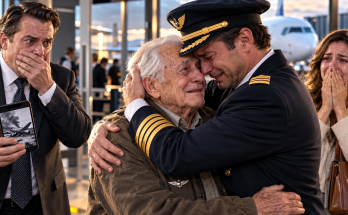
PART 1 — THE RESCUE THAT CHANGED EVERYTHING
The night I saved seventeen strangers from a burning highway, I had no idea that the most dangerous discovery of my life was waiting inside the ambulance.
I was thirty-four years old, a decorated Army major, and the daughter of a man who had spent most of my childhood making me feel as though I had never quite earned my place in his family.
My name is Claire Bennett.
For as long as I could remember, my younger brother, Jason, had been the child my father proudly introduced to everyone. His military achievements were celebrated with expensive dinners, framed photographs, and speeches about dedication.
My own accomplishments were usually met with a nod and a reminder that my career had taken me too far from home.
When Jason received his latest promotion, my father organized a Christmas Eve celebration at the family house in Pennsylvania.
I was supposed to attend.
Three weeks before Christmas, however, my father called and suggested that I stay at my military installation instead.
“Jason has worked hard for this,” he explained. “I don’t want the evening turning into a discussion about your deployments.”
I waited for him to laugh and admit that he was joking.
He didn’t.
“I wasn’t planning to discuss myself, Dad.”
“Claire, you know how these things go. Everyone will want to hear about your work. Your brother deserves his moment.”
I looked at the photograph of my unit hanging above my desk.
We had recently returned from a difficult overseas assignment. Several of my soldiers were still recovering from injuries. I had spent months coordinating operations, making decisions that could not be undone, and learning how to sleep through nightmares I refused to discuss.
Yet my own father believed that simply appearing at his dinner table would somehow steal his son’s attention.
“All right,” I said.
“Good. You understand.”
He ended the call before I could respond.
That evening, I canceled my flight.
I told myself it didn’t matter.
I had colleagues who cared about me. I had soldiers who trusted me. I had built a life that did not depend on my father’s approval.
But on Christmas Eve, when the snow began falling across the base, I found myself thinking about my mother.
She had been dead for ten years.
If she were alive, she would have called me first thing that morning. She would have asked whether I had eaten, whether I was sleeping enough, and whether I was still pretending that rejection didn’t hurt.
Then she would have reminded me of something she used to say when I was little.
“Never let someone else’s inability to love you properly convince you that you’re difficult to love.”
I carried those words everywhere.
At 8:17 p.m., the emergency call came through.
A charter bus had overturned on Interstate 81 during a blizzard. A fuel tanker had jackknifed nearby, blocking several lanes. Multiple vehicles were trapped between the wreckage, and emergency crews feared that leaking fuel could ignite.
Our unit was close enough to assist with evacuation and emergency coordination.
Within minutes, I was inside a military vehicle with my team.
The highway was a frozen nightmare.
Snow swept across the road in thick curtains. Hazard lights blinked through the darkness. The overturned bus lay on its side, its windows shattered, while passengers screamed for help from inside.
I organized the evacuation.
Two soldiers helped injured passengers through a broken window. Another team secured the surrounding vehicles while firefighters assessed the tanker.
Then I heard someone shouting from beneath the wreckage.
A man was trapped inside the tanker cab.
The vehicle had tilted dangerously toward the ditch. Its front end was crushed, and the driver’s leg appeared pinned beneath the dashboard.
“Major, we need to wait for the heavy rescue equipment,” a firefighter warned.
I looked toward the tanker.
Fuel was leaking onto the snow.
“How long?”
“Ten minutes, maybe fifteen.”
We might not have ten minutes.
I ordered the immediate evacuation of everyone within the danger zone, then joined the rescue team.
The driver’s face was streaked with blood. His gray hair was matted against his forehead, and he was struggling to remain conscious.
“Can you hear me?” I shouted.
His eyes opened.
“Don’t leave me here.”
“We’re getting you out.”
I climbed into the damaged cab while the firefighters worked to stabilize the vehicle. Every movement sent a metallic groan through the twisted structure.
The man grabbed my sleeve.
For a moment, his eyes focused on my face.
Then he whispered a name.
“Claire.”
I froze.
“What did you say?”
His lips moved again, but the sound disappeared beneath the wind.
I had never seen this man before.
At least, I thought I hadn’t.
We finally freed his leg and pulled him clear just as the tanker shifted several inches toward the ditch.
The rescue crew rushed him to an ambulance.
Before the doors closed, the man caught my wrist.
His grip was surprisingly strong.
“Your mother,” he whispered.
My entire body went cold.
“What about my mother?”
But his eyes rolled back, and the paramedics began working on him.
The ambulance doors slammed shut.
I stood in the snow, staring after it.
My mother had been dead for ten years.
And a stranger I had just rescued somehow knew her name.
PART 2 — THE NAME ON THE TELEVISION
By midnight, the rescue had become national news.
A reporter stood beside the wreckage, describing how military personnel had helped evacuate passengers from the overturned bus. A camera showed me directing the operation, followed by footage of the injured tanker driver being carried toward an ambulance.
My face appeared on the screen.
Beneath it were the words:
MAJOR CLAIRE BENNETT — LEADS CHRISTMAS EVE HIGHWAY RESCUE.
I was back at the operations center when my phone began vibrating.
Jason had called four times.
My father had called twice.
I ignored both until a message appeared from my sister-in-law, Erica.
Claire, please call Jason immediately. Something has happened.
I stepped into a quiet hallway and called my brother.
He answered on the first ring.
“Claire, are you safe?”
“I’m fine. What happened?”
He sounded as though he had been running.
“We were watching the news. Erica recognized the man you pulled from the tanker.”
“Recognized him from where?”
“From a photograph Dad keeps in his study.”
I leaned against the wall.
“Jason, who is he?”
My brother took a shaky breath.
“His name is Walter Bennett.”
The name meant nothing to me for a moment.
Then something shifted inside my memory.
A closed bedroom door.
A family photograph with one face cut out.
My mother’s voice abruptly stopping whenever I asked why we never visited my grandfather.
Walter Bennett.
My grandfather.
The man my father claimed had abandoned the family twenty-two years earlier.
According to the story I had been told, Walter had left home one winter morning to take a long-distance trucking job. He had never returned. Police searched for him, relatives made inquiries, and eventually the family stopped expecting him to come home.
My father always described him as selfish.
“He chose the road over his own children,” he had told me once.
I was too young to understand why that sentence made my mother cry.
“Are you sure?” I asked Jason.
“His name is on the hospital report. Dad recognized him immediately.”
“Did Dad know he was alive?”
“I don’t think so.”
But Jason hesitated.
“What aren’t you telling me?”
“Dad looks terrified, Claire.”
I closed my eyes.
My father was not a man who frightened easily. He had survived years of military service, a difficult marriage, and the death of the woman he claimed to love more than anyone.
If the sight of Walter Bennett on television had terrified him, then the story of my grandfather’s disappearance was not as simple as I had been told.
“I’ll call you later,” I said.
Before Jason could answer, my commanding officer approached.
“Major, the hospital has been asking for you.”
“Why?”
“The driver regained consciousness briefly. He requested the officer who rescued him.”
I followed my commander into his office.
“He specifically asked for Claire Bennett,” he continued. “The hospital staff checked your identification and confirmed your name.”
“Did he explain why?”
“No. But he asked whether your mother was still alive.”
I felt the floor shift beneath me.
“What did you tell them?”
“Nothing. I thought you should handle that yourself.”
I thanked him and stepped outside.
My phone rang again.
This time, it was my father.
I answered.
“Claire,” he said, his voice unusually quiet. “I saw the news.”
“I assumed you did.”
“You did a remarkable thing tonight.”
“Thank you.”
Another silence.
Then he asked, “Has the man spoken to you?”
I stared at the dark window beside me.
“You know who he is.”
“I know who he might be.”
“His name is Walter Bennett.”
My father exhaled sharply.
“Listen to me. Whatever he tells you, don’t believe everything you hear.”
The words made my stomach tighten.
“Why?”
“Because you don’t know what happened twenty-two years ago.”
“Neither do I, apparently. You never told me the truth.”
“Claire, this is complicated.”
“No. It is a man who disappeared, a mother who died, and a family that refuses to answer simple questions.”
He said nothing.
I continued.
“Did Grandpa abandon you?”
My father took so long to answer that I thought the call had disconnected.
Finally, he said, “I don’t know anymore.”
It was the first honest sentence I could remember hearing from him about Walter.
Then he added something that changed everything.
“Your mother had a letter from him. She kept it hidden for years.”
“Where?”
“I don’t know.”
“Dad, you just said—”
“I said she had it. I never saw what was inside.”
I gripped the phone.
“What else did Mom hide?”
His breathing grew uneven.
“There’s something you need to understand about the night he disappeared.”
Before I could ask what he meant, someone called his name.
He lowered his voice.
“Don’t go to that hospital alone.”
“Why?”
“Because Walter may not be the only person who has been waiting for you to find out the truth.”
The line went dead.
PART 3 — THE MAN WHO REMEMBERED MY CHILDHOOD
The hospital was twenty-six miles from the base.
I drove through the remaining snow with my headlights cutting narrow tunnels through the darkness.
Walter Bennett was in intensive care, recovering from surgery to repair his leg and treat internal injuries. A nurse met me outside his room.
“He’s weak,” she explained. “The doctor wants to keep the conversation short.”
“Does he know who I am?”
“He’s been asking for you since he woke up.”
I entered quietly.
The old man lay beneath a white blanket, his face pale against the pillow. Several monitors surrounded the bed. A bandage covered his forehead, and his left leg was suspended in a brace.
He opened his eyes when I approached.
For several seconds, neither of us spoke.
Then tears gathered in his eyes.
“You look like Claire,” he whispered.
“My mother?”
He nodded.
I pulled a chair beside the bed but remained standing.
“Who are you?”
His mouth trembled.
“I’m your grandfather.”
I had imagined meeting Walter Bennett a thousand different ways without realizing it.
In some versions, I would have shouted at him for abandoning his children.
In others, I would have demanded an explanation for every birthday, every holiday, and every family gathering he had missed.
I thought I would feel anger.
Instead, I felt an unbearable emptiness.
“Why did you leave?” I asked.
Walter closed his eyes.
“Because I believed leaving was the only way to keep your mother safe.”
I stared at him.
“Safe from what?”
He tried to sit up, but pain forced him back against the pillow.
“The accident,” he whispered. “The documents. Your father.”
I stepped closer.
“What documents?”
He looked toward the door.
“Did your father send you?”
“No.”
“Does he know you’re here?”
“Yes.”
Walter’s expression changed.
“Then we have less time than I thought.”
I almost laughed at the absurdity of it.
“You’ve been missing for twenty-two years. You cannot expect me to understand everything because you woke up in a hospital bed.”
“You’re right.”
His answer surprised me.
“I have no right to ask you for trust,” he continued. “But I can ask you to hear the truth before you decide what kind of man I am.”
I sat down.
“Start at the beginning.”
Walter told me that he had worked as a long-haul truck driver while raising my father and his younger sister, Claire, my mother.
He had been strict but devoted. His wife had died when their children were young, and he had done everything he could to keep the family together.
Then, twenty-two years earlier, he had discovered irregularities in the financial records of a small transportation company where he occasionally contracted his services.
Several shipments were being recorded under false names. Payments had been diverted through accounts that did not belong to the company.
Walter initially assumed it was ordinary fraud.
Then he discovered that one of the signatures authorizing the transfers belonged to a relative.
My father.
Walter said he confronted him.
The argument became vicious.
My father insisted that he had signed documents without understanding what they contained. Walter believed he was lying.
A few days later, Walter’s truck was found abandoned near a roadside rest stop.
His wallet was inside.
His vehicle keys were missing.
There was no sign of him.
The police suspected that he had disappeared voluntarily.
But Walter claimed he had been threatened after trying to report the financial irregularities.
“Who threatened you?” I asked.
He shook his head.
“I won’t name anyone without evidence. I spent too many years watching the truth become meaningless whenever I couldn’t prove it.”
“Then how did you survive?”
“I left the state. I changed jobs. I kept my head down.”
“You could have contacted your children.”
His eyes filled with tears.
“I tried.”
“When?”
“Several times during the first year. Your mother was the only one who answered.”
My heart began pounding.
“What did she say?”
“She told me to stay away until I could prove what had happened. She said the family was being watched.”
“Watched by whom?”
“I don’t know. She never explained everything in her letters.”
I leaned forward.
“You had letters from my mother?”
He nodded.
“Not many. She sent them through an intermediary. I kept every one.”
“Where are they?”
“Not with me.”
His answer was immediate.
“Where, then?”
“In a safety deposit box.”
“Which bank?”
“First National, in Harrisburg. Box number 318.”
I memorized the details.
Walter reached beneath his pillow and pulled out a small brass key attached to a faded red thread.
“The bank will require identification and legal documentation. Your mother arranged everything years ago.”
I took the key.
“Why didn’t you come back?”
He looked at me with an expression so exhausted that my anger faltered.
“Because the last letter I received from your mother said that someone had threatened to take you away from her.”
I stopped breathing.
“What?”
“You were four years old. She wrote that she feared someone would use you to force her into silence.”
I stood abruptly.
“My mother never told me that.”
“I know.”
“She would have told me.”
“She wanted to. But she believed that keeping you safe mattered more than giving you answers.”
I walked toward the window.
For thirty-four years, I had believed my mother had died without leaving any mysteries behind.
Now, the man I had been taught to hate was telling me that she had spent years protecting me from a danger no one had ever explained.
I turned back.
“Did you know she was dying?”
Walter’s face crumpled.
“No.”
“Did you know she was sick?”
“No.”
He covered his eyes.
“If I had known, Claire, I would have come home.”
I wanted to believe him.
But wanting something to be true was not the same as knowing it was.
I placed the brass key in my pocket.
“I’m going to find those letters.”
Walter nodded.
Then he caught my hand.
“One more thing.”
“What?”
“Your mother didn’t only leave letters.”
He swallowed painfully.
“She left proof.”
PART 4 — THE BLUE ENVELOPE
The bank opened at nine the following morning.
I had slept for less than an hour when Jason called.
“Dad wants us to come home,” he said.
“Why?”
“He says we need to talk about Grandpa.”
“Did he tell you the truth about the financial records?”
Jason went silent.
“Claire, what financial records?”
I explained what Walter had told me.
By the time I finished, my brother was breathing heavily.
“Dad said Grandpa stole money from the family business.”
“Did you ever see proof?”
“No.”
“Did anyone?”
“I don’t know.”
“Then we need to stop repeating stories we cannot verify.”
Jason agreed to meet me at the bank.
The safety deposit box contained a thick envelope, several folded letters, an old photograph, and a small notebook.
The photograph showed my mother standing beside Walter in front of a modest brick house. She looked about twenty-five, smiling at the camera with one hand resting on her stomach.
On the back, she had written:
For Claire, when she is old enough to understand that love sometimes requires difficult choices.
I stared at the words.
Then I opened the envelope.
The first letter was dated twenty-two years earlier.
Dad,
I know you believe that leaving was the only way to protect us. I also know that you have spent years convincing yourself that silence is the same as safety.
It isn’t.
Jason is asking questions. Claire is too young to understand, but she notices everything. She knows when her father is angry. She knows when I cry in the kitchen. She knows when we stop talking because she enters the room.
I cannot keep raising children inside a mystery.
If you have evidence, preserve it. If you have names, write them down. If you believe someone has committed a crime, find a way to tell the truth without putting the children in danger.
Please don’t disappear forever.
I had to stop reading.
My mother had known.
She had known that I noticed the silence. She had known that our family was breaking beneath the weight of secrets.
And she had tried to stop it.
The second letter was shorter.
Dad,
I have kept the original documents. I made copies of everything, including the transfer records and the letters that prove you were threatened.
If something happens to me, Claire must receive them.
Do not let anyone tell her that you abandoned us because you stopped loving us.
You left because you were afraid.
There is a difference, but she deserves to know the truth.
I pressed the letter against my chest.
Jason sat beside me, his eyes fixed on the notebook.
“Open it,” he whispered.
The notebook contained dates, account numbers, names, and descriptions of financial transactions. Several entries appeared to correspond with the irregularities Walter had described.
One name appeared repeatedly.
Richard Vale.
My father’s former business partner.
Richard had been a frequent visitor to our house when I was a child. He had brought expensive gifts at Christmas, attended Jason’s school events, and once paid for a family vacation after my father claimed we could not afford it.
I remembered my mother refusing to sit beside him at dinner.
I remembered her telling me never to sign anything without reading it.
At the time, I had thought she was simply cautious.
Now, those memories seemed different.
Jason turned another page.
There was a handwritten note beneath a list of dates.
The original authorization forms are in the locked cabinet at the old warehouse. If Richard discovers that Walter kept copies, he will destroy everything.
Jason looked up.
“Richard died five years ago.”
I stared at the page.
“Then why would Dad still be afraid?”
My brother had no answer.
We continued searching the box.
At the bottom lay a sealed blue envelope.
My mother’s name was written across the front.
Inside was a letter addressed to me.
My dearest Claire,
If you are reading this, then you have finally found the truth I was unable to give you while I was alive.
There is something I need you to understand before you judge your grandfather.
He did not leave because he stopped loving us. He left because he believed someone had made our family unsafe.
But fear changed him. It changed your father, too. They both made decisions that hurt people who deserved better.
You do not have to excuse either of them.
You only have to refuse to let their choices determine the person you become.
There is one final document. It is hidden in the place where your father keeps the photographs he cannot bear to display.
When you find it, you will understand why he has spent so many years trying to keep the past buried.
I love you beyond every distance, every silence, and every truth I could not tell you.
Mom.
I read the letter twice.
Then I looked at Jason.
“Where does Dad keep the photographs?”
“In his study.”
“Then that’s where we’re going.”
My brother hesitated.
“Claire, what if he refuses to let us look?”
I slipped the letters back into the envelope.
“Then we ask him why.”
For the first time in my life, I was no longer willing to accept silence as an answer.
PART 5 — THE PHOTOGRAPH BEHIND THE WALL
My father’s house looked exactly as it had when I was a child.
The porch light was broken. A wreath hung crookedly on the front door. Through the windows, I could see the remains of the Christmas dinner still spread across the dining table.
The television was on.
My father sat alone in the living room, staring at the frozen image of the rescue.
When he saw us enter, he stood.
“Where have you been?”
“Finding answers,” I replied.
His gaze moved to the envelope in my hand.
For the first time, I saw genuine fear in his expression.
“Where did you get that?”
“Grandpa gave me a key. Mom left us letters.”
He sat down slowly.
Jason remained beside the door.
“Dad,” he said, “we need to know what happened.”
My father rubbed his hands together.
“I was young.”
“You were thirty-eight,” I replied.
He looked at me sharply.
“You don’t understand what it was like.”
“Then explain it.”
He walked to the window.
Richard Vale had been more than a business partner. He had been my father’s closest friend since childhood. They had built a small transportation company together, and when the business began struggling financially, Richard offered to help secure new contracts.
My father signed documents without checking every detail.
Some authorized payments he did not understand. Others appeared to transfer money into accounts controlled by companies he had never heard of.
When Walter discovered the discrepancies, he confronted both men.
Richard insisted that everything was legitimate.
My father believed him.
At first.
Then Walter showed him copies of the records.
My father finally realized that the business was being used to move money through fraudulent transactions. He also discovered that his own signature appeared on several authorizations.
“I was terrified,” he admitted. “If the authorities investigated, I could lose everything.”
“So you blamed Grandpa,” Jason said.
“I didn’t blame him.”
“You told us he stole from you.”
My father closed his eyes.
“I was angry. I thought he was going to destroy the family.”
“By exposing a crime?” I asked.
“He wanted me to go to the police.”
“And you refused.”
My father did not answer.
Instead, he walked toward the study.
The walls were covered with framed photographs: Jason’s military promotion, Jason’s wedding, Jason standing beside our father at a charity event.
There were no photographs of me.
I had noticed that years ago.
I had simply stopped asking why.
My father stopped in front of a large portrait of my mother.
He lifted it carefully.
Behind the frame was a small metal compartment built into the wall.
Inside lay a photograph, a folded document, and a letter bearing my mother’s handwriting.
I took the photograph first.
It showed my father and Richard Vale standing outside the warehouse on the night Walter disappeared.
My father looked younger, but unmistakably himself.
Richard stood beside him, holding a folder.
On the back was a date.
The date Walter had vanished.
Jason stared at the image.
“You told the police you hadn’t seen Richard that night.”
My father sank into a chair.
“I lied.”
The admission was so quiet that I almost missed it.
I unfolded the document.
It was a statement signed by my father, acknowledging that he had received copies of the suspicious financial records from Walter.
Below his signature was another line.
A promise that he would cooperate with any investigation and provide the original documents if requested.
But the statement had never been delivered to the authorities.
“Why did you keep this?” I asked.
“Because I couldn’t destroy it.”
“Yet you hid it.”
“I was ashamed.”
I placed the document on the desk.
“Shame doesn’t explain twenty-two years of lies.”
He looked up at me.
“I thought Richard would go to prison. I thought the company would collapse. I thought your mother would leave me.”
“So you allowed Grandpa to disappear?”
My father’s face crumpled.
“I didn’t know where he went.”
“Did you know he was threatened?”
He shook his head.
“Not at first.”
“Did you know Mom was communicating with him?”
“Eventually.”
“Then why didn’t you tell us?”
He looked toward the photograph of my mother.
“Because she told me that if I ever used the truth to protect myself instead of protecting you, she would make sure you knew everything.”
My heart pounded.
“What happened to Richard?”
My father lowered his head.
“He died before the investigation could begin.”
“And the records?”
“I kept them.”
“Why?”
“Because I thought one day I might find a way to explain everything.”
I stared at him.
“You had twenty-two years.”
He began to cry.
For the first time, I did not rush to comfort him.
I had spent my childhood protecting my father’s feelings while he dismissed mine.
I would not do it anymore.
PART 6 — THE TRUTH ABOUT THE NIGHT HE DISAPPEARED
Walter was strong enough to speak for longer periods the following afternoon.
Jason and I returned to the hospital with the letters and photographs.
When I showed Walter the image of my father and Richard, his face became unreadable.
“I wondered whether he still had that,” he whispered.
“You knew my father was there that night?”
Walter shook his head.
“I suspected he had met Richard. I never knew what happened after I left the warehouse.”
“Then tell us what you remember.”
Walter explained that he had planned to deliver the original financial records to an attorney the following morning.
Before he could do so, Richard contacted him and asked for a private meeting.
Walter agreed because he believed Richard might finally confess.
Instead, Richard threatened to accuse Walter of stealing company funds.
He claimed he had already prepared documents that would make Walter appear responsible for the fraudulent transactions.
Walter refused to back down.
The argument escalated.
Richard told him that if he went to the authorities, he would destroy the lives of everyone in the family.
Walter left the warehouse and drove toward home.
A truck followed him for several miles.
Eventually, Walter pulled into a roadside stop, intending to call the police.
His phone was missing.
His wallet was gone.
He later discovered that someone had taken his truck keys while he was inside the building.
Fearing that the vehicle had been tampered with, he abandoned it and sought help from a mechanic he knew.
By the following morning, he had learned that Richard had already reported him missing.
“He made it look as though I had run away,” Walter said.
“Why didn’t you contact the police immediately?” Jason asked.
“I tried. But I had no documents, no money, and no proof that the company records were fraudulent. Richard had already told everyone I was unstable and had stolen from the business.”
Walter explained that he had traveled out of state while trying to find legal help.
He sent letters to my mother through a trusted acquaintance. He asked her to tell the children that he loved them and that he would return when it was safe.
But each attempt to come home ended with another warning.
Eventually, he became convinced that returning would expose my mother and the children to retaliation.
“I should have taken the risk,” he said, tears slipping down his cheeks. “I should have found a way to fight for you.”
I sat beside him.
“You can’t change what happened.”
“No.”
“But you can stop hiding from it now.”
He nodded.
Then Jason asked the question neither of us had wanted to ask.
“Did Dad know where you were?”
Walter looked away.
“I don’t know.”
“Did Mom?”
“Your mother knew I was alive. I believe she knew the state where I was living for several years. But I never told her my exact address.”
“Why not?”
“Because I thought Richard might be watching her correspondence.”
I thought of my mother’s letters, her careful handwriting, and the way she had always insisted that we never throw away important documents.
She had been protecting the truth with whatever little power she possessed.
“Did you ever stop loving us?” I asked.
Walter looked directly at me.
“Not for one day.”
The answer did not erase the years of absence.
But it was the first time I had heard someone speak about my childhood without asking me to pretend that the pain had never existed.
Before we left, Walter gave me another piece of information.
“My mother—your great-grandmother—owned a small property near the old warehouse. She kept a locked cabinet there for important family papers.”
“Is it still standing?”
“I don’t know.”
“What was inside?”
“Copies of the original records. At least, that is where I left them before I disappeared.”
Jason and I exchanged a glance.
If those records still existed, they might finally establish what had happened.
And they might reveal why my father had been so afraid of the truth.
PART 7 — THE WAREHOUSE
The old property stood at the edge of a declining industrial district outside Harrisburg.
Most of the surrounding buildings had been demolished. The warehouse was still standing, but its windows were boarded and its loading doors were covered in rust.
A property manager met us at the gate.
“This building has been empty for years,” he explained. “The current owner is preparing to sell the land.”
“Do you know anything about a storage cabinet inside?” I asked.
He frowned.
“There’s an office in the back. We haven’t cleared everything yet.”
He unlocked the door.
Dust filled the air. Broken chairs lay scattered across the floor, and old shipping labels clung to the walls.
We searched the office until Jason discovered a narrow metal cabinet behind a collapsed bookshelf.
The lock was old.
The brass key Walter had given me fit perfectly.
Inside were several folders, a stack of photographs, and a sealed envelope addressed to Walter.
The first folder contained copies of the original transportation records.
The second contained bank statements showing that money had been transferred into accounts controlled by companies associated with Richard Vale.
The third folder held letters between Richard and an unknown business associate.
One letter stood out.
Richard had written that Walter was becoming a problem because he had discovered the unauthorized transfers.
Another referred to a plan to make Walter appear responsible if the authorities investigated.
There was no evidence in the letters that Richard had physically harmed Walter. But there was enough to establish that he had deliberately tried to frame him and destroy his credibility.
Then I found a document bearing my father’s signature.
It showed that he had authorized one of the disputed transfers.
Jason stared at it.
“Dad wasn’t just careless.”
“No,” I said.
“He knew enough to sign the papers.”
We read the document again.
It was impossible to determine from the paperwork alone whether my father had understood the entire scheme. But the evidence suggested he had ignored warning signs and later concealed information that might have helped clear Walter.
At the bottom of the cabinet lay the envelope addressed to my grandfather.
Inside was a letter from my mother, dated three years after Walter disappeared.
Dad,
I have discovered that Richard’s actions were more extensive than we first believed. Jason is still young, and Claire is beginning to understand that the adults around her do not always tell the truth.
I have made copies of the records and placed them where they can be found if I am unable to protect them myself.
I cannot force my husband to confess. I cannot make him admit what he has done.
But I will not allow our children to inherit a lie.
If Claire ever finds these papers, tell her that she is not responsible for the choices her father made. Tell her she does not have to spend her life repairing damage she did not cause.
I read the last sentence several times.
Then I folded the letter carefully.
For years, I had believed my mother had wanted me to keep the family together at any cost.
Now I understood that she had wanted something else.
She wanted me to stop confusing loyalty with silence.
We photographed every document and contacted an attorney who specialized in financial investigations. He advised us not to remove or alter anything further until the property and records could be properly documented.
We followed his instructions.
That evening, I called my father.
“We found the records.”
He said nothing.
“Dad, I need you to tell me everything you remember about Richard.”
His voice sounded exhausted.
“I will.”
“Not to protect yourself. Not to protect me from being upset. Everything.”
“I understand.”
“No, Dad. You don’t understand yet. But you can start by telling the truth.”
For once, he did not argue.
PART 8 — THE CONFESSION
My father came to the hospital the next morning.
Walter was awake when he entered the room.
For several seconds, the two men stared at each other without speaking.
Then my father said, “I’m sorry.”
Walter looked at him.
“For what?”
My father swallowed.
“For allowing you to become the villain in a story I was too frightened to tell honestly.”
Walter’s eyes filled with tears.
“You let your children believe I abandoned them.”
“I know.”
“You let Claire grow up thinking she wasn’t worth coming home for.”
My father looked at me.
“I know.”
“You allowed your wife to carry the truth alone.”
My father lowered his head.
“I know.”
Walter closed his eyes.
“I spent twenty-two years wondering whether my own son had stopped caring about me.”
“I never stopped caring.”
“Then why didn’t you look harder?”
My father had no answer.
The silence that followed was more painful than shouting would have been.
Eventually, my father explained that Richard had threatened to implicate him in the financial scheme if he ever revealed what he knew. He had been afraid of losing his business, his home, and his reputation.
At first, he believed that keeping quiet would protect his children.
Later, he realized that the lie had become more valuable to him than the people it hurt.
He had repeated it so often that admitting the truth seemed impossible.
“When your mother found out how much I knew,” he said, “she told me that fear was turning me into someone she no longer recognized.”
Walter listened without interrupting.
My father continued.
“She wanted me to go to the authorities. She wanted me to tell Jason and Claire that you hadn’t abandoned us. I promised I would.”
“But you didn’t,” I said.
“No.”
“Why?”
He looked at me with tears running down his face.
“Because every year I waited made the next year harder. I convinced myself that I was protecting you. Eventually, I was protecting myself.”
It was the first time he had described his actions without blaming anyone else.
But a confession was not the same as forgiveness.
I told him that the documents would be reviewed by an attorney and that any appropriate authorities would receive the evidence.
He nodded.
“I understand.”
“You also need to understand that I cannot promise everything will go back to normal.”
“I know.”
“You don’t get to decide when I stop being hurt.”
He looked at me.
“No. I don’t.”
Walter reached for my father’s hand.
It was a small gesture, but my father broke down completely.
“I thought I had lost you forever,” he whispered.
Walter squeezed his fingers.
“You lost twenty-two years.”
My father bowed his head.
“Can you ever forgive me?”
Walter was quiet for a long time.
“I can try,” he said. “But forgiveness won’t give us those years back.”
My father nodded.
For the first time, he seemed to understand that the past could not be repaired simply because he was finally willing to discuss it.
Before we left the hospital room, Walter asked me to stay.
He wanted to tell me something privately.
“Your mother was proud of you,” he said.
I smiled sadly.
“I know.”
“No, Claire. You know she loved you. But she told me about your career in every letter she sent.”
He described how she had written about my first promotion, my difficult assignments, and the day I had called her to say that I wanted to remain in the Army.
“She said you were brave enough to build a life that belonged to you.”
My eyes filled with tears.
Walter reached for my hand.
“She was afraid you would spend your life believing you had to earn your father’s approval.”
I looked down.
“Sometimes I still do.”
“Then stop.”
His voice was weak, but the words were clear.
“You don’t have to win an argument with your father to prove that your life has value.”
I sat beside him until visiting hours ended.
For the first time since my mother died, I felt as though a piece of her had found its way back to me.
PART 9 — THE COST OF TELLING THE TRUTH
The documents triggered a formal review of the old financial transactions.
Because Richard Vale was dead, investigators focused on establishing the facts surrounding the disputed transfers and determining whether any surviving individuals had knowingly concealed evidence.
My father cooperated.
He provided statements, explained the documents he had signed, and admitted that he had withheld information from the original inquiries into Walter’s disappearance.
The process was neither quick nor simple.
Some records were incomplete. Several accounts no longer existed. Memories had faded, and certain questions could not be answered conclusively.
But the evidence established something important.
Walter had not simply abandoned his family.
He had been threatened, falsely portrayed as a thief, and driven away by circumstances that his own family had been too frightened to confront.
My father could no longer pretend otherwise.
The news eventually reached relatives who had spent years believing Walter had deserted them.
Some apologized.
Others insisted that the past was too complicated to revisit.
One aunt told me that exposing the truth would only hurt everyone.
I asked her who had been protected by the lie.
She had no answer.
Jason struggled with the revelations more than I expected.
He had always admired our father. Discovering that Dad had concealed so much forced him to reconsider memories he had once treasured.
One evening, he called me from his car.
“I keep thinking about all those Christmas dinners,” he said. “Every year, Dad would tell the story about Grandpa leaving. We believed him because he was our father.”
“I know.”
“Do you think we were wrong to believe him?”
“No. We were children. We trusted the adults who were supposed to protect us.”
Jason was silent.
“I should have defended you more,” he finally said.
I looked through my apartment window at the falling snow.
“You were trying to survive the same family I was.”
“That doesn’t mean I couldn’t have done better.”
“No,” I admitted. “But we can do better now.”
We began calling each other more often.
Not because we had suddenly become the perfect siblings, but because we were finally learning to speak honestly about things we had spent years avoiding.
My father started attending counseling.
At first, he treated it like another obligation, something to endure until everyone stopped asking questions.
Then, slowly, he began to change.
He apologized to relatives he had misled. He corrected the story whenever someone referred to Walter as a runaway. He stopped explaining his intentions before acknowledging the harm he had caused.
It did not make him a different man overnight.
But it was a beginning.
Walter’s recovery was slower.
His leg required additional treatment, and doctors warned that he might never regain full mobility.
He remained in rehabilitation for several weeks.
During that time, I visited whenever my duties allowed.
We talked about my mother, his years on the road, and the family photographs he had carried from one temporary home to another.
He told me about the first time my mother had driven a car, the terrible cake she had made for his birthday, and the way she used to laugh when she thought nobody was watching.
I learned that she had been more than the gentle woman I remembered.
She had been stubborn, funny, impatient, and courageous.
She had challenged people who tried to silence her.
She had loved fiercely.
And she had refused to let fear make her children smaller.
One afternoon, Walter handed me the old photograph from the safety deposit box.
“You should keep this,” he said.
I looked at my mother standing beside him.
“What about you?”
“I have spent twenty-two years carrying memories. It’s time you had some of them.”
I placed the photograph inside my uniform pocket.
For the first time, the family secret felt less like a burden and more like something I could finally set down.
PART 10 — THE CHRISTMAS WE FINALLY CAME HOME
Nearly a year after the highway rescue, my family gathered again on Christmas Eve.
This time, nobody was celebrating a promotion.
Nobody had been asked to stay away.
And nobody was pretending that the past had never happened.
Walter arrived in a wheelchair, wearing a dark blue sweater Jason had bought him. His leg was still stiff, but he insisted on coming.
My father met him at the door.
For a moment, neither man moved.
Then Dad stepped aside.
“Welcome home, Walt.”
Walter looked past him into the house.
“It’s been a long time.”
“Yes,” my father said. “It has.”
They entered together.
The dining room had been rearranged. The medals from Jason’s promotion were still on the shelf, but beside them sat a photograph of Walter, my mother, and my father taken decades earlier.
I had found it in the warehouse.
Someone had tried to hide it, but no one had destroyed it.
My father had placed it where everyone could see it.
Dinner was quieter than the previous year’s celebration.
There were awkward pauses, difficult questions, and moments when someone began a sentence only to realize that the words were not enough.
But there was also laughter.
Walter told a story about my mother accidentally driving his truck into a muddy field. Jason laughed so hard that he nearly dropped his glass.
For a moment, I could almost imagine what our family might have looked like if the truth had never been buried.
After dinner, my father asked whether I would walk with him.
We stepped onto the porch.
Snow fell softly across the garden.
“I owe you another apology,” he said.
“You’ve given me several.”
“I know.”
He looked down at his hands.
“I spent years believing that if I could provide for you, I had done my duty as a father. I paid the bills. I kept a roof over your head. I told myself those things mattered more than anything else.”
“They mattered,” I said. “But they weren’t everything.”
“No.”
He took a slow breath.
“When you joined the Army, I told myself you were choosing a life that would take you away from us. I never considered that perhaps I had already made home a place you needed to escape.”
I said nothing.
“I was proud of you,” he continued. “I always was. But I was frightened that your independence would expose how much of my own life I had built around fear.”
I looked at him.
“You could have told me.”
“I know.”
“You could have invited me home.”
“I know.”
“You could have been proud of me without comparing me to Jason.”
His eyes filled with tears.
“I know.”
For once, I believed he understood.
But understanding did not erase the past.
“I love you, Dad,” I said. “But I can’t promise that everything will feel normal again.”
He nodded.
“I don’t expect you to.”
“I need you to keep telling the truth, even when it makes you look bad.”
“I will.”
“And I need you to stop treating my life like something that happened to you.”
He looked at me for a long time.
Then he nodded again.
“All right.”
We stood in silence as the snow gathered along the porch railing.
Finally, he asked, “Do you think your mother would forgive me?”
I considered the question.
“I think she would want you to become someone who no longer needs to hide from what he did.”
He lowered his head.
“I hope I can.”
“Then start there.”
When we returned inside, Walter was sitting beside the fireplace, watching Jason’s children unwrap their presents.
He looked up as I approached.
“Everything all right?”
I sat beside him.
“Yes.”
He smiled.
“Your mother would have liked tonight.”
I leaned my head against his shoulder.
For twenty-two years, our family had treated the past as a locked room.
We had believed that if we never opened the door, the pain inside would eventually disappear.
But the pain had never disappeared.
It had simply passed from one generation to the next, hidden inside half-truths, missed holidays, and apologies that came too late.
The rescue on the highway had not made me a hero.
It had brought a forgotten man back into our lives.
And that man had forced us to confront the truth we had spent decades avoiding.
I had saved Walter Bennett from a wrecked tanker on Christmas Eve.
But he had given me something in return.
He had given me my mother’s voice back.
Not the memory of her final illness.
Not the sadness of her absence.
The real woman.
The woman who believed that courage meant refusing to make yourself smaller for someone else’s comfort.
The woman who had left letters because she knew the truth mattered.
The woman who had loved her children enough to hope they would one day live without fear.
I looked around the room.
My brother was laughing with his children. My grandfather was watching the fire. My father was standing beside the table, helping clear away the dishes.
We were not a perfect family.
We were not even a completely healed one.
But for the first time in my life, we were no longer pretending.
And sometimes, I realized, that is where a family must begin again.
EPILOGUE — WHAT MY MOTHER LEFT BEHIND
Six months later, I received a package from Walter.
Inside was a small photo album containing pictures from my mother’s childhood.
There were photographs of her riding a bicycle, standing beside her first car, and laughing with her father at a summer picnic.
At the back of the album was a final envelope.
My name was written across it in my mother’s handwriting.
I sat at my kitchen table and opened it.
Claire,
If these words have reached you, then I hope you have finally learned that the truth can hurt without destroying you.
You may discover that the people you love have disappointed you. You may learn that someone you trusted was afraid, selfish, or wrong.
You may even discover that you were wrong about someone you believed you understood.
Do not let those discoveries turn you bitter.
But do not let love become an excuse for accepting lies.
Forgive when you are ready. Walk away when you must. Remember that you can love someone and still require them to take responsibility for what they have done.
And never confuse being needed with being valued.
You were never born to spend your life proving that you deserved a place at the table.
You deserved one because you were my daughter.
You still do.
Love always,
Mom.
I cried for nearly an hour.
Then I placed the letter beside the photograph of my mother and Walter.
The following weekend, I invited my family to my home.
My father arrived early and helped me prepare dinner. Jason brought his children. Walter came with his cane, determined to walk through the front door without assistance.
We ate, talked, and laughed.
At one point, my father stood beside the table and raised his glass.
“I want to thank Claire,” he said. “Not just for saving Walter’s life, but for refusing to let us continue living a lie.”
I looked at him.
He did not turn the moment into a speech about himself. He did not compare my achievements with Jason’s. He simply looked at me and said the words I had waited my entire life to hear.
“I’m proud of you, Claire. And I’m sorry it took me so long to say it.”
For the first time, I believed he meant it.
I smiled.
“Thank you, Dad.”
It wasn’t a magical ending.
Twenty-two years could not be repaired in a single dinner. My grandfather still had painful memories. My father still had work to do. And I still carried the scars of growing up in a family where love was often expressed through silence.
But we were learning.
And that was enough.
Because the greatest rescue of my life had not happened on a frozen highway.
It had happened when I finally stopped believing that keeping my family together was more important than telling the truth.
The stranger beneath the wreckage had been my grandfather.
The missing man had been a father who was afraid.
The secret had belonged to my mother.
And the person who had spent years waiting to be welcomed home had been me.
THE END