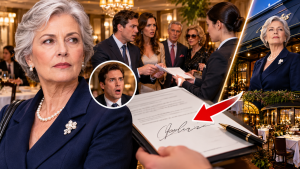
“Charge the entire $38,000 reception to my mother’s account,” my son told the restaurant manager. “She’s old. She won’t even remember authorizing it.”
I stood just six feet behind him.
He had no idea I could hear every word.
He had no idea that the authorization in his hand carried my forged signature.
And he certainly had no idea that the woman he had spent years treating like a lonely, insignificant widow was the person who controlled the restaurant he was trying to exploit.
My name is Margaret Whitmore. I was sixty-eight years old that Mother’s Day, and I had spent most of my life believing that if you loved your children enough, they would eventually understand what you had sacrificed for them.
That Sunday, I discovered how dangerously wrong a mother could be.
I had invited my son, Adam, and his wife, Vanessa, to dinner three weeks earlier.
Vanessa answered his phone.
“We already have plans with my parents,” she told me. “It’s a family occasion, Margaret.”
I remember standing beside my kitchen window, looking at the small vase of yellow flowers I had bought for myself.
“Am I not family?”
She sighed as though I had asked something embarrassingly foolish.
“Please don’t make this dramatic.”
Then she hung up.
I could have stayed home. I could have spent the evening watching television, telling myself that my son was busy and that I shouldn’t take things personally.
Instead, I put on my favorite navy suit, pinned my late husband’s pearl brooch to my lapel, and drove to Bellavita, the elegant Italian restaurant in downtown Boston that my husband and I had built nearly three decades earlier.
I had not told many people how much of that business belonged to me.
Arthur had been the chef. I had been the woman behind the accounts, the leases, the negotiations, and the endless calculations that kept the lights on when we could barely afford the electricity bill.
People remembered his cooking.
Few remembered that I had borrowed against my sewing business to save our first dining room.
That was fine with me.
I had never needed applause to do my work.
But I had once hoped my son would be curious enough to ask about it.
He never was.
That evening, Bellavita was filled with families celebrating Mother’s Day. Mothers received flowers. Children leaned across tables to give their grandmothers kisses. Champagne glasses sparkled beneath the chandeliers.
I sat alone at a small table near the window.
For a while, the loneliness hurt.
Then the pasta arrived, the waiter made me laugh about an overenthusiastic customer who had ordered three desserts, and I began to enjoy my evening.
I paid my $86 bill and stood to leave.
That was when I saw Adam.
He stood near the entrance beside Vanessa, her parents, and a crowd of relatives. His father-in-law, Graham Price, wore a Rolex that flashed whenever he moved his wrist. His mother-in-law carried a designer handbag that probably cost more than my first car.
Adam saw me.
His smile disappeared.
“Mom? What are you doing here?”
“Having dinner, sweetheart.”
Vanessa glanced toward my empty table.
“Alone? How depressing.”
Her mother laughed quietly.
“Some mothers simply refuse to let go.”
I felt the words strike somewhere deep inside me.
But I had learned long ago that not every insult deserved an answer.
“Enjoy your evening,” I said, turning toward the door.
Then I heard my son’s voice behind me.
“The membership number is 000147. Margaret Whitmore. Charge everything to her account.”
I stopped walking.
The restaurant manager, Sofia, sounded uncertain.
“Sir, that’s a Founder’s Reserve account. We need authorization for a charge of this size.”
Adam pulled a folded document from his jacket.
“I’m her son. I have authorization.”
Vanessa laughed.
“My mother-in-law has been getting forgetful lately. She doesn’t always understand these financial arrangements.”
Graham leaned toward Sofia.
“We’re arranging a private reception for prospective investors. Thirty-eight thousand dollars. The account covers it.”
Thirty-eight thousand dollars.
My son had excluded me from Mother’s Day, brought his wife’s entire family to a restaurant, and planned to pay for their lavish celebration with my money.
Then I noticed the signature.
Mine.
Or rather, a perfect imitation of mine.
I recognized the little upward curve at the end of my surname. I recognized the unusual spacing between my initials.
Someone had copied it from a document I had signed years earlier.
And someone had taken the time to make it convincing.
I walked back to the hostess stand.
“Sofia, before you process that transaction, may I see the authorization?”
Adam rolled his eyes.
“Mom, please don’t make a scene.”
I smiled at him.
“Oh, sweetheart. I haven’t even started.”
PART 2 — THE WOMAN THEY THOUGHT THEY COULD HUMILIATE
Sofia looked at Adam, then at the document.
“May I examine it, sir?”
Adam tightened his grip.
“There’s nothing to examine. My mother signed it.”
“Then you won’t mind showing it to me,” I replied.
Graham stepped forward, adjusting his expensive cuff links.
“Margaret, let’s not turn a simple administrative matter into a family dispute.”
“A simple administrative matter?”
I looked at the paper.
“Thirty-eight thousand dollars is a great deal of money for a mother who supposedly cannot remember signing her own name.”
Vanessa folded her arms.
“You’re embarrassing yourself.”
I turned toward her.
“No, Vanessa. I’m asking to see a document bearing my signature. If that embarrasses you, perhaps you should ask yourself why.”
For the first time, her expression faltered.
Then Sofia made a decision.
“Mr. Whitmore, I’m afraid I cannot process this without verification.”
Adam’s face reddened.
“Do you know who my father-in-law is?”
Sofia remained professional.
“I know the account requires authorization.”
Graham leaned closer to her.
“I can have your manager call you tomorrow.”
“I’m the manager on duty.”
“Then perhaps tomorrow you won’t be.”
The threat was delivered quietly, almost politely.
I saw Sofia’s fingers tighten around the document.
That was when I stepped forward.
“Give me the paper, Adam.”
He turned.
“Mom, stop.”
“Give it to me.”
Something in my voice made him hesitate.
He handed the document to Sofia, who placed it beneath the desk lamp.
I read the first paragraph.
Then the second.
The document didn’t merely authorize a single dinner. It named Adam as an administrator of my Founder’s Reserve account. It granted him permission to request invoices, change billing instructions, and approve private-event expenses.
Graham Price was listed as an additional authorized contact.
This wasn’t an improvised attempt to pay for one expensive reception.
Someone had designed a way to access my account repeatedly.
I looked at my son.
“How long have you been planning this?”
His mouth opened.
Nothing came out.
Vanessa stepped between us.
“You’re making an accusation you cannot prove.”
I turned the document around and pointed at the signature.
“Who signed this?”
“You did,” Adam insisted.
“Then tell me where.”
“At your house.”
“When?”
He glanced at Vanessa.
That tiny movement told me more than any confession could have.
I had raised Adam for thirty-five years. I knew the difference between his silence when he was embarrassed and his silence when he was trying to invent an answer.
This was the second kind.
I turned to Sofia.
“Please call our operations director. Preserve this document and every record associated with my account. No transaction is to be processed.”
Sofia stared at me for a moment.
Then she nodded.
“Of course, Mrs. Whitmore.”
Vanessa laughed sharply.
“Why is everyone acting as if she’s the owner of the place?”
Sofia straightened.
“Because she chairs the company that owns it.”
The room went silent.
Graham stopped adjusting his watch.
Celeste, Vanessa’s mother, slowly lowered her handbag.
Adam stared at Sofia.
“What?”
I touched my pearl brooch.
“My husband and I opened Bellavita twenty-nine years ago. Your father cooked in the kitchen. I managed the business. We bought the building, acquired our partners’ shares, and established the company that still owns this restaurant.”
Adam shook his head.
“You told me Dad owned a restaurant.”
“I told you your father was a chef. I never said that was the only thing he did.”
“You never told me you owned all this.”
I studied him.
“You never asked.”
That was the first truth of the evening.
The second was waiting inside the document.
And the third would eventually destroy the comfortable little world Adam and Vanessa had constructed.
I motioned toward the private office.
“Adam, Vanessa, Graham. Come with me.”
Then I looked at the relatives standing behind them.
“Your reservation may proceed, but you will need a different payment arrangement. Nobody here is responsible for another person’s decisions.”
One young woman quietly apologized.
“I didn’t know any of this.”
“I believe you,” I told her.
I had no intention of punishing innocent people simply because they shared a surname with the guilty.
Inside the office, Sofia placed the document on the desk.
Under the bright light, the signature looked even more convincing.
Too convincing.
I had seen that exact version of my name before.
On a birthday check.
A check I had written to Adam years earlier, when he had turned thirty.
He had thanked me with a quick text message and a photograph of a cake.
I remembered it because I had used my favorite fountain pen, the one that occasionally left a tiny ink mark near the end of my surname.
The forged signature contained the same mark.
Someone had copied my signature from an existing document.
I felt a coldness settle in my chest.
“Where did you get this?” I asked.
Graham answered first.
“It was prepared with the understanding that your family would be helping with the event.”
“Helping is not the same as authorizing.”
“Your son assured us you had agreed.”
I looked at Adam.
“Did you?”
He stared at the floor.
“Answer me.”
“I thought we could work something out.”
“You forged my signature.”
“I was going to repay you.”
“With what?”
He didn’t answer.
Sofia returned carrying several printed pages.
“Mrs. Whitmore, the account history shows an earlier charge of $6,400 in February. There were also multiple requests for billing information.”
I looked at the date.
February.
That was when Adam had visited me with soup because I had a terrible cold.
He had kissed my forehead, asked how I was feeling, and offered to collect my mail while I rested.
I remembered thinking that grief had not taken everything from me. My son still cared.
Now I wondered what else he had done while I slept.
“Was that dinner for Graham’s business partners?” I asked.
Sofia checked the file.
“Yes.”
I placed the paper on the desk.
“Then this isn’t the first time.”
Nobody spoke.
I took out my phone and called my attorney, Ruth Bennett.
She answered on the fourth ring.
“Margaret? Is everything all right?”
“No. I’m at Bellavita. Someone has presented a forged authorization to charge thirty-eight thousand dollars to my account.”
There was a pause.
“Has the charge gone through?”
“No.”
“Good. Preserve the original document. Don’t let anyone leave with it. I’ll be there shortly.”
Graham leaned toward me.
“Surely we can resolve this privately.”
“Then you’ll have no objection to preserving the evidence.”
His expression hardened.
For the first time, I saw the man beneath the polished suit.
He wasn’t embarrassed.
He was frightened.
And I was beginning to understand why.
PART 3 — THE ACCOUNT THAT REVEALED EVERYTHING
Ruth arrived forty minutes later.
She listened to Sofia’s account, examined the document, and asked the operations director to preserve all relevant records.
Then she called a forensic accountant.
By the following morning, we had an appointment with Daniel Cho, a quiet, methodical man who had little patience for excuses and an extraordinary ability to find missing money.
He spread the records across my dining table.
“This isn’t only about the proposed reception,” he explained. “We need to determine whether anyone has accessed your account or used the company’s name elsewhere.”
I nodded.
“Find everything.”
We began with the February charge.
The $6,400 dinner had been billed to my account without my approval. A billing clerk remembered receiving a call from a man who identified himself as a family representative.
The clerk had been told that I wanted the invoice sent to Adam’s email address.
There was no signed authorization on file.
Then Daniel found the proposed event guarantee.
Graham had been presenting his new catering venture to prospective investors. In his pitch materials, he described his business as having the backing of a prominent hospitality company.
That company was mine.
Bellavita’s name appeared beside a draft financial guarantee that I had never approved.
The proposed Mother’s Day reception was supposed to help Graham impress investors.
The venue, the expensive meal, the family gathering, and my supposed financial support would make his business appear far more established than it actually was.
He wanted people to believe he had powerful connections and substantial backing.
He had planned to use my reputation to obtain money.
And Adam had helped him.
Daniel found an email in which Adam had supplied my membership number and attached a photograph of my old birthday check.
Another message showed Graham discussing the authorization form.
Vanessa had helped prepare the accompanying correspondence.
Each person had played a different role.
Graham had organized the scheme.
Adam had supplied access and a copied signature.
Vanessa had helped make the arrangement appear legitimate.
Celeste had accepted the claim that I was helping financially without checking whether I had actually agreed.
It was no longer possible to pretend this had been a misunderstanding.
Ruth looked at me.
“We should make a formal report.”
I stared at the documents.
I had spent years protecting Adam from embarrassment.
When he struggled financially, I helped him.
When he made mistakes, I found explanations.
When Vanessa treated me dismissively, I told myself that young couples needed their independence.
Every time something hurt, I searched for a reason it wasn’t really happening.
Now I had to decide whether I would do the same thing again.
“Yes,” I said.
“Let’s make the report.”
At the police station, the investigator asked me several questions.
Had I signed the document?
No.
Had I given Adam permission to charge the February dinner?
No.
Had I authorized Graham to use the restaurant company’s name as financial backing?
Absolutely not.
Then she asked the question that hurt most.
“Do you understand that your son may face legal consequences?”
I looked at her.
“Yes.”
“Do you still wish to proceed?”
My throat tightened.
“Yes.”
I asked for a glass of water afterward.
Outside, Ruth walked beside me in silence.
Finally, I asked, “Does making a report mean I don’t love him anymore?”
“No,” she replied. “It means you are protecting yourself from something he did.”
I wished the distinction were easier to accept.
That evening, Adam called twenty-seven times.
Vanessa sent messages accusing me of destroying the family.
One said her mother had become unwell from the stress.
Another claimed that I was unstable and needed professional help.
I forwarded the messages to Ruth and stopped answering.
At midnight, Adam sent me a photograph.
He was seven years old in it, missing two front teeth, standing between me and his father in front of our first apartment.
His message said:
Remember who we are.
I looked at that little boy for a long time.
Then I typed four words.
I remember all of us.
I didn’t write anything else.
The next morning, I changed my passwords, revoked every unnecessary account permission, and contacted the bank using its official telephone number.
We reviewed my estate documents and confirmed that I had never signed a power of attorney giving Adam control over my finances.
I also replaced the locks at my house.
It felt ridiculous to change the locks because of my own child.
But trust did not mean leaving the door open after someone had used it against me.
For the first time in years, I began making decisions without asking whether Adam would approve.
It was frightening.
It was also strangely liberating.
PART 4 — THE VISIT THAT MADE ME QUESTION EVERYTHING
Three days after the restaurant incident, Celeste arrived at my house.
She wore dark glasses and carried a small handbag.
Helen, my younger sister, was visiting when the doorbell rang.
I opened the door but did not invite Celeste inside.
“May we talk privately?” she asked.
“No.”
Her eyes moved toward Helen.
“This is a family matter.”
“My sister is family.”
Celeste removed her glasses.
For the first time, I saw how tired she looked.
“Graham is under tremendous pressure,” she began. “His business has been struggling. He thought your family might help.”
“Then he should have asked me.”
“He believed you would agree.”
“He used my signature.”
She looked down.
“He expected to repay the money.”
“With what?”
She didn’t answer.
I folded my arms.
“Did you know about the February charge?”
“No. Graham told me the restaurant expenses were covered by a family arrangement.”
“And when Adam told the manager to charge my account on Mother’s Day, why didn’t you ask me?”
Her face reddened.
“I didn’t want to create a scene.”
I almost laughed.
She had watched me being humiliated because she didn’t want an uncomfortable evening.
“I understand,” I said quietly. “You wanted your celebration to continue.”
“Margaret, please.”
“You saw me sitting alone. You laughed about it. Then you watched your family try to spend my money.”
“I was wrong.”
The admission surprised me.
For a moment, I felt sorry for her.
Then she said, “You have so much. You could help us get through this.”
There it was.
Even now, she believed my resources made my consent optional.
“You decided I could afford to be robbed.”
“That isn’t fair.”
“No. What happened at the restaurant wasn’t fair.”
Celeste looked at the ground.
I asked her to provide an accurate account of what she knew to the investigator.
She began to protest, then stopped.
Finally, she nodded.
I closed the door gently.
Helen stood beside me.
“You didn’t have to let her explain herself,” she said.
“I know.”
“Are you all right?”
I looked around my quiet hallway.
“No. But I’m getting better at telling the difference between being kind and allowing people to hurt me.”
That afternoon, I found myself wondering whether I had been a good mother.
Had I spoiled Adam?
Had I made money too readily available?
Had I tried to solve his problems so often that he stopped learning how to solve them himself?
Helen listened while I asked every question.
Then she placed her cup on the table.
“Maggie, you may have made mistakes raising him. Everyone does. But you didn’t forge your own signature.”
I stared at her.
“That’s what I keep forgetting.”
“Then stop forgetting it.”
Her words stayed with me.
I could reflect on my parenting without accepting responsibility for another adult’s dishonesty.
I could acknowledge my imperfections without allowing someone to use them as an excuse for theft.
And I could love my son without pretending he had done nothing wrong.
For the first time, those three things seemed capable of existing together.
PART 5 — MY SON FINALLY TOLD THE TRUTH
Two weeks later, Adam requested a meeting through Ruth.
He wanted to speak without Vanessa or Graham present.
I agreed to meet him in a small public park near the library.
Helen waited on a bench several yards away.
Adam arrived wearing a jacket I had bought him for his thirtieth birthday. He looked exhausted.
We sat beneath a maple tree.
For several minutes, neither of us spoke.
Then he said, “I didn’t think you’d find out.”
I turned toward him.
“Thank you for telling me the truth.”
His eyes filled with tears.
“I was going to repay you.”
“From where?”
“Graham’s business. Once the investors came in, he would have returned the money.”
“And if they hadn’t?”
He looked away.
“I don’t know.”
“Why did you tell the manager I was forgetful?”
“Vanessa said it would make things easier.”
“You heard her insult me.”
“Yes.”
“And you said nothing.”
“Yes.”
I watched a child run across the grass after a red ball.
“Adam, what did you tell Graham about me?”
He pressed his hands together.
“That you wouldn’t miss the money.”
I felt the words settle inside me.
“Anything else?”
“That you didn’t understand business anymore.”
A painful laugh escaped me.
“I negotiated leases, supplier contracts, and bank loans while raising you. I kept a business alive through recessions and your father’s illness. Yet you decided I didn’t understand money?”
“I know how it sounds.”
“Do you know how it felt?”
He lowered his head.
For once, I did not rush to comfort him.
I let the silence remain.
Finally, he said, “Graham told me it was temporary. Vanessa said you had more than enough and that family should help family.”
“And what did you think?”
He stared at his shoes.
“I wanted them to think I belonged with them.”
The answer was so honest that I almost missed how painful it was.
He continued.
“They were always talking about investments, vacations, expensive things. Graham made me feel as if I was finally part of something important. I thought if I helped him, everything would work out.”
“So you made me the price of your acceptance.”
His face crumpled.
“I didn’t think of it that way.”
“That doesn’t change what you did.”
“I know.”
He wiped his eyes.
“Mom, I am sorry.”
I had imagined hearing those words many times.
In some versions, I immediately forgave him.
In others, I stood up and walked away.
But when the moment arrived, I felt neither dramatic relief nor satisfaction.
I felt grief.
Because an apology could acknowledge the wound, but it could not make the wound disappear.
“I love you,” I told him. “But I cannot trust you right now.”
He nodded.
“I understand.”
“No. You are beginning to understand. There is a difference.”
He accepted that without arguing.
Then he asked, “What do you want me to do?”
“Tell the truth. All of it. Accept the consequences. Repay what you owe. Stop asking me to protect you from the decisions you made.”
He looked frightened.
“What if it destroys my marriage?”
I took a slow breath.
“What kind of marriage requires you to deceive your mother to keep it?”
He had no answer.
Before we left, he asked whether he could hug me.
I thought about it.
“Not today.”
His face fell, but he nodded.
“All right.”
It was a small moment.
But it was the first time he had accepted a boundary without trying to negotiate it away.
I watched him walk toward the parking lot.
I wanted to call him back.
I wanted to tell him that everything would be fine.
Instead, I stayed where I was.
For once, I allowed him to carry the weight of his own choices.
PART 6 — THE CONSEQUENCES NO ONE EXPECTED
The investigation continued through the summer.
The proposed guarantee had never been accepted by a lender, and no loan had been funded against it. That was an enormous relief.
My home was safe.
The restaurant remained financially secure.
But the evidence of what had happened was extensive.
Adam had supplied my signature from an old check.
Graham had prepared the authorization.
Vanessa had helped construct the explanation intended to make the arrangement appear legitimate.
The February dinner had already been charged to my account without permission.
There were also emails describing me as a silent financial backer of Graham’s business.
I had never agreed to that arrangement.
When the evidence was reviewed, each person’s conduct was addressed separately.
Graham had organized the scheme and used my name to give his struggling venture credibility.
Adam had knowingly provided information and helped create the false authorization.
Vanessa had participated in the misleading communications.
Celeste cooperated with the investigation and provided an account of what she knew.
I refused to exaggerate anyone’s role simply because I was hurt.
I also refused to minimize what the evidence established.
When Adam’s attorney asked about repayment, I supplied a documented accounting of the unauthorized charges and related expenses.
I did not add imaginary damages to punish him.
I did not demand that he spend the rest of his life paying for the fact that I had raised him.
I wanted restitution for the actual financial harm and accountability for the deception.
The legal process moved slowly.
There were interviews, meetings, documents, and difficult decisions.
Eventually, the matter resulted in separate legal resolutions, financial penalties, and restitution obligations. Graham received a custodial sentence for the offenses established against him. Adam received probation, community service, and a restitution order. Vanessa’s resolution was separate and included supervision and repayment obligations.
The consequences were serious.
They were also not identical.
Justice did not require me to pretend that everyone had done the same thing.
On the day I gave my statement, Helen accompanied me.
Before we entered the building, she buttoned my coat because my fingers were trembling.
“Do you want me to sit where you can see me?” she asked.
“Yes.”
Inside, I looked at Adam.
He appeared older than he had in May.
When my turn came, I unfolded a sheet of paper.
“I was asked to explain the financial harm,” I began.
“That can be calculated.”
I paused.
“The harder damage is that kindness now frightens me before it comforts me.”
The room was silent.
“When someone brings me soup, I wonder what they need. When a family member offers help, I wonder what they want in return.”
I looked toward my son.
“I don’t want that to be the rest of my life.”
My voice shook, but I continued.
“I want my son to be accountable. I also want him to become someone who can be trusted. Both wishes are true.”
I sat down.
For the first time since Mother’s Day, I felt that I had spoken without trying to make anyone comfortable.
Outside, Graham passed me on the courthouse steps.
“All this over money,” he muttered.
I stopped.
“No,” I replied. “Over believing you could erase my consent.”
He walked away.
Adam waited near the entrance.
“I heard you,” he said.
I nodded.
“I mean all of it, Mom.”
I looked at him carefully.
“Then show me.”
It was not a promise of forgiveness.
It was an opportunity to begin earning trust.
He understood the difference.
PART 7 — THE WOMAN I HAD FORGOTTEN
After the legal proceedings, I began to rebuild the parts of my life that had nothing to do with Adam.
At first, I didn’t know where to start.
For years, my days had revolved around helping other people. I had answered family calls, covered unexpected expenses, prepared meals, and rearranged my plans whenever someone needed me.
I had become so accustomed to being useful that I sometimes struggled to understand who I was when nobody needed anything.
My sister Helen suggested a pottery class.
I told her I had no artistic talent.
“Perfect,” she replied. “Then nobody will expect you to make anything impressive.”
My first bowl leaned so badly that it looked as though it had survived an earthquake.
I kept it.
I began taking walks without checking my phone every few minutes.
I invited friends to dinner without waiting for a holiday.
Some were widowed. Some were divorced. Some had children who lived thousands of miles away.
One woman had a perfectly loving family but preferred spending her Thursday evenings with friends because she enjoyed the company.
I stopped asking people to justify why they were available.
We were available.
We ate.
We laughed.
Sometimes, that was enough.
I also began seeing a counselor named Anita.
During our first appointment, I spent twenty minutes explaining Adam’s good qualities.
Anita listened patiently.
Then she asked a question I had never considered.
“What would happen if we spent some time discussing yours?”
I began to cry.
We talked about grief and how my husband’s death had changed my relationship with Adam. After Arthur died, helping my son became a way to feel that I still had a purpose.
When Adam struggled, I offered money before he asked.
When he made mistakes, I tried to solve them.
I thought I was being loving.
Sometimes I was also frightened.
I feared that if I stopped being useful, I might become unnecessary.
Anita never suggested that my choices caused Adam’s deception.
She helped me understand why I had tolerated smaller signs of disrespect for so long.
The canceled lunches.
The jokes about my age.
The assumption that my money was available whenever his plans required it.
I had dismissed each incident because admitting the pattern would have meant facing the possibility that my relationship with my son was changing.
Now I understood something important.
I could acknowledge my mistakes without taking responsibility for his dishonesty.
I could love him without rescuing him.
And I could build a life that did not depend on being needed.
At Bellavita, I also began making changes.
Sofia had followed the account procedures even when Graham threatened her job.
I invited her to lunch.
She arrived looking nervous.
“Are we discussing my performance?” she asked.
“Yes,” I replied.
Her shoulders stiffened.
“You followed the rules when someone important pressured you to ignore them. You protected the business and yourself. I want you to know that mattered.”
She looked down.
“I should have recognized the situation sooner.”
“That wasn’t your responsibility.”
We worked together to improve the restaurant’s financial safeguards.
Unusual charges required additional verification. Family relationships alone could never establish authorization. Staff received clear instructions for reporting pressure from customers or executives.
Sofia helped design the new procedures.
Later, she earned a promotion through the regular review process because of her broader work.
I wanted her to know that doing the right thing was not merely a dramatic moment to be rewarded with a thank-you card.
It was a professional quality worth recognizing.
I also began spending more time at the restaurant.
Not as a frightened owner checking every account.
As a woman returning to a place she had helped build.
One afternoon, I found an old photograph in the service corridor.
Arthur stood in his chef’s uniform, smiling beside a crate of lemons.
I was half-hidden behind him, holding a clipboard.
Paolo, our head chef, noticed me studying it.
“They always crop you out when they print that picture,” he said.
I turned toward him.
“What?”
He shrugged.
“You were there. You built this place with him.”
Such a simple sentence.
It stayed with me all day.
At home, I searched through old boxes until I found the original photograph and several others.
There I was, painting the first dining room.
There I was, negotiating with a supplier.
There I was, asleep over a stack of invoices.
I had not been invisible.
I had simply become accustomed to standing in the background.
The following week, we updated Bellavita’s history wall.
Arthur remained in the center of the display, smiling in his chef’s whites.
But the photographs beside him finally showed the rest of the story.
My story.
I stood there for a long time after the new frames were hung.
For the first time in years, I did not feel like a supporting character in someone else’s life.
I felt like the woman who had lived my own.
PART 8 — THE DAUGHTER-IN-LAW WHO FINALLY STOPPED SMILING
Autumn arrived before Vanessa requested a meeting.
By then, Adam had moved into a modest apartment near his office. Their marriage was falling apart.
Vanessa asked to meet at Ruth’s conference room.
I agreed.
She arrived wearing the same perfume she had worn on Mother’s Day.
For one moment, the smell transported me back to the restaurant entrance.
Then Ruth poured water, and I reminded myself that I was no longer standing beside my empty table.
Vanessa folded her hands.
“I shouldn’t have said those things to you.”
“Which things?”
She looked irritated.
“About your memory. About being alone. About not being family.”
I waited.
“I was angry.”
“At what?”
She stared at me.
“At how easy everything seemed for you.”
I almost looked behind me.
“Easy?”
“You had the house. The restaurant. The money. You never seemed worried about anything.”
I thought of the nights I had stayed awake calculating whether we could afford another week of payroll.
I remembered sewing alterations after Adam went to bed, my fingers aching so badly that I sometimes struggled to hold a needle.
“You met me after the hardest years,” I told her. “You saw the results. You never saw the sacrifices.”
She looked down.
“Adam always chose you.”
“No,” I replied. “Adam often chose whoever made disagreement the most uncomfortable.”
Her face tightened.
She had expected anger.
She had not expected me to describe the pattern so plainly.
For a moment, I saw something beneath her resentment.
Fear.
She had built her identity around appearances, status, and the belief that successful people could arrange the world to suit themselves.
Now the world had stopped cooperating.
“Will you tell the investigator I didn’t understand the document?” she asked.
I looked directly at her.
“Did you understand it?”
She said nothing.
That was the real reason for the meeting.
She wanted me to help her escape the consequences.
I closed my handbag.
“I hope you build a life you don’t need to lie about.”
Her expression hardened.
“You think you’re better than me.”
“No,” I said. “I think I’m tired.”
I stood.
“This is the last private meeting we need to have.”
As I left the room, I realized something extraordinary.
I no longer needed Vanessa to like me.
I no longer needed her to understand my sacrifices.
I no longer needed her approval to believe that I had value.
The woman who had once wondered whether she was allowed to call herself family had finally stopped asking permission to belong.
PART 9 — THE LETTER MY HUSBAND LEFT BEHIND
The most unexpected moment came several months later.
One Thursday afternoon, Paolo called while I was watering the herbs in my kitchen.
“We’re cleaning the old storeroom,” he said. “We found a box with your name on it.”
I drove to Bellavita immediately.
Inside the storeroom, Paolo handed me an old biscuit tin.
The lid was dented, and the label had nearly peeled away.
Inside lay an envelope, several payroll sheets, and a small cassette recorder.
My name was written across the envelope in Arthur’s handwriting.
For Margaret’s next big birthday.
Arthur had died before my sixty-fifth birthday.
I sat down.
For several seconds, I could not speak.
Paolo pulled out a chair beside me.
The letter explained that Arthur had been planning a surprise celebration for me.
He wanted to invite former employees, suppliers, and friends from the early years of Bellavita.
He had planned to ask each person to share a story about something I had done that had made their lives better.
Not stories about his cooking.
Stories about me.
Beside one name, he had written:
She remembers the winter furnace.
Beside another:
Ask about Margaret and the bank.
I laughed through my tears.
The bank story involved a broken shoe heel, a refused loan extension, and six blocks of walking in my stockings because I had been too stubborn to miss an appointment.
Arthur used to tell that story as if I had crossed an ocean.
At the bottom of the letter, he had written:
Maggie, if I fuss over you, you tell me to stop. So this is official notice: I won’t.
You made this place possible. Let people thank you while you’re here to hear them.
I pressed the letter against my chest.
For nearly a year, I had been trying to recover a life that betrayal had made me question.
Here was proof that someone had seen me clearly all along.
The cassette recorder still worked after Paolo found fresh batteries.
First came static.
Then Arthur’s voice.
“Well, this machine hates me.”
I covered my mouth.
He talked about menu ideas, former employees, and a reminder to call Helen.
Then he paused.
“Maggie, if you find this before I’m finished, you’ll ruin the surprise.”
He laughed softly.
“You never did enjoy waiting to know things.”
I began to cry.
Not the desperate crying I had done on my bedroom floor after Mother’s Day.
This was different.
It was grief with warmth inside it.
Arthur continued.
He talked about our first apartment, the sewing machine that overheated, and the night I fell asleep holding a calculator because I had been trying to balance the accounts.
Then his voice became quieter.
“I hope the boy learns what you’ve done someday. But you don’t need his understanding to make it true.”
I closed my eyes.
For years, I had mistaken my son’s recognition for the final proof that my life mattered.
Arthur’s voice released me from that belief.
I had mattered when I worked those long nights.
I had mattered when I borrowed money to keep the restaurant open.
I had mattered when I raised Adam.
I had mattered even when Adam failed to recognize any of it.
My life did not become valuable the moment someone acknowledged it.
It had always been valuable.
PART 10 — A MOTHER’S DAY THAT BELONGED TO ME
I invited Adam to my house the following Sunday.
It was the first time he had visited since the restaurant incident.
He stopped at the doorway.
“Should I take my shoes off?”
It was such a small, careful question that I nearly smiled.
“Yes.”
We sat at the kitchen table.
I made tea and placed Arthur’s cassette recorder between us.
When Adam heard his father’s voice, his expression changed.
“Dad?”
I nodded.
We listened together.
By the end, Adam had covered his face with both hands.
“I didn’t know,” he whispered.
“About the restaurant. About any of it.”
“You knew enough to treat me kindly.”
He nodded immediately.
“Yes.”
I was grateful he didn’t argue.
He studied the payroll sheets.
“Were you really not paying yourself during those years?”
“For a while.”
“How long?”
“Long enough.”
He stared at the dates.
“That was when I started private school.”
“Yes.”
He set the papers down carefully.
For years, Adam had believed that his father’s success had paid for his childhood.
The truth was less glamorous.
Unpaid hours.
Deferred wages.
A woman sewing strangers’ clothes after her own child had fallen asleep.
I had not shown him the records to create a debt.
I told him that.
“I don’t want you to spend your life trying to repay the fact that I raised you.”
He looked at me, tears gathering in his eyes.
“Then what do you want?”
“For you to understand that I was a person while I was doing it.”
He bowed his head.
After a long silence, he said, “I think I’m beginning to understand.”
We did not solve thirty-five years of complicated feelings that afternoon.
We washed the cups.
That was enough for one visit.
Over the following months, Adam began making restitution payments.
He sold his expensive car and stopped attending Graham’s social gatherings.
He attended counseling and completed his community service.
He did not ask me to intervene with the court or to excuse what he had done.
Sometimes he called simply to ask how my day had gone.
At first, I found those calls uncomfortable.
I kept waiting for the real request.
Eventually, I began to believe that a conversation could exist without a hidden invoice attached.
His marriage ended the following spring.
When we met for coffee, he did not blame Vanessa.
“I liked what her family represented,” he admitted. “The clothes, the connections, the feeling that everyone had already won.”
“What did winning look like to you?”
He wrapped his hands around his cup.
“Never having to explain how you paid for anything.”
“And now?”
He looked at me.
“Being able to show the receipt.”
It was an imperfect answer.
But he had paid for his own coffee before I arrived.
Small things mattered.
So did repetition.
I continued my pottery class.
I invited friends over for dinner.
I began taking short trips with Helen.
I discovered that I liked quiet mornings, badly shaped bowls, and the freedom of having an entire afternoon with no obligations.
I was learning that being alone and being abandoned were not the same thing.
Loneliness could visit a person who was surrounded by people.
Peace could find someone sitting alone at a table.
The difference was whether you were being forced to disappear to make someone else comfortable.
The following Mother’s Day, Adam called two weeks ahead.
“Would you have dinner with me?”
I stood by my kitchen window.
Outside, the lilac bush had begun to bloom.
“Where?”
“Anywhere you’d like.”
“Who else?”
“Whoever you want.”
I considered it.
“Bellavita.”
He paused.
Then he said, “All right.”
“And Helen.”
“Of course.”
“And Sofia’s mother, if she’s available. We promised her another lunch.”
He laughed softly.
“That sounds good.”
I arrived before him because I wanted a moment alone.
The foyer looked the same.
The marble stand.
The soft lighting.
A vase of fresh branches.
For a moment, my body remembered the humiliation of the previous year.
Then Sofia appeared.
“Your table is ready, Mrs. Whitmore.”
Her smile was warm and ordinary.
I touched the edge of the hostess stand where Adam’s forged authorization had once rested.
Then I walked past it.
Our table had six places.
Helen.
Me.
Adam.
Sofia’s mother.
A friend from pottery.
An older neighbor whose daughter lived overseas.
Nobody needed to justify belonging.
Adam arrived carrying yellow tulips wrapped in brown paper.
“These are for you.”
“Thank you.”
He waited until I leaned toward him before kissing my cheek.
During dinner, we talked about ordinary things.
Helen’s disastrous bridge game.
A stubborn oven.
My neighbor’s mischievous cat.
The pleasure of ordinary conversation felt almost extravagant.
When the bill arrived, Adam reached for it.
Then he stopped.
“May I?”
The question nearly undid me.
Not because he was offering to pay.
Because he was asking.
“Yes,” I replied.
He paid with his own card.
No account number.
No folded document.
No borrowed permission.
After dinner, we lingered over coffee.
Adam stood beside me at the restaurant’s history wall.
He studied the photograph of me on the ladder.
“You look fearless,” he said.
“I was terrified.”
“Really?”
“The ladder wobbled. We were behind on rent, and your father had ordered the wrong stove.”
Adam laughed.
Then his expression softened.
“I wish I’d asked more questions.”
“You can ask them now.”
So I told him about the first night the dining room filled.
How Arthur burned a sauce.
How I hid in the pantry for thirty seconds because I was frightened we might actually succeed.
How his father found me, kissed flour from my cheek, and said, “Come on, partner. They’re waiting for us.”
Adam listened.
He didn’t interrupt.
He didn’t glance at his phone.
For once, he allowed my life to occupy the whole conversation.
Outside, Boston smelled of rain and warm pavement.
Helen offered me a ride.
I shook my head.
“I’m going to walk a little first.”
Adam stood nearby.
“Can I join you?”
“Just to the corner.”
We walked slowly.
At the crossing, he turned toward me.
“I love you, Mom.”
“I love you, too.”
I meant it.
But my love no longer meant surrender.
It no longer meant that I would ignore a lie because the truth might hurt him.
It no longer meant that my home, my money, and my time were available whenever he wanted them.
Love had survived, but it stood differently now.
On its own feet.
With room around it.
When the light changed, Adam stepped back and let me choose which way to go.
That small gesture told me more than a hundred apologies could have.
At home, I placed the tulips in my crooked pottery bowl.
It leaked slightly, so I set a saucer beneath it.
Then I opened the window.
Evening air moved the curtains.
I made tea, removed my shoes, and unpinned Arthur’s pearl brooch.
Beside my cup lay his birthday letter.
I read the final lines once more.
Let people thank you while you’re here to hear them.
“I did,” I whispered.
The house remained quiet.
But quiet no longer meant that I had been left behind.
It meant I could hear the kettle.
The birds settling outside.
My own breathing.
Tomorrow, there would be bills to pay, bread to buy, a pottery class, and another restitution payment to record.
There would be work inside the life I had chosen to keep.
My son would still be learning how to become trustworthy.
I would still be learning how to forgive without abandoning myself.
Neither process would be finished overnight.
But tonight, there were tulips.
Tea.
An open window.
And a place at my own table that nobody could take away.
And if there was one thing I wanted every mother who had ever felt forgotten to understand, it was this:
You do not have to become indispensable to deserve love. You do not have to pay for a place in your own family. And you do not have to accept disrespect simply because the person hurting you is someone you raised.
Sometimes the most loving thing a mother can do is stop protecting her child from the consequences of his choices.
Sometimes the most courageous thing she can do is sit alone at a restaurant, order the meal she loves, and refuse to believe that an empty chair means she has failed.
And sometimes, the most beautiful Mother’s Day is not the one when everyone finally comes home.
It is the one when you discover that you can come home to yourself.
THE END.