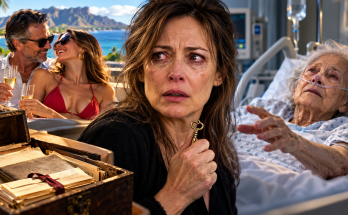
The examination room at Mercy General was separated from the corridor by a pale curtain that never quite closed properly. Through the narrow opening, I could see nurses moving between beds, their rubber-soled shoes making soft sounds against the floor. A monitor beeped somewhere beyond the doorway. I was lying on a narrow hospital bed with my head supported by a thin pillow, trying not to move because every change in position brought another wave of dizziness. Claire sat beside me, the skirt of her wedding gown gathered awkwardly around the legs of a plastic chair. She had removed her veil. Without it, she looked less like a bride than a frightened woman who had arrived at the hospital wearing the wrong clothes.
The attending physician introduced himself as Dr. Adrian Shaw. He appeared to be in his late forties, with dark hair beginning to gray near his temples and the concentrated expression of someone accustomed to making decisions while other people were frightened. He asked me to describe the injury in my own words. I explained that my brother had swung an empty champagne bottle at the side of my head during his wedding reception. When I reached the part about his claiming it was a joke, I heard how absurd the explanation sounded. Dr. Shaw did not comment on my brother's intentions. He wanted to know whether I had lost consciousness, whether I remembered the moments immediately before and after the impact, and whether I had experienced vomiting or changes in vision.
I answered slowly, concentrating on each question. I remembered everything immediately before the blow, including the moment I noticed the bottle in Ethan's hand. I remembered Claire calling out and my own unsuccessful attempt to make him stop. I remembered the impact itself, though the seconds following it were less distinct. I did not believe I had lost consciousness. What frightened me most was the continuing vertigo. Even lying still, I felt as though the bed had been placed on a surface that was tilting beneath me. Dr. Shaw asked me to follow the movement of a small light with my eyes, then checked my pupils. He spoke calmly, allowing me time to answer without rushing.
When he began examining the wound, I felt Claire move closer. The doctor parted my hair carefully and cleaned away the dried blood. The antiseptic stung, and I gripped the edge of the mattress. I had expected the wound to be enormous because of how much blood I had seen. Dr. Shaw explained that scalp injuries often bleed heavily and that the visible laceration, while painful, did not necessarily reflect the severity of the injury beneath it. He seemed cautiously reassured by the appearance of the cut, but he remained concerned about the dizziness and the force of the impact.
I asked whether I would need stitches. He said the wound appeared manageable and that he expected to close it without extensive treatment, provided no complications emerged. The answer relieved me more than it should have. I had spent the journey imagining that my skull might be cracked or that I would require emergency surgery. Hearing that the surface injury was relatively limited made me want to believe the incident had been less dangerous than it felt. Dr. Shaw noticed my expression and reminded me that the symptoms still required investigation. A small wound did not rule out significant damage from a blow to the head.
Claire listened without interrupting. She had taken off her earrings and placed them inside her purse. Every few minutes, her phone vibrated, but she ignored it. When a nurse asked whether she needed anything, she requested water for me and a clean cloth to remove the blood from my neck. Her practical attention helped keep me calm. I could see that she was upset, but she did not make her distress my responsibility. She seemed determined that, whatever else happened that night, I would receive the care I needed.
Dr. Shaw recommended a CT scan. He explained that the persistent vertigo and the mechanism of injury made imaging appropriate to assess for bleeding or other intracranial problems. I agreed immediately. The possibility of discovering something serious frightened me, yet I was more frightened by the thought of going home without knowing what was wrong. The doctor completed his examination and arranged for the scan while a nurse finished cleaning and dressing the injury. I watched the nurse dispose of the bloody gauze and found myself wondering whether Ethan had seen the same amount of blood when I left.
That question led to another. What was he doing now? Was he still at the reception, explaining his actions to the guests? Had he gone home? Had he called our parents? I could imagine him pacing through a room, growing increasingly angry that everyone had misunderstood him. It was an unfair thought, perhaps, but it came from years of watching him respond to criticism. Whenever someone challenged his behavior, he rarely began by considering what he had done. He concentrated instead on how the reaction affected him. I wondered whether tonight would finally be different.
Claire noticed me looking at her phone. She turned it over and showed me the unread notifications. Most were from Ethan. There were also messages from relatives asking whether I was all right. Claire had responded briefly to a few people, telling them we were at the hospital and that she would provide an update when there was reliable information. She had not answered Ethan. I asked whether he had apologized. She pressed her lips together before saying that he seemed more interested in getting her to return to the reception. I told her she did not have to stay with me. She looked genuinely startled by the suggestion.
"Maya, I'm not leaving you here by yourself."
"But it's your wedding night."
She shook her head. "I know what night it is."
There was nothing more to say. I looked down at the blanket covering my legs and felt an unexpected rush of gratitude. Claire had known me for only a few years, yet she had responded to my injury more directly than people who had loved me since birth. That did not mean my parents were indifferent. I knew they were worried. My mother had been visibly shaken, and my father had wanted to drive me himself. But both had spent decades interpreting Ethan's behavior through explanations that softened its consequences. Claire had no such investment in maintaining that interpretation. She had witnessed the event, recognized it as unacceptable, and acted accordingly.
A hospital orderly arrived with a wheelchair to take me for imaging. I tried to stand, but my balance was poor, so he asked me to remain seated. Claire followed us through the corridor until we reached the imaging department. She waited outside while the technician helped me onto the scanning table. The room was cool, and the equipment made a low mechanical sound. I was instructed to remain still. The technician adjusted the support beneath my head and explained that the process would be brief. I stared upward, concentrating on the ceiling while the table moved into the scanner.
I had never liked hospitals. The uncertainty made every ordinary sound seem significant. While I lay inside the machine, I tried to picture the scan revealing an entirely normal skull. Perhaps the doctor would tell me that I had a concussion and needed rest. Perhaps I would be discharged with instructions to avoid strenuous activity. I imagined returning to my apartment, washing the blood from my hair, and sleeping until the headache began to ease. I did not imagine that the scan would reveal an injury older than the one that had brought me there.
When I returned to the examination area, Claire had found a clean towel and a bottle of water. She helped me drink a little while we waited for the physician. The minutes passed slowly. My headache seemed more manageable when I remained motionless, but the dizziness persisted whenever I turned toward the door. I watched the clock above the nurses' station. It was well past the hour when the wedding reception had been scheduled to end. Somewhere, guests were probably collecting coats and arranging rides home. I wondered what version of the evening they would repeat the following morning.
Dr. Shaw returned approximately forty-five minutes later. He carried a tablet and wore an expression that immediately caught my attention. He did not appear alarmed, but he was more thoughtful than before. Instead of standing at the foot of the bed to discuss the results, he pulled a stool beside me and sat down. He first explained that the scan had not revealed the acute intracranial bleeding he had been concerned about. I felt my shoulders relax. Claire reached for my hand. The relief lasted only a moment because the doctor had clearly not finished speaking.
He told me there was another finding on the images. It did not appear to be associated with the injury I had suffered that evening. He asked whether I had ever experienced a serious head injury in childhood. I stared at him, trying to understand the question. I told him I had never been treated for anything comparable to what had happened tonight. I remembered ordinary childhood illnesses, a broken wrist, and minor injuries from playing outdoors, but nothing involving my skull. He watched me carefully before turning the tablet toward us.
The screen displayed a grayscale image of my head. I could recognize the broad outline of the skull, though the internal details meant very little to me. Dr. Shaw enlarged a section near the right side, beneath the area where Ethan's bottle had struck. He pointed toward an irregular region of bone. At first, I assumed I was looking at the new injury. The doctor explained that the finding was much older. The bone had healed and remodeled over time, leaving a permanent change in its shape.
I leaned closer, then stopped when the movement made me dizzy. "What exactly is it?"
He explained that the image showed evidence of an old depressed skull fracture. It appeared to have occurred many years earlier, possibly when I was a child. The bone had healed, but the residual deformity suggested an injury significant enough to require careful medical assessment at the time. He asked again whether I remembered a severe fall, a serious accident, or an extended hospital stay. I shook my head. The questions sounded increasingly impossible. I was twenty-nine years old. Surely I would know if I had once fractured my skull.
Claire studied the image in silence. She asked whether the new blow had caused the older mark to become visible. Dr. Shaw explained that the earlier injury was already present; the current scan had simply revealed it. It was not a new fracture from tonight. He also cautioned that the scan could not establish exactly how the original trauma had occurred. It could show the consequences of an old injury, but it could not identify the event responsible. To understand the circumstances, I would need a medical history or records from the original treatment.
I searched my memory. My childhood had not been free of accidents, but I could not remember anything severe enough to explain what the doctor was describing. There had been a backyard play structure built by my father, with a yellow slide and a small green roof. I remembered climbing it and arguing with Ethan over whose turn it was to use the ladder. I remembered the smell of warm wood in summer, the rough texture of the rope, and the way the platform shook when someone ran across it. But there was no memory of falling from it, no ambulance, no hospital room, and no explanation from my parents about a serious injury.
I asked whether it was possible that I had been too young to remember. Dr. Shaw said it was entirely possible not to retain a clear memory of childhood trauma, particularly when the injury itself affected consciousness or memory. But he emphasized that the absence of personal recollection did not mean the event had never been documented or discussed by the adults involved. He suggested contacting my parents and requesting any available pediatric records. He also wanted me to understand that the old fracture was separate from the immediate medical concerns created by tonight's impact.
I looked at Claire. She had turned pale. For several seconds neither of us spoke. Then she asked me whether my parents had ever mentioned surgery, hospitalization, or a serious injury when I was little. I told her no. My family discussed childhood memories constantly, often in far more detail than I wanted. Ethan had spent years recycling stories about every embarrassing thing I had done before adolescence. Yet nobody had ever mentioned that my skull had once been fractured. The omission seemed more unsettling the longer I considered it.
Dr. Shaw asked permission to note the finding in my medical record and encouraged me to bring any historical documentation to my regular physician. He explained the warning symptoms that would require urgent reassessment after my current head injury. I listened carefully, but part of my attention remained fixed on the image. The irregularity was unmistakable once he showed me where to look. It was a physical trace of something that had happened to me long before I had the words or authority to understand it.
When Dr. Shaw stepped away to complete my discharge arrangements, I kept staring at the space where the tablet had been. I tried to remember whether I had ever felt an unusual indentation beneath my hair. Perhaps I had, without considering what it meant. I rarely examined the shape of my skull. I trusted that my parents had told me about important events in my medical history. That trust was so ordinary, so unquestioned, that I had never recognized it as something capable of being broken.
Claire sat beside me and asked if I wanted her to call my mother. I looked at my phone. Several messages from Mom were waiting, asking whether the doctor had seen me and whether we knew anything about the injury. My father had also called. I hesitated, surprised by my reluctance to speak to either of them. Until that moment, I would have expected to turn toward my parents automatically when confronted with unexpected medical information. But the discovery had created a question that only they could answer, and I found myself afraid of what they might say.
I called my mother first. She answered almost immediately. Her voice sounded strained, and she asked whether I was still at the hospital. I reassured her that the scan had not shown acute bleeding and that the doctor was arranging follow-up care for my concussion symptoms. She released a shaky breath. I could hear a television playing quietly in the background. She told me she had been worried since I left the reception. For a few seconds, we spoke about the wound and the doctor's advice. Everything sounded ordinary.
Then I told her that the scan had revealed an old injury.
The television noise continued behind her, but she stopped speaking.
I explained that the doctor had identified a healed skull fracture, probably dating back to childhood. I told her it was on the right side of my head, beneath the new injury. I asked whether she knew anything about it. She did not answer immediately. I heard a small sound, perhaps the movement of her hand against the phone, followed by a breath that seemed to catch in her throat.
"Mom?" I said.
She finally asked me to repeat what the doctor had found.
I did, more slowly this time.
Another silence followed.
The reaction frightened me more than an immediate denial would have. My mother was not a woman who struggled to fill conversational gaps. She could talk for an hour about shopping, gardening, or a distant relative's minor illness. Yet when I asked whether I had once suffered a major head injury, she seemed unable to find the words.
I sat upright despite the pain, holding the phone tightly against my ear.
"Mom, what happened to me when I was little?"
And for the first time that evening, I heard genuine fear in her voice.